Research Methodology
Interpretation
Amandeep Singh
Assistant Professor,
Department of Biotechnology,
GSSDGS Khalsa College,
Patiala.
Interpretation
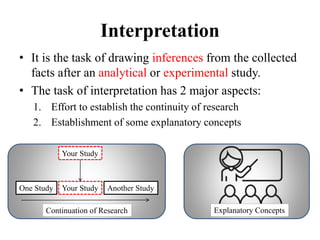
• It is the task of drawing inferences from the collected
facts after an analytical or experimental study.
• The task of interpretation has 2 major aspects:
1. Effort to establish the continuity of research
2. Establishment of some explanatory concepts
One Study Another Study
Your Study
Your Study
Continuation of Research Explanatory Concepts
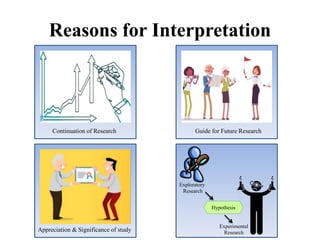
Reasons for Interpretation
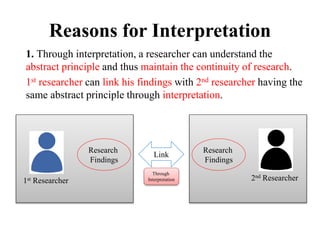
1. Through interpretation, a researcher can understand the
abstract principle and thus maintain the continuity of research.
1st researcher can link his findings with 2nd researcher having the
same abstract principle through interpretation.
1st Researcher 2nd Researcher
Research
Findings
Research
Findings
Link
Through
Interpretation
Reasons for Interpretation
2. Serve as a guide for future research.
3. Researcher can better appreciate only through
interpretation and to understand the real
significance of his study.
4. Interpretation of exploratory research often
results into hypothesis of experimental research,
results in transition from exploratory to
experimental research. This type of interpretation
is known as ‘post factum’ (after the fact)
interpretation.
Reasons for Interpretation
Appreciation & Significance of study
Continuation of Research Guide for Future Research
Exploratory
Research
Experimental
Research
Hypothesis
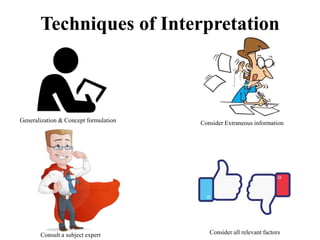
Techniques of Interpretation
1. Generalization & Concept formulation
2. Extraneous information (irrelevant or unrelated
to the subject being studied) must be considered,
which prove to be a key factor in understanding
the problem under consideration.
3. Before final interpretation, consult a subject
expert or friend with that specialization to point
out omissions and errors in the research work.
4. Considering all relevant factors to avoid false
generalization.
Techniques of Interpretation
Generalization & Concept formulation Consider Extraneous information
Consult a subject expert Consider all relevant factors
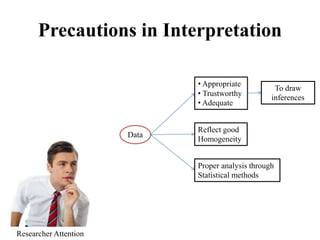
Precautions in Interpretation
If data are properly calculated and analyzed
but wrong interpretation is done that leads to
inaccurate conclusion.
Data
Wrong Interpretation
Inaccurate Conclusion
X
X
Data
Correct Interpretation
Accurate Conclusion
Precautions in Interpretation
Researcher Attention
Data
• Appropriate
• Trustworthy
• Adequate
Reflect good
Homogeneity
Proper analysis through
Statistical methods
To draw
inferences
Precautions in Interpretation
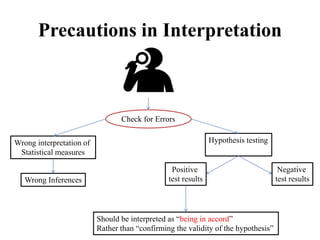
Check for Errors
Wrong interpretation of
Statistical measures
Hypothesis testing
Positive
test results
Negative
test results
Should be interpreted as “being in accord”
Rather than “confirming the validity of the hypothesis”
Wrong Inferences
Precautions in Interpretation
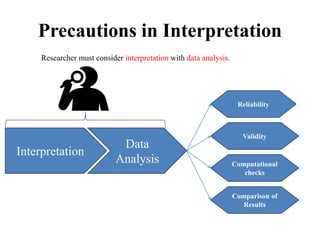
Researcher must consider interpretation with data analysis.
Data
Analysis
Interpretation
Reliability
Validity
Computational
checks
Comparison of
Results
Precautions in Interpretation
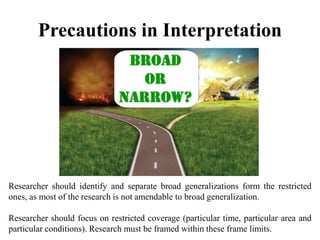
Researcher should identify and separate broad generalizations form the restricted
ones, as most of the research is not amendable to broad generalization.
Researcher should focus on restricted coverage (particular time, particular area and
particular conditions). Research must be framed within these frame limits.
Precautions in Interpretation
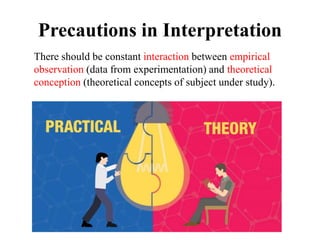
There should be constant interaction between empirical
observation (data from experimentation) and theoretical
conception (theoretical concepts of subject under study).

Research methodology interpretation

  • 1.
    Research Methodology Interpretation Amandeep Singh AssistantProfessor, Department of Biotechnology, GSSDGS Khalsa College, Patiala.
  • 2.
    Interpretation • It isthe task of drawing inferences from the collected facts after an analytical or experimental study. • The task of interpretation has 2 major aspects: 1. Effort to establish the continuity of research 2. Establishment of some explanatory concepts One Study Another Study Your Study Your Study Continuation of Research Explanatory Concepts
  • 3.
    Reasons for Interpretation 1.Through interpretation, a researcher can understand the abstract principle and thus maintain the continuity of research. 1st researcher can link his findings with 2nd researcher having the same abstract principle through interpretation. 1st Researcher 2nd Researcher Research Findings Research Findings Link Through Interpretation
  • 4.
    Reasons for Interpretation 2.Serve as a guide for future research. 3. Researcher can better appreciate only through interpretation and to understand the real significance of his study. 4. Interpretation of exploratory research often results into hypothesis of experimental research, results in transition from exploratory to experimental research. This type of interpretation is known as ‘post factum’ (after the fact) interpretation.
  • 5.
    Reasons for Interpretation Appreciation& Significance of study Continuation of Research Guide for Future Research Exploratory Research Experimental Research Hypothesis
  • 6.
    Techniques of Interpretation 1.Generalization & Concept formulation 2. Extraneous information (irrelevant or unrelated to the subject being studied) must be considered, which prove to be a key factor in understanding the problem under consideration. 3. Before final interpretation, consult a subject expert or friend with that specialization to point out omissions and errors in the research work. 4. Considering all relevant factors to avoid false generalization.
  • 7.
    Techniques of Interpretation Generalization& Concept formulation Consider Extraneous information Consult a subject expert Consider all relevant factors
  • 8.
    Precautions in Interpretation Ifdata are properly calculated and analyzed but wrong interpretation is done that leads to inaccurate conclusion. Data Wrong Interpretation Inaccurate Conclusion X X Data Correct Interpretation Accurate Conclusion
  • 9.
    Precautions in Interpretation ResearcherAttention Data • Appropriate • Trustworthy • Adequate Reflect good Homogeneity Proper analysis through Statistical methods To draw inferences
  • 10.
    Precautions in Interpretation Checkfor Errors Wrong interpretation of Statistical measures Hypothesis testing Positive test results Negative test results Should be interpreted as “being in accord” Rather than “confirming the validity of the hypothesis” Wrong Inferences
  • 11.
    Precautions in Interpretation Researchermust consider interpretation with data analysis. Data Analysis Interpretation Reliability Validity Computational checks Comparison of Results
  • 12.
    Precautions in Interpretation Researchershould identify and separate broad generalizations form the restricted ones, as most of the research is not amendable to broad generalization. Researcher should focus on restricted coverage (particular time, particular area and particular conditions). Research must be framed within these frame limits.
  • 13.
    Precautions in Interpretation Thereshould be constant interaction between empirical observation (data from experimentation) and theoretical conception (theoretical concepts of subject under study).