
 Introduction to Hypothesis
 Definition of the hypothesis
 Purpose of the hypothesis
 Components of hypothesis
 The functions of hypothesis
 Characteristics of hypothesis
 Types of hypothesis
 Conclusion
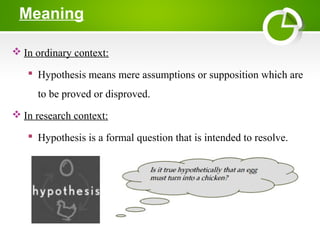
Meaning
 In ordinary context:
 Hypothesis means mere assumptions or supposition which are
to be proved or disproved.
 In research context:
 Hypothesis is a formal question that is intended to resolve.
Hypothesis Defined
An educated guess
A tentative point of view
A proposition not yet tested
A preliminary explanation
A preliminary Postulate
Definition by Various Authors
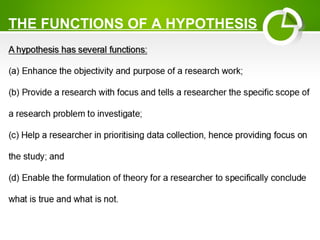
THE FUNCTIONS OF A HYPOTHESIS
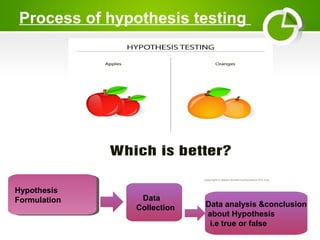
Process of hypothesis testing
Hypothesis
Formulation
Hypothesis
Formulation Data
Collection Data analysis &conclusion
about Hypothesis
i.e true or false
CHARACTERISTICS OF HYPOTHESIS
Precise, Simple and
Specific
Related to the Existing
Body of Knowledge
must be Capable of
Verification
State relation
Amenable with time
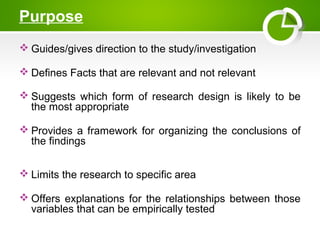
Purpose
 Guides/gives direction to the study/investigation
 Defines Facts that are relevant and not relevant
 Suggests which form of research design is likely to be
the most appropriate
 Provides a framework for organizing the conclusions of
the findings
 Limits the research to specific area
 Offers explanations for the relationships between those
variables that can be empirically tested
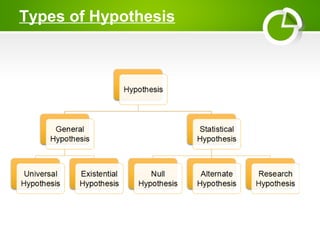
Types of Hypothesis
Universal hypothesis
• It is one, which denotes that, the stated relationship holds for
all specified variables for all times at all places.
• For example,
– “if brave soldiers are frequently rewarded for their better
performance, they will perform better.”
• This relationship hold true for all time and all place.
Existential Hypothesis
• It is one in which the stated relationship is said to exist for
atleast one particular case.
• For example,
– There are at least few corporate workers who are scrounger
and may not perform better despite the fact that he is being
awarded suitably for better performance.s
Null hypothesis
• Null hypothesis always predicts that there is no relationship
between the variables being studied.
• The researcher wishes to disapprove this hypothesis.
• It is denoted by H0
• For example:
– “There is no relationship between smoking and
lung cancer.”
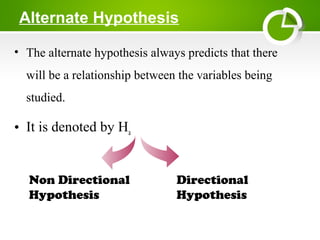
Alternate Hypothesis
• The alternate hypothesis always predicts that there
will be a relationship between the variables being
studied.
• It is denoted by Ha
Non Directional
Hypothesis
Directional
Hypothesis
Alternate Hypothesis(types)
• If the hypothesis uses so-called comparison terms, such as
“greater,”“less,”“better,” or “worse,” then it is a directional
hypothesis. It is directional because it predicts that there
will be a difference between the two groups and it specifies
how the two groups will differ
– “smoking will increase the chances of lungs cancer
in a person than a person who do not smoke.
• If the hypothesis simply predicts that there will be a
difference between the two groups, then it is a non-
directional hypothesis. It is non-directional because it
predicts that there will be a difference but does not specify
how the groups will differ.
– “smoking leads to lungs cancer”
Research Hypothesis
• This type of hypothesis is derived from some type of
theory or some observation and examination.
• In other words, the hypothesis set upon the basis of
theory or prior observation or on logical grounds.
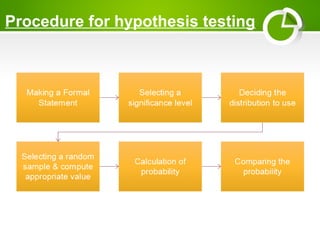
Procedure for hypothesis testing
Conclusion:
• Hypothesis is important to help researchers focus on their research
study and to provide clarity.
• A hypothesis is generally a speculative statement that needs to be
verified in a research work.
• During hypothesis formulation, it is important to keep the statement
simple,precise and clear, and derive it from an existing body of
knowledge.
References....
 Books
• Bailey, K. D. (1978). Methods of social research (3rd ed.). New York: The
Free Press.
• Kumar R. (2005). Research methodology. SAGE Publications
 Internet Resources
• Trochim, W. K. (2007). Research method tutorials
• http://www.socialresearchmethods.net/tutorial/tutorial.htm
• http://psychology.about.com/od/researchmethods/ss/expdesintro.htm

Hypothesis

  • 2.
     Introduction toHypothesis  Definition of the hypothesis  Purpose of the hypothesis  Components of hypothesis  The functions of hypothesis  Characteristics of hypothesis  Types of hypothesis  Conclusion
  • 3.
    Meaning  In ordinarycontext:  Hypothesis means mere assumptions or supposition which are to be proved or disproved.  In research context:  Hypothesis is a formal question that is intended to resolve.
  • 4.
    Hypothesis Defined An educatedguess A tentative point of view A proposition not yet tested A preliminary explanation A preliminary Postulate
  • 5.
  • 6.
    THE FUNCTIONS OFA HYPOTHESIS
  • 7.
    Process of hypothesistesting Hypothesis Formulation Hypothesis Formulation Data Collection Data analysis &conclusion about Hypothesis i.e true or false
  • 8.
    CHARACTERISTICS OF HYPOTHESIS Precise,Simple and Specific Related to the Existing Body of Knowledge must be Capable of Verification State relation Amenable with time
  • 9.
    Purpose  Guides/gives directionto the study/investigation  Defines Facts that are relevant and not relevant  Suggests which form of research design is likely to be the most appropriate  Provides a framework for organizing the conclusions of the findings  Limits the research to specific area  Offers explanations for the relationships between those variables that can be empirically tested
  • 10.
  • 11.
    Universal hypothesis • Itis one, which denotes that, the stated relationship holds for all specified variables for all times at all places. • For example, – “if brave soldiers are frequently rewarded for their better performance, they will perform better.” • This relationship hold true for all time and all place.
  • 12.
    Existential Hypothesis • Itis one in which the stated relationship is said to exist for atleast one particular case. • For example, – There are at least few corporate workers who are scrounger and may not perform better despite the fact that he is being awarded suitably for better performance.s
  • 13.
    Null hypothesis • Nullhypothesis always predicts that there is no relationship between the variables being studied. • The researcher wishes to disapprove this hypothesis. • It is denoted by H0 • For example: – “There is no relationship between smoking and lung cancer.”
  • 14.
    Alternate Hypothesis • Thealternate hypothesis always predicts that there will be a relationship between the variables being studied. • It is denoted by Ha Non Directional Hypothesis Directional Hypothesis
  • 15.
    Alternate Hypothesis(types) • Ifthe hypothesis uses so-called comparison terms, such as “greater,”“less,”“better,” or “worse,” then it is a directional hypothesis. It is directional because it predicts that there will be a difference between the two groups and it specifies how the two groups will differ – “smoking will increase the chances of lungs cancer in a person than a person who do not smoke. • If the hypothesis simply predicts that there will be a difference between the two groups, then it is a non- directional hypothesis. It is non-directional because it predicts that there will be a difference but does not specify how the groups will differ. – “smoking leads to lungs cancer”
  • 16.
    Research Hypothesis • Thistype of hypothesis is derived from some type of theory or some observation and examination. • In other words, the hypothesis set upon the basis of theory or prior observation or on logical grounds.
  • 17.
  • 18.
    Conclusion: • Hypothesis isimportant to help researchers focus on their research study and to provide clarity. • A hypothesis is generally a speculative statement that needs to be verified in a research work. • During hypothesis formulation, it is important to keep the statement simple,precise and clear, and derive it from an existing body of knowledge.
  • 19.
    References....  Books • Bailey,K. D. (1978). Methods of social research (3rd ed.). New York: The Free Press. • Kumar R. (2005). Research methodology. SAGE Publications  Internet Resources • Trochim, W. K. (2007). Research method tutorials • http://www.socialresearchmethods.net/tutorial/tutorial.htm • http://psychology.about.com/od/researchmethods/ss/expdesintro.htm