Harry Stack Sullivan developed interpersonal theory, which views personality as developing within social contexts. According to the theory, healthy development requires satisfying interpersonal relationships where intimacy and trust can grow. Anxiety arises from problems in relationships and can interfere with intimacy. The theory focuses on how people experience tension and needs, and how they act to reduce anxiety and fulfill needs through interpersonal interactions and dynamics like malevolence, lust, and intimacy. Development occurs through relationships with significant others from infancy through adolescence.
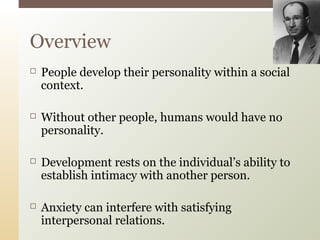
People developtheir personality within a social
context.
Without other people, humans would have no
personality.
Development rests on the individual’s ability to
establish intimacy with another person.
Anxiety can interfere with satisfying
interpersonal relations.
Overview
3.
Healthy developmententails experiencing
intimacy and lust toward another same
person.
Overview
4.
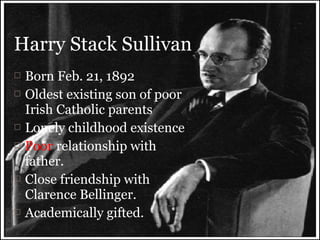
Born Feb.21, 1892
Oldest existing son of poor
Irish Catholic parents
Lonely childhood existence
Poor relationship with
father.
Close friendship with
Clarence Bellinger.
Academically gifted.
Harry Stack Sullivan
5.
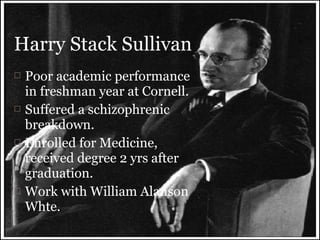
Poor academicperformance
in freshman year at Cornell.
Suffered a schizophrenic
breakdown.
Enrolled for Medicine,
received degree 2 yrs after
graduation.
Work with William Alanson
Whte.
Harry Stack Sullivan
6.
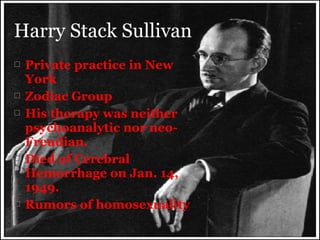
Private practicein New
York
Zodiac Group
His therapy was neither
psychoanalytic nor neo-
Freudian.
Died of Cerebral
Hemorrhage on Jan. 14,
1949.
Rumors of homosexuality
Harry Stack Sullivan
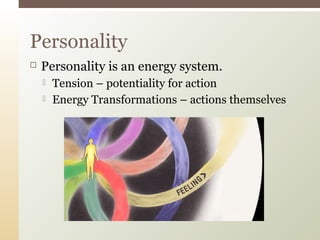
Personality isan energy system.
Tension – potentiality for action
Energy Transformations – actions themselves
Personality
9.
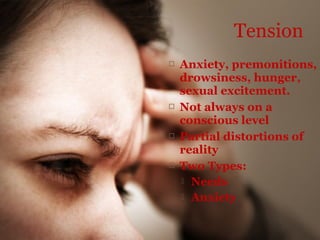
Anxiety, premonitions,
drowsiness,hunger,
sexual excitement.
Not always on a
conscious level
Partial distortions of
reality
Two Types:
Needs
Anxiety
Tension
10.
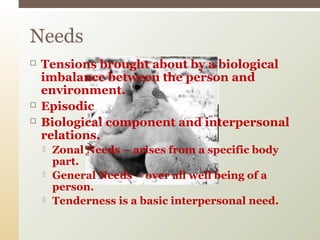
Tensions broughtabout by a biological
imbalance between the person and
environment.
Episodic
Biological component and interpersonal
relations.
Zonal Needs – arises from a specific body
part.
General Needs – over all well being of a
person.
Tenderness is a basic interpersonal need.
Needs
11.
Disjunctive, diffuseand vague, call forth
no consistent action for relief.
Transferred through empathy.
Chief disruptive force blocking the
development of healthy interpersonal
relations.
Prevents people from learning from
mistakes
Persisting pursuance of childish wish
for security
Ensures people will not learn from
experience.
Its presence is worse than its absence.
Anxiety
12.
Stems fromcomplex interpersonal
relations.
Vaguely represented in awareness
No positive value
Blocks satisfaction of needs
Anxiety
13.
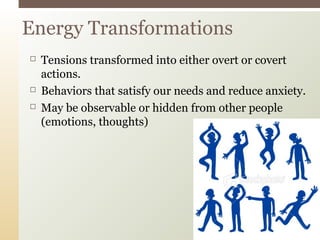
Tensions transformedinto either overt or covert
actions.
Behaviors that satisfy our needs and reduce anxiety.
May be observable or hidden from other people
(emotions, thoughts)
Energy Transformations
14.
Tensions transformedinto either overt or covert
actions.
Behaviors that satisfy our needs and reduce anxiety.
May be observable or hidden from other people
(emotions, thoughts)
Evolves into dynamisms
Energy Transformations
15.
Traits orhabit patterns
Major Classes:
Related to specific zones of the body
Mouth, anus, genitals
Those related to tensions
Disjunctive (Malevolence)
Isolating (Lust)
Conjunctive (Intimacy and Self- System)
Dynamisms
16.
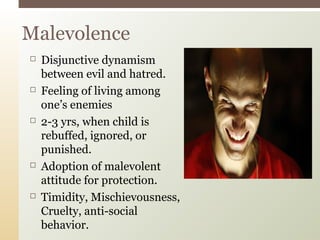
Disjunctive dynamism
betweenevil and hatred.
Feeling of living among
one’s enemies
2-3 yrs, when child is
rebuffed, ignored, or
punished.
Adoption of malevolent
attitude for protection.
Timidity, Mischievousness,
Cruelty, anti-social
behavior.
Malevolence
17.
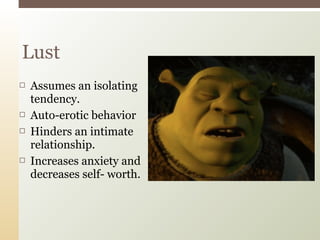
Assumes anisolating
tendency.
Auto-erotic behavior
Hinders an intimate
relationship.
Increases anxiety and
decreases self- worth.
Lust
18.
Close interpersonalrelationship between 2 people
of equal status.
Equal partnership
Integrating dynamism that draws out loving
reactions from people.
Decreases loneliness and anxiety
Rewarding experiences most healthy people desire.
Intimacy
19.
Most complexand inclusive of
all dynamisms.
Consistent pattern of behavior
that maintains people’s
interpersonal security by
protecting them from anxiety.
Principal stumbling block to
favorable changes in personality.
Security Operations
Self- System
20.
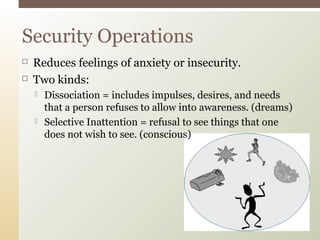
Reduces feelingsof anxiety or insecurity.
Two kinds:
Dissociation = includes impulses, desires, and needs
that a person refuses to allow into awareness. (dreams)
Selective Inattention = refusal to see things that one
does not wish to see. (conscious)
Security Operations
21.
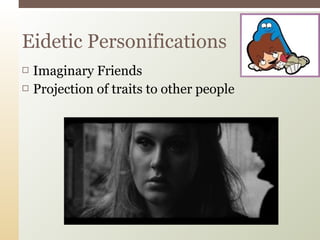
People’s imagesof themselves or others
Begins in infancy and continues throughout
development.
Bad mother – good mother
Me
Eidetic Personifications
Personifications
22.
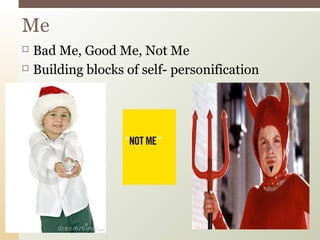
Bad Me,Good Me, Not Me
Building blocks of self- personification
Me
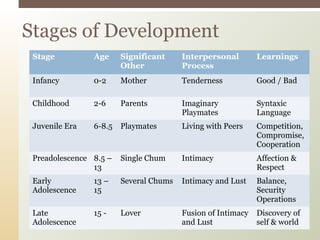
Stages of Development
StageAge Significant
Other
Interpersonal
Process
Learnings
Infancy 0-2 Mother Tenderness Good / Bad
Childhood 2-6 Parents Imaginary
Playmates
Syntaxic
Language
Juvenile Era 6-8.5 Playmates Living with Peers Competition,
Compromise,
Cooperation
Preadolescence 8.5 –
13
Single Chum Intimacy Affection &
Respect
Early
Adolescence
13 –
15
Several Chums Intimacy and Lust Balance,
Security
Operations
Late
Adolescence
15 - Lover Fusion of Intimacy
and Lust
Discovery of
self & world
25.
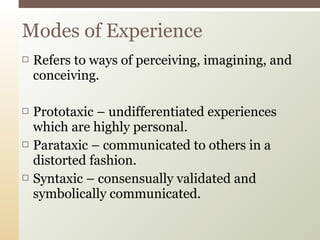
Refers toways of perceiving, imagining, and
conceiving.
Prototaxic – undifferentiated experiences
which are highly personal.
Parataxic – communicated to others in a
distorted fashion.
Syntaxic – consensually validated and
symbolically communicated.
Modes of Experience
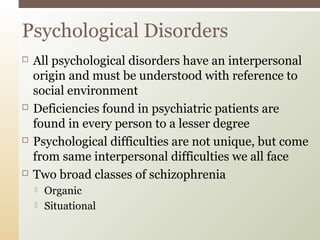
All psychologicaldisorders have an interpersonal
origin and must be understood with reference to
social environment
Deficiencies found in psychiatric patients are
found in every person to a lesser degree
Psychological difficulties are not unique, but come
from same interpersonal difficulties we all face
Two broad classes of schizophrenia
Organic
Situational
Psychological Disorders
29.
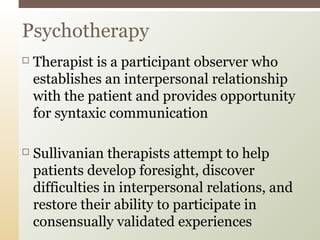
Therapist isa participant observer who
establishes an interpersonal relationship
with the patient and provides opportunity
for syntaxic communication
Sullivanian therapists attempt to help
patients develop foresight, discover
difficulties in interpersonal relations, and
restore their ability to participate in
consensually validated experiences
Psychotherapy
30.
SULLIVAN, HarryStack (1931a) 1962 Socio-
Psychiatric Research: Its Implications for the
Schizophrenia Problem and for Mental
Hygiene. Pages 256-270 in Harry Stack
Sullivan, Schizophrenia as a Human Process.
New York: Norton.
Sullivan, Harry Stack (1931b) 1962 the
Modified Psychoanalytic Treatment of
Schizophrenia. Pages 272-294 in Harry Stack
Sullivan, Schizophrenia as a Human Process.
New York: Norton.
BIBLIOGRAPHY
31.
Sullivan, HarryStack (1938)1964 the Data of
Psychiatry. Pages 32-55 in Harry Stack
Sullivan, The Fusion of Psychiatry and Social
Science. New York: Norton.
Sullivan, Harry Stack (1940-1945) 1953
Conceptions of Modern Psychiatry. With a
critical appraisal of the theory by Patrick
Mullahy. 2d Ed. New York: Norton.
Sullivan, Harry Stack 1949 Psychiatry:
Introduction to the Study of Interpersonal
Relations. Pages 98-121 in Patrick Mullahy
(editor), A Study of Interpersonal Relations.
New York: Hermitage.
32.
Sullivan, HarryStack 1953 the Interpersonal
Theory of Psychiatry. Edited by Helen Swick
Perry and Mary Ladd Gawel. New York:
Norton.
Sullivan, Harry Stack 1954 the Psychiatric
Interview. Edited by Helen Swick Perry and
Mary Ladd Gawel. New York: Norton.
Sullivan, Harry Stack 1956 Clinical Studies in
Psychiatry. Edited by Helen Swick Perry,
Mary Ladd Gawel, and Martha Gibbon. New
York: Norton.
33.
Sullivan, HarryStack 1964 the Fusion of
Psychiatry and Social Science. With an
introduction by Helen Swick Perry. New
York: Norton.
Thompson, Clara (1949) 1962 Harry Stack
Sullivan, the Man. Pages xxxii-xxxv in Harry
Stack Sullivan, Schizophrenia as a Human
Process. New York: Norton. White, Mary
Julian 1952 Sullivan and Treatment. Pages
117-150 in William Alanson White
Association, The Contributions of Harry Stack
Sullivan. New York: Hermitage.