

PRESENTED BY : RITIKA SONI
FAMILY THERAPY
Introduction
• Family therapy is often thought of as
therapeutic modality
– To be employed when overt conflict is recognized
in members of the same family and
psychotherapeutic interventions are required .
– Is an essential intervention in a family system to
change the family.
– Family is the unit which is being treated for better
interactions among each other.
– Can be conducted at hospital or during home visit
– Maximum 20 sessions are planned and by the end
of 10th session changes can be seen.
DEFINITION
• “A psychotherapeutic approach that focuses on
interactions between a couple with in nuclear family
or its members in extended family or between the
family and other interpersonal system with the goal
of alleviating problems initially presented by
individual family members , family subsystems , the
family as a whole or other referral sources.”
Wynne, 1988
How many sessions will we need?
• Wherever possible, decisions about the
number of sessions and the intervals
between appointments are made
collaboratively between the therapist and
family.
• The number of appointments offered will
depend on the service setting and family
members’ needs.
 Most sessions last between 45 minutes and
one and a half hours.
Do family therapists only work
with families?
• No.
• They may see children and adults individually and/or in family
member groups. They may work with couples, or with other groups
and communities.
• When a family is involved with several different agencies, family
therapists may work with the network of professionals as well as
with family members
– to ensure their input is coordinated and helpful.
– Some systemic psychotherapists use their understandings of
relationships to work with organizations.
– Many use their skills in family sensitive working to supervise other
professionals
What’s meant by ‘family’?
• Family therapists recognize that different
cultures and groups have different ideas of what
‘family’ means.
• They take ‘family’ to describe any group of
people who care about each other and define
themselves as such. As well as parents and
children of all ages, they may work with
grandparents, siblings, uncles and aunts, cousins,
friends, carers, other professionals
• whoever people identify as important to their
lives
TYPES
1.FAMILY SYSTEM THERAPY :
o To clarify and distinguish thinking and feeling
process in the family members which leads to
undifferentiated family ego
2. FAMILY STRUCTURE THERAPY :
o Based on a normative concept of a healthy
family , emphasizing the boundaries between
family subsystem and the establishment ,
maintenance of a clear hierarchy based on
parental competence.
Functional
Family Therapy
• Functional Family Therapy (FFT) is a :
family-based prevention and intervention
program to treat a range of these high-risk
youth and their families.
• As such, FFT is a good example of the current
generation of family-based treatments for
adolescent behavior problems
(Mendel, 2000; Sexton and Alexander, 1999)
FFT may include :
 diversion, probation, alternatives to
incarceration, or reentry programs for youth
returning to the community following release
from a high-security, severely restrictive
institutional setting.
• FFT is a short-term intervention
— including, on average, 8 to 12 sessions for
mild cases and up to 30 hours of direct service
(e.g., clinical sessions, telephone calls, and
meetings involving community resources)
- for more difficult cases.
 In most cases, sessions are spread over a 3-
month period.
Core Principles, Goals,
and Techniques
• To identify the primary focus of intervention (the
family)
• reflect an understanding that positive and negative
behaviors both influence and are influenced by
multiple relational systems (i.e., are functional).
• FFT is a multisystem prevention program,
 meaning that it focuses on the multiple domains and
systems within which adolescents and their families
live.
 FFT is also focuses on the treatment system, family and
individual functioning, and the therapist as major
components.
• FFT works first to develop family members’
inner strengths and sense of being able to
improve their situation.
• These characteristics provide the family with
a platform for change and future functioning
that extends beyond the direct support of the
therapist and other social systems.
• In the long run, the FFT philosophy leads to
greater self-sufficiency, fewer total treatment
needs, and considerably lower costs.
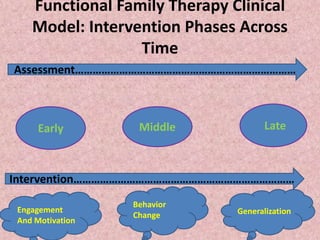
Functional Family Therapy Clinical
Model: Intervention Phases Across
Time
Assessment…………………………………………………………………
Intervention…………………………………………………………………
Early Middle Late
Engagement
And Motivation
Behavior
Change Generalization
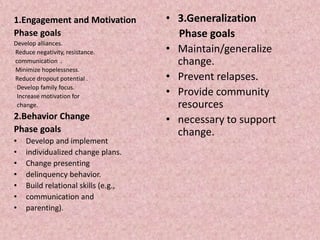
1.Engagement and Motivation
Phase goals
Develop alliances.
Reduce negativity, resistance.
communication .
Minimize hopelessness.
Reduce dropout potential .
Develop family focus.
Increase motivation for
change.
2.Behavior Change
Phase goals
• Develop and implement
• individualized change plans.
• Change presenting
• delinquency behavior.
• Build relational skills (e.g.,
• communication and
• parenting).
• 3.Generalization
Phase goals
• Maintain/generalize
change.
• Prevent relapses.
• Provide community
resources
• necessary to support
change.
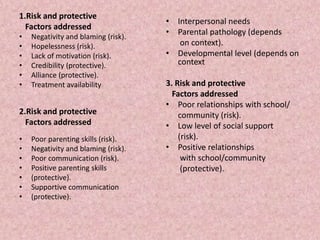
1.Risk and protective
Factors addressed
• Negativity and blaming (risk).
• Hopelessness (risk).
• Lack of motivation (risk).
• Credibility (protective).
• Alliance (protective).
• Treatment availability
2.Risk and protective
Factors addressed
• Poor parenting skills (risk).
• Negativity and blaming (risk).
• Poor communication (risk).
• Positive parenting skills
• (protective).
• Supportive communication
• (protective).
• Interpersonal needs
• Parental pathology (depends
on context).
• Developmental level (depends on
context
3. Risk and protective
Factors addressed
• Poor relationships with school/
community (risk).
• Low level of social support
(risk).
• Positive relationships
with school/community
(protective).
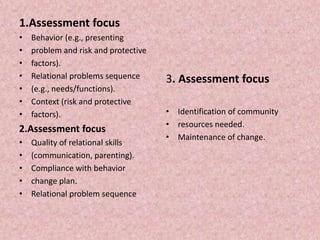
1.Assessment focus
• Behavior (e.g., presenting
• problem and risk and protective
• factors).
• Relational problems sequence
• (e.g., needs/functions).
• Context (risk and protective
• factors).
2.Assessment focus
• Quality of relational skills
• (communication, parenting).
• Compliance with behavior
• change plan.
• Relational problem sequence
3. Assessment focus
• Identification of community
• resources needed.
• Maintenance of change.
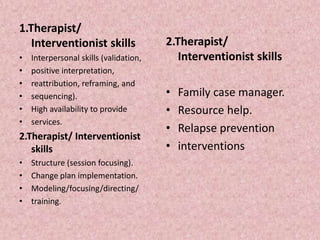
1.Therapist/
Interventionist skills
• Interpersonal skills (validation,
• positive interpretation,
• reattribution, reframing, and
• sequencing).
• High availability to provide
• services.
2.Therapist/ Interventionist
skills
• Structure (session focusing).
• Change plan implementation.
• Modeling/focusing/directing/
• training.
2.Therapist/
Interventionist skills
• Family case manager.
• Resource help.
• Relapse prevention
• interventions
Structural Family Therapy
• Salvador Minuchin’s Background :
Born in 1921 to Russian Jewish emigrants in Argentina
 In 1948 he joined the Israeli army as a doctor
 In 1950, Minuchin came to United States with the
intention of studying with Bruno Bettelheim in
Chicago
1. Met Nathan Ackerman in New York and
chose to stay there
2. In 1954 Minuchin began studying
psychoanalysis .
Minuchin Became Director of Philadelphia
Child Guidance Clinic (1967)
 He transformed the clinic into a family therapy center
 Gained a reputation as a tough and demanding
administrator
 Developed many innovative ideas at the Clinic
Example: Institute for Family Counseling, a training
program for community paraprofessionals that was
effective in providing mental health services to
the poor
 Minuchin published Families and Family Therapy in1974
 Most clearly written and popular books in field of family
therapy
 In 1975 Minuchin stepped down as director of clinic, but
remained head of training until 1981
Key Concepts of Structural Family Therapy
• Focus is on family interactions to understand
the structure/organization of the family
• Symptoms/presenting problem viewed as by-
product of structural failings
• Structural changes must occur in a family
before an individual’s symptoms can be
reduced
Structural Goals
– To the extent permitted by the hypotheses, the therapist
determines immediate goals for the intervention that is to
follow
• Reduce symptoms of dysfunction
• Bring about structural change because it is assumed that faulty
family structures have:
– Boundaries that are rigid or diffuse
– Subsystems that have inappropriate tasks and functions
Structural Family Therapist’s Function
• The therapeutic task is to help move family
from a dysfunctional stage to a new stage
(evolved different structures have more
stable levels of functioning)
• Actively engage family unit to initiate
structural change by joining and
accommodating.
Understanding the Problem
 The therapist determines the issues around
which to explore and intervene in the session.
• Joining the family in a position of leadership
entering their reality and becoming part that
family’s patterns of relating/structure
Collecting Data
The therapist tracks content and learns about the family
issue and draws together all data relevant to the issue
as gathered from prior information
– Mapping family’s underlying structure
observe family to see structure, focusing on the how,
when, and to whom family members relate
– who says what to whom
– in what way
– with what result
Formulating Hypotheses
On the basis of the data, the therapist commits to
hypotheses about the significance of the current
transactional sequence of the nature of the problem, its
locus, and sustaining structure.
– Conducts experiments through probes and challenges to
assess the flexibility of family patterns
Intervening
– Intervening in ways designed to transform an ineffective structure
– The therapist:
(a) to facilitates change in patterns of transactional sequences among
family members and/or between self and family members
(b) to controls for variables in the transaction so that the effects of the
intervention can be assessed
– Challenging family rules, fostering boundary reorganization,
prompting conflict resolution, creating an effective hierarchical
structure, increasing degree of flexibility in family interactions,
modifying dysfunctional family structures, and supporting greater
individuation of family members.
Feedback
– On the basis of the reactions of the family members to the
intervention, the therapist restarts the cycle from the second step.
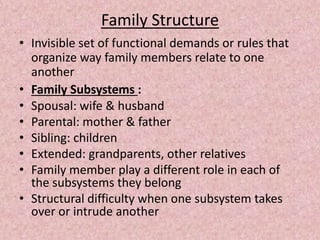
Family Structure
• Invisible set of functional demands or rules that
organize way family members relate to one
another
• Family Subsystems :
• Spousal: wife & husband
• Parental: mother & father
• Sibling: children
• Extended: grandparents, other relatives
• Family member play a different role in each of
the subsystems they belong
• Structural difficulty when one subsystem takes
over or intrude another
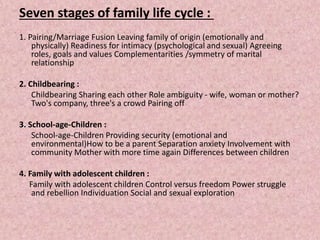
Seven stages of family life cycle :
1. Pairing/Marriage Fusion Leaving family of origin (emotionally and
physically) Readiness for intimacy (psychological and sexual) Agreeing
roles, goals and values Complementarities /symmetry of marital
relationship
2. Childbearing :
Childbearing Sharing each other Role ambiguity - wife, woman or mother?
Two's company, three's a crowd Pairing off
3. School-age-Children :
School-age-Children Providing security (emotional and
environmental)How to be a parent Separation anxiety Involvement with
community Mother with more time again Differences between children
4. Family with adolescent children :
Family with adolescent children Control versus freedom Power struggle
and rebellion Individuation Social and sexual exploration
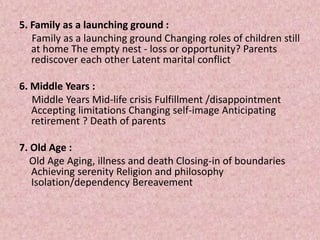
5. Family as a launching ground :
Family as a launching ground Changing roles of children still
at home The empty nest - loss or opportunity? Parents
rediscover each other Latent marital conflict
6. Middle Years :
Middle Years Mid-life crisis Fulfillment /disappointment
Accepting limitations Changing self-image Anticipating
retirement ? Death of parents
7. Old Age :
Old Age Aging, illness and death Closing-in of boundaries
Achieving serenity Religion and philosophy
Isolation/dependency Bereavement
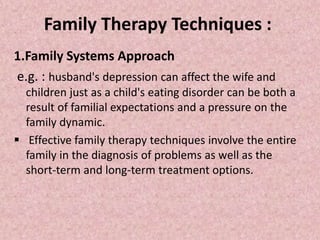
Family Therapy Techniques :
1.Family Systems Approach
e.g. : husband's depression can affect the wife and
children just as a child's eating disorder can be both a
result of familial expectations and a pressure on the
family dynamic.
 Effective family therapy techniques involve the entire
family in the diagnosis of problems as well as the
short-term and long-term treatment options.
2. Observation :
• A clinical psychologist is trained to observe the family
dynamic and monitor both verbal and non-verbal cues.
• During the assessment phase and initial interviews, the
family systems psychologist will monitor how the parents
interact with each other and how their children react to
them.
• He or she will compare his or her observations with testing
data offered in both subjective and objective forms.
– The subjective test data is gathered during the interview
– the objective test data is gathered via clinical tests that family
members are requested to fill out and return to the
psychologist.
3. Effective Communication
• Effective communication is an important lessons
that family systems psychologist incorporate into
group and individual family therapy sessions.
– To create an effective solution to any dysfunction or
problem in the group dynamic requires effective
communication so that all members of the group or
family are in touch with each other.
• Effective Communication allows a family to
dialogue on their problems, concerns and feeling
obligated to resolve the problems being shared.
• A large portion of effective communication
resides in active listening, a skill that must be
learned.
4. Problem Solving :
4. Problem solving is an effective therapy
technique not because it teaches the family
how to resolve the issues
 but it teaches them how to identify,
develop plans and create resolutions for
future problems.
 Problem solving may seem like a common
sense resolution, but it requires a willingness
on the parts of all parties to contribute to the
solution
5.Psycho education:
 Psycho education refers to the education offered to people
who live with a psychological disturbance.
 Frequently psycho education training involves patients with
schizophrenia, clinical depression, anxiety disorders, psychotic
illnesses, eating disorders, and personality disorders, as well
as patient training courses in the treatment of physical
illnesses.
 Family members are also included.
 A goal is for the patient to understand and be better able to
deal with the presented illness.
 Also, the patient's own strengths, resources and coping skills
are reinforced,
 in order to avoid relapse and contribute to their own health
and wellness on a long-term basis.
Indications
• No improvement in individual therapy
• Problem lies in the family rather than an
individual
• Family facing transactional stage in the family life
cycle
• Facing communication problems
• Substance abuse
• Schizophrenia
• Childhood psychiatric disorder
• Psychosis
• Anxiety disorder
• Bipolar disorder
AIMS
• To change the relationships which produced
pain in the members
• To establish good communication pattern
• To improve integration of family system in to
societal system
• To assist ,to locate the community resources
• To reduce anxiety , stress and establish
balance in the family.
PRINCIPLES
1. is based on principle that “change your behavior
and you will change your relationship”
• Making the use of emotional closeness ,
differentiating the self from ‘we’ relieves the
person from uncomfortable closeness , hostile
rejection which increases emotional closeness
without fusion.
2. the family system itself is more influential than
individual conflicts in producing abnormal
behavior
• It holds that the family system has contributed to
the chronic behaviors which an individual has
developed.
3. In the structured family therapy , change the
origin of the family in such a way that family
members behave more positively and
supportively towards each other.
Points to be kept in mind during
therapy
• Always go along with therapy process ,ways of
working and their walks of life , as their mood ,
communication pattern ,and beliefs.
• Give ear to their words
• Respect their culture , values etc.
• Give weight age for the weakness and strength
• Know about available resources
• Respect the supporting family subsystem by
which problem arises or helps to resolve it.
Role of nurse
• The nurse plays a vital role in in assisting the therapist,
apart from this she also act as a co-therapist..
– Assess the type of family as functional or dysfunctional
– Assess family for :
 homeostasis ,
 problem solving approach
 attitude about other family members
 relationship among family members
 With neighbor
 Care o child such as overprotection ,distance keeping
parents.
• Assist the therapist in selection of type therapy
based on the assessments
• Develop a clear contact with family members
regarding time , sessions , procedures to be
followed
• Encourage the family members to take
responsibility for the self and not try to change
others
• Nurse must limit her action and avoid becoming
involved
• Set up norms , values and rules to be followed
• Help the family to find out their own problem
solving approach.

Family therapy ppt

  • 1.
    PRESENTED BY :RITIKA SONI FAMILY THERAPY
  • 2.
    Introduction • Family therapyis often thought of as therapeutic modality – To be employed when overt conflict is recognized in members of the same family and psychotherapeutic interventions are required . – Is an essential intervention in a family system to change the family. – Family is the unit which is being treated for better interactions among each other. – Can be conducted at hospital or during home visit – Maximum 20 sessions are planned and by the end of 10th session changes can be seen.
  • 3.
    DEFINITION • “A psychotherapeuticapproach that focuses on interactions between a couple with in nuclear family or its members in extended family or between the family and other interpersonal system with the goal of alleviating problems initially presented by individual family members , family subsystems , the family as a whole or other referral sources.” Wynne, 1988
  • 4.
    How many sessionswill we need? • Wherever possible, decisions about the number of sessions and the intervals between appointments are made collaboratively between the therapist and family. • The number of appointments offered will depend on the service setting and family members’ needs.  Most sessions last between 45 minutes and one and a half hours.
  • 5.
    Do family therapistsonly work with families? • No. • They may see children and adults individually and/or in family member groups. They may work with couples, or with other groups and communities. • When a family is involved with several different agencies, family therapists may work with the network of professionals as well as with family members – to ensure their input is coordinated and helpful. – Some systemic psychotherapists use their understandings of relationships to work with organizations. – Many use their skills in family sensitive working to supervise other professionals
  • 6.
    What’s meant by‘family’? • Family therapists recognize that different cultures and groups have different ideas of what ‘family’ means. • They take ‘family’ to describe any group of people who care about each other and define themselves as such. As well as parents and children of all ages, they may work with grandparents, siblings, uncles and aunts, cousins, friends, carers, other professionals • whoever people identify as important to their lives
  • 7.
    TYPES 1.FAMILY SYSTEM THERAPY: o To clarify and distinguish thinking and feeling process in the family members which leads to undifferentiated family ego 2. FAMILY STRUCTURE THERAPY : o Based on a normative concept of a healthy family , emphasizing the boundaries between family subsystem and the establishment , maintenance of a clear hierarchy based on parental competence.
  • 8.
    Functional Family Therapy • FunctionalFamily Therapy (FFT) is a : family-based prevention and intervention program to treat a range of these high-risk youth and their families. • As such, FFT is a good example of the current generation of family-based treatments for adolescent behavior problems (Mendel, 2000; Sexton and Alexander, 1999)
  • 9.
    FFT may include:  diversion, probation, alternatives to incarceration, or reentry programs for youth returning to the community following release from a high-security, severely restrictive institutional setting.
  • 10.
    • FFT isa short-term intervention — including, on average, 8 to 12 sessions for mild cases and up to 30 hours of direct service (e.g., clinical sessions, telephone calls, and meetings involving community resources) - for more difficult cases.  In most cases, sessions are spread over a 3- month period.
  • 11.
    Core Principles, Goals, andTechniques • To identify the primary focus of intervention (the family) • reflect an understanding that positive and negative behaviors both influence and are influenced by multiple relational systems (i.e., are functional). • FFT is a multisystem prevention program,  meaning that it focuses on the multiple domains and systems within which adolescents and their families live.  FFT is also focuses on the treatment system, family and individual functioning, and the therapist as major components.
  • 12.
    • FFT worksfirst to develop family members’ inner strengths and sense of being able to improve their situation. • These characteristics provide the family with a platform for change and future functioning that extends beyond the direct support of the therapist and other social systems. • In the long run, the FFT philosophy leads to greater self-sufficiency, fewer total treatment needs, and considerably lower costs.
  • 13.
    Functional Family TherapyClinical Model: Intervention Phases Across Time Assessment………………………………………………………………… Intervention………………………………………………………………… Early Middle Late Engagement And Motivation Behavior Change Generalization
  • 14.
    1.Engagement and Motivation Phasegoals Develop alliances. Reduce negativity, resistance. communication . Minimize hopelessness. Reduce dropout potential . Develop family focus. Increase motivation for change. 2.Behavior Change Phase goals • Develop and implement • individualized change plans. • Change presenting • delinquency behavior. • Build relational skills (e.g., • communication and • parenting). • 3.Generalization Phase goals • Maintain/generalize change. • Prevent relapses. • Provide community resources • necessary to support change.
  • 15.
    1.Risk and protective Factorsaddressed • Negativity and blaming (risk). • Hopelessness (risk). • Lack of motivation (risk). • Credibility (protective). • Alliance (protective). • Treatment availability 2.Risk and protective Factors addressed • Poor parenting skills (risk). • Negativity and blaming (risk). • Poor communication (risk). • Positive parenting skills • (protective). • Supportive communication • (protective). • Interpersonal needs • Parental pathology (depends on context). • Developmental level (depends on context 3. Risk and protective Factors addressed • Poor relationships with school/ community (risk). • Low level of social support (risk). • Positive relationships with school/community (protective).
  • 16.
    1.Assessment focus • Behavior(e.g., presenting • problem and risk and protective • factors). • Relational problems sequence • (e.g., needs/functions). • Context (risk and protective • factors). 2.Assessment focus • Quality of relational skills • (communication, parenting). • Compliance with behavior • change plan. • Relational problem sequence 3. Assessment focus • Identification of community • resources needed. • Maintenance of change.
  • 17.
    1.Therapist/ Interventionist skills • Interpersonalskills (validation, • positive interpretation, • reattribution, reframing, and • sequencing). • High availability to provide • services. 2.Therapist/ Interventionist skills • Structure (session focusing). • Change plan implementation. • Modeling/focusing/directing/ • training. 2.Therapist/ Interventionist skills • Family case manager. • Resource help. • Relapse prevention • interventions
  • 18.
    Structural Family Therapy •Salvador Minuchin’s Background : Born in 1921 to Russian Jewish emigrants in Argentina  In 1948 he joined the Israeli army as a doctor  In 1950, Minuchin came to United States with the intention of studying with Bruno Bettelheim in Chicago 1. Met Nathan Ackerman in New York and chose to stay there 2. In 1954 Minuchin began studying psychoanalysis .
  • 19.
    Minuchin Became Directorof Philadelphia Child Guidance Clinic (1967)  He transformed the clinic into a family therapy center  Gained a reputation as a tough and demanding administrator  Developed many innovative ideas at the Clinic Example: Institute for Family Counseling, a training program for community paraprofessionals that was effective in providing mental health services to the poor  Minuchin published Families and Family Therapy in1974  Most clearly written and popular books in field of family therapy  In 1975 Minuchin stepped down as director of clinic, but remained head of training until 1981
  • 20.
    Key Concepts ofStructural Family Therapy • Focus is on family interactions to understand the structure/organization of the family • Symptoms/presenting problem viewed as by- product of structural failings • Structural changes must occur in a family before an individual’s symptoms can be reduced
  • 21.
    Structural Goals – Tothe extent permitted by the hypotheses, the therapist determines immediate goals for the intervention that is to follow • Reduce symptoms of dysfunction • Bring about structural change because it is assumed that faulty family structures have: – Boundaries that are rigid or diffuse – Subsystems that have inappropriate tasks and functions
  • 22.
    Structural Family Therapist’sFunction • The therapeutic task is to help move family from a dysfunctional stage to a new stage (evolved different structures have more stable levels of functioning) • Actively engage family unit to initiate structural change by joining and accommodating.
  • 23.
    Understanding the Problem The therapist determines the issues around which to explore and intervene in the session. • Joining the family in a position of leadership entering their reality and becoming part that family’s patterns of relating/structure
  • 24.
    Collecting Data The therapisttracks content and learns about the family issue and draws together all data relevant to the issue as gathered from prior information – Mapping family’s underlying structure observe family to see structure, focusing on the how, when, and to whom family members relate – who says what to whom – in what way – with what result
  • 25.
    Formulating Hypotheses On thebasis of the data, the therapist commits to hypotheses about the significance of the current transactional sequence of the nature of the problem, its locus, and sustaining structure. – Conducts experiments through probes and challenges to assess the flexibility of family patterns
  • 26.
    Intervening – Intervening inways designed to transform an ineffective structure – The therapist: (a) to facilitates change in patterns of transactional sequences among family members and/or between self and family members (b) to controls for variables in the transaction so that the effects of the intervention can be assessed – Challenging family rules, fostering boundary reorganization, prompting conflict resolution, creating an effective hierarchical structure, increasing degree of flexibility in family interactions, modifying dysfunctional family structures, and supporting greater individuation of family members. Feedback – On the basis of the reactions of the family members to the intervention, the therapist restarts the cycle from the second step.
  • 27.
    Family Structure • Invisibleset of functional demands or rules that organize way family members relate to one another • Family Subsystems : • Spousal: wife & husband • Parental: mother & father • Sibling: children • Extended: grandparents, other relatives • Family member play a different role in each of the subsystems they belong • Structural difficulty when one subsystem takes over or intrude another
  • 28.
    Seven stages offamily life cycle : 1. Pairing/Marriage Fusion Leaving family of origin (emotionally and physically) Readiness for intimacy (psychological and sexual) Agreeing roles, goals and values Complementarities /symmetry of marital relationship 2. Childbearing : Childbearing Sharing each other Role ambiguity - wife, woman or mother? Two's company, three's a crowd Pairing off 3. School-age-Children : School-age-Children Providing security (emotional and environmental)How to be a parent Separation anxiety Involvement with community Mother with more time again Differences between children 4. Family with adolescent children : Family with adolescent children Control versus freedom Power struggle and rebellion Individuation Social and sexual exploration
  • 29.
    5. Family asa launching ground : Family as a launching ground Changing roles of children still at home The empty nest - loss or opportunity? Parents rediscover each other Latent marital conflict 6. Middle Years : Middle Years Mid-life crisis Fulfillment /disappointment Accepting limitations Changing self-image Anticipating retirement ? Death of parents 7. Old Age : Old Age Aging, illness and death Closing-in of boundaries Achieving serenity Religion and philosophy Isolation/dependency Bereavement
  • 30.
    Family Therapy Techniques: 1.Family Systems Approach e.g. : husband's depression can affect the wife and children just as a child's eating disorder can be both a result of familial expectations and a pressure on the family dynamic.  Effective family therapy techniques involve the entire family in the diagnosis of problems as well as the short-term and long-term treatment options.
  • 31.
    2. Observation : •A clinical psychologist is trained to observe the family dynamic and monitor both verbal and non-verbal cues. • During the assessment phase and initial interviews, the family systems psychologist will monitor how the parents interact with each other and how their children react to them. • He or she will compare his or her observations with testing data offered in both subjective and objective forms. – The subjective test data is gathered during the interview – the objective test data is gathered via clinical tests that family members are requested to fill out and return to the psychologist.
  • 32.
    3. Effective Communication •Effective communication is an important lessons that family systems psychologist incorporate into group and individual family therapy sessions. – To create an effective solution to any dysfunction or problem in the group dynamic requires effective communication so that all members of the group or family are in touch with each other. • Effective Communication allows a family to dialogue on their problems, concerns and feeling obligated to resolve the problems being shared. • A large portion of effective communication resides in active listening, a skill that must be learned.
  • 33.
    4. Problem Solving: 4. Problem solving is an effective therapy technique not because it teaches the family how to resolve the issues  but it teaches them how to identify, develop plans and create resolutions for future problems.  Problem solving may seem like a common sense resolution, but it requires a willingness on the parts of all parties to contribute to the solution
  • 34.
    5.Psycho education:  Psychoeducation refers to the education offered to people who live with a psychological disturbance.  Frequently psycho education training involves patients with schizophrenia, clinical depression, anxiety disorders, psychotic illnesses, eating disorders, and personality disorders, as well as patient training courses in the treatment of physical illnesses.  Family members are also included.  A goal is for the patient to understand and be better able to deal with the presented illness.  Also, the patient's own strengths, resources and coping skills are reinforced,  in order to avoid relapse and contribute to their own health and wellness on a long-term basis.
  • 35.
    Indications • No improvementin individual therapy • Problem lies in the family rather than an individual • Family facing transactional stage in the family life cycle • Facing communication problems • Substance abuse • Schizophrenia • Childhood psychiatric disorder • Psychosis • Anxiety disorder • Bipolar disorder
  • 36.
    AIMS • To changethe relationships which produced pain in the members • To establish good communication pattern • To improve integration of family system in to societal system • To assist ,to locate the community resources • To reduce anxiety , stress and establish balance in the family.
  • 37.
    PRINCIPLES 1. is basedon principle that “change your behavior and you will change your relationship” • Making the use of emotional closeness , differentiating the self from ‘we’ relieves the person from uncomfortable closeness , hostile rejection which increases emotional closeness without fusion. 2. the family system itself is more influential than individual conflicts in producing abnormal behavior • It holds that the family system has contributed to the chronic behaviors which an individual has developed.
  • 38.
    3. In thestructured family therapy , change the origin of the family in such a way that family members behave more positively and supportively towards each other.
  • 39.
    Points to bekept in mind during therapy • Always go along with therapy process ,ways of working and their walks of life , as their mood , communication pattern ,and beliefs. • Give ear to their words • Respect their culture , values etc. • Give weight age for the weakness and strength • Know about available resources • Respect the supporting family subsystem by which problem arises or helps to resolve it.
  • 40.
    Role of nurse •The nurse plays a vital role in in assisting the therapist, apart from this she also act as a co-therapist.. – Assess the type of family as functional or dysfunctional – Assess family for :  homeostasis ,  problem solving approach  attitude about other family members  relationship among family members  With neighbor  Care o child such as overprotection ,distance keeping parents.
  • 41.
    • Assist thetherapist in selection of type therapy based on the assessments • Develop a clear contact with family members regarding time , sessions , procedures to be followed • Encourage the family members to take responsibility for the self and not try to change others • Nurse must limit her action and avoid becoming involved • Set up norms , values and rules to be followed • Help the family to find out their own problem solving approach.