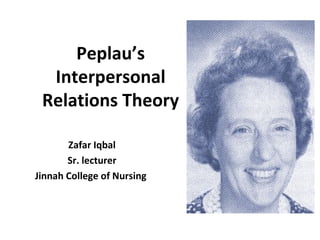
Peplau’s
  Interpersonal
 Relations Theory

       Zafar Iqbal
       Sr. lecturer
Jinnah College of Nursing
Hildegard E. Peplau’s Interpersonal
Relations in Nursing
Regarded as “mother of psychiatric nursing”
 Born in 1909 , Pennsylvania
Diploma from Pottstown Hospital School of
Nursing,
BA in interpersonal psychology from
Bennington College Pennsylvania in 1931.
 MA in psychiatric nursing from Colombia
University, New York in 1947
Her Theory was published in 1953
Framework for psychodynamic nursing
Continue…
Theory was influenced by Harry Stack Sullivan’s
theory of interpersonal relations.
Middle range, descriptive, classification theory
she led the way towards humane treatment of
patients with behavior and personality disorders.
Nurses, she thought, could facilitate this
through observation, description, formulation,
interpretation, validation, and intervention.
she taught interpersonal concepts and
interviewing techniques, as well as individual,
family, and group therapy.
Interpersonal Relations in Nursing
               Theory
• Stresses the importance of nurses’ ability to
  understand their own behaviors to help
  others identify perceived difficulties.
• Emphasizes the focus on the interpersonal
  processes and therapeutic relationship that
  develops between the nurse and client.
• Four phases of the nurse-patient relationship
  are identified
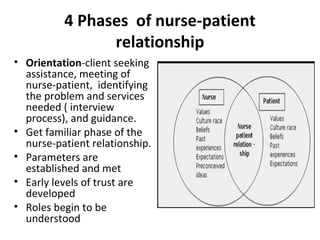
4 Phases of nurse-patient
                relationship
• Orientation-client seeking
  assistance, meeting of
  nurse-patient, identifying
  the problem and services
  needed ( interview
  process), and guidance.
• Get familiar phase of the
  nurse-patient relationship.
• Parameters are
  established and met
• Early levels of trust are
  developed
• Roles begin to be
  understood
Phases cont.
Identification- identifying who is best to support
  needs, patient addresses personal feelings about
  the experience and is encouraged to participate
  in care to promote personal acceptance and
  satisfaction.
• The client begins to identify problems to be
  worked on within relationship
• The goal of the nurse: help the patient to
  recognize his/her own
  interdependent/participation role and promote
  responsibility for self
Phases cont.
Exploitation- patient attempts to explore,
  understand and deal with the problem, and gains
  independence on achieving the goal
• Client’s trust of nurse reached full potential
• Client making full use of nursing services
• Solving immediate problems
• Identifying and orienting self to [discharge] goals
Phases cont.
Resolution- termination of the therapeutic
  relationship to encourage emotional balance for
  nurse and patient ( difficult for both patient and
  nurse as psychological dependence persists)
• Client met needs
• Mutual termination of relationship
• Sense of security is formed
• Patient is less reliant on nurse
• Increased self reliance to deal with own
  problems.
Peplau's Seven Nursing Roles
• Peplau's Seven Nursing Roles illustrate the dynamic
  character roles typical to clinical nursing.
• Stranger role: Receives the client the same way one
  meets a stranger in other life situations; provides an
  accepting climate that builds trust.
• Resource role: Answers questions, interprets clinical
  treatment data, gives information.
• Teaching role: Gives instructions and provides training;
  involves analysis and synthesis of the learner's
  experience.
Peplau's Seven Nursing Roles
• Counseling role: Helps client understand and
  integrate the meaning of current life circumstances;
  provides guidance and encouragement to make
  changes.
• Surrogate role: Helps client clarify domains of
  dependence, interdependence, and independence
  and acts on clients behalf as advocate.
• Active leadership: Helps client assume maximum
  responsibility for meeting treatment goals in a
  mutually satisfying way.
• Technical expert role: Provides physical care by
  displaying clinical skills; Operates equipment
Application of Interpersonal Theory in
           Nursing Practice
• An article in Current Nursing evaluated using the
  theory in nursing practice
  – Assessment= Orientation phase
  – Nursing diagnosis
  – Planning=Identification phase
  – Implementing=Exploitation phase
  – Evaluation=Resolution phase
  (the theory allowed client’s needs to be assessed.
    Application of the theory helped provide
    comprehensive care to the client)
Research completed
• Urology Nursing used the theory to educate
  newly diagnosed bladder cancer patients with
  the need for a urinary diversion, and ensure
  understanding.
  Outcome shows that the scope of a patient’s needs
   requires a competent nurse to assume the
   changing roles in the four phases of the theory,
   expressing the importance of involving the
   patient in establishing goals and reviewing the
   goals frequently.
Research completed
• British Journal of Nursing had an article researching
  the credibility of Peplau’s theory, in mental health
  care, due to the expansion of nursing knowledge and
  the dynamics of a multidisciplinary team currently
  used in today’s practice.
• Public Health Nursing did a study, in homecare visits,
  (testing the use of Peplau’s theory) to work with multi-
  problem families, to identify interventions,
  individualized for the members, to see if relationship
  progression was increased within the family system
  resulting in optimized care of the patient.
Application of theory in “MY” nursing
                  practice
• This theory would be useful with our newly diagnosed cancer patients
  and their family. Resistance is met when trying to educate them about
  the treatment, encouraging enrolment in studies, and education about
  how to care for the patient in their home setting.
   – Orientation-patient gets admitted to the unit, nurse helps the patient to
      recognize and understand that they have cancer and the importance of
      treatment.
   – Identification-Patient takes the time to internalize the diagnosis, the nurse
      participates in helping the patient to do so.
   -- Exploitation-the nurse works to have the patient explore what help is
      needed to meet goals, incorporating other disciplines to problem solve
      (oncologists, therapists, alternative medicine, etc.).Patient test the limits of
      the nurses availability, and the nurse encourages patient to evaluate ways
      to meet their final goals.
   -- Resolution-when in-patient treatment is complete, the nurse has to
      evaluate feelings and remove themselves from the bond that is made,
      allowing the patient and family to move on and regain balance in their own
      lives.

Peplau’s+interpersonal+relations+theory+power+point

  • 1.
    Peplau’s Interpersonal Relations Theory Zafar Iqbal Sr. lecturer Jinnah College of Nursing
  • 2.
    Hildegard E. Peplau’sInterpersonal Relations in Nursing Regarded as “mother of psychiatric nursing”  Born in 1909 , Pennsylvania Diploma from Pottstown Hospital School of Nursing, BA in interpersonal psychology from Bennington College Pennsylvania in 1931.  MA in psychiatric nursing from Colombia University, New York in 1947 Her Theory was published in 1953 Framework for psychodynamic nursing
  • 3.
    Continue… Theory was influencedby Harry Stack Sullivan’s theory of interpersonal relations. Middle range, descriptive, classification theory she led the way towards humane treatment of patients with behavior and personality disorders. Nurses, she thought, could facilitate this through observation, description, formulation, interpretation, validation, and intervention. she taught interpersonal concepts and interviewing techniques, as well as individual, family, and group therapy.
  • 4.
    Interpersonal Relations inNursing Theory • Stresses the importance of nurses’ ability to understand their own behaviors to help others identify perceived difficulties. • Emphasizes the focus on the interpersonal processes and therapeutic relationship that develops between the nurse and client. • Four phases of the nurse-patient relationship are identified
  • 5.
    4 Phases ofnurse-patient relationship • Orientation-client seeking assistance, meeting of nurse-patient, identifying the problem and services needed ( interview process), and guidance. • Get familiar phase of the nurse-patient relationship. • Parameters are established and met • Early levels of trust are developed • Roles begin to be understood
  • 6.
    Phases cont. Identification- identifyingwho is best to support needs, patient addresses personal feelings about the experience and is encouraged to participate in care to promote personal acceptance and satisfaction. • The client begins to identify problems to be worked on within relationship • The goal of the nurse: help the patient to recognize his/her own interdependent/participation role and promote responsibility for self
  • 7.
    Phases cont. Exploitation- patientattempts to explore, understand and deal with the problem, and gains independence on achieving the goal • Client’s trust of nurse reached full potential • Client making full use of nursing services • Solving immediate problems • Identifying and orienting self to [discharge] goals
  • 8.
    Phases cont. Resolution- terminationof the therapeutic relationship to encourage emotional balance for nurse and patient ( difficult for both patient and nurse as psychological dependence persists) • Client met needs • Mutual termination of relationship • Sense of security is formed • Patient is less reliant on nurse • Increased self reliance to deal with own problems.
  • 9.
    Peplau's Seven NursingRoles • Peplau's Seven Nursing Roles illustrate the dynamic character roles typical to clinical nursing. • Stranger role: Receives the client the same way one meets a stranger in other life situations; provides an accepting climate that builds trust. • Resource role: Answers questions, interprets clinical treatment data, gives information. • Teaching role: Gives instructions and provides training; involves analysis and synthesis of the learner's experience.
  • 10.
    Peplau's Seven NursingRoles • Counseling role: Helps client understand and integrate the meaning of current life circumstances; provides guidance and encouragement to make changes. • Surrogate role: Helps client clarify domains of dependence, interdependence, and independence and acts on clients behalf as advocate. • Active leadership: Helps client assume maximum responsibility for meeting treatment goals in a mutually satisfying way. • Technical expert role: Provides physical care by displaying clinical skills; Operates equipment
  • 11.
    Application of InterpersonalTheory in Nursing Practice • An article in Current Nursing evaluated using the theory in nursing practice – Assessment= Orientation phase – Nursing diagnosis – Planning=Identification phase – Implementing=Exploitation phase – Evaluation=Resolution phase (the theory allowed client’s needs to be assessed. Application of the theory helped provide comprehensive care to the client)
  • 12.
    Research completed • UrologyNursing used the theory to educate newly diagnosed bladder cancer patients with the need for a urinary diversion, and ensure understanding. Outcome shows that the scope of a patient’s needs requires a competent nurse to assume the changing roles in the four phases of the theory, expressing the importance of involving the patient in establishing goals and reviewing the goals frequently.
  • 13.
    Research completed • BritishJournal of Nursing had an article researching the credibility of Peplau’s theory, in mental health care, due to the expansion of nursing knowledge and the dynamics of a multidisciplinary team currently used in today’s practice. • Public Health Nursing did a study, in homecare visits, (testing the use of Peplau’s theory) to work with multi- problem families, to identify interventions, individualized for the members, to see if relationship progression was increased within the family system resulting in optimized care of the patient.
  • 14.
    Application of theoryin “MY” nursing practice • This theory would be useful with our newly diagnosed cancer patients and their family. Resistance is met when trying to educate them about the treatment, encouraging enrolment in studies, and education about how to care for the patient in their home setting. – Orientation-patient gets admitted to the unit, nurse helps the patient to recognize and understand that they have cancer and the importance of treatment. – Identification-Patient takes the time to internalize the diagnosis, the nurse participates in helping the patient to do so. -- Exploitation-the nurse works to have the patient explore what help is needed to meet goals, incorporating other disciplines to problem solve (oncologists, therapists, alternative medicine, etc.).Patient test the limits of the nurses availability, and the nurse encourages patient to evaluate ways to meet their final goals. -- Resolution-when in-patient treatment is complete, the nurse has to evaluate feelings and remove themselves from the bond that is made, allowing the patient and family to move on and regain balance in their own lives.