COUNSELLING

• Rev JOBIN JOHN
MODULE 1 : COUNSELLING
Meaning
Definition
Characteristics
Goals of counselling
Elements of counselling
COUNSELLING : Meaning
•
•
•
•
•
•
•
•
•
•

C – caring, Committed , confidentiality
O- Open mind
U – Understands the person and his problems
N – Neutral and objective, non- judgmental
S- Systematic , Service oriented , sincere
E – Empathise, expect no reward/ return
L – Listens with interest
L – Loyal to the client’s welfare
O – Obliging , optimistic
R – Resourceful and reaches out to do the best to the
client , respects the clients unconditionally
COUNSELLING : Meaning
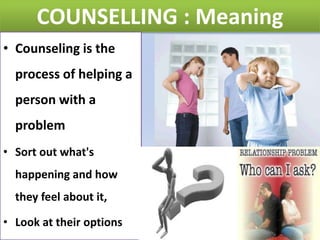
• Counseling is the
process of helping a
person with a
problem
• Sort out what's
happening and how

they feel about it,
• Look at their options
COUNSELLING : Meaning
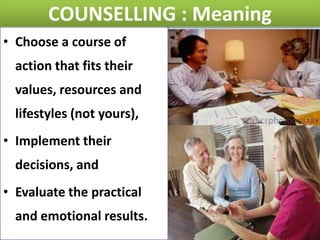
• Choose a course of
action that fits their

values, resources and
lifestyles (not yours),

• Implement their
decisions, and
• Evaluate the practical
and emotional results.
COUNSELLING : Meaning
 Is

about

normal,
people

helping
functional

handle

usual

the

problems,

opportunities

and

choices that come up
in any life.
COUNSELLING : Meaning
 Primarily provide with a safe

time and place in which
to figure out their own
situation, and

 Secondarily by sharing our

specialized knowledge
and resources with them
when asked.
Few examples of reasons we might want
to see a counselor
"She/he isn't
"She/he
Thoughts
making any
won't listen"
sense"
Feelings

Constant
anger

Stressed out

"Everyone's out
to get me"

"If only they
knew what I
was really like,
..."

Feeling blamed

Constant
tiredness

Not getting
Shutting
Allowing
Shouting,
your voice
yourself away
Behaviour
yourself to be slamming doors,
or opinion
from other
bullied
throwing things
heard
people

"I don't
know what
Explore/
to do about
Clarify
my

Feeling
confused
about a
situation or

My life lacks
direction

Personal
worries
What is Counselling?
Counselling is the opportunity to talk with a
professionally trained counsellor who can offer
support, advice and new perspectives on your
issues.
The main steps in the counselling process are:
• To help clarify the problem
• To identify options open to you in the situation
• To work out what you hope to achieve
• Identify ways to achieve this goal
• Provide support and advice as you work towards
your goal.
COUNSELLING : Definition
• Counselling is defined as ‘the
service of helping people to
adjust to or deal with personal
problems by enabling them to
discover for themselves the
solution to the problems while
receiving attention from a
counsellor.’
(Chambers
Dictionary)
COUNSELLING : Definition
• Counselling is an interactive process characterized
by a unique relationship between counselor and
client that leads to change in the client in one or
more of the following areas:
– Behaviour (overt changes in the ways clients act, their
coping skills, decision making skills, and / or relationship
skills)
– Beliefs and values ( Ways of thinking about self , others,
and the world) or emotional concerns relating to these
perceptions
– Level of emotional distress ( uncomfortable feelings or
reactivity to environmental stress.)
COUNSELLING : Definition
• Counseling is a learning oriented process, carried on
a simple one to one social environment, in
which the counselor professionally competent
in psychological skills and knowledge seeks to assist
the Client by methods appropriate to the
latter’s needs and within the context of the total
personal programme, to learn how to put such
understanding into effect in relation to more clearly
perceived and realistically defined goals to the
end that the client may become a happier and

more productive member of the society.
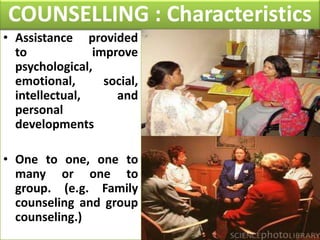
COUNSELLING : Characteristics
• Assistance provided
to
improve
psychological,
emotional,
social,
intellectual,
and
personal
developments
• One to one, one to
many or one to
group. (e.g. Family
counseling and group
counseling.)
COUNSELLING : Characteristics
• It is through a helping
relationship between the
counselor
and
the
counselee
• It
is
through
the
professional conversation
and series of problem
solving interviews
• A process that leads
action on the part of the
counselee
Goals of COUNSELLING
Goals are the expected results and
objectives from the counseling process
• Allow the person to ventilate his
feelings in a safe and accepting
atmosphere.
• Help the counselee to place his
problem in the context of reality
without his emotions getting in the
way.
• Enable the individual to chose among
possible options the one which seems
good for him/her.
Goals of COUNSELLING
• To make the individual
fully functioning and
productive individual
• To solve the immediate
problems and concerns to
recapitulate
the
real
existence of the client
• To fulfill the potentials of
the individual.
Goals of COUNSELLING

• Counselor’s goals:
understanding the behavior,
motivation, feeling..
• Counselee’s goals:
relief from tension, solving a
problem, taking a decision.
Goals of COUNSELLING
The goals will give a sense of direction needed for a
useful evaluation and monitoring of the process.

• Immediate goals or Short-term goals
--counselee’s problems.
• Long-term goals --purpose in general
counselor’s goals.
• Process goals --for the counselor
counselee relationship.
Goals of COUNSELLING
•Achievement of positive mental health. - Selfactualisingself realizing-fully functioning.
•Resolution of problems.

•Improving personal effectiveness.
•To aid the change process
•Improvising decision-making.
•Preventing the further occurrences of issues
•Behavior modification.
Elements of COUNSELLING
• Empathetic relationship

• Adherence to the clients problems
• Existence of an atmosphere of mutual
trust and confidence
• Clearly defined goals and objectives
• Well maintained rapport

Counselling

  • 1.
  • 2.
    MODULE 1 :COUNSELLING Meaning Definition Characteristics Goals of counselling Elements of counselling
  • 3.
    COUNSELLING : Meaning • • • • • • • • • • C– caring, Committed , confidentiality O- Open mind U – Understands the person and his problems N – Neutral and objective, non- judgmental S- Systematic , Service oriented , sincere E – Empathise, expect no reward/ return L – Listens with interest L – Loyal to the client’s welfare O – Obliging , optimistic R – Resourceful and reaches out to do the best to the client , respects the clients unconditionally
  • 4.
    COUNSELLING : Meaning •Counseling is the process of helping a person with a problem • Sort out what's happening and how they feel about it, • Look at their options
  • 5.
    COUNSELLING : Meaning •Choose a course of action that fits their values, resources and lifestyles (not yours), • Implement their decisions, and • Evaluate the practical and emotional results.
  • 6.
    COUNSELLING : Meaning Is about normal, people helping functional handle usual the problems, opportunities and choices that come up in any life.
  • 7.
    COUNSELLING : Meaning Primarily provide with a safe time and place in which to figure out their own situation, and  Secondarily by sharing our specialized knowledge and resources with them when asked.
  • 8.
    Few examples ofreasons we might want to see a counselor "She/he isn't "She/he Thoughts making any won't listen" sense" Feelings Constant anger Stressed out "Everyone's out to get me" "If only they knew what I was really like, ..." Feeling blamed Constant tiredness Not getting Shutting Allowing Shouting, your voice yourself away Behaviour yourself to be slamming doors, or opinion from other bullied throwing things heard people "I don't know what Explore/ to do about Clarify my Feeling confused about a situation or My life lacks direction Personal worries
  • 9.
    What is Counselling? Counsellingis the opportunity to talk with a professionally trained counsellor who can offer support, advice and new perspectives on your issues. The main steps in the counselling process are: • To help clarify the problem • To identify options open to you in the situation • To work out what you hope to achieve • Identify ways to achieve this goal • Provide support and advice as you work towards your goal.
  • 10.
    COUNSELLING : Definition •Counselling is defined as ‘the service of helping people to adjust to or deal with personal problems by enabling them to discover for themselves the solution to the problems while receiving attention from a counsellor.’ (Chambers Dictionary)
  • 11.
    COUNSELLING : Definition •Counselling is an interactive process characterized by a unique relationship between counselor and client that leads to change in the client in one or more of the following areas: – Behaviour (overt changes in the ways clients act, their coping skills, decision making skills, and / or relationship skills) – Beliefs and values ( Ways of thinking about self , others, and the world) or emotional concerns relating to these perceptions – Level of emotional distress ( uncomfortable feelings or reactivity to environmental stress.)
  • 12.
    COUNSELLING : Definition •Counseling is a learning oriented process, carried on a simple one to one social environment, in which the counselor professionally competent in psychological skills and knowledge seeks to assist the Client by methods appropriate to the latter’s needs and within the context of the total personal programme, to learn how to put such understanding into effect in relation to more clearly perceived and realistically defined goals to the end that the client may become a happier and more productive member of the society.
  • 13.
    COUNSELLING : Characteristics •Assistance provided to improve psychological, emotional, social, intellectual, and personal developments • One to one, one to many or one to group. (e.g. Family counseling and group counseling.)
  • 14.
    COUNSELLING : Characteristics •It is through a helping relationship between the counselor and the counselee • It is through the professional conversation and series of problem solving interviews • A process that leads action on the part of the counselee
  • 15.
    Goals of COUNSELLING Goalsare the expected results and objectives from the counseling process • Allow the person to ventilate his feelings in a safe and accepting atmosphere. • Help the counselee to place his problem in the context of reality without his emotions getting in the way. • Enable the individual to chose among possible options the one which seems good for him/her.
  • 16.
    Goals of COUNSELLING •To make the individual fully functioning and productive individual • To solve the immediate problems and concerns to recapitulate the real existence of the client • To fulfill the potentials of the individual.
  • 17.
    Goals of COUNSELLING •Counselor’s goals: understanding the behavior, motivation, feeling.. • Counselee’s goals: relief from tension, solving a problem, taking a decision.
  • 18.
    Goals of COUNSELLING Thegoals will give a sense of direction needed for a useful evaluation and monitoring of the process. • Immediate goals or Short-term goals --counselee’s problems. • Long-term goals --purpose in general counselor’s goals. • Process goals --for the counselor counselee relationship.
  • 19.
    Goals of COUNSELLING •Achievementof positive mental health. - Selfactualisingself realizing-fully functioning. •Resolution of problems. •Improving personal effectiveness. •To aid the change process •Improvising decision-making. •Preventing the further occurrences of issues •Behavior modification.
  • 20.
    Elements of COUNSELLING •Empathetic relationship • Adherence to the clients problems • Existence of an atmosphere of mutual trust and confidence • Clearly defined goals and objectives • Well maintained rapport