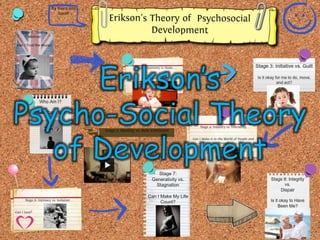
Eight Stages
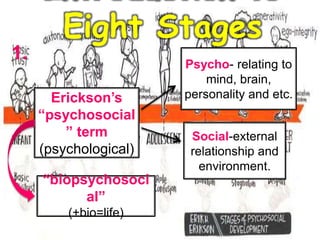
Erickson’s
“psychosocial
” term
(psychological)
Psycho- relating to
mind, brain,
personality and etc.
Social-external
relationship and
environment.
“biopsychosoci
al”
(+bio=life)
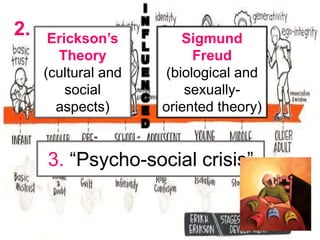
Erickson’s
Theory
(cultural and
social
aspects)
Sigmund
Freud
(biological and
sexually-
oriented theory)
3. “Psycho-social crisis”
4. Erickson’s model is simple and
well-designed.
5. Because Erickson’s Eight Stages
Theory is tremendously powerful
model, it can use in teaching,
parenting, self-awareness and more.
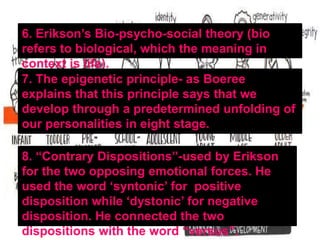
6. Erikson’s Bio-psycho-social theory (bio
refers to biological, which the meaning in
context is life).
7. The epigenetic principle- as Boeree
explains that this principle says that we
develop through a predetermined unfolding of
our personalities in eight stage.
8. “Contrary Dispositions”-used by Erikson
for the two opposing emotional forces. He
used the word ‘syntonic’ for positive
disposition while ‘dystonic’ for negative
disposition. He connected the two
dispositions with the word “versus”.
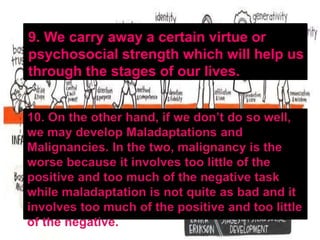
9. We carry away a certain virtue or
psychosocial strength which will help us
through the stages of our lives.
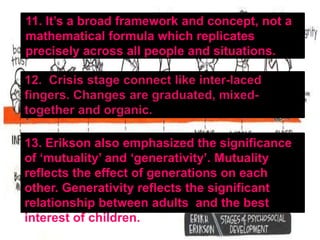
11. It’s a broad framework and concept, not a
mathematical formula which replicates
precisely across all people and situations.
13. Erikson also emphasized the significance
of ‘mutuality’ and ‘generativity’. Mutuality
reflects the effect of generations on each
other. Generativity reflects the significant
relationship between adults and the best
interest of children.
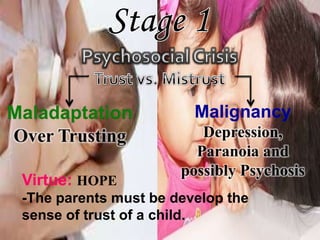
Malignancy
Depression,
Paranoia and
possibly Psychosis
Virtue: HOPE
-The parents must be develop the
sense of trust of a child.
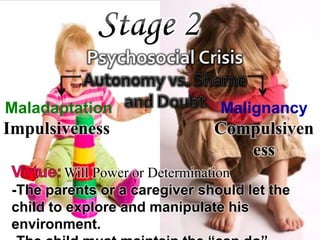
Maladaptation
Impulsiveness
Malignancy
Compulsiven
ess
Will Power or Determination
-The parents or a caregiver should let the
child to explore and manipulate his
environment.
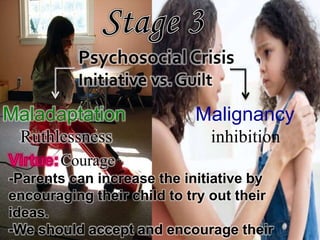
Maladaptation
Ruthlessness
Malignancy
inhibition
Courage
-Parents can increase the initiative by
encouraging their child to try out their
ideas.
-We should accept and encourage their
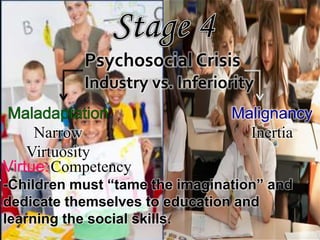
Narrow
Virtuosity
Malignancy
Inertia
Virtue:Competency
-Children must “tame the imagination” and
dedicate themselves to education and
learning the social skills.
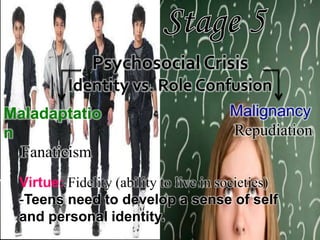
Maladaptatio
n
Fanaticism
Malignancy
Repudiation
Virtue:: Fidelity (ability to live in societies)
-Teens need to develop a sense of self
and personal identity.
Maladaptation
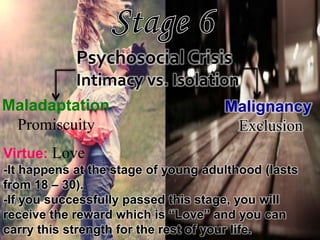
Promiscuity
Malignancy
Exclusion
Virtue: Love
-It happens at the stage of young adulthood (lasts
from 18 – 30).
-If you successfully passed this stage, you will
receive the reward which is “Love” and you can
carry this strength for the rest of your life.
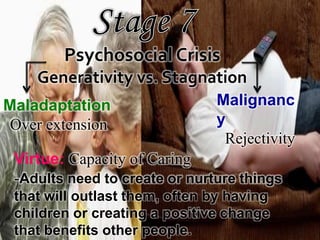
Maladaptation
Over extension
Malignanc
y
Rejectivity
Virtue: Capacity of Caring
-Adults need to create or nurture things
that will outlast them, often by having
children or creating a positive change
that benefits other people.
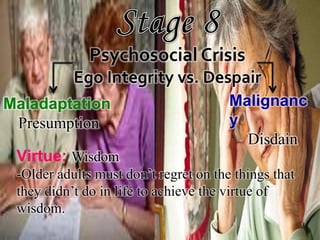
Maladaptation
Presumption
Malignanc
y
Disdain
Virtue: Wisdom
-Older adults must don’t regret on the things that
they didn’t do in life to achieve the virtue of
wisdom.
Educ101- Child and Adolescent Development

Educ101- Child and Adolescent Development