SOCIAL
PSYCHOLOGICAL
THEORIES (HORNEY
AND SULLIVAN)
GROUP 4
Embor, Madelle
Velonza, John Carlo
Cuadra, Shantal Janel
Mariñas, Michelle
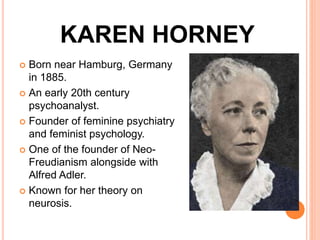
KAREN HORNEY
 Born near Hamburg, Germany
in 1885.
 An early 20th century
psychoanalyst.
 Founder of feminine psychiatry
and feminist psychology.
 One of the founder of Neo-
Freudianism alongside with
Alfred Adler.
 Known for her theory on
neurosis.
HORNEY AND FREUD
 She published a series of papers that criticized
Freud and proposed her own feminine psychology.
 She conceived of her ideas as falling within the
framework of Freudian psychology, however, not as
constituting an entirely new approach to the
understanding of personality. She wrote, “nothing of
importance in the field of psychology and
psychotherapy has been done without reliance of
Freud’s fundamental findings”.
 She aspired to eliminate the fallacies in Freud’s
thinking – fallacies that have their root, she
believed, in his mechanistic, biological orientation –
in order that psychoanalysis may realize its full
potentialities as a science of humans.
 Following Adler, she also believed that Freud’s de-
emphasis of the interrelationships among people
led him to an erroneous overemphasis on sexual
motivation and conflict. She transformed Freud’s
instinctual focus into a cultural focus.
 She objected strongly to Freud’s concept of penis
envy as the determining factor in the psychology of
women. Freud, it will be recalled, observed that the
distinctive attitudes and feelings of women and their
most profound conflict grew out of their feeling of
genital inferiority and their jealousy of the men.
 She believed that feminine psychology is based on
lack of confidence and an overemphasis of the love
relationship and has very little to do with the
anatomy of her sex organs.
 She felt that the Oedipus complex is not a sexual-
aggressive conflict between child and parent but an
anxiety growing out of basic disturbances, for
example, rejection, overprotection, and punishment,
in the child’s relationships with the mother and
father.
 She also took issue with the following Freudian
concepts: repetition compulsion: the id, ego, and
superego; anxiety; and masochism.
 On the positive side, she endorsed Freud’s
doctrines of psychic determinism, unconscious
motivation, and emotional, non-rational motives.
BASIC ANXIETY
 She believed that neurosis resulted from basic anxiety
caused by interpersonal relationships. Her theory
proposes that strategies used to cope with anxiety can be
overused, causing them to take on the appearance of
needs.
 "basic anxiety (and therefore neurosis) could result from a
variety of things including, " . . . direct or indirect
domination, indifference, erratic behavior, lack of
respect for the child's individual needs, lack of real
guidance, disparaging attitudes, too much admiration
or the absence of it, lack of reliable warmth, having to
take sides in parental disagreements, too much or too
little responsibility, over-protection, isolation from
other children, injustice, discrimination, unkept
promises, hostile atmosphere, and so on and so on"
(Horney, 1945).
10 NEUROTIC NEEDS
1. The Neurotic Need for Affection and Approval -
This need​ includes the desires to be liked, to
please other people, and meet the expectations of
others. People with this type of need are extremely
sensitive to rejection and criticism and fear the anger
or hostility of others.
2. The Neurotic Need for a Partner Who Will Take
Over One’s Life - This involves the need to be
centered on a partner. People with this need suffer
extreme fear of being abandoned by their partner.
Oftentimes, these individuals place an exaggerated
importance on love and believe that having a
partner will resolve all of life’s troubles.
3. Neurotic Need to Restrict One’s Life Within
Narrow Borders - Individuals with this need prefer
to remain inconspicuous and unnoticed. They
are undemanding and content with little. They
avoid wishing for material things, often making
their own needs secondary and undervaluing their
own talents and abilities.
4. The Neurotic Need for Power - Individuals with
this need seek power for its own sake. They usually
praise strength, despise weakness, and will
exploit or dominate other people. These people
fear personal limitations, helplessness, and
uncontrollable situations.
5. The Neurotic Need to Exploit Others - These
individuals view others in terms of what can be
gained through association with them. People with
this need generally pride themselves on their
ability to exploit other people and are often
focused on manipulating others to obtain
desired objectives, including such things as
ideas, power, money, or sex.
6. The Neurotic Need for Prestige - Individuals with
a need for prestige value themselves in terms of
public recognition and acclaim. Material
possessions, personality characteristics,
professional accomplishments, and loved ones are
evaluated based on prestige value. These
individuals often fear public embarrassment and
loss of social status.
7. The Neurotic Need for Personal
Admiration - Individuals with a neurotic
need for personal admiration are
narcissistic and have an exaggerated
self-perception. They want to be admired
based on this imagined self-view, not
upon how they really are.
8. The Neurotic Need for Personal
Achievement - According to Horney,
people push themselves to achieve
greater and greater things as a result of
basic insecurity. These individuals fear
failure and feel a constant need to
accomplish more than other people and to
top even their own earlier successes.
9. The Neurotic Need for Self-Sufficiency
and Independence - These individuals
exhibit a “loner” mentality, distancing
themselves from others in order to avoid
being tied down or dependent upon other
people.
10. The Neurotic Need for Perfection and
Unassailability - These individuals
constantly strive for complete infallibility. A
common feature of this neurotic need is
searching for personal flaws in order to
quickly change or cover up these
perceived imperfections.
THE THREE
SOLUTIONS
 Needs that move you towards others. - These
neurotic needs cause individuals to seek
affirmation and acceptance from others and are
often described as needy or clingy as they seek
out approval and love.
 Needs that move you away from others. These
neurotic needs to create hostility and antisocial
behavior. These individuals are often described as
cold, indifferent, and aloof.
 Needs that move you against others. - These
neurotic needs result in hostility and a need to
control other people. These individuals are often
described as difficult, domineering, and unkind.
ALIENATION
 She emphasizes alienation as the consequence of
the child’s attempt to cope with the basic anxiety.
 “Real-self” – inadequate, unworthy, and unlovable.
 “Despised self” – responds defensively to this
despicable self-description by creating and striving
to obtain an idealized image of the person he or
she should be.
 “Idealized self” – exists in conjunction with a series
of stringent self-expectations, creating what she
termed “the tyranny of the should” and the “search
for glory”.
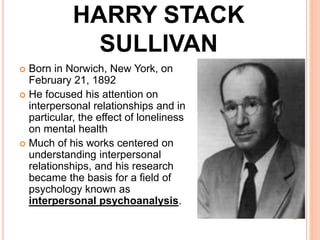
HARRY STACK
SULLIVAN
 Born in Norwich, New York, on
February 21, 1892
 He focused his attention on
interpersonal relationships and in
particular, the effect of loneliness
on mental health
 Much of his works centered on
understanding interpersonal
relationships, and his research
became the basis for a field of
psychology known as
interpersonal psychoanalysis.
DYNAMISM
 The smallest unit that can bee employed in the
study of the individual.
 It is defined as “the relatively enduring pattern of
energy transformations, which recurrently
characterize the organism in its duration as a living
organism”.
 The dynamisms that are distinctively human in
character are those that characterize one’s
interpersonal relations.
 It usually employs a particular zone of the body
such as the mouth, the hands, the anus, and the
genitals by means of which it interacts with the
environment.
DYNAMISM OF THE SELF-
SYSTEM
 The self-system as the guardian of one’s security
tends to become isolated from the rest of the
personality; it excludes information that is
incongruous with its present organization and falls
thereby to profit from experience.
 Although, the self-system serves the useful
purposes of reducing anxiety, it interferes with one’s
ability to live constructively with others.
 He believed that the self-system is a product of the
irrational aspects of society.
PERSONIFICATION
An image that an individual has of himself
or himself or of another person.
It is a complex of feelings, attitudes, and
conceptions that grows out of experiences
with need satisfaction and anxiety.
Personifications of the self such as the
good-me and the bad-me follow the same
principles as personifications of others.
Good-me personification - results
from interpersonal experiences that
are rewarding in character.
Bad-me personification - results from
anxiety-arousing situations.
Personifications of other people -
these self-personifications tend to
stand in the way of objective self-
evaluation.
Stereotypes - are consensually
validated conceptions, that is,
ideas that have wide acceptance
among the members of a society
and are handed down from
generation to generation.
COGNITIVE
PROCESSES
 Three modes:
 1. Prototaxic - may be regarded as the discrete
series of momentary states of the sensitive
organism.
 2. Parataxic - consists of causal relationship
between events that occur at about the same
time but are not logically related.
 3. Syntaxic - consists of consensually validated
symbol activity, especially of a verbal nature. It
produces logical order among experiences and
enables people to communicate with one
another.
TENSION
 He began with the familiar conception of the
organism as a tension system that
theoretically can vary between the limits of
absolute relaxation, or euphoria as he
preferred to call it, and absolute tension as
exemplified by extreme terror.
 Two main sources of tension: 1) Tensions
that arise from the needs of the organism
and 2) Tensions that result from anxiety.
TENSIONS THAT ARISE FROM THE
NEEDS OF THE ORGANISM
 Needs may be general in character, such as
hunger, or they may be more specifically related to
a zone of the body, such as an infant's need to
suck.
 One result of need reduction is an experience of
satisfaction: "Tensions can be regarded as needs
for particular energy transformations that will
dissipate the tension, often with a accompanying
change of "mental state", a change of awareness,
to which we can apply the general term,
satisfaction".
TENSIONS THAT RESULT FROM
ANXIETY
 Anxiety is the experience of tension that results
from real or imaginary threats to one's security. In
large amounts, it reduces the efficiency of the
individuals in satisfying their needs, disturbs
interpersonal relations, and produces confusion in
thinking.
 Anxiety varies in intensity depending upon the
seriousness of the threat and the effectiveness of
the security operations that the persons have at
their command.
 He believed that anxiety is the first great educative
influence in living.
ENERGY
TRANSFORMATIONS
 Energy is transformed by performing work. Work
may be overt actions involving the striped muscles
of the body or it may be mental such as perceiving,
remembering, and thinking.
 "What anyone can discover by investigating his
past is that patterns of tensions and energy
transformations which make up his living are to a
truly astonishing extent matters of his education for
living in a particular society."
 An individual learns to behave in a particular way
as a result of interactions with people, and not
because he or she possesses innate imperatives
for certain kinds of action.
STAGES OF
DEVELOPMENT
1. Infancy - the period in which the
oral zone is the primary zone of
interaction between the baby and its
environment.
Features of the environment that
stands out during this stage is the
object that supplies food to the hungry
baby, either the nipple of the mother's
breast or the nipple of the bottle.
CONCEPTIONS OF THE NIPPLES
 1. Good Nipple - signal for nursing and a sign that
satisfaction is forthcoming.
 2. Good but Unsatisfactory Nipple - Baby is not
hungry.
 3. Wrong Nipple - does not give milk and is a
signal for rejection and subsequent search for
another nipple.
 4. Bad Nipple - avoidance
CHARACTERISTIC FEATURES OF THE
INFANTILE STATE
 1. Appearance of the dynamism of apathy and
somnolent detachment.
 2. Transition from a prototaxic to a parataxic mode
of cognition.
 3. The organization of personification
 4. The organization of experience through learning
and the emergence of the rudiments of the self-
system.
 5. Differentiation of the baby's own body
 6. Learning of coordinated movements
2. Childhood - emergence of
articulate speech to the
appearance of the need for
playmates.
the development of language
permits
self-system begins to develop
the conception of gender.
Dramatizations - Growth of symbolic
ability enables the child of play at
being a grownup.
Preoccupations - Allows the child to
become concerned with various
activities both overt and covert that
serve the purpose of warding off
punishment and anxiety.
MALEVOLENT TRANSFORMATION
 Feeling that one lives among enemies.
 Distorts the child's interpersonal relations and
causes the child to isolate itself.
 Caused by painful and anxious experiences with
people and may lead to a regression to the less
threatening stage of infancy.
SUBLIMATION
The unwitting substitution for a
behavior pattern which encounters
anxiety or collides with the self-system
of a socially more acceptable activity
pattern which satisfies parts of the
motivational system that caused
trouble.
 3. Juvenile - period for becoming social, for
acquiring experiences of social subordination to
authority figures outside of the family, for becoming
competitive and cooperative, for learning the
meaning of ostracism, disparagement and group
feeling.
 Learns to be inattentive to external circumstances
that do not interest him or her, to supervise
behavior by internal controls, to form stereotypes in
attitudes, to develop new and more effective modes
of sublimation, and to distinguish more clearly
between fantasy and reality.
4. Preadolescence - marked by the
need of an intimate relationship with a
peer of the same sex.
It marks the beginning of genuine
human relationships with other people.
The child begins to form peer
relationships in which there are
equality, mutuality and reciprocity
between the members.
 5. Early adolescence - the main problem of
this period was the development of a
pattern of heterosexual activity.
 He pointed out that many of the conflicts of
adolescence arise out of the opposing
needs for sexual gratification, security and
intimacy.
 It persists until the person has found some
stable pattern of performances that satisfies
the person's genital drives.
6. Late adolescence - extends from
the patterning of preferred genital
activity through the unnumbered
educative and educative steps to the
establishment of a fully human or
mature repertory of interpersonal
relations as permitted by available
opportunity, personal and cultural.
DETERMINERS OF
DEVELOPMENT
 He did acknowledge the importance of heredity in
providing certain capacities, chief among which are
the capacities for receiving and elaborating
experiences. He also accepted the principle that
training cannot be effective before maturation has
laid the structural groundwork.
 Heredity and maturation provide the biological
substratum for the development of personality, that
is, the capacities and predispositions and
inclinations.
 The first educative influence is that of anxiety that
forces the young organism to discriminate between
the increasing and decreasing tension and to guide
its activity in the direction of the latter.
 The second great educational force is that of trial
and success. Success, as many psychologists have
pointed out, tends to stamp in the activity that has
led to gratification. It may be equated with the
earning of rewards... Similarly, failure may be
equated with punishments…
He did not believe that personality
is set at an early age. It may
change at any time as new
interpersonal situations arise
because the organism is
extremely plastic and malleable.
RESEARCH ON
SCHIZOPHRENIA
 Sullivan's principal research contribution in
psychopathology consists of a series of articles on
the etiology, dynamics, and treatment of
schizophrenia.
 Empathy was a highly developed trait in his
personality, and he used it to excellent advantage in
studying and treating the victims of schizophrenia.
 For him, these victims are not hopeless cases to be
shut away in the hack wards of mental institutions;
they can be treated successfully if the psychiatrist is
willing to be patient, understanding and observant.
THANK YOU
VERY MUCH!
  

Horney and-sullivan

  • 1.
    SOCIAL PSYCHOLOGICAL THEORIES (HORNEY AND SULLIVAN) GROUP4 Embor, Madelle Velonza, John Carlo Cuadra, Shantal Janel Mariñas, Michelle
  • 2.
    KAREN HORNEY  Bornnear Hamburg, Germany in 1885.  An early 20th century psychoanalyst.  Founder of feminine psychiatry and feminist psychology.  One of the founder of Neo- Freudianism alongside with Alfred Adler.  Known for her theory on neurosis.
  • 3.
    HORNEY AND FREUD She published a series of papers that criticized Freud and proposed her own feminine psychology.  She conceived of her ideas as falling within the framework of Freudian psychology, however, not as constituting an entirely new approach to the understanding of personality. She wrote, “nothing of importance in the field of psychology and psychotherapy has been done without reliance of Freud’s fundamental findings”.
  • 4.
     She aspiredto eliminate the fallacies in Freud’s thinking – fallacies that have their root, she believed, in his mechanistic, biological orientation – in order that psychoanalysis may realize its full potentialities as a science of humans.  Following Adler, she also believed that Freud’s de- emphasis of the interrelationships among people led him to an erroneous overemphasis on sexual motivation and conflict. She transformed Freud’s instinctual focus into a cultural focus.
  • 5.
     She objectedstrongly to Freud’s concept of penis envy as the determining factor in the psychology of women. Freud, it will be recalled, observed that the distinctive attitudes and feelings of women and their most profound conflict grew out of their feeling of genital inferiority and their jealousy of the men.  She believed that feminine psychology is based on lack of confidence and an overemphasis of the love relationship and has very little to do with the anatomy of her sex organs.
  • 6.
     She feltthat the Oedipus complex is not a sexual- aggressive conflict between child and parent but an anxiety growing out of basic disturbances, for example, rejection, overprotection, and punishment, in the child’s relationships with the mother and father.  She also took issue with the following Freudian concepts: repetition compulsion: the id, ego, and superego; anxiety; and masochism.  On the positive side, she endorsed Freud’s doctrines of psychic determinism, unconscious motivation, and emotional, non-rational motives.
  • 7.
    BASIC ANXIETY  Shebelieved that neurosis resulted from basic anxiety caused by interpersonal relationships. Her theory proposes that strategies used to cope with anxiety can be overused, causing them to take on the appearance of needs.  "basic anxiety (and therefore neurosis) could result from a variety of things including, " . . . direct or indirect domination, indifference, erratic behavior, lack of respect for the child's individual needs, lack of real guidance, disparaging attitudes, too much admiration or the absence of it, lack of reliable warmth, having to take sides in parental disagreements, too much or too little responsibility, over-protection, isolation from other children, injustice, discrimination, unkept promises, hostile atmosphere, and so on and so on" (Horney, 1945).
  • 8.
    10 NEUROTIC NEEDS 1.The Neurotic Need for Affection and Approval - This need​ includes the desires to be liked, to please other people, and meet the expectations of others. People with this type of need are extremely sensitive to rejection and criticism and fear the anger or hostility of others. 2. The Neurotic Need for a Partner Who Will Take Over One’s Life - This involves the need to be centered on a partner. People with this need suffer extreme fear of being abandoned by their partner. Oftentimes, these individuals place an exaggerated importance on love and believe that having a partner will resolve all of life’s troubles.
  • 9.
    3. Neurotic Needto Restrict One’s Life Within Narrow Borders - Individuals with this need prefer to remain inconspicuous and unnoticed. They are undemanding and content with little. They avoid wishing for material things, often making their own needs secondary and undervaluing their own talents and abilities. 4. The Neurotic Need for Power - Individuals with this need seek power for its own sake. They usually praise strength, despise weakness, and will exploit or dominate other people. These people fear personal limitations, helplessness, and uncontrollable situations.
  • 10.
    5. The NeuroticNeed to Exploit Others - These individuals view others in terms of what can be gained through association with them. People with this need generally pride themselves on their ability to exploit other people and are often focused on manipulating others to obtain desired objectives, including such things as ideas, power, money, or sex. 6. The Neurotic Need for Prestige - Individuals with a need for prestige value themselves in terms of public recognition and acclaim. Material possessions, personality characteristics, professional accomplishments, and loved ones are evaluated based on prestige value. These individuals often fear public embarrassment and loss of social status.
  • 11.
    7. The NeuroticNeed for Personal Admiration - Individuals with a neurotic need for personal admiration are narcissistic and have an exaggerated self-perception. They want to be admired based on this imagined self-view, not upon how they really are. 8. The Neurotic Need for Personal Achievement - According to Horney, people push themselves to achieve greater and greater things as a result of basic insecurity. These individuals fear failure and feel a constant need to accomplish more than other people and to top even their own earlier successes.
  • 12.
    9. The NeuroticNeed for Self-Sufficiency and Independence - These individuals exhibit a “loner” mentality, distancing themselves from others in order to avoid being tied down or dependent upon other people. 10. The Neurotic Need for Perfection and Unassailability - These individuals constantly strive for complete infallibility. A common feature of this neurotic need is searching for personal flaws in order to quickly change or cover up these perceived imperfections.
  • 13.
    THE THREE SOLUTIONS  Needsthat move you towards others. - These neurotic needs cause individuals to seek affirmation and acceptance from others and are often described as needy or clingy as they seek out approval and love.  Needs that move you away from others. These neurotic needs to create hostility and antisocial behavior. These individuals are often described as cold, indifferent, and aloof.  Needs that move you against others. - These neurotic needs result in hostility and a need to control other people. These individuals are often described as difficult, domineering, and unkind.
  • 14.
    ALIENATION  She emphasizesalienation as the consequence of the child’s attempt to cope with the basic anxiety.  “Real-self” – inadequate, unworthy, and unlovable.  “Despised self” – responds defensively to this despicable self-description by creating and striving to obtain an idealized image of the person he or she should be.  “Idealized self” – exists in conjunction with a series of stringent self-expectations, creating what she termed “the tyranny of the should” and the “search for glory”.
  • 15.
    HARRY STACK SULLIVAN  Bornin Norwich, New York, on February 21, 1892  He focused his attention on interpersonal relationships and in particular, the effect of loneliness on mental health  Much of his works centered on understanding interpersonal relationships, and his research became the basis for a field of psychology known as interpersonal psychoanalysis.
  • 16.
    DYNAMISM  The smallestunit that can bee employed in the study of the individual.  It is defined as “the relatively enduring pattern of energy transformations, which recurrently characterize the organism in its duration as a living organism”.  The dynamisms that are distinctively human in character are those that characterize one’s interpersonal relations.  It usually employs a particular zone of the body such as the mouth, the hands, the anus, and the genitals by means of which it interacts with the environment.
  • 17.
    DYNAMISM OF THESELF- SYSTEM  The self-system as the guardian of one’s security tends to become isolated from the rest of the personality; it excludes information that is incongruous with its present organization and falls thereby to profit from experience.  Although, the self-system serves the useful purposes of reducing anxiety, it interferes with one’s ability to live constructively with others.  He believed that the self-system is a product of the irrational aspects of society.
  • 18.
    PERSONIFICATION An image thatan individual has of himself or himself or of another person. It is a complex of feelings, attitudes, and conceptions that grows out of experiences with need satisfaction and anxiety. Personifications of the self such as the good-me and the bad-me follow the same principles as personifications of others.
  • 19.
    Good-me personification -results from interpersonal experiences that are rewarding in character. Bad-me personification - results from anxiety-arousing situations. Personifications of other people - these self-personifications tend to stand in the way of objective self- evaluation.
  • 20.
    Stereotypes - areconsensually validated conceptions, that is, ideas that have wide acceptance among the members of a society and are handed down from generation to generation.
  • 21.
    COGNITIVE PROCESSES  Three modes: 1. Prototaxic - may be regarded as the discrete series of momentary states of the sensitive organism.  2. Parataxic - consists of causal relationship between events that occur at about the same time but are not logically related.  3. Syntaxic - consists of consensually validated symbol activity, especially of a verbal nature. It produces logical order among experiences and enables people to communicate with one another.
  • 22.
    TENSION  He beganwith the familiar conception of the organism as a tension system that theoretically can vary between the limits of absolute relaxation, or euphoria as he preferred to call it, and absolute tension as exemplified by extreme terror.  Two main sources of tension: 1) Tensions that arise from the needs of the organism and 2) Tensions that result from anxiety.
  • 23.
    TENSIONS THAT ARISEFROM THE NEEDS OF THE ORGANISM  Needs may be general in character, such as hunger, or they may be more specifically related to a zone of the body, such as an infant's need to suck.  One result of need reduction is an experience of satisfaction: "Tensions can be regarded as needs for particular energy transformations that will dissipate the tension, often with a accompanying change of "mental state", a change of awareness, to which we can apply the general term, satisfaction".
  • 24.
    TENSIONS THAT RESULTFROM ANXIETY  Anxiety is the experience of tension that results from real or imaginary threats to one's security. In large amounts, it reduces the efficiency of the individuals in satisfying their needs, disturbs interpersonal relations, and produces confusion in thinking.  Anxiety varies in intensity depending upon the seriousness of the threat and the effectiveness of the security operations that the persons have at their command.  He believed that anxiety is the first great educative influence in living.
  • 25.
    ENERGY TRANSFORMATIONS  Energy istransformed by performing work. Work may be overt actions involving the striped muscles of the body or it may be mental such as perceiving, remembering, and thinking.  "What anyone can discover by investigating his past is that patterns of tensions and energy transformations which make up his living are to a truly astonishing extent matters of his education for living in a particular society."  An individual learns to behave in a particular way as a result of interactions with people, and not because he or she possesses innate imperatives for certain kinds of action.
  • 26.
    STAGES OF DEVELOPMENT 1. Infancy- the period in which the oral zone is the primary zone of interaction between the baby and its environment. Features of the environment that stands out during this stage is the object that supplies food to the hungry baby, either the nipple of the mother's breast or the nipple of the bottle.
  • 27.
    CONCEPTIONS OF THENIPPLES  1. Good Nipple - signal for nursing and a sign that satisfaction is forthcoming.  2. Good but Unsatisfactory Nipple - Baby is not hungry.  3. Wrong Nipple - does not give milk and is a signal for rejection and subsequent search for another nipple.  4. Bad Nipple - avoidance
  • 28.
    CHARACTERISTIC FEATURES OFTHE INFANTILE STATE  1. Appearance of the dynamism of apathy and somnolent detachment.  2. Transition from a prototaxic to a parataxic mode of cognition.  3. The organization of personification  4. The organization of experience through learning and the emergence of the rudiments of the self- system.  5. Differentiation of the baby's own body  6. Learning of coordinated movements
  • 29.
    2. Childhood -emergence of articulate speech to the appearance of the need for playmates. the development of language permits self-system begins to develop the conception of gender.
  • 30.
    Dramatizations - Growthof symbolic ability enables the child of play at being a grownup. Preoccupations - Allows the child to become concerned with various activities both overt and covert that serve the purpose of warding off punishment and anxiety.
  • 31.
    MALEVOLENT TRANSFORMATION  Feelingthat one lives among enemies.  Distorts the child's interpersonal relations and causes the child to isolate itself.  Caused by painful and anxious experiences with people and may lead to a regression to the less threatening stage of infancy.
  • 32.
    SUBLIMATION The unwitting substitutionfor a behavior pattern which encounters anxiety or collides with the self-system of a socially more acceptable activity pattern which satisfies parts of the motivational system that caused trouble.
  • 33.
     3. Juvenile- period for becoming social, for acquiring experiences of social subordination to authority figures outside of the family, for becoming competitive and cooperative, for learning the meaning of ostracism, disparagement and group feeling.  Learns to be inattentive to external circumstances that do not interest him or her, to supervise behavior by internal controls, to form stereotypes in attitudes, to develop new and more effective modes of sublimation, and to distinguish more clearly between fantasy and reality.
  • 34.
    4. Preadolescence -marked by the need of an intimate relationship with a peer of the same sex. It marks the beginning of genuine human relationships with other people. The child begins to form peer relationships in which there are equality, mutuality and reciprocity between the members.
  • 35.
     5. Earlyadolescence - the main problem of this period was the development of a pattern of heterosexual activity.  He pointed out that many of the conflicts of adolescence arise out of the opposing needs for sexual gratification, security and intimacy.  It persists until the person has found some stable pattern of performances that satisfies the person's genital drives.
  • 36.
    6. Late adolescence- extends from the patterning of preferred genital activity through the unnumbered educative and educative steps to the establishment of a fully human or mature repertory of interpersonal relations as permitted by available opportunity, personal and cultural.
  • 37.
    DETERMINERS OF DEVELOPMENT  Hedid acknowledge the importance of heredity in providing certain capacities, chief among which are the capacities for receiving and elaborating experiences. He also accepted the principle that training cannot be effective before maturation has laid the structural groundwork.  Heredity and maturation provide the biological substratum for the development of personality, that is, the capacities and predispositions and inclinations.
  • 38.
     The firsteducative influence is that of anxiety that forces the young organism to discriminate between the increasing and decreasing tension and to guide its activity in the direction of the latter.  The second great educational force is that of trial and success. Success, as many psychologists have pointed out, tends to stamp in the activity that has led to gratification. It may be equated with the earning of rewards... Similarly, failure may be equated with punishments…
  • 39.
    He did notbelieve that personality is set at an early age. It may change at any time as new interpersonal situations arise because the organism is extremely plastic and malleable.
  • 40.
    RESEARCH ON SCHIZOPHRENIA  Sullivan'sprincipal research contribution in psychopathology consists of a series of articles on the etiology, dynamics, and treatment of schizophrenia.  Empathy was a highly developed trait in his personality, and he used it to excellent advantage in studying and treating the victims of schizophrenia.  For him, these victims are not hopeless cases to be shut away in the hack wards of mental institutions; they can be treated successfully if the psychiatrist is willing to be patient, understanding and observant.
  • 41.