Cognitive Learning Theory
        Allison Sullivan
        EME2040
Menu

 What?
 Who?
 How?
 In my classroom?


                        The end
What?


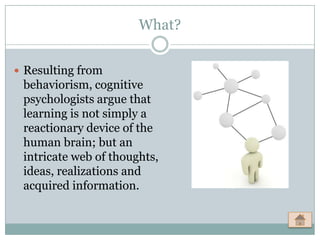
 Resulting from
 behaviorism, cognitive
 psychologists argue that
 learning is not simply a
 reactionary device of the
 human brain; but an
 intricate web of thoughts,
 ideas, realizations and
 acquired information.
What is Cognitive Learning Theory?

 A theory which suggests that certain activities, like
  thinking and remembering, are actually behaviors
  that lead to learning.
     When approached as behaviors, the actions can be used to
      analyze and measure their effect on learning.
 Approaches to the theory:
   Paivio’s Dual Coding theory

   Gagne’s nine events of instruction

   Gardner’s theory of Multiple Intelligences

   Bloom’s Taxonomy of Learning
Who?
                          Allan Paivio

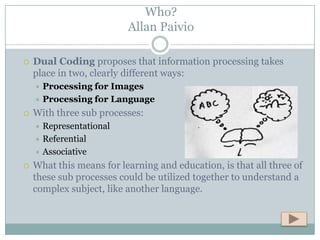
   Dual Coding proposes that information processing takes
    place in two, clearly different ways:
     Processing for Images
     Processing for Language

   With three sub processes:
     Representational
     Referential
     Associative

   What this means for learning and education, is that all three of
    these sub processes could be utilized together to understand a
    complex subject, like another language.
Who?
                          Robert Gagne
 In order to measure
 successful integration he
 acknowledged five areas of
 learning objectives:
    Verbal information, Intellectual
     skills, Cognitive Strategies, Motor
     Skills, and Attitudes.
 This lead him to discover
 what conditions were
 optimal for students to learn,
 and lead him to identifying
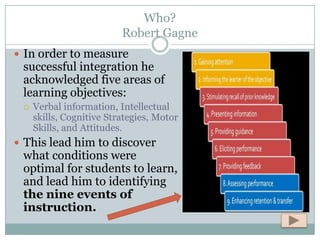
 the nine events of
 instruction.
Who?
                            Howard Gardner
 Multiple Intelligences
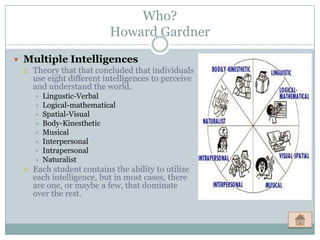
   Theory that that concluded that individuals
    use eight different intelligences to perceive
    and understand the world.
         Lingustic-Verbal
         Logical-mathematical
         Spatial-Visual
         Body-Kinesthetic
         Musical
         Interpersonal
         Intrapersonal
         Naturalist
     Each student contains the ability to utilize
      each intelligence, but in most cases, there
      are one, or maybe a few, that dominate
      over the rest.
Who?
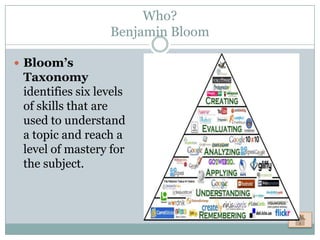
                  Benjamin Bloom

 Bloom’s
 Taxonomy
 identifies six levels
 of skills that are
 used to understand
 a topic and reach a
 level of mastery for
 the subject.
How can this theory be used in the classroom?

Multiple Intelligence theory could be each teacher’s
  tool to understanding and developing each of their
  student’s learning capabilities and habits on an
  individual basis.
.
Each intelligence can be both identified and cultivated
  with the use of technology in the classroom by the
  teacher personalizing instruction and curriculum.
Multiple Intelligence Integration In my classroom

In my opinion, this is the most diversely disciplined
  approach to educational theory, which has the world
  to do with my personal teaching theory.

I also feel understanding these abilities can make all of
  the difference when requiring teamwork or group
  assignments. By recognizing the strengths each
  student has
In my classroom

For instance, when assigning presentations on
  geocacheing, I would take the following into account:
I’ve already recognized that Cody has an interpersonal,
  naturalist, spatial-visual ability to learn. I would
  team him with Katie who is also interpersonal, but
  also linguistic-verbal and logical-mathematical. By
  understanding their strengths before teaming them
  together, I’ve made sure they can play on each
  other’s abilities and communicate efficiently to
  complete the objective.

Sullivan theory

  • 1.
    Cognitive Learning Theory Allison Sullivan EME2040
  • 2.
    Menu  What?  Who? How?  In my classroom? The end
  • 3.
    What?  Resulting from behaviorism, cognitive psychologists argue that learning is not simply a reactionary device of the human brain; but an intricate web of thoughts, ideas, realizations and acquired information.
  • 4.
    What is CognitiveLearning Theory?  A theory which suggests that certain activities, like thinking and remembering, are actually behaviors that lead to learning.  When approached as behaviors, the actions can be used to analyze and measure their effect on learning.  Approaches to the theory:  Paivio’s Dual Coding theory  Gagne’s nine events of instruction  Gardner’s theory of Multiple Intelligences  Bloom’s Taxonomy of Learning
  • 5.
    Who? Allan Paivio  Dual Coding proposes that information processing takes place in two, clearly different ways:  Processing for Images  Processing for Language  With three sub processes:  Representational  Referential  Associative  What this means for learning and education, is that all three of these sub processes could be utilized together to understand a complex subject, like another language.
  • 6.
    Who? Robert Gagne  In order to measure successful integration he acknowledged five areas of learning objectives:  Verbal information, Intellectual skills, Cognitive Strategies, Motor Skills, and Attitudes.  This lead him to discover what conditions were optimal for students to learn, and lead him to identifying the nine events of instruction.
  • 7.
    Who? Howard Gardner  Multiple Intelligences  Theory that that concluded that individuals use eight different intelligences to perceive and understand the world.  Lingustic-Verbal  Logical-mathematical  Spatial-Visual  Body-Kinesthetic  Musical  Interpersonal  Intrapersonal  Naturalist  Each student contains the ability to utilize each intelligence, but in most cases, there are one, or maybe a few, that dominate over the rest.
  • 8.
    Who? Benjamin Bloom  Bloom’s Taxonomy identifies six levels of skills that are used to understand a topic and reach a level of mastery for the subject.
  • 9.
    How can thistheory be used in the classroom? Multiple Intelligence theory could be each teacher’s tool to understanding and developing each of their student’s learning capabilities and habits on an individual basis. . Each intelligence can be both identified and cultivated with the use of technology in the classroom by the teacher personalizing instruction and curriculum.
  • 10.
    Multiple Intelligence IntegrationIn my classroom In my opinion, this is the most diversely disciplined approach to educational theory, which has the world to do with my personal teaching theory. I also feel understanding these abilities can make all of the difference when requiring teamwork or group assignments. By recognizing the strengths each student has
  • 11.
    In my classroom Forinstance, when assigning presentations on geocacheing, I would take the following into account: I’ve already recognized that Cody has an interpersonal, naturalist, spatial-visual ability to learn. I would team him with Katie who is also interpersonal, but also linguistic-verbal and logical-mathematical. By understanding their strengths before teaming them together, I’ve made sure they can play on each other’s abilities and communicate efficiently to complete the objective.