ANTISOCIAL PERSONALITY
DISORDER
By
ARINDAM SAIN(CSIR-JRF), M.Sc. (Human
Physiology)
PHYSIOLOGY NEWS
Antisocial personality disorder
 Antisocial personality disorder is a mental condition in which a
person consistently shows no regard for right and wrong and
ignores the rights and feelings of others
 People with antisocial personality disorder tend to antagonize,
manipulate or treat others harshly or with callous indifference
 They show no guilt or remorse for their behaviour
 Individuals with antisocial personality disorder often violate the law,
becoming criminals
 They may lie, behave violently or impulsively, and have problems
with drug and alcohol use
PHYSIOLOGY NEWS
PHYSIOLOGY NEWS
Antisocial personality disorder (ASPD) is characterized by gross and
guiltless disregard for and violation of others’ rights, present since age
15 and persisting in adulthood. Diagnostic and Statistical Manual of
Mental Disorders (5th ed.; DSM-5; American Psychiatric Association
2013) criteria include:
 Nonconformity to social norms, unlawful behaviour.
 Deceitful, impulsive, irresponsible, and reckless behaviour.
 Irritability and aggressiveness, with no remorse.
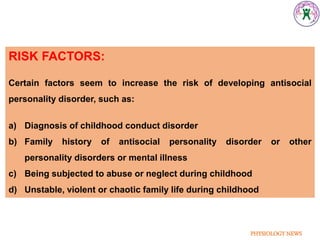
Symptoms:
People with antisocial personality disorder tend to have
few symptoms. Rather, they cause discomfort or distress
to others through socially unacceptable behaviour and
by being:
 Deceitful
 Impulsive
 Aggressive or irritable
 Reckless
 Irresponsible
 Remorseless
PHYSIOLOGY NEWS
PHYSIOLOGY NEWS
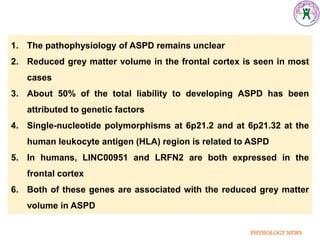
RISK FACTORS:
Certain factors seem to increase the risk of developing antisocial
personality disorder, such as:
a) Diagnosis of childhood conduct disorder
b) Family history of antisocial personality disorder or other
personality disorders or mental illness
c) Being subjected to abuse or neglect during childhood
d) Unstable, violent or chaotic family life during childhood
PHYSIOLOGY NEWS
1. The pathophysiology of ASPD remains unclear
2. Reduced grey matter volume in the frontal cortex is seen in most
cases
3. About 50% of the total liability to developing ASPD has been
attributed to genetic factors
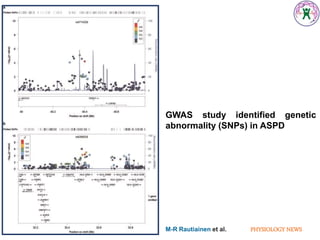
4. Single-nucleotide polymorphisms at 6p21.2 and at 6p21.32 at the
human leukocyte antigen (HLA) region is related to ASPD
5. In humans, LINC00951 and LRFN2 are both expressed in the
frontal cortex
6. Both of these genes are associated with the reduced grey matter
volume in ASPD
GWAS study identified genetic
abnormality (SNPs) in ASPD
PHYSIOLOGY NEWSM-R Rautiainen et al.
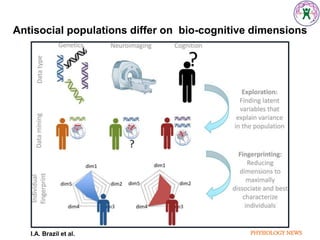
Antisocial populations differ on bio-cognitive dimensions
PHYSIOLOGY NEWSI.A. Brazil et al.
TREATMENT:
 In younger people, family or group psychotherapy may help to
change destructive patterns of behaviour, teach new vocational and
relationship skills, and reinforce a person's social support
 Psychotherapy also may help a person with this disorder learn to be
more sensitive to the feelings of others and encourage new, socially
acceptable and productive ways of thinking about one's goals and
aims
 Cognitive therapy attempts to change sociopathic ways of thinking
 Behaviour therapy uses reward and punishment to promote good
behaviour
THANK YOU

Antisocial personality disorder

  • 1.
    ANTISOCIAL PERSONALITY DISORDER By ARINDAM SAIN(CSIR-JRF),M.Sc. (Human Physiology) PHYSIOLOGY NEWS
  • 2.
    Antisocial personality disorder Antisocial personality disorder is a mental condition in which a person consistently shows no regard for right and wrong and ignores the rights and feelings of others  People with antisocial personality disorder tend to antagonize, manipulate or treat others harshly or with callous indifference  They show no guilt or remorse for their behaviour  Individuals with antisocial personality disorder often violate the law, becoming criminals  They may lie, behave violently or impulsively, and have problems with drug and alcohol use PHYSIOLOGY NEWS
  • 3.
    PHYSIOLOGY NEWS Antisocial personalitydisorder (ASPD) is characterized by gross and guiltless disregard for and violation of others’ rights, present since age 15 and persisting in adulthood. Diagnostic and Statistical Manual of Mental Disorders (5th ed.; DSM-5; American Psychiatric Association 2013) criteria include:  Nonconformity to social norms, unlawful behaviour.  Deceitful, impulsive, irresponsible, and reckless behaviour.  Irritability and aggressiveness, with no remorse.
  • 4.
    Symptoms: People with antisocialpersonality disorder tend to have few symptoms. Rather, they cause discomfort or distress to others through socially unacceptable behaviour and by being:  Deceitful  Impulsive  Aggressive or irritable  Reckless  Irresponsible  Remorseless PHYSIOLOGY NEWS
  • 5.
    PHYSIOLOGY NEWS RISK FACTORS: Certainfactors seem to increase the risk of developing antisocial personality disorder, such as: a) Diagnosis of childhood conduct disorder b) Family history of antisocial personality disorder or other personality disorders or mental illness c) Being subjected to abuse or neglect during childhood d) Unstable, violent or chaotic family life during childhood
  • 6.
    PHYSIOLOGY NEWS 1. Thepathophysiology of ASPD remains unclear 2. Reduced grey matter volume in the frontal cortex is seen in most cases 3. About 50% of the total liability to developing ASPD has been attributed to genetic factors 4. Single-nucleotide polymorphisms at 6p21.2 and at 6p21.32 at the human leukocyte antigen (HLA) region is related to ASPD 5. In humans, LINC00951 and LRFN2 are both expressed in the frontal cortex 6. Both of these genes are associated with the reduced grey matter volume in ASPD
  • 7.
    GWAS study identifiedgenetic abnormality (SNPs) in ASPD PHYSIOLOGY NEWSM-R Rautiainen et al.
  • 8.
    Antisocial populations differon bio-cognitive dimensions PHYSIOLOGY NEWSI.A. Brazil et al.
  • 9.
    TREATMENT:  In youngerpeople, family or group psychotherapy may help to change destructive patterns of behaviour, teach new vocational and relationship skills, and reinforce a person's social support  Psychotherapy also may help a person with this disorder learn to be more sensitive to the feelings of others and encourage new, socially acceptable and productive ways of thinking about one's goals and aims  Cognitive therapy attempts to change sociopathic ways of thinking  Behaviour therapy uses reward and punishment to promote good behaviour
  • 10.