Mastering the Basics
of Communication
Communication is the power that sets you free
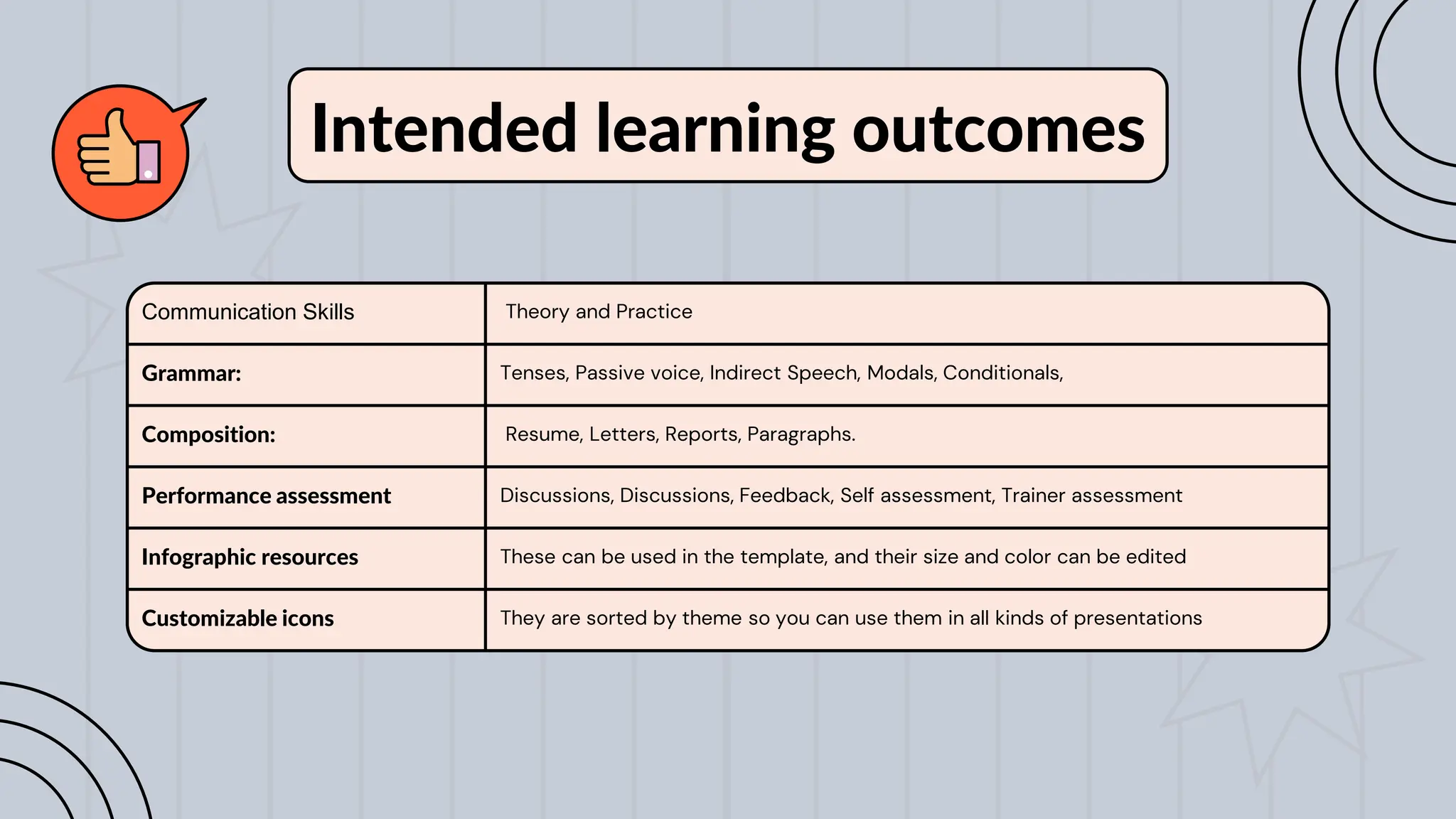
Intended learning outcomes
Communication Skills Theory and Practice
Grammar: Tenses, Passive voice, Indirect Speech, Modals, Conditionals,
Composition: Resume, Letters, Reports, Paragraphs.
Performance assessment Discussions, Discussions, Feedback, Self assessment, Trainer assessment
Infographic resources These can be used in the template, and their size and color can be edited
Customizable icons They are sorted by theme so you can use them in all kinds of presentations
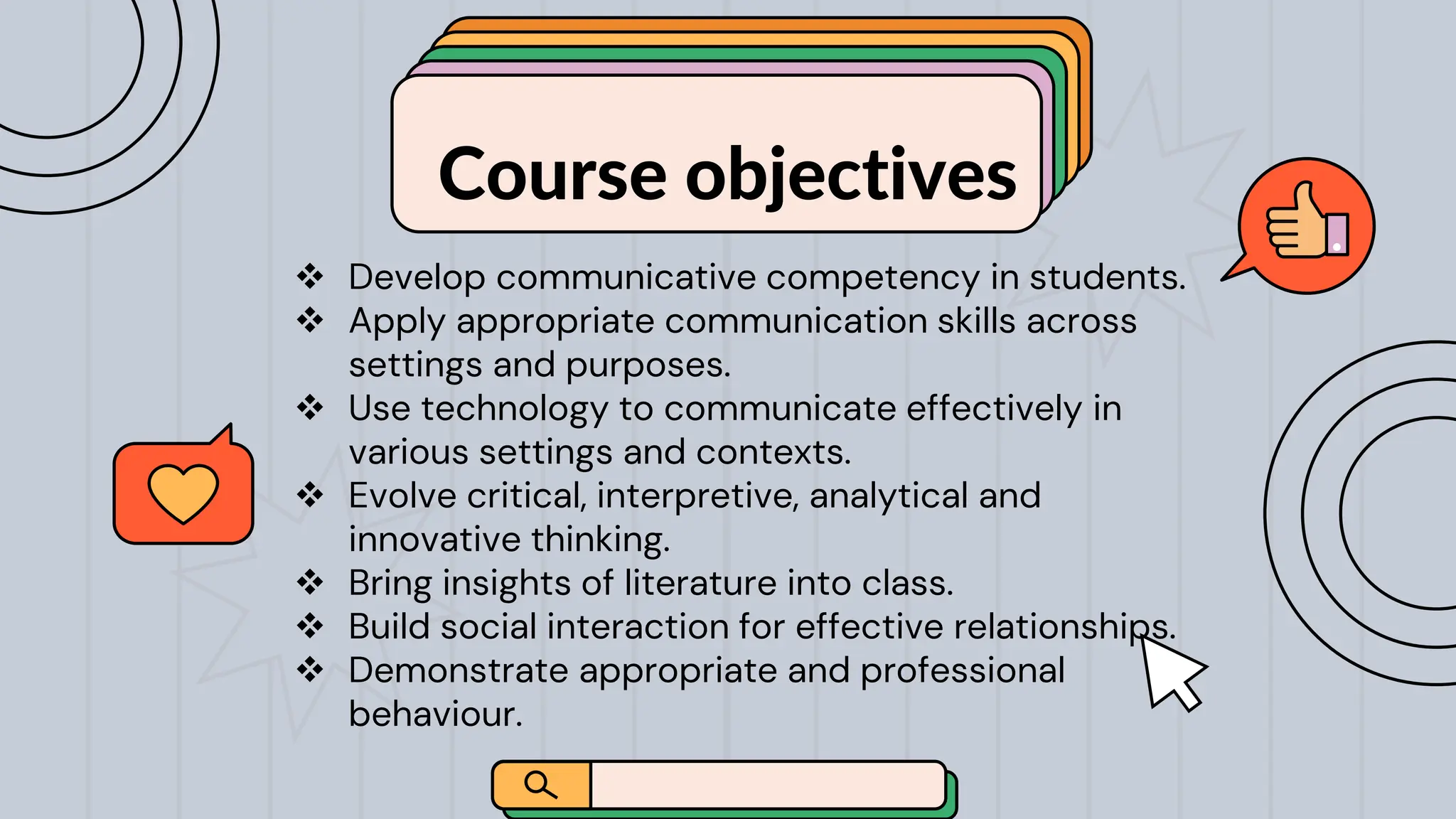
Course objectives
pssr
 Develop communicative competency in students.
 Apply appropriate communication skills across
settings and purposes.
 Use technology to communicate effectively in
various settings and contexts.
 Evolve critical, interpretive, analytical and
innovative thinking.
 Bring insights of literature into class.
 Build social interaction for effective relationships.
 Demonstrate appropriate and professional
behaviour.
01 02
03 04
05 06
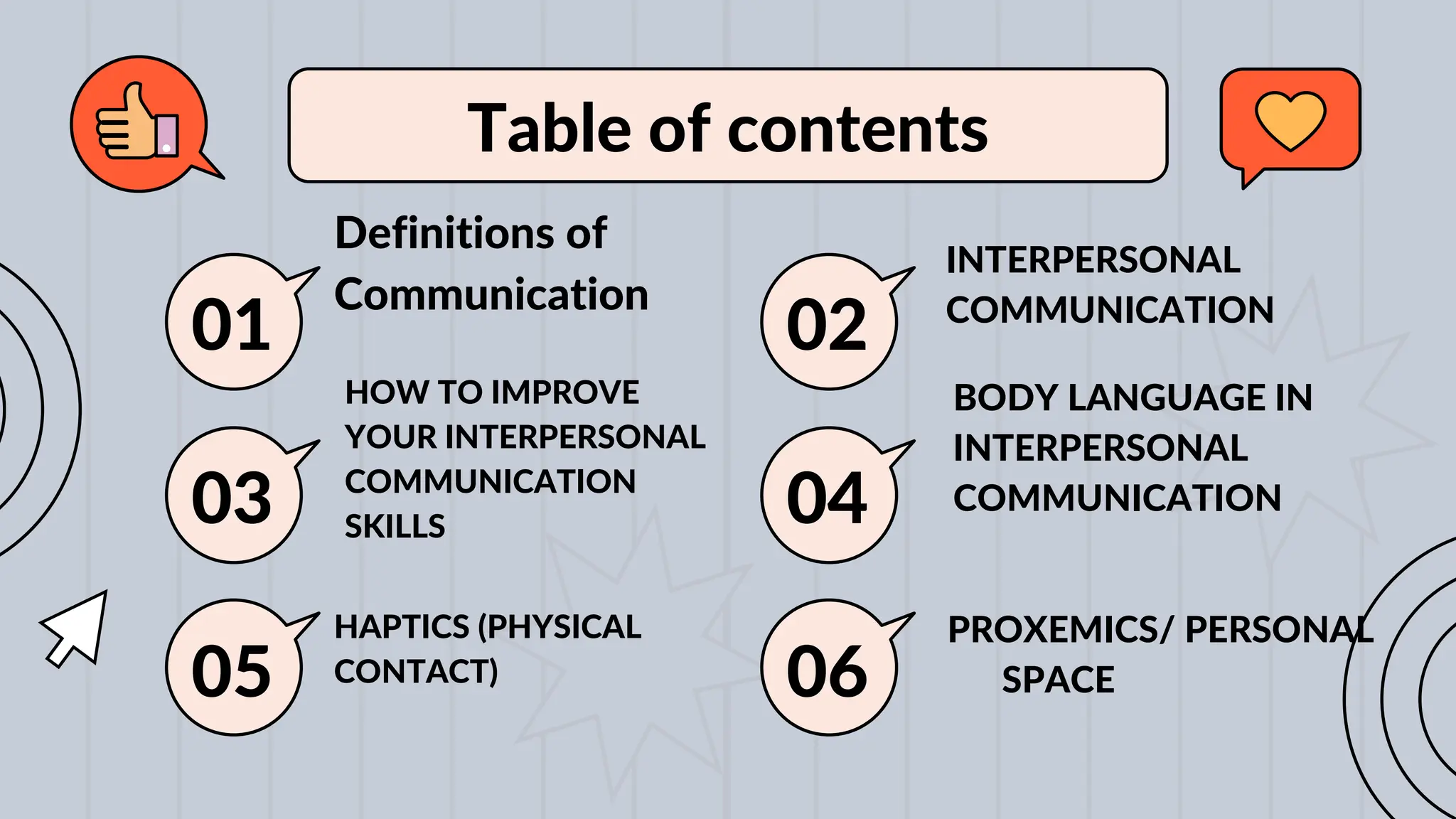
Table of contents
Definitions of
Communication
INTERPERSONAL
COMMUNICATION
HOW TO IMPROVE
YOUR INTERPERSONAL
COMMUNICATION
SKILLS
BODY LANGUAGE IN
INTERPERSONAL
COMMUNICATION
HAPTICS (PHYSICAL
CONTACT)
PROXEMICS/ PERSONAL
SPACE
07 08
09 10
11 12
Table of contents
CHRONEMICS SILENCE
Barriers of
communication
Interpersonal
conflict
Personal
appearance and
communication
Improving
communication
Introduction
Being able to communicate
effectively is the most important
of all life skills. Communication is
simply the act of transferring
information from one place to
another. This may be vocally
(using voice), written (using
printed or digital media such as
books, magazines, websites or
emails), visually (using logos,
maps, charts or graphs) or non-
verbally (using body language,
gestures and the tone and pitch
of voice)
First concepts
01
Defination of communication
AGENDA
►What is communication
►Filters in communication
►Effective communication
►Barriers to communication
►Listening vs Hearing
►Communication styles
►Communication with DISC
styles
Objectives
A2 Acquire Skills for Improving Learning
A:A2.2 Demonstrate how effort and persistence positively affect
learning
A:A2.3 Use communications skills to know when and how to ask for
help when needed
A:A2.4 Apply knowledge and learning styles to positively influence
school performance
PS:A2 Acquire Interpersonal Skills
PS:A2.6 Use effective communications skills
PS:A2.7 Know that communication involves speaking, listening and
nonverbal behavior
DEFINITION OF COMMUNICATION
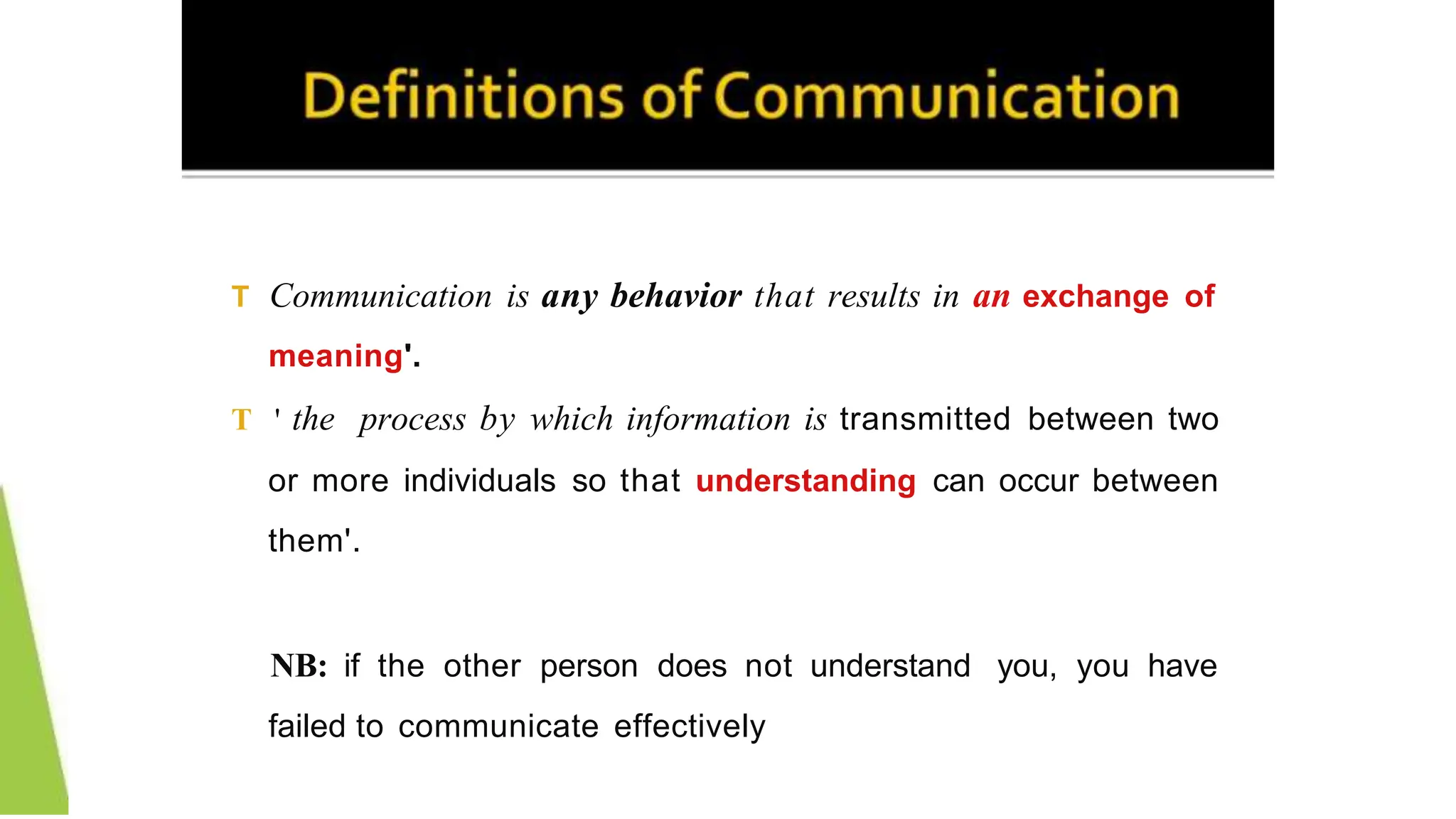
Communication can be defined in many ways.
In simple terms communication is:
• Information transmitted
• A verbal or nonverbal message
• A process by which information is exchanged between
individuals through a common system of symbols, signs, or
behavior
COMMUNICATION
communication is the illusion that itfl.
taken plac
What if communication were not possible?
Frustration and Chaos!
T Communication is any behavior that results in an exchange of
meaning'.
T ' the process by which information is transmitted between two
or more individuals so that understanding can occur between
them'.
NB: if the other person does not understand you, you have
failed to communicate effectively
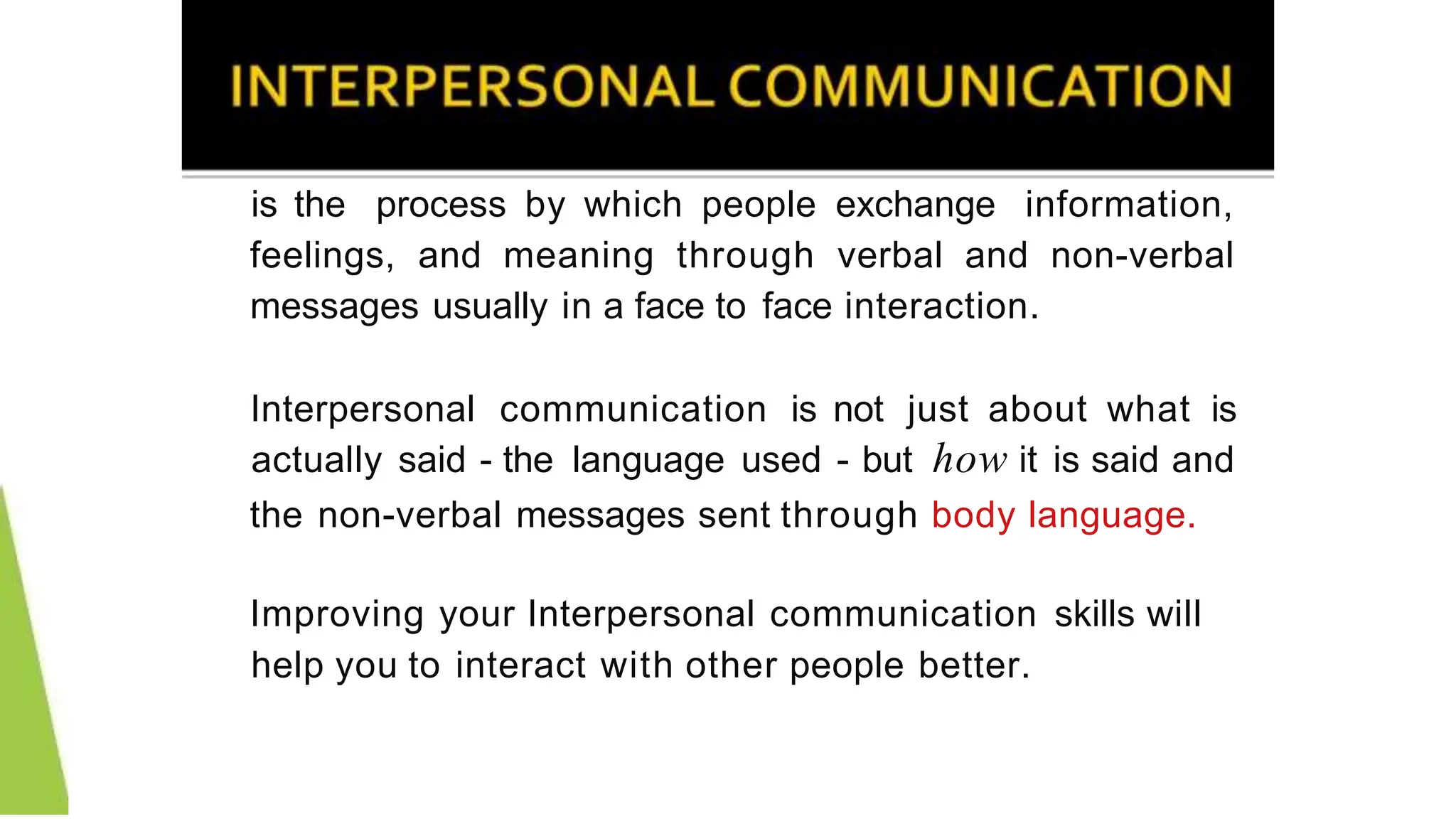
is the process by which people exchange information,
feelings, and meaning through verbal and non-verbal
messages usually in a face to face interaction.
Interpersonal communication is not just about what is
actually said - the language used - but how it is said and
the non-verbal messages sent through body language.
Improving your Interpersonal communication skills will
help you to interact with other people better.
Awesome
words
“This is a quote, words full of wisdom
that someone important said and can
make the reader get inspired.”
—Someone Famous
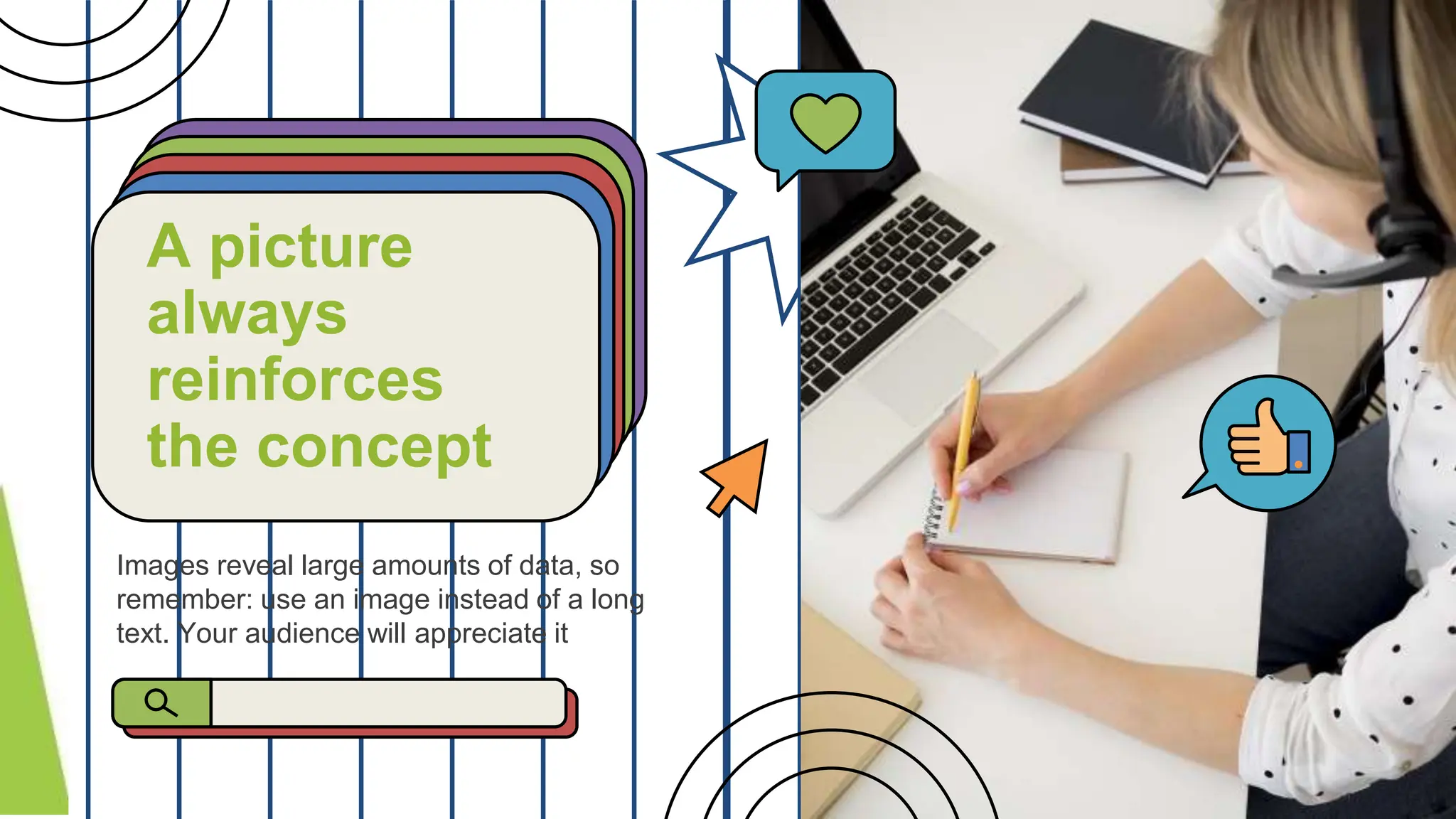
A picture is worth
a thousand words
Images reveal large amounts of data, so
remember: use an image instead of a long
text. Your audience will appreciate it
A picture
always
reinforces
the concept
ACTIVITY
'
Think of a recent example in which you
involved in a miscommunication and answ
following questions:
I
'

1. Why did the miscommunication occur?
2. What impact did it have?
3.If you had a chance to do it over again, wha
specifically would you do differently?
Do You Know?
►An average person spends 50% of
communicating?
his or her
►Business success is 85% dependent on effec
I
t
communication and interpersonal skills?
►45% oftime spent communicating is listening?
►Writing represents 9% of communication time? 
►25% of all workplace mistakes are the result of poor
communication?
►A remarkable 75% of communication is non-verbal?
►Filters' represent our perceptions 
everything we encounter and are based p

the sum total of who we are
►Filters impact:
►How we see others,
►How we Interpret situations
►How we act and feel
►"We don't see things as they are, we
see them as we are."
Filters in Communication
'
Features of Effective Communi
I
• Active Listening
• Eye contact
• Posture
• Simple language
• Questioning skills
I
I
The basics
02
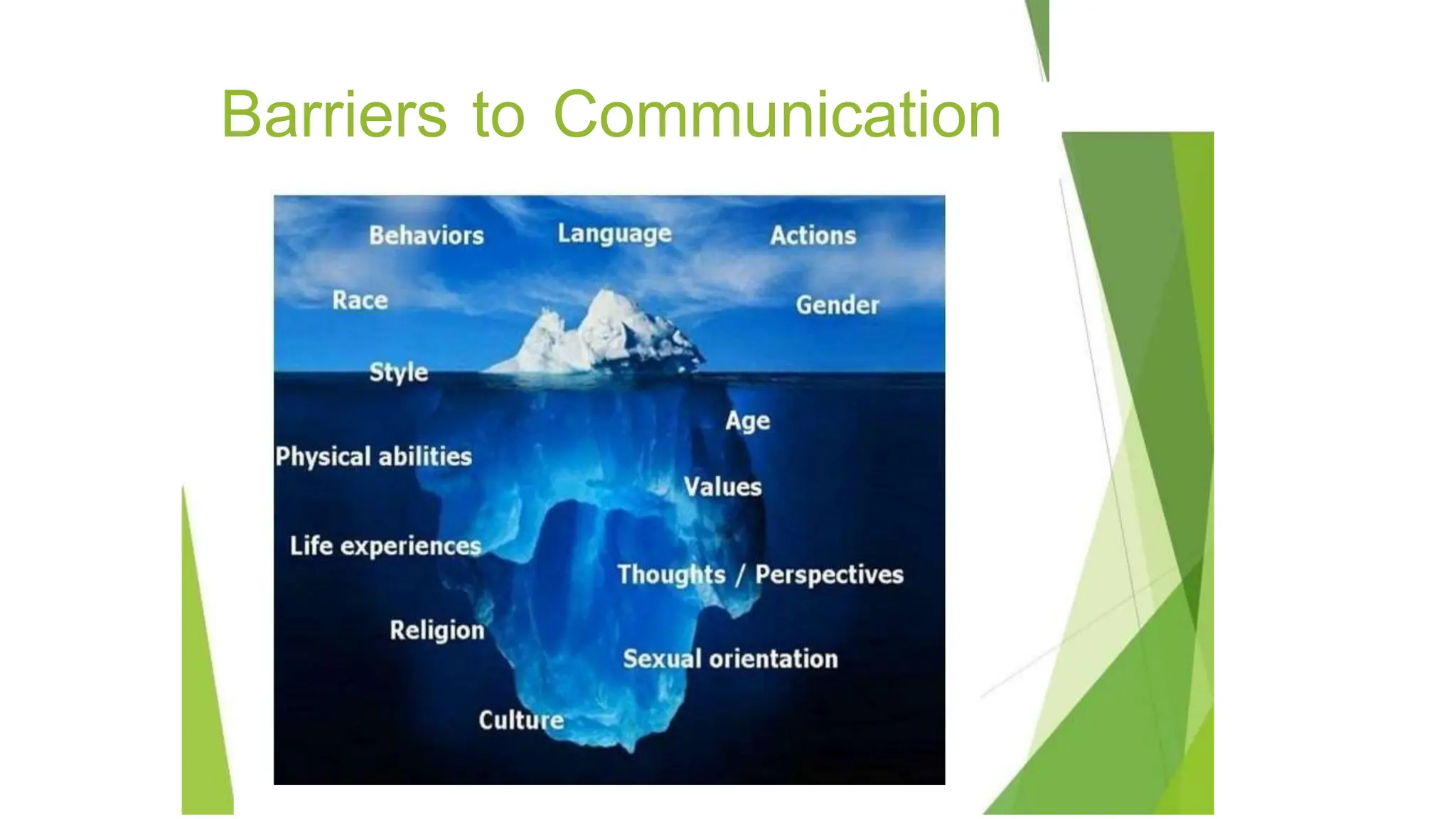
Barriers to Communication
Listening VS Hearing
►Hearing -Physical process, natural,
passi•
ve
►Listening -
- Physical as well as mental process,
active,
►-learned process, a skill
►Listening is hard. You must
choose to participate in the process
of listening.
I
I
l
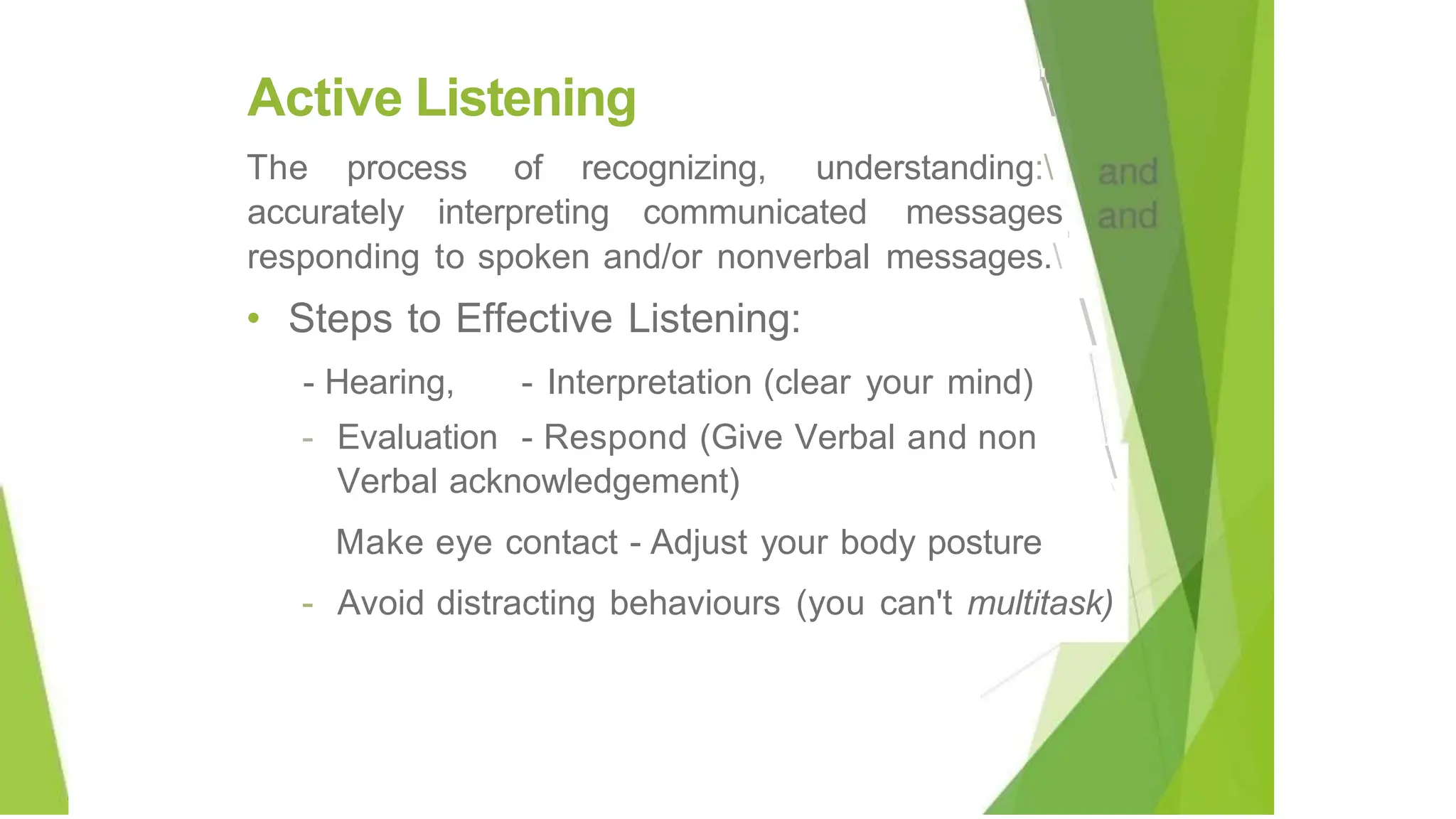
Active Listening 
The process of recognizing, understanding:
accurately interpreting communicated messagesI
responding to spoken and/or nonverbal messages.
• Steps to Effective Listening:
- Hearing, - Interpretation (clear your mind)
- Evaluation - Respond (Give Verbal and non
Verbal acknowledgement)
Make eye contact - Adjust your body posture
- Avoid distracting behaviours (you can't multitask)
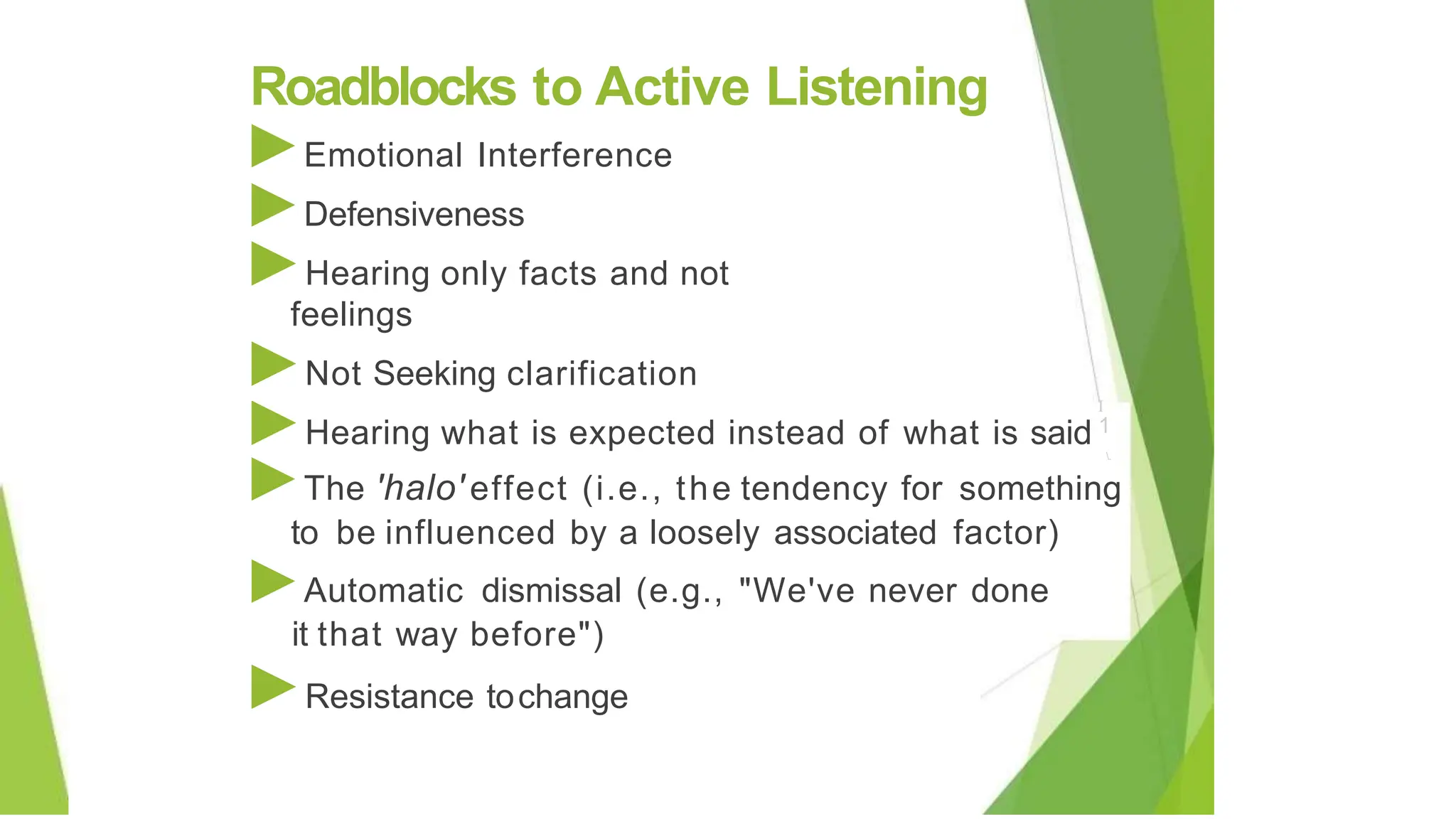
Roadblocks to Active Listening
►Emotional Interference
►Defensiveness
►Hearing only facts and not
feelings
►Not Seeking clarification
►Hearing what is expected instead of what is said
I
1
.
►The 'halo' effect (i.e., the tendency for something
to be influenced by a loosely associated factor)
►Automatic dismissal (e.g., "We've never done
it that way before")
►Resistance tochange
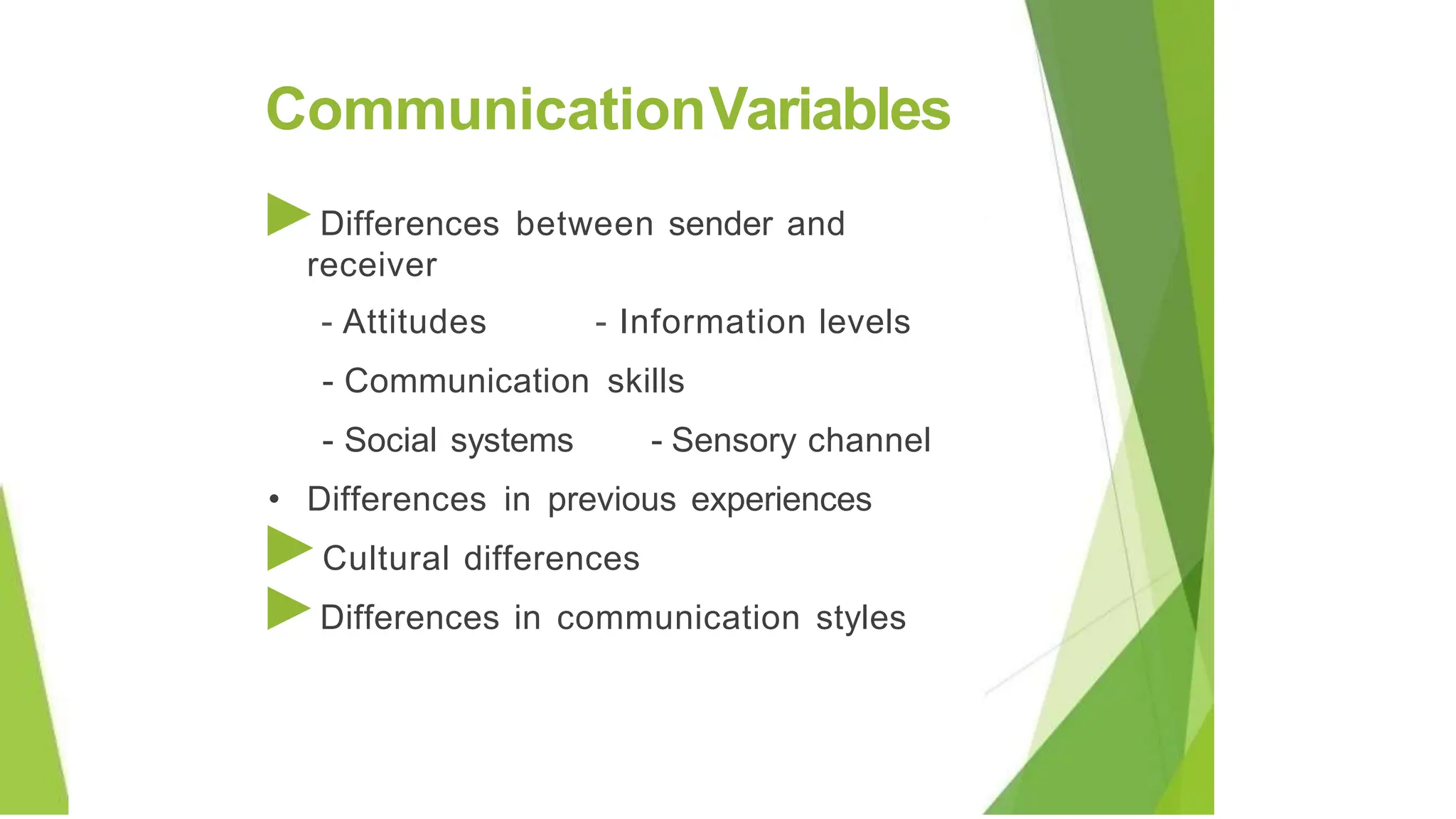
CommunicationVariables
►Differences between sender and
receiver
- Attitudes - Information levels
- Communication skills
- Social systems - Sensory channel
• Differences in previous experiences
►Cultural differences
►Differences in communication styles
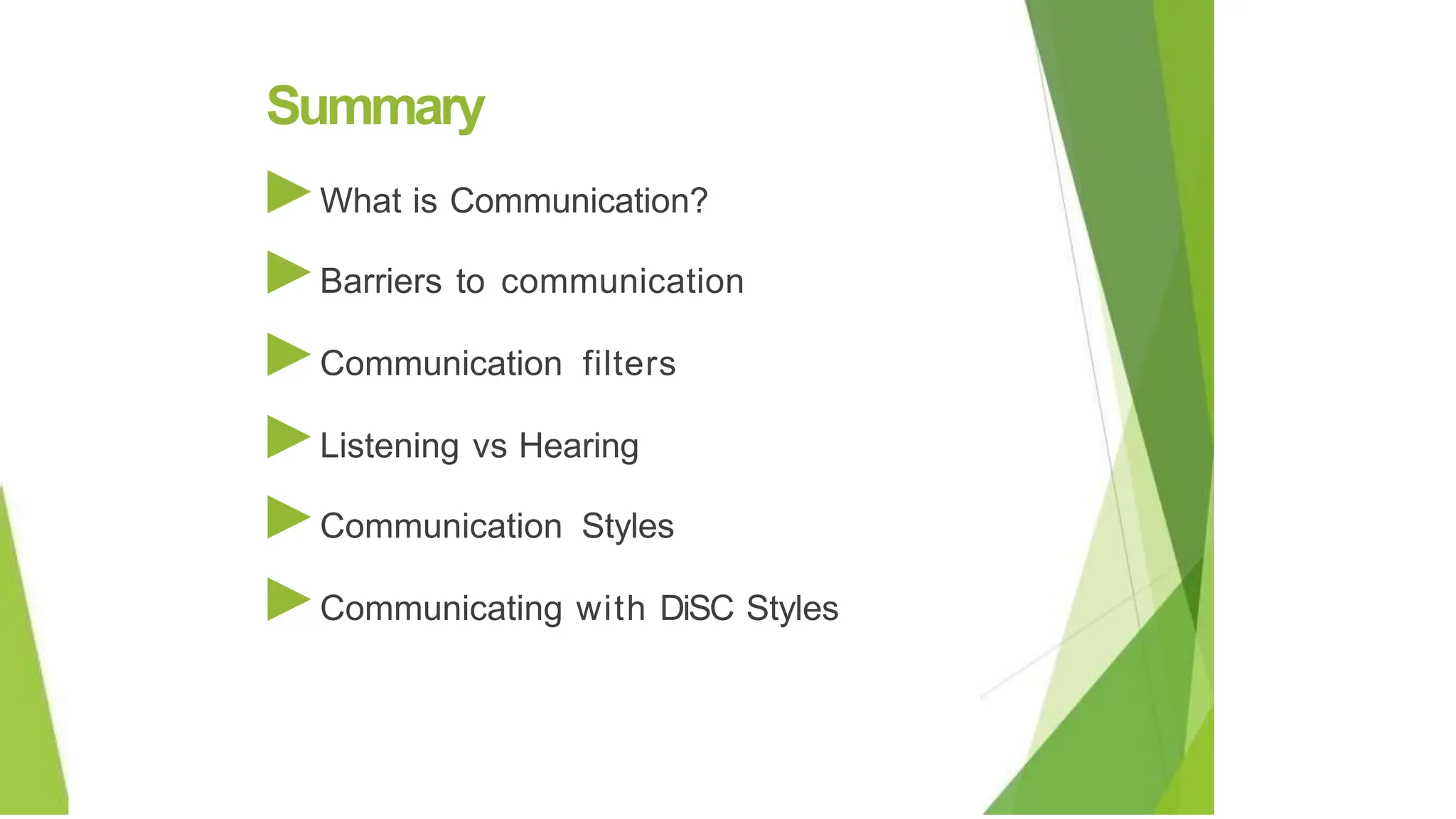
Summary
►What is Communication?
►Barriers to communication
►Communication filters
►Listening vs Hearing
►Communication Styles
►Communicating with DiSC Styles
Achieving Success Through
Effective Business
Communication
1.. Learn why communication matters
2. Identify skills today's employers expect
3. Learn the audience-centered approach
4. Assess the communication process
5. Review communication technology
6. Explore ethical communication
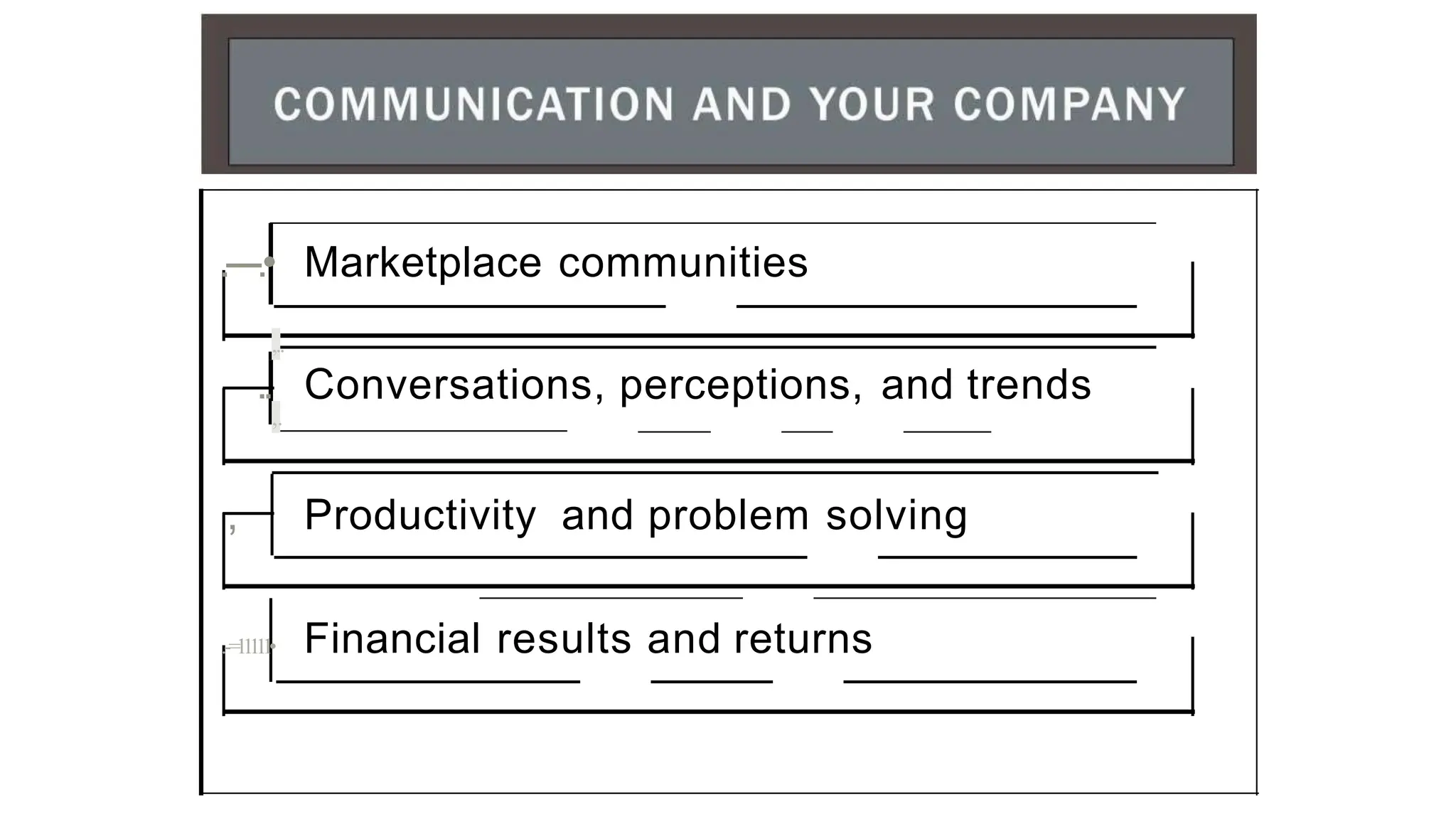
.----.• Marketplace communities
,..
.. Conversations, perceptions, and trends
,.
, Productivity and problem solving
.-=
1
1
1
1
1
• Financial results and returns
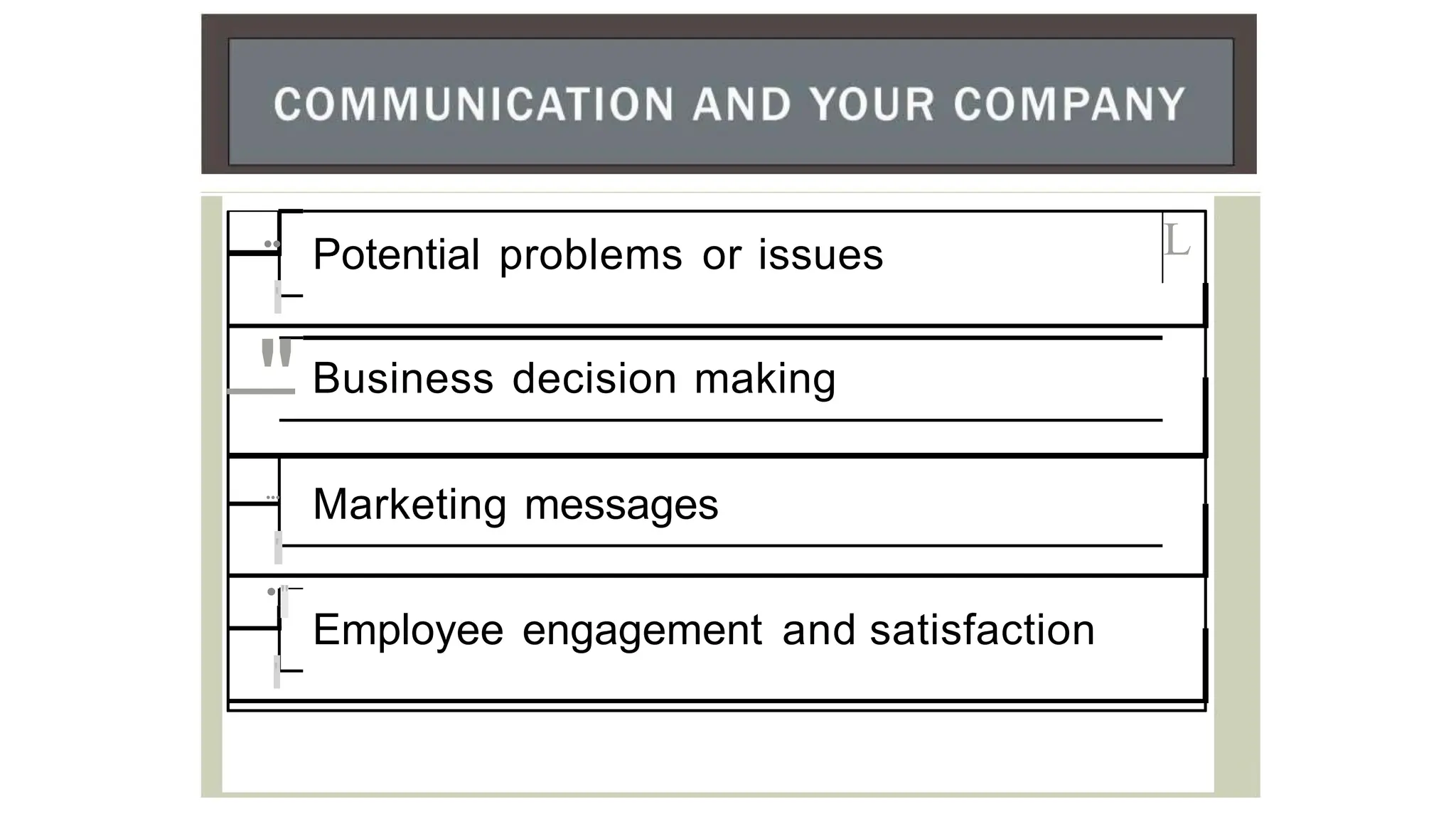
.. Potential problems or issues L
'
"Business decision making
...
Marketing messages
'
•"
Employee engagement and satisfaction
'
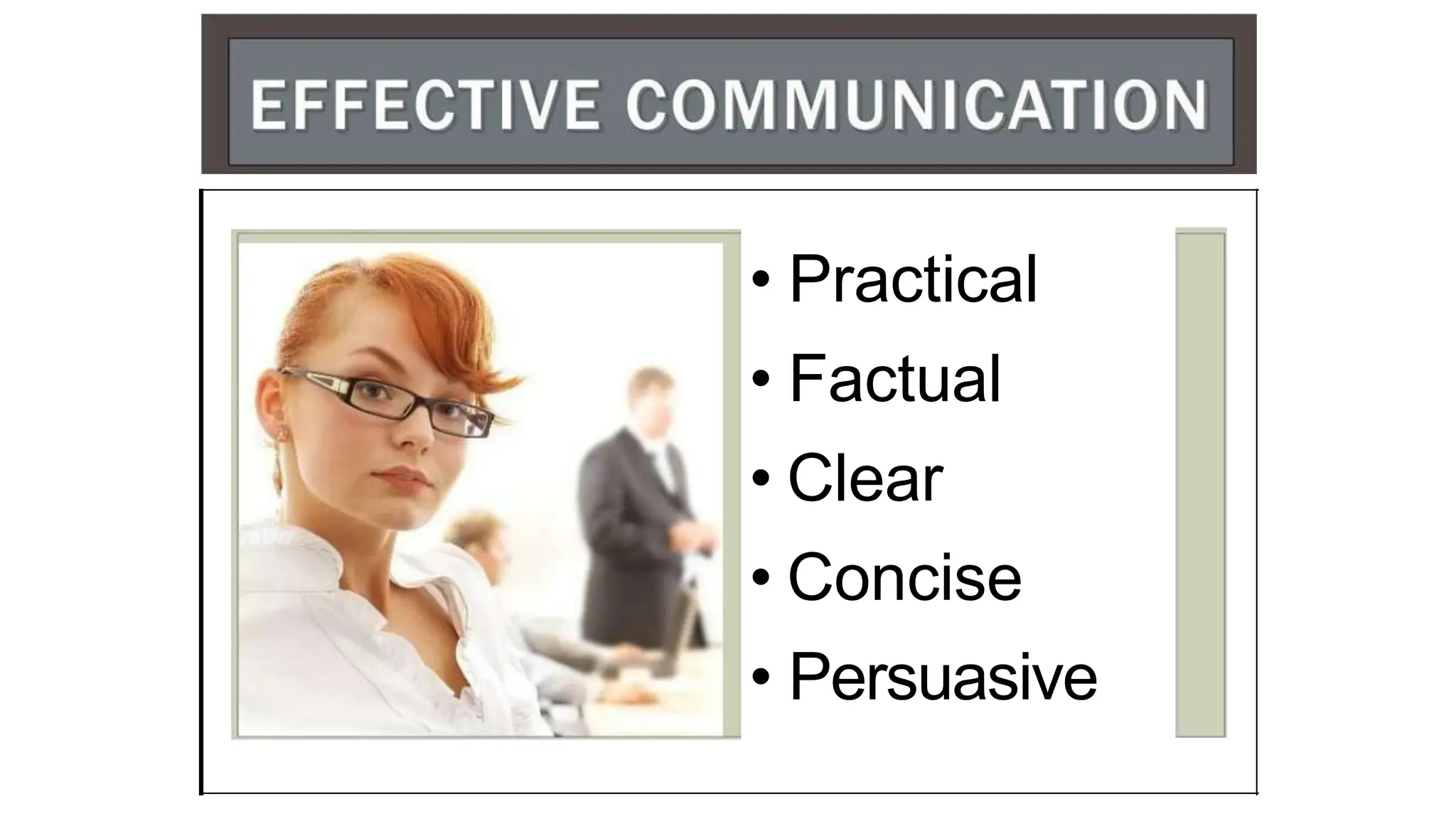
• Practical
• Factual
• Clear
• Concise
• Persuasive
UNIQUE CHALLENGES OF BUSINESS
COMMUNICATION
• Globalization and diversity
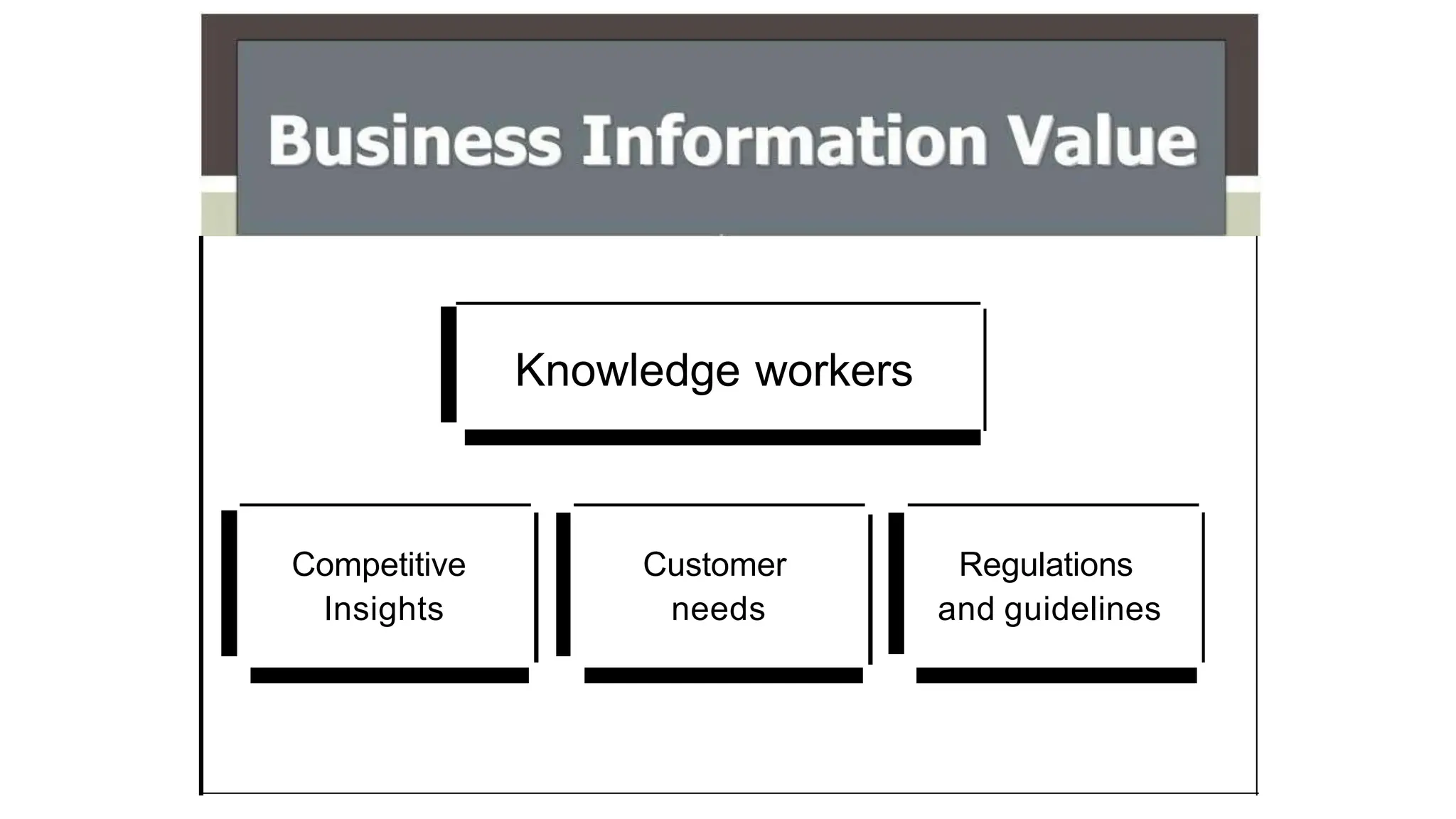
• Business information value
• Pervasiveness of technology
• Organizational structures
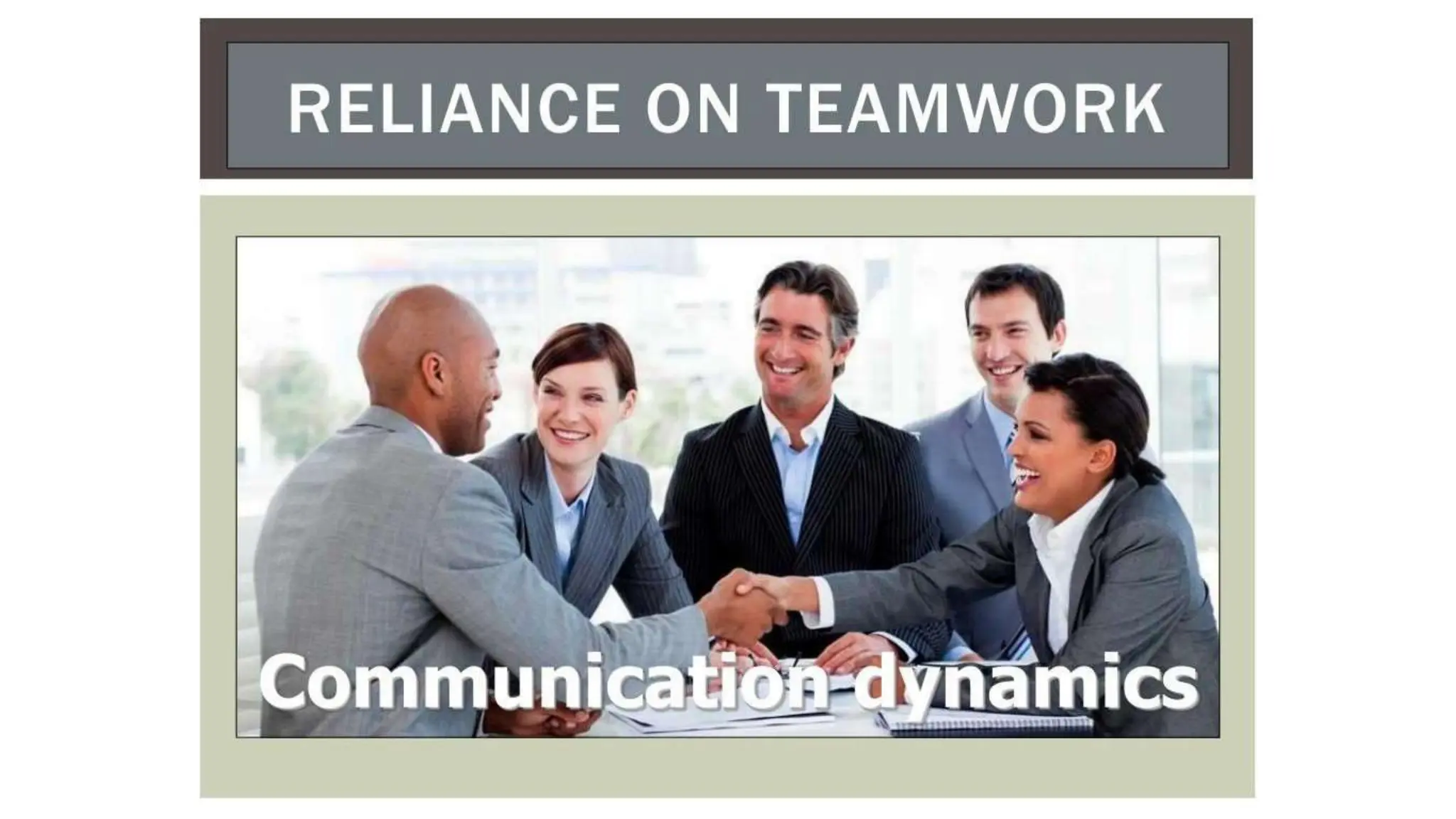
• Growing reliance on teamwork
Knowledge workers
Competitive
Insights
Customer
needs
Regulations
and guidelines
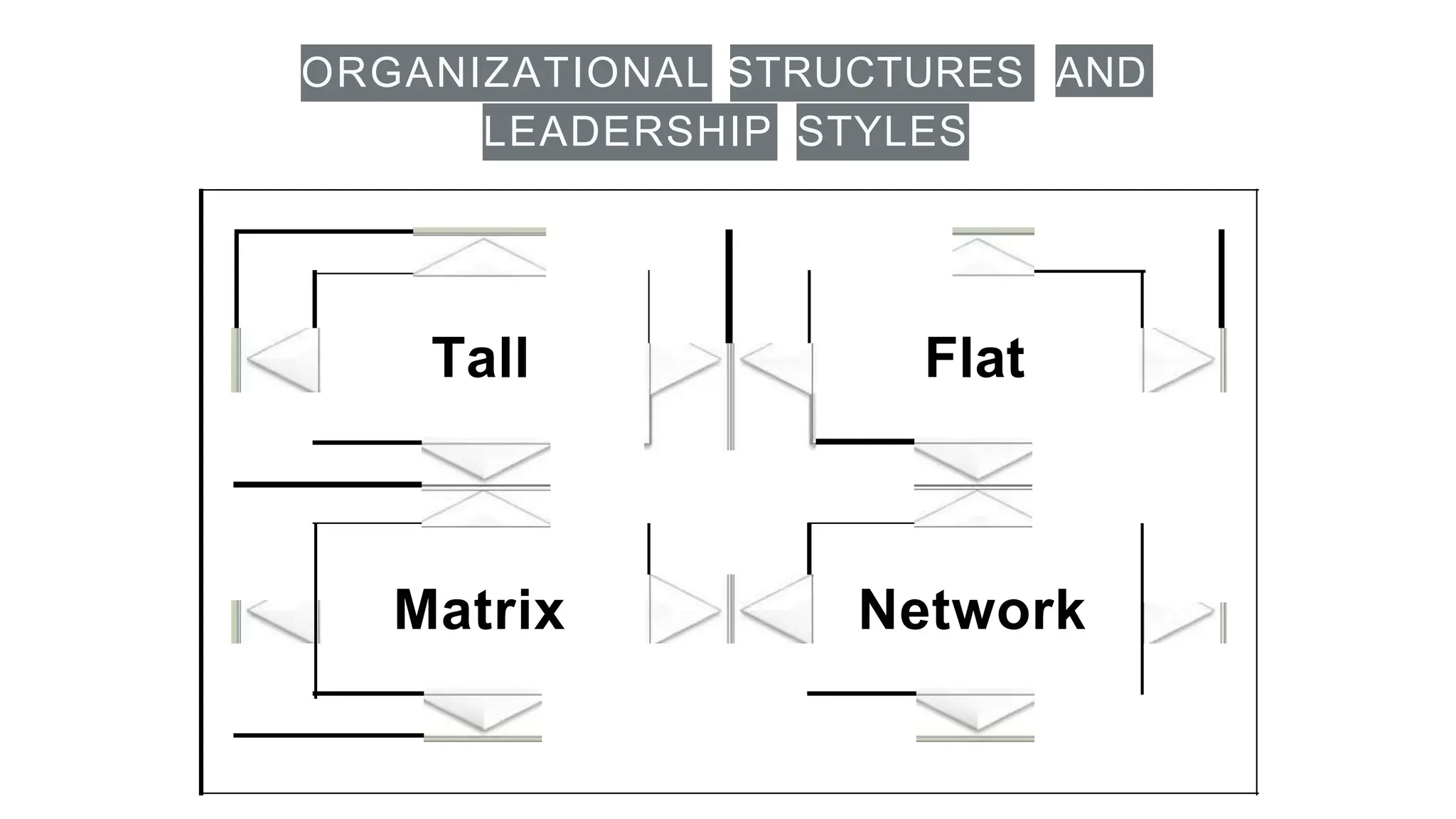
ORGANIZATIONAL STRUCTURES AND
LEADERSHIP STYLES
Tall Flat
Matrix Network
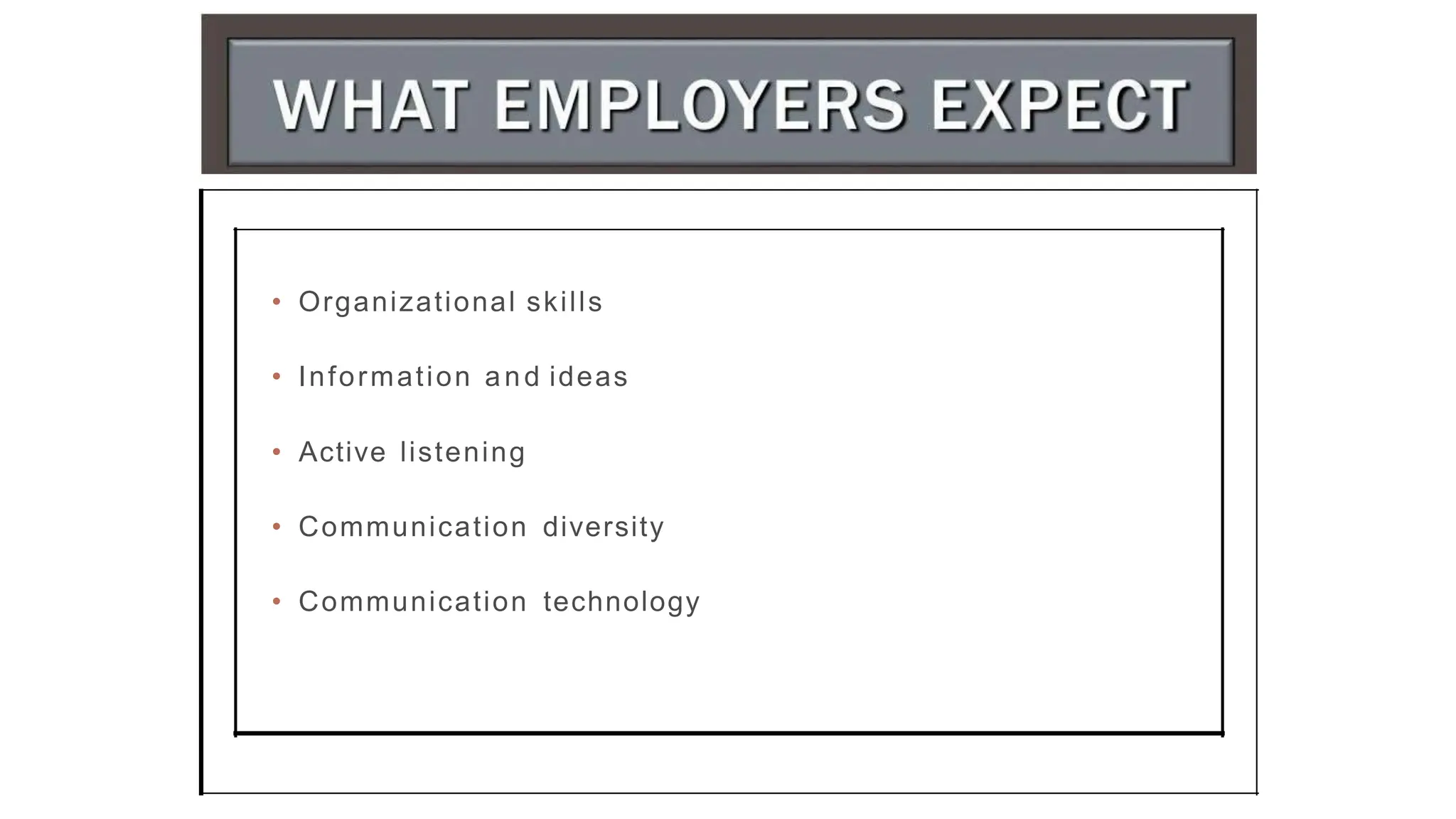
• Organizational skills
• Information and ideas
• Active listening
• Communication diversity
• Communication technology
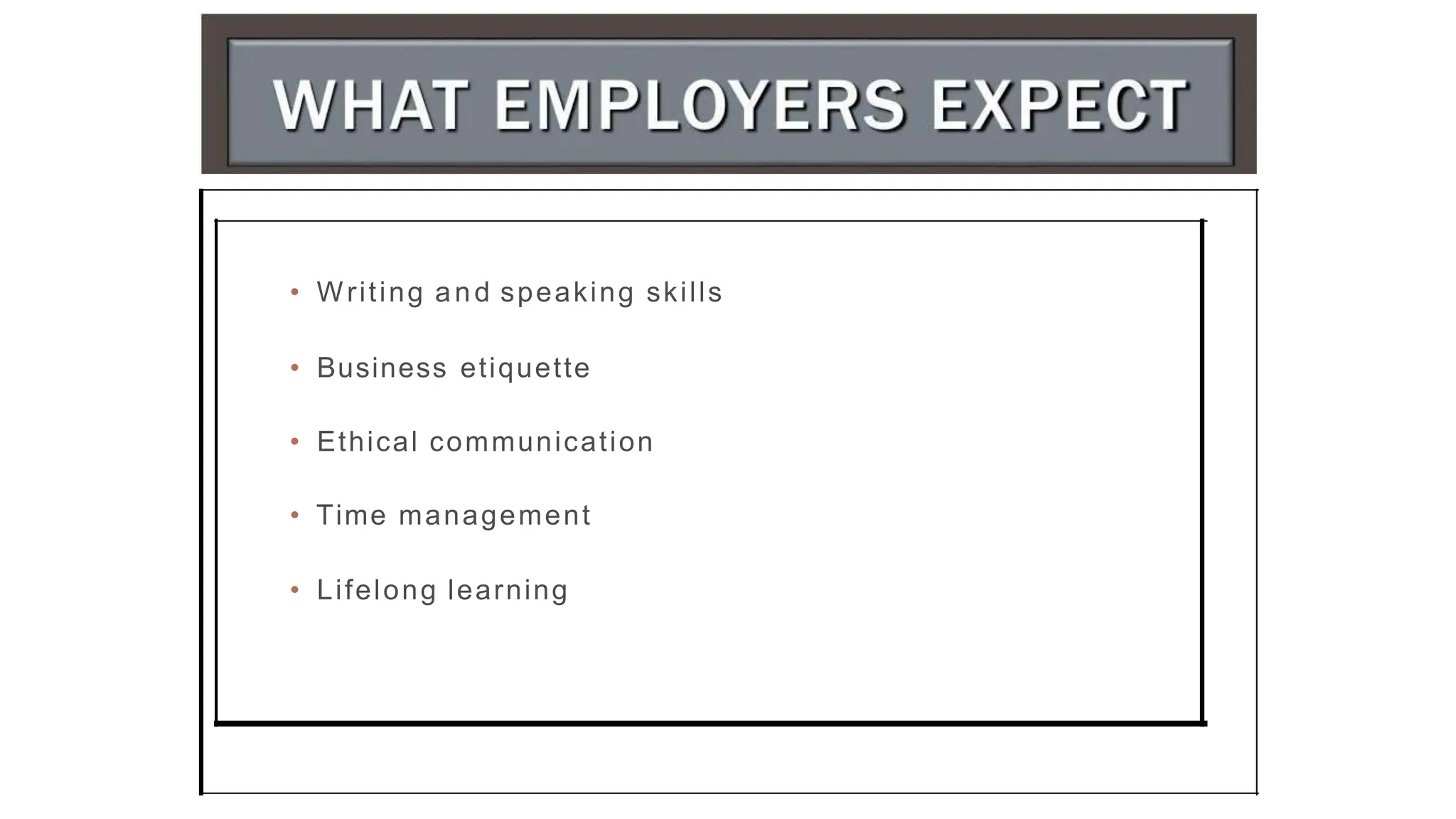
• Writing and speaking skills
• Business etiquette
• Ethical communication
• Time management
• Lifelong learning
• Sender generates an idea
............... .............................................-]
• Sender encodes a message
""""""""-
• Sender produces a message
= = = = = = = -
• Sender transmits the message
• Audience receives the message
- = = = = - - -
• Audience decodes the message ]
• Audience responds to the message
" = = = =
• Audience provides feedback
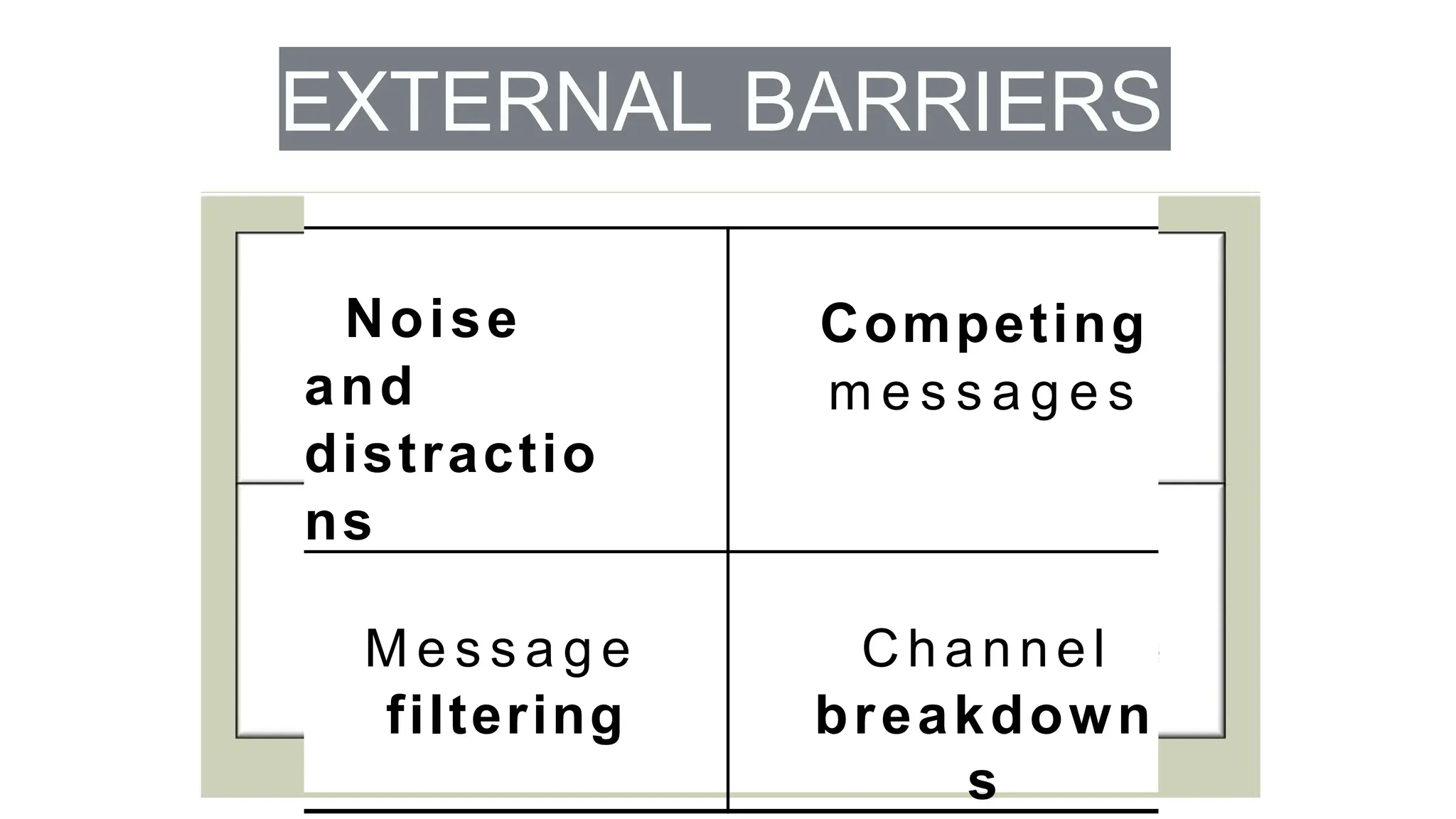
Noise
and
distractio
ns
Competing
m e s s a g e s
M e s s a g e
filtering
C h a n nel
breakdown
s
EXTERNAL BARRIERS
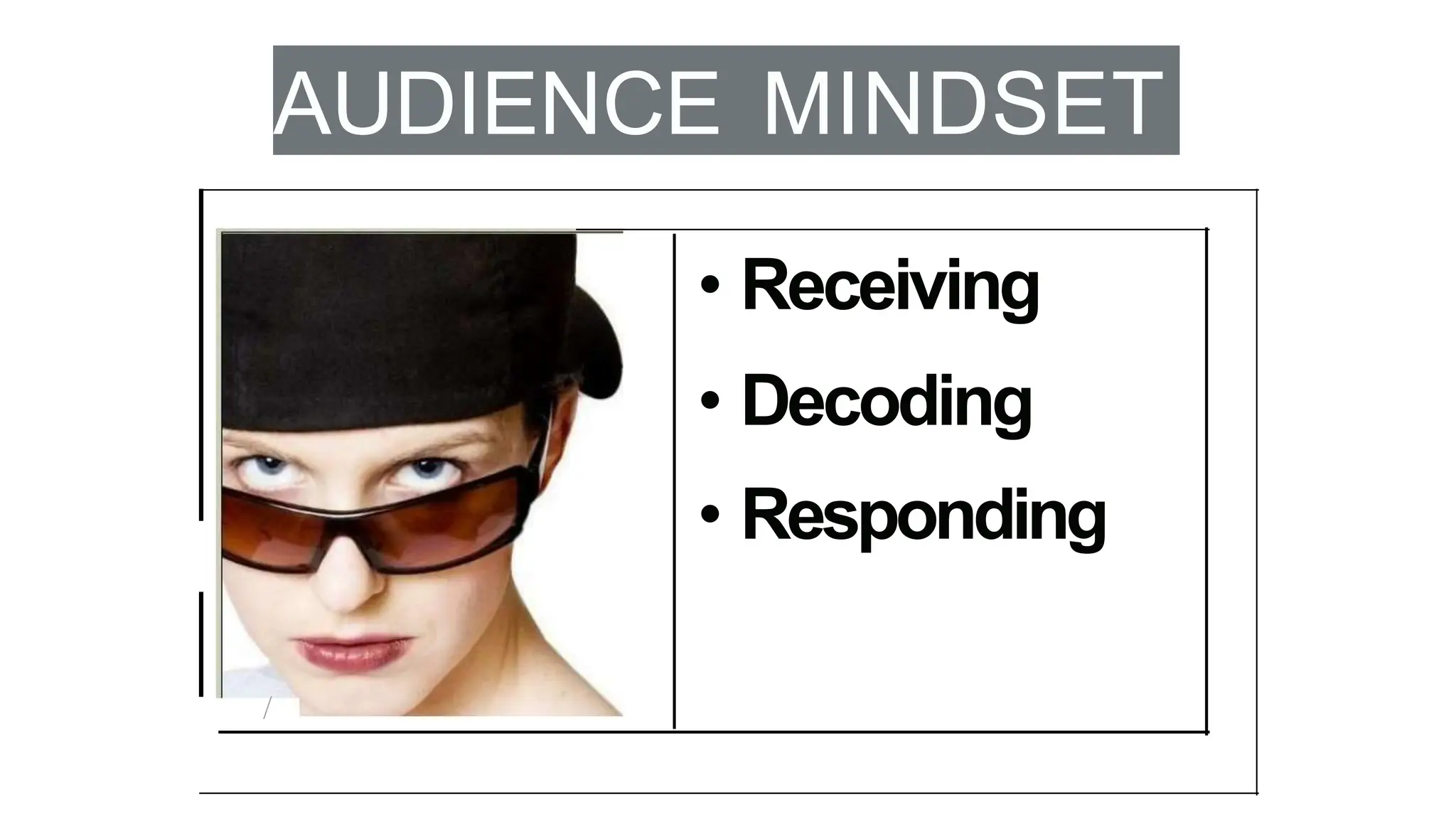
AUDIENCE MINDSET
/
• Receiving
• Decoding
• Responding
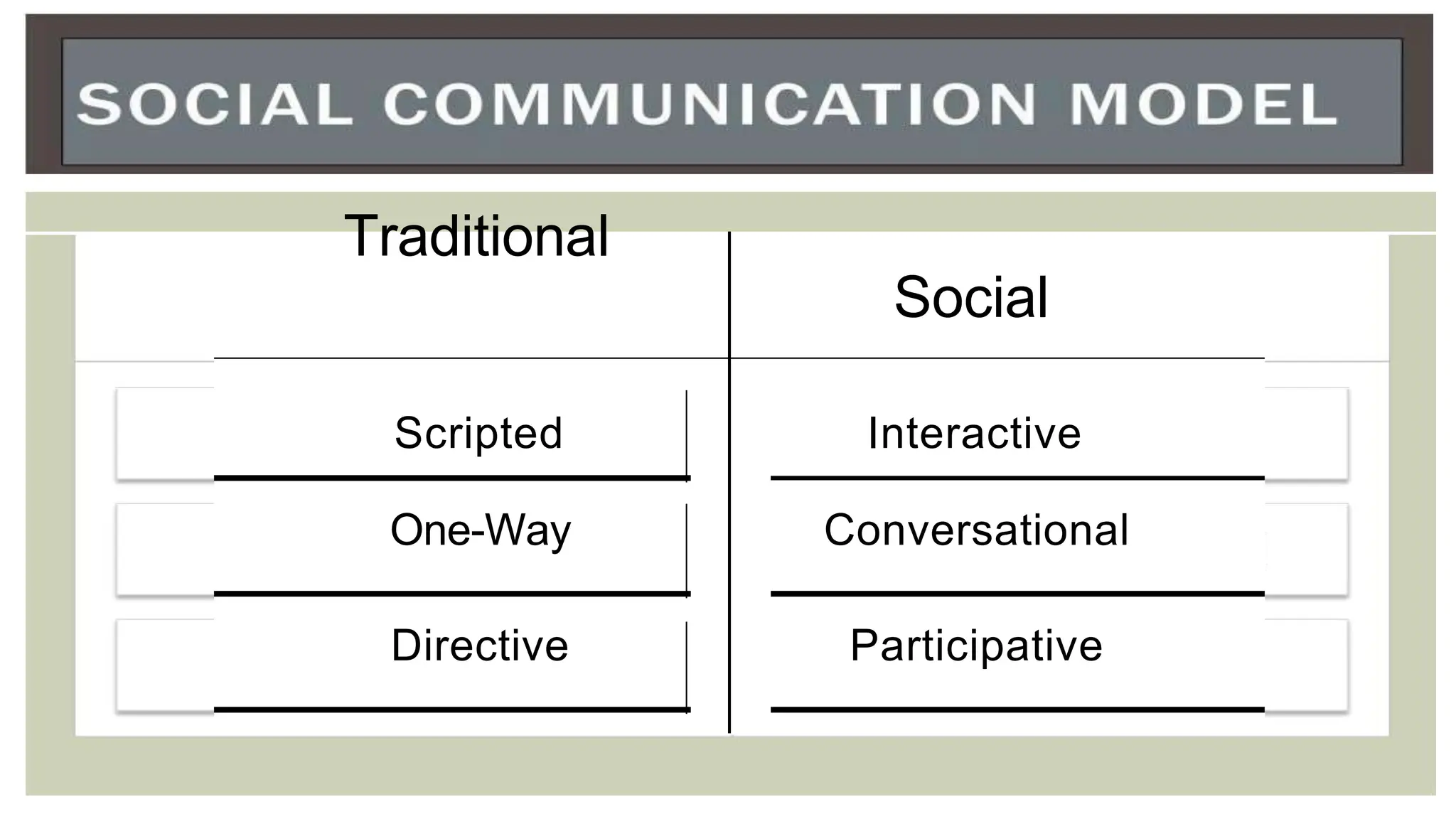
Traditional
Social
Scripted
One-Way
Directive
Interactive
Conversational
Participative
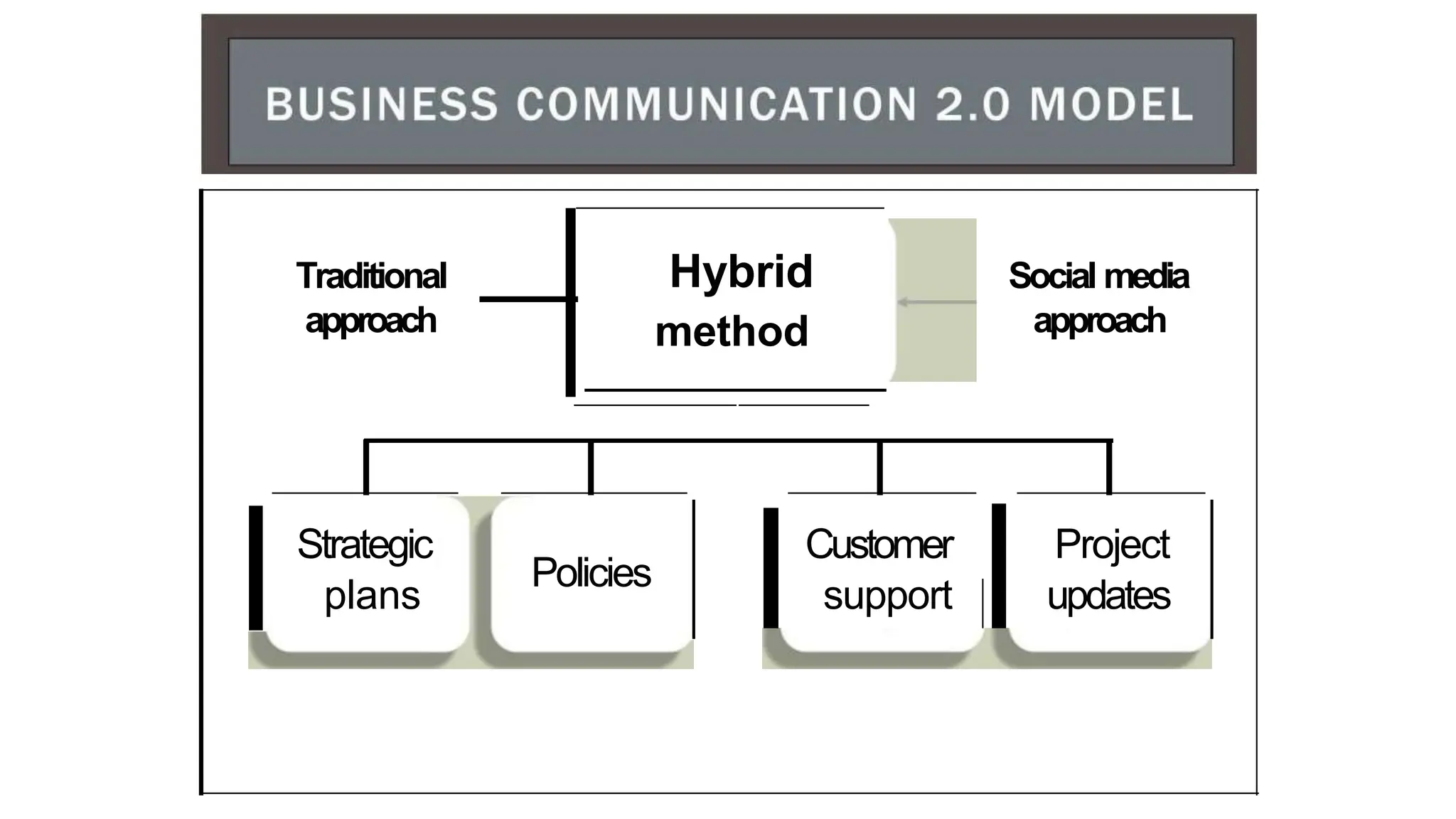
Traditional
approach
Hybrid
method
Social media
approach
Strategic
plans
Policies
Customer
support
Project
updates
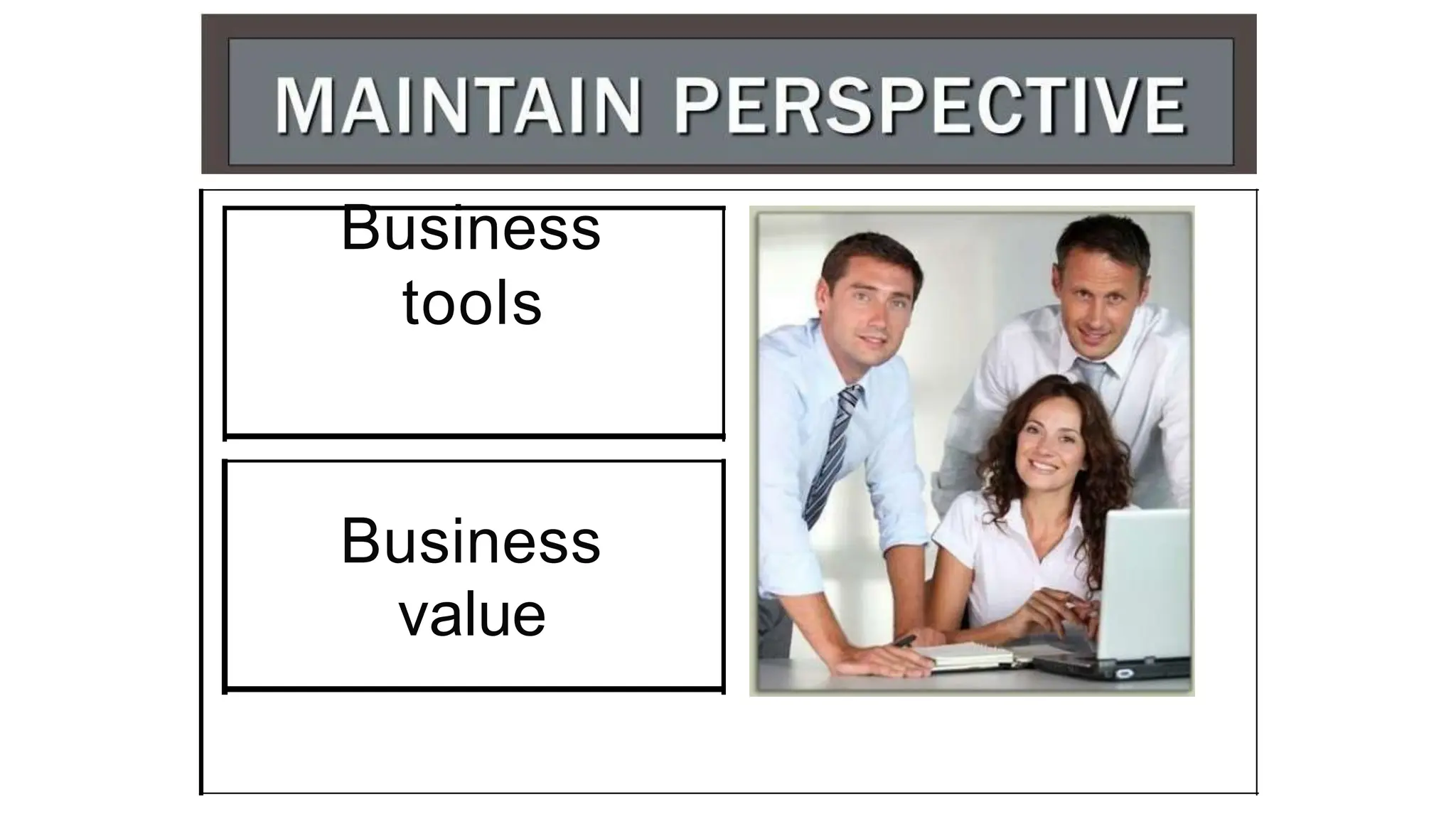
Business
tools
Business
value
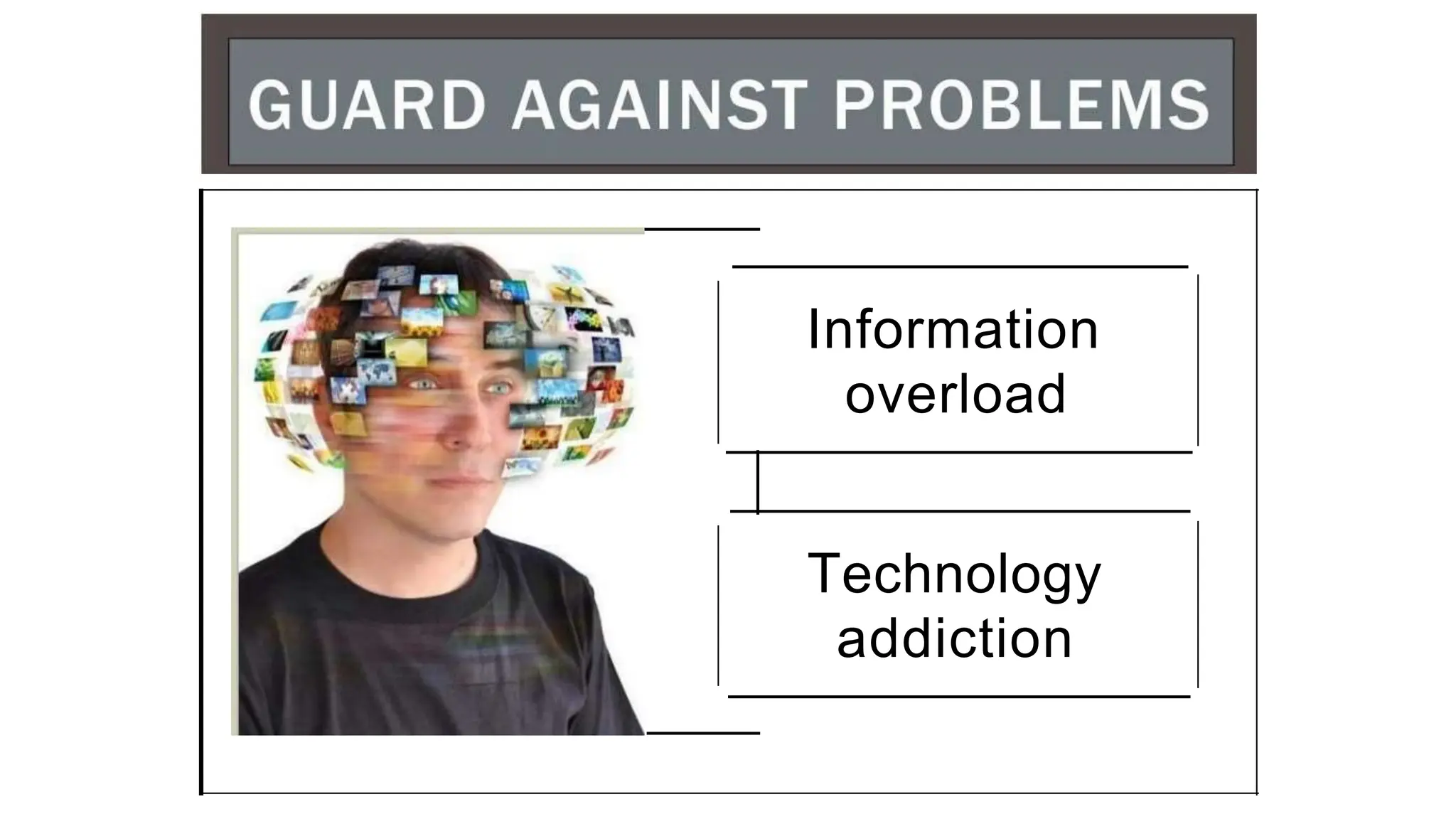
Information
overload
Technology
addiction
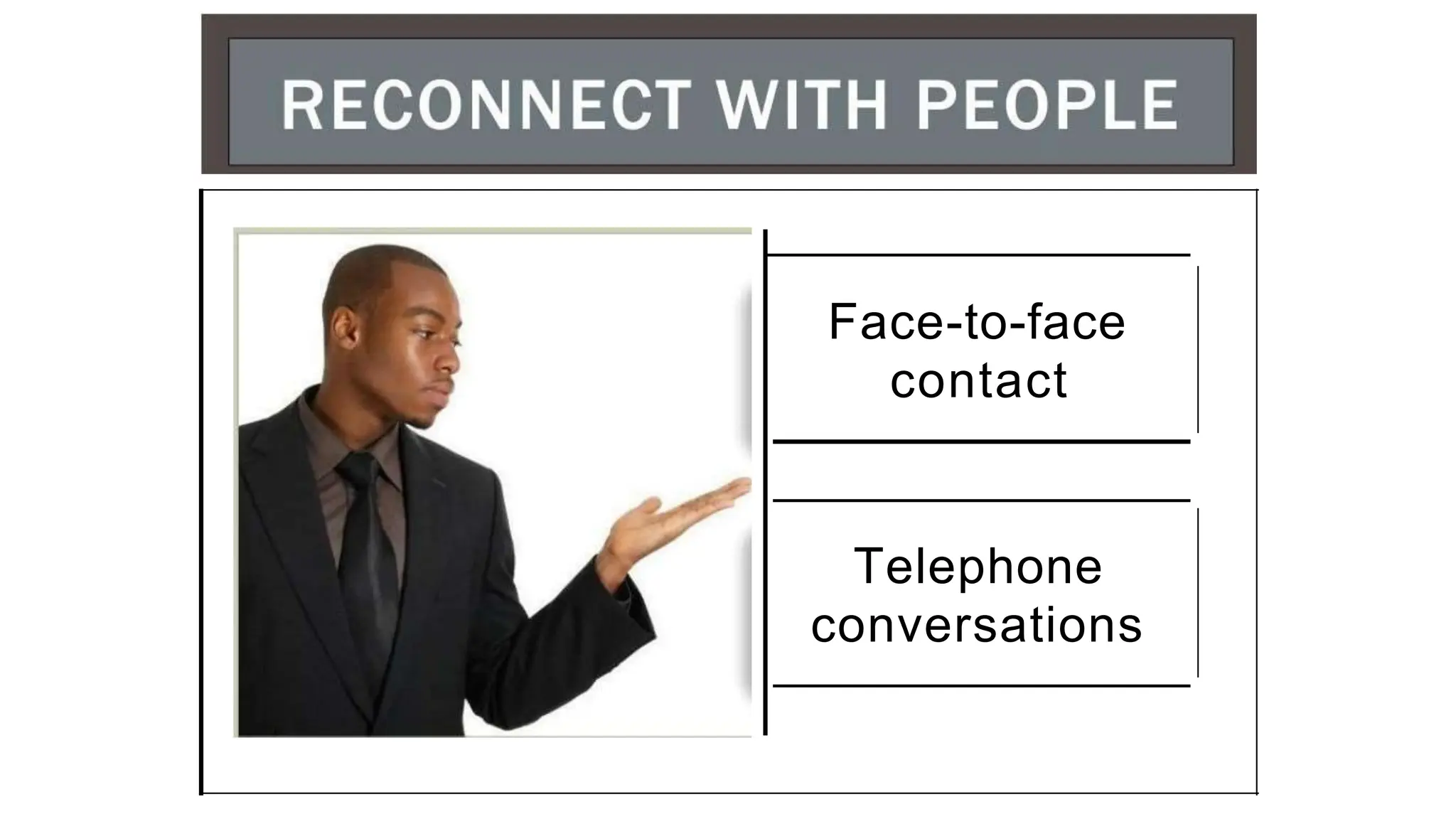
Face-to-face
contact
Telephone
conversations
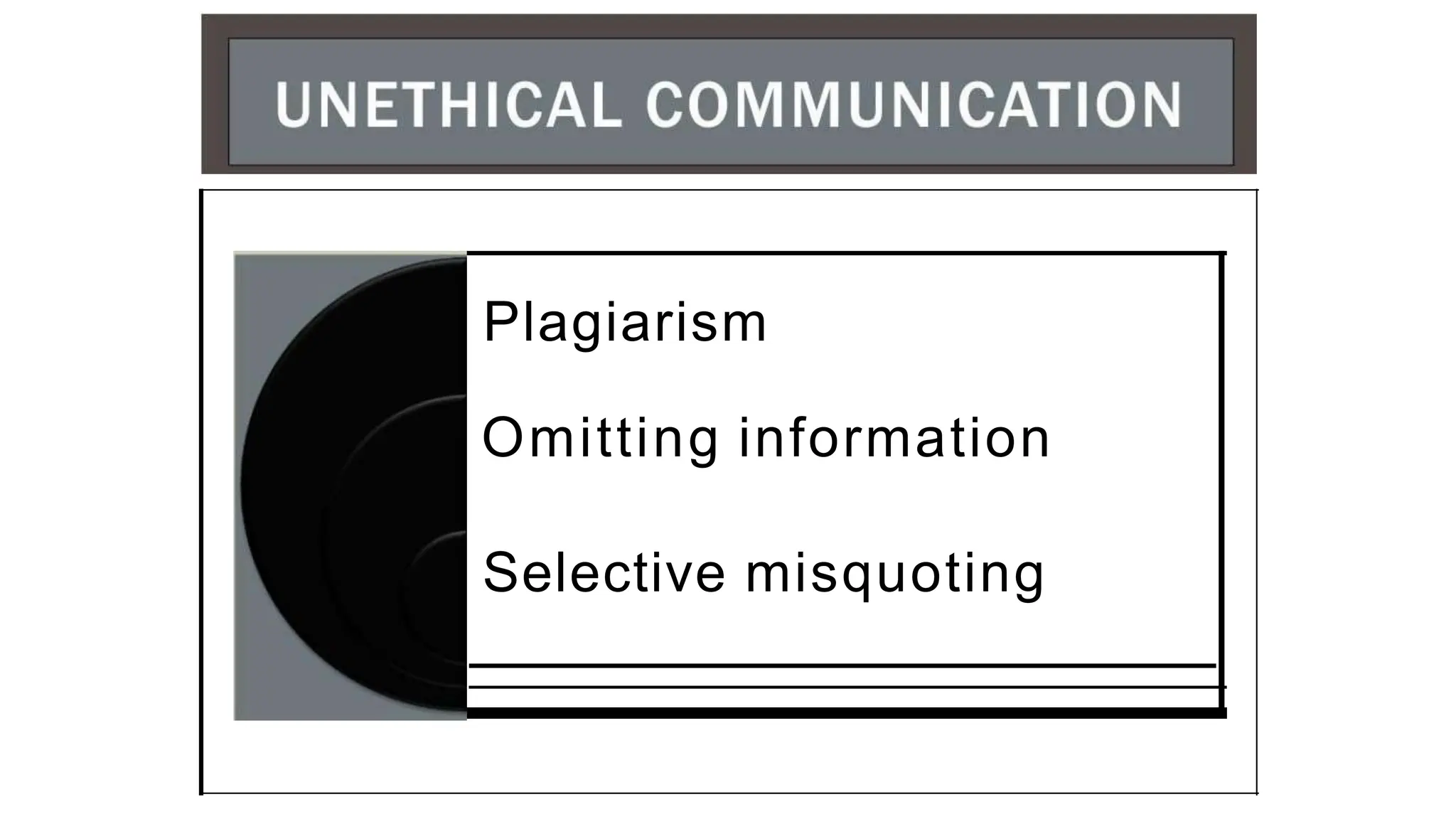
Plagiarism
Omitting information
Selective misquoting
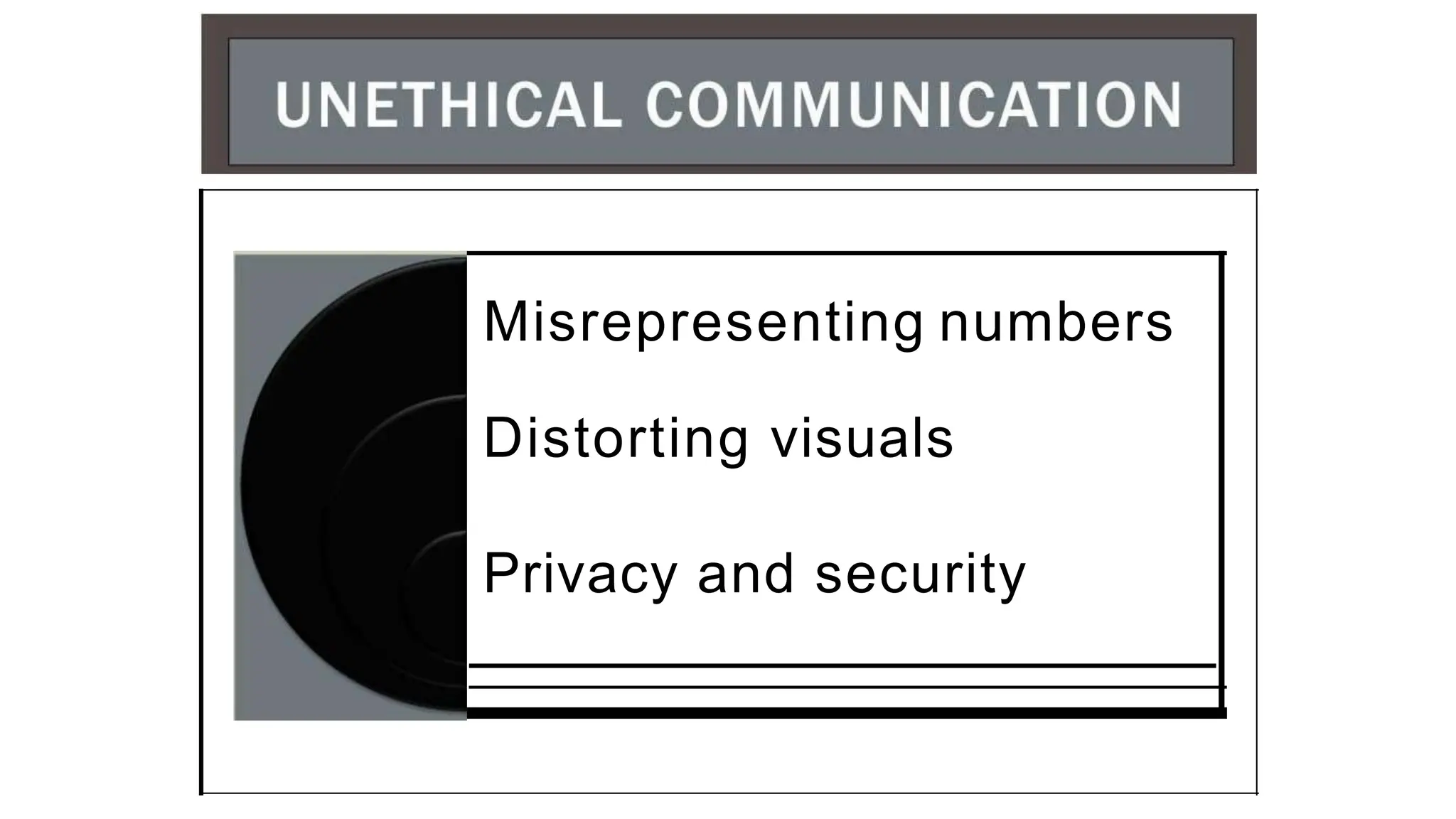
Misrepresenting numbers
Distorting visuals
Privacy and security
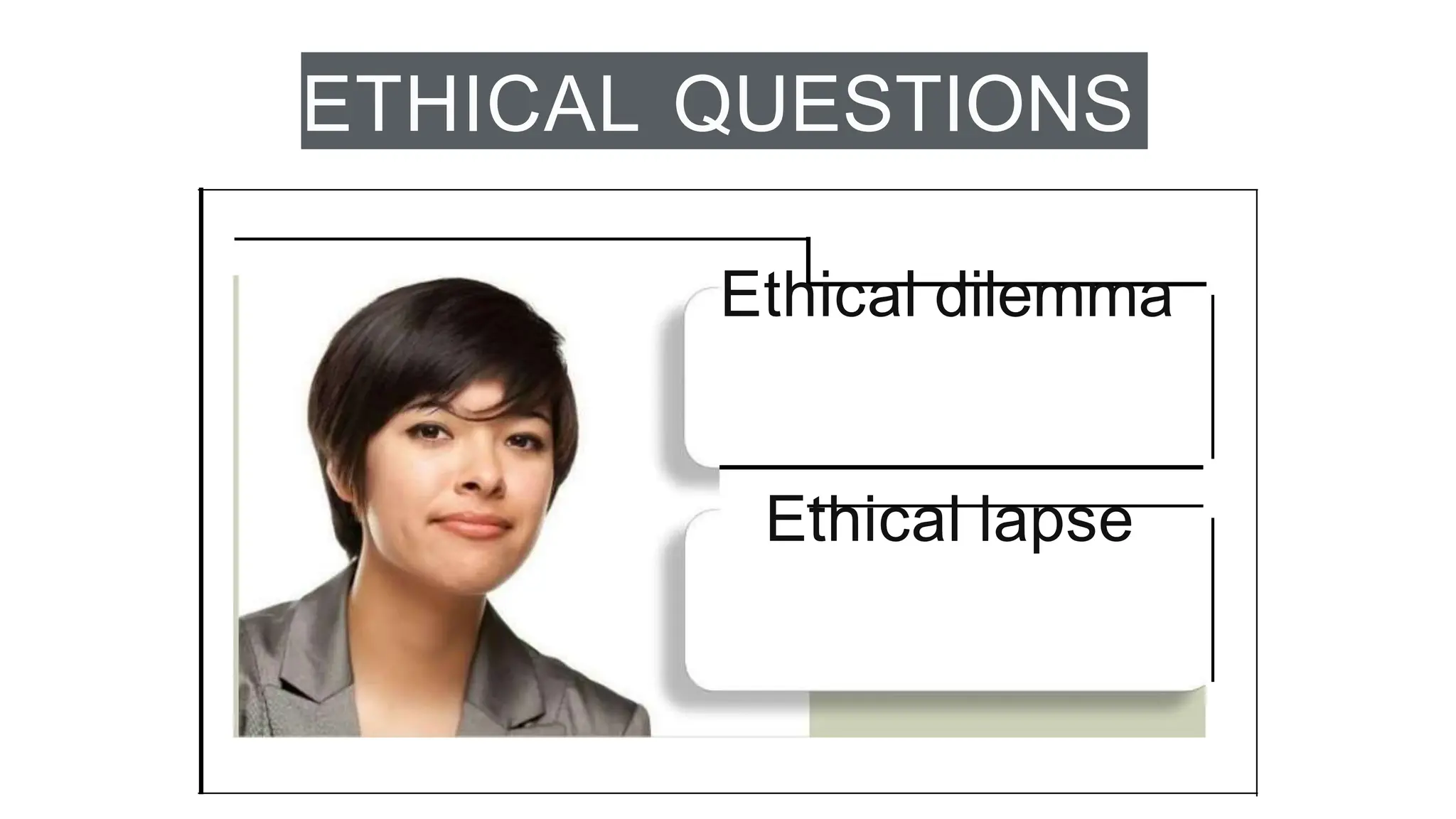
ETHICAL QUESTIONS
Ethical dilemma
Ethical lapse
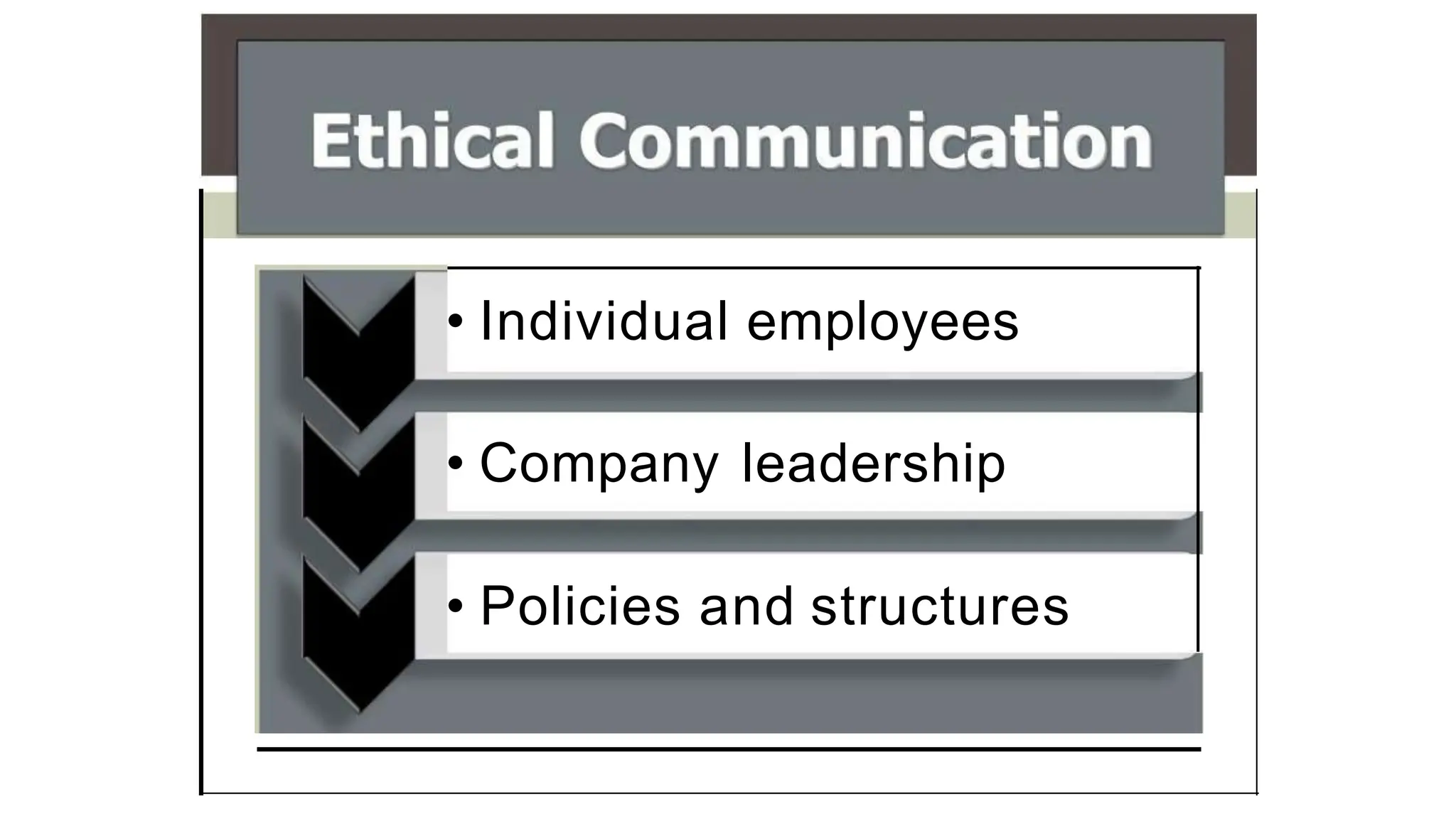
• Individual employees
• Company leadership
• Policies and structures
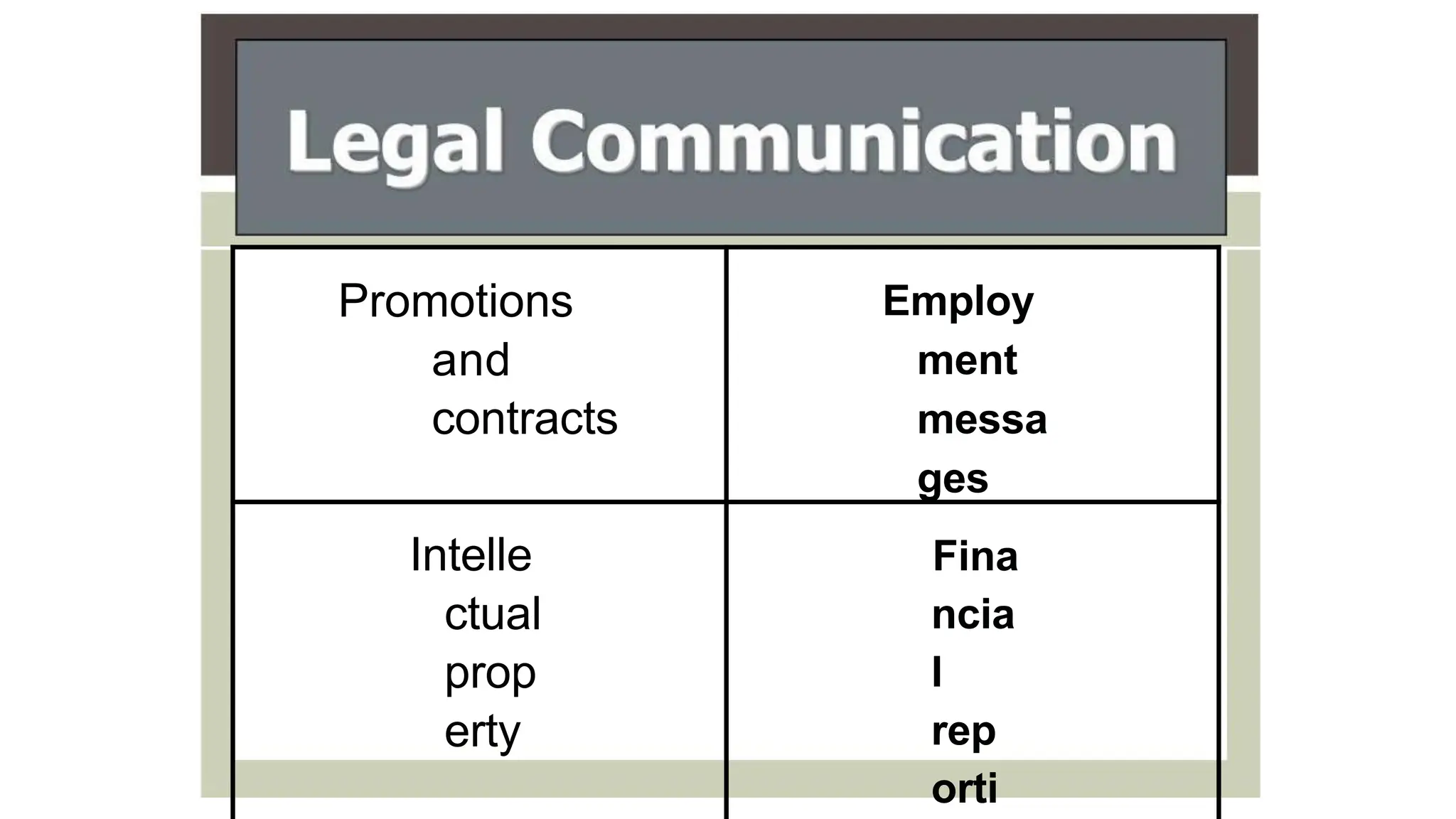
Promotions
and
contracts
Employ
ment
messa
ges
Intelle
ctual
prop
erty
Fina
ncia
l
rep
orti
Leaders must be able to speak regularly and
easily with others in order to persuade and
influence people
Leaders must be able to communicate
effectively and must be able to:
● Listen with the ability to elicit information
through effective questioning
● Build rapport quickly and effectively
● Adapt accordingly without missing a beat
Effective communication
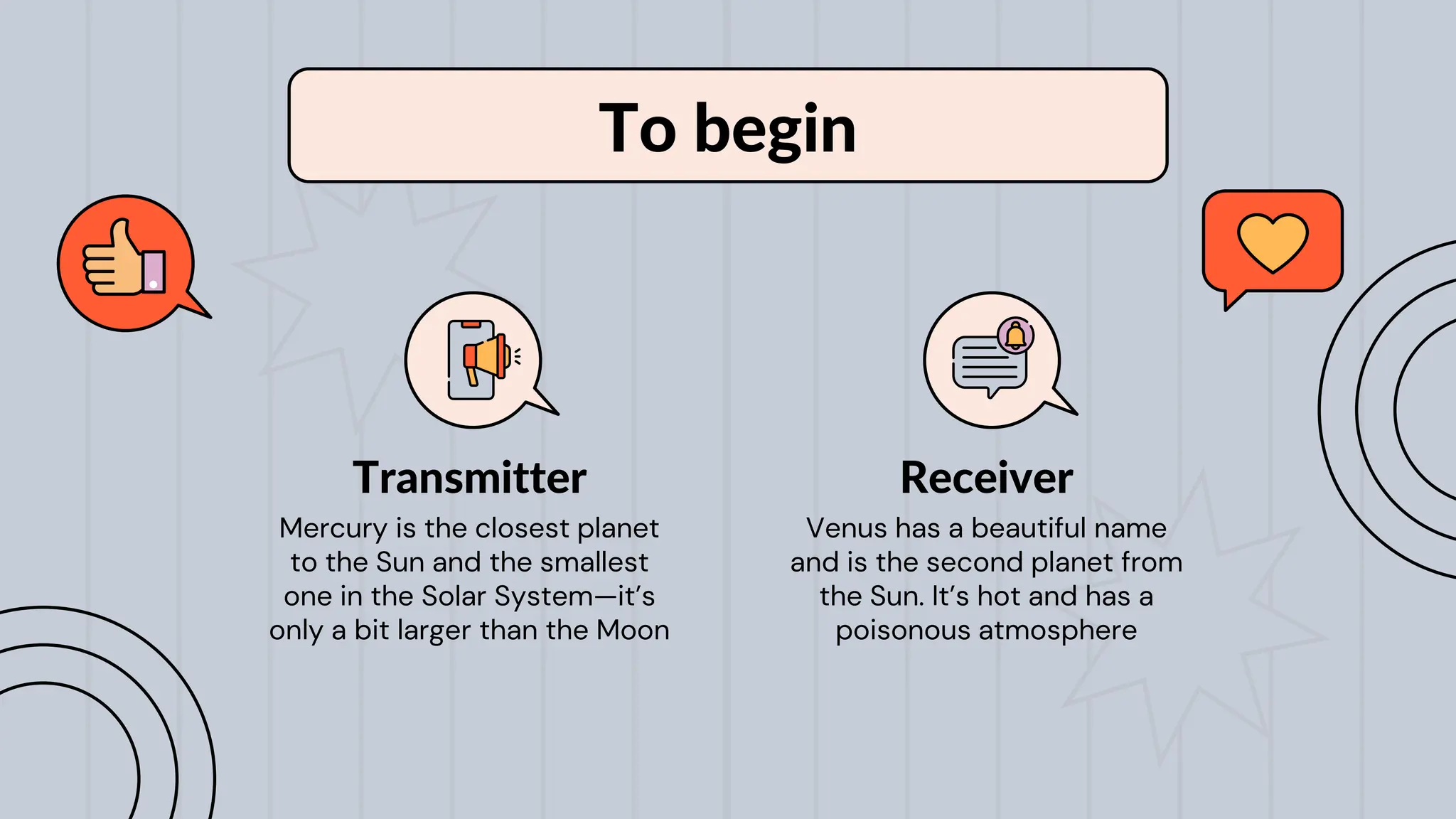
To begin
Mercury is the closest planet
to the Sun and the smallest
one in the Solar System—it’s
only a bit larger than the Moon
Transmitter
Venus has a beautiful name
and is the second planet from
the Sun. It’s hot and has a
poisonous atmosphere
Receiver
What is Communication?
QUIZ:
'I
1. A process where information is exchang
between at least two people resulting i
common understanding
I

2. The successful transfer of information in
such a way that is received, understood and
correctly acted upon
Goals of Communication
►To change behavior
►To get action
►To persuade
►To ensure
understanding
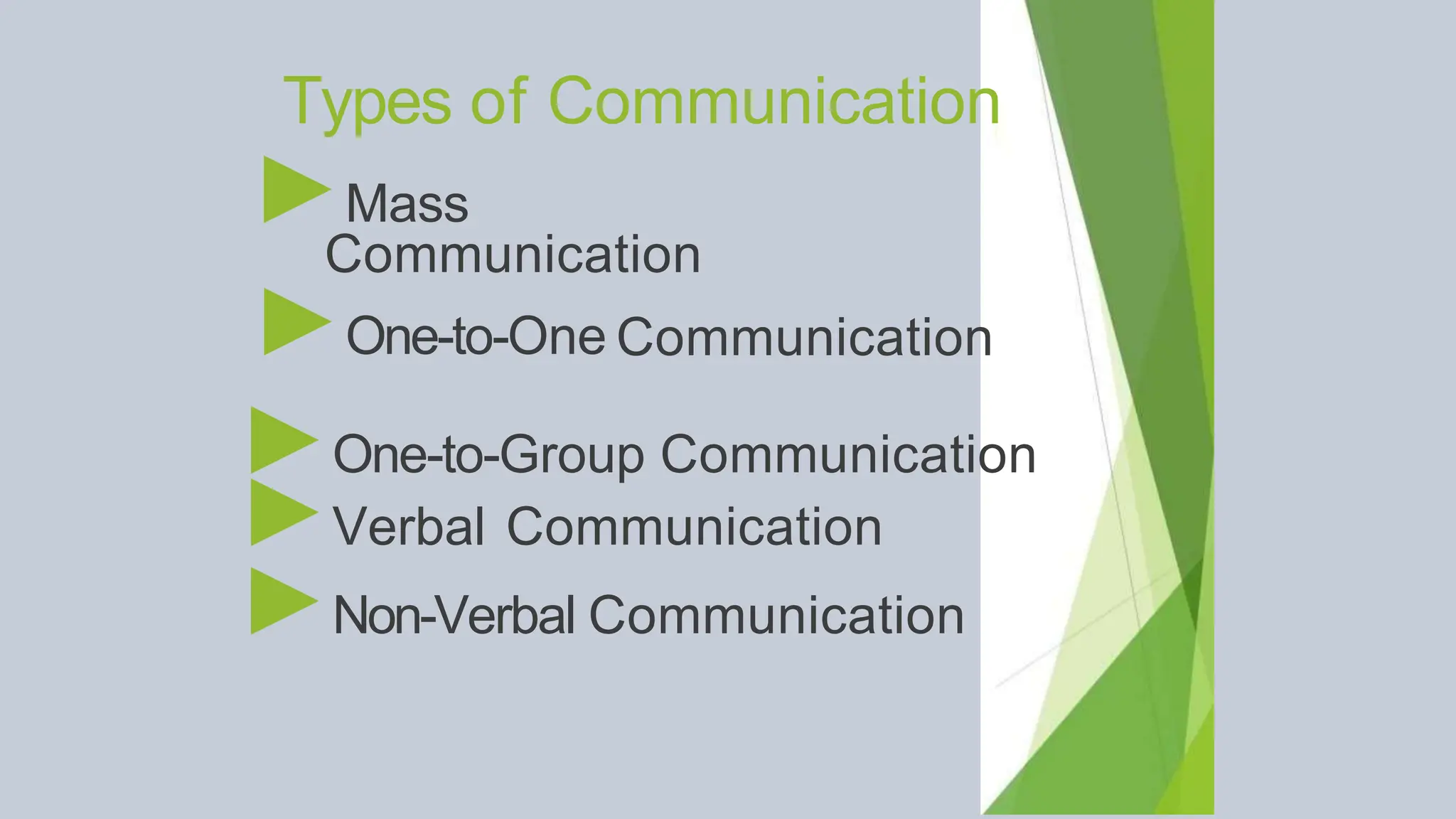
Types of Communication
►Mass
Communication
►One-to-One Communication
►One-to-Group Communication
►Verbal Communication
►Non-Verbal Communication
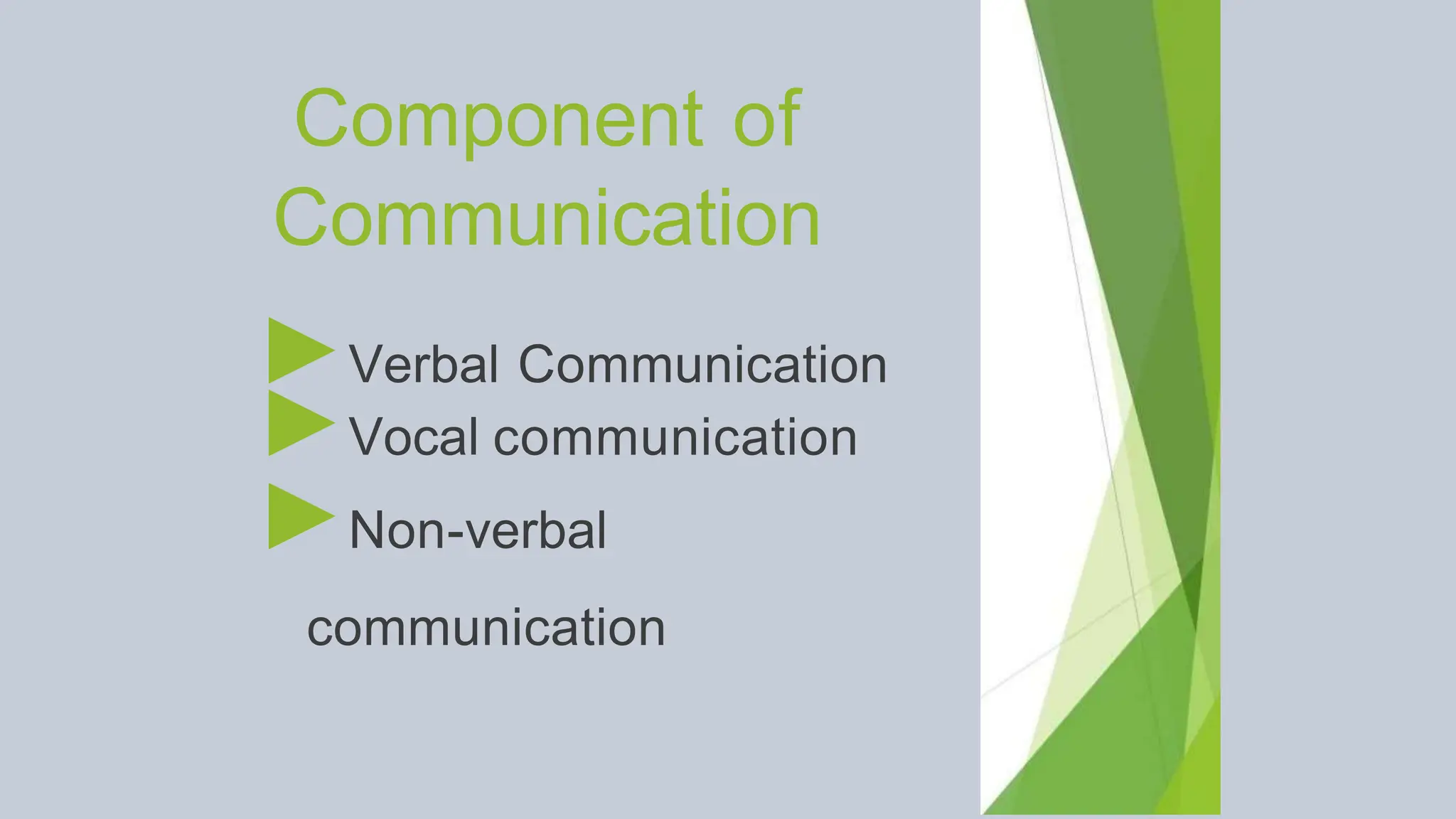
Component of
Communication
►Verbal Communication
►Vocal communication
►Non-verbal
communication
Main concepts
Mercury is the closest
planet to the Sun and the
smallest of them all
Channel
Venus has a beautiful
name and is the second
planet from the Sun
Message
Despite being red, Mars is
actually a cold place. It’s
full of iron oxide dust
Environment
-
-
-
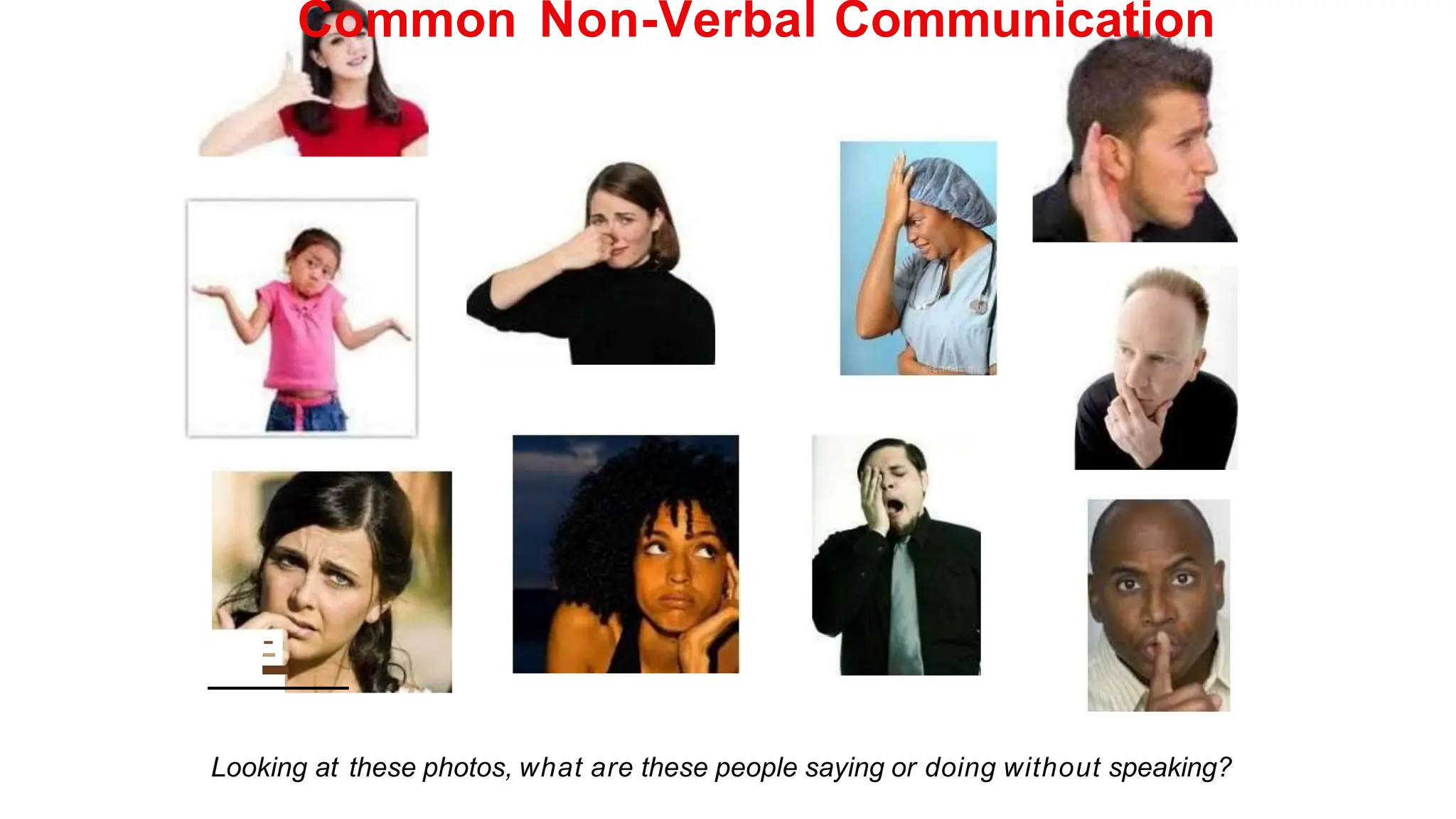
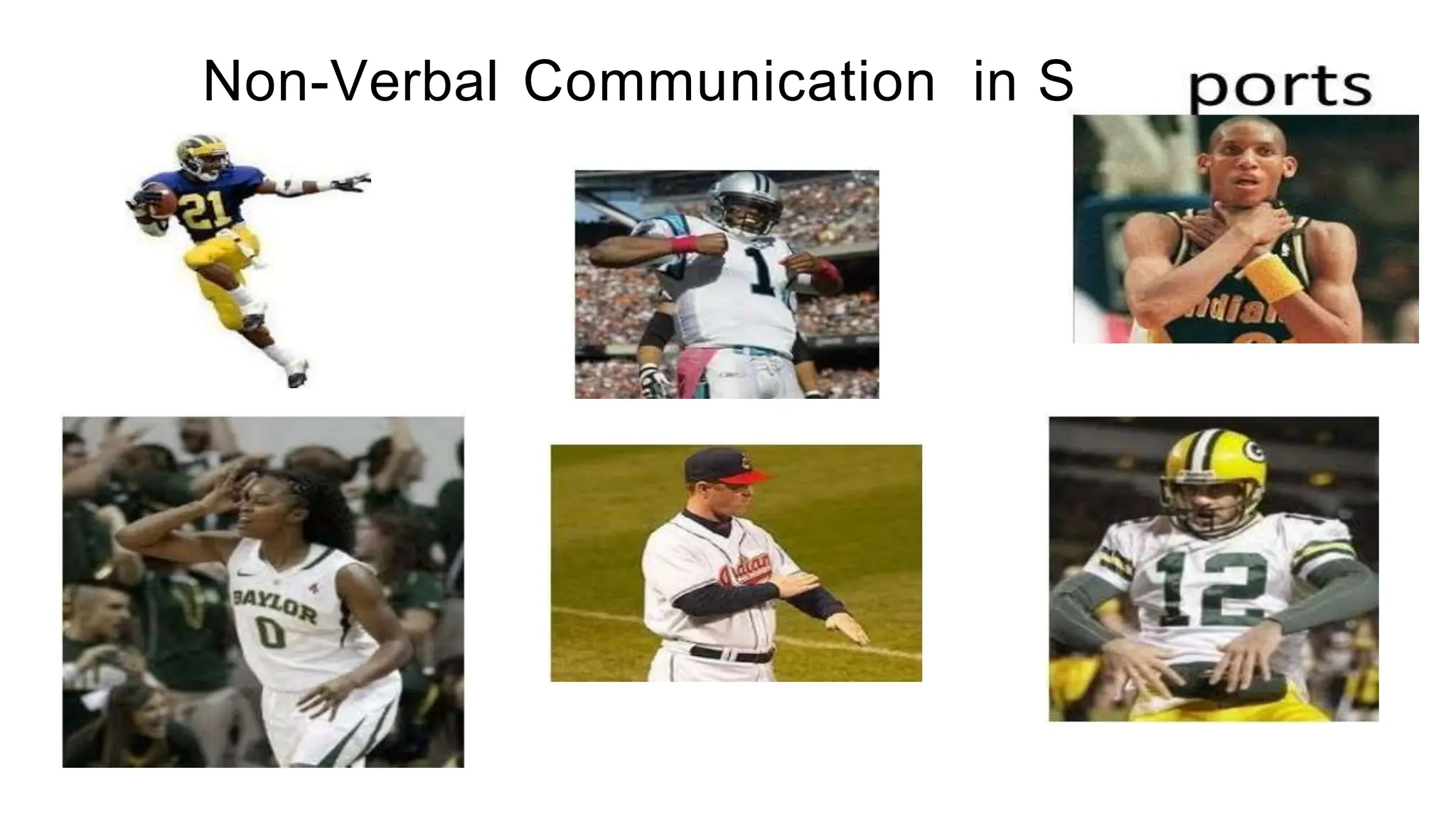
Common Non-Verbal Communication
Looking at these photos, what are these people saying or doing without speaking?
Non-Verbal Communication in S
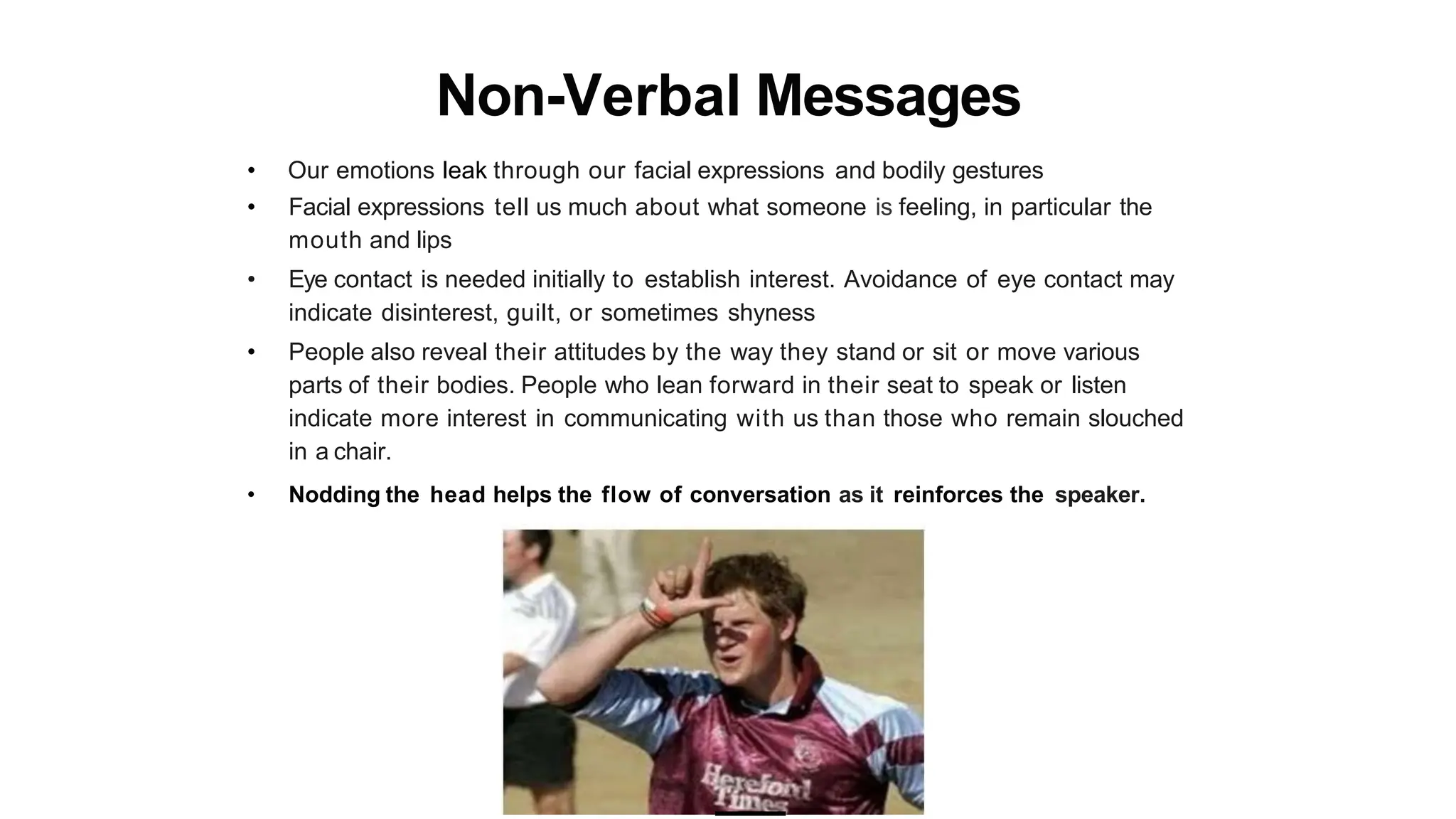
Non-Verbal Messages
• Our emotions leak through our facial expressions and bodily gestures
• Facial expressions tell us much about what someone is feeling, in particular the
mouth and lips
• Eye contact is needed initially to establish interest. Avoidance of eye contact may
indicate disinterest, guilt, or sometimes shyness
• People also reveal their attitudes by the way they stand or sit or move various
parts of their bodies. People who lean forward in their seat to speak or listen
indicate more interest in communicating with us than those who remain slouched
in a chair.
• Nodding the head helps the flow of conversation as it reinforces the speaker.
COMMUNICATION TOOLS
There are four basic communication tools:
• Listening
• Speaking
• Reading
• Writing
·-
Of the above1 which one are we not taught?
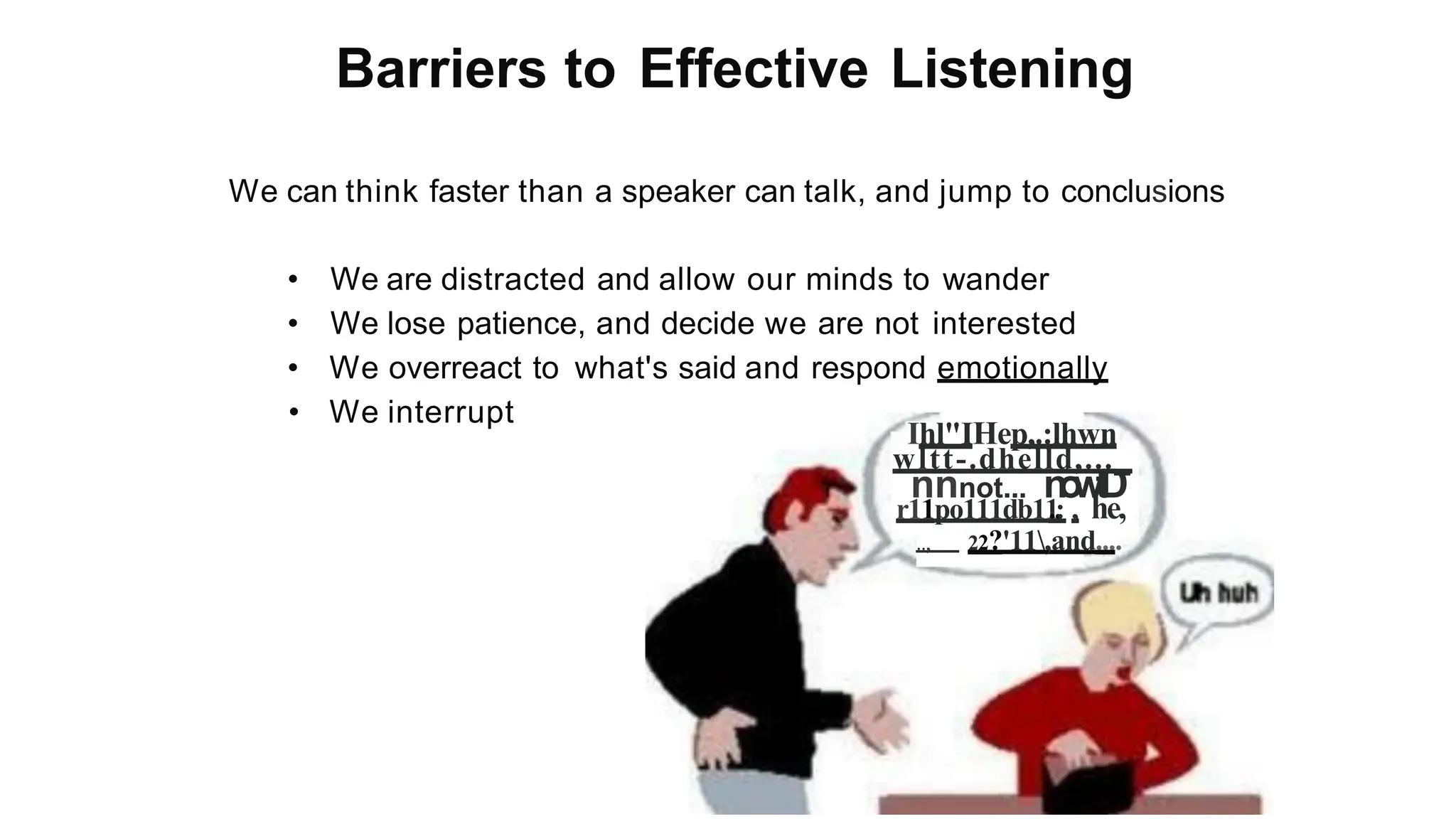
Barriers to Effective Listening
We can think faster than a speaker can talk, and jump to conclusions
• We are distracted and allow our minds to wander
• We lose patience, and decide we are not interested
• We overreact to what's said and respond emotionally
• We interrupt
Ihl"IHep,.:lhwn
wltt-.dhelld,..._
nnnot... n
o
w
t
D
r11po111db11
..
: , he,
.., 22?'11,and....
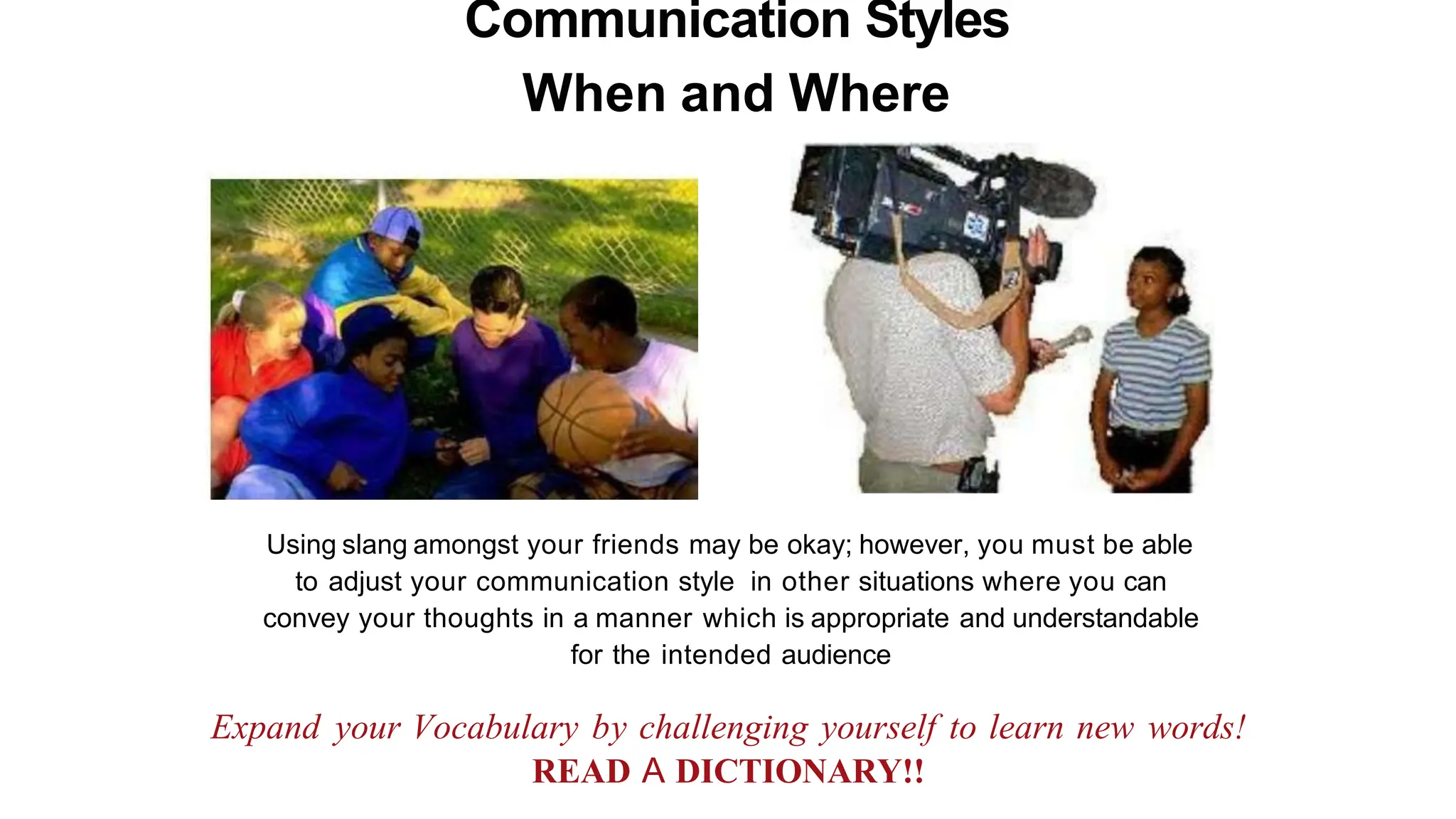
Communication Styles
When and Where
Using slang amongst your friends may be okay; however, you must be able
to adjust your communication style in other situations where you can
convey your thoughts in a manner which is appropriate and understandable
for the intended audience
Expand your Vocabulary by challenging yourself to learn new words!
READ A DICTIONARY!!
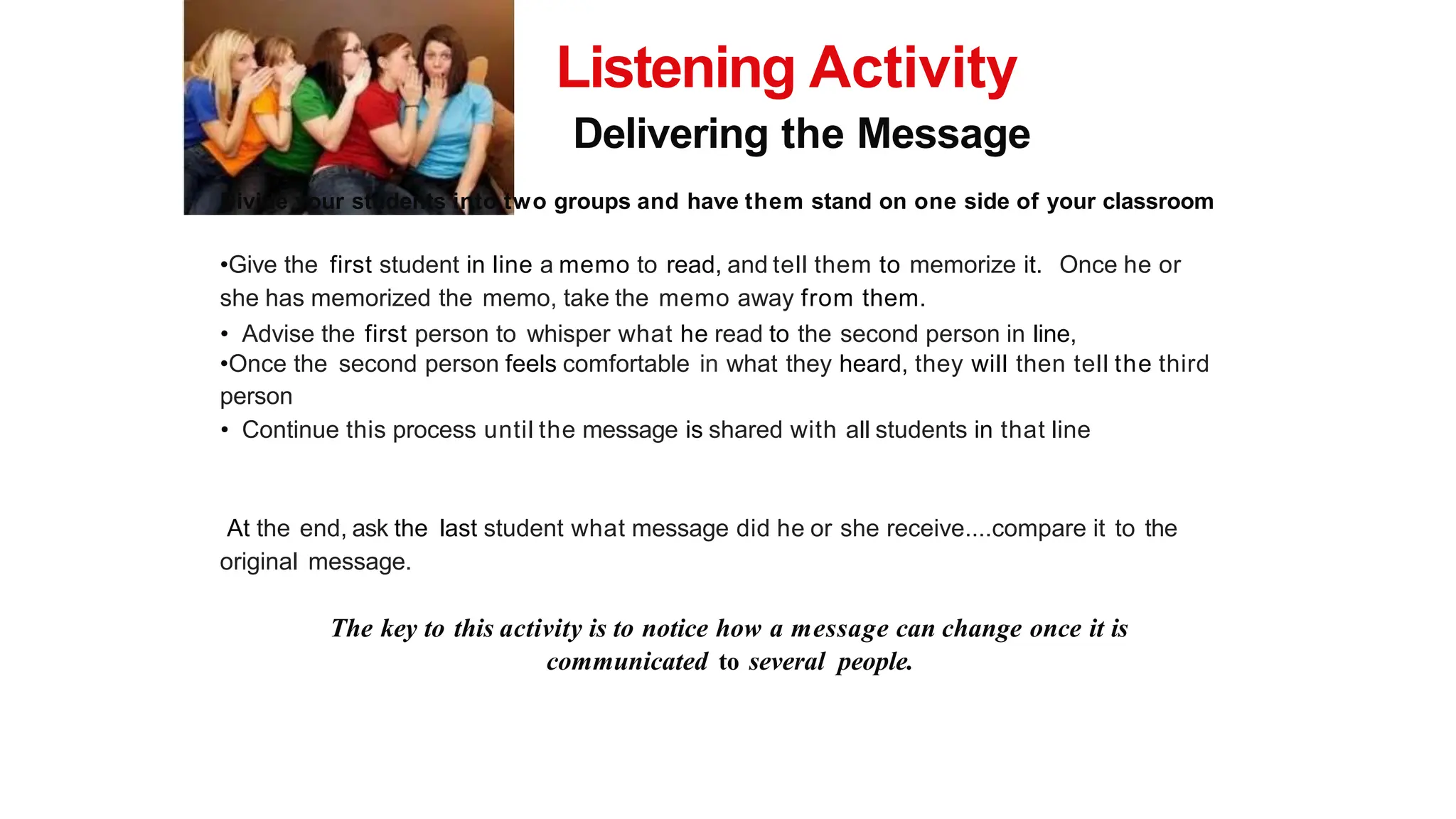
Listening Activity
Delivering the Message
Divide your students into two groups and have them stand on one side of your classroom
•Give the first student in line a memo to read, and tell them to memorize it. Once he or
she has memorized the memo, take the memo away from them.
• Advise the first person to whisper what he read to the second person in line,
•Once the second person feels comfortable in what they heard, they will then tell the third
person
• Continue this process until the message is shared with all students in that line
At the end, ask the last student what message did he or she receive....compare it to the
original message.
The key to this activity is to notice how a message can change once it is
communicated to several people.
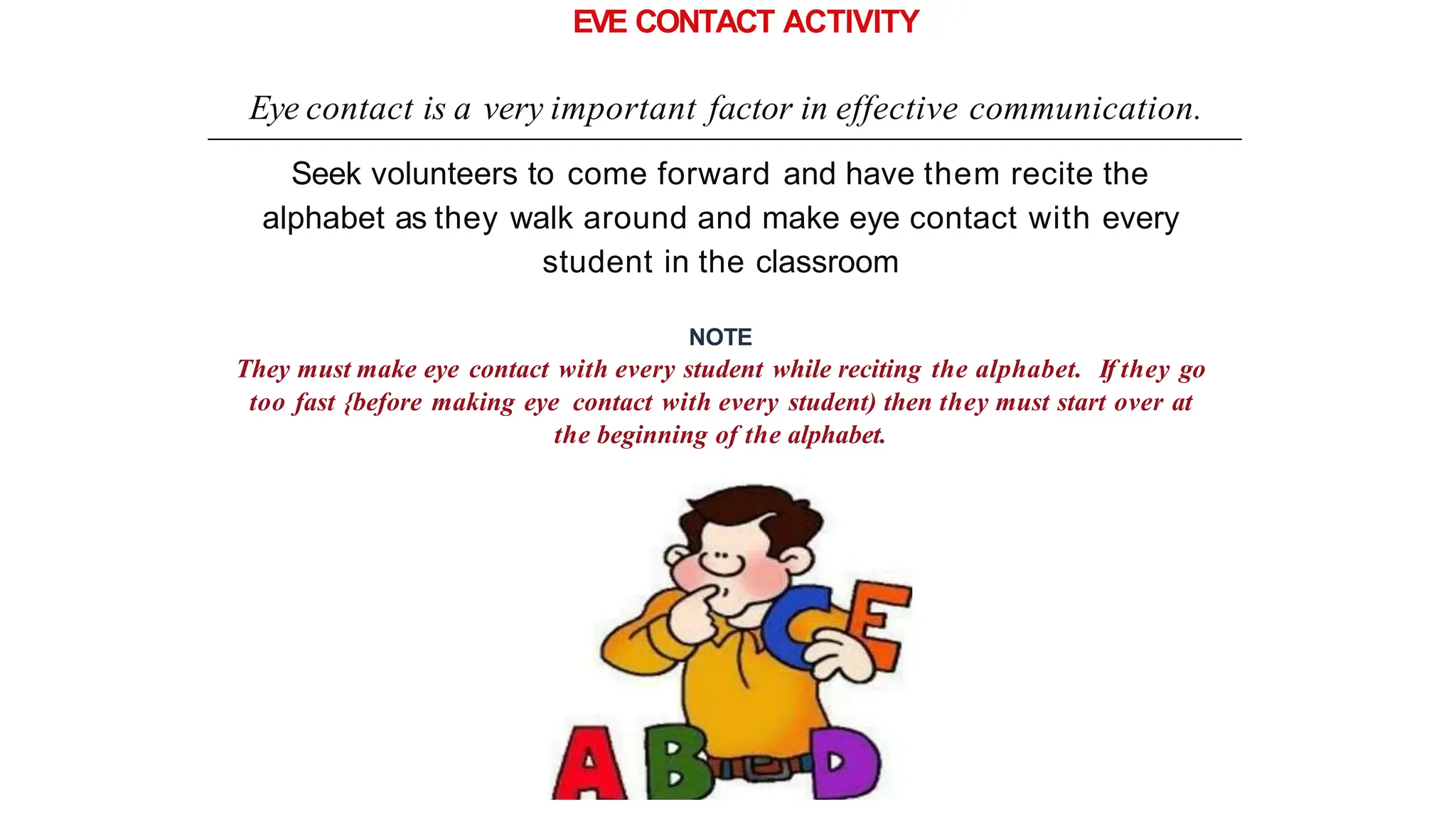
EVE CONTACT ACTIVITY
Eye contact is a very important factor in effective communication.
Seek volunteers to come forward and have them recite the
alphabet as they walk around and make eye contact with every
student in the classroom
NOTE
They must make eye contact with every student while reciting the alphabet. If they go
too fast {before making eye contact with every student) then they must start over at
the beginning of the alphabet.
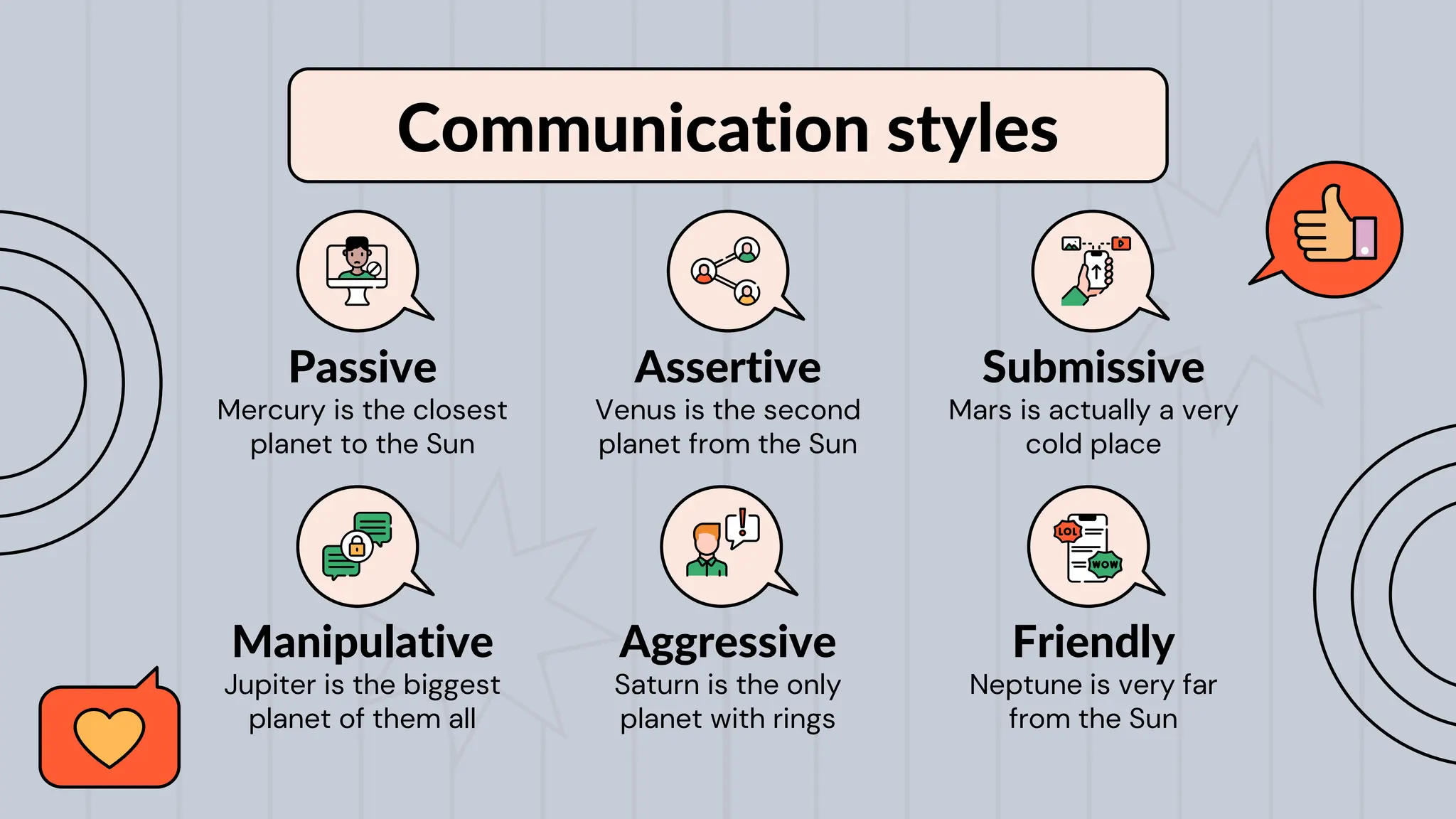
Communication styles
Mercury is the closest
planet to the Sun
Passive
Venus is the second
planet from the Sun
Assertive
Jupiter is the biggest
planet of them all
Manipulative
Saturn is the only
planet with rings
Aggressive
Mars is actually a very
cold place
Submissive
Neptune is very far
from the Sun
Friendly
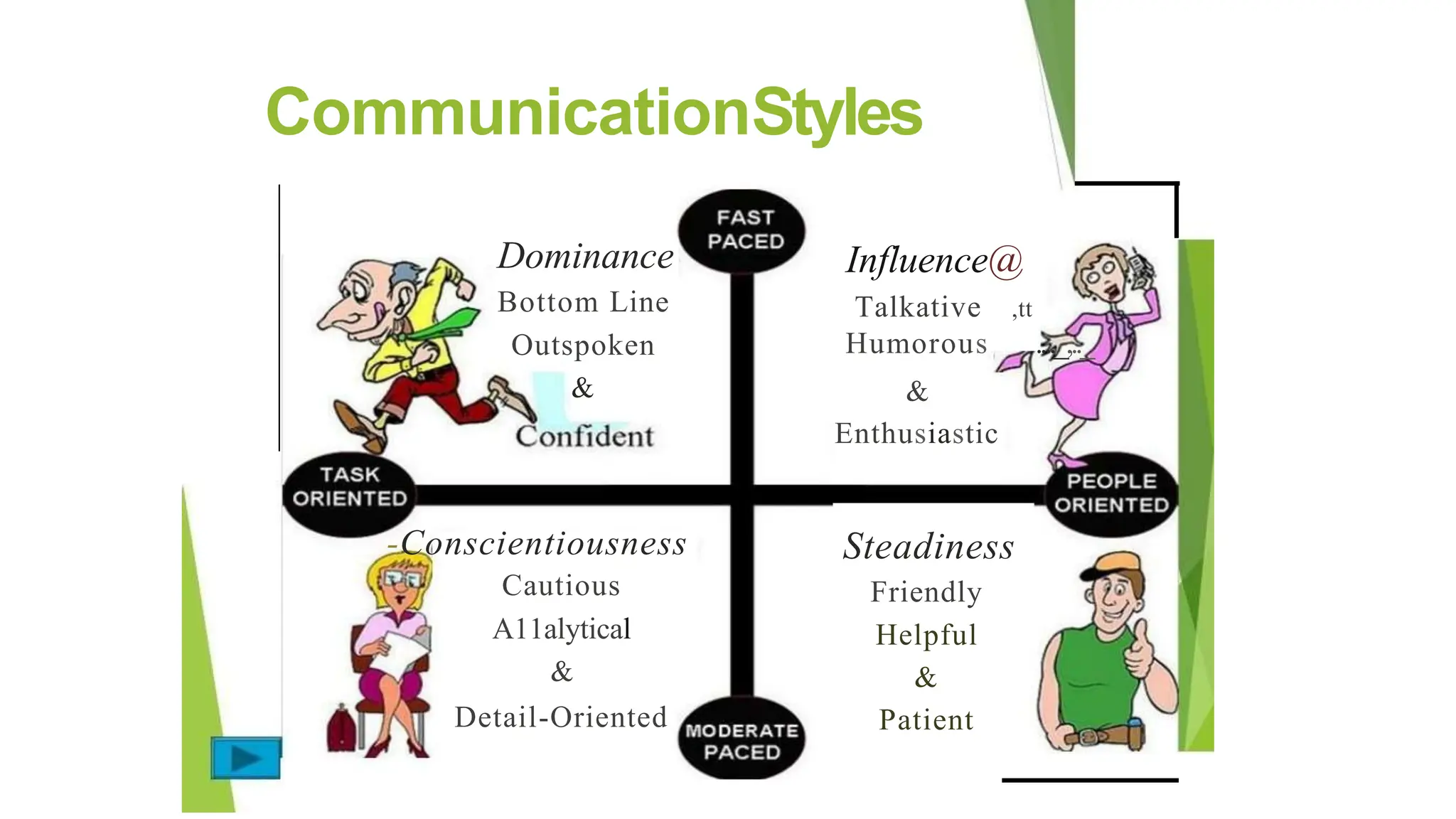
CommunicationStyles
Dominance
Bottom Line
Outspoken
&
...._,.._
Influence@
Talkative ,tt
Humorous
&
Enthusiastic
-Conscientiousness
Cautious
A11alytical
&
Detail-Oriented
Steadiness
Friendly
Helpful
&
Patient
Daminant Style 
I

►Value
control.
►Driven by a strong inner need to lead/achieve 
I
results.
►Take-charge people who seek toreach goals.
►Focus on results rather than process.
►Tend todownplay feelings and emotions.
►Sometimes viewed as "unfeeling
Influence Style
I
►Crave action and an energetic pace. 
►Seek opportunities to "shine" or to be "
on stage." I
►Relationshipstake priority over tasks.
►Focus is on outcomes. 
►Try to influence others with optimism
and friendliness.
►Recognition and approval are
strong motivators
Steadiness Style...
►Easy going and relationship focused.
►Value security.
'I
►Work tomaintain stable relationships/environme
►Find change difficult.
►Reliable and good at follow- through.
►Appreciate respect from others.
►Value others' respect of them
Conscientious
►Goal-oriented; driven to be precise and controlled


►Can seem uncomfortable at expressing or dealing wi

I

►Logical thinkers who value accuracy and organization.
.
►Like to think through tasks before starting.
►Feel a need to do things themselves.
►Perfectionists and strong desire for things to be "righ
emotions.
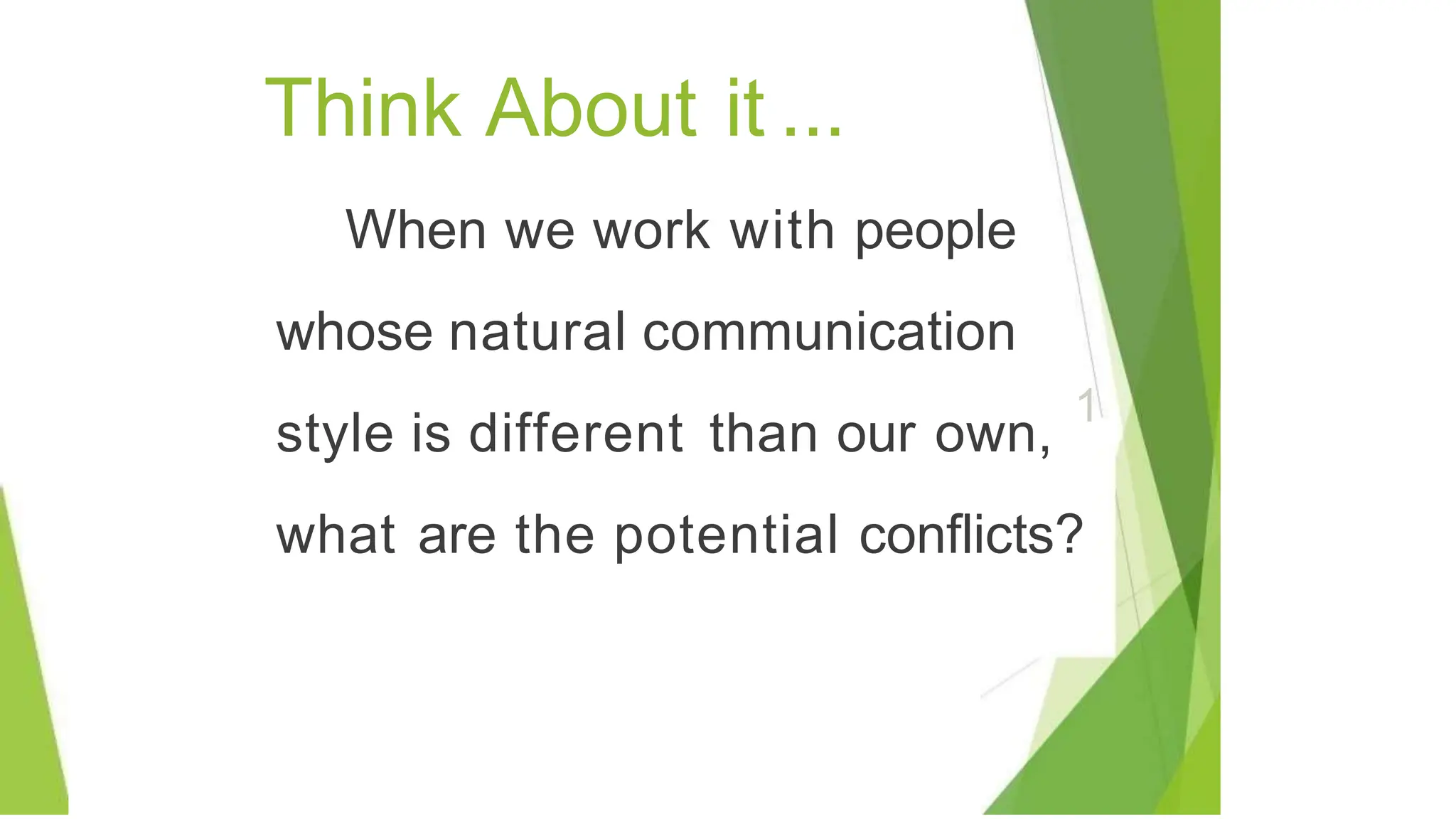
Think About it ...
When we work with people
whose natural communication
style is different than our own,
1
what are the potential conflicts?
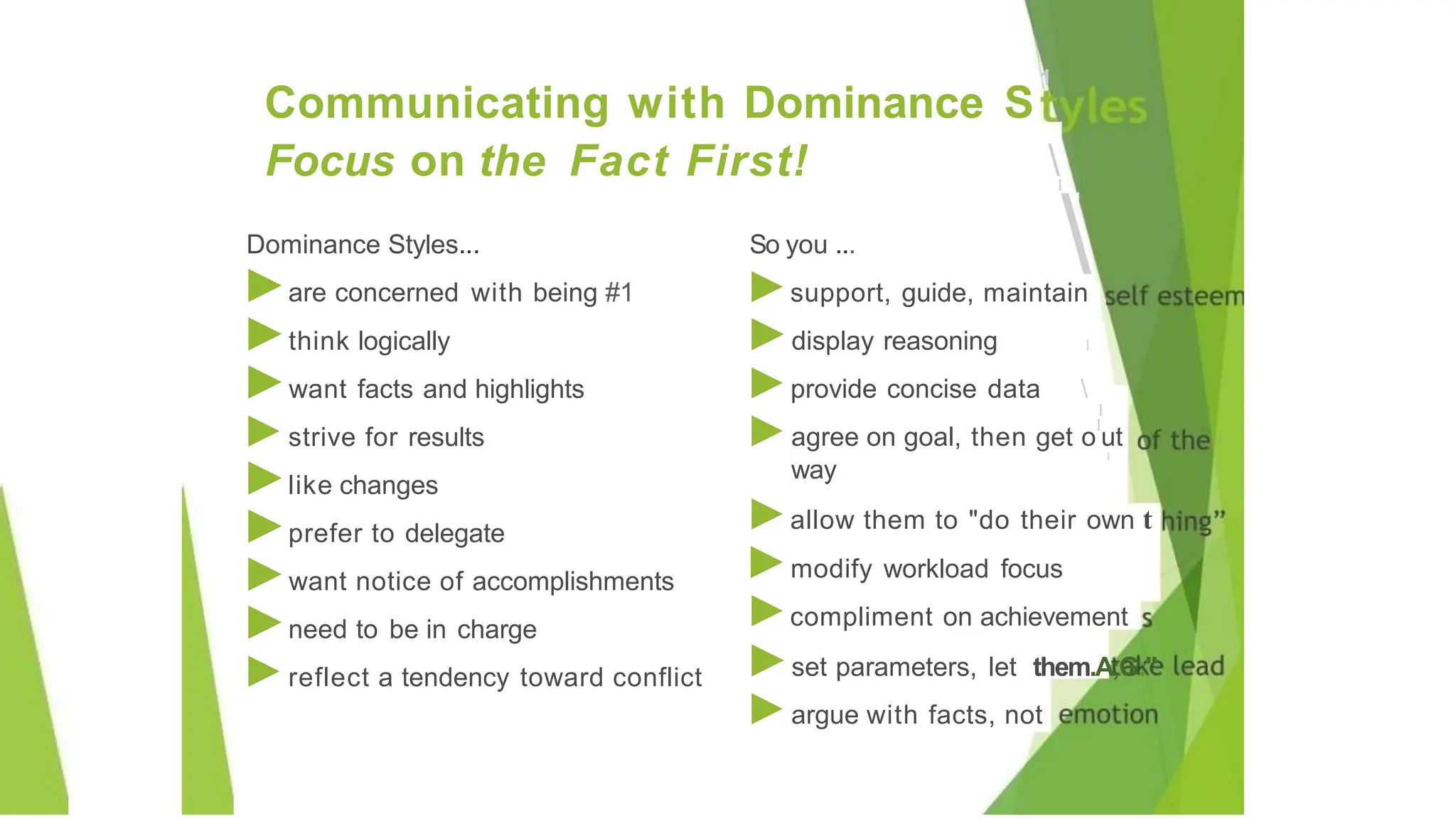
Dominance Styles... So you ...
►are concerned with being #1
►think logically
►want facts and highlights
►strive for results
►like changes
►prefer to delegate
►want notice of accomplishments
►need to be in charge
►reflect a tendency toward conflict
Communicating with Dominance S
1
Focus on the Fact First! I

1
I
l
way
►support, guide, maintain
►display reasoning
►provide concise data 
►agree on goal, then get o
I
ut
►allow them to "do their own t
►modify workload focus
►compliment on achievement
►set parameters, let them.A;G:"
►argue with facts, not
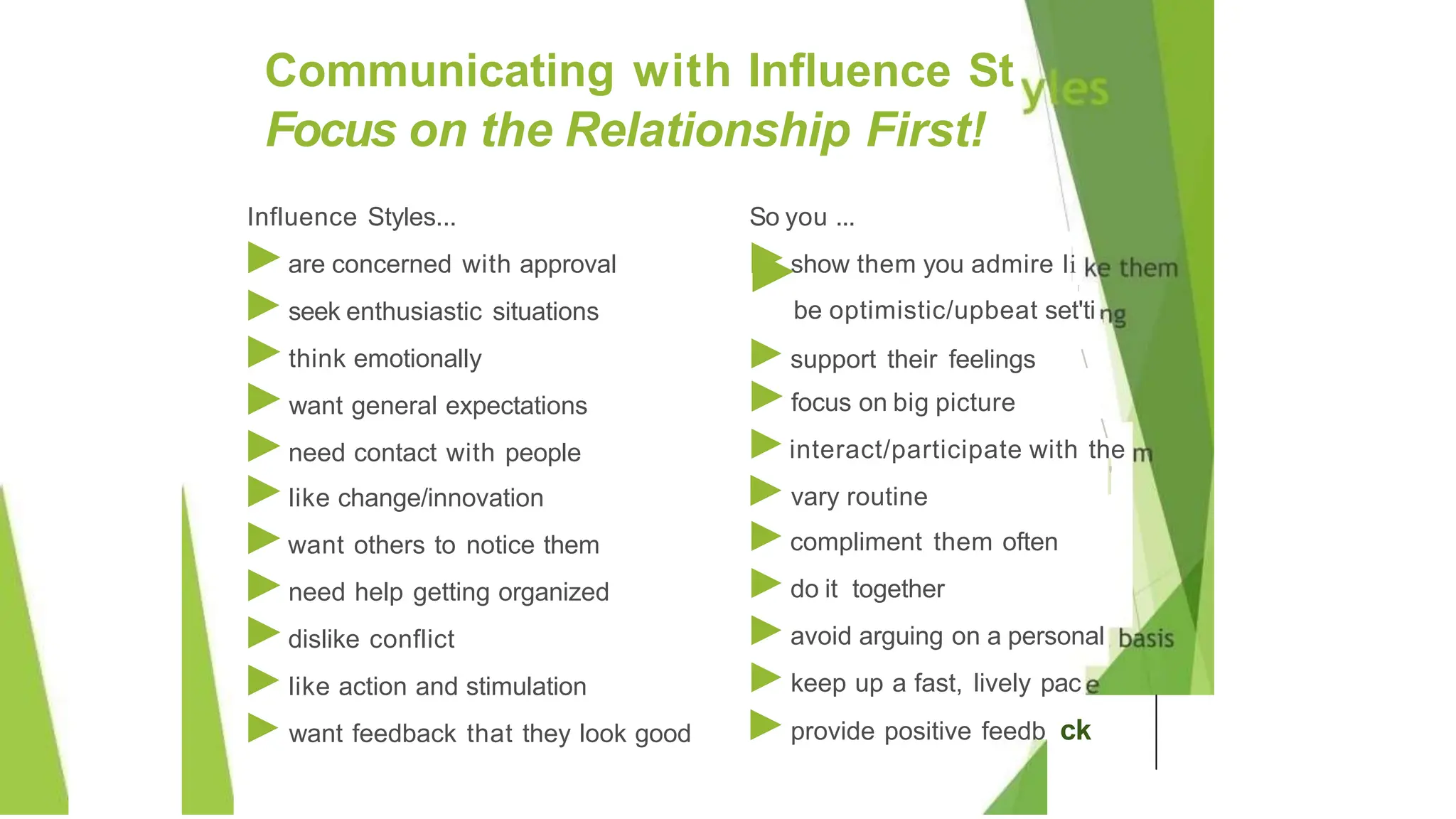
Communicating with Influence St
Focus on the Relationship First!
Influence Styles... So you ...
►are concerned with approval
►seek enthusiastic situations
►think emotionally
►want general expectations
►need contact with people
►like change/innovation
►want others to notice them
►need help getting organized
►dislike conflict
►like action and stimulation
►want feedback that they look good

'
►show them you admire li
► I
be optimistic/upbeat set'ti
►support their feelings 
►focus on big picture
►interact/participate with the
►vary routine
►compliment them often
►do it together
►avoid arguing on a personal
►keep up a fast, lively pac
►provide positive feedb ck
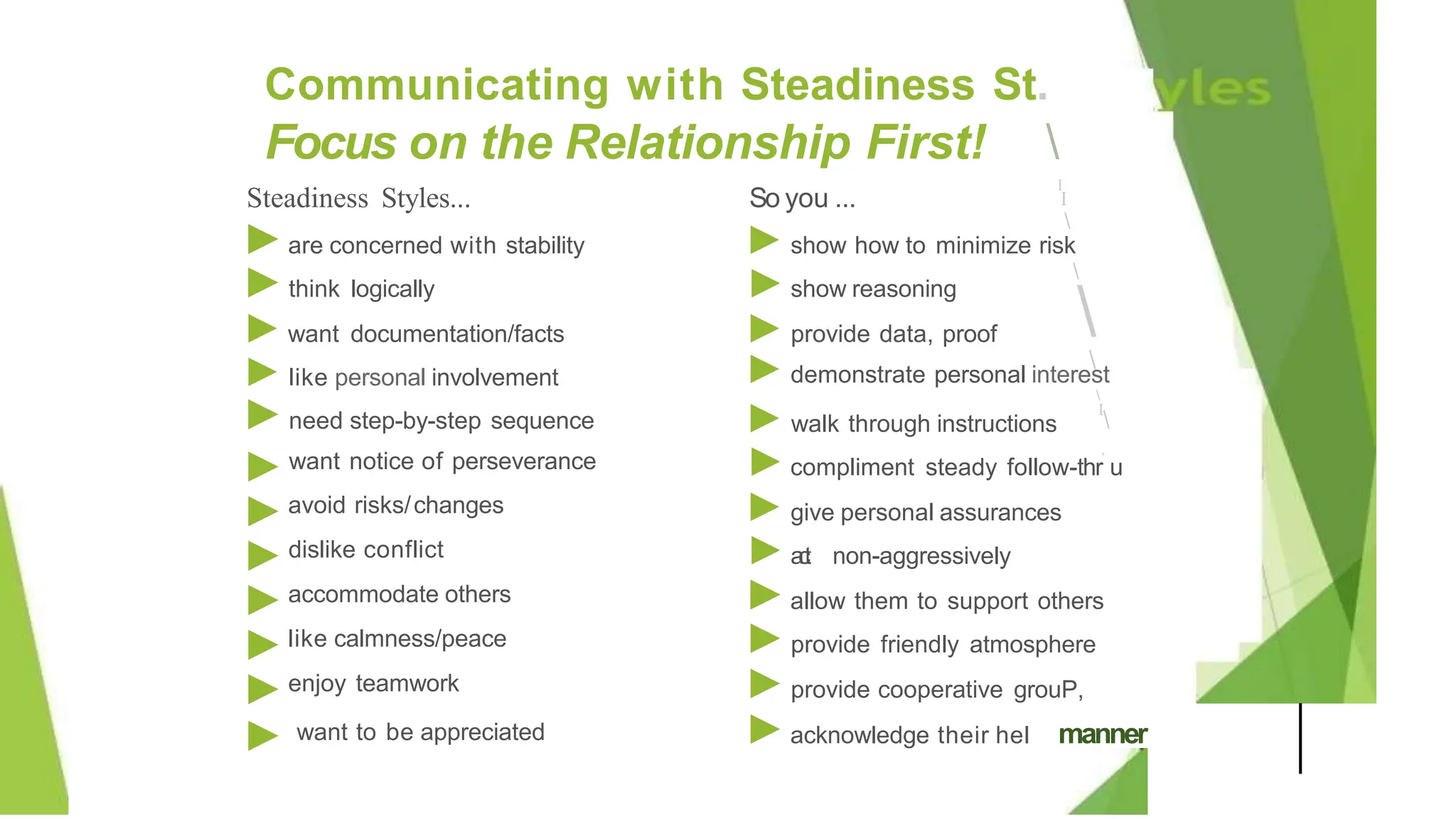
Steadiness Styles... So you ...
Communicating with Steadiness St.
Focus on the Relationship First! 
I
I


►
►
►
►
►
►
►
►are concerned with stability
►think logically
►want documentation/facts
►like personal involvement
►need step-by-step sequence
want notice of perseverance
avoid risks/changes
dislike conflict
accommodate others
like calmness/peace
enjoy teamwork
want to be appreciated

I

►show how to minimize risk
►show reasoning

►provide data, proof
►demonstrate personal interest

► walk through instructions
►compliment steady follow-thr
'
u
►give personal assurances
►a
c
t non-aggressively
►allow them to support others
►provide friendly atmosphere
►provide cooperative grouP,
►acknowledge their hel manner
Steadiness Styles...
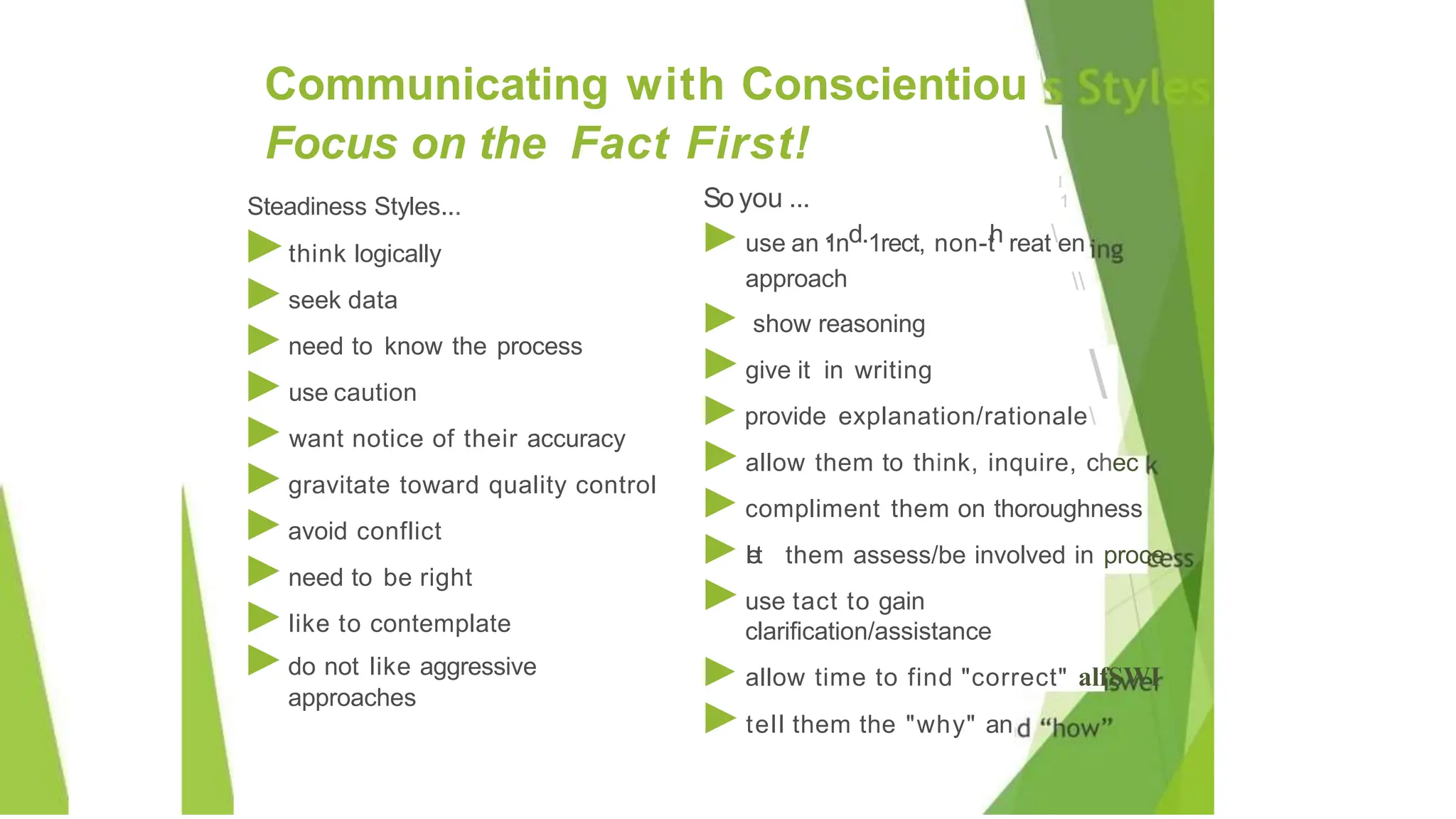
►think logically
►seek data
►need to know the process
►use caution
►want notice of their accuracy
►gravitate toward quality control
►avoid conflict
►need to be right
►like to contemplate
►do not like aggressive
approaches
Communicating with Conscientiou
Focus on the Fact First! 
I
1
So you ...


►use an 1
.nd.1rect, non-t
h reaten
approach
► show reasoning
►give it in writing
►provide explanation/rationale
►allow them to think, inquire, chec
►compliment them on thoroughness
►let them assess/be involved in proce
►use tact to gain
clarification/assistance
►allow time to find "correct" alfSWI
►tell them the "why" an
Best strategies
03
You can enter a subtitle here if you need it
HOW TO IMPROVE YOUR INTERPERSONAL
COMMUNICATION SKILLS
•There are many tools available to help you improve
your interpersonal communication skills.
■The better you become at using these tools, the
better you'll be at communicating with other people.
•The two primary categories of these tools are verbal
and nonverbal tools.
People judge you by the words you use, and this is true because
words are a way of expressing yourself.
Words have power. They have the power to build and they
have the power to destroy as welI.
Avoid using slang words or slurs of any type which will make
people to think negatively of you.
Your vocabulary can reveal to others how educated you are
and others may make judgments about you that can affect
your opportunities with them.
The best communicators will use an expanded vocabulary
with more educated groups and a more basic vocabulary
with less-educated groups.
An expanded vocabulary will help you express yourself better
It is the act of articulating words correctly in terms of how
they sound..
Pronouncing a word incorrectly can lead to embarrassment yet
it is something that can be avoided..
Examples of words usually pronounced incorrectly are;
JEOPARDY
CHASSIS
COIFFURE
DHOW... etc
It is the ability to convey information in a brief and concise
manner.
It requires you to stop beating about the bush and go straight to the
point.
Brevity requires you to leave out any irrelevant details
Brevity shows that you respect and value the other person's time.
Former US president Franklyn D. Roosevelt once said BE SINCERE,
BE BRIEF, BE SEATED"
The emotions you communicate while speaking are vital.
The key here is to show emotion without getting emotional.11
Emotions can be a very effective communicator. For example,
showing anger can communicate that you are very serious
about something. For example summons on hell-fire
Emotions allow you to put more of you into what you say.
COMMUNICATION IS 20% WHAT YOU KNOW AND 80% WHAT
YOU FEELABOUTWHATYOU KNOW..
Listening is about giving your attention to sound or actions.
When listening, you must hear what others are saying, and trying
to understand what it means and then respond accordingly
A good listener has the following attributes;
Does not interrupt the speaker
.... AVOIDS distractions
+- Faces the speaker and maintains eye contact
+- Give feedback through body language and paralinguistics
+- Tries to feel the speakers emotions etc
BODY LANGUAGE IN
INTERPERSONAL COMMUNICATION
Body language is a type of non-verbal communication that relies
on body movements such as gestures, posture and facial
expressions to convey messages.
It can be used consciously or unconsciously and may accompany
verbal messages or serve as a substitute for speech
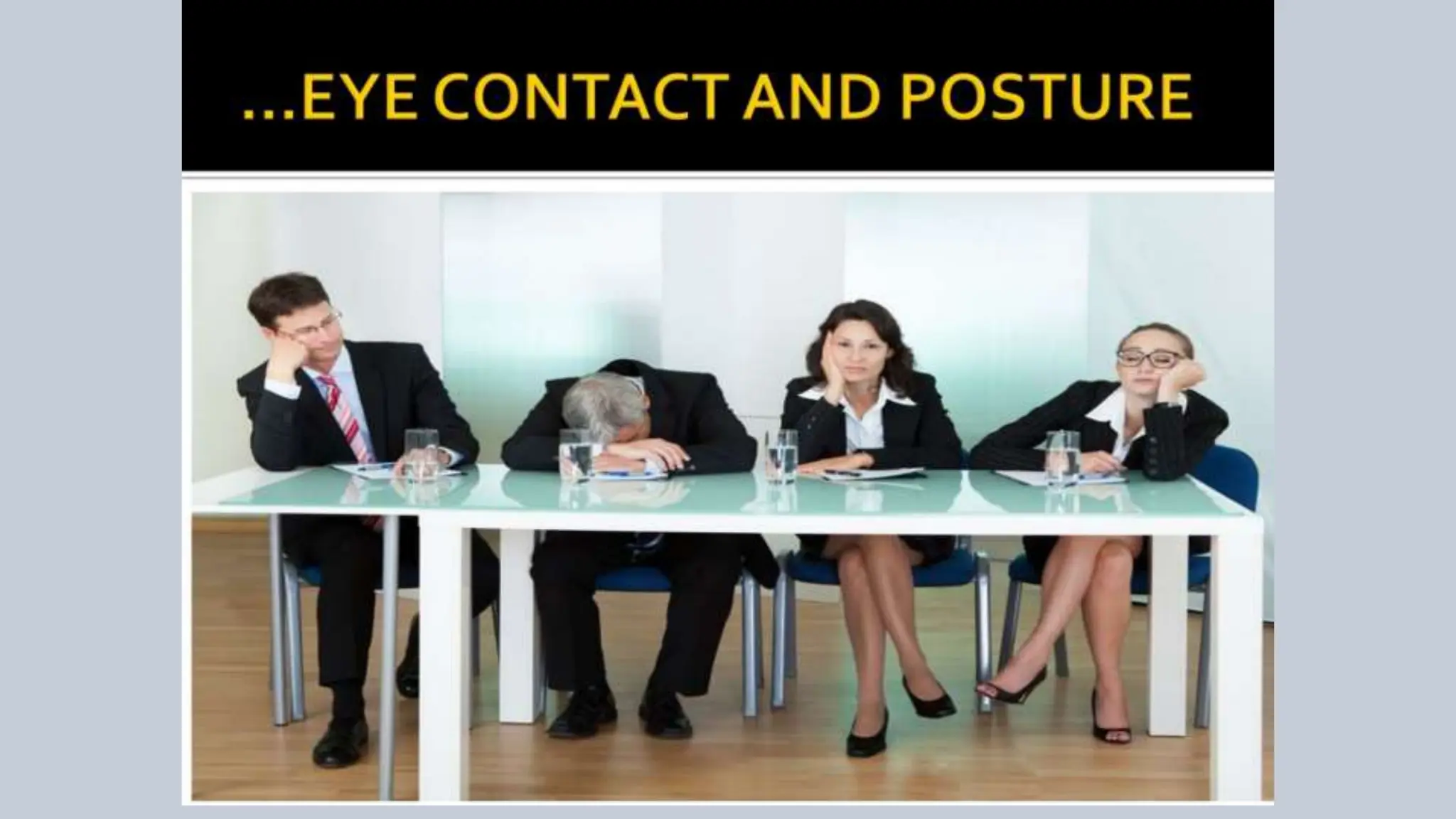
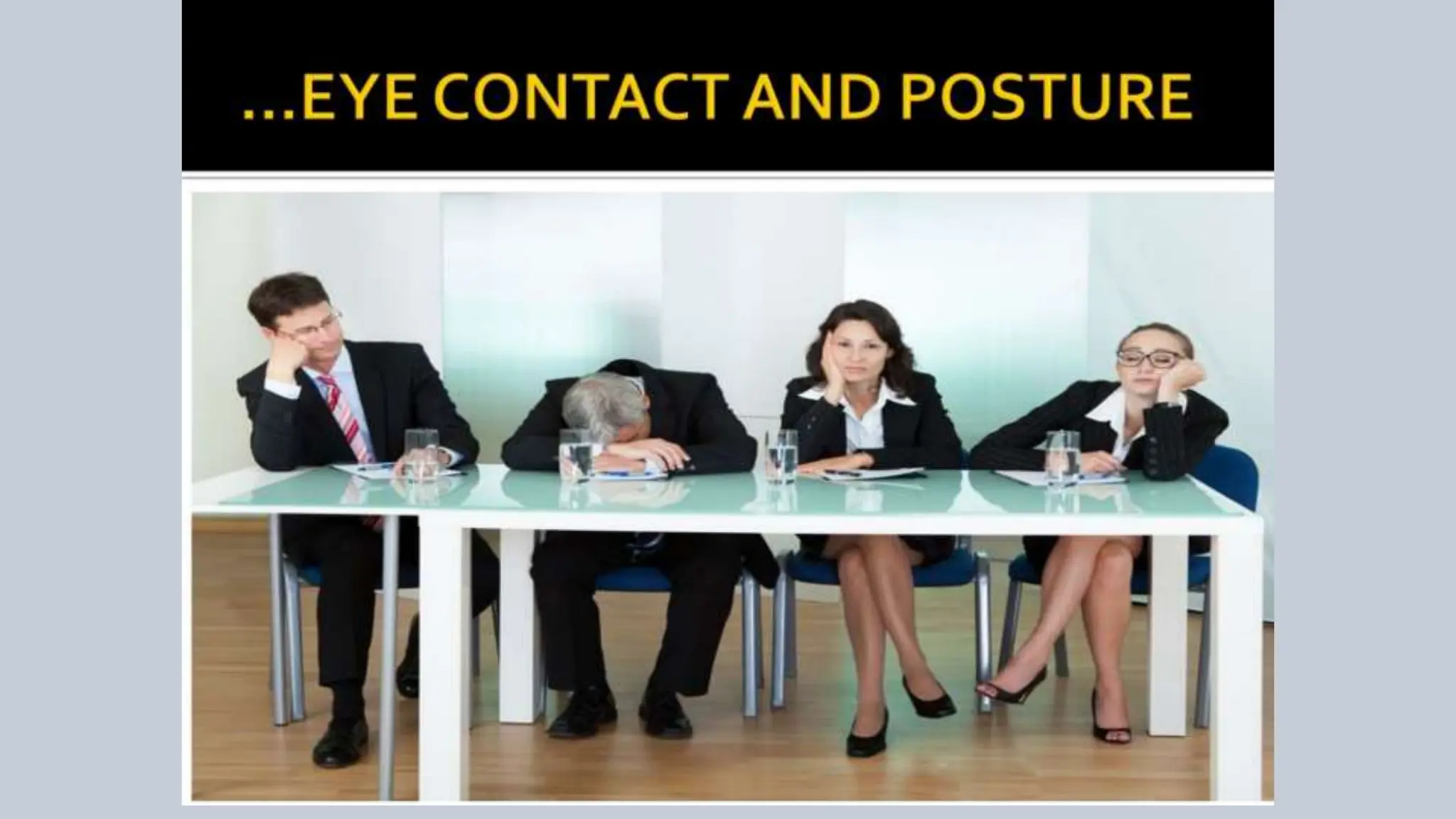
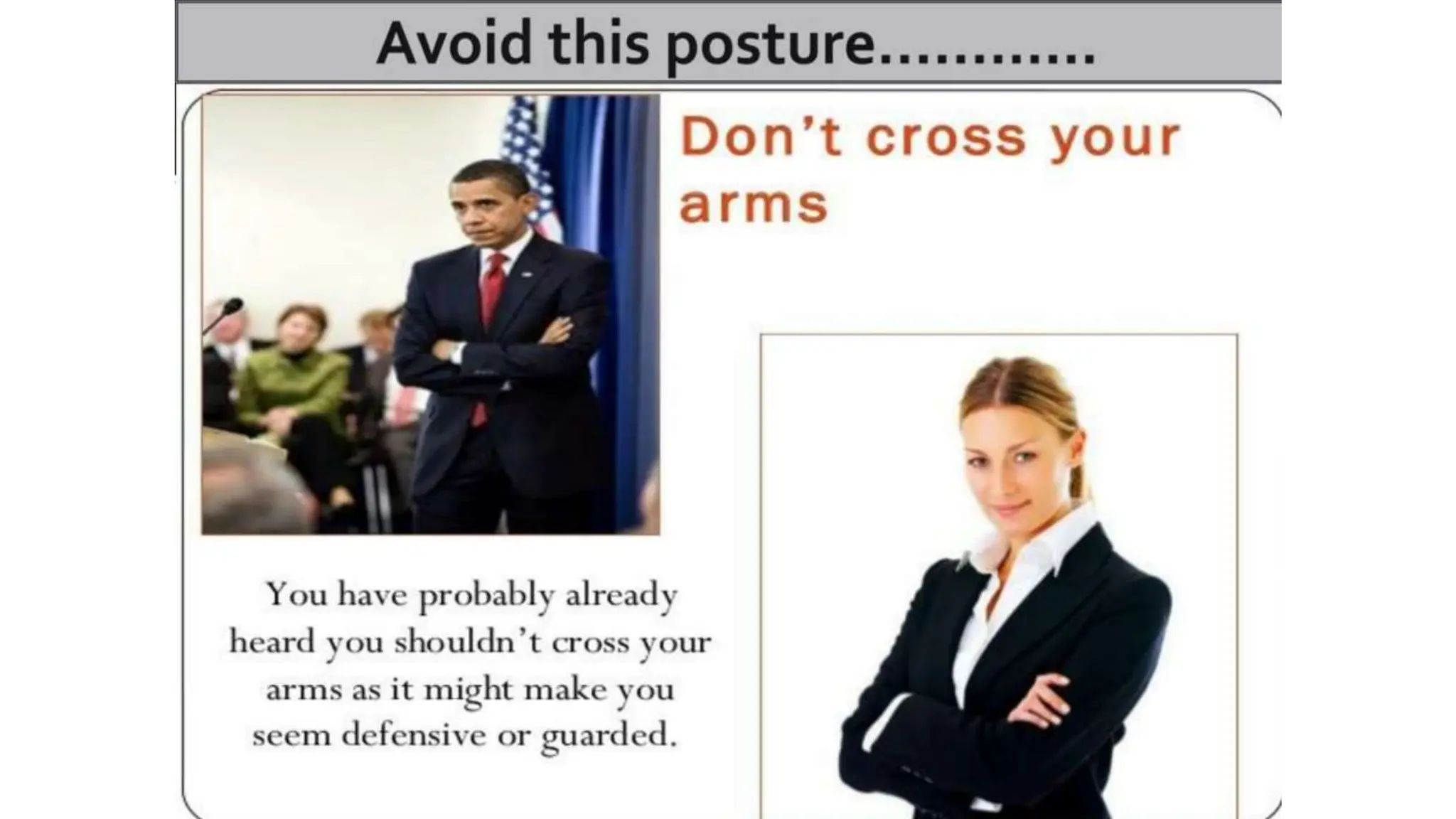
Having and sustaining eye contact with someone is a sign of
interest and sincerity
Posture is the manner in which
communicating with someone
you sit or stand when
For example when you talk to someone and he or she is
leaning towards the door.... It means they are in a hurry
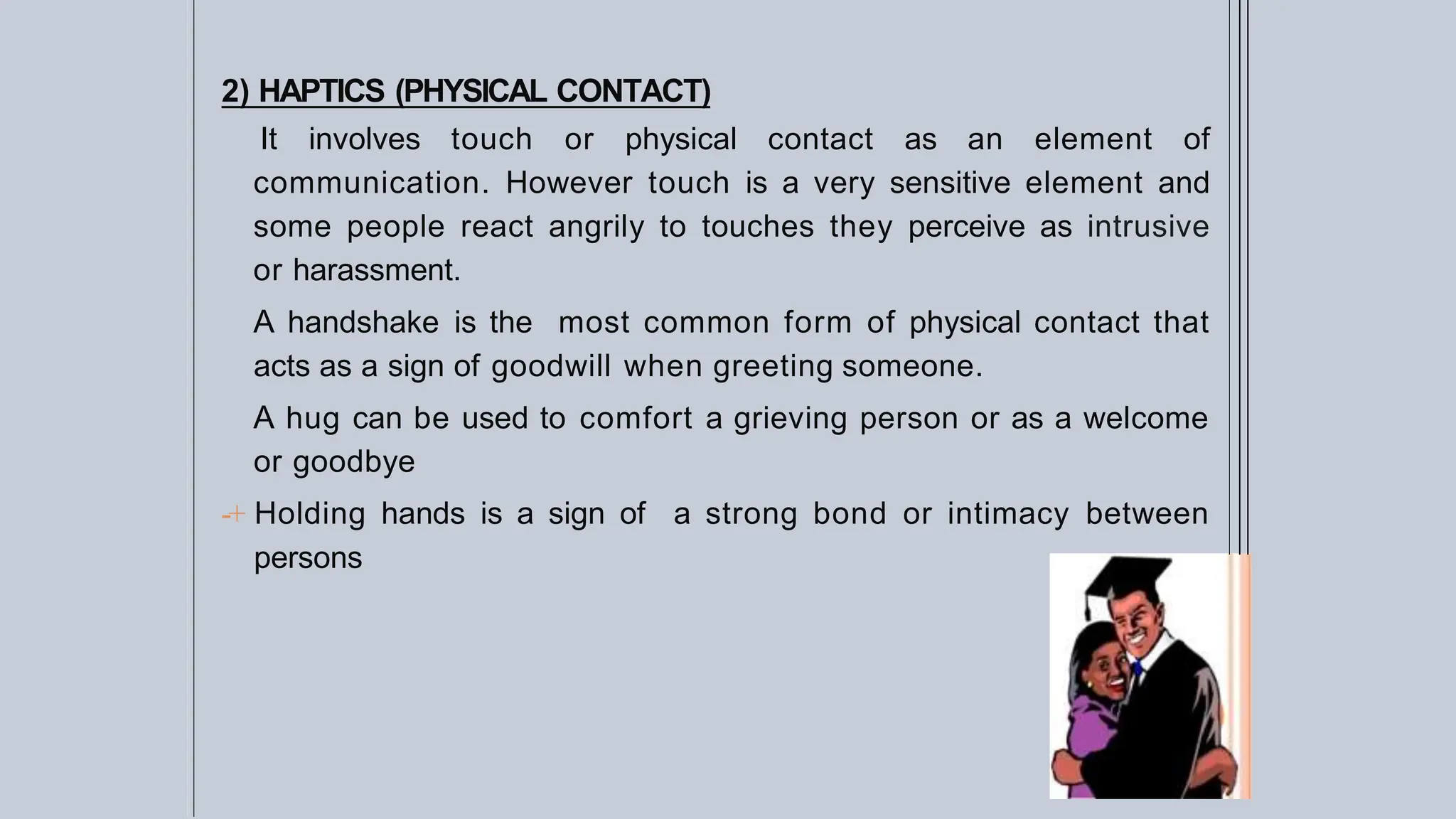
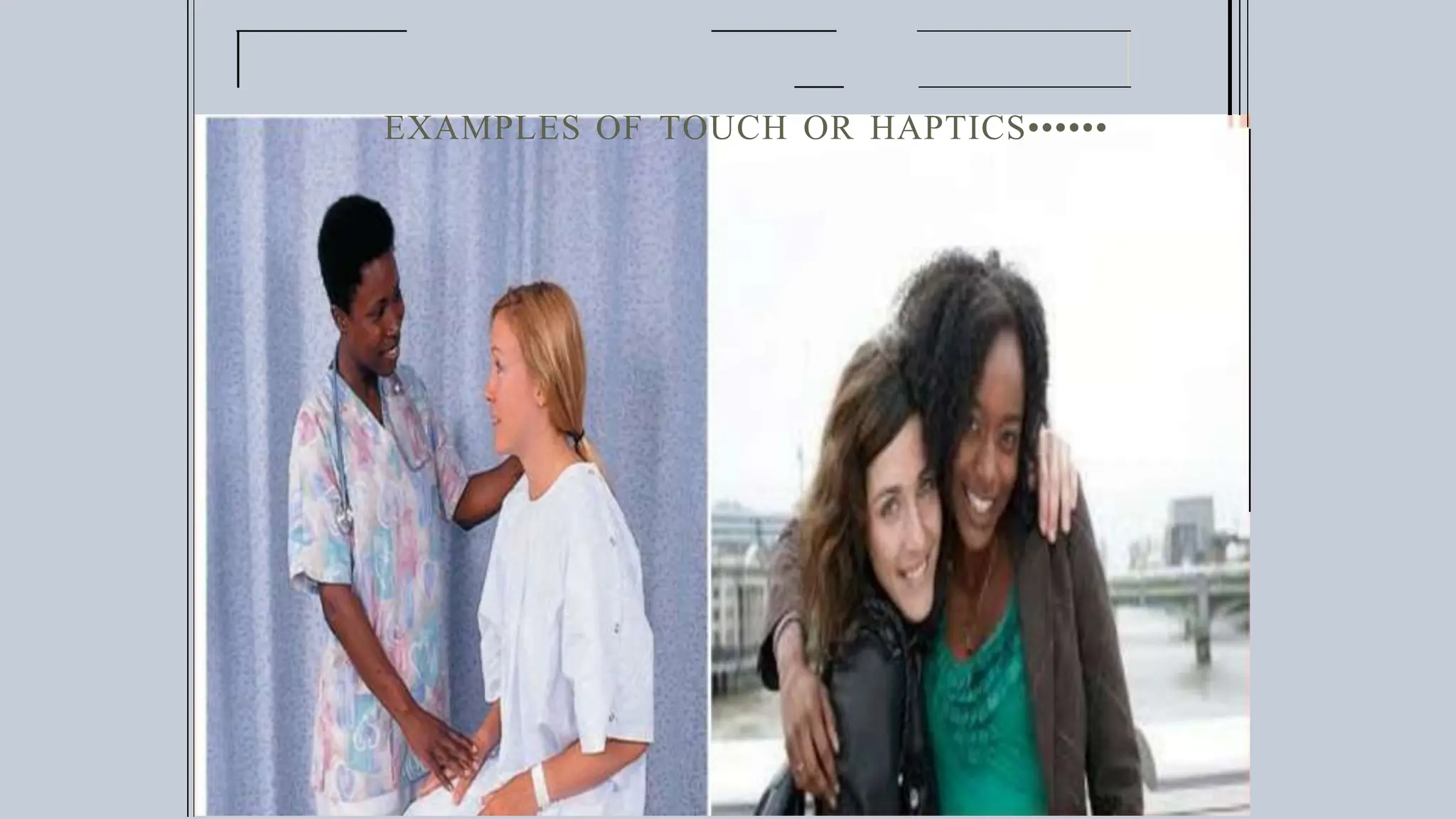
2) HAPTICS (PHYSICAL CONTACT)
It involves touch or physical contact as an element of
communication. However touch is a very sensitive element and
some people react angrily to touches they perceive as intrusive
or harassment.
A handshake is the most common form of physical contact that
acts as a sign of goodwill when greeting someone.
A hug can be used to comfort a grieving person or as a welcome
or goodbye
-+ Holding hands is a sign of a strong bond or intimacy between
persons
EXAMPLES OF TOUCH OR HAPTICS••••••
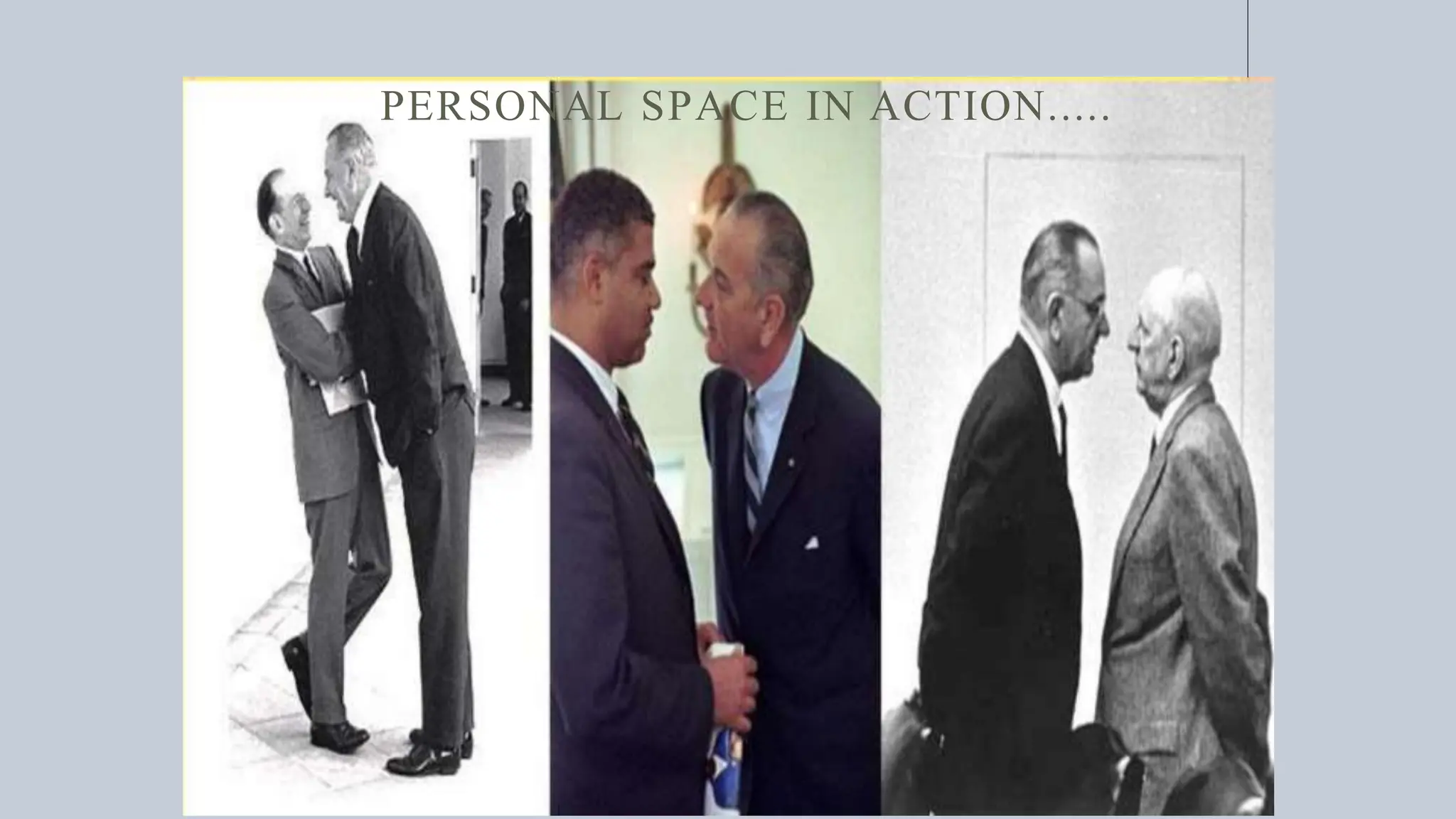
3) PROXEMICS/ PERSONAL SPACE
_. It refers to the physical distance between two people in a
social, family or work environment.
_. The distance between 2 people can tell you the nature of their
relationship. (whether it good or bad)
we feel very awkward or annoyed when someone invades our
personal space ( for example by standing too close)
-+ But you also wonder why your friend is sitting or standing far
away from you.
.,. how you handle personal space depends on your culture, the
social situation, gender, your relationship with the other person
and your intention...
PERSONAL SPACE IN ACTION.....
TIPS TO REMEMBER ON PERSONAL SP ACE
-+Never lean over someone else's shoulder to read or view
something unless you have been invited to do so
-+ Never go through someone's personal belongings.. This would be
an invasion of personal space
-+ Do not fling your arm around someone's shoulder or pat someone
on the back unless you know each other very well
-+When someone leans away from you, you are probably in that
person's intimate space... you need to step back
-+ Do not enter a room or office without knocking first. That room or
office is someone's personal space..
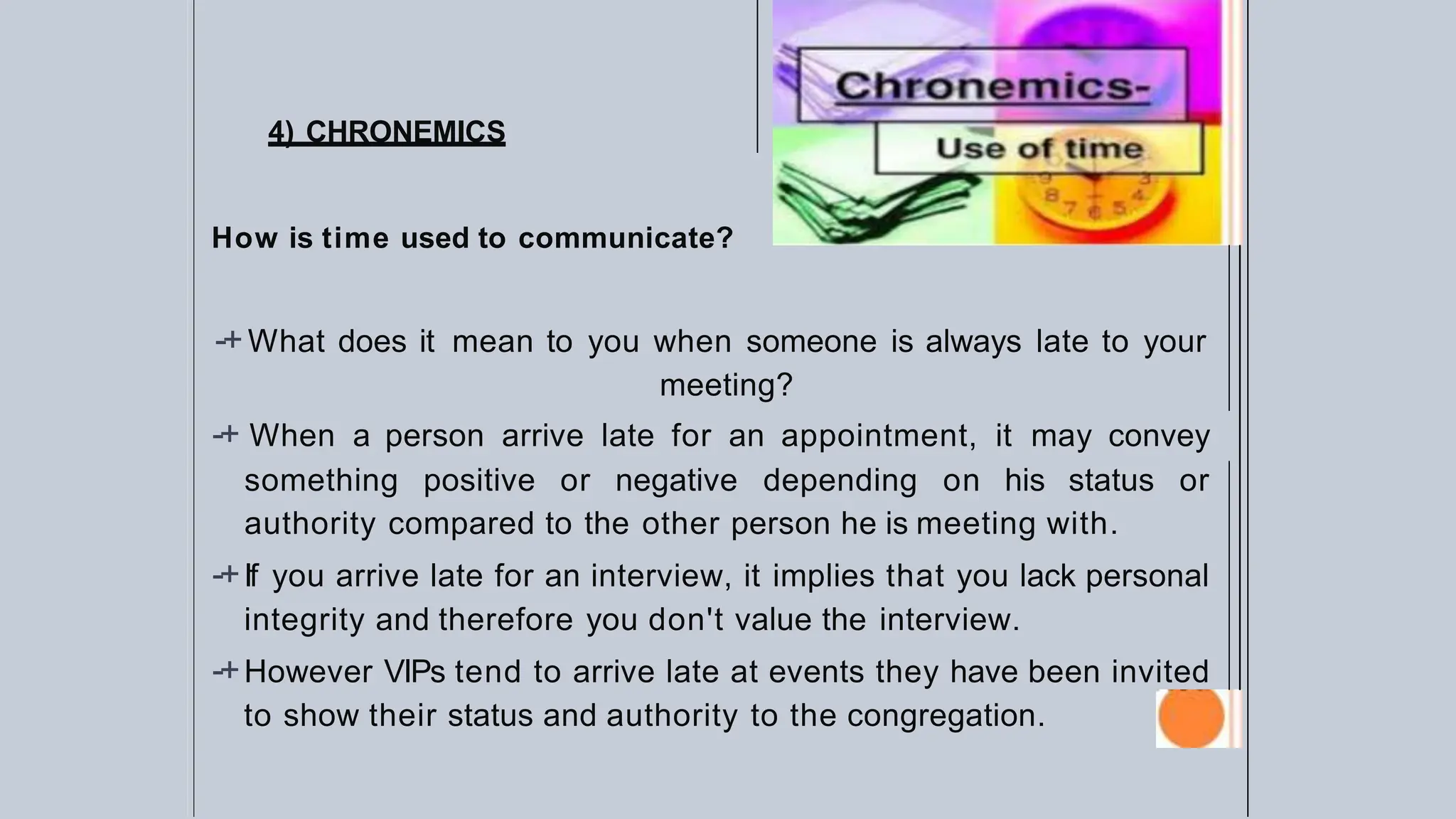
4) CHRONEMICS
How is time used to communicate?
-+What does it mean to you when someone is always late to your
meeting?
-+ When a person arrive late for an appointment, it may convey
something positive or negative depending on his status or
authority compared to the other person he is meeting with.
-+If you arrive late for an interview, it implies that you lack personal
integrity and therefore you don't value the interview.
-+However VIPs tend to arrive late at events they have been invited
to show their status and authority to the congregation.
5) SILENCE
''speech is silver; silence is golden."
● -+ Keeping quiet can
communicate contentment,
awkwardness, anger, respect,
thoughtfulness, empathy etc.
depending on the situation.
● -+ Positive silence relates to someone
who uses silence as a tool of
communication to promote, to
solidify or to maintain the
TRANSACTIONAL
ANALYSIS
INTRODUCTION
● The study of human behaviour is very complex and
complicated concept.
● It is affected by the psychological factors such as perception,
learning, peronality and motivation.
● In addition to these factors, individual behaviour affects and
affected by the behaviour of others.
● One of the major problems in the study of organisational
behaviour is to analyse and improve, the interpersonal
relationships.
● One basic approach to study interpersonal relations in an
organisational system is transactional analysis.
● This analysis deals with understanding, predicting and
controlling interpersonal relationships.
TRANSACTIONAL ANALYSIS
● It was introduced by Eric Berne.
● Transactional analysis is a technique used to help
people better understand their own and other’s
behaviour, especially in interpersonal relationships.
● It is a good method for understanding interpersonal
behaviour.
● It offers a model of personality and the dynamics of
self and its relationship to others that makes
possible a clear and meaningful discussion of
behaviour.
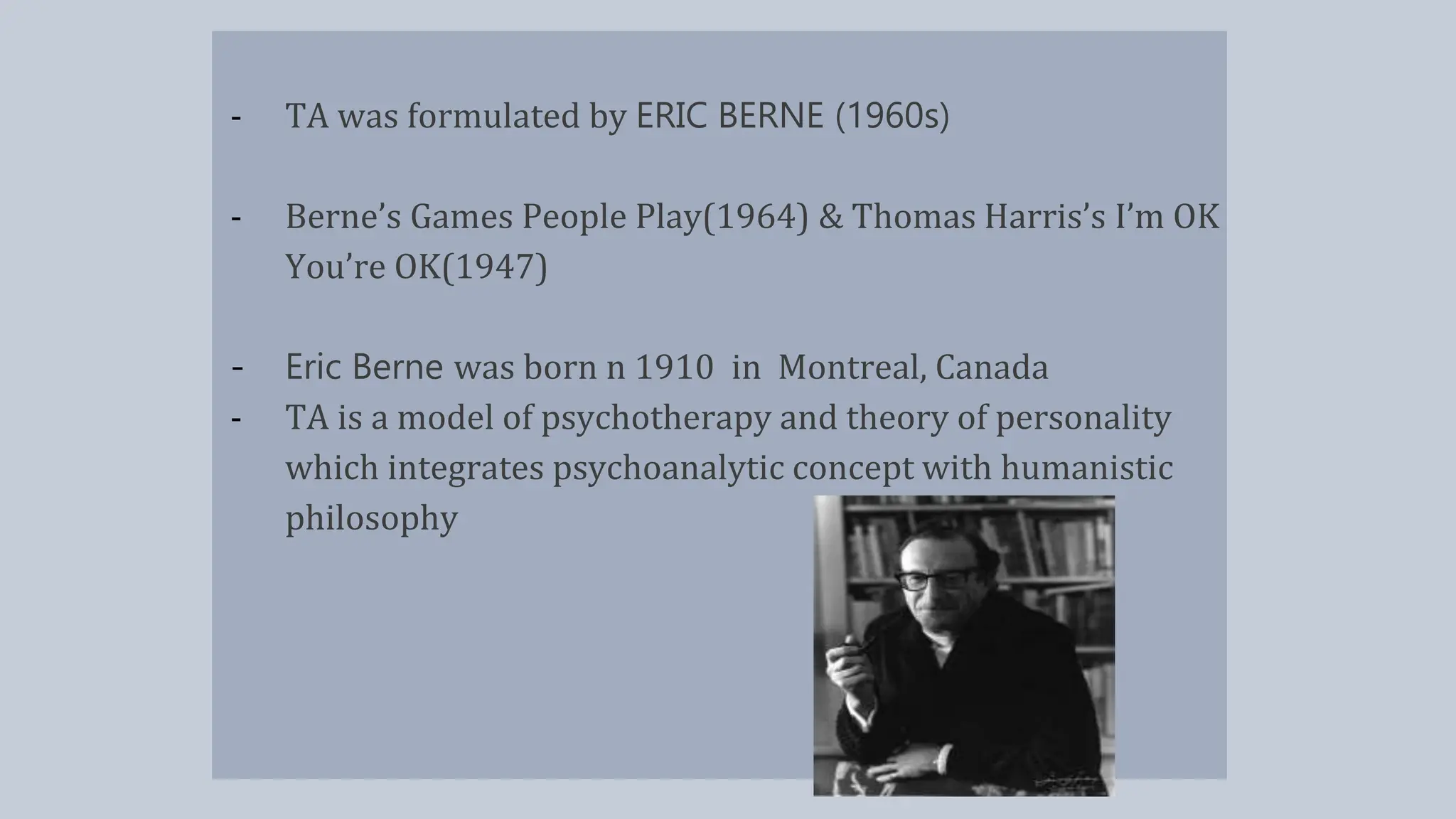
- TA was formulated by ERIC BERNE (1960s)
- Berne’s Games People Play(1964) & Thomas Harris’s I’m OK
You’re OK(1947)
- Eric Berne was born n 1910 in Montreal, Canada
- TA is a model of psychotherapy and theory of personality
which integrates psychoanalytic concept with humanistic
philosophy
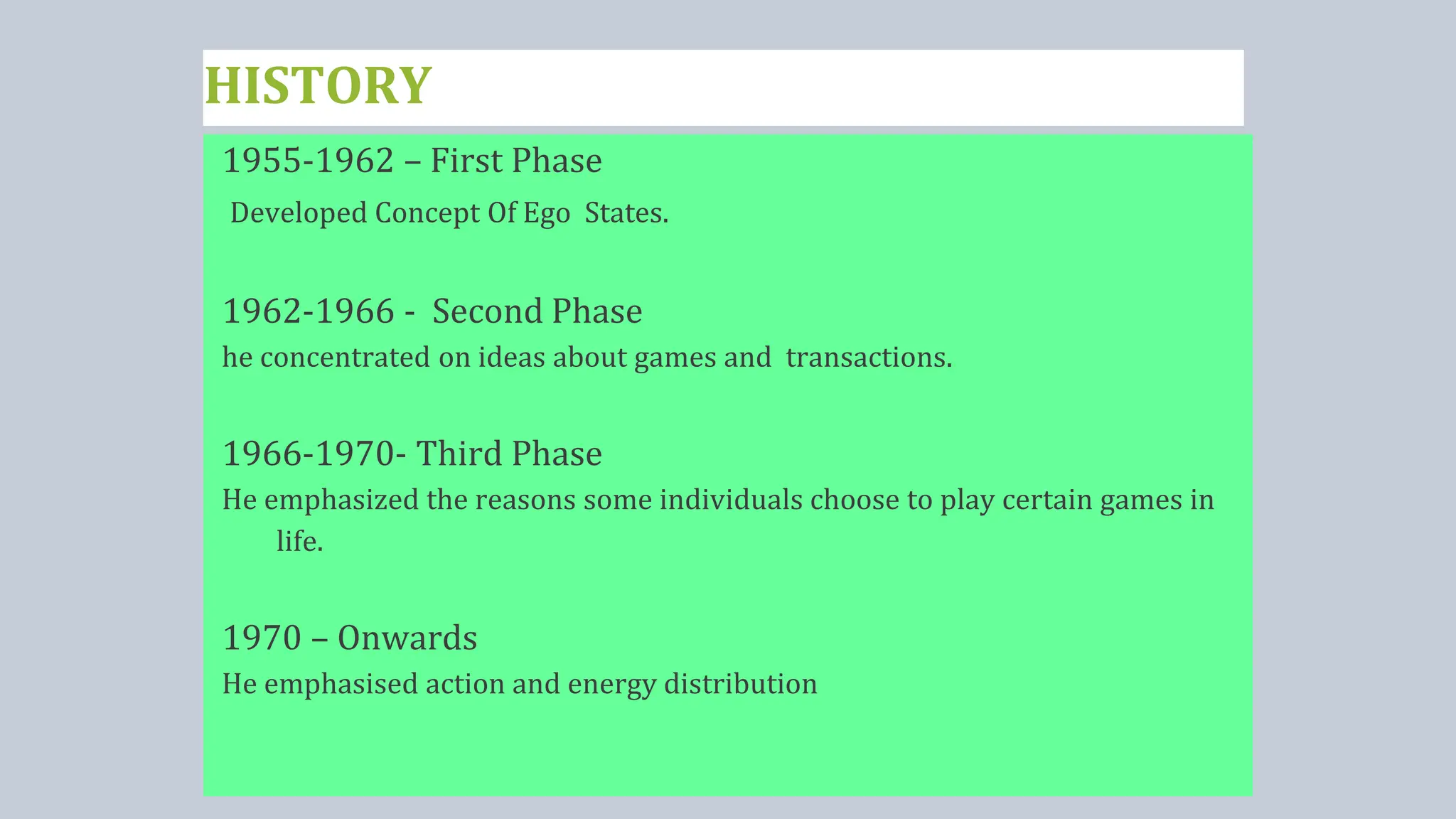
HISTORY
1955-1962 – First Phase
Developed Concept Of Ego States.
1962-1966 - Second Phase
he concentrated on ideas about games and transactions.
1966-1970- Third Phase
He emphasized the reasons some individuals choose to play certain games in
life.
1970 – Onwards
He emphasised action and energy distribution
View Of Human Nature
- TA is an optimistic theory
- Its basic assumption is the people can change despite any
unfortunate events of the past
- TA is also anti- anti deterministic, believing that people
have choices in their lives
BASIC PHILOSOPHICAL ASSUMPTIONS
1. People are born OK: psychological disturbances is acquired.
2. People are capable of thinking independently(unless severely brain damaged)
3. People are responsible for the decision they made, and their consequences.
Transactional analysis is primarily concerned with
following:
 Analysis of self awareness
 Analysis of ego states
 Analysis of transactions
 Script analysis
 Games analysis
 Analysis of life positions
 stroking
1. ANALYSIS OF SELF
AWARENESS
● The interpersonal relationships are composed of interself.
● Self is the core of personality pattern which provides integration.
● Self awareness is an important concept, it describes the self in terms of image,
both conscious and unconscious.
● Joseph Luft and Harrington have developed a diagram to look at one’s
personality including behaviours and attitudes that can be known and
unknown to self and known and unknown to others.
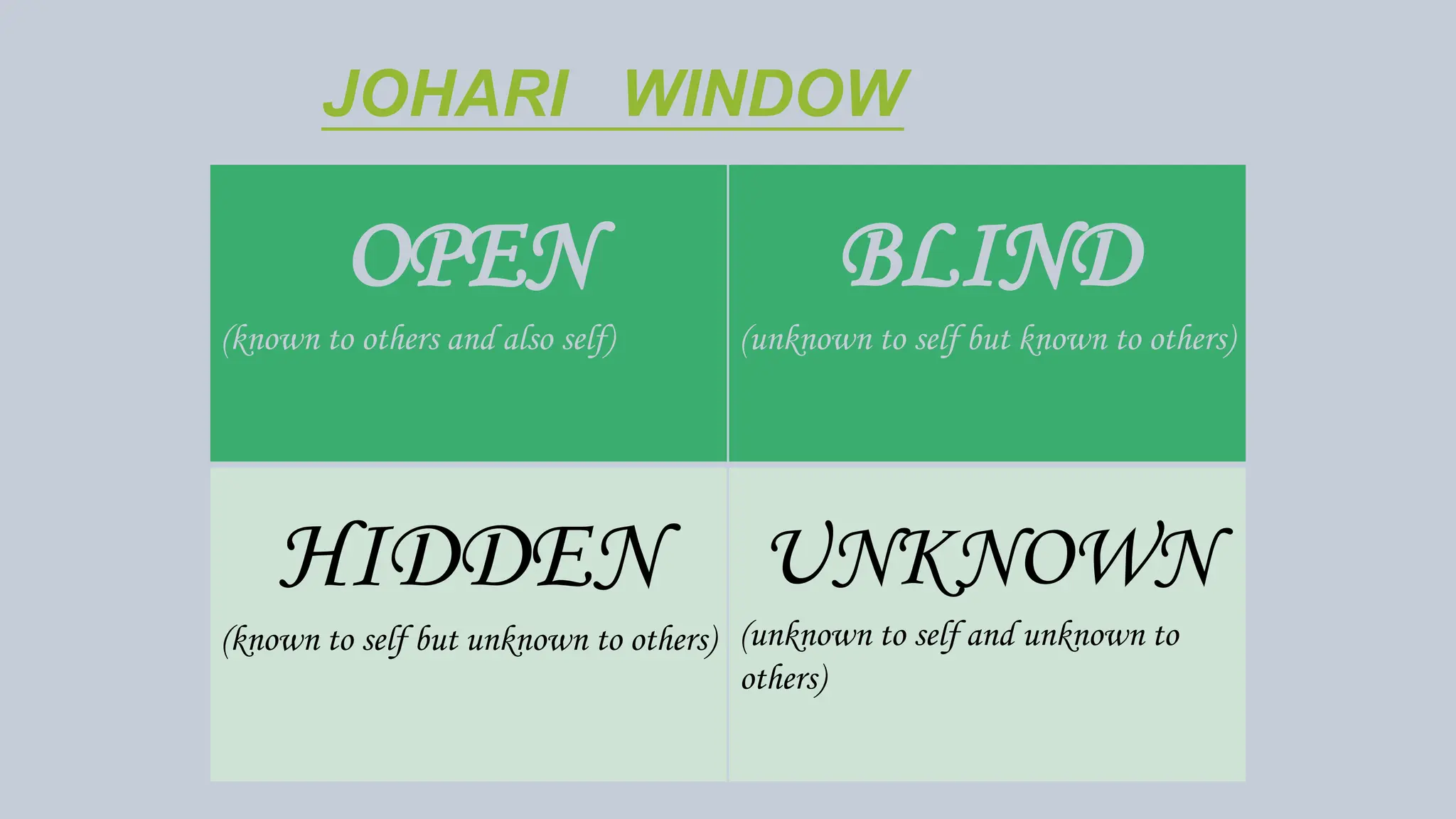
● This diagram is known as the JOHARI WINDOW.
● It comprising of 4 parts.
JOHARI WINDOW
OPEN
(known to others and also self)
BLIND
(unknown to self but known to others)
HIDDEN
(known to self but unknown to others)
UNKNOWN
(unknown to self and unknown to
others)
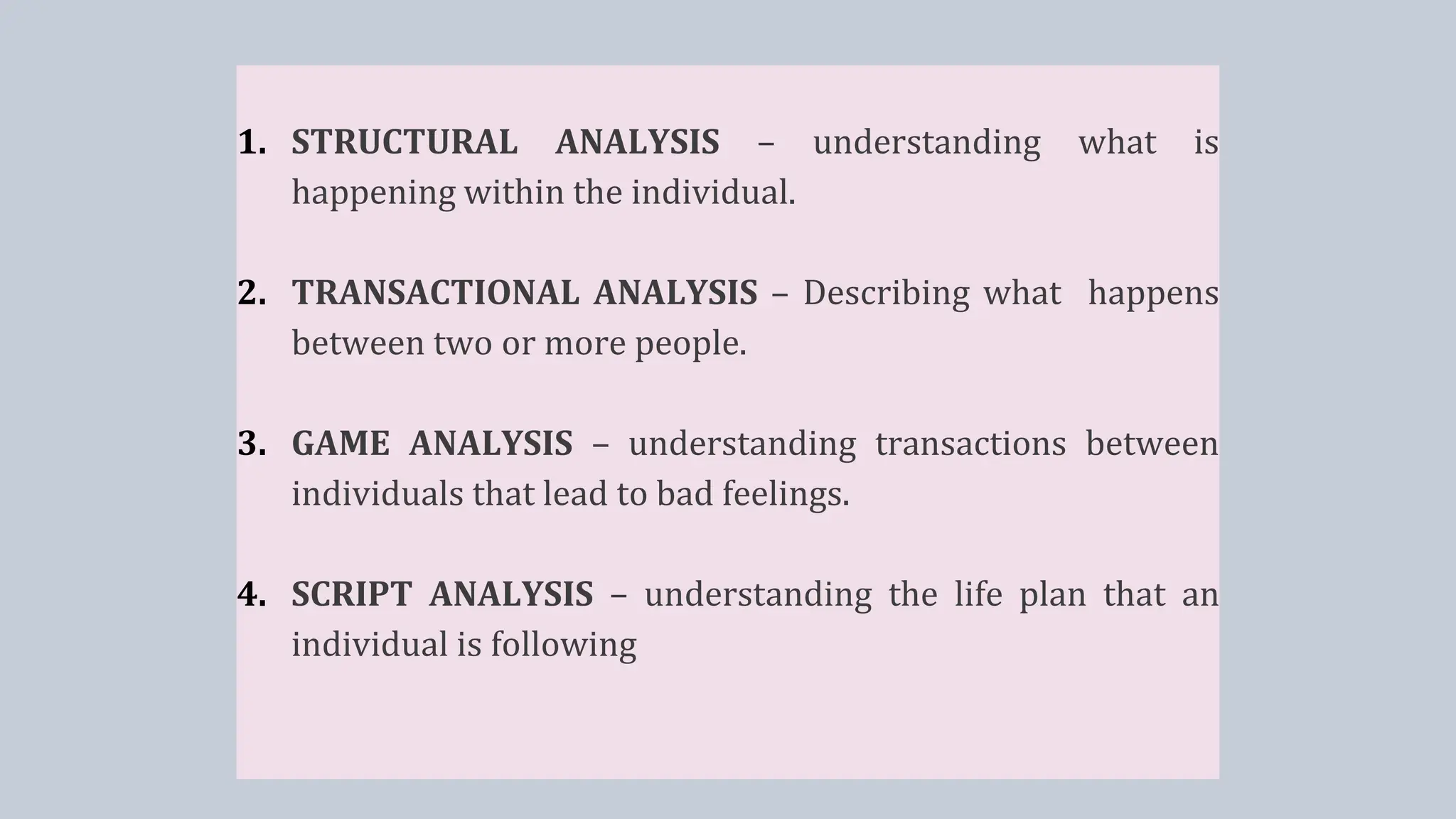
1. STRUCTURAL ANALYSIS – understanding what is
happening within the individual.
2. TRANSACTIONAL ANALYSIS – Describing what happens
between two or more people.
3. GAME ANALYSIS – understanding transactions between
individuals that lead to bad feelings.
4. SCRIPT ANALYSIS – understanding the life plan that an
individual is following
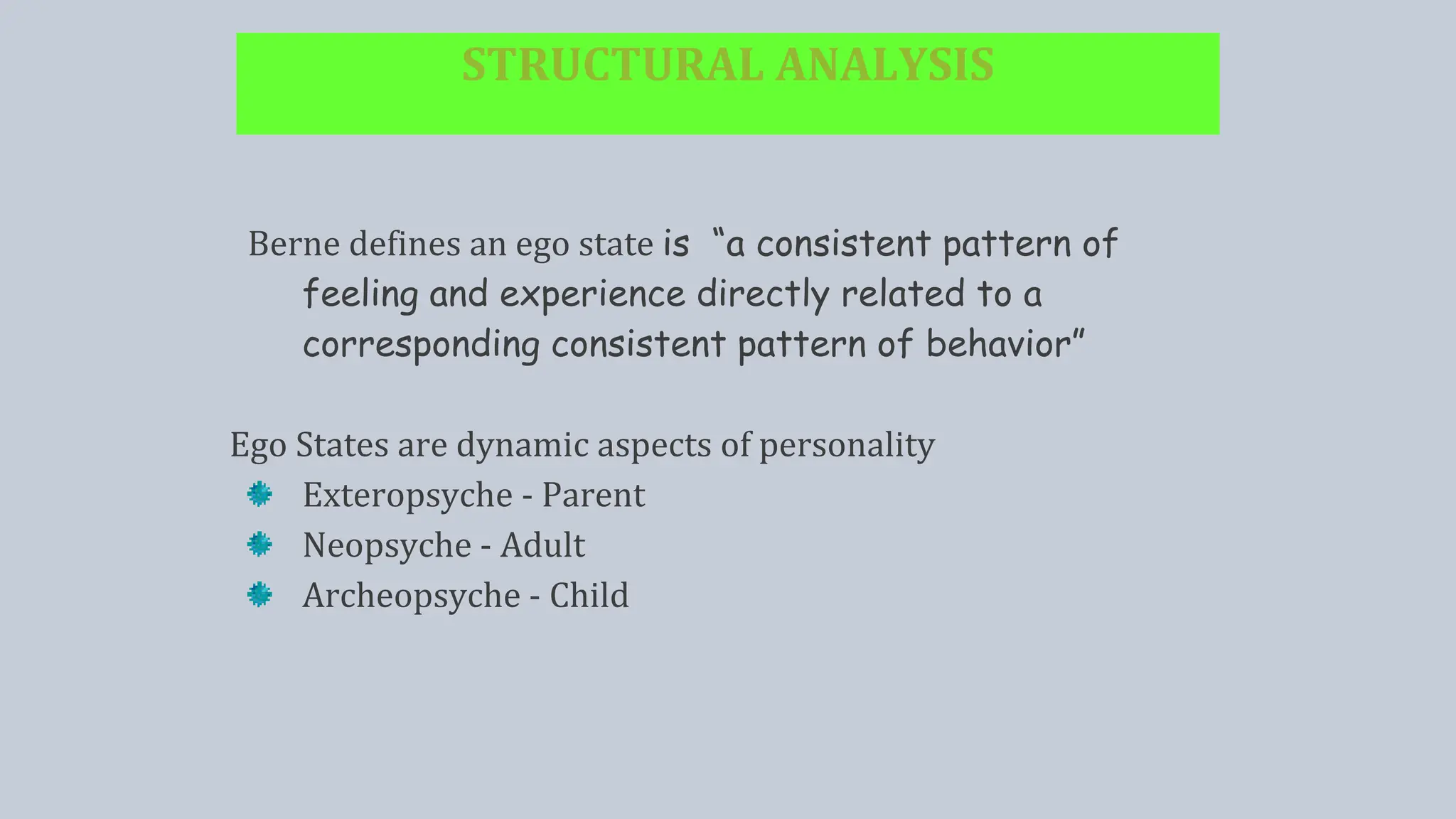
STRUCTURAL ANALYSIS
Berne defines an ego state is “a consistent pattern of
feeling and experience directly related to a
corresponding consistent pattern of behavior”
Ego States are dynamic aspects of personality
Exteropsyche - Parent
Neopsyche - Adult
Archeopsyche - Child
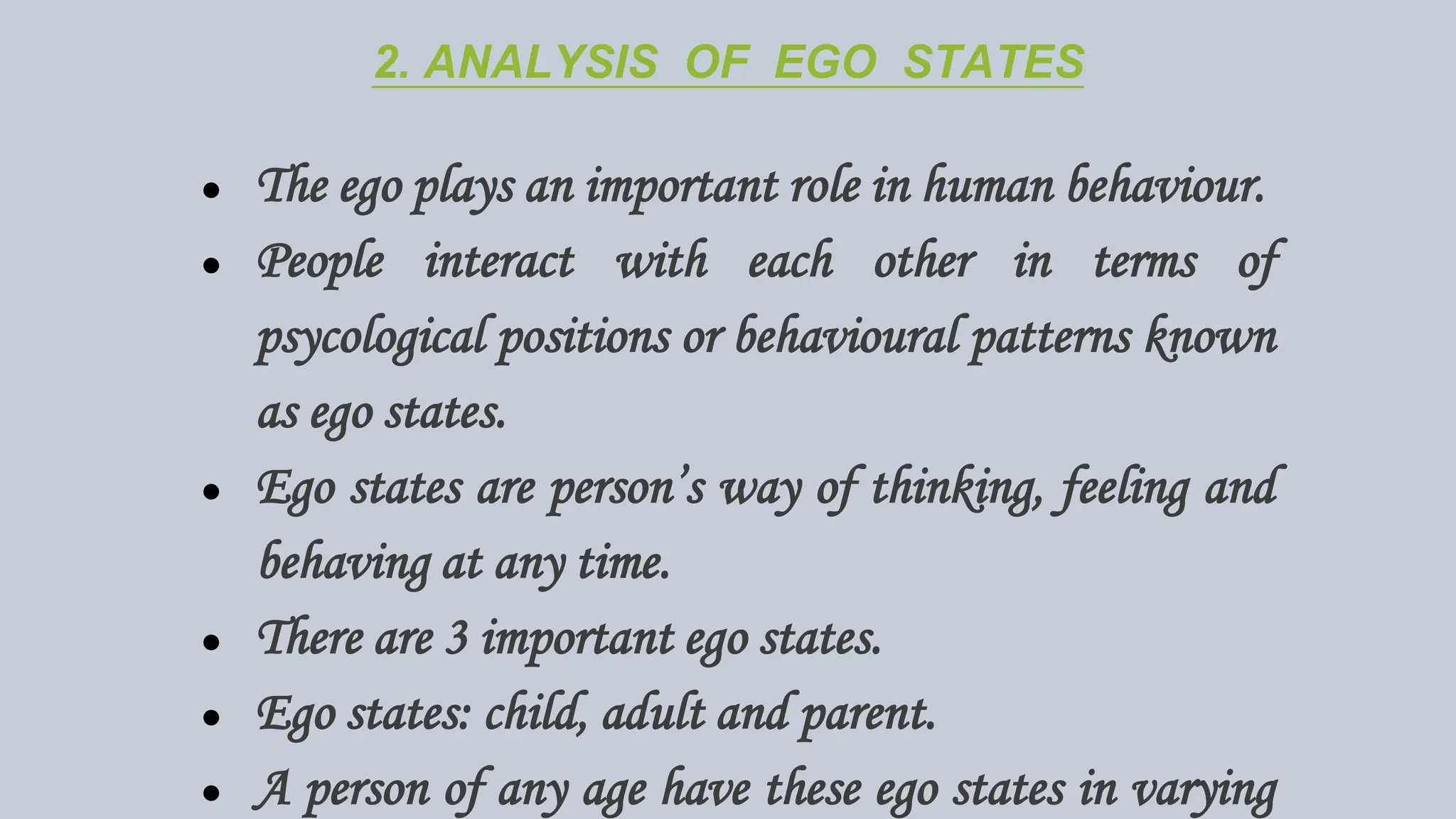
2. ANALYSIS OF EGO STATES
● The ego plays an important role in human behaviour.
● People interact with each other in terms of
psycological positions or behavioural patterns known
as ego states.
● Ego states are person’s way of thinking, feeling and
behaving at any time.
● There are 3 important ego states.
● Ego states: child, adult and parent.
● A person of any age have these ego states in varying
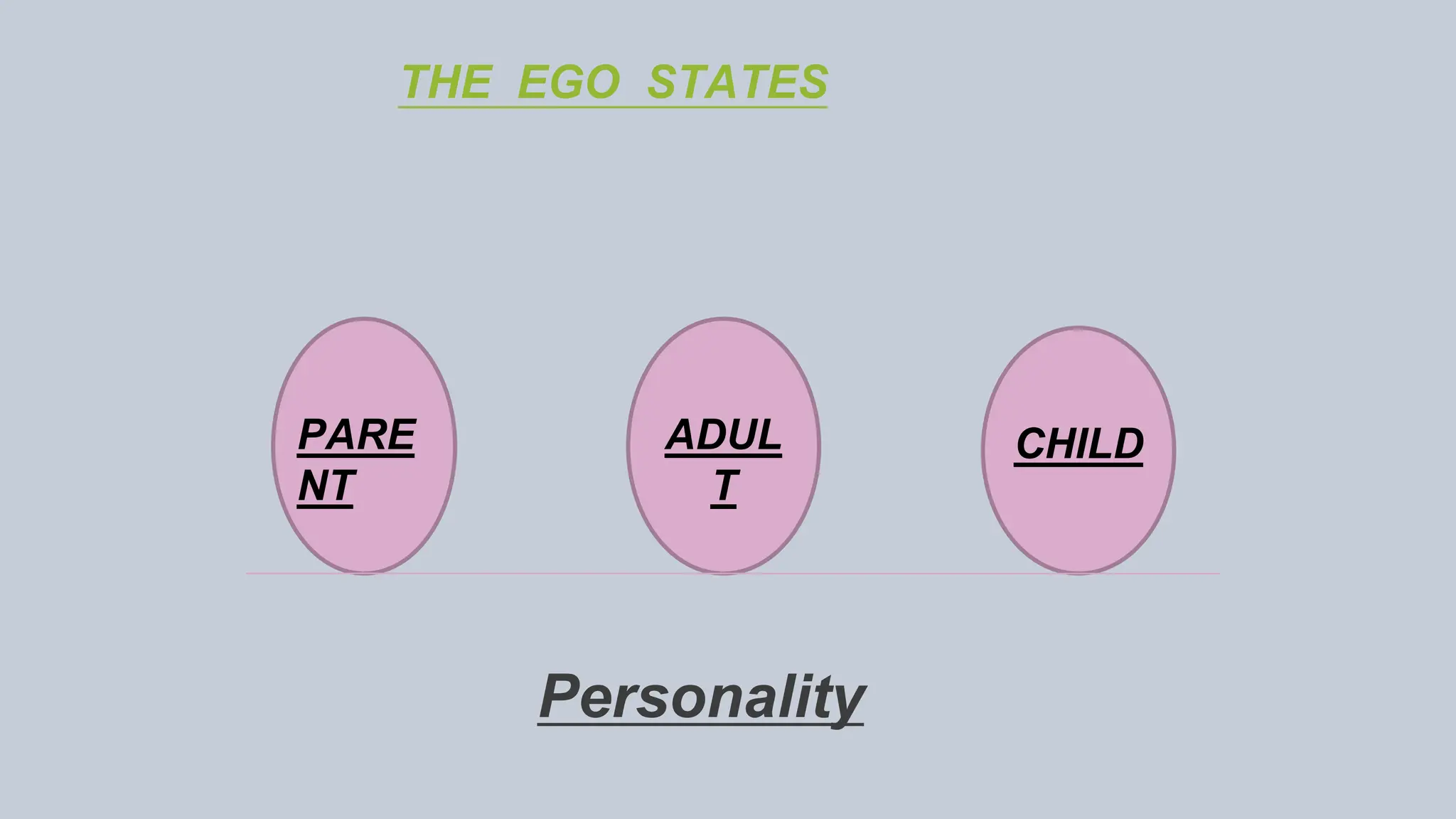
THE EGO STATES
Personality
PARE
NT
ADUL
T
CHILD
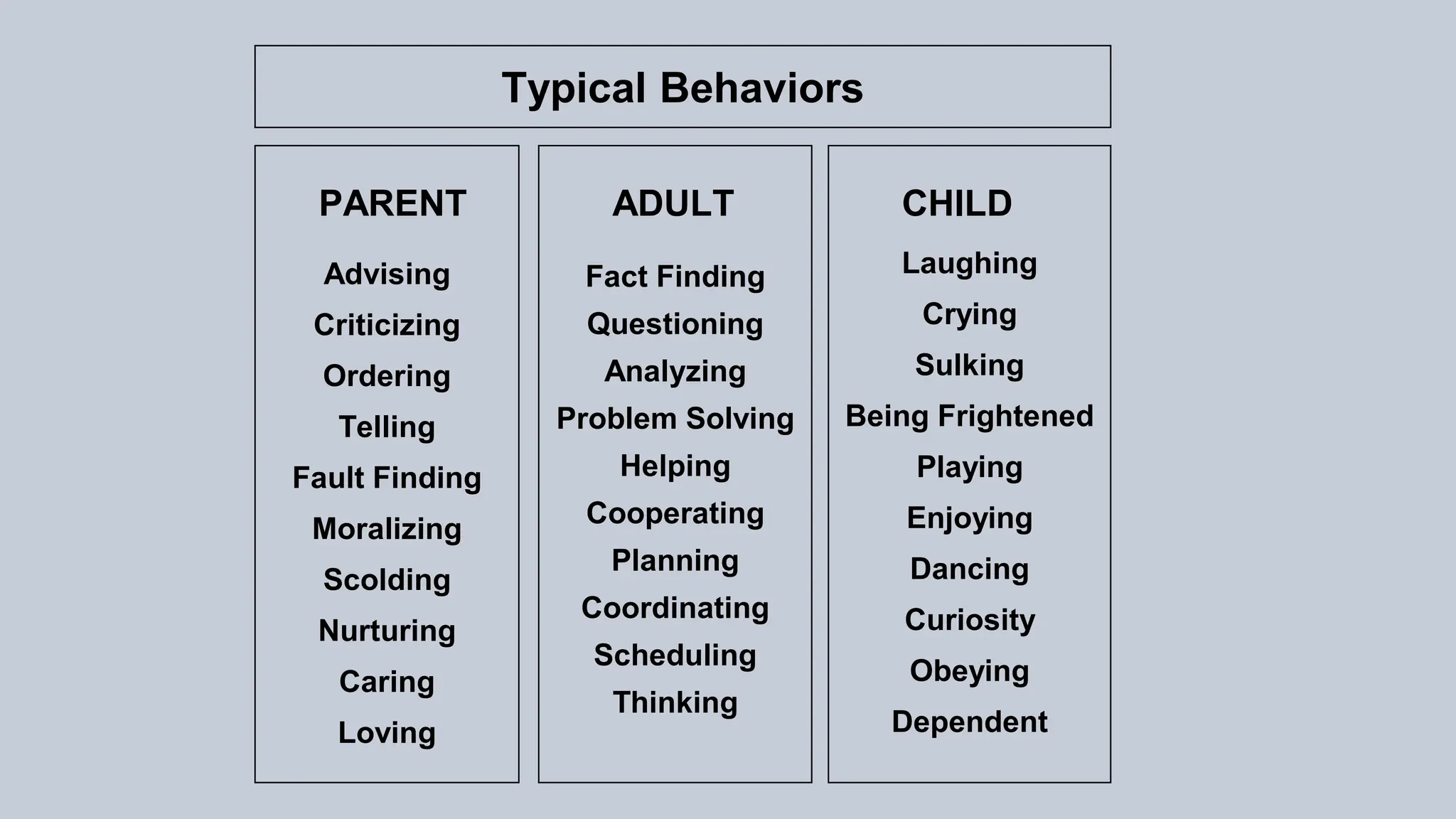
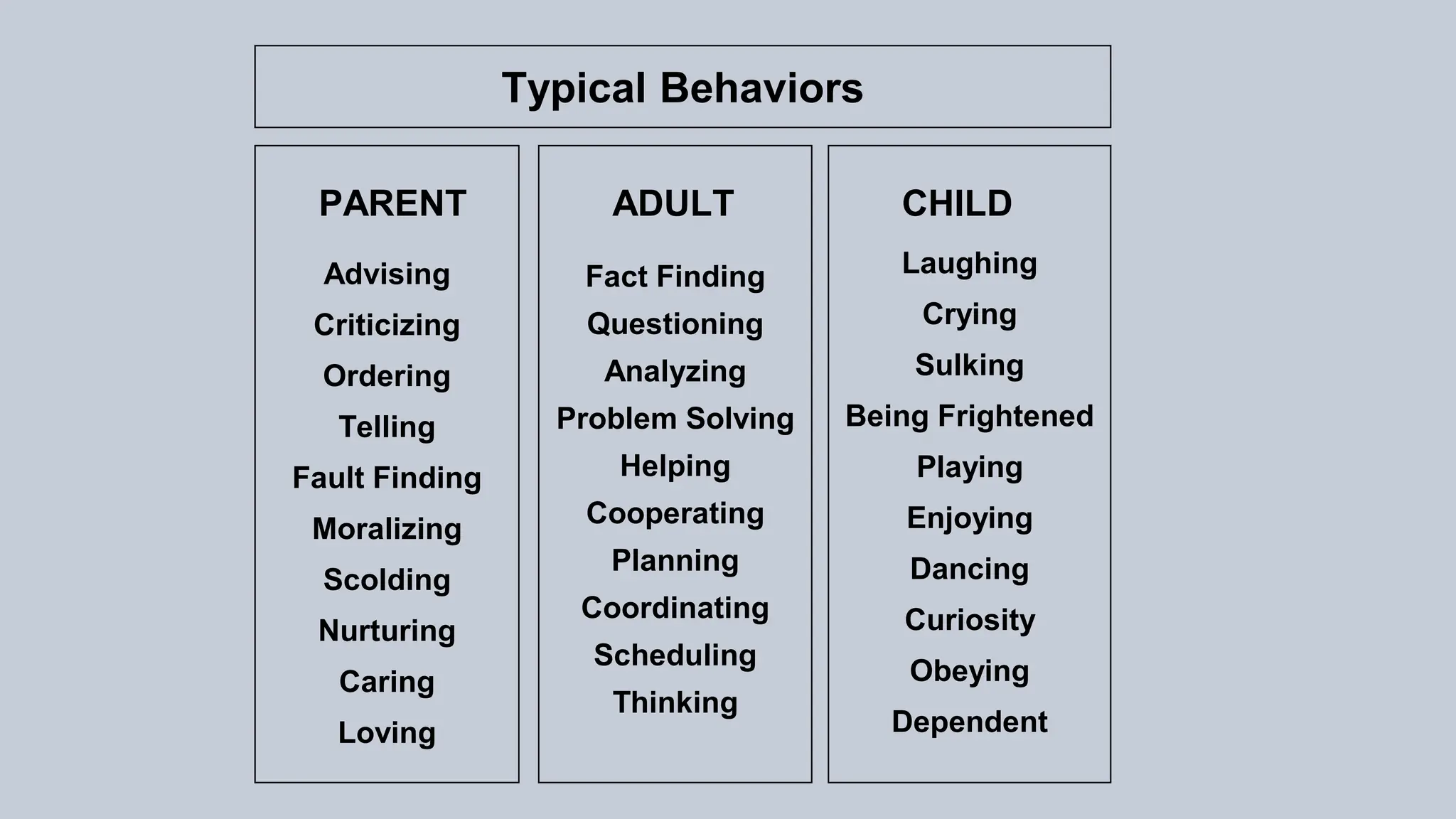
Typical Behaviors
Advising
Criticizing
Ordering
Telling
Fault Finding
Moralizing
Scolding
Nurturing
Caring
Loving
Fact Finding
Questioning
Analyzing
Problem Solving
Helping
Cooperating
Planning
Coordinating
Scheduling
Thinking
Laughing
Crying
Sulking
Being Frightened
Playing
Enjoying
Dancing
Curiosity
Obeying
Dependent
PARENT ADULT CHILD
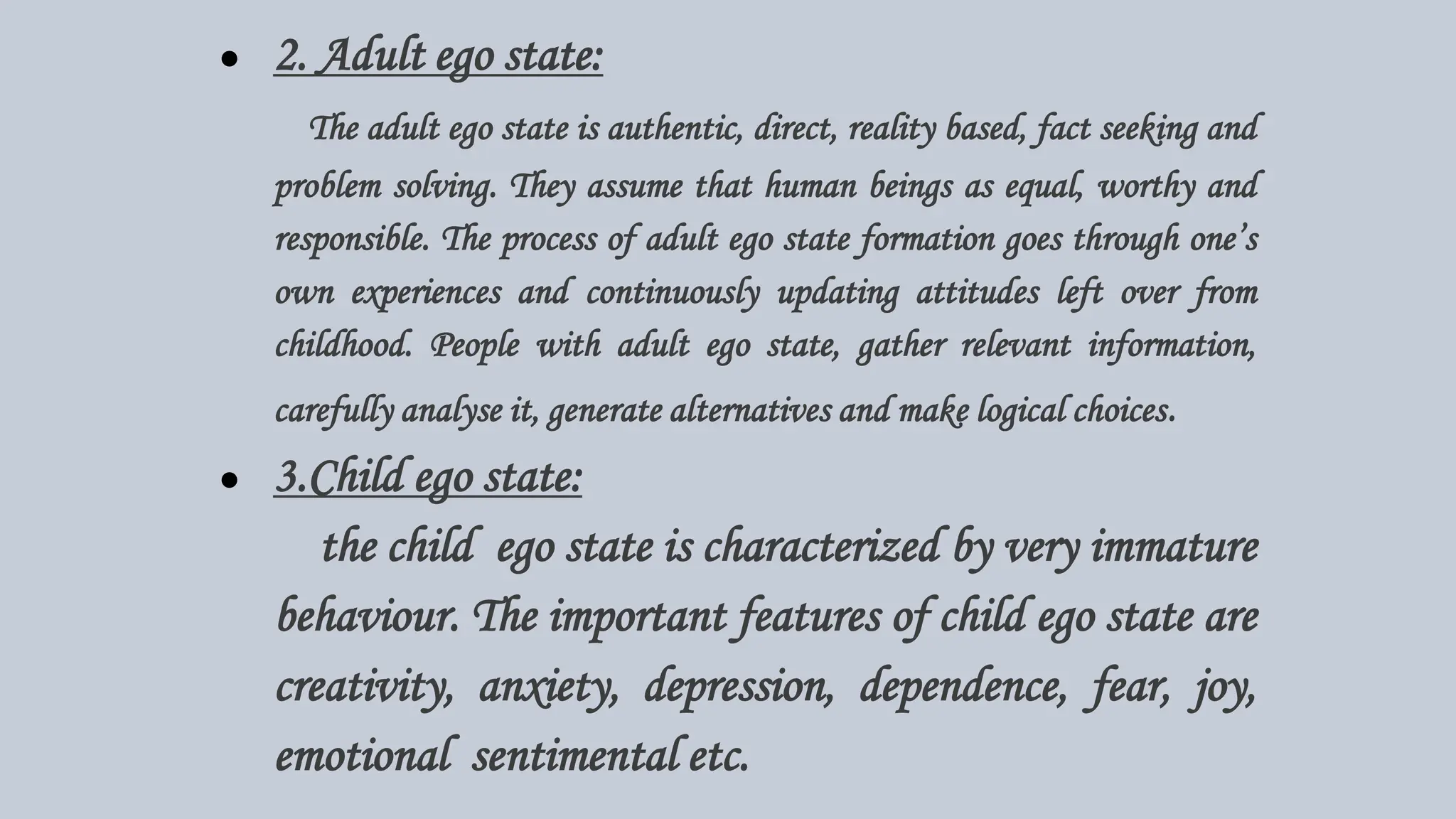
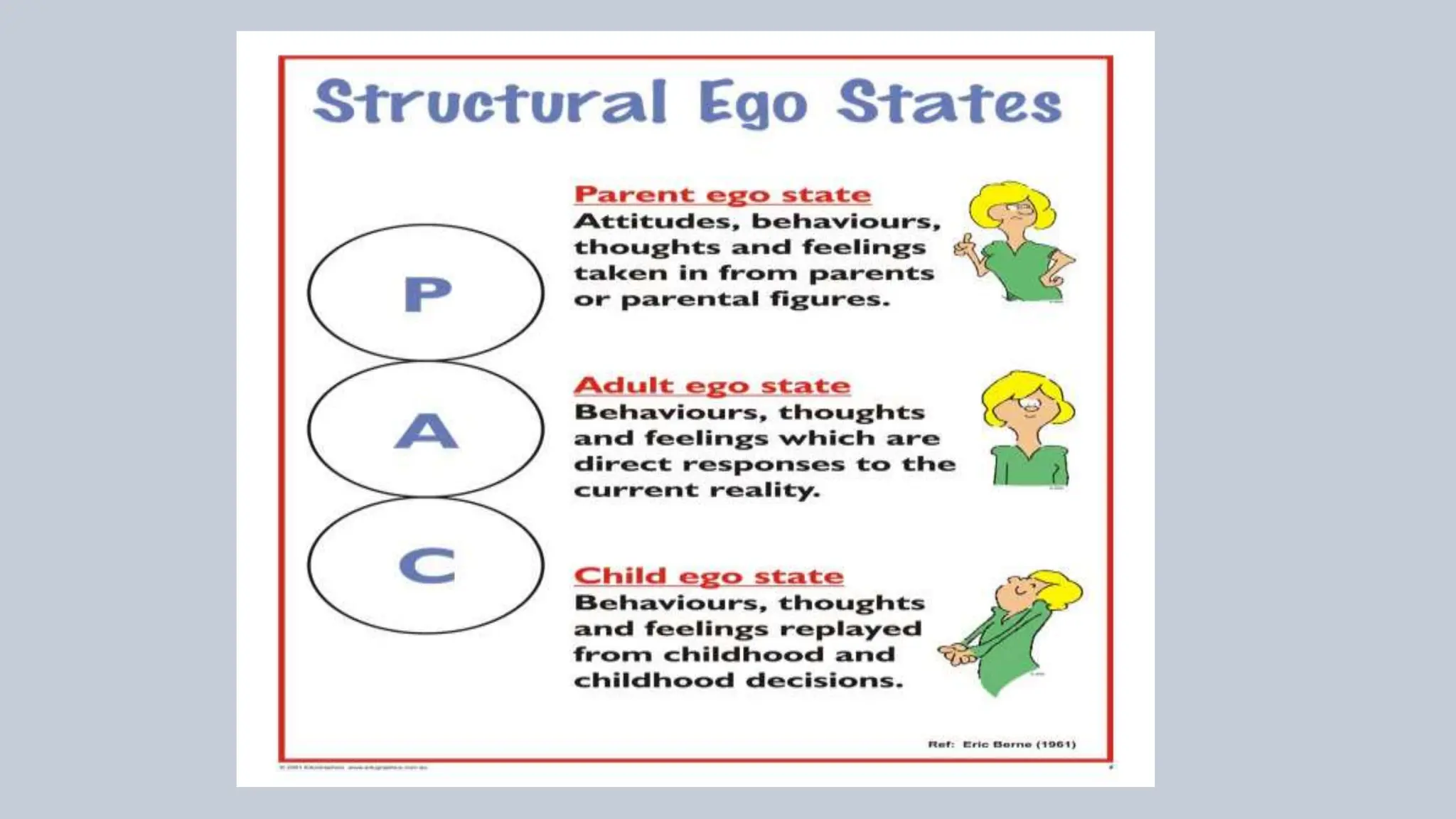
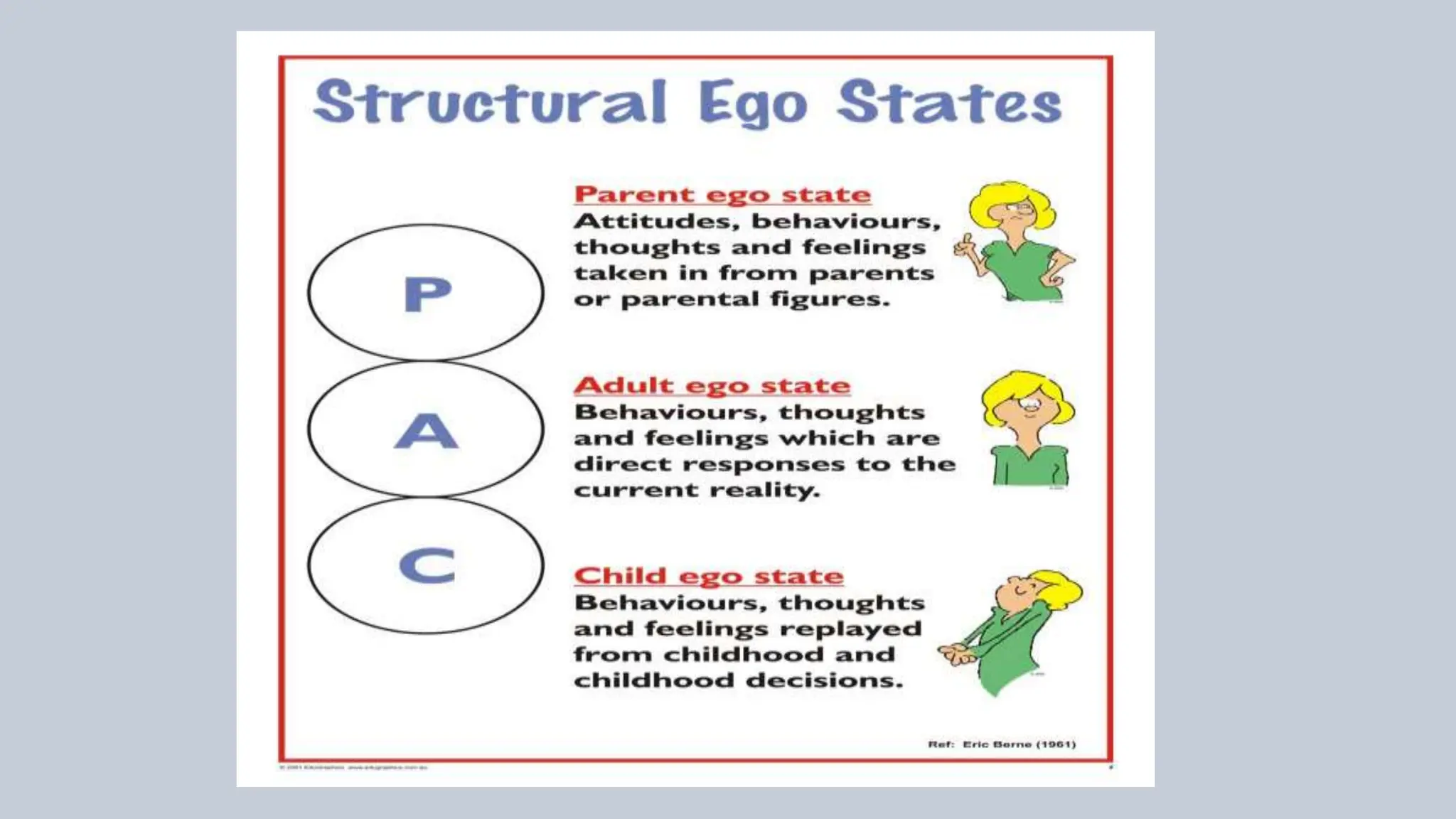
● 2. Adult ego state:
The adult ego state is authentic, direct, reality based, fact seeking and
problem solving. They assume that human beings as equal, worthy and
responsible. The process of adult ego state formation goes through one’s
own experiences and continuously updating attitudes left over from
childhood. People with adult ego state, gather relevant information,
carefully analyse it, generate alternatives and make logical choices.
● 3.Child ego state:
the child ego state is characterized by very immature
behaviour. The important features of child ego state are
creativity, anxiety, depression, dependence, fear, joy,
emotional sentimental etc.
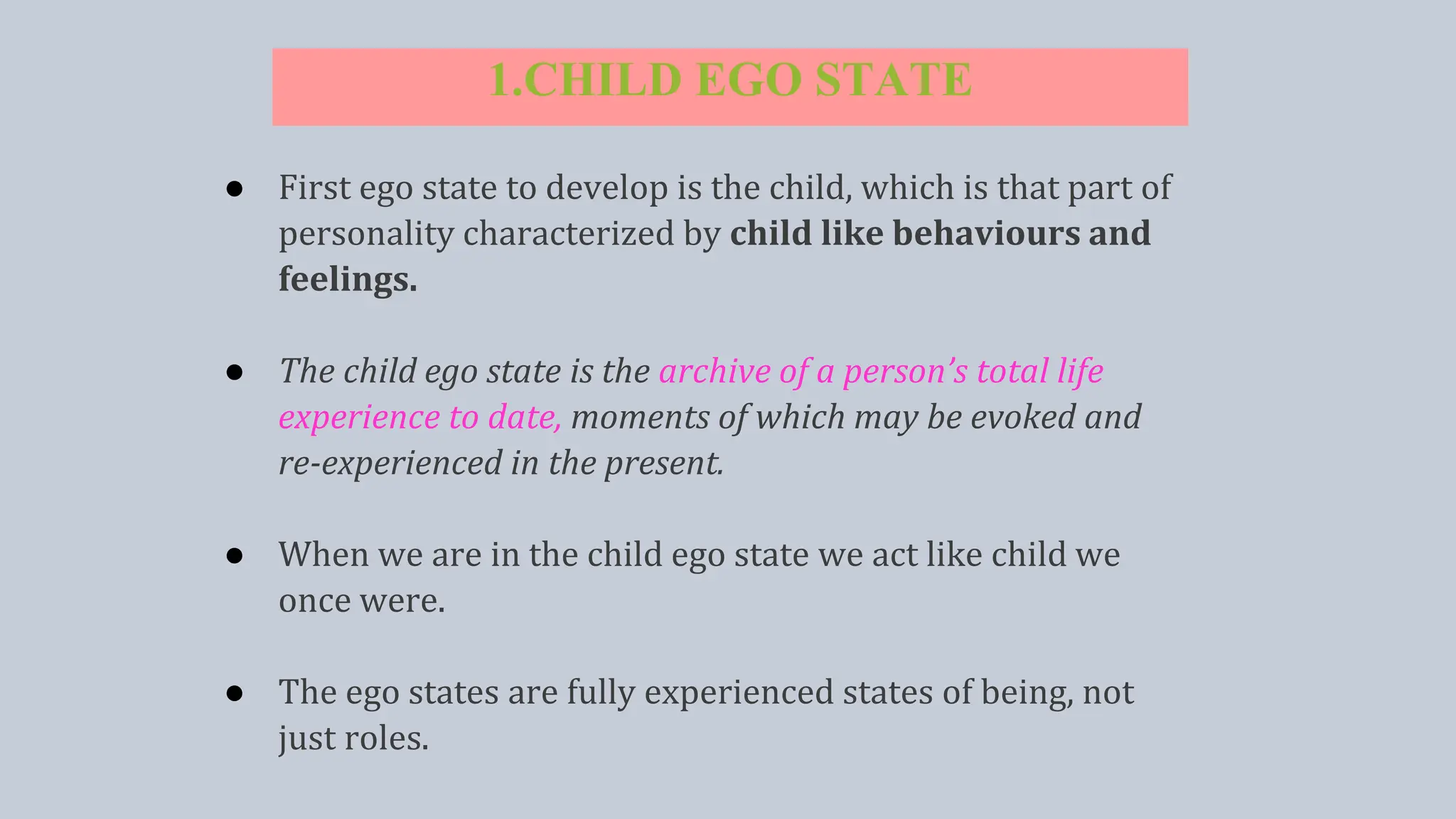
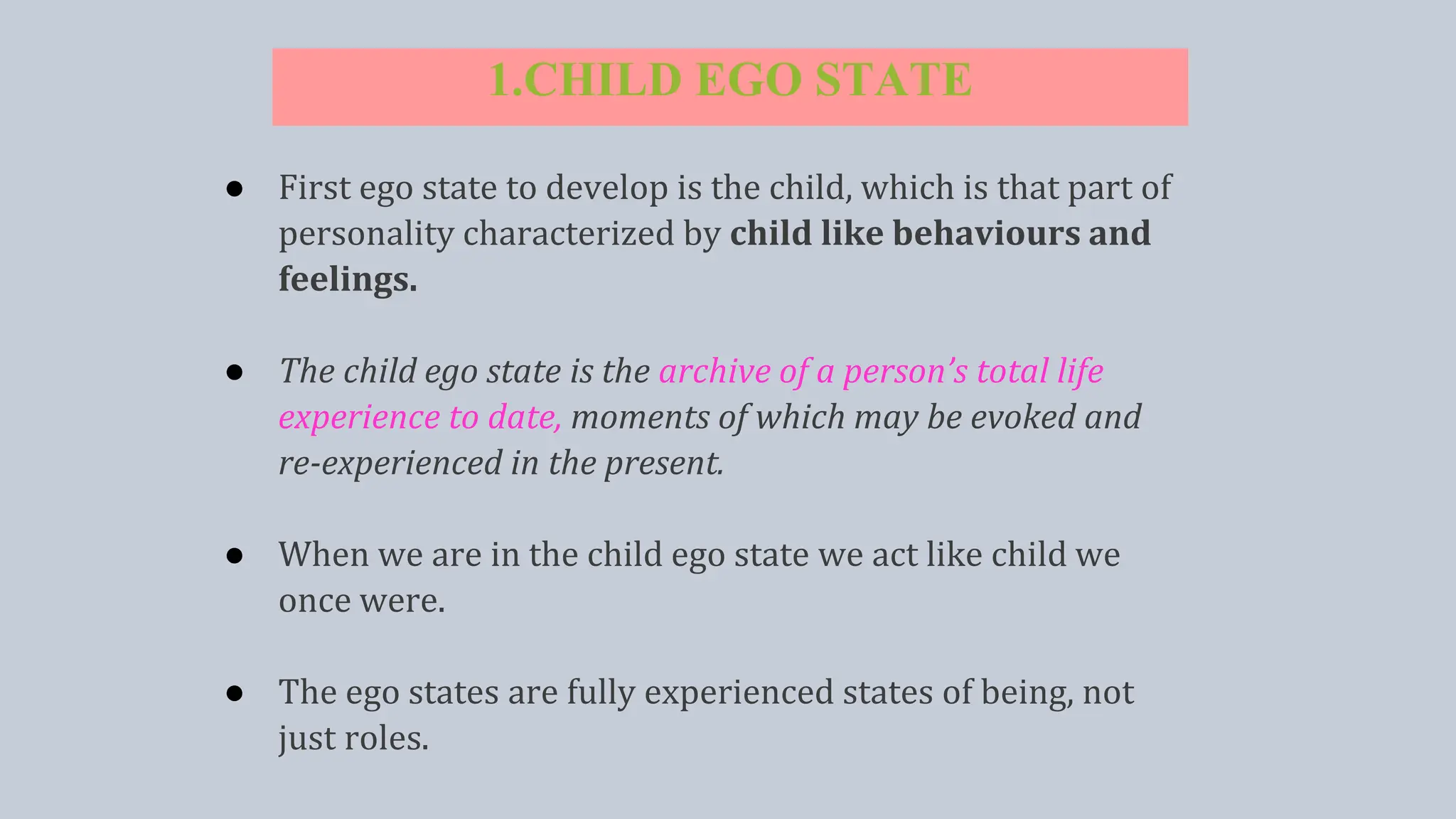
1.CHILD EGO STATE
● First ego state to develop is the child, which is that part of
personality characterized by child like behaviours and
feelings.
● The child ego state is the archive of a person’s total life
experience to date, moments of which may be evoked and
re-experienced in the present.
● When we are in the child ego state we act like child we
once were.
● The ego states are fully experienced states of being, not
just roles.
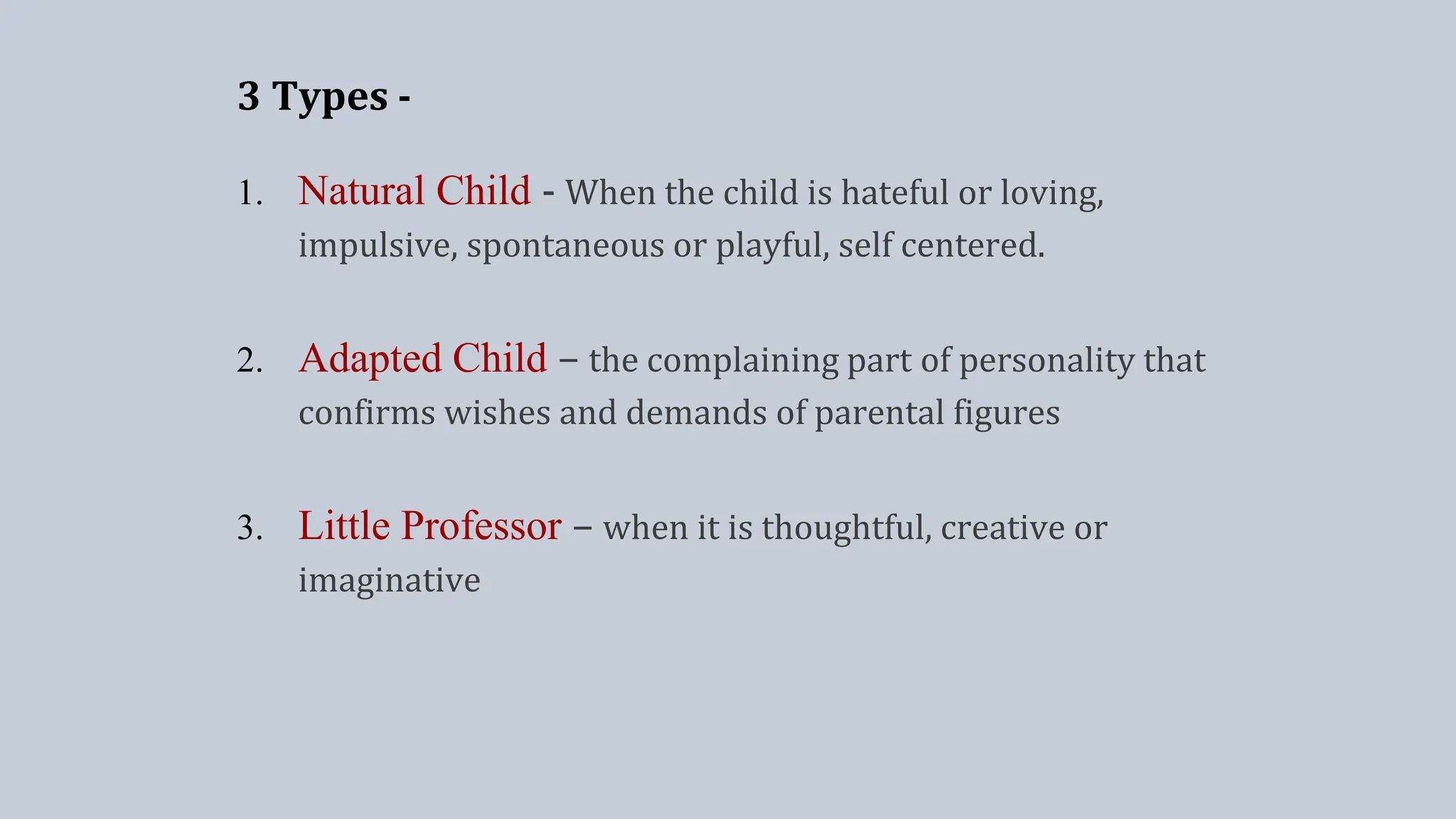
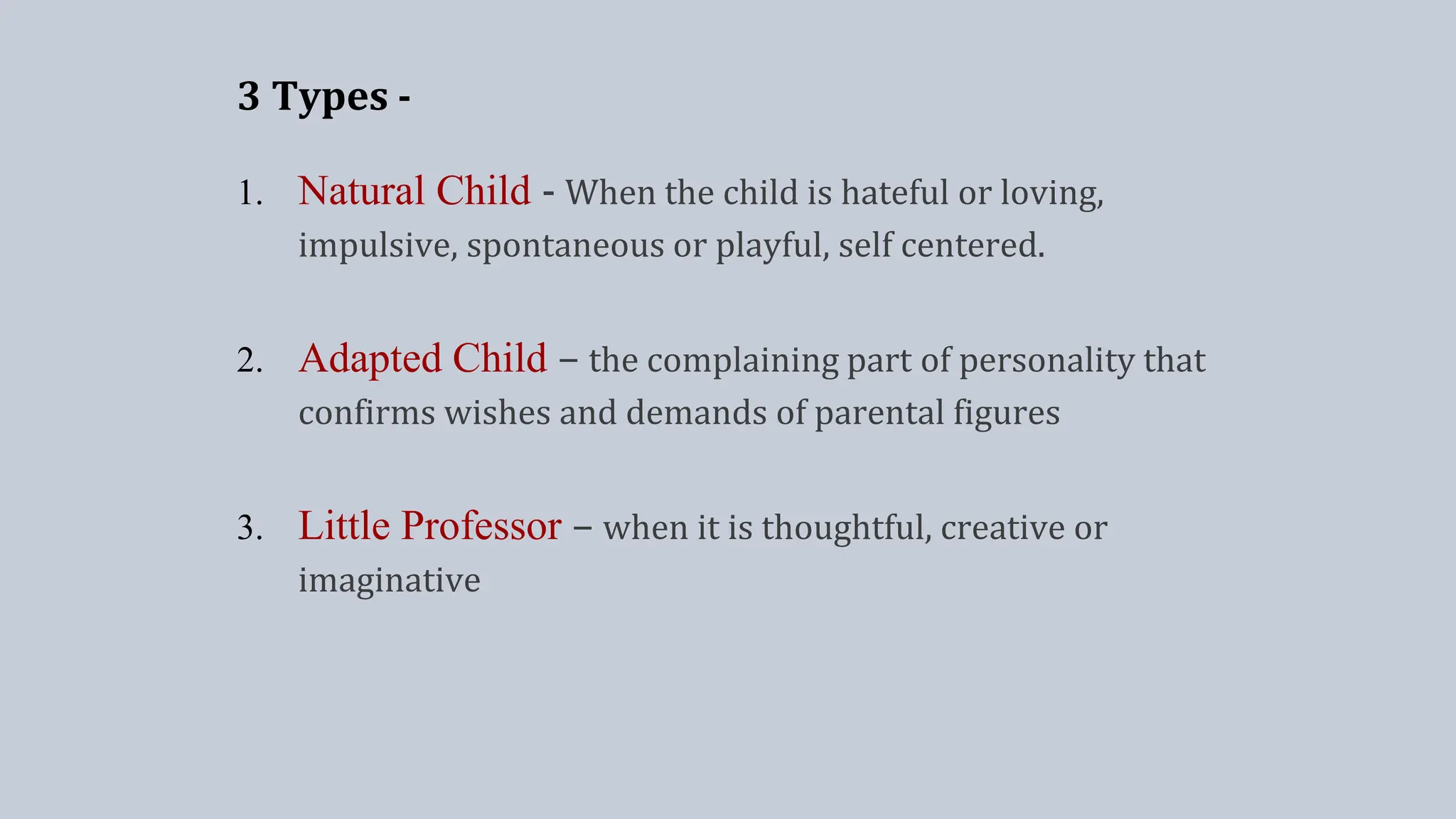
3 Types -
1. Natural Child - When the child is hateful or loving,
impulsive, spontaneous or playful, self centered.
2. Adapted Child – the complaining part of personality that
confirms wishes and demands of parental figures
3. Little Professor – when it is thoughtful, creative or
imaginative
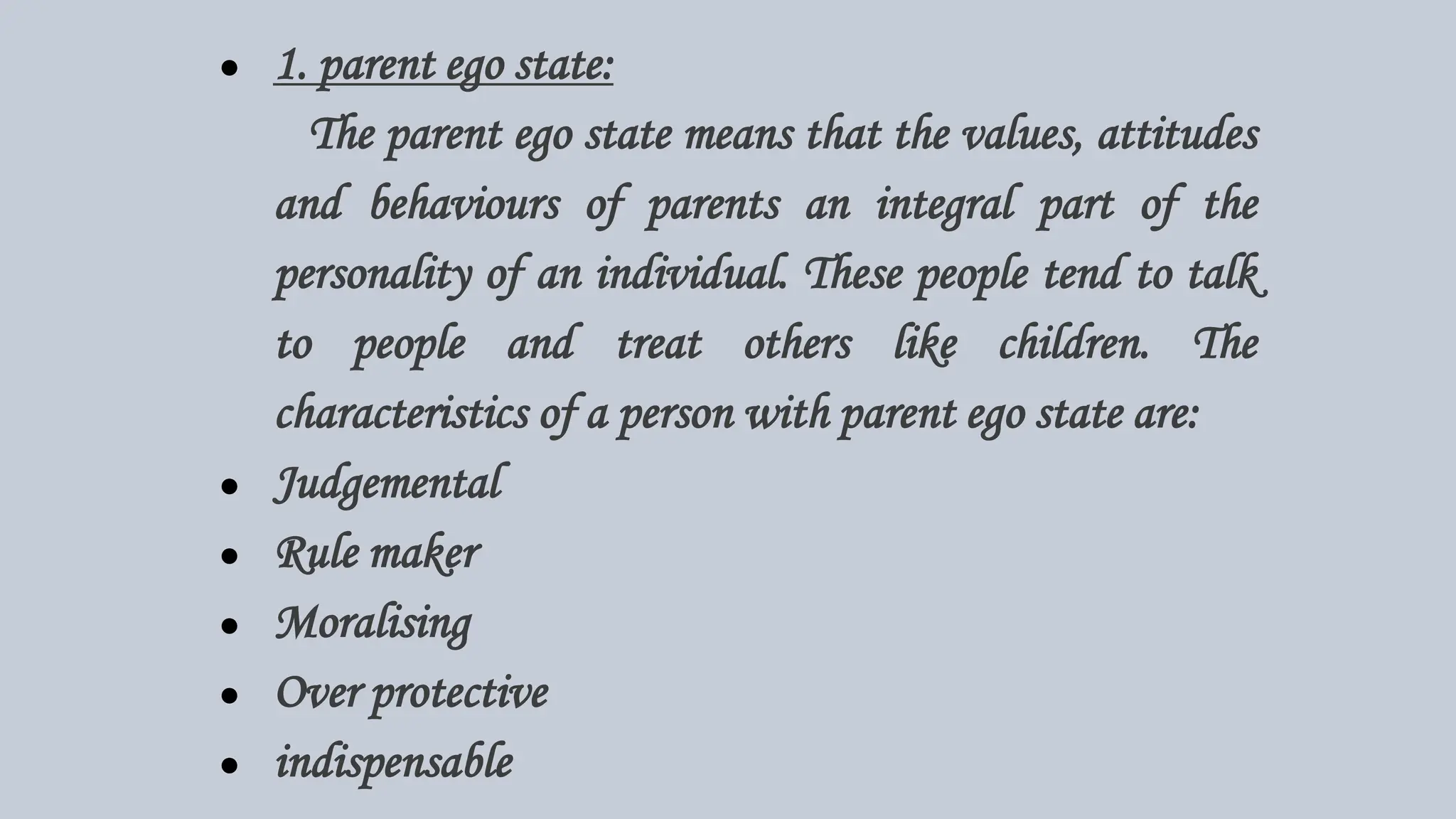
● 1. parent ego state:
The parent ego state means that the values, attitudes
and behaviours of parents an integral part of the
personality of an individual. These people tend to talk
to people and treat others like children. The
characteristics of a person with parent ego state are:
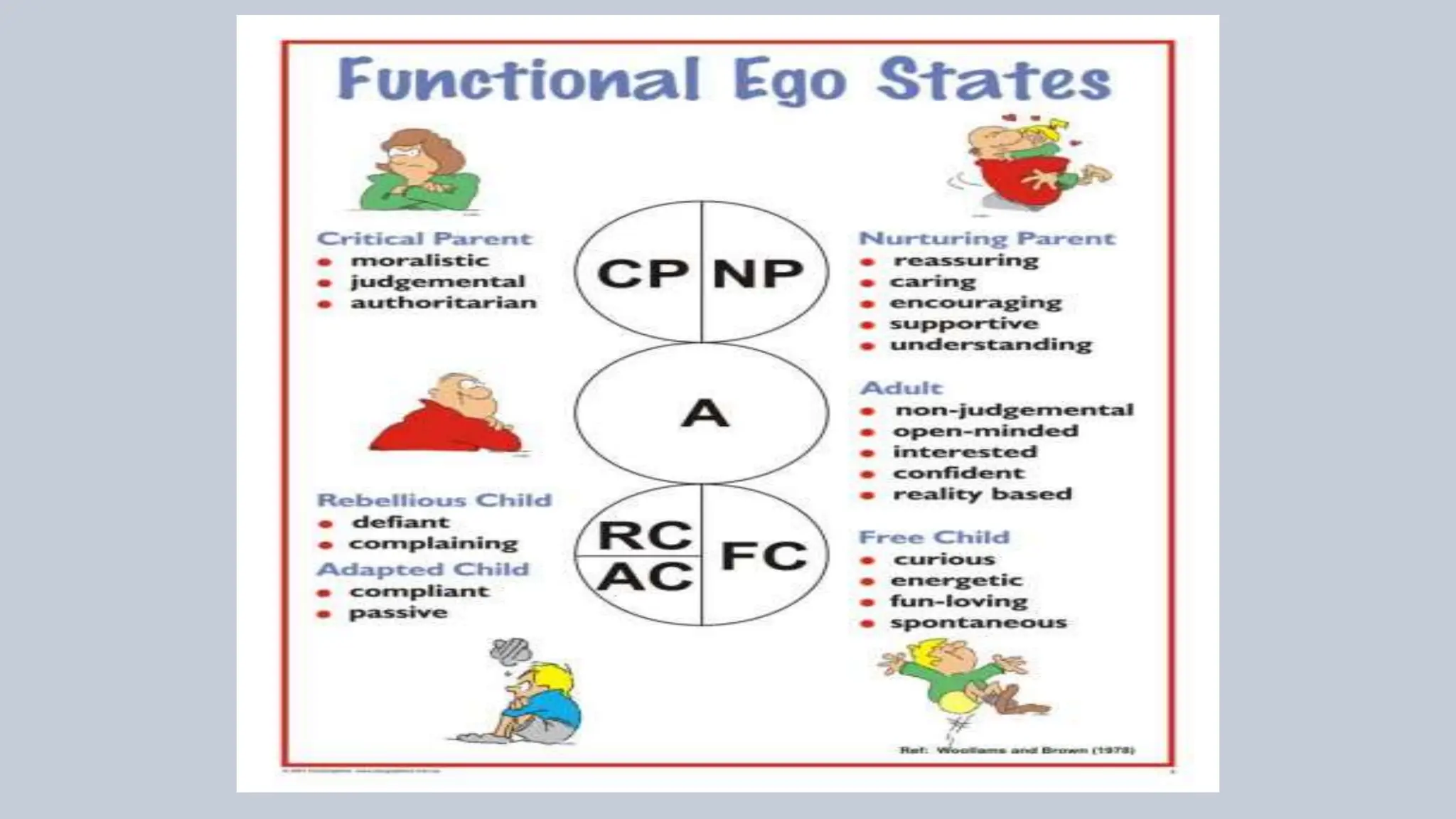
● Judgemental
● Rule maker
● Moralising
● Over protective
● indispensable
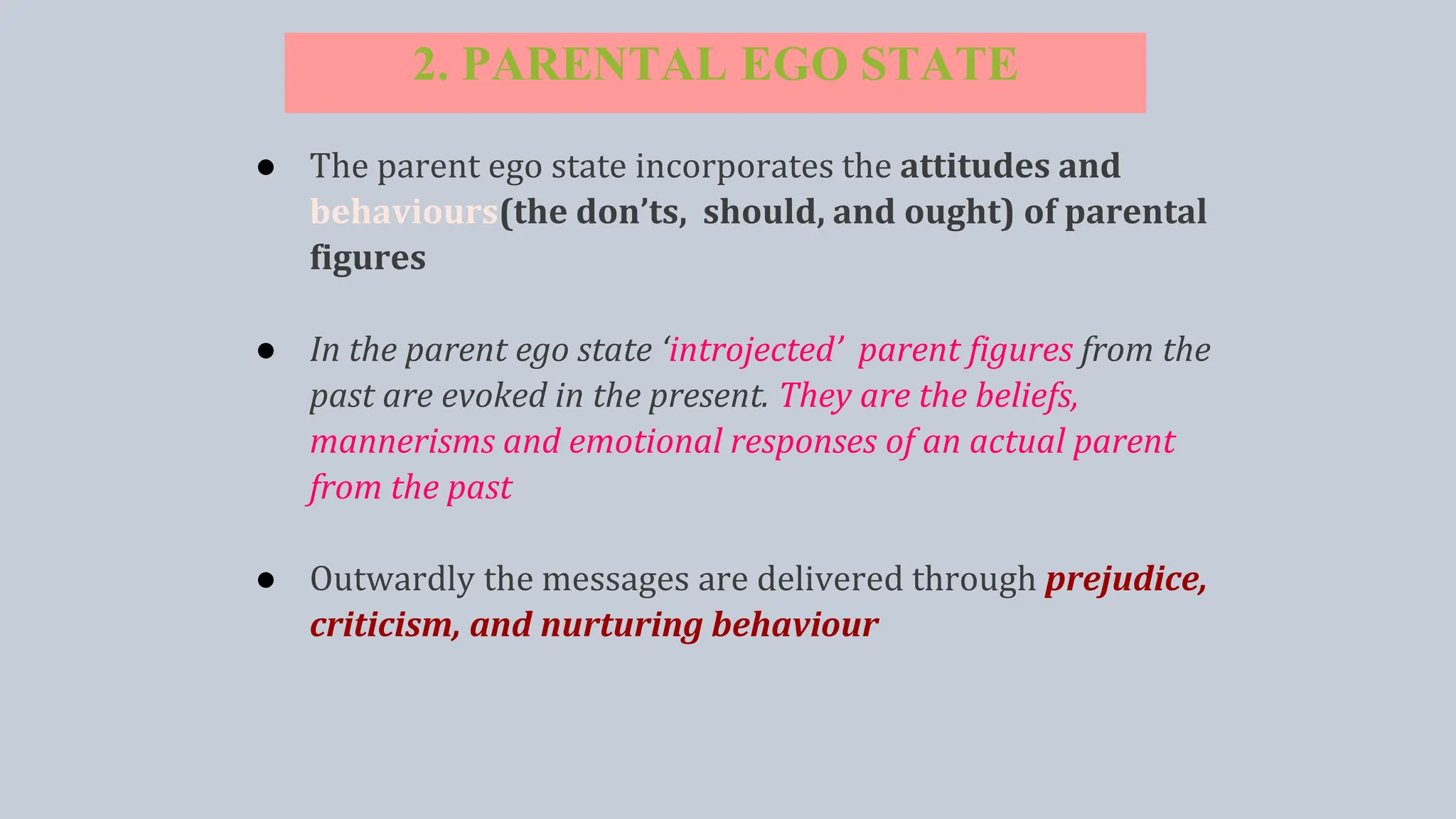
2. PARENTAL EGO STATE
● The parent ego state incorporates the attitudes and
behaviours(the don’ts, should, and ought) of parental
figures
● In the parent ego state ‘introjected’ parent figures from the
past are evoked in the present. They are the beliefs,
mannerisms and emotional responses of an actual parent
from the past
● Outwardly the messages are delivered through prejudice,
criticism, and nurturing behaviour
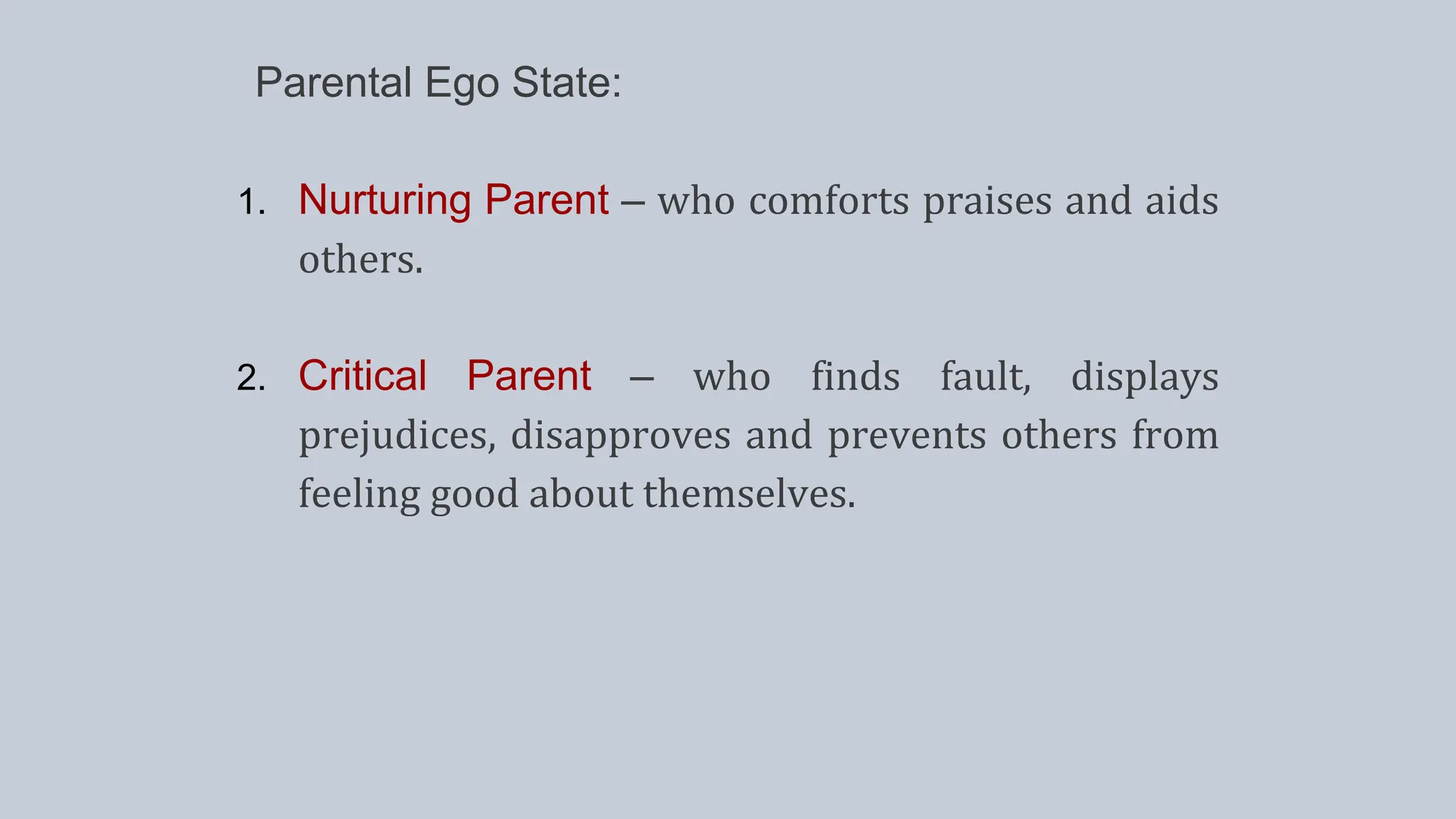
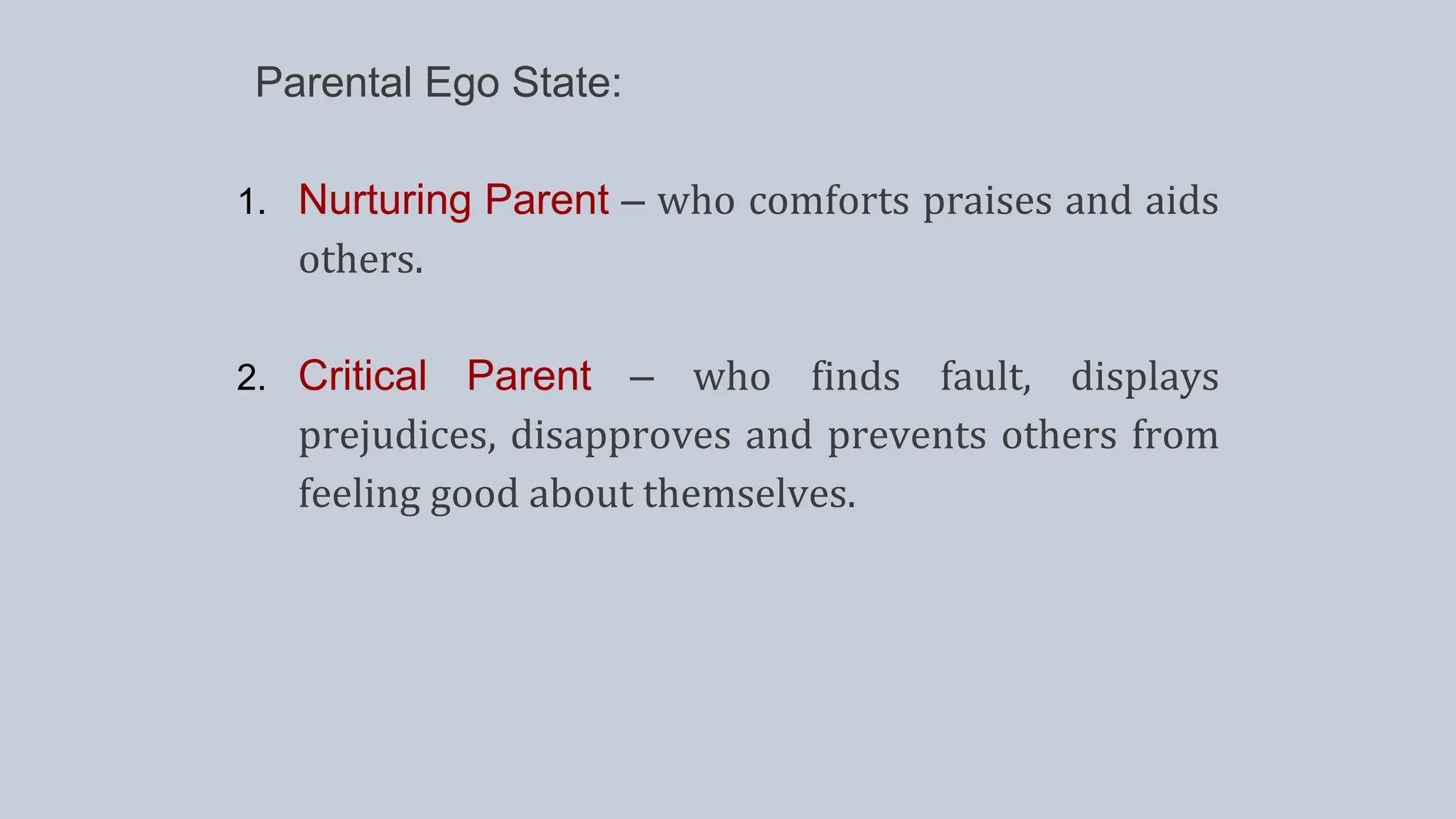
Parental Ego State:
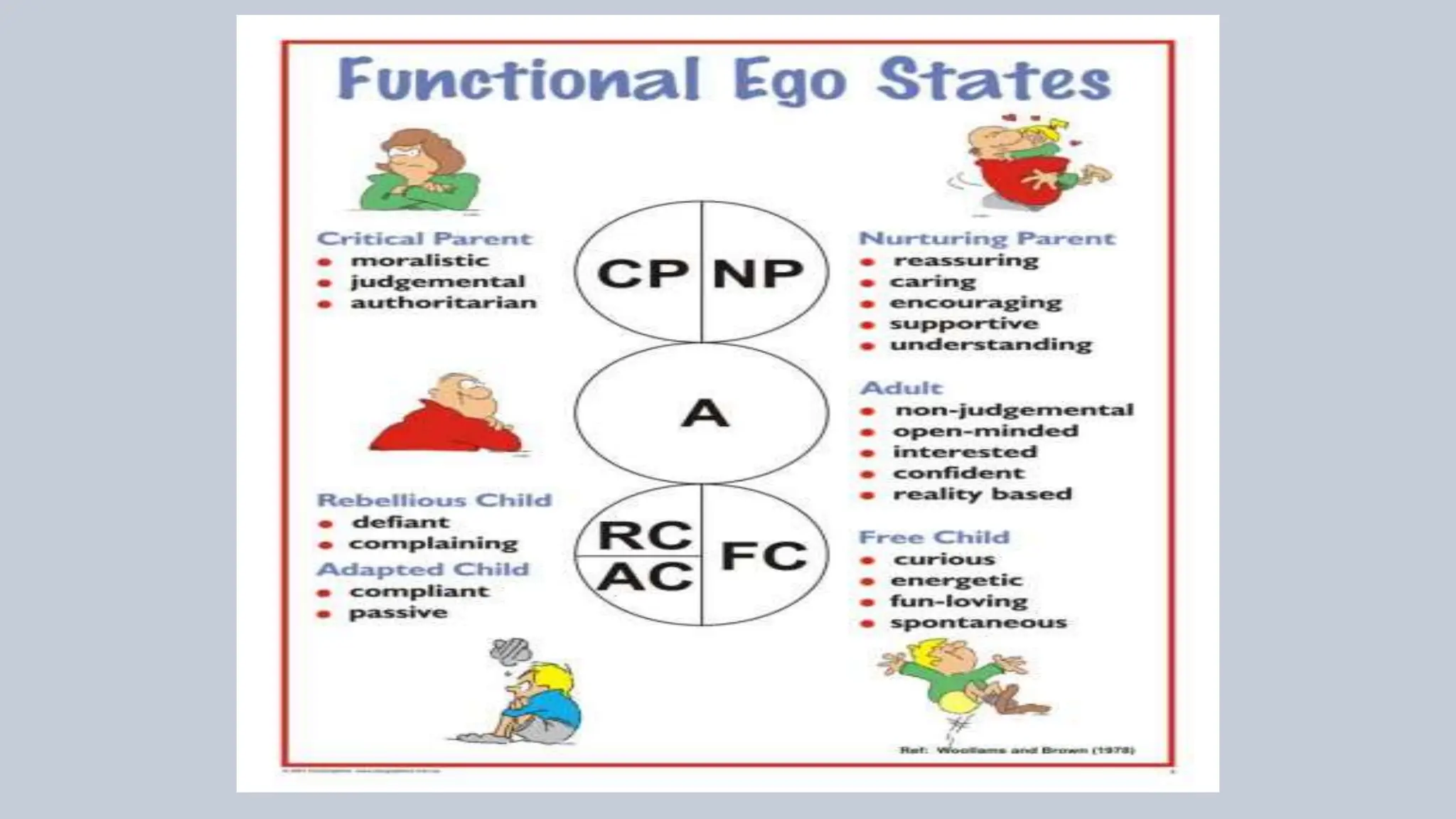
1. Nurturing Parent – who comforts praises and aids
others.
2. Critical Parent – who finds fault, displays
prejudices, disapproves and prevents others from
feeling good about themselves.
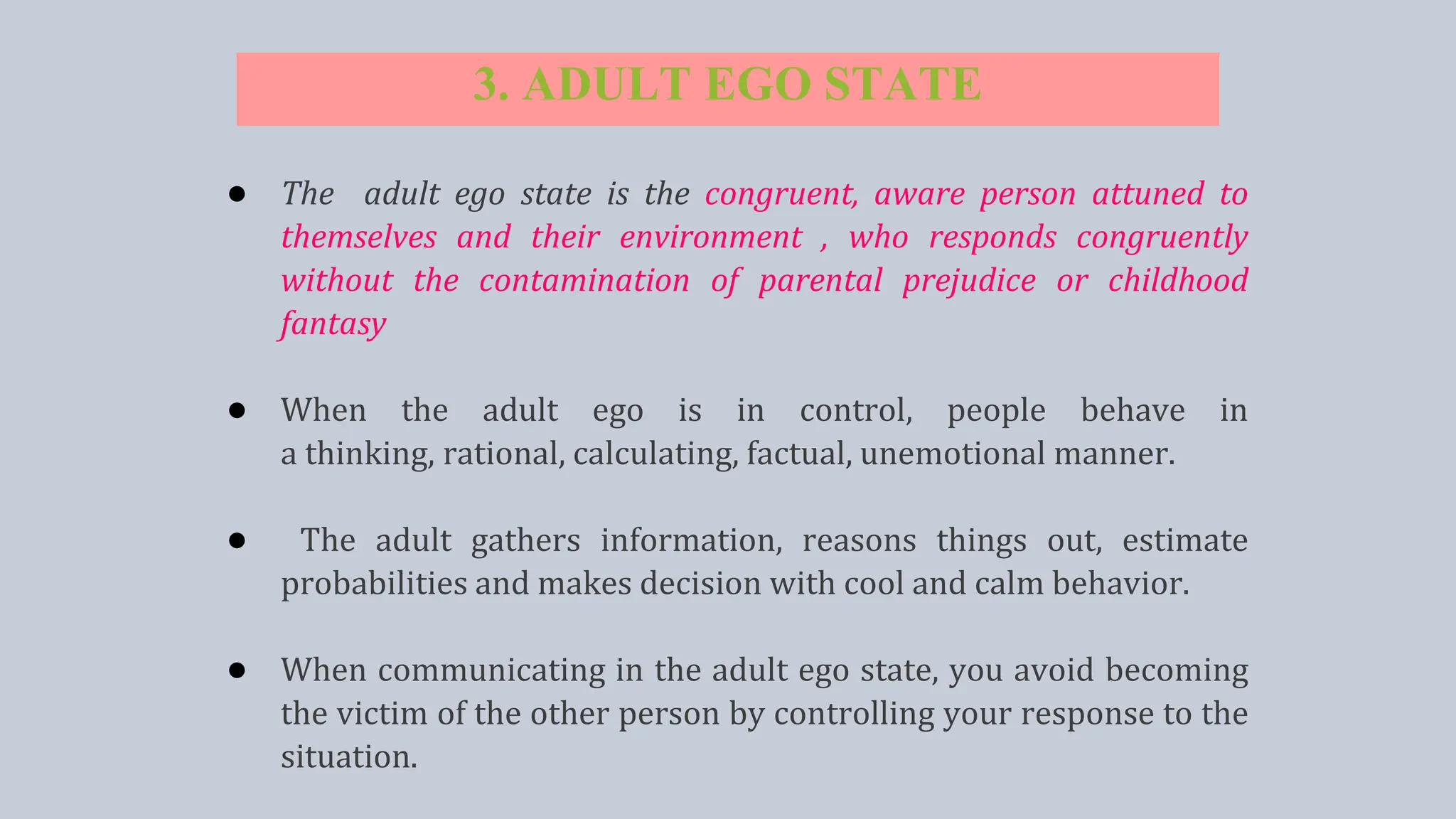
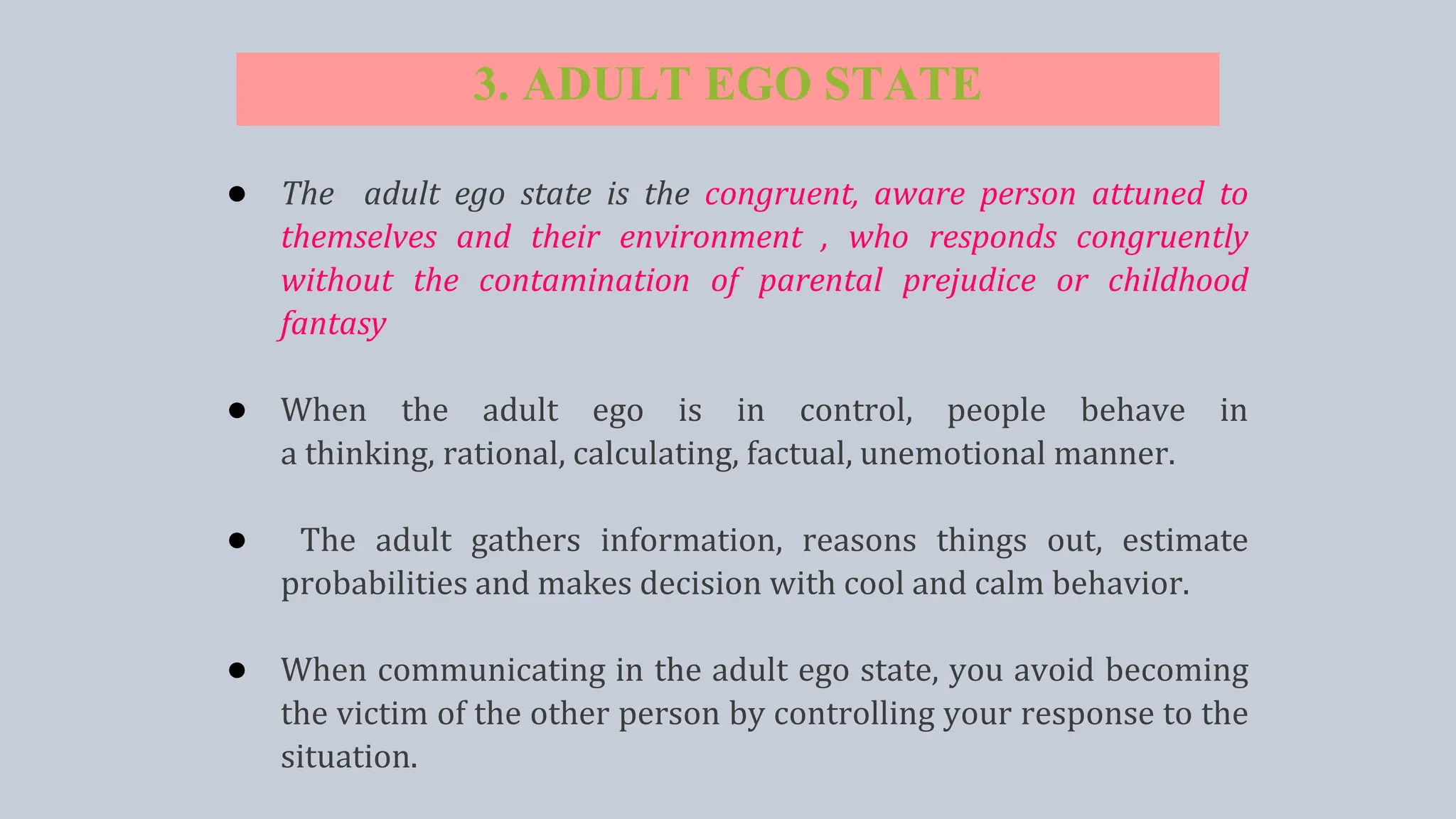
3. ADULT EGO STATE
● The adult ego state is the congruent, aware person attuned to
themselves and their environment , who responds congruently
without the contamination of parental prejudice or childhood
fantasy
● When the adult ego is in control, people behave in
a thinking, rational, calculating, factual, unemotional manner.
● The adult gathers information, reasons things out, estimate
probabilities and makes decision with cool and calm behavior.
● When communicating in the adult ego state, you avoid becoming
the victim of the other person by controlling your response to the
situation.
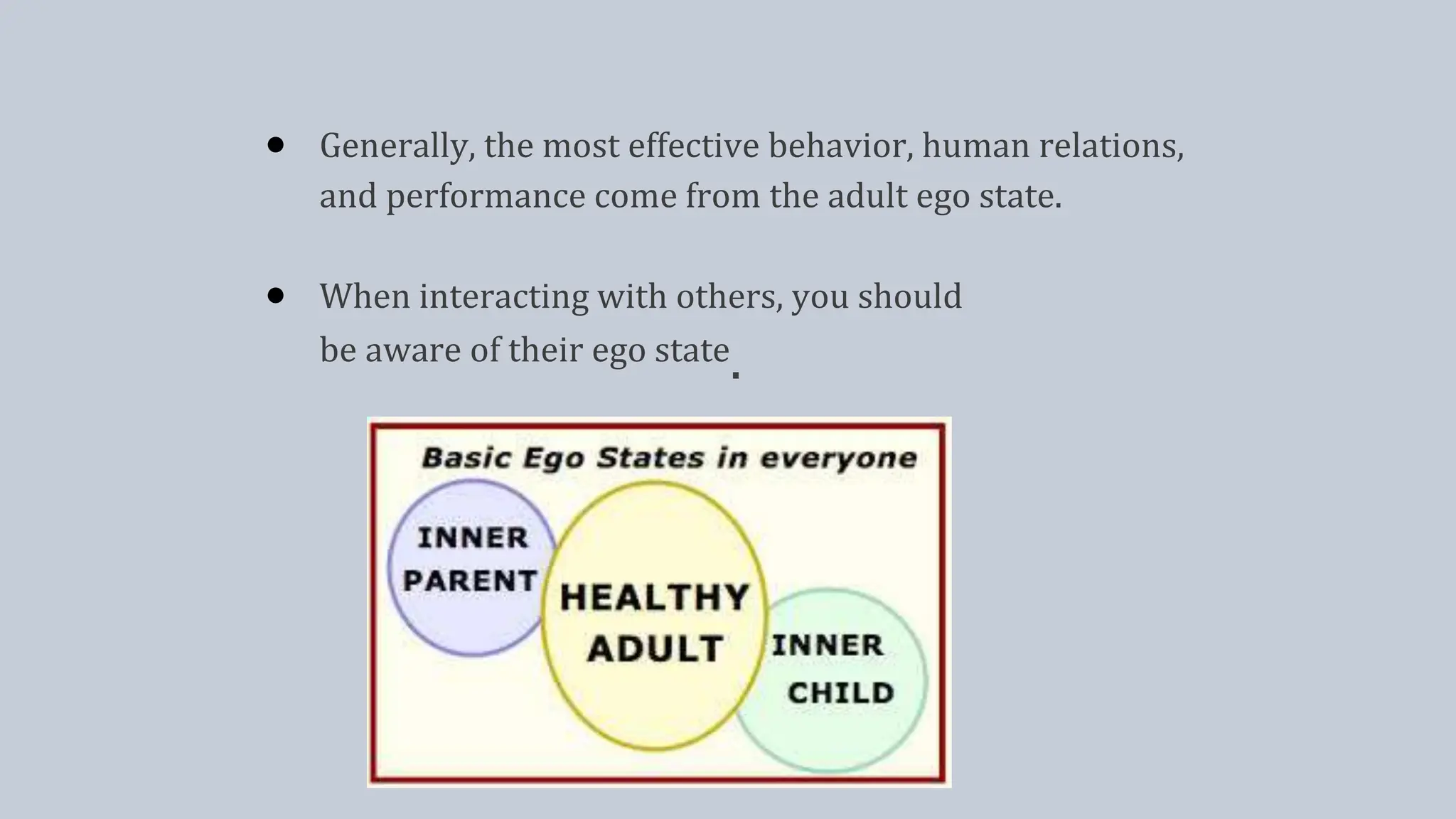
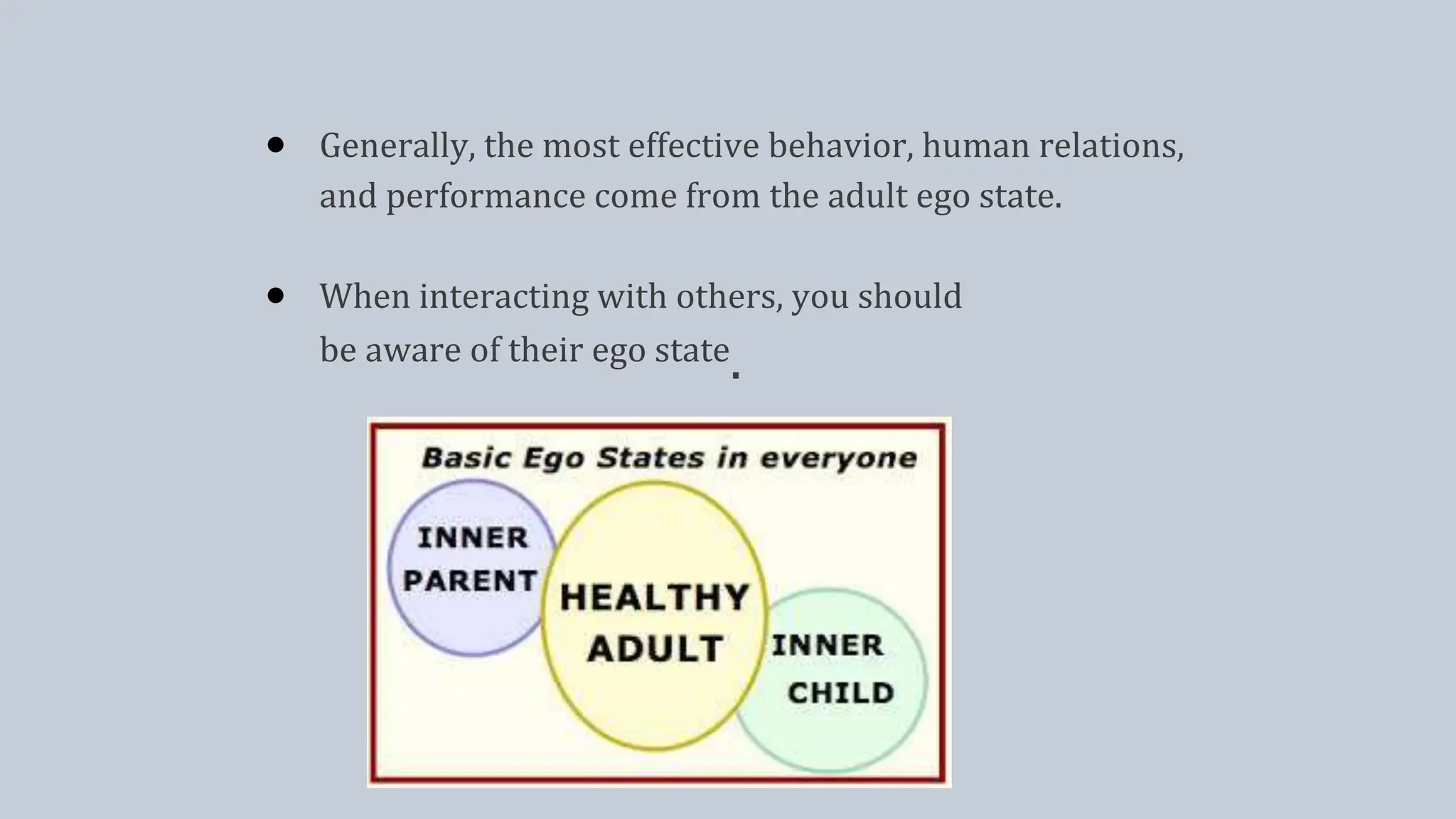
● Generally, the most effective behavior, human relations,
and performance come from the adult ego state.
● When interacting with others, you should
be aware of their ego state.
151
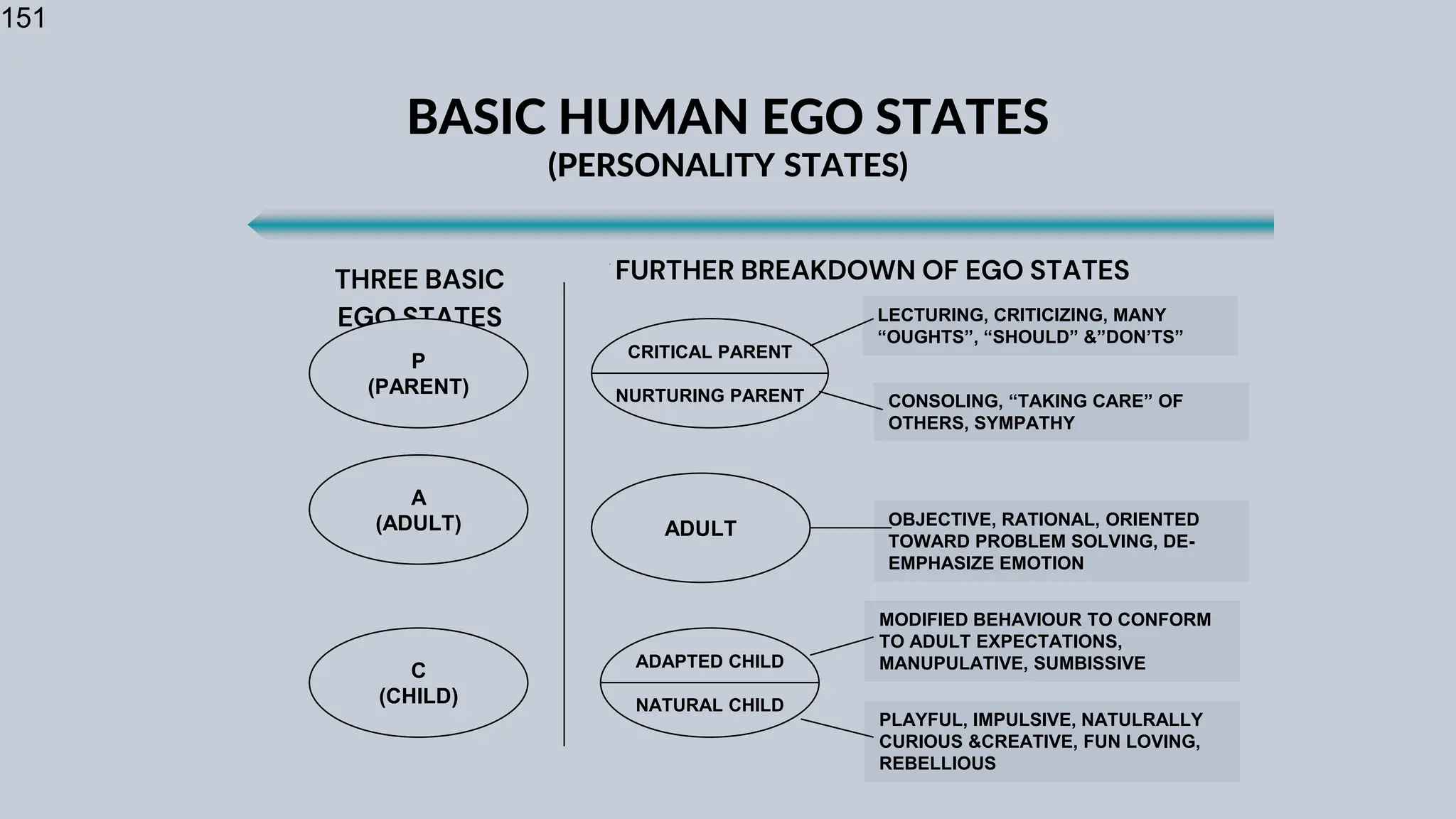
BASIC HUMAN EGO STATES
(PERSONALITY STATES)
THREE BASIC
EGO STATES
FURTHER BREAKDOWN OF EGO STATES
P
(PARENT)
A
(ADULT)
C
(CHILD)
CRITICAL PARENT
NURTURING PARENT
ADULT
ADAPTED CHILD
NATURAL CHILD
LECTURING, CRITICIZING, MANY
“OUGHTS”, “SHOULD” &”DON’TS”
CONSOLING, “TAKING CARE” OF
OTHERS, SYMPATHY
OBJECTIVE, RATIONAL, ORIENTED
TOWARD PROBLEM SOLVING, DE-
EMPHASIZE EMOTION
MODIFIED BEHAVIOUR TO CONFORM
TO ADULT EXPECTATIONS,
MANUPULATIVE, SUMBISSIVE
PLAYFUL, IMPULSIVE, NATULRALLY
CURIOUS &CREATIVE, FUN LOVING,
REBELLIOUS
3.ANALYSIS OF TRANSACTIONS
● A transaction is a basic unit of social interaction.
● The heart of transactional analysis is the study and
diagramming of the exchanges between two persons.
● Thus where a verbal or non verbal stimulus from one
person is being responded by another person a
transaction occurs.
● Transactional analysis can help us to determine which
ego state is most heavily influencing our behaviour and
the behaviour of the other people with whom we
interact.
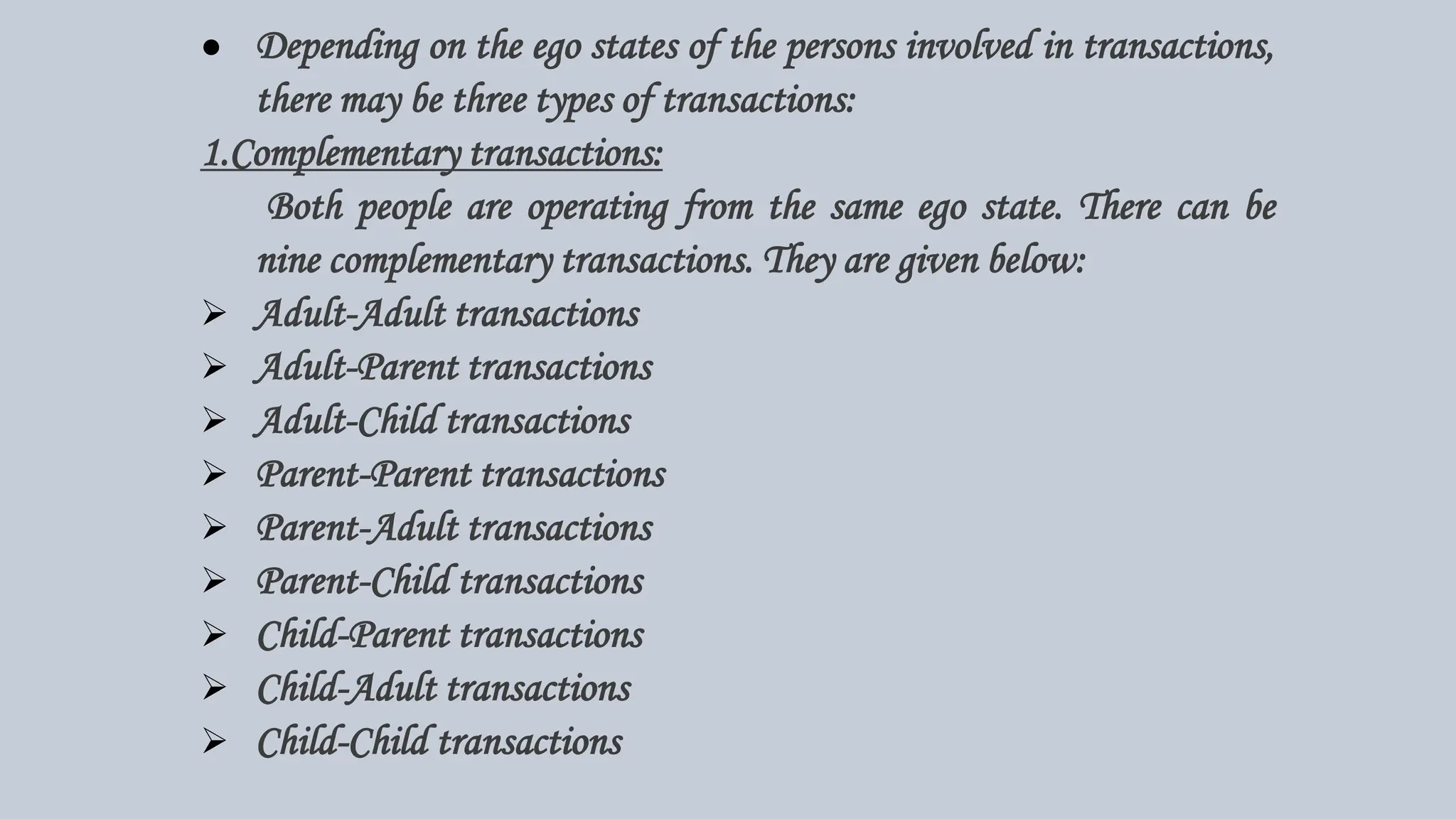
● Depending on the ego states of the persons involved in transactions,
there may be three types of transactions:
1.Complementary transactions:
Both people are operating from the same ego state. There can be
nine complementary transactions. They are given below:
 Adult-Adult transactions
 Adult-Parent transactions
 Adult-Child transactions
 Parent-Parent transactions
 Parent-Adult transactions
 Parent-Child transactions
 Child-Parent transactions
 Child-Adult transactions
 Child-Child transactions
Typical Behaviors
Advising
Criticizing
Ordering
Telling
Fault Finding
Moralizing
Scolding
Nurturing
Caring
Loving
Fact Finding
Questioning
Analyzing
Problem Solving
Helping
Cooperating
Planning
Coordinating
Scheduling
Thinking
Laughing
Crying
Sulking
Being Frightened
Playing
Enjoying
Dancing
Curiosity
Obeying
Dependent
PARENT ADULT CHILD
1.CHILD EGO STATE
● First ego state to develop is the child, which is that part of
personality characterized by child like behaviours and
feelings.
● The child ego state is the archive of a person’s total life
experience to date, moments of which may be evoked and
re-experienced in the present.
● When we are in the child ego state we act like child we
once were.
● The ego states are fully experienced states of being, not
just roles.
3 Types -
1. Natural Child - When the child is hateful or loving,
impulsive, spontaneous or playful, self centered.
2. Adapted Child – the complaining part of personality that
confirms wishes and demands of parental figures
3. Little Professor – when it is thoughtful, creative or
imaginative
2. PARENTAL EGO STATE
● The parent ego state incorporates the attitudes and
behaviours(the don’ts, should, and ought) of parental
figures
● In the parent ego state ‘introjected’ parent figures from the
past are evoked in the present. They are the beliefs,
mannerisms and emotional responses of an actual parent
from the past
● Outwardly the messages are delivered through prejudice,
criticism, and nurturing behaviour
Parental Ego State:
1. Nurturing Parent – who comforts praises and aids
others.
2. Critical Parent – who finds fault, displays
prejudices, disapproves and prevents others from
feeling good about themselves.
3. ADULT EGO STATE
● The adult ego state is the congruent, aware person attuned to
themselves and their environment , who responds congruently
without the contamination of parental prejudice or childhood
fantasy
● When the adult ego is in control, people behave in
a thinking, rational, calculating, factual, unemotional manner.
● The adult gathers information, reasons things out, estimate
probabilities and makes decision with cool and calm behavior.
● When communicating in the adult ego state, you avoid becoming
the victim of the other person by controlling your response to the
situation.
● Generally, the most effective behavior, human relations,
and performance come from the adult ego state.
● When interacting with others, you should
be aware of their ego state.
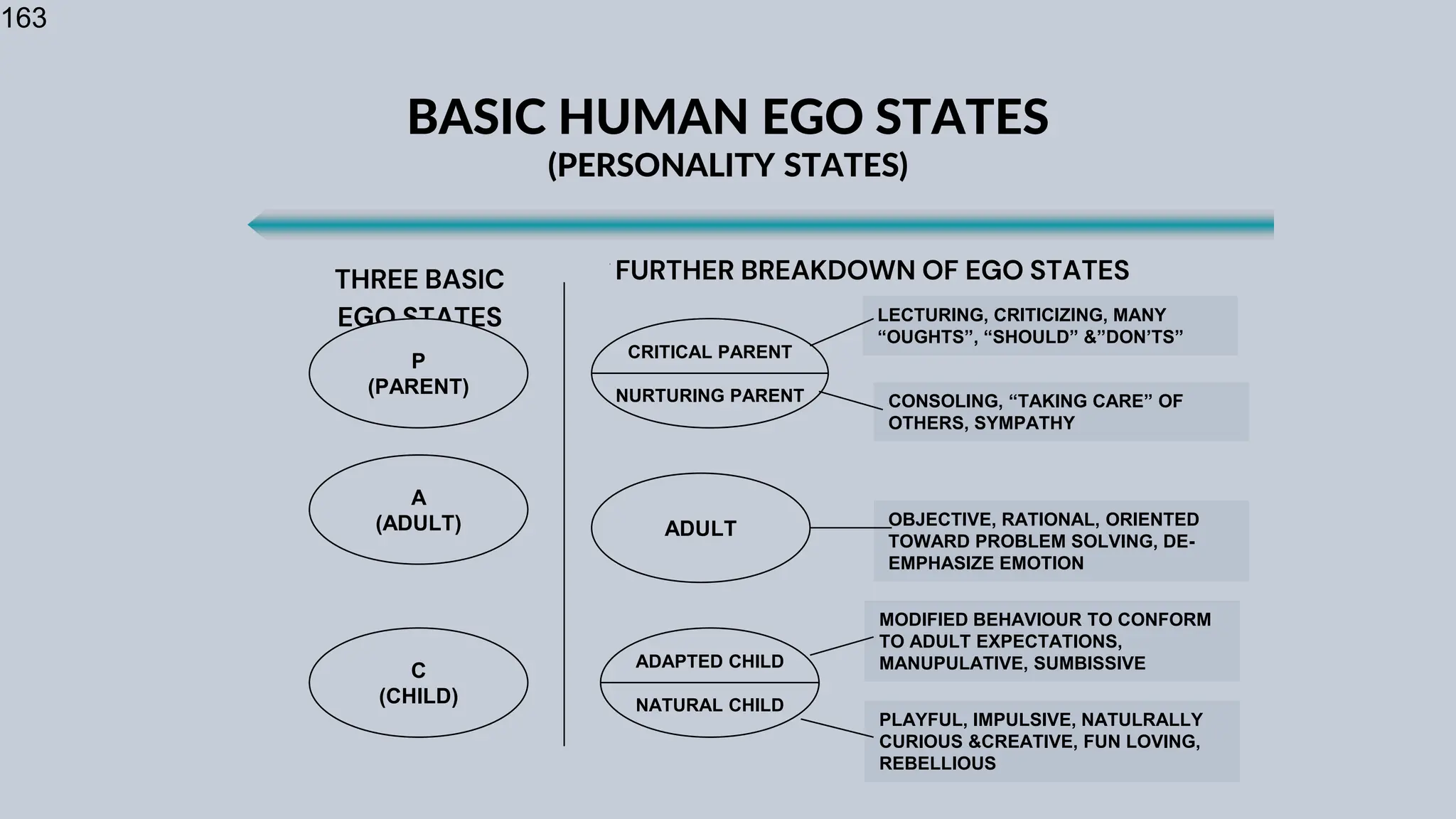
163
BASIC HUMAN EGO STATES
(PERSONALITY STATES)
THREE BASIC
EGO STATES
FURTHER BREAKDOWN OF EGO STATES
P
(PARENT)
A
(ADULT)
C
(CHILD)
CRITICAL PARENT
NURTURING PARENT
ADULT
ADAPTED CHILD
NATURAL CHILD
LECTURING, CRITICIZING, MANY
“OUGHTS”, “SHOULD” &”DON’TS”
CONSOLING, “TAKING CARE” OF
OTHERS, SYMPATHY
OBJECTIVE, RATIONAL, ORIENTED
TOWARD PROBLEM SOLVING, DE-
EMPHASIZE EMOTION
MODIFIED BEHAVIOUR TO CONFORM
TO ADULT EXPECTATIONS,
MANUPULATIVE, SUMBISSIVE
PLAYFUL, IMPULSIVE, NATULRALLY
CURIOUS &CREATIVE, FUN LOVING,
REBELLIOUS
TRANSACTIONAL ANALYSIS
● These are the basic unit of communication.
● Transactions occur when a person relates to another person
● Each transaction is made up of a stimulus and a response
● Within ego states there are three different types of transaction: co
mplementary, crossed, and ulterior
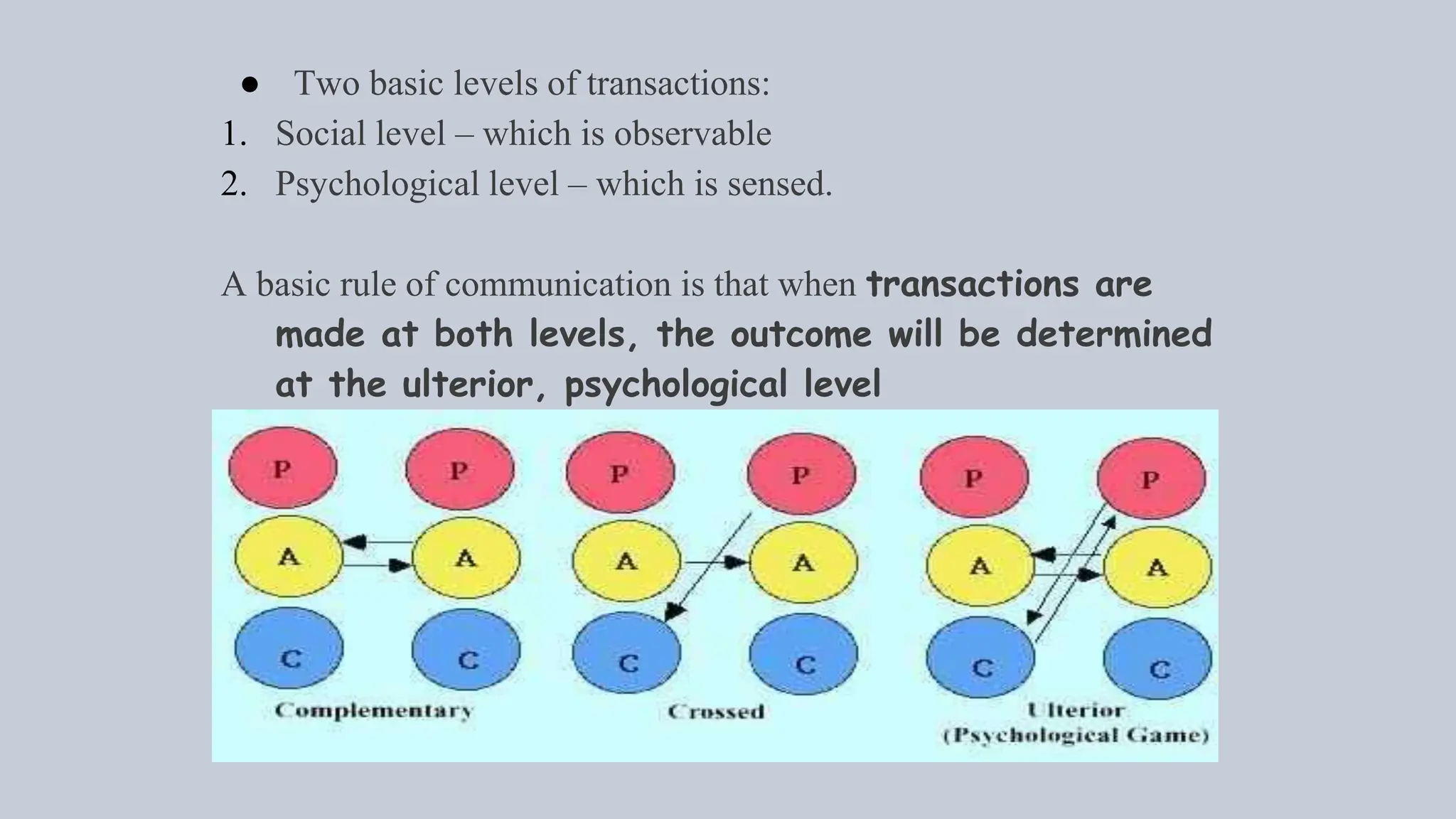
● Two basic levels of transactions:
1. Social level – which is observable
2. Psychological level – which is sensed.
A basic rule of communication is that when transactions are
made at both levels, the outcome will be determined
at the ulterior, psychological level
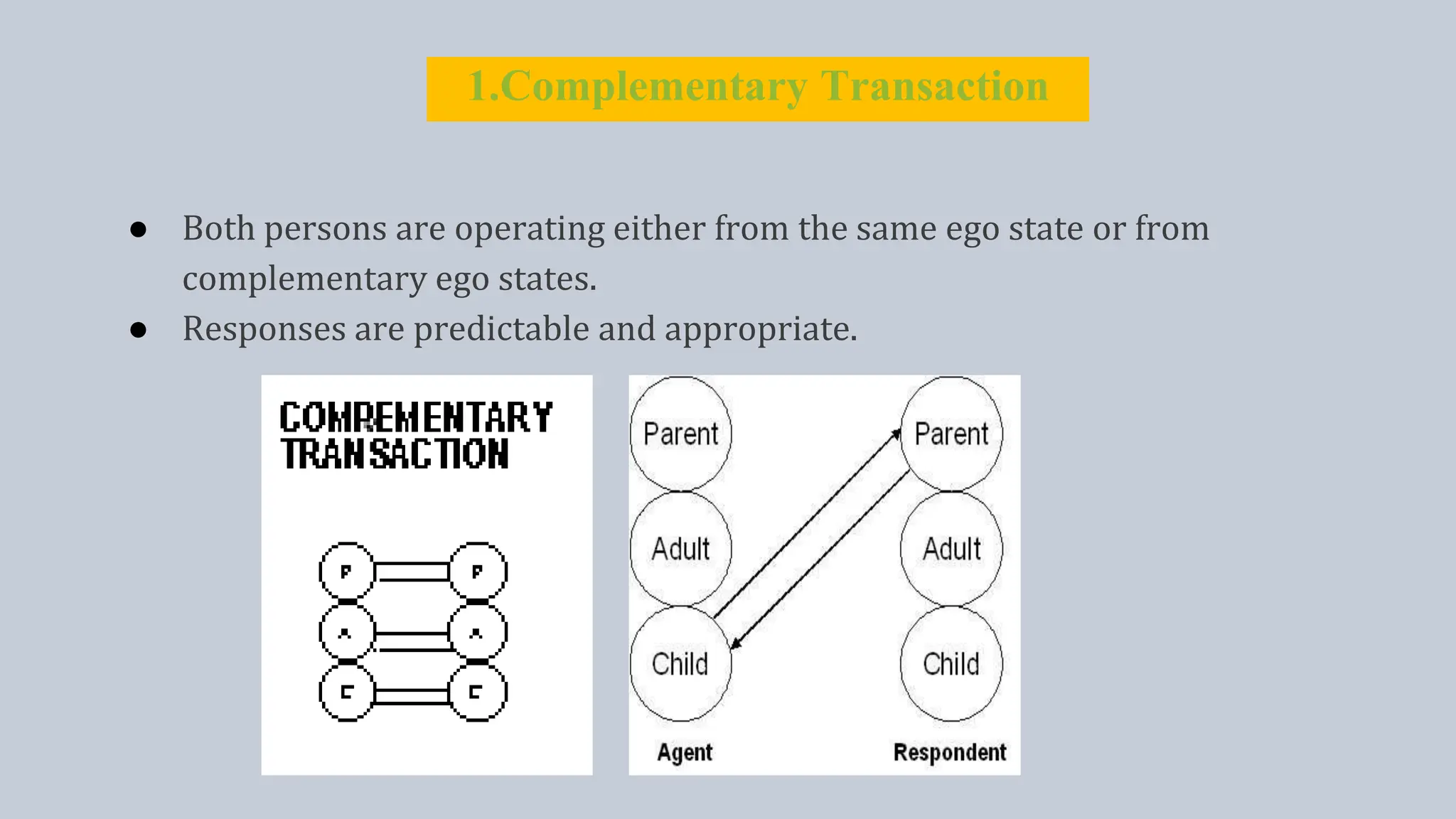
1.Complementary Transaction
● Both persons are operating either from the same ego state or from
complementary ego states.
● Responses are predictable and appropriate.
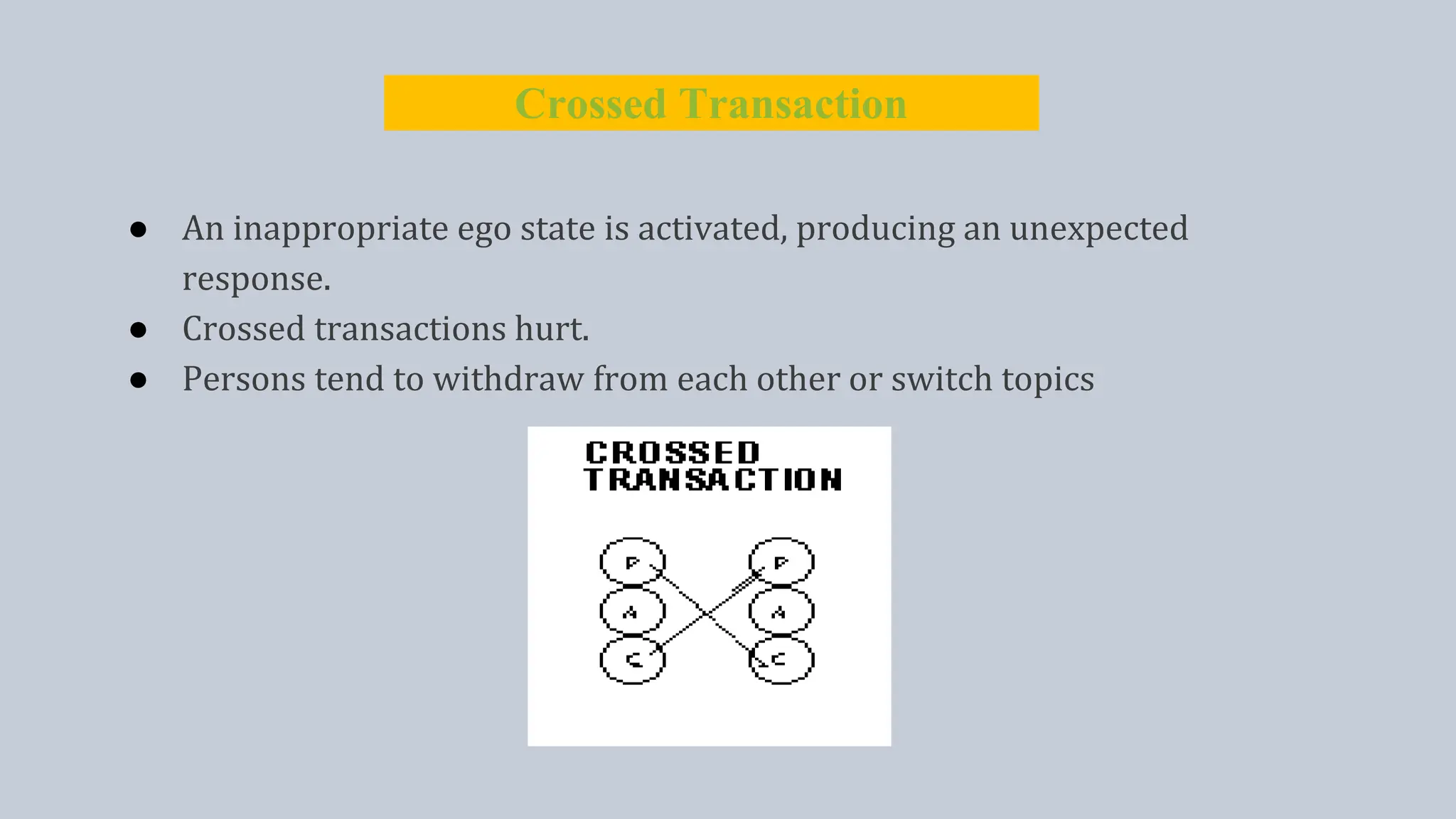
Crossed Transaction
● An inappropriate ego state is activated, producing an unexpected
response.
● Crossed transactions hurt.
● Persons tend to withdraw from each other or switch topics
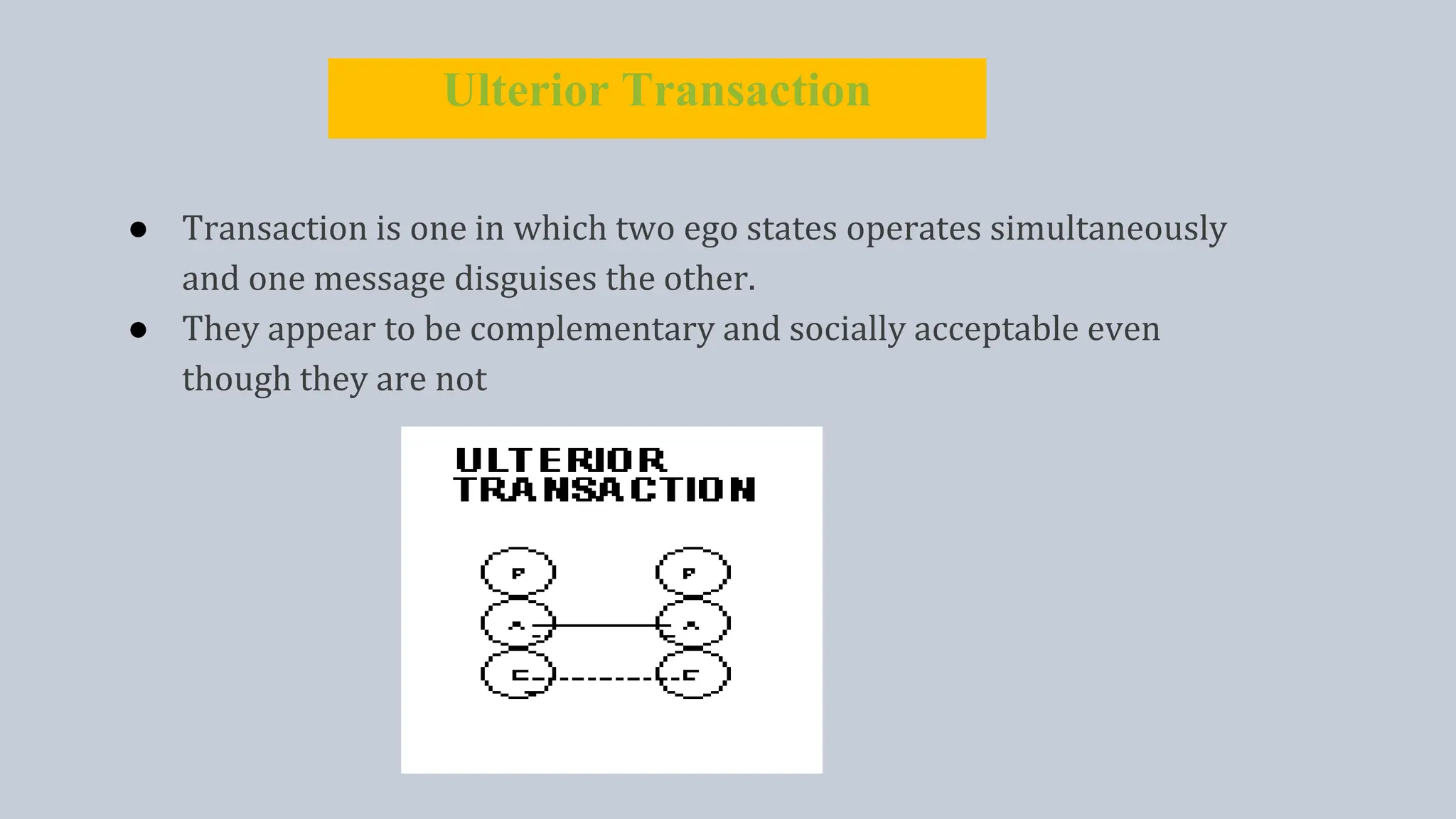
Ulterior Transaction
● Transaction is one in which two ego states operates simultaneously
and one message disguises the other.
● They appear to be complementary and socially acceptable even
though they are not
2. Crossed transactions:
a crossed transaction is one in which the sender sends
message a behaviour on the basis of his ego state, but this
message is reacted to by an unexpected ego state on the
part of the receiver. Crossed communication should be
avoided as far as possible. Whenever such transactions
occur, communication tends to blocked and a satisfactory
transaction is not accomplished.
3.Ulterior transactions:
two ego states within the same person but one disguises
the other one.
4. SCRIPT ANALYSIS
● In a layman’s view ,a script is the text of play, motion
picture, or a radio or TV programme.
● In transactional analysis a person’s life is compared to a
play and the script is the text of the play.
● According to Eric Berne,” a script is an ongoing
programme, developed in early childhood under parental
influence which directs the individual behaviour in the
most important aspects of his life.
● A script is a complete plan of living, offering
prescriptions, permissions and structure which makes
one winner or loser in life.
5. ANALYSIS OF LIFE POSITIONS
● In the process of growing up people make basic assumptions
about their own self worth as well as about the worth of
significant people in their environment.
● The combination of assumptions about self and the other person
called as life position.
● Transactional analysis constructs the following classifications of
the four possible life positions or psychological positions:
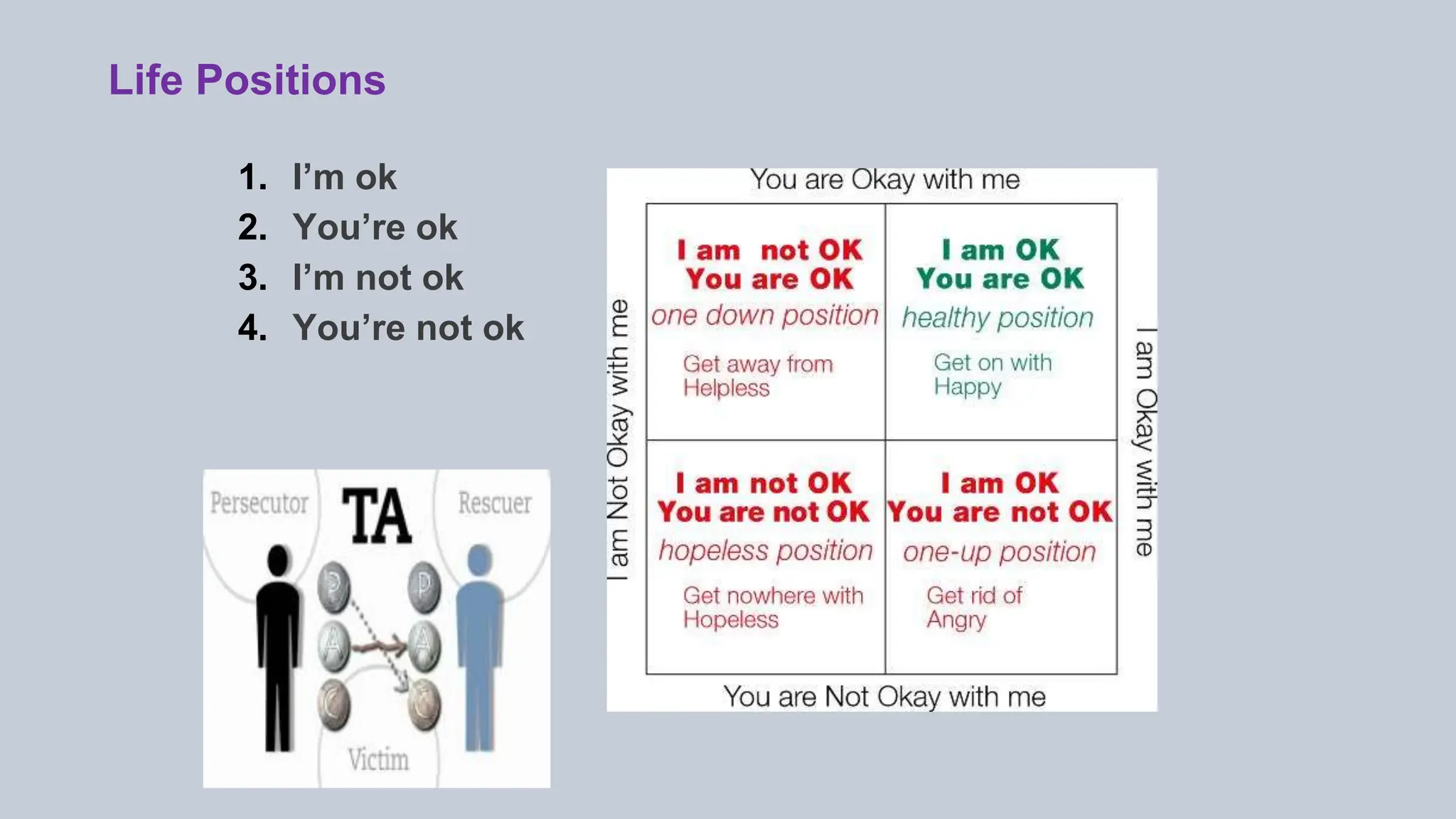
● I am OK,, you are OK.
● I am OK, ,you are not OK.
● I am not OK,, you are OK.
● I an not OK,, you are not OK
● I am OK, you are OK:
It appears to be an ideal life position. People with this type of life
position have confidence in themselves as well as trust and
confidence in others.
● I am OK, you are not OK:
This is a distrustful psychological positions. This is the attitude of
those people, who think that whatever they do is correct.
● :I am not OK, you are OK
This is a common position for those people who feel power less
when they compare themselves to others.
● I am not OK,, you are not OK:
people in this position tend to feel bad about themselves and see
the whole world as miserable. They do not trust others and have no
7. GAMES ANALYSIS
● When people fail to get enough strokes at work
they try a variety of things.
● One of the most important thing is that they play
psychological games.
● A psychological game is a set of transaction with
three characteristics:
 The transaction tend to be repeated.
 They make sense on superficial or social level.
GAME ANALYSIS
● Games are ulteriorly motivated transactions that appear
complementary on the surface but end in bad feelings.
● Games are a series of transactions with a familiar pattern and
predictable outcome.
● Those who are involved start out in one of three classical
game roles : - Persecutor, Rescuer or Victim.
● A game is characterized by the sudden switching of roles and
the collection of a payoff.
● Types of games:
* A first degree game is one which is socially
acceptable in the agent’s circle.
* A second degree game is one which more
intimate end up with bad feelings.
* A third degree game is one which usually
involve physical injury.
6.STROKING
● Stroking is an important aspects of the
transactional analysis.
● The term stroke refers to “giving some kind of
recognition to others.”
● People need strokes for their sense of survival and
well being on the job. Lack of stroking can have
negative consequences both on physiological and
psychological well being of a person.
● There are three types of strokes:
STROKE
● These games are played outside awareness as a means of
generating familiar, often negative, unit of recognition or
‘stroke’
● Stroke – the fundamental unit of social action
● A stroke is a unit of recognition, when one person
recognizes another person either verbally or non
verbally.
● In infancy strokes are essential for survival and comes mainly
from close physical contact with a primary parent figures..
● Later strokes are symbolized by word and gestures.
● Spitz observed that infants deprived of handling – in other
words, not receiving any strokes – were more prone to
emotional and physical difficulties.
● Berne took Spitz’s observations of these infants and developed
theories about the needs of adults for strokes.
● Berne postulated that adults need physical contact just like
infants, but have learned to substitute other types of
recognition instead of physical stimulation.
● Berne also reasoned that any stroke, be it positive or negative,
is better than no strokes at all.
SCRIPT ANALYSIS
● Everyone makes a life script or life plan, early in childhood,
by the age of five.
● Life scripts is constructed in infancy in response to parental
influence.
● The scripts passes from consciousness but it is often faithfully
acted out.
● Infants, depends on parental figures for survival, reach
conclusions based on themselves and others on the basis of
perceived messages from parents and adapt accordingly .
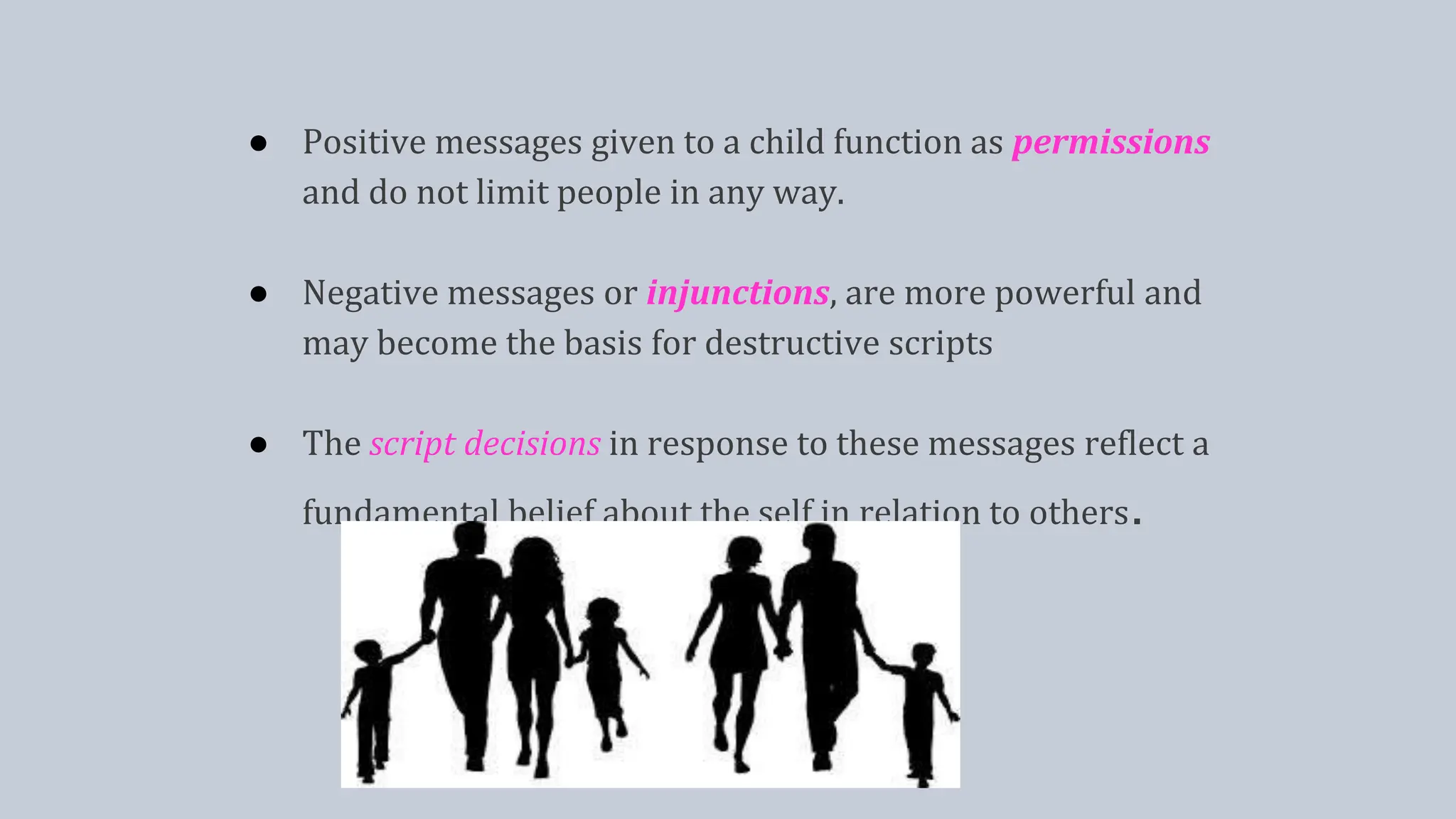
● Positive messages given to a child function as permissions
and do not limit people in any way.
● Negative messages or injunctions, are more powerful and
may become the basis for destructive scripts
● The script decisions in response to these messages reflect a
fundamental belief about the self in relation to others.
Life Positions
1. I’m ok
2. You’re ok
3. I’m not ok
4. You’re not ok
1.Positive strokes:
the stroke one feel good, is a positive stroke.
Recognition, approval are some of the examples.
2. Negative strokes:
a stroke one feel bad or not good is a negative
stroke. negative strokes hurt physically or
psychologically.
3.Mixed strokes:
a stroke may be of a mixed type also.
Example :the boss comment to a worker “you did an
excellent job inspite your limited experience.
BENEFITS AND UTILITY OF
TRANSACATIONAL ANALYSIS
● Improved interpersonal communication.
● Source of positive energy.
● Understanding ego state.
● motivation.
● Organisational development
ROLE OF THERAPIST
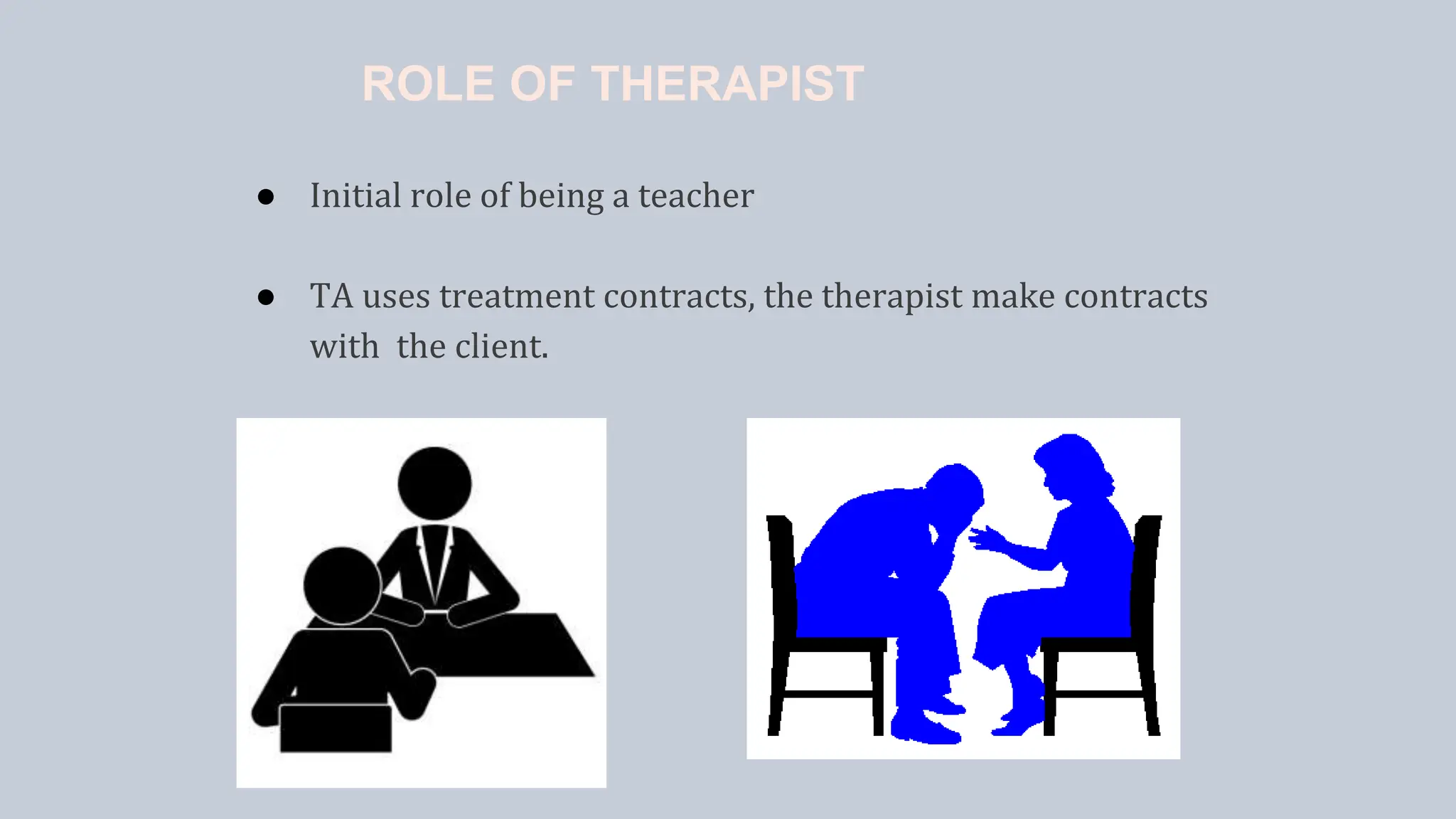
● Initial role of being a teacher
● TA uses treatment contracts, the therapist make contracts
with the client.
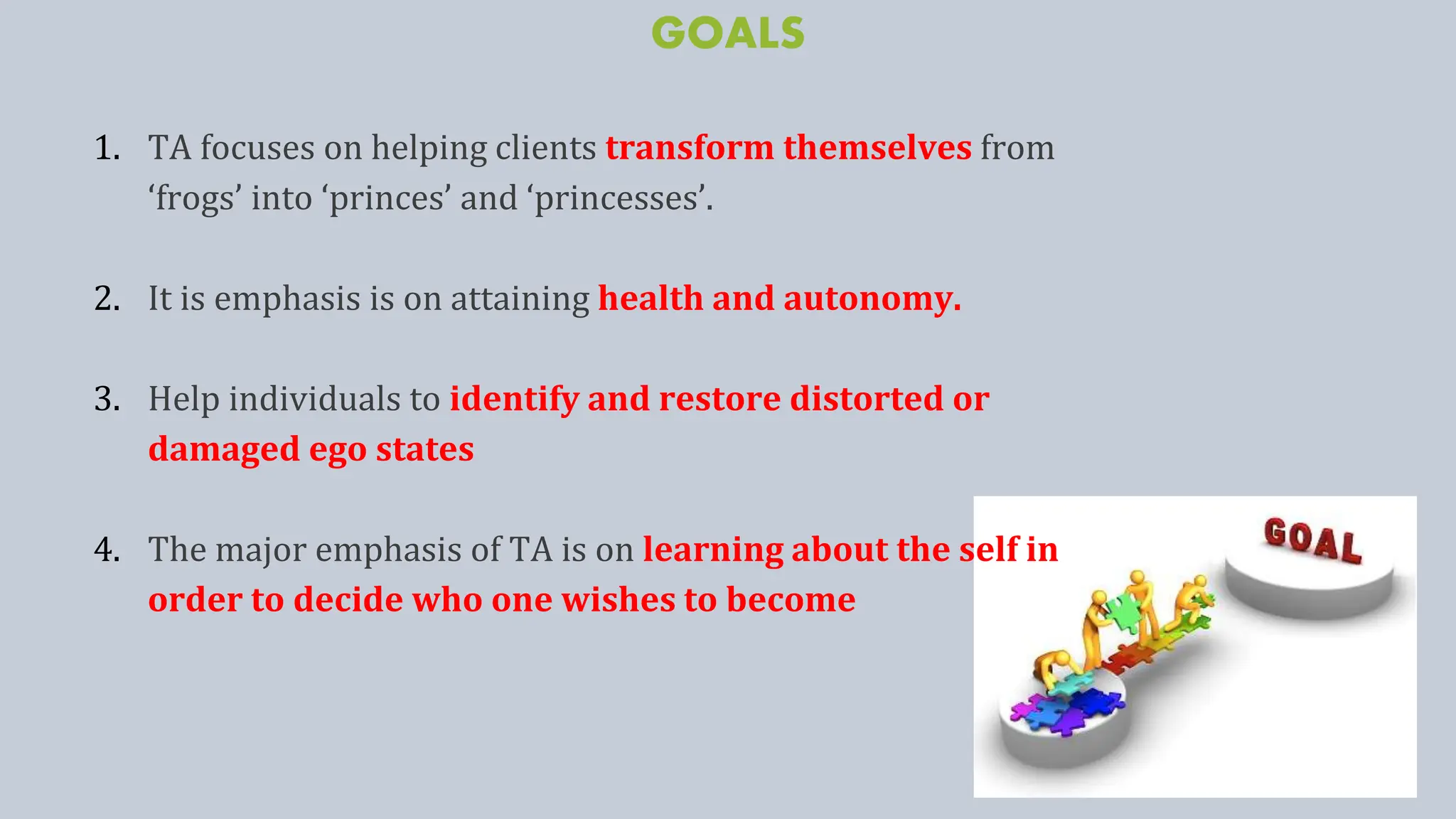
GOALS
1. TA focuses on helping clients transform themselves from
‘frogs’ into ‘princes’ and ‘princesses’.
2. It is emphasis is on attaining health and autonomy.
3. Help individuals to identify and restore distorted or
damaged ego states
4. The major emphasis of TA is on learning about the self in
order to decide who one wishes to become
TECHNIQUES
1. TREATMENT CONTRACT
A specific , concrete contract that emphasizes agreed upon
responsibilities for both counsellor and client
2. INTERROGATION
Speaking to a client’s adult state until the counsellor receives an
adult response
3. EXPLANATION
Occurs on an adult to adult ego state level. The counsellor
teaches the client about some aspects of TA
4. ILLUSTRATION
Enlightens the client or elaborate a point
5. CONFIRMATION
Used when previously modified behaviour occurs again and the
therapist points this out to the client
6. INTERPRETATION
Involves the therapist’s explanation to the child ego state of the
client the reasons for the client’s behaviour
7. CRYSTALLIZATION
Consists of an adults - to – adults transactions in which the
client comes to an awareness that individuals game
playing may be given up if so desired
8. CONFRONTATION
It involves the therapist’s pointing out inconsistencies in the
client’s behaviour or speech
STAGES OF TREATMENT
1st Stage
Establishing a work alliance, mapping the nature problem and
negotiating a preliminary contract
2nd Stage
De-contamination of the adult ego state
 The therapist help the client to identify the parental
prejudices and childhood fantasies that they have used to
distort reality and reign force their life script
3rd Stage
De- confusing the child ego state and developing an internal
nurturing parent
 It is important to establish that they have decided to keep
themselves safe, act safely with others and stay touch with the
reality
4th Stage
Integration of new decisions and bringing to a close therapeutic
relation ship.
 This stage often involves the client reviewing other
relationships, discovering disowned aspects of their authentic
self and experimenting with new ways of being
Transactional Analysis applies to
different levels:-
1. The clinical side of therapy.
2. The analysis of personality.
3. The interpersonal communication.
4. The group dynamics.
5. The organization analysis (organizational theory of Eric
Berne).
6. Used in the domains of education, consulting, training,
coaching, recruitment, skills assessment and organization.
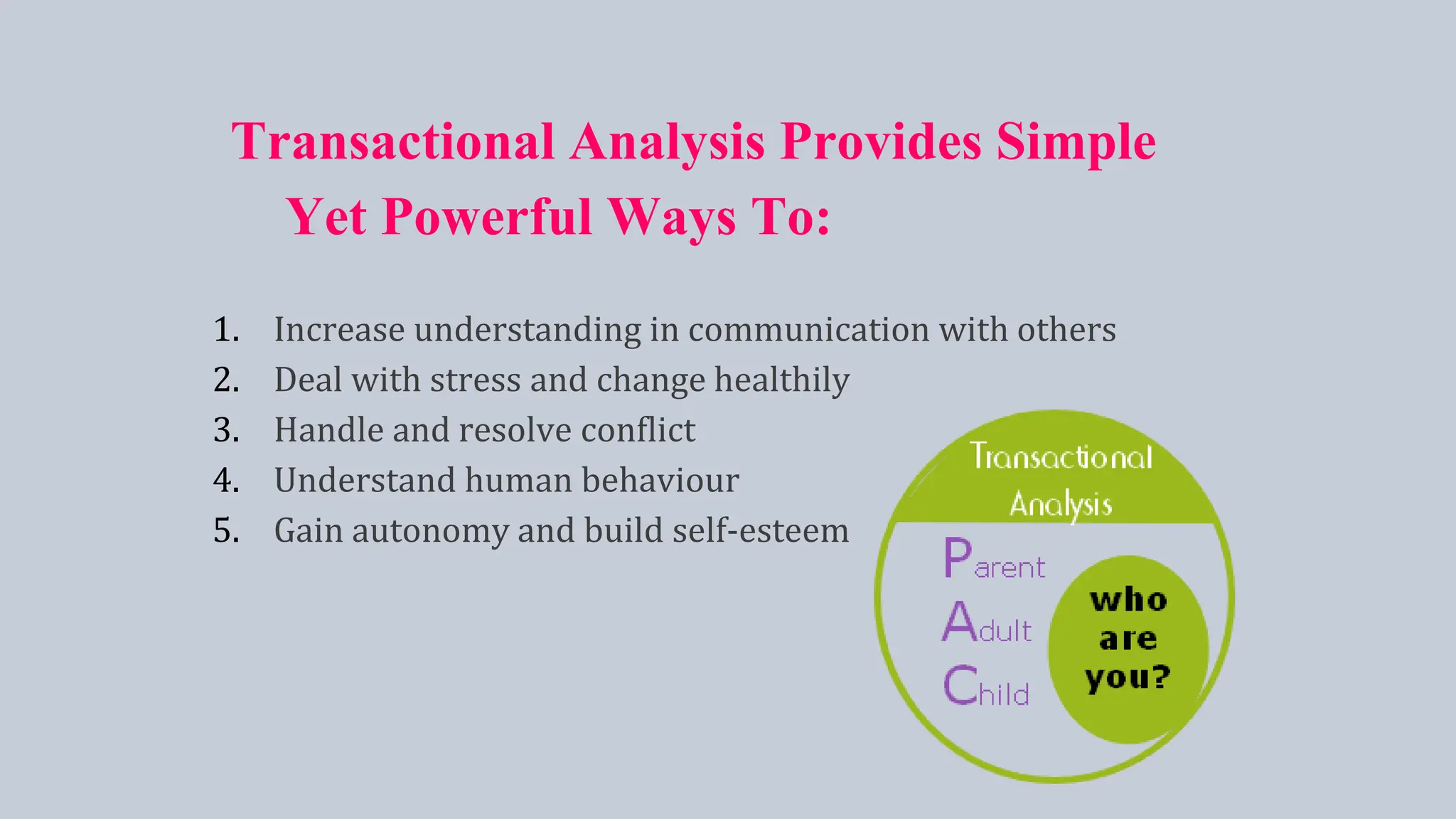
Transactional Analysis Provides Simple
Yet Powerful Ways To:
1. Increase understanding in communication with others
2. Deal with stress and change healthily
3. Handle and resolve conflict
4. Understand human behaviour
5. Gain autonomy and build self-esteem
STRENGTHS
1. The approach uses terms that are easily understood and
clearly defined.
2. The approach is easily and collectively companied with
other more action – oriented approaches
3. The approach puts the responsibility of change on the
client
4. The approach is goal- directed
CRITICISMS
1. The approach has been criticized for its primary cognitive orientation.
2. The approach is criticized for its simplicity, structure, and popularity
3. The research behind the approach is relatively weak.
4. The approach has not developed much after Berne’s death in 1970
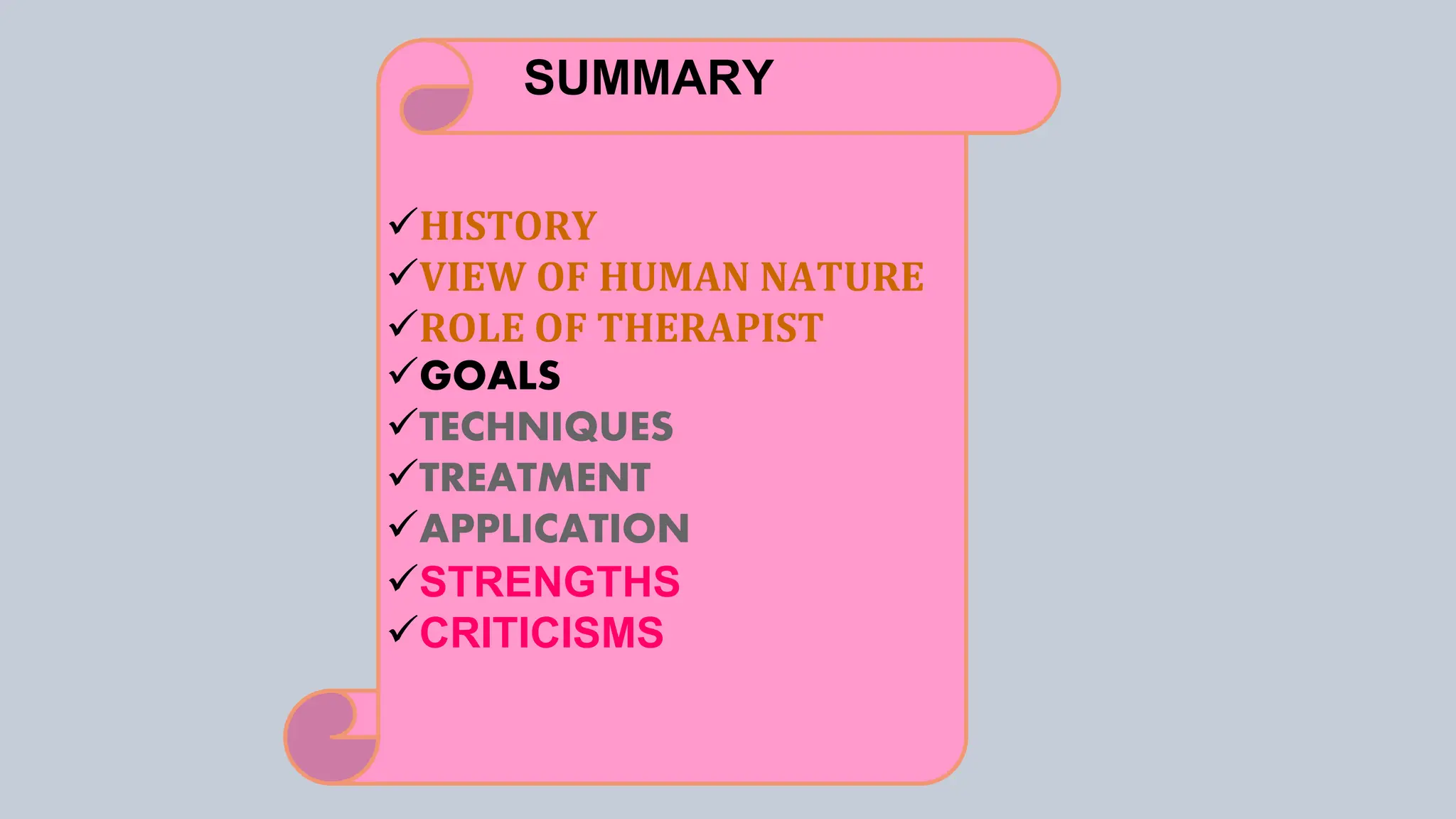
SUMMARY
HISTORY
VIEW OF HUMAN NATURE
ROLE OF THERAPIST
GOALS
TECHNIQUES
TREATMENT
APPLICATION
STRENGTHS
CRITICISMS
Reference
1. www.ericberne.com/transactional-analysis/ accessed
date:28/2/16 Time: 2.30 pm
2. www.counselling-directory.org.uk/transactional analysis.html
date: 28/2/16 Time: 4.00 pm
3. http://www.transactional-analysis.info/menuglossaire.html
Date: 28/2/16 Time: 4.30 pm
4. Stein M Samuel. Essentials of psychotherapy. Oxford Auckland
Boston Johannesburg Melbourne. New Delhi.
5. Gladding ,T. Samuel Counseling A Comprehensive
Profession. Indian edition published by Dorling Kindersley India
pvt ltd 2009
Mastering the Basics of Communication.pptx

Mastering the Basics of Communication.pptx

  • 1.
    Mastering the Basics ofCommunication Communication is the power that sets you free
  • 2.
    Intended learning outcomes CommunicationSkills Theory and Practice Grammar: Tenses, Passive voice, Indirect Speech, Modals, Conditionals, Composition: Resume, Letters, Reports, Paragraphs. Performance assessment Discussions, Discussions, Feedback, Self assessment, Trainer assessment Infographic resources These can be used in the template, and their size and color can be edited Customizable icons They are sorted by theme so you can use them in all kinds of presentations
  • 3.
    Course objectives pssr  Developcommunicative competency in students.  Apply appropriate communication skills across settings and purposes.  Use technology to communicate effectively in various settings and contexts.  Evolve critical, interpretive, analytical and innovative thinking.  Bring insights of literature into class.  Build social interaction for effective relationships.  Demonstrate appropriate and professional behaviour.
  • 4.
    01 02 03 04 0506 Table of contents Definitions of Communication INTERPERSONAL COMMUNICATION HOW TO IMPROVE YOUR INTERPERSONAL COMMUNICATION SKILLS BODY LANGUAGE IN INTERPERSONAL COMMUNICATION HAPTICS (PHYSICAL CONTACT) PROXEMICS/ PERSONAL SPACE
  • 5.
    07 08 09 10 1112 Table of contents CHRONEMICS SILENCE Barriers of communication Interpersonal conflict Personal appearance and communication Improving communication
  • 6.
    Introduction Being able tocommunicate effectively is the most important of all life skills. Communication is simply the act of transferring information from one place to another. This may be vocally (using voice), written (using printed or digital media such as books, magazines, websites or emails), visually (using logos, maps, charts or graphs) or non- verbally (using body language, gestures and the tone and pitch of voice)
  • 7.
  • 8.
    AGENDA ►What is communication ►Filtersin communication ►Effective communication ►Barriers to communication ►Listening vs Hearing ►Communication styles ►Communication with DISC styles
  • 9.
    Objectives A2 Acquire Skillsfor Improving Learning A:A2.2 Demonstrate how effort and persistence positively affect learning A:A2.3 Use communications skills to know when and how to ask for help when needed A:A2.4 Apply knowledge and learning styles to positively influence school performance PS:A2 Acquire Interpersonal Skills PS:A2.6 Use effective communications skills PS:A2.7 Know that communication involves speaking, listening and nonverbal behavior
  • 10.
    DEFINITION OF COMMUNICATION Communicationcan be defined in many ways. In simple terms communication is: • Information transmitted • A verbal or nonverbal message • A process by which information is exchanged between individuals through a common system of symbols, signs, or behavior
  • 12.
    COMMUNICATION communication is theillusion that itfl. taken plac What if communication were not possible? Frustration and Chaos!
  • 13.
    T Communication isany behavior that results in an exchange of meaning'. T ' the process by which information is transmitted between two or more individuals so that understanding can occur between them'. NB: if the other person does not understand you, you have failed to communicate effectively
  • 14.
    is the processby which people exchange information, feelings, and meaning through verbal and non-verbal messages usually in a face to face interaction. Interpersonal communication is not just about what is actually said - the language used - but how it is said and the non-verbal messages sent through body language. Improving your Interpersonal communication skills will help you to interact with other people better.
  • 15.
  • 16.
    “This is aquote, words full of wisdom that someone important said and can make the reader get inspired.” —Someone Famous
  • 17.
    A picture isworth a thousand words
  • 18.
    Images reveal largeamounts of data, so remember: use an image instead of a long text. Your audience will appreciate it A picture always reinforces the concept
  • 19.
    ACTIVITY ' Think of arecent example in which you involved in a miscommunication and answ following questions: I ' 1. Why did the miscommunication occur? 2. What impact did it have? 3.If you had a chance to do it over again, wha specifically would you do differently?
  • 20.
    Do You Know? ►Anaverage person spends 50% of communicating? his or her ►Business success is 85% dependent on effec I t communication and interpersonal skills? ►45% oftime spent communicating is listening? ►Writing represents 9% of communication time? ►25% of all workplace mistakes are the result of poor communication? ►A remarkable 75% of communication is non-verbal?
  • 21.
    ►Filters' represent ourperceptions everything we encounter and are based p the sum total of who we are ►Filters impact: ►How we see others, ►How we Interpret situations ►How we act and feel ►"We don't see things as they are, we see them as we are." Filters in Communication
  • 22.
    ' Features of EffectiveCommuni I • Active Listening • Eye contact • Posture • Simple language • Questioning skills I I
  • 23.
  • 24.
  • 25.
    Listening VS Hearing ►Hearing-Physical process, natural, passi• ve ►Listening - - Physical as well as mental process, active, ►-learned process, a skill ►Listening is hard. You must choose to participate in the process of listening. I I
  • 26.
    l Active Listening Theprocess of recognizing, understanding: accurately interpreting communicated messagesI responding to spoken and/or nonverbal messages. • Steps to Effective Listening: - Hearing, - Interpretation (clear your mind) - Evaluation - Respond (Give Verbal and non Verbal acknowledgement) Make eye contact - Adjust your body posture - Avoid distracting behaviours (you can't multitask)
  • 27.
    Roadblocks to ActiveListening ►Emotional Interference ►Defensiveness ►Hearing only facts and not feelings ►Not Seeking clarification ►Hearing what is expected instead of what is said I 1 . ►The 'halo' effect (i.e., the tendency for something to be influenced by a loosely associated factor) ►Automatic dismissal (e.g., "We've never done it that way before") ►Resistance tochange
  • 28.
    CommunicationVariables ►Differences between senderand receiver - Attitudes - Information levels - Communication skills - Social systems - Sensory channel • Differences in previous experiences ►Cultural differences ►Differences in communication styles
  • 29.
    Summary ►What is Communication? ►Barriersto communication ►Communication filters ►Listening vs Hearing ►Communication Styles ►Communicating with DiSC Styles
  • 30.
  • 31.
    1.. Learn whycommunication matters 2. Identify skills today's employers expect 3. Learn the audience-centered approach 4. Assess the communication process 5. Review communication technology 6. Explore ethical communication
  • 34.
    .----.• Marketplace communities ,.. ..Conversations, perceptions, and trends ,. , Productivity and problem solving .-= 1 1 1 1 1 • Financial results and returns
  • 35.
    .. Potential problemsor issues L ' "Business decision making ... Marketing messages ' •" Employee engagement and satisfaction '
  • 36.
    • Practical • Factual •Clear • Concise • Persuasive
  • 39.
    UNIQUE CHALLENGES OFBUSINESS COMMUNICATION • Globalization and diversity • Business information value • Pervasiveness of technology • Organizational structures • Growing reliance on teamwork
  • 41.
  • 43.
    ORGANIZATIONAL STRUCTURES AND LEADERSHIPSTYLES Tall Flat Matrix Network
  • 45.
    • Organizational skills •Information and ideas • Active listening • Communication diversity • Communication technology
  • 46.
    • Writing andspeaking skills • Business etiquette • Ethical communication • Time management • Lifelong learning
  • 49.
    • Sender generatesan idea ............... .............................................-] • Sender encodes a message """"""""- • Sender produces a message = = = = = = = - • Sender transmits the message
  • 50.
    • Audience receivesthe message - = = = = - - - • Audience decodes the message ] • Audience responds to the message " = = = = • Audience provides feedback
  • 51.
    Noise and distractio ns Competing m e ss a g e s M e s s a g e filtering C h a n nel breakdown s EXTERNAL BARRIERS
  • 52.
    AUDIENCE MINDSET / • Receiving •Decoding • Responding
  • 53.
  • 54.
  • 57.
  • 58.
  • 59.
  • 62.
  • 63.
  • 64.
  • 65.
    • Individual employees •Company leadership • Policies and structures
  • 66.
  • 75.
    Leaders must beable to speak regularly and easily with others in order to persuade and influence people Leaders must be able to communicate effectively and must be able to: ● Listen with the ability to elicit information through effective questioning ● Build rapport quickly and effectively ● Adapt accordingly without missing a beat Effective communication
  • 80.
    To begin Mercury isthe closest planet to the Sun and the smallest one in the Solar System—it’s only a bit larger than the Moon Transmitter Venus has a beautiful name and is the second planet from the Sun. It’s hot and has a poisonous atmosphere Receiver
  • 81.
    What is Communication? QUIZ: 'I 1.A process where information is exchang between at least two people resulting i common understanding I 2. The successful transfer of information in such a way that is received, understood and correctly acted upon
  • 82.
    Goals of Communication ►Tochange behavior ►To get action ►To persuade ►To ensure understanding
  • 83.
    Types of Communication ►Mass Communication ►One-to-OneCommunication ►One-to-Group Communication ►Verbal Communication ►Non-Verbal Communication
  • 84.
    Component of Communication ►Verbal Communication ►Vocalcommunication ►Non-verbal communication
  • 85.
    Main concepts Mercury isthe closest planet to the Sun and the smallest of them all Channel Venus has a beautiful name and is the second planet from the Sun Message Despite being red, Mars is actually a cold place. It’s full of iron oxide dust Environment
  • 86.
    - - - Common Non-Verbal Communication Lookingat these photos, what are these people saying or doing without speaking?
  • 87.
  • 88.
    Non-Verbal Messages • Ouremotions leak through our facial expressions and bodily gestures • Facial expressions tell us much about what someone is feeling, in particular the mouth and lips • Eye contact is needed initially to establish interest. Avoidance of eye contact may indicate disinterest, guilt, or sometimes shyness • People also reveal their attitudes by the way they stand or sit or move various parts of their bodies. People who lean forward in their seat to speak or listen indicate more interest in communicating with us than those who remain slouched in a chair. • Nodding the head helps the flow of conversation as it reinforces the speaker.
  • 89.
    COMMUNICATION TOOLS There arefour basic communication tools: • Listening • Speaking • Reading • Writing ·- Of the above1 which one are we not taught?
  • 90.
    Barriers to EffectiveListening We can think faster than a speaker can talk, and jump to conclusions • We are distracted and allow our minds to wander • We lose patience, and decide we are not interested • We overreact to what's said and respond emotionally • We interrupt Ihl"IHep,.:lhwn wltt-.dhelld,..._ nnnot... n o w t D r11po111db11 .. : , he, .., 22?'11,and....
  • 91.
    Communication Styles When andWhere Using slang amongst your friends may be okay; however, you must be able to adjust your communication style in other situations where you can convey your thoughts in a manner which is appropriate and understandable for the intended audience Expand your Vocabulary by challenging yourself to learn new words! READ A DICTIONARY!!
  • 92.
    Listening Activity Delivering theMessage Divide your students into two groups and have them stand on one side of your classroom •Give the first student in line a memo to read, and tell them to memorize it. Once he or she has memorized the memo, take the memo away from them. • Advise the first person to whisper what he read to the second person in line, •Once the second person feels comfortable in what they heard, they will then tell the third person • Continue this process until the message is shared with all students in that line At the end, ask the last student what message did he or she receive....compare it to the original message. The key to this activity is to notice how a message can change once it is communicated to several people.
  • 93.
    EVE CONTACT ACTIVITY Eyecontact is a very important factor in effective communication. Seek volunteers to come forward and have them recite the alphabet as they walk around and make eye contact with every student in the classroom NOTE They must make eye contact with every student while reciting the alphabet. If they go too fast {before making eye contact with every student) then they must start over at the beginning of the alphabet.
  • 94.
    Communication styles Mercury isthe closest planet to the Sun Passive Venus is the second planet from the Sun Assertive Jupiter is the biggest planet of them all Manipulative Saturn is the only planet with rings Aggressive Mars is actually a very cold place Submissive Neptune is very far from the Sun Friendly
  • 95.
  • 96.
    Daminant Style I ►Value control. ►Drivenby a strong inner need to lead/achieve I results. ►Take-charge people who seek toreach goals. ►Focus on results rather than process. ►Tend todownplay feelings and emotions. ►Sometimes viewed as "unfeeling

  • 97.
    Influence Style I ►Crave actionand an energetic pace. ►Seek opportunities to "shine" or to be " on stage." I ►Relationshipstake priority over tasks. ►Focus is on outcomes. ►Try to influence others with optimism and friendliness. ►Recognition and approval are strong motivators
  • 98.
    Steadiness Style... ►Easy goingand relationship focused. ►Value security. 'I ►Work tomaintain stable relationships/environme ►Find change difficult. ►Reliable and good at follow- through. ►Appreciate respect from others. ►Value others' respect of them
  • 99.
    Conscientious ►Goal-oriented; driven tobe precise and controlled ►Can seem uncomfortable at expressing or dealing wi I ►Logical thinkers who value accuracy and organization. . ►Like to think through tasks before starting. ►Feel a need to do things themselves. ►Perfectionists and strong desire for things to be "righ emotions.
  • 100.
    Think About it... When we work with people whose natural communication style is different than our own, 1 what are the potential conflicts?
  • 101.
    Dominance Styles... Soyou ... ►are concerned with being #1 ►think logically ►want facts and highlights ►strive for results ►like changes ►prefer to delegate ►want notice of accomplishments ►need to be in charge ►reflect a tendency toward conflict Communicating with Dominance S 1 Focus on the Fact First! I 1 I l way ►support, guide, maintain ►display reasoning ►provide concise data ►agree on goal, then get o I ut ►allow them to "do their own t ►modify workload focus ►compliment on achievement ►set parameters, let them.A;G:" ►argue with facts, not
  • 102.
    Communicating with InfluenceSt Focus on the Relationship First! Influence Styles... So you ... ►are concerned with approval ►seek enthusiastic situations ►think emotionally ►want general expectations ►need contact with people ►like change/innovation ►want others to notice them ►need help getting organized ►dislike conflict ►like action and stimulation ►want feedback that they look good ' ►show them you admire li ► I be optimistic/upbeat set'ti ►support their feelings ►focus on big picture ►interact/participate with the ►vary routine ►compliment them often ►do it together ►avoid arguing on a personal ►keep up a fast, lively pac ►provide positive feedb ck
  • 103.
    Steadiness Styles... Soyou ... Communicating with Steadiness St. Focus on the Relationship First! I I ► ► ► ► ► ► ► ►are concerned with stability ►think logically ►want documentation/facts ►like personal involvement ►need step-by-step sequence want notice of perseverance avoid risks/changes dislike conflict accommodate others like calmness/peace enjoy teamwork want to be appreciated I ►show how to minimize risk ►show reasoning ►provide data, proof ►demonstrate personal interest ► walk through instructions ►compliment steady follow-thr ' u ►give personal assurances ►a c t non-aggressively ►allow them to support others ►provide friendly atmosphere ►provide cooperative grouP, ►acknowledge their hel manner
  • 104.
    Steadiness Styles... ►think logically ►seekdata ►need to know the process ►use caution ►want notice of their accuracy ►gravitate toward quality control ►avoid conflict ►need to be right ►like to contemplate ►do not like aggressive approaches Communicating with Conscientiou Focus on the Fact First! I 1 So you ... ►use an 1 .nd.1rect, non-t h reaten approach ► show reasoning ►give it in writing ►provide explanation/rationale ►allow them to think, inquire, chec ►compliment them on thoroughness ►let them assess/be involved in proce ►use tact to gain clarification/assistance ►allow time to find "correct" alfSWI ►tell them the "why" an
  • 105.
    Best strategies 03 You canenter a subtitle here if you need it
  • 107.
    HOW TO IMPROVEYOUR INTERPERSONAL COMMUNICATION SKILLS •There are many tools available to help you improve your interpersonal communication skills. ■The better you become at using these tools, the better you'll be at communicating with other people. •The two primary categories of these tools are verbal and nonverbal tools.
  • 108.
    People judge youby the words you use, and this is true because words are a way of expressing yourself. Words have power. They have the power to build and they have the power to destroy as welI. Avoid using slang words or slurs of any type which will make people to think negatively of you.
  • 109.
    Your vocabulary canreveal to others how educated you are and others may make judgments about you that can affect your opportunities with them. The best communicators will use an expanded vocabulary with more educated groups and a more basic vocabulary with less-educated groups. An expanded vocabulary will help you express yourself better
  • 110.
    It is theact of articulating words correctly in terms of how they sound.. Pronouncing a word incorrectly can lead to embarrassment yet it is something that can be avoided.. Examples of words usually pronounced incorrectly are; JEOPARDY CHASSIS COIFFURE DHOW... etc
  • 111.
    It is theability to convey information in a brief and concise manner. It requires you to stop beating about the bush and go straight to the point. Brevity requires you to leave out any irrelevant details Brevity shows that you respect and value the other person's time. Former US president Franklyn D. Roosevelt once said BE SINCERE, BE BRIEF, BE SEATED"
  • 112.
    The emotions youcommunicate while speaking are vital. The key here is to show emotion without getting emotional.11 Emotions can be a very effective communicator. For example, showing anger can communicate that you are very serious about something. For example summons on hell-fire Emotions allow you to put more of you into what you say. COMMUNICATION IS 20% WHAT YOU KNOW AND 80% WHAT YOU FEELABOUTWHATYOU KNOW..
  • 113.
    Listening is aboutgiving your attention to sound or actions. When listening, you must hear what others are saying, and trying to understand what it means and then respond accordingly A good listener has the following attributes; Does not interrupt the speaker .... AVOIDS distractions +- Faces the speaker and maintains eye contact +- Give feedback through body language and paralinguistics +- Tries to feel the speakers emotions etc
  • 114.
    BODY LANGUAGE IN INTERPERSONALCOMMUNICATION Body language is a type of non-verbal communication that relies on body movements such as gestures, posture and facial expressions to convey messages. It can be used consciously or unconsciously and may accompany verbal messages or serve as a substitute for speech
  • 115.
    Having and sustainingeye contact with someone is a sign of interest and sincerity Posture is the manner in which communicating with someone you sit or stand when For example when you talk to someone and he or she is leaning towards the door.... It means they are in a hurry
  • 119.
    2) HAPTICS (PHYSICALCONTACT) It involves touch or physical contact as an element of communication. However touch is a very sensitive element and some people react angrily to touches they perceive as intrusive or harassment. A handshake is the most common form of physical contact that acts as a sign of goodwill when greeting someone. A hug can be used to comfort a grieving person or as a welcome or goodbye -+ Holding hands is a sign of a strong bond or intimacy between persons
  • 120.
    EXAMPLES OF TOUCHOR HAPTICS••••••
  • 121.
    3) PROXEMICS/ PERSONALSPACE _. It refers to the physical distance between two people in a social, family or work environment. _. The distance between 2 people can tell you the nature of their relationship. (whether it good or bad) we feel very awkward or annoyed when someone invades our personal space ( for example by standing too close) -+ But you also wonder why your friend is sitting or standing far away from you. .,. how you handle personal space depends on your culture, the social situation, gender, your relationship with the other person and your intention...
  • 122.
    PERSONAL SPACE INACTION.....
  • 123.
    TIPS TO REMEMBERON PERSONAL SP ACE -+Never lean over someone else's shoulder to read or view something unless you have been invited to do so -+ Never go through someone's personal belongings.. This would be an invasion of personal space -+ Do not fling your arm around someone's shoulder or pat someone on the back unless you know each other very well -+When someone leans away from you, you are probably in that person's intimate space... you need to step back -+ Do not enter a room or office without knocking first. That room or office is someone's personal space..
  • 124.
    4) CHRONEMICS How istime used to communicate? -+What does it mean to you when someone is always late to your meeting? -+ When a person arrive late for an appointment, it may convey something positive or negative depending on his status or authority compared to the other person he is meeting with. -+If you arrive late for an interview, it implies that you lack personal integrity and therefore you don't value the interview. -+However VIPs tend to arrive late at events they have been invited to show their status and authority to the congregation.
  • 125.
    5) SILENCE ''speech issilver; silence is golden." ● -+ Keeping quiet can communicate contentment, awkwardness, anger, respect, thoughtfulness, empathy etc. depending on the situation. ● -+ Positive silence relates to someone who uses silence as a tool of communication to promote, to solidify or to maintain the
  • 127.
  • 128.
    INTRODUCTION ● The studyof human behaviour is very complex and complicated concept. ● It is affected by the psychological factors such as perception, learning, peronality and motivation. ● In addition to these factors, individual behaviour affects and affected by the behaviour of others. ● One of the major problems in the study of organisational behaviour is to analyse and improve, the interpersonal relationships. ● One basic approach to study interpersonal relations in an organisational system is transactional analysis. ● This analysis deals with understanding, predicting and controlling interpersonal relationships.
  • 129.
    TRANSACTIONAL ANALYSIS ● Itwas introduced by Eric Berne. ● Transactional analysis is a technique used to help people better understand their own and other’s behaviour, especially in interpersonal relationships. ● It is a good method for understanding interpersonal behaviour. ● It offers a model of personality and the dynamics of self and its relationship to others that makes possible a clear and meaningful discussion of behaviour.
  • 130.
    - TA wasformulated by ERIC BERNE (1960s) - Berne’s Games People Play(1964) & Thomas Harris’s I’m OK You’re OK(1947) - Eric Berne was born n 1910 in Montreal, Canada - TA is a model of psychotherapy and theory of personality which integrates psychoanalytic concept with humanistic philosophy
  • 131.
    HISTORY 1955-1962 – FirstPhase Developed Concept Of Ego States. 1962-1966 - Second Phase he concentrated on ideas about games and transactions. 1966-1970- Third Phase He emphasized the reasons some individuals choose to play certain games in life. 1970 – Onwards He emphasised action and energy distribution
  • 132.
    View Of HumanNature - TA is an optimistic theory - Its basic assumption is the people can change despite any unfortunate events of the past - TA is also anti- anti deterministic, believing that people have choices in their lives
  • 133.
    BASIC PHILOSOPHICAL ASSUMPTIONS 1.People are born OK: psychological disturbances is acquired. 2. People are capable of thinking independently(unless severely brain damaged) 3. People are responsible for the decision they made, and their consequences.
  • 134.
    Transactional analysis isprimarily concerned with following:  Analysis of self awareness  Analysis of ego states  Analysis of transactions  Script analysis  Games analysis  Analysis of life positions  stroking
  • 135.
    1. ANALYSIS OFSELF AWARENESS ● The interpersonal relationships are composed of interself. ● Self is the core of personality pattern which provides integration. ● Self awareness is an important concept, it describes the self in terms of image, both conscious and unconscious. ● Joseph Luft and Harrington have developed a diagram to look at one’s personality including behaviours and attitudes that can be known and unknown to self and known and unknown to others. ● This diagram is known as the JOHARI WINDOW. ● It comprising of 4 parts.
  • 136.
    JOHARI WINDOW OPEN (known toothers and also self) BLIND (unknown to self but known to others) HIDDEN (known to self but unknown to others) UNKNOWN (unknown to self and unknown to others)
  • 137.
    1. STRUCTURAL ANALYSIS– understanding what is happening within the individual. 2. TRANSACTIONAL ANALYSIS – Describing what happens between two or more people. 3. GAME ANALYSIS – understanding transactions between individuals that lead to bad feelings. 4. SCRIPT ANALYSIS – understanding the life plan that an individual is following
  • 138.
    STRUCTURAL ANALYSIS Berne definesan ego state is “a consistent pattern of feeling and experience directly related to a corresponding consistent pattern of behavior” Ego States are dynamic aspects of personality Exteropsyche - Parent Neopsyche - Adult Archeopsyche - Child
  • 139.
    2. ANALYSIS OFEGO STATES ● The ego plays an important role in human behaviour. ● People interact with each other in terms of psycological positions or behavioural patterns known as ego states. ● Ego states are person’s way of thinking, feeling and behaving at any time. ● There are 3 important ego states. ● Ego states: child, adult and parent. ● A person of any age have these ego states in varying
  • 140.
  • 141.
    Typical Behaviors Advising Criticizing Ordering Telling Fault Finding Moralizing Scolding Nurturing Caring Loving FactFinding Questioning Analyzing Problem Solving Helping Cooperating Planning Coordinating Scheduling Thinking Laughing Crying Sulking Being Frightened Playing Enjoying Dancing Curiosity Obeying Dependent PARENT ADULT CHILD
  • 142.
    ● 2. Adultego state: The adult ego state is authentic, direct, reality based, fact seeking and problem solving. They assume that human beings as equal, worthy and responsible. The process of adult ego state formation goes through one’s own experiences and continuously updating attitudes left over from childhood. People with adult ego state, gather relevant information, carefully analyse it, generate alternatives and make logical choices. ● 3.Child ego state: the child ego state is characterized by very immature behaviour. The important features of child ego state are creativity, anxiety, depression, dependence, fear, joy, emotional sentimental etc.
  • 143.
    1.CHILD EGO STATE ●First ego state to develop is the child, which is that part of personality characterized by child like behaviours and feelings. ● The child ego state is the archive of a person’s total life experience to date, moments of which may be evoked and re-experienced in the present. ● When we are in the child ego state we act like child we once were. ● The ego states are fully experienced states of being, not just roles.
  • 144.
    3 Types - 1.Natural Child - When the child is hateful or loving, impulsive, spontaneous or playful, self centered. 2. Adapted Child – the complaining part of personality that confirms wishes and demands of parental figures 3. Little Professor – when it is thoughtful, creative or imaginative
  • 145.
    ● 1. parentego state: The parent ego state means that the values, attitudes and behaviours of parents an integral part of the personality of an individual. These people tend to talk to people and treat others like children. The characteristics of a person with parent ego state are: ● Judgemental ● Rule maker ● Moralising ● Over protective ● indispensable
  • 146.
    2. PARENTAL EGOSTATE ● The parent ego state incorporates the attitudes and behaviours(the don’ts, should, and ought) of parental figures ● In the parent ego state ‘introjected’ parent figures from the past are evoked in the present. They are the beliefs, mannerisms and emotional responses of an actual parent from the past ● Outwardly the messages are delivered through prejudice, criticism, and nurturing behaviour
  • 147.
    Parental Ego State: 1.Nurturing Parent – who comforts praises and aids others. 2. Critical Parent – who finds fault, displays prejudices, disapproves and prevents others from feeling good about themselves.
  • 148.
    3. ADULT EGOSTATE ● The adult ego state is the congruent, aware person attuned to themselves and their environment , who responds congruently without the contamination of parental prejudice or childhood fantasy ● When the adult ego is in control, people behave in a thinking, rational, calculating, factual, unemotional manner. ● The adult gathers information, reasons things out, estimate probabilities and makes decision with cool and calm behavior. ● When communicating in the adult ego state, you avoid becoming the victim of the other person by controlling your response to the situation.
  • 149.
    ● Generally, themost effective behavior, human relations, and performance come from the adult ego state. ● When interacting with others, you should be aware of their ego state.
  • 151.
    151 BASIC HUMAN EGOSTATES (PERSONALITY STATES) THREE BASIC EGO STATES FURTHER BREAKDOWN OF EGO STATES P (PARENT) A (ADULT) C (CHILD) CRITICAL PARENT NURTURING PARENT ADULT ADAPTED CHILD NATURAL CHILD LECTURING, CRITICIZING, MANY “OUGHTS”, “SHOULD” &”DON’TS” CONSOLING, “TAKING CARE” OF OTHERS, SYMPATHY OBJECTIVE, RATIONAL, ORIENTED TOWARD PROBLEM SOLVING, DE- EMPHASIZE EMOTION MODIFIED BEHAVIOUR TO CONFORM TO ADULT EXPECTATIONS, MANUPULATIVE, SUMBISSIVE PLAYFUL, IMPULSIVE, NATULRALLY CURIOUS &CREATIVE, FUN LOVING, REBELLIOUS
  • 153.
    3.ANALYSIS OF TRANSACTIONS ●A transaction is a basic unit of social interaction. ● The heart of transactional analysis is the study and diagramming of the exchanges between two persons. ● Thus where a verbal or non verbal stimulus from one person is being responded by another person a transaction occurs. ● Transactional analysis can help us to determine which ego state is most heavily influencing our behaviour and the behaviour of the other people with whom we interact.
  • 154.
    ● Depending onthe ego states of the persons involved in transactions, there may be three types of transactions: 1.Complementary transactions: Both people are operating from the same ego state. There can be nine complementary transactions. They are given below:  Adult-Adult transactions  Adult-Parent transactions  Adult-Child transactions  Parent-Parent transactions  Parent-Adult transactions  Parent-Child transactions  Child-Parent transactions  Child-Adult transactions  Child-Child transactions
  • 155.
    Typical Behaviors Advising Criticizing Ordering Telling Fault Finding Moralizing Scolding Nurturing Caring Loving FactFinding Questioning Analyzing Problem Solving Helping Cooperating Planning Coordinating Scheduling Thinking Laughing Crying Sulking Being Frightened Playing Enjoying Dancing Curiosity Obeying Dependent PARENT ADULT CHILD
  • 156.
    1.CHILD EGO STATE ●First ego state to develop is the child, which is that part of personality characterized by child like behaviours and feelings. ● The child ego state is the archive of a person’s total life experience to date, moments of which may be evoked and re-experienced in the present. ● When we are in the child ego state we act like child we once were. ● The ego states are fully experienced states of being, not just roles.
  • 157.
    3 Types - 1.Natural Child - When the child is hateful or loving, impulsive, spontaneous or playful, self centered. 2. Adapted Child – the complaining part of personality that confirms wishes and demands of parental figures 3. Little Professor – when it is thoughtful, creative or imaginative
  • 158.
    2. PARENTAL EGOSTATE ● The parent ego state incorporates the attitudes and behaviours(the don’ts, should, and ought) of parental figures ● In the parent ego state ‘introjected’ parent figures from the past are evoked in the present. They are the beliefs, mannerisms and emotional responses of an actual parent from the past ● Outwardly the messages are delivered through prejudice, criticism, and nurturing behaviour
  • 159.
    Parental Ego State: 1.Nurturing Parent – who comforts praises and aids others. 2. Critical Parent – who finds fault, displays prejudices, disapproves and prevents others from feeling good about themselves.
  • 160.
    3. ADULT EGOSTATE ● The adult ego state is the congruent, aware person attuned to themselves and their environment , who responds congruently without the contamination of parental prejudice or childhood fantasy ● When the adult ego is in control, people behave in a thinking, rational, calculating, factual, unemotional manner. ● The adult gathers information, reasons things out, estimate probabilities and makes decision with cool and calm behavior. ● When communicating in the adult ego state, you avoid becoming the victim of the other person by controlling your response to the situation.
  • 161.
    ● Generally, themost effective behavior, human relations, and performance come from the adult ego state. ● When interacting with others, you should be aware of their ego state.
  • 163.
    163 BASIC HUMAN EGOSTATES (PERSONALITY STATES) THREE BASIC EGO STATES FURTHER BREAKDOWN OF EGO STATES P (PARENT) A (ADULT) C (CHILD) CRITICAL PARENT NURTURING PARENT ADULT ADAPTED CHILD NATURAL CHILD LECTURING, CRITICIZING, MANY “OUGHTS”, “SHOULD” &”DON’TS” CONSOLING, “TAKING CARE” OF OTHERS, SYMPATHY OBJECTIVE, RATIONAL, ORIENTED TOWARD PROBLEM SOLVING, DE- EMPHASIZE EMOTION MODIFIED BEHAVIOUR TO CONFORM TO ADULT EXPECTATIONS, MANUPULATIVE, SUMBISSIVE PLAYFUL, IMPULSIVE, NATULRALLY CURIOUS &CREATIVE, FUN LOVING, REBELLIOUS
  • 165.
    TRANSACTIONAL ANALYSIS ● Theseare the basic unit of communication. ● Transactions occur when a person relates to another person ● Each transaction is made up of a stimulus and a response ● Within ego states there are three different types of transaction: co mplementary, crossed, and ulterior
  • 166.
    ● Two basiclevels of transactions: 1. Social level – which is observable 2. Psychological level – which is sensed. A basic rule of communication is that when transactions are made at both levels, the outcome will be determined at the ulterior, psychological level
  • 167.
    1.Complementary Transaction ● Bothpersons are operating either from the same ego state or from complementary ego states. ● Responses are predictable and appropriate.
  • 168.
    Crossed Transaction ● Aninappropriate ego state is activated, producing an unexpected response. ● Crossed transactions hurt. ● Persons tend to withdraw from each other or switch topics
  • 169.
    Ulterior Transaction ● Transactionis one in which two ego states operates simultaneously and one message disguises the other. ● They appear to be complementary and socially acceptable even though they are not
  • 170.
    2. Crossed transactions: acrossed transaction is one in which the sender sends message a behaviour on the basis of his ego state, but this message is reacted to by an unexpected ego state on the part of the receiver. Crossed communication should be avoided as far as possible. Whenever such transactions occur, communication tends to blocked and a satisfactory transaction is not accomplished. 3.Ulterior transactions: two ego states within the same person but one disguises the other one.
  • 171.
    4. SCRIPT ANALYSIS ●In a layman’s view ,a script is the text of play, motion picture, or a radio or TV programme. ● In transactional analysis a person’s life is compared to a play and the script is the text of the play. ● According to Eric Berne,” a script is an ongoing programme, developed in early childhood under parental influence which directs the individual behaviour in the most important aspects of his life. ● A script is a complete plan of living, offering prescriptions, permissions and structure which makes one winner or loser in life.
  • 172.
    5. ANALYSIS OFLIFE POSITIONS ● In the process of growing up people make basic assumptions about their own self worth as well as about the worth of significant people in their environment. ● The combination of assumptions about self and the other person called as life position. ● Transactional analysis constructs the following classifications of the four possible life positions or psychological positions: ● I am OK,, you are OK. ● I am OK, ,you are not OK. ● I am not OK,, you are OK. ● I an not OK,, you are not OK
  • 173.
    ● I amOK, you are OK: It appears to be an ideal life position. People with this type of life position have confidence in themselves as well as trust and confidence in others. ● I am OK, you are not OK: This is a distrustful psychological positions. This is the attitude of those people, who think that whatever they do is correct. ● :I am not OK, you are OK This is a common position for those people who feel power less when they compare themselves to others. ● I am not OK,, you are not OK: people in this position tend to feel bad about themselves and see the whole world as miserable. They do not trust others and have no
  • 174.
    7. GAMES ANALYSIS ●When people fail to get enough strokes at work they try a variety of things. ● One of the most important thing is that they play psychological games. ● A psychological game is a set of transaction with three characteristics:  The transaction tend to be repeated.  They make sense on superficial or social level.
  • 175.
    GAME ANALYSIS ● Gamesare ulteriorly motivated transactions that appear complementary on the surface but end in bad feelings. ● Games are a series of transactions with a familiar pattern and predictable outcome. ● Those who are involved start out in one of three classical game roles : - Persecutor, Rescuer or Victim. ● A game is characterized by the sudden switching of roles and the collection of a payoff.
  • 176.
    ● Types ofgames: * A first degree game is one which is socially acceptable in the agent’s circle. * A second degree game is one which more intimate end up with bad feelings. * A third degree game is one which usually involve physical injury.
  • 177.
    6.STROKING ● Stroking isan important aspects of the transactional analysis. ● The term stroke refers to “giving some kind of recognition to others.” ● People need strokes for their sense of survival and well being on the job. Lack of stroking can have negative consequences both on physiological and psychological well being of a person. ● There are three types of strokes:
  • 178.
    STROKE ● These gamesare played outside awareness as a means of generating familiar, often negative, unit of recognition or ‘stroke’ ● Stroke – the fundamental unit of social action ● A stroke is a unit of recognition, when one person recognizes another person either verbally or non verbally. ● In infancy strokes are essential for survival and comes mainly from close physical contact with a primary parent figures.. ● Later strokes are symbolized by word and gestures.
  • 179.
    ● Spitz observedthat infants deprived of handling – in other words, not receiving any strokes – were more prone to emotional and physical difficulties. ● Berne took Spitz’s observations of these infants and developed theories about the needs of adults for strokes. ● Berne postulated that adults need physical contact just like infants, but have learned to substitute other types of recognition instead of physical stimulation. ● Berne also reasoned that any stroke, be it positive or negative, is better than no strokes at all.
  • 180.
    SCRIPT ANALYSIS ● Everyonemakes a life script or life plan, early in childhood, by the age of five. ● Life scripts is constructed in infancy in response to parental influence. ● The scripts passes from consciousness but it is often faithfully acted out. ● Infants, depends on parental figures for survival, reach conclusions based on themselves and others on the basis of perceived messages from parents and adapt accordingly .
  • 181.
    ● Positive messagesgiven to a child function as permissions and do not limit people in any way. ● Negative messages or injunctions, are more powerful and may become the basis for destructive scripts ● The script decisions in response to these messages reflect a fundamental belief about the self in relation to others.
  • 182.
    Life Positions 1. I’mok 2. You’re ok 3. I’m not ok 4. You’re not ok
  • 183.
    1.Positive strokes: the strokeone feel good, is a positive stroke. Recognition, approval are some of the examples. 2. Negative strokes: a stroke one feel bad or not good is a negative stroke. negative strokes hurt physically or psychologically. 3.Mixed strokes: a stroke may be of a mixed type also. Example :the boss comment to a worker “you did an excellent job inspite your limited experience.
  • 184.
    BENEFITS AND UTILITYOF TRANSACATIONAL ANALYSIS ● Improved interpersonal communication. ● Source of positive energy. ● Understanding ego state. ● motivation. ● Organisational development
  • 185.
    ROLE OF THERAPIST ●Initial role of being a teacher ● TA uses treatment contracts, the therapist make contracts with the client.
  • 186.
    GOALS 1. TA focuseson helping clients transform themselves from ‘frogs’ into ‘princes’ and ‘princesses’. 2. It is emphasis is on attaining health and autonomy. 3. Help individuals to identify and restore distorted or damaged ego states 4. The major emphasis of TA is on learning about the self in order to decide who one wishes to become
  • 187.
    TECHNIQUES 1. TREATMENT CONTRACT Aspecific , concrete contract that emphasizes agreed upon responsibilities for both counsellor and client 2. INTERROGATION Speaking to a client’s adult state until the counsellor receives an adult response 3. EXPLANATION Occurs on an adult to adult ego state level. The counsellor teaches the client about some aspects of TA
  • 188.
    4. ILLUSTRATION Enlightens theclient or elaborate a point 5. CONFIRMATION Used when previously modified behaviour occurs again and the therapist points this out to the client 6. INTERPRETATION Involves the therapist’s explanation to the child ego state of the client the reasons for the client’s behaviour
  • 189.
    7. CRYSTALLIZATION Consists ofan adults - to – adults transactions in which the client comes to an awareness that individuals game playing may be given up if so desired 8. CONFRONTATION It involves the therapist’s pointing out inconsistencies in the client’s behaviour or speech
  • 190.
    STAGES OF TREATMENT 1stStage Establishing a work alliance, mapping the nature problem and negotiating a preliminary contract 2nd Stage De-contamination of the adult ego state  The therapist help the client to identify the parental prejudices and childhood fantasies that they have used to distort reality and reign force their life script
  • 191.
    3rd Stage De- confusingthe child ego state and developing an internal nurturing parent  It is important to establish that they have decided to keep themselves safe, act safely with others and stay touch with the reality 4th Stage Integration of new decisions and bringing to a close therapeutic relation ship.  This stage often involves the client reviewing other relationships, discovering disowned aspects of their authentic self and experimenting with new ways of being
  • 192.
    Transactional Analysis appliesto different levels:- 1. The clinical side of therapy. 2. The analysis of personality. 3. The interpersonal communication. 4. The group dynamics. 5. The organization analysis (organizational theory of Eric Berne). 6. Used in the domains of education, consulting, training, coaching, recruitment, skills assessment and organization.
  • 193.
    Transactional Analysis ProvidesSimple Yet Powerful Ways To: 1. Increase understanding in communication with others 2. Deal with stress and change healthily 3. Handle and resolve conflict 4. Understand human behaviour 5. Gain autonomy and build self-esteem
  • 194.
    STRENGTHS 1. The approachuses terms that are easily understood and clearly defined. 2. The approach is easily and collectively companied with other more action – oriented approaches 3. The approach puts the responsibility of change on the client 4. The approach is goal- directed
  • 195.
    CRITICISMS 1. The approachhas been criticized for its primary cognitive orientation. 2. The approach is criticized for its simplicity, structure, and popularity 3. The research behind the approach is relatively weak. 4. The approach has not developed much after Berne’s death in 1970
  • 196.
    SUMMARY HISTORY VIEW OF HUMANNATURE ROLE OF THERAPIST GOALS TECHNIQUES TREATMENT APPLICATION STRENGTHS CRITICISMS
  • 197.
    Reference 1. www.ericberne.com/transactional-analysis/ accessed date:28/2/16Time: 2.30 pm 2. www.counselling-directory.org.uk/transactional analysis.html date: 28/2/16 Time: 4.00 pm 3. http://www.transactional-analysis.info/menuglossaire.html Date: 28/2/16 Time: 4.30 pm 4. Stein M Samuel. Essentials of psychotherapy. Oxford Auckland Boston Johannesburg Melbourne. New Delhi. 5. Gladding ,T. Samuel Counseling A Comprehensive Profession. Indian edition published by Dorling Kindersley India pvt ltd 2009