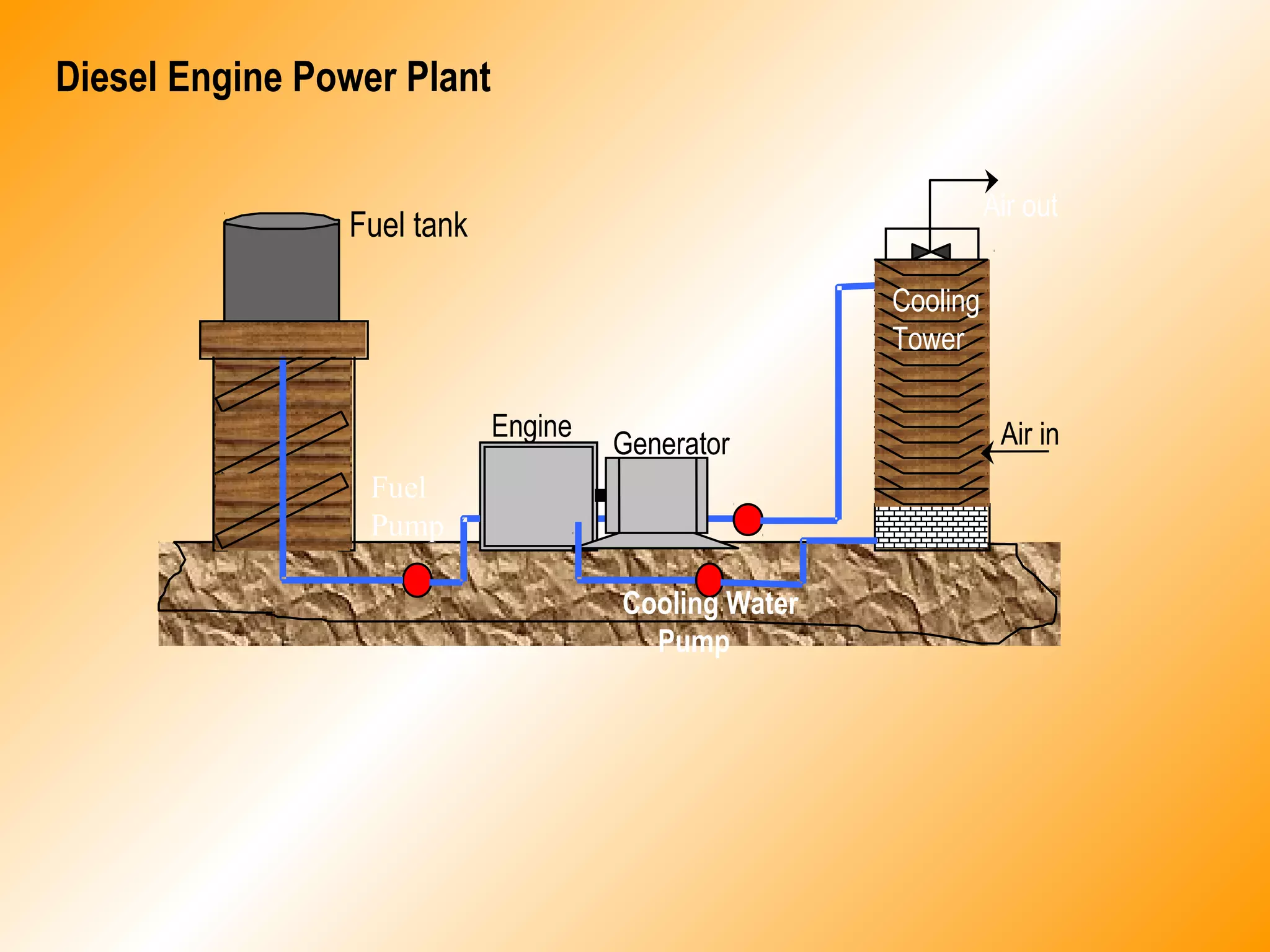
Diesel Engine Power Plant
Fuel tank
Engine
Generator
Cooling
Tower
Fuel
Pump
Cooling Water
Pump
Air in
Air out
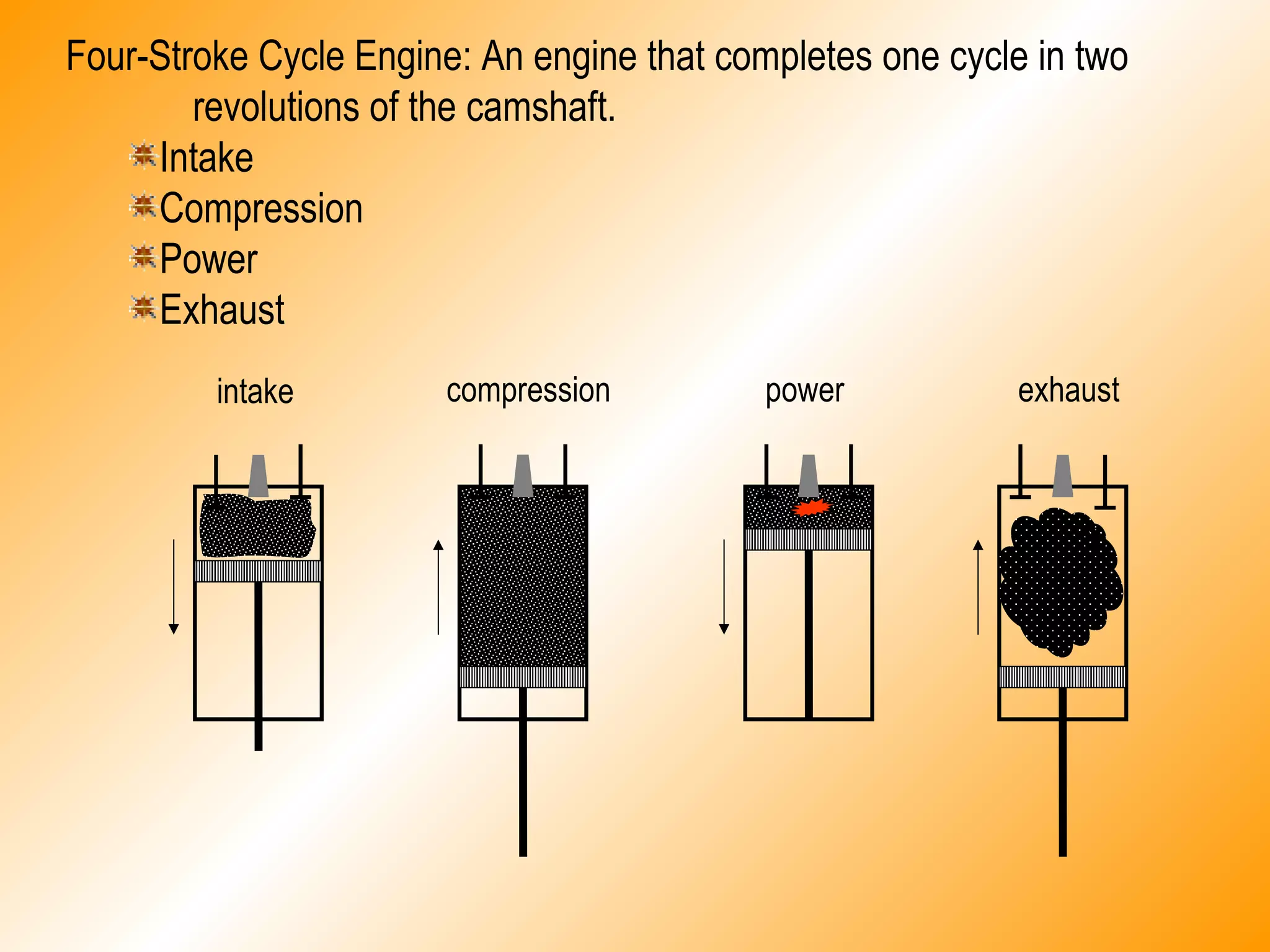
Four-Stroke Cycle Engine: An engine that completes one cycle in two
revolutions of the camshaft.
Intake
Compression
Power
Exhaust
intake compression power exhaust
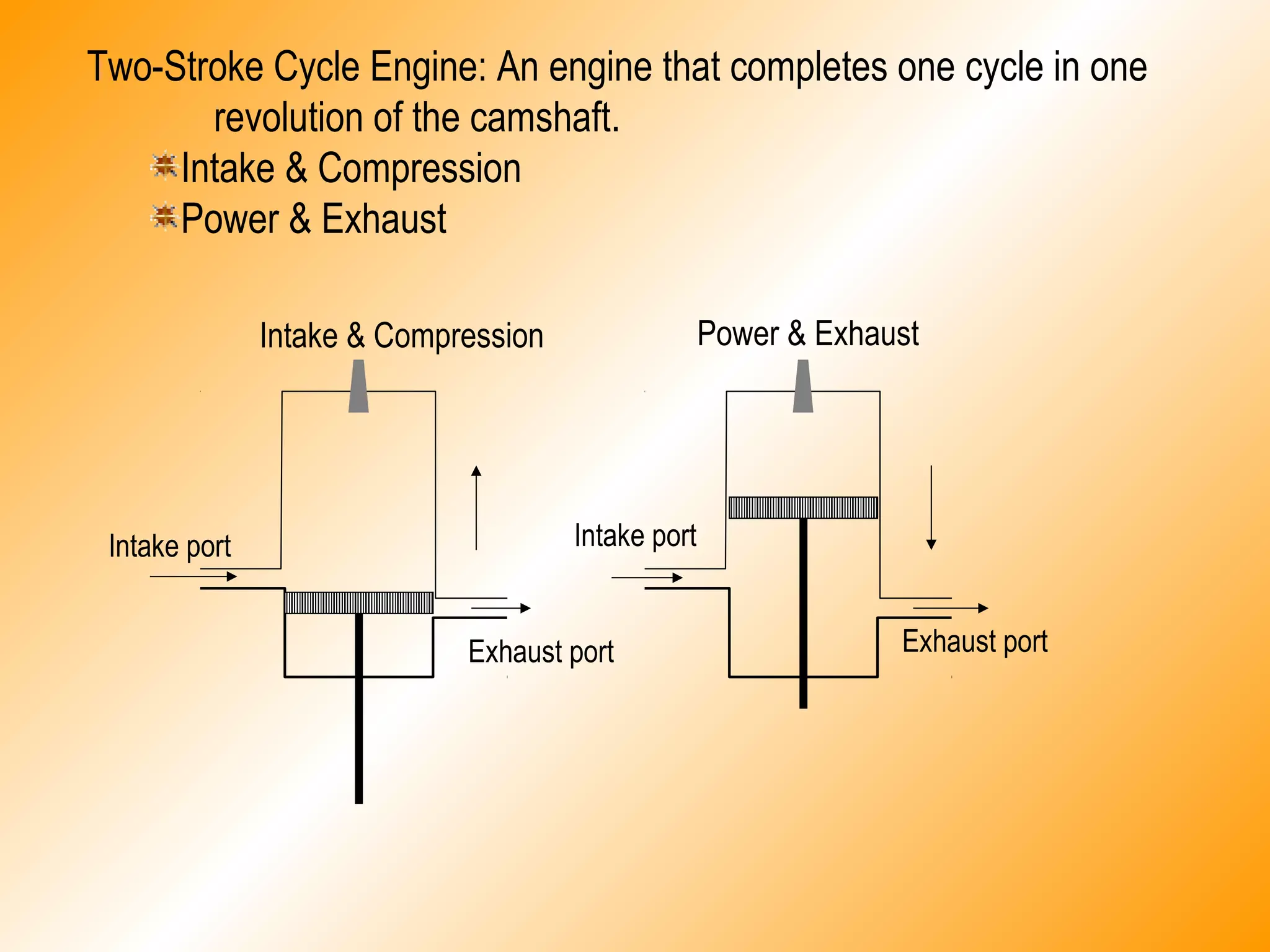
Two-Stroke Cycle Engine: An engine that completes one cycle in one
revolution of the camshaft.
Intake & Compression
Power & Exhaust
Exhaust port Exhaust port
Intake port Intake port
Intake & Compression Power & Exhaust
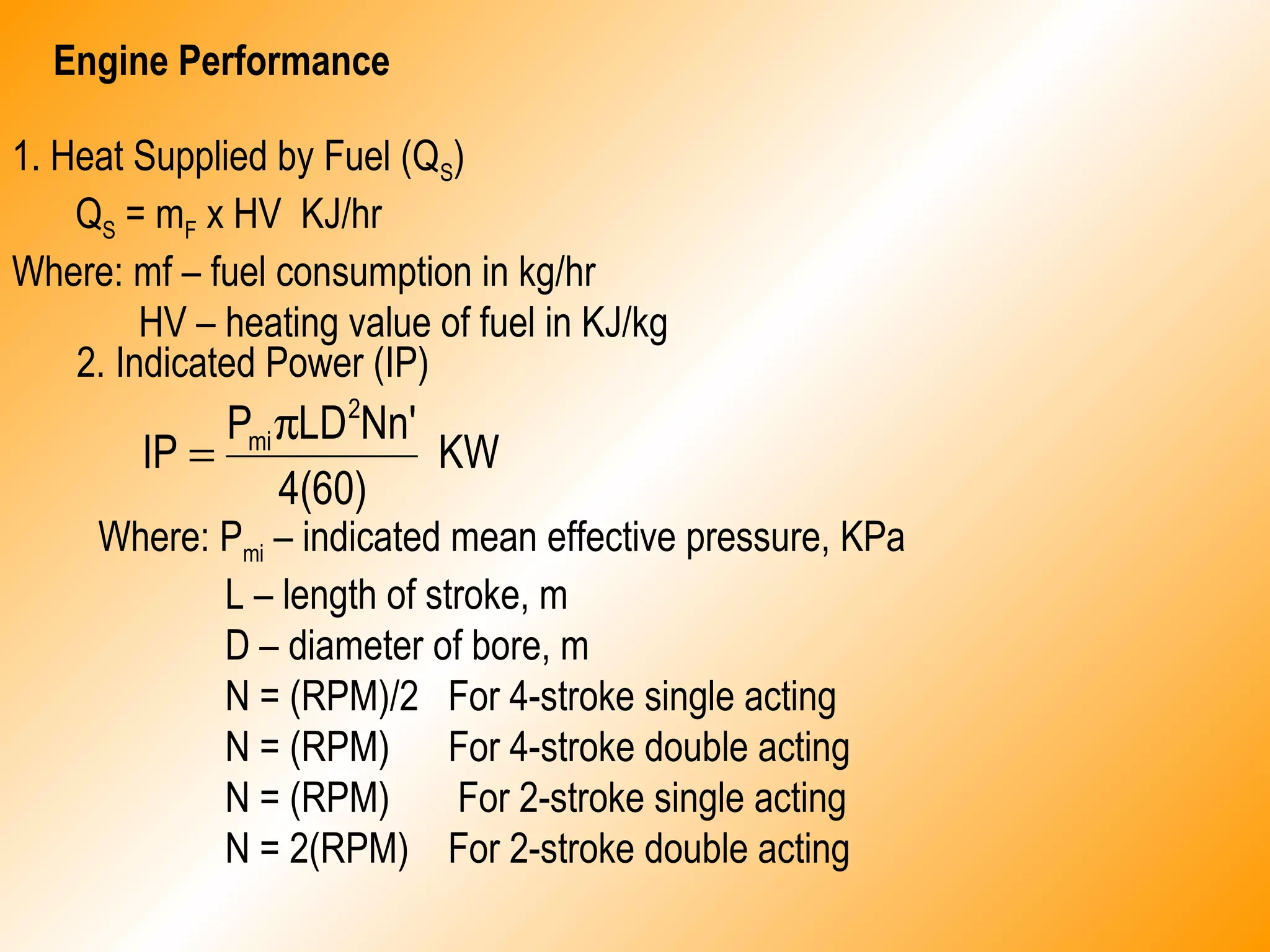
Engine Performance
1. Heat Supplied by Fuel (QS)
QS = mF x HV KJ/hr
Where: mf – fuel consumption in kg/hr
HV – heating value of fuel in KJ/kg
KW
4(60)
Nn'LDP
IP
2
miπ
=
2. Indicated Power (IP)
Where: Pmi – indicated mean effective pressure, KPa
L – length of stroke, m
D – diameter of bore, m
N = (RPM)/2 For 4-stroke single acting
N = (RPM) For 4-stroke double acting
N = (RPM) For 2-stroke single acting
N = 2(RPM) For 2-stroke double acting
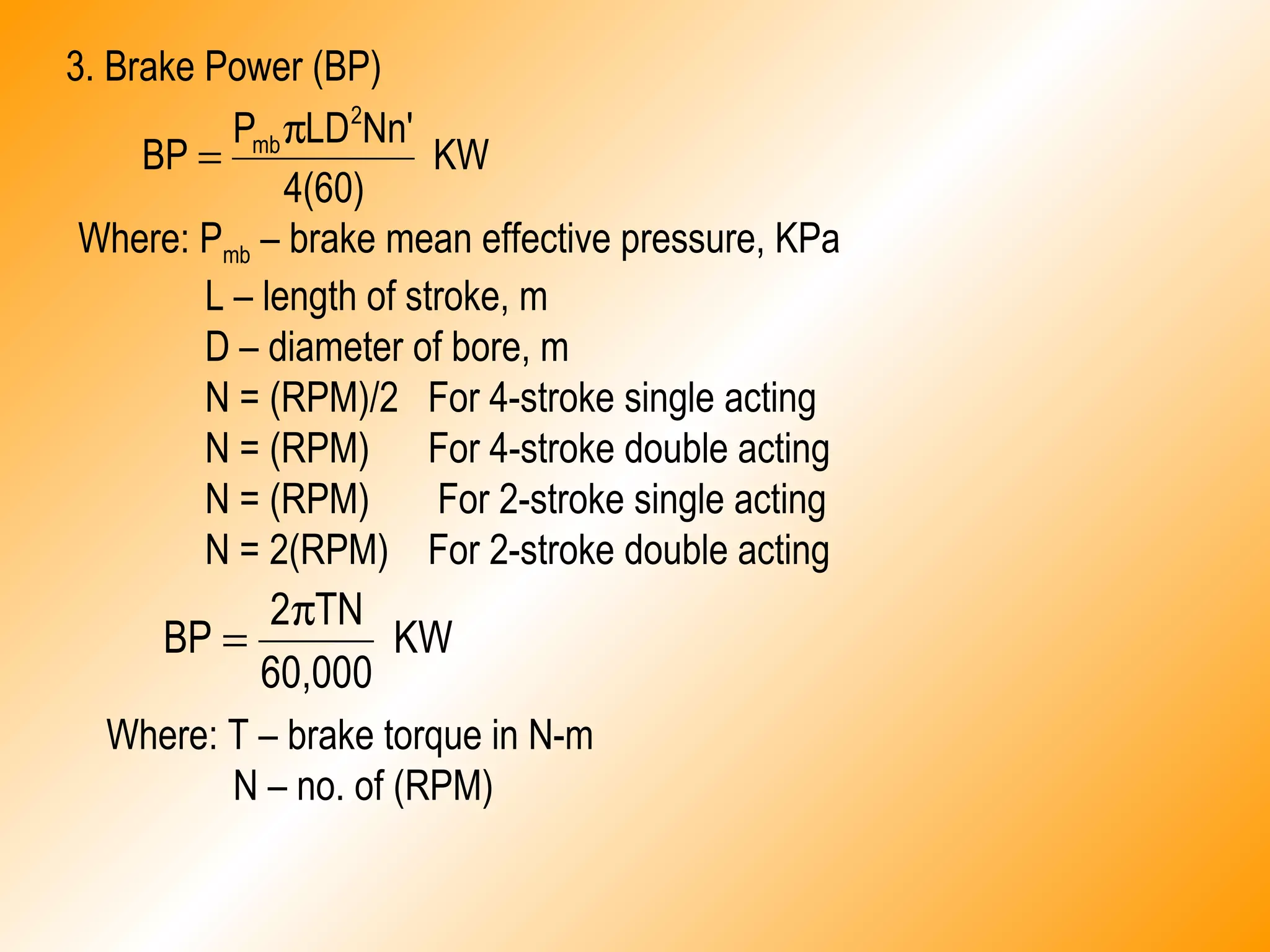
KW
4(60)
Nn'LDP
BP
2
mbπ
=
3. Brake Power (BP)
KW
60,000
TN2
BP
π
=
Where: Pmb – brake mean effective pressure, KPa
L – length of stroke, m
D – diameter of bore, m
N = (RPM)/2 For 4-stroke single acting
N = (RPM) For 4-stroke double acting
N = (RPM) For 2-stroke single acting
N = 2(RPM) For 2-stroke double acting
Where: T – brake torque in N-m
N – no. of (RPM)
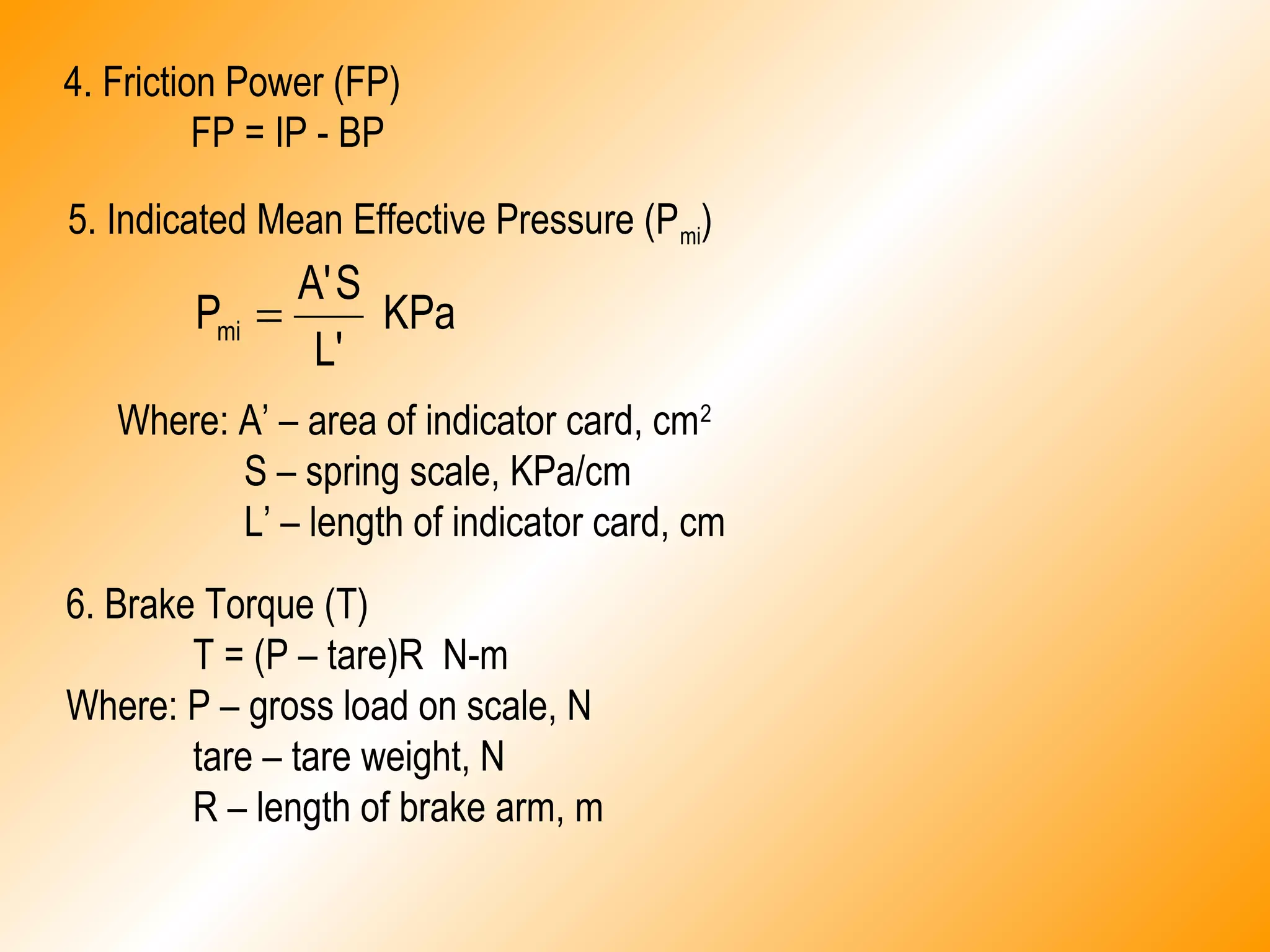
4. Friction Power (FP)
FP = IP - BP
5. Indicated Mean Effective Pressure (Pmi)
KPa
L'
SA'
Pmi =
Where: A’ – area of indicator card, cm2
S – spring scale, KPa/cm
L’ – length of indicator card, cm
6. Brake Torque (T)
T = (P – tare)R N-m
Where: P – gross load on scale, N
tare – tare weight, N
R – length of brake arm, m
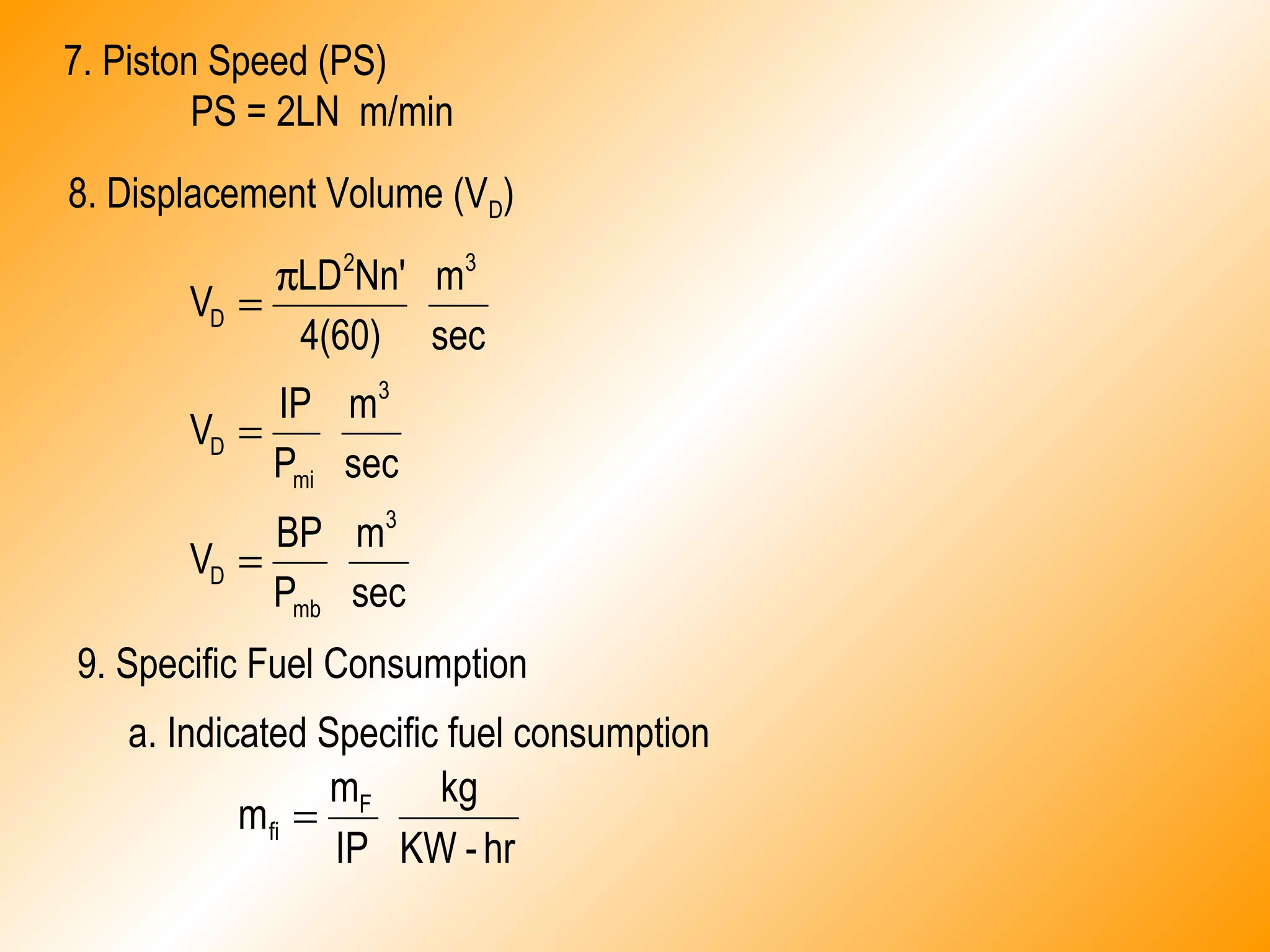
7. Piston Speed (PS)
PS = 2LN m/min
8. Displacement Volume (VD)
sec
m
P
BP
V
sec
m
P
IP
V
sec
m
4(60)
Nn'LD
V
3
mb
D
3
mi
D
32
D
=
=
π
=
9. Specific Fuel Consumption
a. Indicated Specific fuel consumption
hr-KW
kg
IP
m
m F
fi =
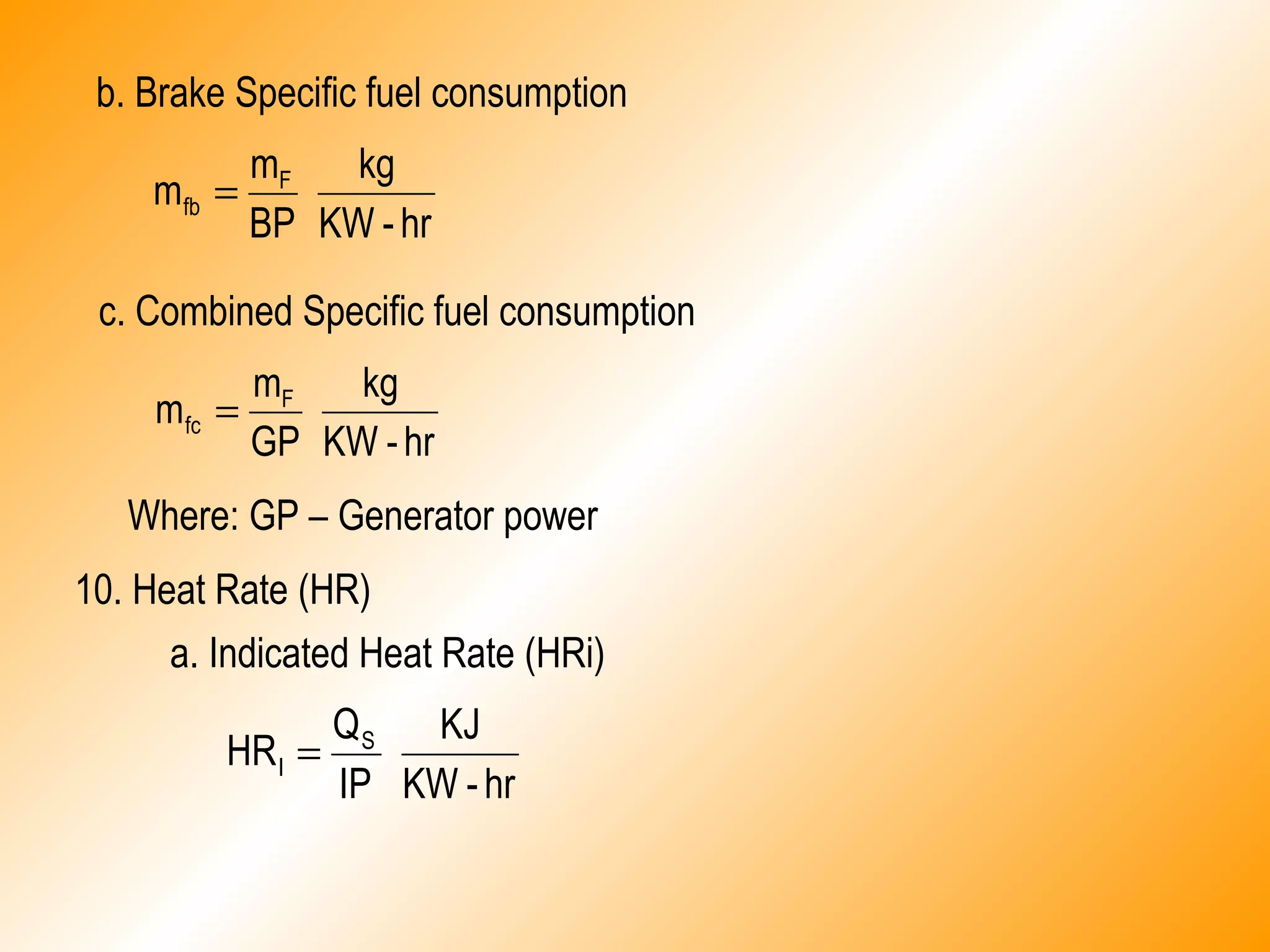
b. Brake Specific fuel consumption
hr-KW
kg
BP
m
m F
fb =
c. Combined Specific fuel consumption
hr-KW
kg
GP
m
m F
fc =
Where: GP – Generator power
10. Heat Rate (HR)
a. Indicated Heat Rate (HRi)
hr-KW
KJ
IP
Q
HR S
I =
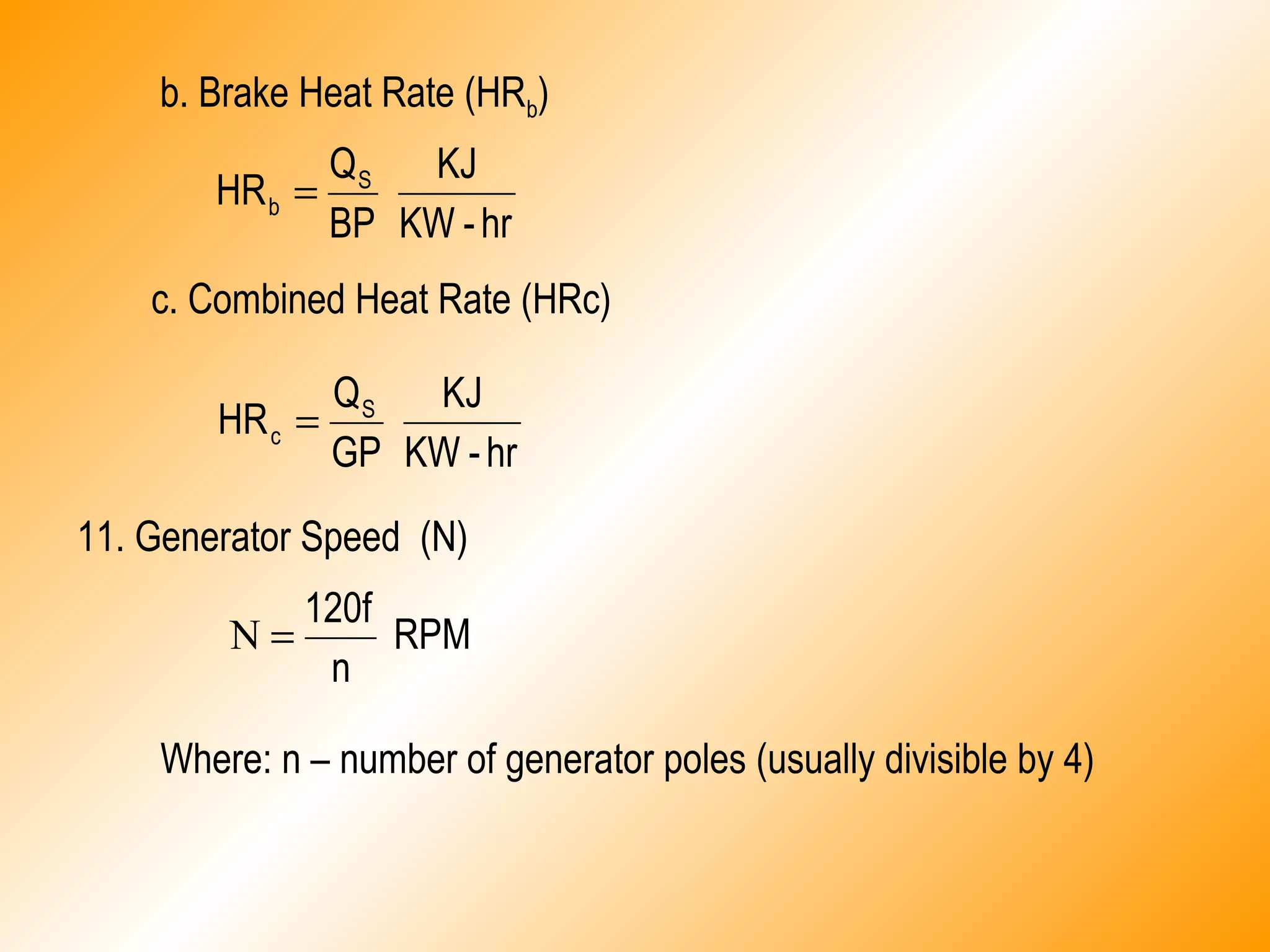
b. Brake Heat Rate (HRb)
hr-KW
KJ
BP
Q
HR S
b =
c. Combined Heat Rate (HRc)
hr-KW
KJ
GP
Q
HR S
c =
11. Generator Speed (N)
RPM
n
120f
=N
Where: n – number of generator poles (usually divisible by 4)
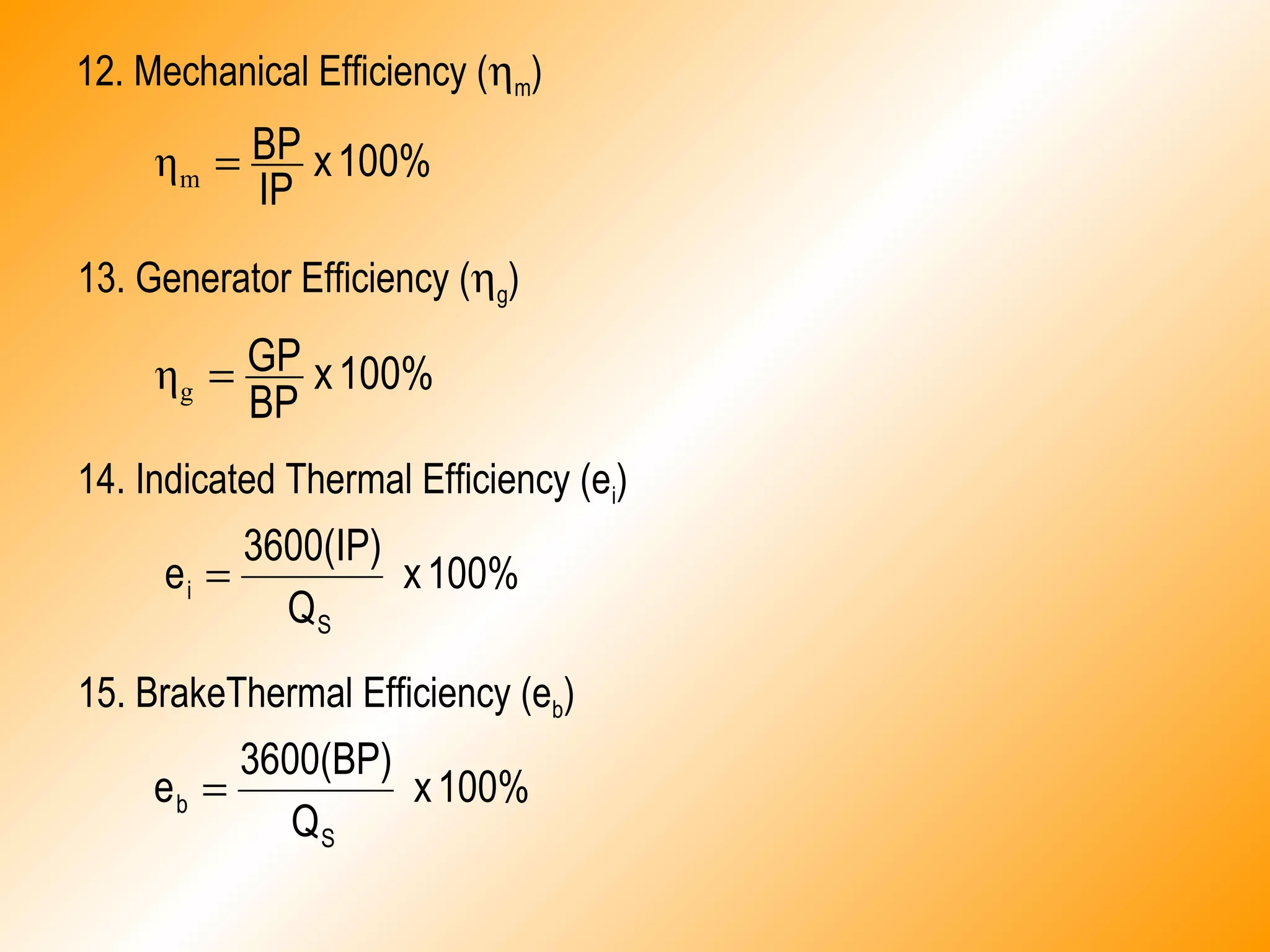
12. Mechanical Efficiency (ηm)
100%x
BP
GP=gη
100%x
IP
BP=mη
13. Generator Efficiency (ηg)
14. Indicated Thermal Efficiency (ei)
100%x
Q
3600(IP)
e
S
i =
15. BrakeThermal Efficiency (eb)
100%x
Q
3600(BP)
e
S
b =
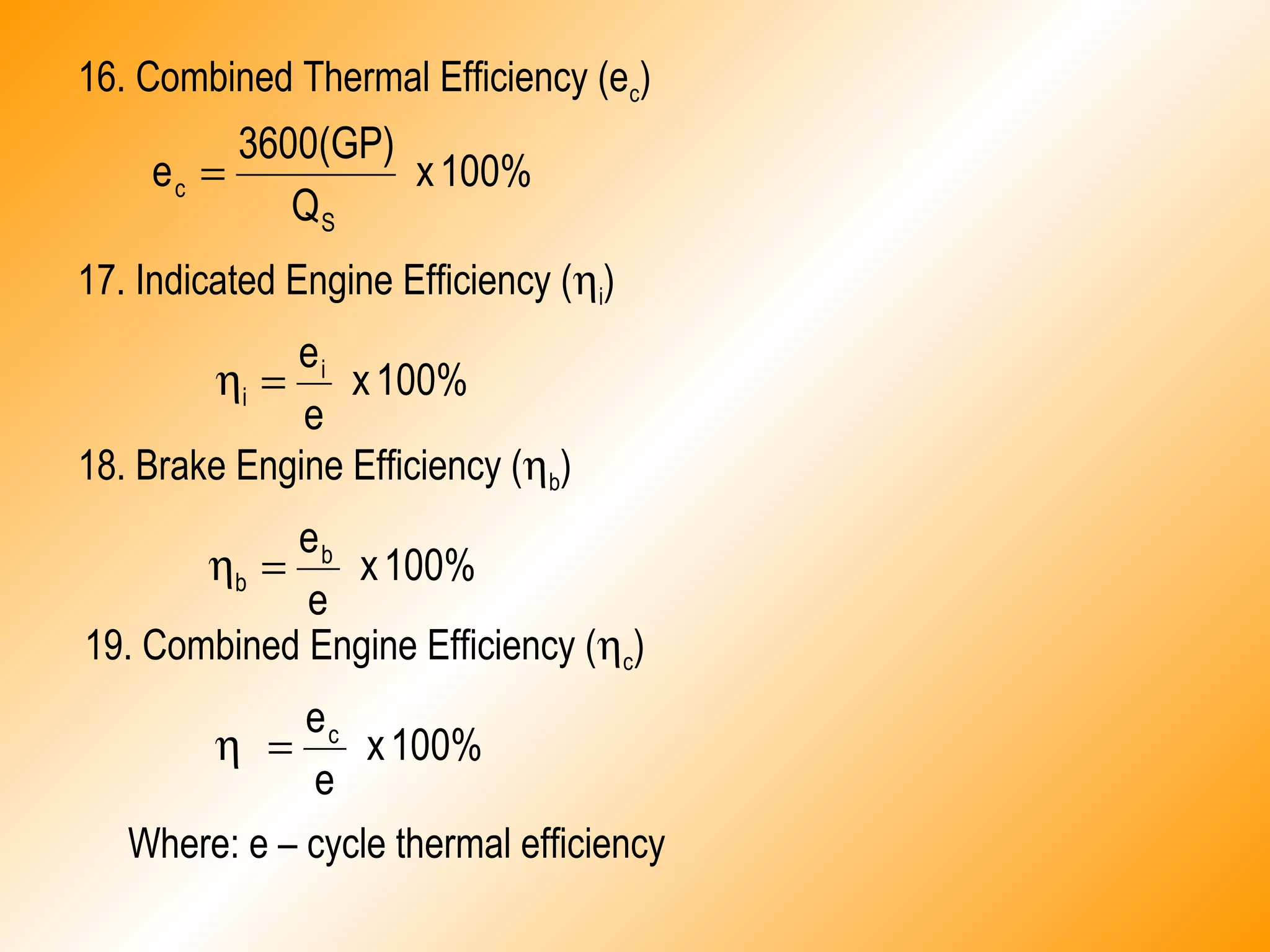
16. Combined Thermal Efficiency (ec)
100%x
Q
3600(GP)
e
S
c =
17. Indicated Engine Efficiency (ηi)
100%x
e
ei
i =η
18. Brake Engine Efficiency (ηb)
100%x
e
eb
b =η
19. Combined Engine Efficiency (ηc)
100%x
e
ec
=η
Where: e – cycle thermal efficiency
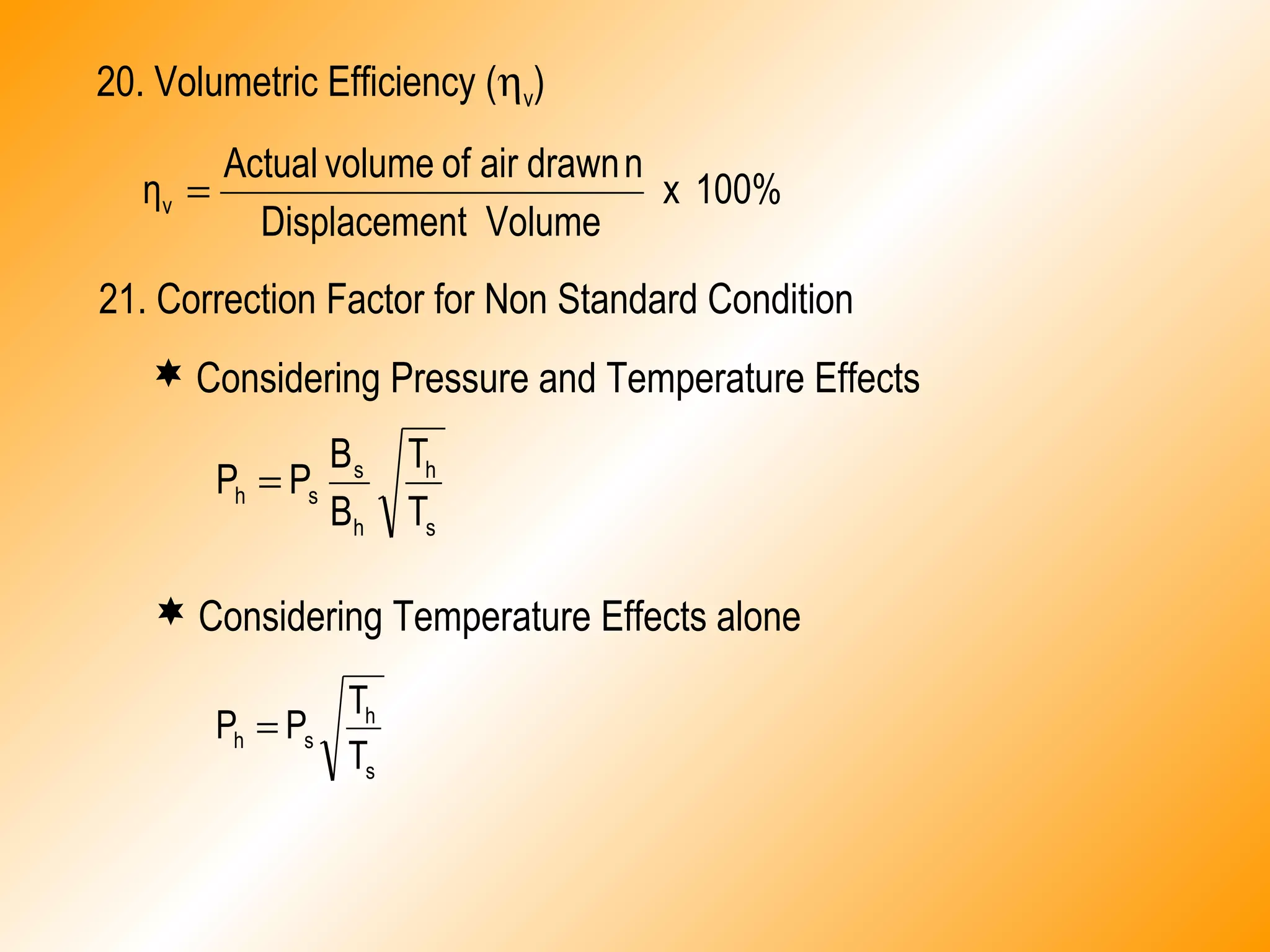
20. Volumetric Efficiency (ηv)
100%x
VolumentDisplaceme
ndrawnairofvolumeActual
ηv =
s
h
h
s
sh
T
T
B
B
PP =
21. Correction Factor for Non Standard Condition
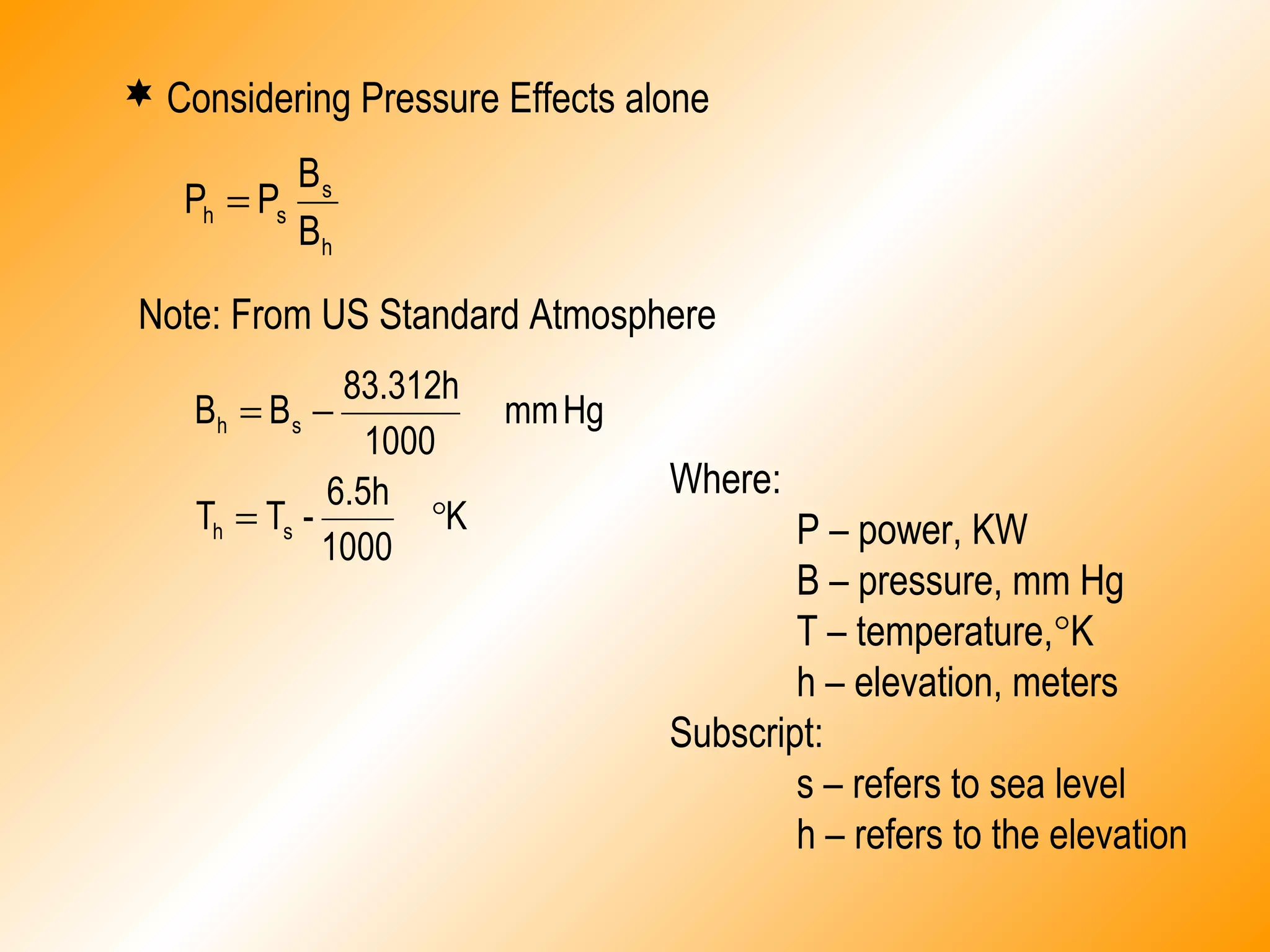
 Considering Pressure and Temperature Effects
 Considering Temperature Effects alone
s
h
sh
T
T
PP =
 Considering Pressure Effects alone
h
s
sh
B
B
PP =
Note: From US Standard Atmosphere
K
1000
6.5h
-TT
Hgmm
1000
83.312h
BB
sh
sh
°=
−=
Where:
P – power, KW
B – pressure, mm Hg
T – temperature,°K
h – elevation, meters
Subscript:
s – refers to sea level
h – refers to the elevation
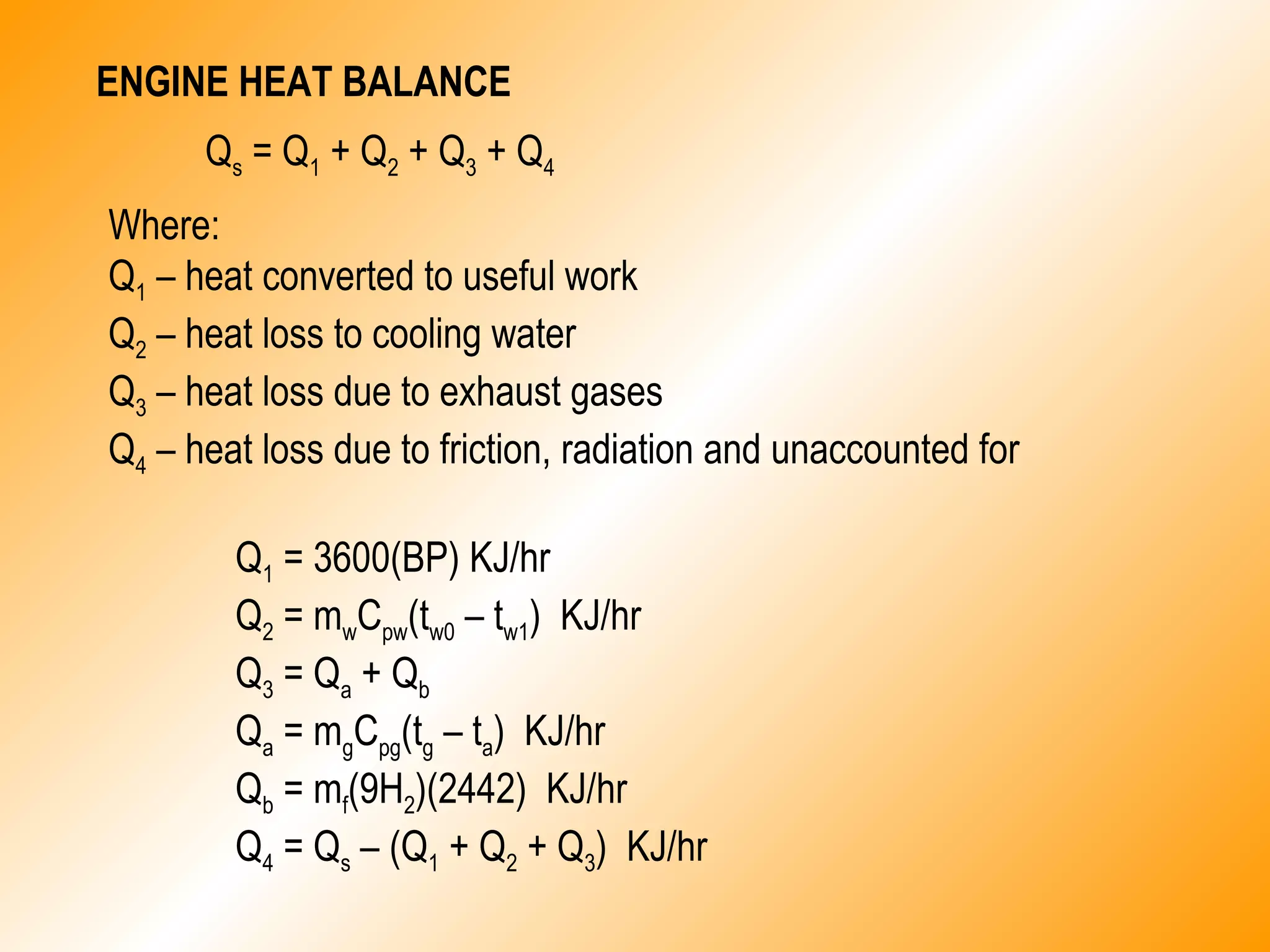
ENGINE HEAT BALANCE
Qs = Q1 + Q2 + Q3 + Q4
Where:
Q1 – heat converted to useful work
Q2 – heat loss to cooling water
Q3 – heat loss due to exhaust gases
Q4 – heat loss due to friction, radiation and unaccounted for
Q1 = 3600(BP) KJ/hr
Q2 = mwCpw(tw0 – tw1) KJ/hr
Q3 = Qa + Qb
Qa = mgCpg(tg – ta) KJ/hr
Qb = mf(9H2)(2442) KJ/hr
Q4 = Qs – (Q1 + Q2 + Q3) KJ/hr
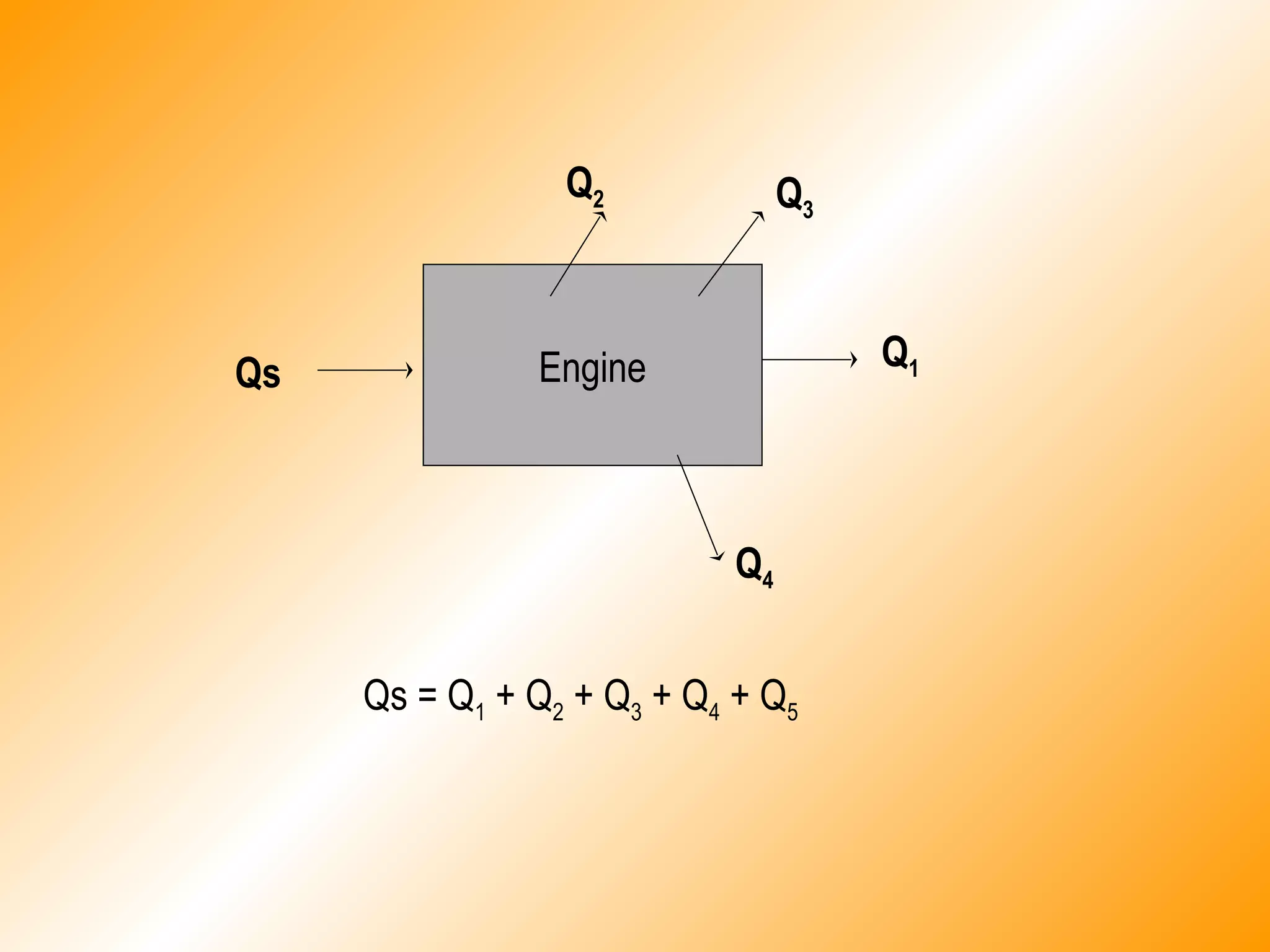
EngineQs
Q2 Q3
Q1
Q4
Qs = Q1 + Q2 + Q3 + Q4 + Q5

Internal combustion engine power plant

  • 1.
    Diesel Engine PowerPlant Fuel tank Engine Generator Cooling Tower Fuel Pump Cooling Water Pump Air in Air out
  • 2.
    Four-Stroke Cycle Engine:An engine that completes one cycle in two revolutions of the camshaft. Intake Compression Power Exhaust intake compression power exhaust
  • 3.
    Two-Stroke Cycle Engine:An engine that completes one cycle in one revolution of the camshaft. Intake & Compression Power & Exhaust Exhaust port Exhaust port Intake port Intake port Intake & Compression Power & Exhaust
  • 4.
    Engine Performance 1. HeatSupplied by Fuel (QS) QS = mF x HV KJ/hr Where: mf – fuel consumption in kg/hr HV – heating value of fuel in KJ/kg KW 4(60) Nn'LDP IP 2 miπ = 2. Indicated Power (IP) Where: Pmi – indicated mean effective pressure, KPa L – length of stroke, m D – diameter of bore, m N = (RPM)/2 For 4-stroke single acting N = (RPM) For 4-stroke double acting N = (RPM) For 2-stroke single acting N = 2(RPM) For 2-stroke double acting
  • 5.
    KW 4(60) Nn'LDP BP 2 mbπ = 3. Brake Power(BP) KW 60,000 TN2 BP π = Where: Pmb – brake mean effective pressure, KPa L – length of stroke, m D – diameter of bore, m N = (RPM)/2 For 4-stroke single acting N = (RPM) For 4-stroke double acting N = (RPM) For 2-stroke single acting N = 2(RPM) For 2-stroke double acting Where: T – brake torque in N-m N – no. of (RPM)
  • 6.
    4. Friction Power(FP) FP = IP - BP 5. Indicated Mean Effective Pressure (Pmi) KPa L' SA' Pmi = Where: A’ – area of indicator card, cm2 S – spring scale, KPa/cm L’ – length of indicator card, cm 6. Brake Torque (T) T = (P – tare)R N-m Where: P – gross load on scale, N tare – tare weight, N R – length of brake arm, m
  • 7.
    7. Piston Speed(PS) PS = 2LN m/min 8. Displacement Volume (VD) sec m P BP V sec m P IP V sec m 4(60) Nn'LD V 3 mb D 3 mi D 32 D = = π = 9. Specific Fuel Consumption a. Indicated Specific fuel consumption hr-KW kg IP m m F fi =
  • 8.
    b. Brake Specificfuel consumption hr-KW kg BP m m F fb = c. Combined Specific fuel consumption hr-KW kg GP m m F fc = Where: GP – Generator power 10. Heat Rate (HR) a. Indicated Heat Rate (HRi) hr-KW KJ IP Q HR S I =
  • 9.
    b. Brake HeatRate (HRb) hr-KW KJ BP Q HR S b = c. Combined Heat Rate (HRc) hr-KW KJ GP Q HR S c = 11. Generator Speed (N) RPM n 120f =N Where: n – number of generator poles (usually divisible by 4)
  • 10.
    12. Mechanical Efficiency(ηm) 100%x BP GP=gη 100%x IP BP=mη 13. Generator Efficiency (ηg) 14. Indicated Thermal Efficiency (ei) 100%x Q 3600(IP) e S i = 15. BrakeThermal Efficiency (eb) 100%x Q 3600(BP) e S b =
  • 11.
    16. Combined ThermalEfficiency (ec) 100%x Q 3600(GP) e S c = 17. Indicated Engine Efficiency (ηi) 100%x e ei i =η 18. Brake Engine Efficiency (ηb) 100%x e eb b =η 19. Combined Engine Efficiency (ηc) 100%x e ec =η Where: e – cycle thermal efficiency
  • 12.
    20. Volumetric Efficiency(ηv) 100%x VolumentDisplaceme ndrawnairofvolumeActual ηv = s h h s sh T T B B PP = 21. Correction Factor for Non Standard Condition  Considering Pressure and Temperature Effects  Considering Temperature Effects alone s h sh T T PP =
  • 13.
     Considering PressureEffects alone h s sh B B PP = Note: From US Standard Atmosphere K 1000 6.5h -TT Hgmm 1000 83.312h BB sh sh °= −= Where: P – power, KW B – pressure, mm Hg T – temperature,°K h – elevation, meters Subscript: s – refers to sea level h – refers to the elevation
  • 14.
    ENGINE HEAT BALANCE Qs= Q1 + Q2 + Q3 + Q4 Where: Q1 – heat converted to useful work Q2 – heat loss to cooling water Q3 – heat loss due to exhaust gases Q4 – heat loss due to friction, radiation and unaccounted for Q1 = 3600(BP) KJ/hr Q2 = mwCpw(tw0 – tw1) KJ/hr Q3 = Qa + Qb Qa = mgCpg(tg – ta) KJ/hr Qb = mf(9H2)(2442) KJ/hr Q4 = Qs – (Q1 + Q2 + Q3) KJ/hr
  • 15.
    EngineQs Q2 Q3 Q1 Q4 Qs =Q1 + Q2 + Q3 + Q4 + Q5