Engine theory andcalculations
22-08-
2012
1 Engine theory and
calculations.docx
Bore
D
Suction v alv e
Intake or suction manif old
Cy linder head
Exhaust v alv e
Exhaust manif old
Top dead center T.D.C. Clearance v olume.Vc
Piston
Gudgeon or wrist pin
Bottom dead center B.D.C.
Cy linder v olume’V’
Stroke v olume.Vs
Cy linder
Connecting rod
Crankcase
Crankshaf t
Crank pin
Crank
TERMINOLOGY
Important positions and volumes in reciprocating engine
Engine Cylinder diameter (bore) (D): The nominal inner diameter of the working cylinder.
Piston area (A): The area of a circle of diameter equal to engine cylinder diameter (bore).
A   / 4  D2
Engine Stroke length (L): The nominal distance through which a working piston moves
betweentwo successivereversals ofits direction of motion.
Dead center: The position of the working piston and the moving parts, which are
mechanically connected to it at the moment when the direction of the piston motion is
reversed (at either end point of thestroke).
Bottom dead center (BDC): Dead center when the piston is nearest to the crankshaft.
Sometimes it is also called outer dead center (ODC).
Top dead center (TDC): Dead center when the position is farthest from the crankshaft.
Sometimes it is also called inner dead center (IDC).
Sweptvolume(VS):Thenominalvolumegeneratedby theworkingpistonwhentravelling from one
dead center to next one, calculated as the product of piston area and stroke. The capacity described
byenginemanufacturersinccisthesweptvolumeoftheengine.Vs  A L   / 4 D2
L
Clearance volume(VC): The nominal volume of the spaceon the combustionsideof the
piston at top dead center.
Engine theory andcalculations
22-08-
2012
2 Engine theory and
calculations.docx
Cylinder volume: The sum of swept volume and clearance volume. V  Vs  Vc
Compression ratio (CR): The numerical value of the cylinder volume divided by the numerical
value of clearancevolume.CR  V /Vc
Four stroke cycle engine
Infour-strokecycleengine, thecycleofoperation is completedinfourstrokes ofthepistonortwo
revolutions of the crankshaft. Each stroke consists of 1800
of crankshaft rotation and hence a cycle
consistsof7200
ofcrankshaftrotation.Theseriesofoperationofanidealfour-strokeengineareas
follows:
1. Suction or Induction stroke: The inlet valve is open, and the piston travels down the
cylinder, drawing in a charge of air. In the case of a spark ignition engine the fuel is usually pre-
mixed with the air.
2. Compression stroke: Both valves are closed, and the piston travels up the cylinder. As the
piston approaches top dead centre (TDC), ignition occurs. In the case of compression ignition
engines, the fuel is injected towards the end of compressionstroke.
3. Expansion or Power or Working stroke: Combustion propagates throughout the charge,
raising the pressure and temperature, and forcing the piston down. At the end of the power
stroke the exhaust valve opens, and the irreversible expansion of the exhaust gases is termed
‘blow-down’.
4. Exhaust stroke: The exhaust valve remains open, and as the piston travels up the cylinder
the remaining gases are expelled. At the end of the exhaust stroke, when the exhaust valve closes
some exhaust gas residuals will be left; thesewill dilute the next charge.
Two stroke cycle engine
In two stroke engines the cycle is completed in two strokes of piston i.e. one revolution of the
crankshaftas againsttworevolutions offourstrokecycleengine.Thetwo-strokecycleeliminates
the separate induction and exhaust strokes.
1. Compression stroke: The piston travels up the cylinder, socompressingthe
trappedcharge.Ifthefuelis notpre-mixed,thefuelis injectedtowards theendofthecompression
stroke; ignition should again occur before TDC. Simultaneously under side of the piston is drawing in
a charge through a spring-loaded non-return inlet valve.
2. Power stroke: The burning mixture raises the temperature and pressure in the cylinder,
and forces the piston down. The downward motion of the piston also compresses the charge
in the crankcase. As the piston approaches the end of its stroke the exhaust port is
uncovered and blowdown occurs. When the piston is at BDC the transfer port is also
uncovered, and the compressed charge in the crankcase expands into the cylinder. Some of
the remaining exhaust
Engine theory andcalculations
22-08-
2012
3 Engine theory and
calculations.docx
BP
(C)
IP
(B)
Energy
in fuel
(A)
gases are displaced by the fresh charge; because of the flow mechanism this is called ‘loop
scavenging'.As thepistontravels upthecylinder,thepistoncloses thefirsttransferport,andthen
the exhaust port is closed.
Performanceof I.C.Engines
Indicated thermal efficiency (ηt): Indicated thermal efficiency is the ratio of energy in the indicated
power to the fuel energy.
t  IndicatedPower / FuelEnergy
t (%) 
IndicatedPower(KW )  3600
FuelFlow (Kg / Hr) CalorificValue(KJ / Kg)
100
Brake thermal efficiency (ηbth): A measure of overall efficiency of the engine
isgivenbythebrakethermalefficiency.Brakethermalefficiencyistheratioof
energy in the brake powerto the fuel energy.
bth  BrakePower / FuelEnergy
bth (%) 
BrakePower(KW )  3600
FuelFlow (Kg / Hr) CalorificValue(KJ / Kg)
100
Mechanical efficiency (ηm): Mechanical efficiency is the ratio of brake horsepower
(delivered power)to the indicated horsepower(power provided to the piston).
m  BrakePower / IndicatedPower
and Frictional power = Indicated power – Brake power
Following figure gives diagrammatic representation of various efficiencies,
Energy lost in exhaust, coolant, and radiation
Energy lost in friction, pumping etc.
Indicated thermal efficiency = B/A
Brake thermal efficiency = C/A
Engine theory andcalculations
22-08-
2012
4 Engine theory and
calculations.docx
Mechanical efficiency = C/B
Volumetric efficiency (ηv): Theengine output is limited bythemaximum amountofair that can
be taken in during the suction stroke, because only a certain amount of fuel can be burned
effectively with a given quantity of air. Volumetric efficiency is an indication of the ‘breathing’
ability of the engine and is defined as the ratio of the air actually induced at ambient conditions
to the swept volumeoftheengine. In practicetheenginedoes notinduceacompletecylinderfull
ofaironeach stroke, and it is convenient to define volumetric efficiency as:
Mass of air consumed
ηv (%)=
massofflowofairtofill sweptvolumeatatmosphericconditions
 (%)  AirFlow(Kg / Hr) 100
v  / 4 D2 L(m3 )  N(RPM ) / n  NoofCyl  AirDen(Kg / m3 ) 60
Where n= 1 for 2 stroke engine and n= 2 for 4 stroke engine.
Air flow:
For air consumption measurement air box with orifice is used.
AitFlow (Kg / Hr)  Cd  / 4 D2   Aden  3600
Where Cd = Coefficient of discharge of orifice
D = Orifice diameter in m
g=Accelerationduetogravity(m/s2
)=9.81m/s2
h= Differential headacross orifice(m ofwater)
Wden= Waterdensity(kg/m3
)=@1000kg/m3
Wair=Airdensityatworkingcondition(kg/m3
)=p/RT
Where
p= Atmospheric pressure in kgf/m2
(1 Standard atm. = 1.0332X10⁴
kgf/m2
)
R= Gas constant = 29.27 kgf.m/kg0
k
T= Atmospheric temperature in 0
k
Specific fuel consumption (SFC): Brake specific fuel consumption and indicated specific
fuel consumption, abbreviated BSFC and ISFC, are the fuel consumptions on the basis of Brake
power and Indicated powerrespectively.
Fuel-air (F/A) or air-fuel (A/F) ratio: The relative proportions of the fuel and air in the engine
are very important from standpoint of combustion and efficiency of the engine. This is expressed
either as the ratio of the mass ofthe fuel to that of the air or vice versa.
2g  hwater Wden / Aden
Engine theory andcalculations
22-08-
2012
5 Engine theory and
calculations.docx
Calorific value or Heating value or Heat of combustion: It is the energy
released per unit quantity of the fuel, when the combustible is burned and the products of
combustion are cooled back to the initial temperature of combustible mixture. The heating value so
obtainediscalledthehigherorgrosscalorificvalueofthefuel.Thelowerornetcalorificvalueisthe
heat released when water in the products of combustion is not condensed and remains in the
vapour form.
Power and Mechanical efficiency: Power is defined as rate of doing work and equal to the
product of force and linear velocity or the product of torque and angular velocity. Thus, the
measurementof power involves the measurementof force(or torque) as well as speed.
Thepowerdevelopedbyanengineattheoutputshaftiscalledbrakepowerandisgivenby
Power =NT/60,000 in kW
where T= torque in Nm = WR
W=9.81*Netmassappliedinkg.R=Radiusinm
N is speed in RPM
Meaneffective pressureandtorque:Mean effectivepressureisdefinedasahypothetical
pressure, which is thought to be acting on the piston throughout the power stroke.
PowerinkW=(Pm LAN/n100)/60inbar
wherePm = meaneffectivepressure
L= length ofthestrokein m
A= areaof thepiston inm2
N = Rotational speed of engine RPM
n= number of revolutions required to complete one engine cycle
n= 1 (for two stroke engine)
n=2(forfourstrokeengine)
Thus we can see that for a given engine the power output can be measured in terms of mean
effectivepressure.Ifthemeaneffectivepressureis basedonbrakepoweritis calledbrakemean
effective pressure (BMEP) and if based on indicated power it is called indicated mean effective
pressure(IMEP).
BMEP(bar) 
BrakePower(KW )  60
L A (N / n)  NoOfCyl 100
IMEP(bar) 
IndicatedPower(KW )  60
L  A  (N / n)  NoOfCyl 100
Similarly, the friction means effective pressure (FMEP) can be defined as
Engine theory andcalculations
22-08-
2012
6 Engine theory and
calculations.docx
FMEP= IMEP – BMEP
Basic measurements
Thebasic measurements,whichusuallyshouldbeundertakentoevaluatetheperformanceofan
engine on almostall tests,are the following:
1 Measurement of speed
Following different speedmeasuringdevices areusedforspeedmeasurement.
1 Photoelectric/Inductive proximity pickup withspeed indicator
2 Rotary encoder
2 Measurement of fuel consumption
I) Volumetric method: The fuel consumed by an engine is measured by determining the
volume flow of the fuel in a given time interval and multiplying it by the specific gravity of fuel.
Generally a glass burette having graduations inml is used for volume flow measurement. Time
taken by the engine to consumethis volume is measured by stopwatch.
II) Gravimetric method: In this method the time to consume a given weight of the fuel is
measured. Differential pressure transmitters working on hydrostatic head principles can
used for fuel consumptionmeasurement.
3 Measurement of air consumption
Air box method: In IC engines, as the air flow is pulsating, for satisfactory measurement of air
consumptionanairbox ofsuitablevolumeis fittedwithorifice.Theairboxis usedfordampingout
the pulsations. The differential pressure across the orifice is measured by manometer and pressure
transmitter.
4 Measurement of brake power
MeasurementofBPinvolves determinationofthetorque andangularspeedof theengineoutput
shaft. This torque-measuring device is called a dynamometer.
The dynamometers used are of following types:
I) Rope brake dynamometer: It consists of a number of turns of rope wound around the
rotating drum attached to the output shaft. One side of the rope is connected to a spring
balance and the other to a loading device. The power is absorbed in friction between the rope
and the drum.The drum therefore requires cooling.
Brake power = ∏DN (W-S)/60,000 in kW
where D is the brake drum diameter, W is the weight and S is the spring scale reading.
II) Hydraulic dynamometer: Hydraulic dynamometer works on the principal of dissipating
the power in fluid friction. It consists of an inner rotating member or impeller coupled to output
shaft of the engine. This impeller rotates in a casing, due to the centrifugal force developed,
tends to
Engine theory andcalculations
22-08-
2012
7 Engine theory and
calculations.docx
revolve with impeller, but is resistedby torque arm supportingthe balance weight. The frictional
forces betweentheimpellerandthefluidaremeasuredbythespring-balancefittedonthecasing.
Heatdevelopedduetodissipationofpoweris carriedawaybyacontinuous supplyoftheworking
fluidusuallywater.Theoutput(powerabsorbed)canbecontrolledbyvaryingthequantityofwater
circulatinginthevortexoftherotorandstatorelements.Thisisachievedbyamovingsluicegatein
the dynamometercasing.
III) Eddy current dynamometer: It consists of a stator on which are fitted a number of
electromagnets andarotordisc andcoupledtotheoutputshaftofthe engine.Whenrotorrotates
eddycurrents areproducedinthestatorduetomagnetic fluxsetupbythepassageoffieldcurrent
in the electromagnets. These eddy currents oppose the rotor motion, thus loading the engine.
These eddy currents are dissipated in producing heat so that this type of dynamometer needs
cooling arrangement. A moment arm measures the torque. Regulating the current in
electromagnets controls theload.
Note: While using with variable speed engines sometimes in certain speed zone the dynamometer
operating line arenearly parallel withengine operating lines whichresultin poor stability.
5 Measurement of indicatedpower
There are two methods of finding the IHP of an engine.
I) Indicator diagram: A dynamic pressure sensor (piezo sensor) is fitted in the cylinder
head to sense combustion pressure. A rotary encoder is fitted on the engine shaft for crank
angle signal. Both signals are simultaneously scanned by an engine indicator (electronic unit) and
communicated to computer. The software in the computer draws pressure crank-angle and
pressure volume plots and computes indicated power of the engine.
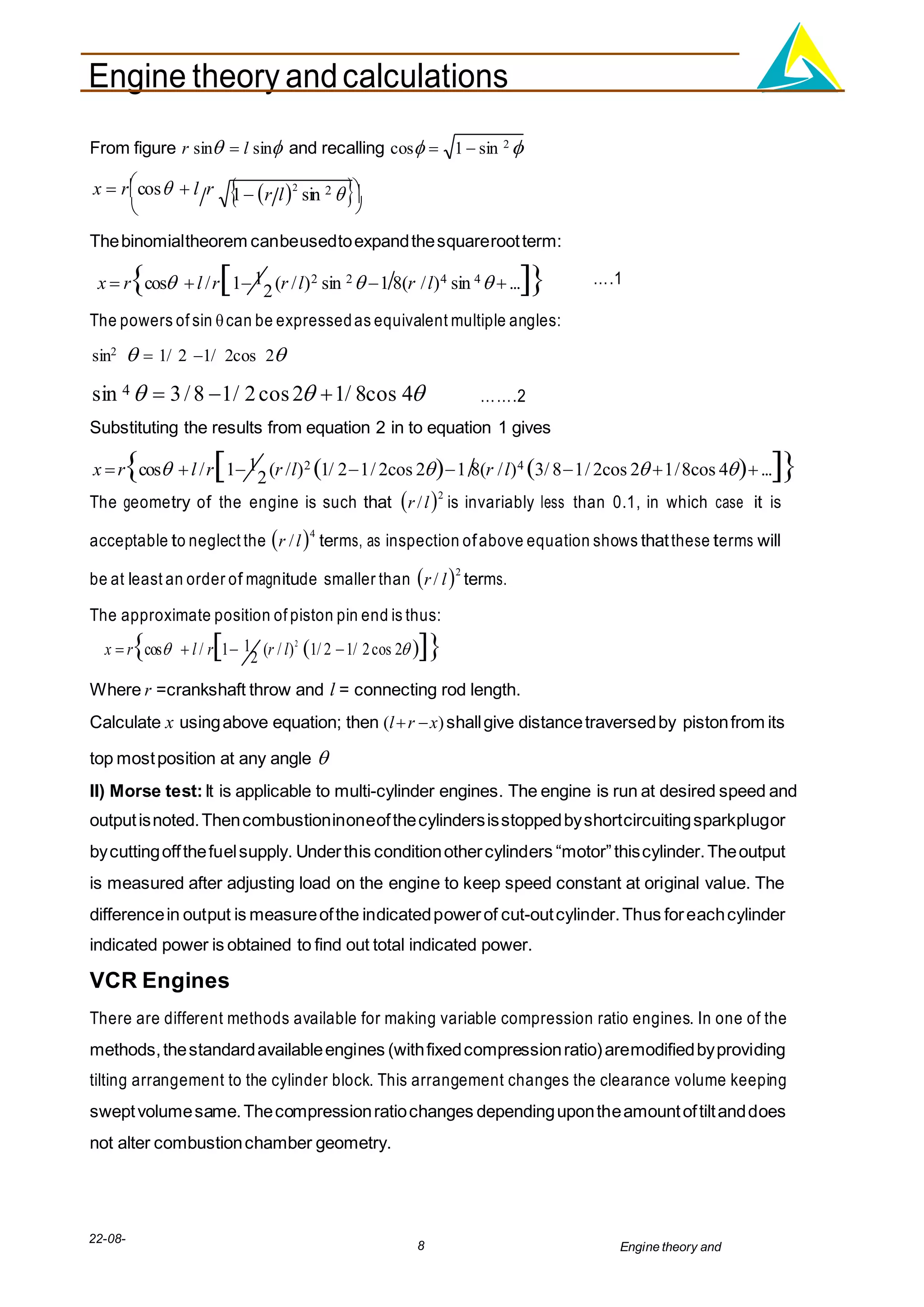
Conversion of pressure crank-angle plot to pressure volume plot:
The figure shows crank-slider mechanism. The piston pin position is given by
x  r cos  l cos
Engine theory andcalculations
22-08-
2012
8 Engine theory and
calculations.docx

From figure r sin  l sin and recalling cos 
x  r
cos  l r

1 r l2
sin 2 


Thebinomialtheorem canbeusedtoexpandthesquarerootterm:
x  rcos l /r11
2(r /l)2 sin 2 1 8(r /l)4 sin 4 ...
The powers of sin can be expressedas equivalent multiple angles:
sin2
  1/ 2 1/ 2cos 2


….1
sin 4   3/8 1/ 2cos2 1/ 8cos 4

…….2
Substituting the results from equation 2 in to equation 1 gives
x rcos l /r11
2(r /l)2 1/ 21/ 2cos 21 8(r /l)4 3/ 81/ 2cos 2 1/8cos 4...
The geometry of the engine is such that r/l2
is invariably less than 0.1, in which case it is
acceptable to neglect the r /l4
terms, as inspection ofabove equation shows thatthese terms will
be at least an order of magnitude smaller than r/ l2
terms.
The approximate position of piston pin end is thus:
x  rcos  l / r1 1
2 (r / l)2
1/ 2 1/ 2cos 2 
Where r =crankshaft throw and l = connecting rod length.
Calculate x usingabove equation; then (lr x)shallgive distancetraversedby pistonfrom its
top mostposition at any angle 
II) Morse test:It is applicable to multi-cylinder engines. The engine is run at desired speed and
outputisnoted.Thencombustioninoneofthecylindersisstoppedbyshortcircuitingsparkplugor
bycuttingoffthefuelsupply. Underthis conditionothercylinders “motor”thiscylinder.Theoutput
is measured after adjusting load on the engine to keep speed constant at original value. The
differencein output is measureofthe indicatedpowerof cut-outcylinder.Thus foreachcylinder
indicated power is obtained to find out total indicated power.
VCR Engines
There are different methods available for making variable compression ratio engines. In one of the
methods,thestandardavailableengines (withfixedcompressionratio)aremodifiedbyproviding
tilting arrangement to the cylinder block. This arrangement changes the clearance volume keeping
sweptvolumesame.Thecompressionratiochanges dependingupontheamountoftiltanddoes
not alter combustionchamber geometry.
1  sin 2 
Engine theory andcalculations
22-08-
2012
9 Engine theory and
calculations.docx
Calculations
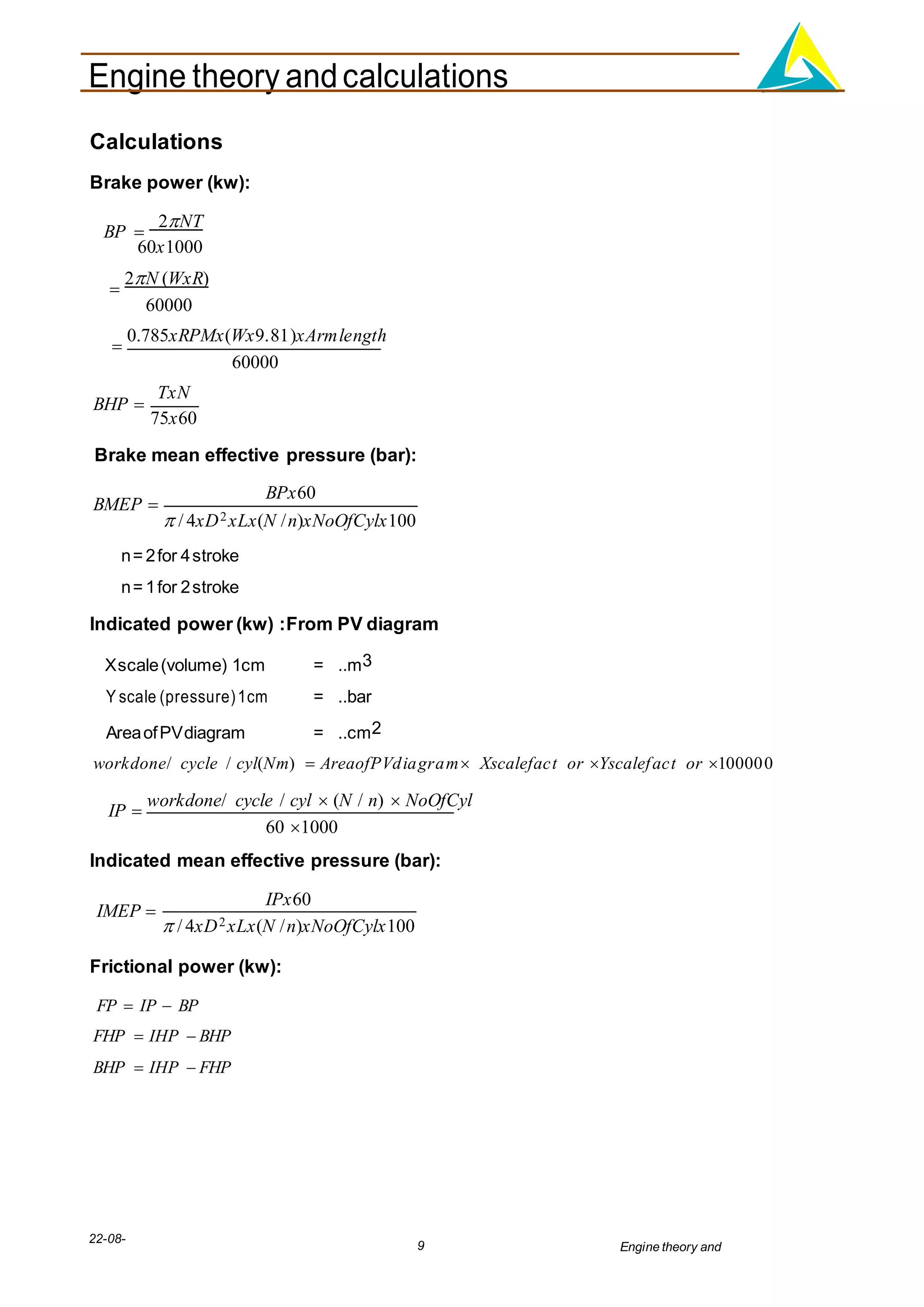
Brake power (kw):
BP 
2NT
60x1000

2N (WxR)
60000

0.785xRPMx(Wx9.81)xArmlength
60000
BHP 
TxN
75x60
Brake mean effective pressure (bar):
BMEP 
BPx60
 / 4xD2xLx(N /n)xNoOfCylx100
n= 2for 4stroke
n= 1for 2stroke
Indicated power (kw) :From PV diagram
Xscale(volume) 1cm = ..m3
Y scale (pressure)1cm = ..bar
AreaofPVdiagram = ..cm2
workdone/ cycle / cyl(Nm)  AreaofPVdiagram Xscalefact or Yscalefact or 100000
IP 
workdone/ cycle / cyl  (N / n)  NoOfCyl
60 1000
Indicated mean effective pressure (bar):
IMEP 
IPx60
 / 4xD2xLx(N /n)xNoOfCylx100
Frictional power (kw):
FP  IP  BP
FHP  IHP  BHP
BHP  IHP  FHP
Engine theory andcalculations
22-08-
2012
10 Engine theory and
calculations.docx
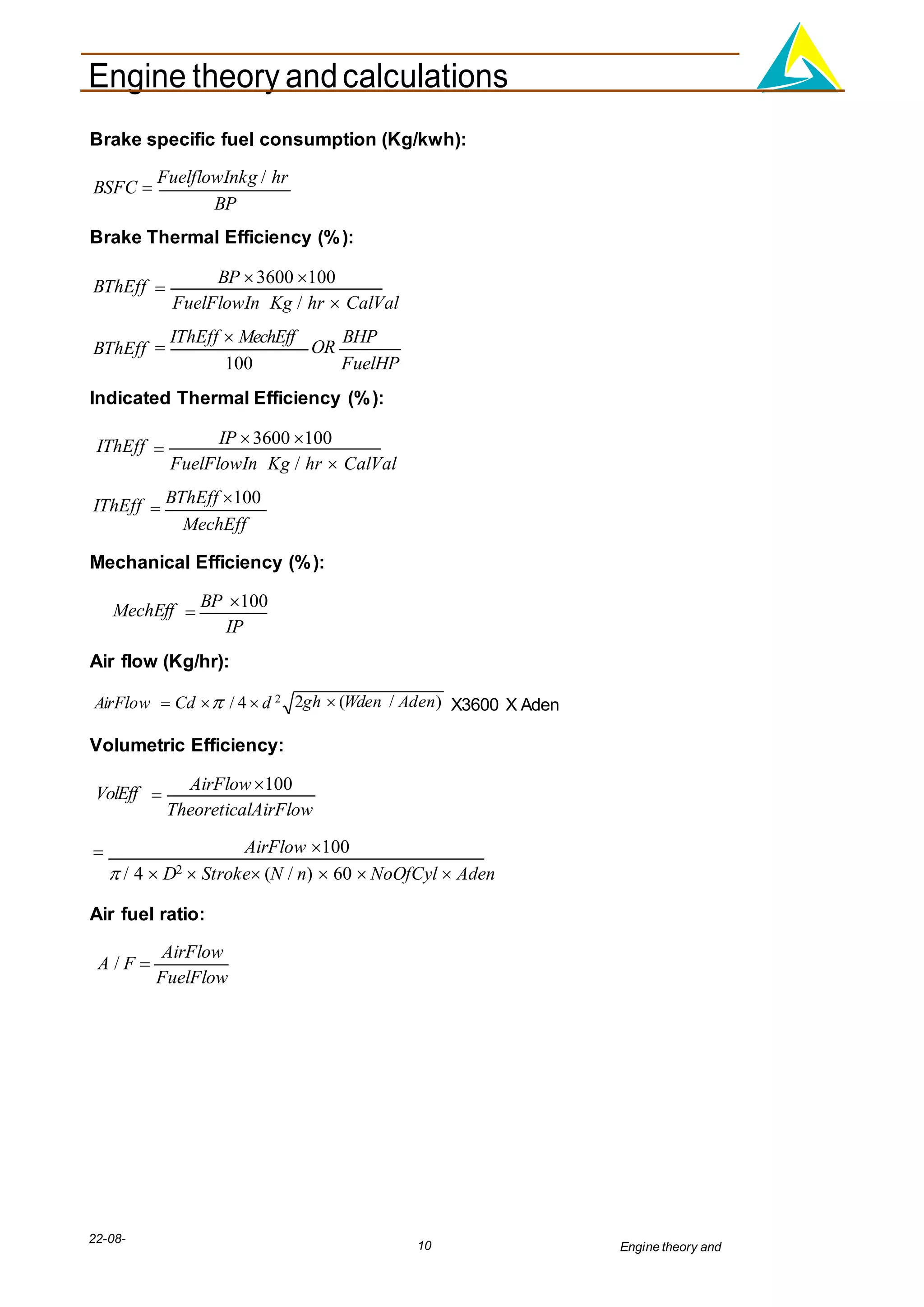
Brake specific fuel consumption (Kg/kwh):
BSFC 
FuelflowInkg / hr
BP
Brake Thermal Efficiency (%):
BThEff 
BP 3600 100
FuelFlowIn Kg / hr  CalVal
BThEff 
IThEff  MechEff
100
OR
BHP
FuelHP
Indicated Thermal Efficiency (%):
IThEff 
IP 3600 100
FuelFlowIn Kg / hr  CalVal
IThEff 
BThEff 100
MechEff
Mechanical Efficiency (%):
MechEff 
BP 100
IP
Air flow (Kg/hr):
AirFlow  Cd  / 4  d 2
X3600 X Aden
Volumetric Efficiency:
VolEff


AirFlow 100
TheoreticalAirFlow
AirFlow 100
 / 4  D2  Stroke (N / n)  60  NoOfCyl  Aden
Air fuel ratio:
A / F 
AirFlow
FuelFlow
2gh  (Wden / Aden)
Engine theory andcalculations
Email: support@apexinnovations.co.in Web: www.apexinnovations.co.in
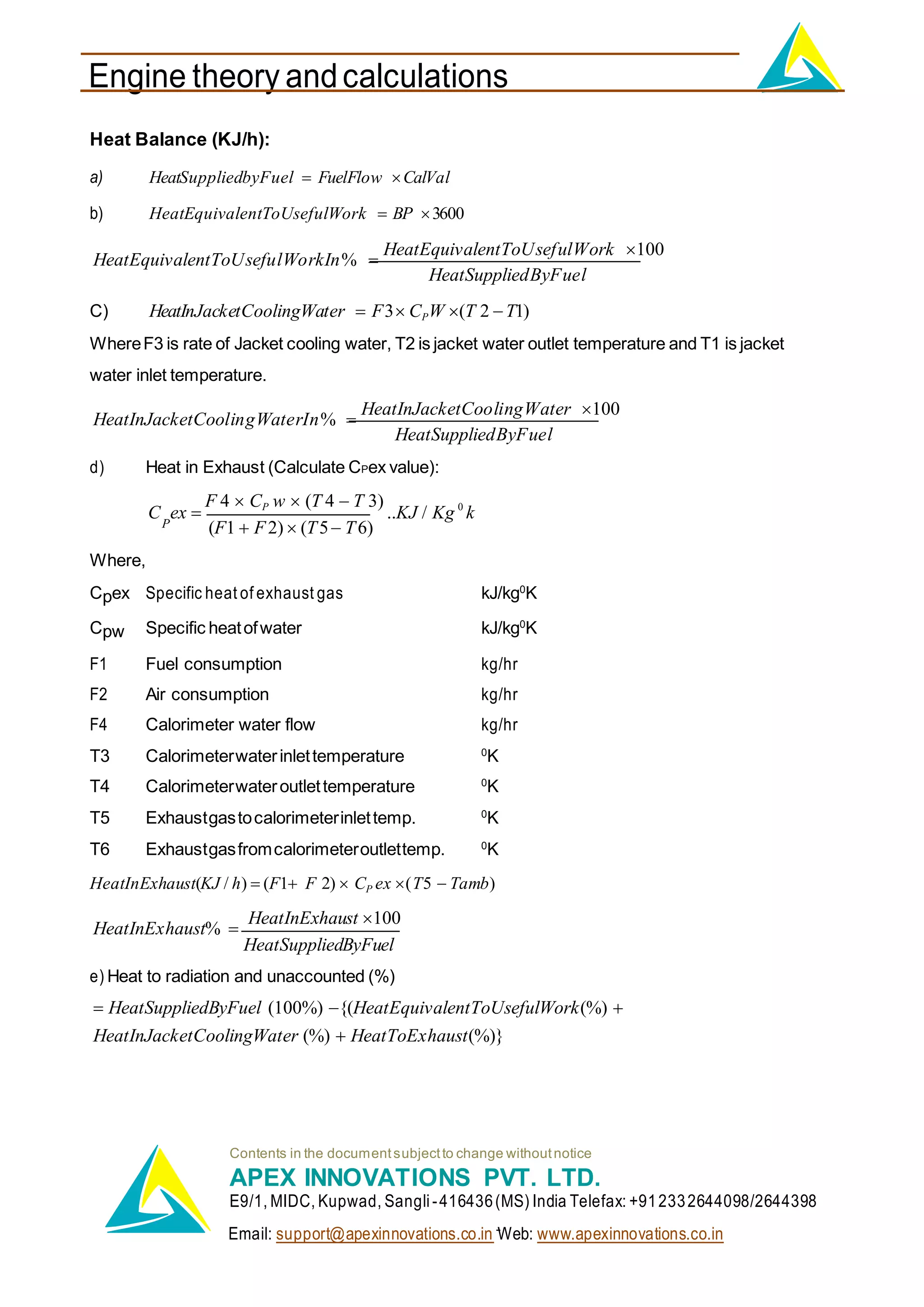
Heat Balance (KJ/h):
a) HeatSuppliedbyFuel  FuelFlow CalVal
b) HeatEquivalentToUsefulWork  BP 3600
HeatEquivalentToUsefulWorkIn% 
HeatEquivalentToUsefulWork 100
HeatSuppliedByFuel
C) HeatInJacketCoolingWater  F3 CPW (T 2 T1)
WhereF3 is rate of Jacket cooling water, T2 is jacket water outlet temperature and T1 is jacket
water inlet temperature.
HeatInJacketCoolingWaterIn% 
HeatInJacketCoolingWater 100
HeatSuppliedByFuel
d) Heat in Exhaust (Calculate CPex value):
C ex 
F 4  CP w  (T 4  T 3)
..KJ / Kg 0
k
P (F1  F2)  (T5 T6)
Where,
Cpex Specific heat of exhaust gas kJ/kg0
K
Cpw Specific heatofwater kJ/kg0
K
F1 Fuel consumption kg/hr
F2 Air consumption kg/hr
F4 Calorimeter water flow kg/hr
T3 Calorimeterwaterinlettemperature 0
K
T4 Calorimeterwateroutlettemperature 0
K
T5 Exhaustgastocalorimeterinlettemp. 0
K
T6 Exhaustgasfromcalorimeteroutlettemp. 0
K
HeatInExhaust(KJ / h)  (F1 F 2)  CP ex (T5  Tamb)
HeatInExhaust% 
HeatInExhaust 100
HeatSuppliedByFuel
e) Heat to radiation and unaccounted (%)
 HeatSuppliedByFuel (100%) {(HeatEquivalentToUsefulWork(%) 
HeatInJacketCoolingWater (%)  HeatToExhaust(%)}
Contents in the documentsubjectto change withoutnotice
APEX INNOVATIONS PVT. LTD.
E9/1, MIDC, Kupwad, Sangli-416436(MS) India Telefax: +912332644098/2644398

Engine_theory_and_calculations-converted.docx

  • 1.
    Engine theory andcalculations 22-08- 2012 1Engine theory and calculations.docx Bore D Suction v alv e Intake or suction manif old Cy linder head Exhaust v alv e Exhaust manif old Top dead center T.D.C. Clearance v olume.Vc Piston Gudgeon or wrist pin Bottom dead center B.D.C. Cy linder v olume’V’ Stroke v olume.Vs Cy linder Connecting rod Crankcase Crankshaf t Crank pin Crank TERMINOLOGY Important positions and volumes in reciprocating engine Engine Cylinder diameter (bore) (D): The nominal inner diameter of the working cylinder. Piston area (A): The area of a circle of diameter equal to engine cylinder diameter (bore). A   / 4  D2 Engine Stroke length (L): The nominal distance through which a working piston moves betweentwo successivereversals ofits direction of motion. Dead center: The position of the working piston and the moving parts, which are mechanically connected to it at the moment when the direction of the piston motion is reversed (at either end point of thestroke). Bottom dead center (BDC): Dead center when the piston is nearest to the crankshaft. Sometimes it is also called outer dead center (ODC). Top dead center (TDC): Dead center when the position is farthest from the crankshaft. Sometimes it is also called inner dead center (IDC). Sweptvolume(VS):Thenominalvolumegeneratedby theworkingpistonwhentravelling from one dead center to next one, calculated as the product of piston area and stroke. The capacity described byenginemanufacturersinccisthesweptvolumeoftheengine.Vs  A L   / 4 D2 L Clearance volume(VC): The nominal volume of the spaceon the combustionsideof the piston at top dead center.
  • 2.
    Engine theory andcalculations 22-08- 2012 2Engine theory and calculations.docx Cylinder volume: The sum of swept volume and clearance volume. V  Vs  Vc Compression ratio (CR): The numerical value of the cylinder volume divided by the numerical value of clearancevolume.CR  V /Vc Four stroke cycle engine Infour-strokecycleengine, thecycleofoperation is completedinfourstrokes ofthepistonortwo revolutions of the crankshaft. Each stroke consists of 1800 of crankshaft rotation and hence a cycle consistsof7200 ofcrankshaftrotation.Theseriesofoperationofanidealfour-strokeengineareas follows: 1. Suction or Induction stroke: The inlet valve is open, and the piston travels down the cylinder, drawing in a charge of air. In the case of a spark ignition engine the fuel is usually pre- mixed with the air. 2. Compression stroke: Both valves are closed, and the piston travels up the cylinder. As the piston approaches top dead centre (TDC), ignition occurs. In the case of compression ignition engines, the fuel is injected towards the end of compressionstroke. 3. Expansion or Power or Working stroke: Combustion propagates throughout the charge, raising the pressure and temperature, and forcing the piston down. At the end of the power stroke the exhaust valve opens, and the irreversible expansion of the exhaust gases is termed ‘blow-down’. 4. Exhaust stroke: The exhaust valve remains open, and as the piston travels up the cylinder the remaining gases are expelled. At the end of the exhaust stroke, when the exhaust valve closes some exhaust gas residuals will be left; thesewill dilute the next charge. Two stroke cycle engine In two stroke engines the cycle is completed in two strokes of piston i.e. one revolution of the crankshaftas againsttworevolutions offourstrokecycleengine.Thetwo-strokecycleeliminates the separate induction and exhaust strokes. 1. Compression stroke: The piston travels up the cylinder, socompressingthe trappedcharge.Ifthefuelis notpre-mixed,thefuelis injectedtowards theendofthecompression stroke; ignition should again occur before TDC. Simultaneously under side of the piston is drawing in a charge through a spring-loaded non-return inlet valve. 2. Power stroke: The burning mixture raises the temperature and pressure in the cylinder, and forces the piston down. The downward motion of the piston also compresses the charge in the crankcase. As the piston approaches the end of its stroke the exhaust port is uncovered and blowdown occurs. When the piston is at BDC the transfer port is also uncovered, and the compressed charge in the crankcase expands into the cylinder. Some of the remaining exhaust
  • 3.
    Engine theory andcalculations 22-08- 2012 3Engine theory and calculations.docx BP (C) IP (B) Energy in fuel (A) gases are displaced by the fresh charge; because of the flow mechanism this is called ‘loop scavenging'.As thepistontravels upthecylinder,thepistoncloses thefirsttransferport,andthen the exhaust port is closed. Performanceof I.C.Engines Indicated thermal efficiency (ηt): Indicated thermal efficiency is the ratio of energy in the indicated power to the fuel energy. t  IndicatedPower / FuelEnergy t (%)  IndicatedPower(KW )  3600 FuelFlow (Kg / Hr) CalorificValue(KJ / Kg) 100 Brake thermal efficiency (ηbth): A measure of overall efficiency of the engine isgivenbythebrakethermalefficiency.Brakethermalefficiencyistheratioof energy in the brake powerto the fuel energy. bth  BrakePower / FuelEnergy bth (%)  BrakePower(KW )  3600 FuelFlow (Kg / Hr) CalorificValue(KJ / Kg) 100 Mechanical efficiency (ηm): Mechanical efficiency is the ratio of brake horsepower (delivered power)to the indicated horsepower(power provided to the piston). m  BrakePower / IndicatedPower and Frictional power = Indicated power – Brake power Following figure gives diagrammatic representation of various efficiencies, Energy lost in exhaust, coolant, and radiation Energy lost in friction, pumping etc. Indicated thermal efficiency = B/A Brake thermal efficiency = C/A
  • 4.
    Engine theory andcalculations 22-08- 2012 4Engine theory and calculations.docx Mechanical efficiency = C/B Volumetric efficiency (ηv): Theengine output is limited bythemaximum amountofair that can be taken in during the suction stroke, because only a certain amount of fuel can be burned effectively with a given quantity of air. Volumetric efficiency is an indication of the ‘breathing’ ability of the engine and is defined as the ratio of the air actually induced at ambient conditions to the swept volumeoftheengine. In practicetheenginedoes notinduceacompletecylinderfull ofaironeach stroke, and it is convenient to define volumetric efficiency as: Mass of air consumed ηv (%)= massofflowofairtofill sweptvolumeatatmosphericconditions  (%)  AirFlow(Kg / Hr) 100 v  / 4 D2 L(m3 )  N(RPM ) / n  NoofCyl  AirDen(Kg / m3 ) 60 Where n= 1 for 2 stroke engine and n= 2 for 4 stroke engine. Air flow: For air consumption measurement air box with orifice is used. AitFlow (Kg / Hr)  Cd  / 4 D2   Aden  3600 Where Cd = Coefficient of discharge of orifice D = Orifice diameter in m g=Accelerationduetogravity(m/s2 )=9.81m/s2 h= Differential headacross orifice(m ofwater) Wden= Waterdensity(kg/m3 )=@1000kg/m3 Wair=Airdensityatworkingcondition(kg/m3 )=p/RT Where p= Atmospheric pressure in kgf/m2 (1 Standard atm. = 1.0332X10⁴ kgf/m2 ) R= Gas constant = 29.27 kgf.m/kg0 k T= Atmospheric temperature in 0 k Specific fuel consumption (SFC): Brake specific fuel consumption and indicated specific fuel consumption, abbreviated BSFC and ISFC, are the fuel consumptions on the basis of Brake power and Indicated powerrespectively. Fuel-air (F/A) or air-fuel (A/F) ratio: The relative proportions of the fuel and air in the engine are very important from standpoint of combustion and efficiency of the engine. This is expressed either as the ratio of the mass ofthe fuel to that of the air or vice versa. 2g  hwater Wden / Aden
  • 5.
    Engine theory andcalculations 22-08- 2012 5Engine theory and calculations.docx Calorific value or Heating value or Heat of combustion: It is the energy released per unit quantity of the fuel, when the combustible is burned and the products of combustion are cooled back to the initial temperature of combustible mixture. The heating value so obtainediscalledthehigherorgrosscalorificvalueofthefuel.Thelowerornetcalorificvalueisthe heat released when water in the products of combustion is not condensed and remains in the vapour form. Power and Mechanical efficiency: Power is defined as rate of doing work and equal to the product of force and linear velocity or the product of torque and angular velocity. Thus, the measurementof power involves the measurementof force(or torque) as well as speed. Thepowerdevelopedbyanengineattheoutputshaftiscalledbrakepowerandisgivenby Power =NT/60,000 in kW where T= torque in Nm = WR W=9.81*Netmassappliedinkg.R=Radiusinm N is speed in RPM Meaneffective pressureandtorque:Mean effectivepressureisdefinedasahypothetical pressure, which is thought to be acting on the piston throughout the power stroke. PowerinkW=(Pm LAN/n100)/60inbar wherePm = meaneffectivepressure L= length ofthestrokein m A= areaof thepiston inm2 N = Rotational speed of engine RPM n= number of revolutions required to complete one engine cycle n= 1 (for two stroke engine) n=2(forfourstrokeengine) Thus we can see that for a given engine the power output can be measured in terms of mean effectivepressure.Ifthemeaneffectivepressureis basedonbrakepoweritis calledbrakemean effective pressure (BMEP) and if based on indicated power it is called indicated mean effective pressure(IMEP). BMEP(bar)  BrakePower(KW )  60 L A (N / n)  NoOfCyl 100 IMEP(bar)  IndicatedPower(KW )  60 L  A  (N / n)  NoOfCyl 100 Similarly, the friction means effective pressure (FMEP) can be defined as
  • 6.
    Engine theory andcalculations 22-08- 2012 6Engine theory and calculations.docx FMEP= IMEP – BMEP Basic measurements Thebasic measurements,whichusuallyshouldbeundertakentoevaluatetheperformanceofan engine on almostall tests,are the following: 1 Measurement of speed Following different speedmeasuringdevices areusedforspeedmeasurement. 1 Photoelectric/Inductive proximity pickup withspeed indicator 2 Rotary encoder 2 Measurement of fuel consumption I) Volumetric method: The fuel consumed by an engine is measured by determining the volume flow of the fuel in a given time interval and multiplying it by the specific gravity of fuel. Generally a glass burette having graduations inml is used for volume flow measurement. Time taken by the engine to consumethis volume is measured by stopwatch. II) Gravimetric method: In this method the time to consume a given weight of the fuel is measured. Differential pressure transmitters working on hydrostatic head principles can used for fuel consumptionmeasurement. 3 Measurement of air consumption Air box method: In IC engines, as the air flow is pulsating, for satisfactory measurement of air consumptionanairbox ofsuitablevolumeis fittedwithorifice.Theairboxis usedfordampingout the pulsations. The differential pressure across the orifice is measured by manometer and pressure transmitter. 4 Measurement of brake power MeasurementofBPinvolves determinationofthetorque andangularspeedof theengineoutput shaft. This torque-measuring device is called a dynamometer. The dynamometers used are of following types: I) Rope brake dynamometer: It consists of a number of turns of rope wound around the rotating drum attached to the output shaft. One side of the rope is connected to a spring balance and the other to a loading device. The power is absorbed in friction between the rope and the drum.The drum therefore requires cooling. Brake power = ∏DN (W-S)/60,000 in kW where D is the brake drum diameter, W is the weight and S is the spring scale reading. II) Hydraulic dynamometer: Hydraulic dynamometer works on the principal of dissipating the power in fluid friction. It consists of an inner rotating member or impeller coupled to output shaft of the engine. This impeller rotates in a casing, due to the centrifugal force developed, tends to
  • 7.
    Engine theory andcalculations 22-08- 2012 7Engine theory and calculations.docx revolve with impeller, but is resistedby torque arm supportingthe balance weight. The frictional forces betweentheimpellerandthefluidaremeasuredbythespring-balancefittedonthecasing. Heatdevelopedduetodissipationofpoweris carriedawaybyacontinuous supplyoftheworking fluidusuallywater.Theoutput(powerabsorbed)canbecontrolledbyvaryingthequantityofwater circulatinginthevortexoftherotorandstatorelements.Thisisachievedbyamovingsluicegatein the dynamometercasing. III) Eddy current dynamometer: It consists of a stator on which are fitted a number of electromagnets andarotordisc andcoupledtotheoutputshaftofthe engine.Whenrotorrotates eddycurrents areproducedinthestatorduetomagnetic fluxsetupbythepassageoffieldcurrent in the electromagnets. These eddy currents oppose the rotor motion, thus loading the engine. These eddy currents are dissipated in producing heat so that this type of dynamometer needs cooling arrangement. A moment arm measures the torque. Regulating the current in electromagnets controls theload. Note: While using with variable speed engines sometimes in certain speed zone the dynamometer operating line arenearly parallel withengine operating lines whichresultin poor stability. 5 Measurement of indicatedpower There are two methods of finding the IHP of an engine. I) Indicator diagram: A dynamic pressure sensor (piezo sensor) is fitted in the cylinder head to sense combustion pressure. A rotary encoder is fitted on the engine shaft for crank angle signal. Both signals are simultaneously scanned by an engine indicator (electronic unit) and communicated to computer. The software in the computer draws pressure crank-angle and pressure volume plots and computes indicated power of the engine. Conversion of pressure crank-angle plot to pressure volume plot: The figure shows crank-slider mechanism. The piston pin position is given by x  r cos  l cos
  • 8.
    Engine theory andcalculations 22-08- 2012 8Engine theory and calculations.docx  From figure r sin  l sin and recalling cos  x  r cos  l r  1 r l2 sin 2    Thebinomialtheorem canbeusedtoexpandthesquarerootterm: x  rcos l /r11 2(r /l)2 sin 2 1 8(r /l)4 sin 4 ... The powers of sin can be expressedas equivalent multiple angles: sin2   1/ 2 1/ 2cos 2   ….1 sin 4   3/8 1/ 2cos2 1/ 8cos 4  …….2 Substituting the results from equation 2 in to equation 1 gives x rcos l /r11 2(r /l)2 1/ 21/ 2cos 21 8(r /l)4 3/ 81/ 2cos 2 1/8cos 4... The geometry of the engine is such that r/l2 is invariably less than 0.1, in which case it is acceptable to neglect the r /l4 terms, as inspection ofabove equation shows thatthese terms will be at least an order of magnitude smaller than r/ l2 terms. The approximate position of piston pin end is thus: x  rcos  l / r1 1 2 (r / l)2 1/ 2 1/ 2cos 2  Where r =crankshaft throw and l = connecting rod length. Calculate x usingabove equation; then (lr x)shallgive distancetraversedby pistonfrom its top mostposition at any angle  II) Morse test:It is applicable to multi-cylinder engines. The engine is run at desired speed and outputisnoted.Thencombustioninoneofthecylindersisstoppedbyshortcircuitingsparkplugor bycuttingoffthefuelsupply. Underthis conditionothercylinders “motor”thiscylinder.Theoutput is measured after adjusting load on the engine to keep speed constant at original value. The differencein output is measureofthe indicatedpowerof cut-outcylinder.Thus foreachcylinder indicated power is obtained to find out total indicated power. VCR Engines There are different methods available for making variable compression ratio engines. In one of the methods,thestandardavailableengines (withfixedcompressionratio)aremodifiedbyproviding tilting arrangement to the cylinder block. This arrangement changes the clearance volume keeping sweptvolumesame.Thecompressionratiochanges dependingupontheamountoftiltanddoes not alter combustionchamber geometry. 1  sin 2 
  • 9.
    Engine theory andcalculations 22-08- 2012 9Engine theory and calculations.docx Calculations Brake power (kw): BP  2NT 60x1000  2N (WxR) 60000  0.785xRPMx(Wx9.81)xArmlength 60000 BHP  TxN 75x60 Brake mean effective pressure (bar): BMEP  BPx60  / 4xD2xLx(N /n)xNoOfCylx100 n= 2for 4stroke n= 1for 2stroke Indicated power (kw) :From PV diagram Xscale(volume) 1cm = ..m3 Y scale (pressure)1cm = ..bar AreaofPVdiagram = ..cm2 workdone/ cycle / cyl(Nm)  AreaofPVdiagram Xscalefact or Yscalefact or 100000 IP  workdone/ cycle / cyl  (N / n)  NoOfCyl 60 1000 Indicated mean effective pressure (bar): IMEP  IPx60  / 4xD2xLx(N /n)xNoOfCylx100 Frictional power (kw): FP  IP  BP FHP  IHP  BHP BHP  IHP  FHP
  • 10.
    Engine theory andcalculations 22-08- 2012 10Engine theory and calculations.docx Brake specific fuel consumption (Kg/kwh): BSFC  FuelflowInkg / hr BP Brake Thermal Efficiency (%): BThEff  BP 3600 100 FuelFlowIn Kg / hr  CalVal BThEff  IThEff  MechEff 100 OR BHP FuelHP Indicated Thermal Efficiency (%): IThEff  IP 3600 100 FuelFlowIn Kg / hr  CalVal IThEff  BThEff 100 MechEff Mechanical Efficiency (%): MechEff  BP 100 IP Air flow (Kg/hr): AirFlow  Cd  / 4  d 2 X3600 X Aden Volumetric Efficiency: VolEff   AirFlow 100 TheoreticalAirFlow AirFlow 100  / 4  D2  Stroke (N / n)  60  NoOfCyl  Aden Air fuel ratio: A / F  AirFlow FuelFlow 2gh  (Wden / Aden)
  • 11.
    Engine theory andcalculations Email:support@apexinnovations.co.in Web: www.apexinnovations.co.in Heat Balance (KJ/h): a) HeatSuppliedbyFuel  FuelFlow CalVal b) HeatEquivalentToUsefulWork  BP 3600 HeatEquivalentToUsefulWorkIn%  HeatEquivalentToUsefulWork 100 HeatSuppliedByFuel C) HeatInJacketCoolingWater  F3 CPW (T 2 T1) WhereF3 is rate of Jacket cooling water, T2 is jacket water outlet temperature and T1 is jacket water inlet temperature. HeatInJacketCoolingWaterIn%  HeatInJacketCoolingWater 100 HeatSuppliedByFuel d) Heat in Exhaust (Calculate CPex value): C ex  F 4  CP w  (T 4  T 3) ..KJ / Kg 0 k P (F1  F2)  (T5 T6) Where, Cpex Specific heat of exhaust gas kJ/kg0 K Cpw Specific heatofwater kJ/kg0 K F1 Fuel consumption kg/hr F2 Air consumption kg/hr F4 Calorimeter water flow kg/hr T3 Calorimeterwaterinlettemperature 0 K T4 Calorimeterwateroutlettemperature 0 K T5 Exhaustgastocalorimeterinlettemp. 0 K T6 Exhaustgasfromcalorimeteroutlettemp. 0 K HeatInExhaust(KJ / h)  (F1 F 2)  CP ex (T5  Tamb) HeatInExhaust%  HeatInExhaust 100 HeatSuppliedByFuel e) Heat to radiation and unaccounted (%)  HeatSuppliedByFuel (100%) {(HeatEquivalentToUsefulWork(%)  HeatInJacketCoolingWater (%)  HeatToExhaust(%)} Contents in the documentsubjectto change withoutnotice APEX INNOVATIONS PVT. LTD. E9/1, MIDC, Kupwad, Sangli-416436(MS) India Telefax: +912332644098/2644398