GAS TURBINES
GAS TURBINES – HISTORY : 
 A Gas turbine is a Turbo-machine and basically similar to steam turbine 
regarding its working principle 
 The first turbine to produce useful work was probably a wind mill, where no 
compression and no combustion exist 
 Now a days gas turbine include a compression process and combustion 
process. 
 Joule and brayton independently proposed the cycle that is the ideal 
prototype 
2
CLASSIFICATION OF GAS TURBINES : 
 Gas turbines are classified according to three factors , These are : 
1. Combustion process 
2. Path of working substance 
3. Action of combustion gases in turbine 
3
4 
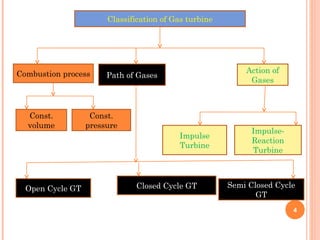
Classification of Gas turbine 
Combustion process Path of Gases Action of 
Gases 
Const. 
volume 
Const. 
pressure 
Impulse 
Turbine 
Impulse- 
Reaction 
Turbine 
Open Cycle GT Closed Cycle GT Semi Closed Cycle 
GT
5 
Brayton Cycle: Ideal Cycle for Gas-Turbine Engines 
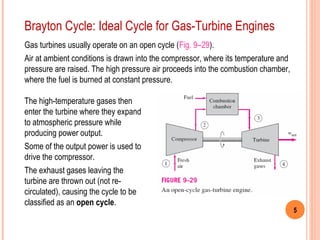
Gas turbines usually operate on an open cycle (Fig. 9–29). 
Air at ambient conditions is drawn into the compressor, where its temperature and 
pressure are raised. The high pressure air proceeds into the combustion chamber, 
where the fuel is burned at constant pressure. 
The high-temperature gases then 
enter the turbine where they expand 
to atmospheric pressure while 
producing power output. 
Some of the output power is used to 
drive the compressor. 
The exhaust gases leaving the 
turbine are thrown out (not re-circulated), 
causing the cycle to be 
classified as an open cycle.
6 
Closed Cycle Model 
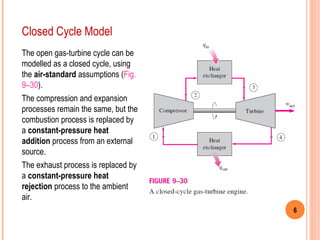
The open gas-turbine cycle can be 
modelled as a closed cycle, using 
the air-standard assumptions (Fig. 
9–30). 
The compression and expansion 
processes remain the same, but the 
combustion process is replaced by 
a constant-pressure heat 
addition process from an external 
source. 
The exhaust process is replaced by 
a constant-pressure heat 
rejection process to the ambient 
air.
7 
The Brayton Cycle 
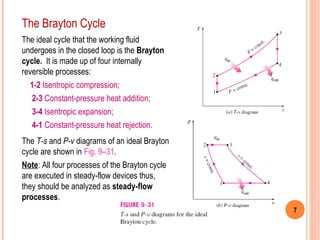
The ideal cycle that the working fluid 
undergoes in the closed loop is the Brayton 
cycle. It is made up of four internally 
reversible processes: 
1-2 Isentropic compression; 
2-3 Constant-pressure heat addition; 
3-4 Isentropic expansion; 
4-1 Constant-pressure heat rejection. 
The T-s and P-v diagrams of an ideal Brayton 
cycle are shown in Fig. 9–31. 
Note: All four processes of the Brayton cycle 
are executed in steady-flow devices thus, 
they should be analyzed as steady-flow 
processes.
8 
Thermal Efficiency 
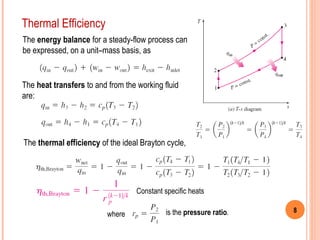
The energy balance for a steady-flow process can 
be expressed, on a unit–mass basis, as 
The heat transfers to and from the working fluid 
are: 
The thermal efficiency of the ideal Brayton cycle, 
Constant specific heats 
where is the pressure ratio.
9 
Parameters Affecting Thermal 
Efficiency 
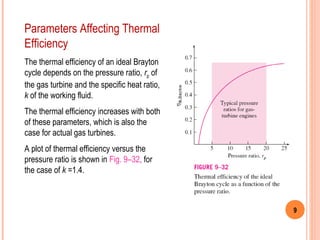
The thermal efficiency of an ideal Brayton 
cycle depends on the pressure ratio, rp of 
the gas turbine and the specific heat ratio, 
k of the working fluid. 
The thermal efficiency increases with both 
of these parameters, which is also the 
case for actual gas turbines. 
A plot of thermal efficiency versus the 
pressure ratio is shown in Fig. 9–32, for 
the case of k =1.4.
10 
Improvements of Gas Turbine’s Performance 
The early gas turbines (1940s to 1959s) found only limited use despite their 
versatility and their ability to burn a variety of fuels, because its thermal efficiency 
was only about 17%. Efforts to improve the cycle efficiency are concentrated in 
three areas: 
1. Increasing the turbine inlet (or firing) temperatures. 
The turbine inlet temperatures have increased steadily from about 540°C 
(1000°F) in the 1940s to 1425°C (2600°F) and even higher today. 
2. Increasing the efficiencies of turbo-machinery components (turbines, 
compressors). 
The advent of computers and advanced techniques for computer-aided design 
made it possible to design these components aerodynamically with minimal 
losses. 
3. Adding modifications to the basic cycle (intercooling, regeneration or 
recuperation, and reheating). 
The simple-cycle efficiencies of early gas turbines were practically doubled by 
incorporating intercooling, regeneration (or recuperation), and reheating.
11 
Actual Gas-Turbine Cycles 
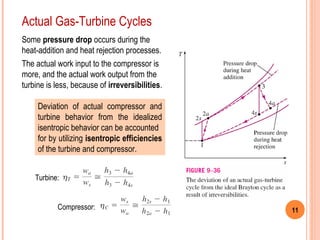
Some pressure drop occurs during the 
heat-addition and heat rejection processes. 
The actual work input to the compressor is 
more, and the actual work output from the 
turbine is less, because of irreversibilities. 
Deviation of actual compressor and 
turbine behavior from the idealized 
isentropic behavior can be accounted 
for by utilizing isentropic efficiencies 
of the turbine and compressor. 
Turbine: 
Compressor:
12 
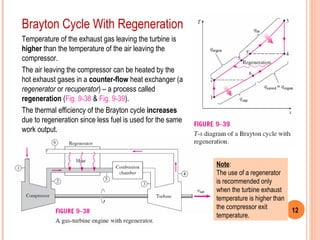
Brayton Cycle With Regeneration 
Temperature of the exhaust gas leaving the turbine is 
higher than the temperature of the air leaving the 
compressor. 
The air leaving the compressor can be heated by the 
hot exhaust gases in a counter-flow heat exchanger (a 
regenerator or recuperator) – a process called 
regeneration (Fig. 9-38 & Fig. 9-39). 
The thermal efficiency of the Brayton cycle increases 
due to regeneration since less fuel is used for the same 
work output. 
Note: 
The use of a regenerator 
is recommended only 
when the turbine exhaust 
temperature is higher than 
the compressor exit 
temperature.
13 
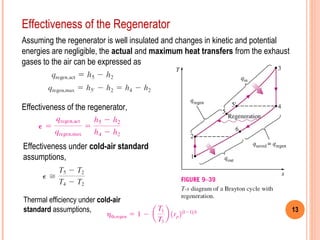
Effectiveness of the Regenerator 
Assuming the regenerator is well insulated and changes in kinetic and potential 
energies are negligible, the actual and maximum heat transfers from the exhaust 
gases to the air can be expressed as 
Effectiveness of the regenerator, 
Effectiveness under cold-air standard 
assumptions, 
Thermal efficiency under cold-air 
standard assumptions,
14 
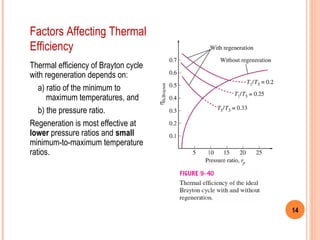
Factors Affecting Thermal 
Efficiency 
Thermal efficiency of Brayton cycle 
with regeneration depends on: 
a) ratio of the minimum to 
maximum temperatures, and 
b) the pressure ratio. 
Regeneration is most effective at 
lower pressure ratios and small 
minimum-to-maximum temperature 
ratios.
15 
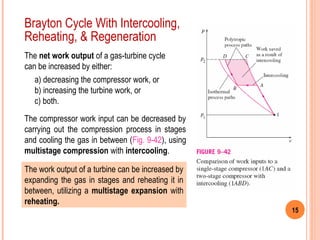
Brayton Cycle With Intercooling, 
Reheating, & Regeneration 
The net work output of a gas-turbine cycle 
can be increased by either: 
a) decreasing the compressor work, or 
b) increasing the turbine work, or 
c) both. 
The compressor work input can be decreased by 
carrying out the compression process in stages 
and cooling the gas in between (Fig. 9-42), using 
multistage compression with intercooling. 
The work output of a turbine can be increased by 
expanding the gas in stages and reheating it in 
between, utilizing a multistage expansion with 
reheating.
16 
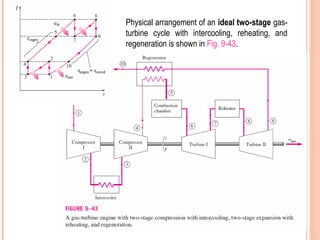
Physical arrangement of an ideal two-stage gas-turbine 
cycle with intercooling, reheating, and 
regeneration is shown in Fig. 9-43.
17 
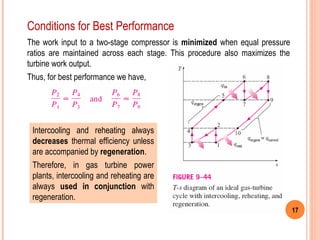
Conditions for Best Performance 
The work input to a two-stage compressor is minimized when equal pressure 
ratios are maintained across each stage. This procedure also maximizes the 
turbine work output. 
Thus, for best performance we have, 
Intercooling and reheating always 
decreases thermal efficiency unless 
are accompanied by regeneration. 
Therefore, in gas turbine power 
plants, intercooling and reheating are 
always used in conjunction with 
regeneration.
Compare Open cycle and Closed cycle Gas turbines 
Open cycle: 
1.Warm-up time. Once the turbine is brought up to the rated speed by the starting motor 
and the fuel is ignited, the gas turbine will be accelerated from cold start to full load 
without warm-up time. 
2. Low weight and size. The weight in kg per kW developed is less. 
3. Open cycle plants occupy comparatively little space. 
4. Open-cycle gas turbine power plant, except those having an intercooler, does not 
18 
require cooling water. 
5. The part load efficiency of the open cycle plant decreases rapidly as the 
considerable percentage of power developed by the turbine is used to drive the 
compressor. 
6. The open-cycle gas turbine plant has high air rate compared to the other cycles, 
therefore, it results in increased loss of heat in the exhaust gases.
19 
Compare Open cycle and Closed cycle Gas turbines 
Contd… 
Closed cycle: 
1. The machine can be smaller and cheaper than the machine used to develop the 
same power using open cycle plant. 
2. The closed cycle avoids erosion of the turbine blades due to the contaminated 
gases and fouling of compressor blades due to dust. Therefore, it is practically free from 
deterioration of efficiency in service. 
3. The need for filtration of the incoming air which is a severe problem in open cycle plant 
is completely eliminated. 
4. The maintenance cost is low and reliability is high due to longer useful life. 
5. The system is dependent on external means as considerable quantity of cooling water 
is required in the pre-cooler. 
6. The response to the load variations is poor compared to the open-cycle plant

Gas turbines working ppt

  • 1.
  • 2.
    GAS TURBINES –HISTORY :  A Gas turbine is a Turbo-machine and basically similar to steam turbine regarding its working principle  The first turbine to produce useful work was probably a wind mill, where no compression and no combustion exist  Now a days gas turbine include a compression process and combustion process.  Joule and brayton independently proposed the cycle that is the ideal prototype 2
  • 3.
    CLASSIFICATION OF GASTURBINES :  Gas turbines are classified according to three factors , These are : 1. Combustion process 2. Path of working substance 3. Action of combustion gases in turbine 3
  • 4.
    4 Classification ofGas turbine Combustion process Path of Gases Action of Gases Const. volume Const. pressure Impulse Turbine Impulse- Reaction Turbine Open Cycle GT Closed Cycle GT Semi Closed Cycle GT
  • 5.
    5 Brayton Cycle:Ideal Cycle for Gas-Turbine Engines Gas turbines usually operate on an open cycle (Fig. 9–29). Air at ambient conditions is drawn into the compressor, where its temperature and pressure are raised. The high pressure air proceeds into the combustion chamber, where the fuel is burned at constant pressure. The high-temperature gases then enter the turbine where they expand to atmospheric pressure while producing power output. Some of the output power is used to drive the compressor. The exhaust gases leaving the turbine are thrown out (not re-circulated), causing the cycle to be classified as an open cycle.
  • 6.
    6 Closed CycleModel The open gas-turbine cycle can be modelled as a closed cycle, using the air-standard assumptions (Fig. 9–30). The compression and expansion processes remain the same, but the combustion process is replaced by a constant-pressure heat addition process from an external source. The exhaust process is replaced by a constant-pressure heat rejection process to the ambient air.
  • 7.
    7 The BraytonCycle The ideal cycle that the working fluid undergoes in the closed loop is the Brayton cycle. It is made up of four internally reversible processes: 1-2 Isentropic compression; 2-3 Constant-pressure heat addition; 3-4 Isentropic expansion; 4-1 Constant-pressure heat rejection. The T-s and P-v diagrams of an ideal Brayton cycle are shown in Fig. 9–31. Note: All four processes of the Brayton cycle are executed in steady-flow devices thus, they should be analyzed as steady-flow processes.
  • 8.
    8 Thermal Efficiency The energy balance for a steady-flow process can be expressed, on a unit–mass basis, as The heat transfers to and from the working fluid are: The thermal efficiency of the ideal Brayton cycle, Constant specific heats where is the pressure ratio.
  • 9.
    9 Parameters AffectingThermal Efficiency The thermal efficiency of an ideal Brayton cycle depends on the pressure ratio, rp of the gas turbine and the specific heat ratio, k of the working fluid. The thermal efficiency increases with both of these parameters, which is also the case for actual gas turbines. A plot of thermal efficiency versus the pressure ratio is shown in Fig. 9–32, for the case of k =1.4.
  • 10.
    10 Improvements ofGas Turbine’s Performance The early gas turbines (1940s to 1959s) found only limited use despite their versatility and their ability to burn a variety of fuels, because its thermal efficiency was only about 17%. Efforts to improve the cycle efficiency are concentrated in three areas: 1. Increasing the turbine inlet (or firing) temperatures. The turbine inlet temperatures have increased steadily from about 540°C (1000°F) in the 1940s to 1425°C (2600°F) and even higher today. 2. Increasing the efficiencies of turbo-machinery components (turbines, compressors). The advent of computers and advanced techniques for computer-aided design made it possible to design these components aerodynamically with minimal losses. 3. Adding modifications to the basic cycle (intercooling, regeneration or recuperation, and reheating). The simple-cycle efficiencies of early gas turbines were practically doubled by incorporating intercooling, regeneration (or recuperation), and reheating.
  • 11.
    11 Actual Gas-TurbineCycles Some pressure drop occurs during the heat-addition and heat rejection processes. The actual work input to the compressor is more, and the actual work output from the turbine is less, because of irreversibilities. Deviation of actual compressor and turbine behavior from the idealized isentropic behavior can be accounted for by utilizing isentropic efficiencies of the turbine and compressor. Turbine: Compressor:
  • 12.
    12 Brayton CycleWith Regeneration Temperature of the exhaust gas leaving the turbine is higher than the temperature of the air leaving the compressor. The air leaving the compressor can be heated by the hot exhaust gases in a counter-flow heat exchanger (a regenerator or recuperator) – a process called regeneration (Fig. 9-38 & Fig. 9-39). The thermal efficiency of the Brayton cycle increases due to regeneration since less fuel is used for the same work output. Note: The use of a regenerator is recommended only when the turbine exhaust temperature is higher than the compressor exit temperature.
  • 13.
    13 Effectiveness ofthe Regenerator Assuming the regenerator is well insulated and changes in kinetic and potential energies are negligible, the actual and maximum heat transfers from the exhaust gases to the air can be expressed as Effectiveness of the regenerator, Effectiveness under cold-air standard assumptions, Thermal efficiency under cold-air standard assumptions,
  • 14.
    14 Factors AffectingThermal Efficiency Thermal efficiency of Brayton cycle with regeneration depends on: a) ratio of the minimum to maximum temperatures, and b) the pressure ratio. Regeneration is most effective at lower pressure ratios and small minimum-to-maximum temperature ratios.
  • 15.
    15 Brayton CycleWith Intercooling, Reheating, & Regeneration The net work output of a gas-turbine cycle can be increased by either: a) decreasing the compressor work, or b) increasing the turbine work, or c) both. The compressor work input can be decreased by carrying out the compression process in stages and cooling the gas in between (Fig. 9-42), using multistage compression with intercooling. The work output of a turbine can be increased by expanding the gas in stages and reheating it in between, utilizing a multistage expansion with reheating.
  • 16.
    16 Physical arrangementof an ideal two-stage gas-turbine cycle with intercooling, reheating, and regeneration is shown in Fig. 9-43.
  • 17.
    17 Conditions forBest Performance The work input to a two-stage compressor is minimized when equal pressure ratios are maintained across each stage. This procedure also maximizes the turbine work output. Thus, for best performance we have, Intercooling and reheating always decreases thermal efficiency unless are accompanied by regeneration. Therefore, in gas turbine power plants, intercooling and reheating are always used in conjunction with regeneration.
  • 18.
    Compare Open cycleand Closed cycle Gas turbines Open cycle: 1.Warm-up time. Once the turbine is brought up to the rated speed by the starting motor and the fuel is ignited, the gas turbine will be accelerated from cold start to full load without warm-up time. 2. Low weight and size. The weight in kg per kW developed is less. 3. Open cycle plants occupy comparatively little space. 4. Open-cycle gas turbine power plant, except those having an intercooler, does not 18 require cooling water. 5. The part load efficiency of the open cycle plant decreases rapidly as the considerable percentage of power developed by the turbine is used to drive the compressor. 6. The open-cycle gas turbine plant has high air rate compared to the other cycles, therefore, it results in increased loss of heat in the exhaust gases.
  • 19.
    19 Compare Opencycle and Closed cycle Gas turbines Contd… Closed cycle: 1. The machine can be smaller and cheaper than the machine used to develop the same power using open cycle plant. 2. The closed cycle avoids erosion of the turbine blades due to the contaminated gases and fouling of compressor blades due to dust. Therefore, it is practically free from deterioration of efficiency in service. 3. The need for filtration of the incoming air which is a severe problem in open cycle plant is completely eliminated. 4. The maintenance cost is low and reliability is high due to longer useful life. 5. The system is dependent on external means as considerable quantity of cooling water is required in the pre-cooler. 6. The response to the load variations is poor compared to the open-cycle plant