The Ideal Reheat Rankine Cycle
How can we take advantage of the increased
efficiencies at higher boiler pressures
without facing the problem of excessive
moisture at the final stages of the turbine?
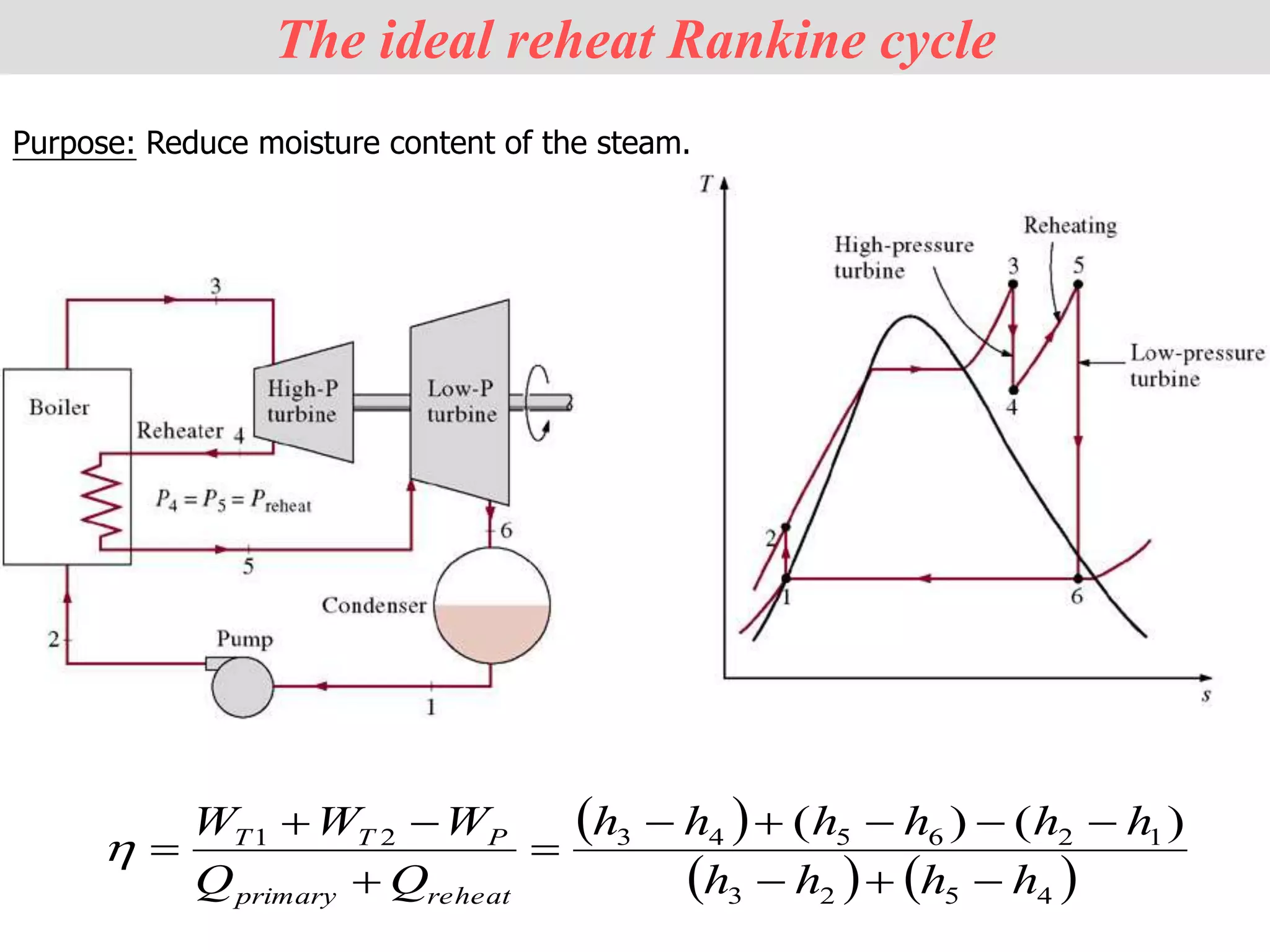
The ideal reheat Rankine cycle
Purpose: Reduce moisture content of the steam.
 
   
4
5
2
3
1
2
6
5
4
3
2
1 )
(
)
(
h
h
h
h
h
h
h
h
h
h
Q
Q
W
W
W
reheat
primary
P
T
T














The ideal reheat Rankine cycle
Some important points:
1. Improvement from 2nd reheat is about half of 1st.
2. Double reheat almost always used in super-critical
pressure power plants.
3. Steam is not allowed to expand deep into the two-phase
region before it is taken for reheating.
4. Optimum reheat pressure for most modern power plants
is between one-fourth to one-fifth of the maximum
cycle pressure.
Advantage:
– very high heat addition
=> high 
Disadvantage:
– material requirements
(thermal/mechanical stress)
=> high initial costs
The ideal Supercritical reheat Rankine cycle
A non-ideal reheat Rankine cycle
%
100
, 
P
T 

Note: T = Turbine ; P = Pump
s
4
6s
6
.
.
2.
2s
Assignment # 2
1. Calculate the thermal efficiency for the ideal Reheat
Rankine cycle if we consider that the steam enters
the first-stage turbine at 3 MPa & 500 °C and
expands to 600 kPa. It is reheated to 450°C and
finally condensed at a pressure of 10 kPa. Also, (a)
for a 100 MW net power output, calculate the mass
flow rate of steam (in kg/hr) (b) the mass flow rate
of the condenser cooling water (in kg/hr), if the
cooling water enters the condenser at 15°C and exits
at 36°C (d) what is the decrease in efficiency if we
consider the isentropic efficiency of both the turbine
and pump to be 85%.
Assignment # 2
2. Calculate the thermal efficiency, heat input and heat
rejected for the super-critical double-reheat ideal
Rankine cycle shown in the diagram.

Ideal reheat rankine cycle

  • 1.
    The Ideal ReheatRankine Cycle How can we take advantage of the increased efficiencies at higher boiler pressures without facing the problem of excessive moisture at the final stages of the turbine?
  • 2.
    The ideal reheatRankine cycle Purpose: Reduce moisture content of the steam.       4 5 2 3 1 2 6 5 4 3 2 1 ) ( ) ( h h h h h h h h h h Q Q W W W reheat primary P T T              
  • 3.
    The ideal reheatRankine cycle Some important points: 1. Improvement from 2nd reheat is about half of 1st. 2. Double reheat almost always used in super-critical pressure power plants. 3. Steam is not allowed to expand deep into the two-phase region before it is taken for reheating. 4. Optimum reheat pressure for most modern power plants is between one-fourth to one-fifth of the maximum cycle pressure.
  • 4.
    Advantage: – very highheat addition => high  Disadvantage: – material requirements (thermal/mechanical stress) => high initial costs The ideal Supercritical reheat Rankine cycle
  • 5.
    A non-ideal reheatRankine cycle % 100 ,  P T   Note: T = Turbine ; P = Pump s 4 6s 6 . . 2. 2s
  • 6.
    Assignment # 2 1.Calculate the thermal efficiency for the ideal Reheat Rankine cycle if we consider that the steam enters the first-stage turbine at 3 MPa & 500 °C and expands to 600 kPa. It is reheated to 450°C and finally condensed at a pressure of 10 kPa. Also, (a) for a 100 MW net power output, calculate the mass flow rate of steam (in kg/hr) (b) the mass flow rate of the condenser cooling water (in kg/hr), if the cooling water enters the condenser at 15°C and exits at 36°C (d) what is the decrease in efficiency if we consider the isentropic efficiency of both the turbine and pump to be 85%.
  • 7.
    Assignment # 2 2.Calculate the thermal efficiency, heat input and heat rejected for the super-critical double-reheat ideal Rankine cycle shown in the diagram.