LECTURE UNIT NO. 2

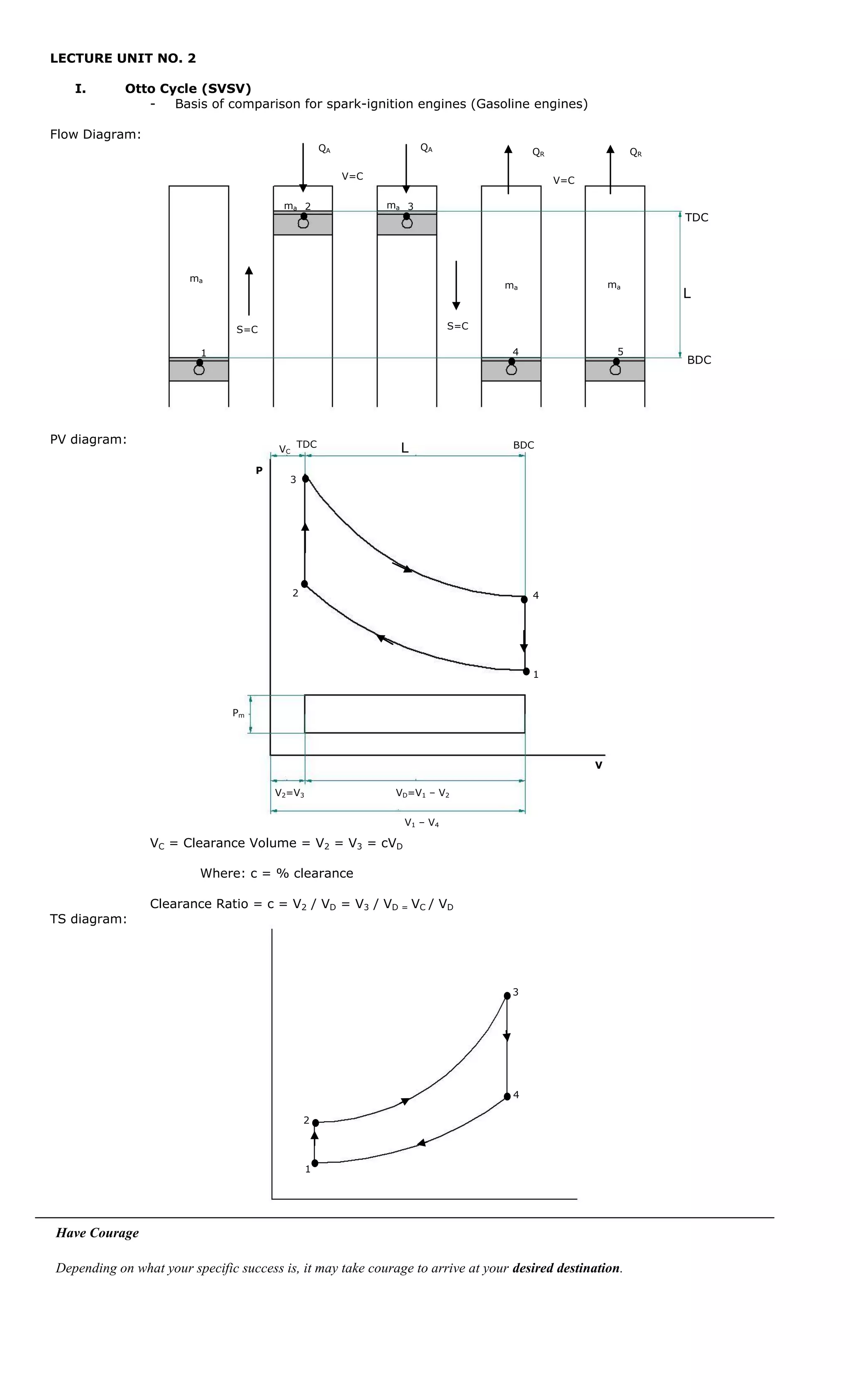
   I.       Otto Cycle (SVSV)
               -   Basis of comparison for spark-ignition engines (Gasoline engines)

Flow Diagram:
                                                    QA                QA              QR                  QR

                                                         V=C                               V=C

                                         ma 2                  ma 3
                                                                                                               TDC


                        ma
                                                                                 ma                  ma
                                                                                                               L

                                S=C                                        S=C

                          1                                                       4                   5
                                                                                                               BDC


PV diagram:
                                        VC TDC                   L                BDC

                                    P
                                          3


                                          2                                           4


                                                                                      1


                               Pm


                                                                                                 V

                                        V2=V3                   VD=V1 – V2


                                                                 V1 – V4

                VC = Clearance Volume = V2 = V3 = cVD

                         Where: c = % clearance

                Clearance Ratio = c = V2 / VD = V3 / VD = VC / VD
TS diagram:


                                                                                  3


                                                                                  4

                                              2


                                                1


Have Courage

Depending on what your specific success is, it may take courage to arrive at your desired destination.
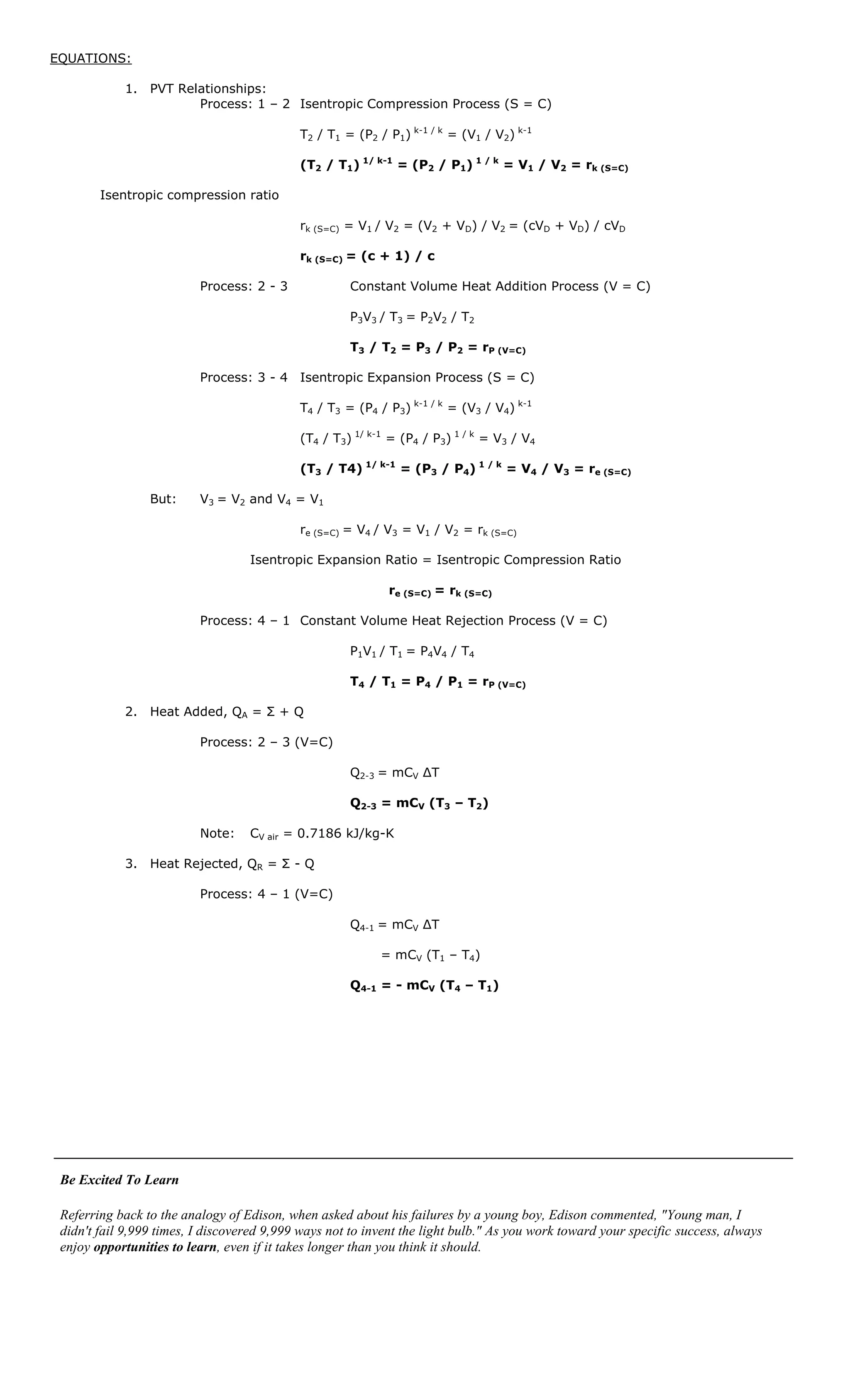
EQUATIONS:

            1. PVT Relationships:
                      Process: 1 – 2 Isentropic Compression Process (S = C)

                                            T2 / T1 = (P2 / P1) k-1 / k = (V1 / V2) k-1

                                            (T2 / T1) 1/ k-1 = (P2 / P1) 1 / k = V1 / V2 = rk (S=C)

        Isentropic compression ratio

                                            rk (S=C) = V1 / V2 = (V2 + VD) / V2 = (cVD + VD) / cVD

                                            rk (S=C) = (c + 1) / c

                          Process: 2 - 3             Constant Volume Heat Addition Process (V = C)

                                                     P3V3 / T3 = P2V2 / T2

                                                     T3 / T2 = P3 / P2 = rP (V=C)

                          Process: 3 - 4 Isentropic Expansion Process (S = C)

                                            T4 / T3 = (P4 / P3) k-1 / k = (V3 / V4) k-1

                                            (T4 / T3) 1/ k-1 = (P4 / P3) 1 / k = V3 / V4

                                            (T3 / T4) 1/ k-1 = (P3 / P4) 1 / k = V4 / V3 = re (S=C)

                 But:     V3 = V2 and V4 = V1

                                            re (S=C) = V4 / V3 = V1 / V2 = rk (S=C)

                                   Isentropic Expansion Ratio = Isentropic Compression Ratio

                                                            re (S=C) = rk (S=C)

                          Process: 4 – 1 Constant Volume Heat Rejection Process (V = C)

                                                     P1V1 / T1 = P4V4 / T4

                                                     T4 / T1 = P4 / P1 = rP (V=C)

            2. Heat Added, QA = Σ + Q

                          Process: 2 – 3 (V=C)

                                                     Q2-3 = mCV ΔT

                                                     Q2-3 = mCV (T3 – T2)

                          Note:    CV air = 0.7186 kJ/kg-K

            3. Heat Rejected, QR = Σ - Q

                          Process: 4 – 1 (V=C)

                                                     Q4-1 = mCV ΔT

                                                           = mCV (T1 – T4)

                                                     Q4-1 = - mCV (T4 – T1)


 Be Excited To Learn

 Referring back to the analogy of Edison, when asked about his failures by a young boy, Edison commented, "Young man, I
 didn't fail 9,999 times, I discovered 9,999 ways not to invent the light bulb." As you work toward your specific success, always
 enjoy opportunities to learn, even if it takes longer than you think it should.


                                    better, more educated decisions from the lessons learned.
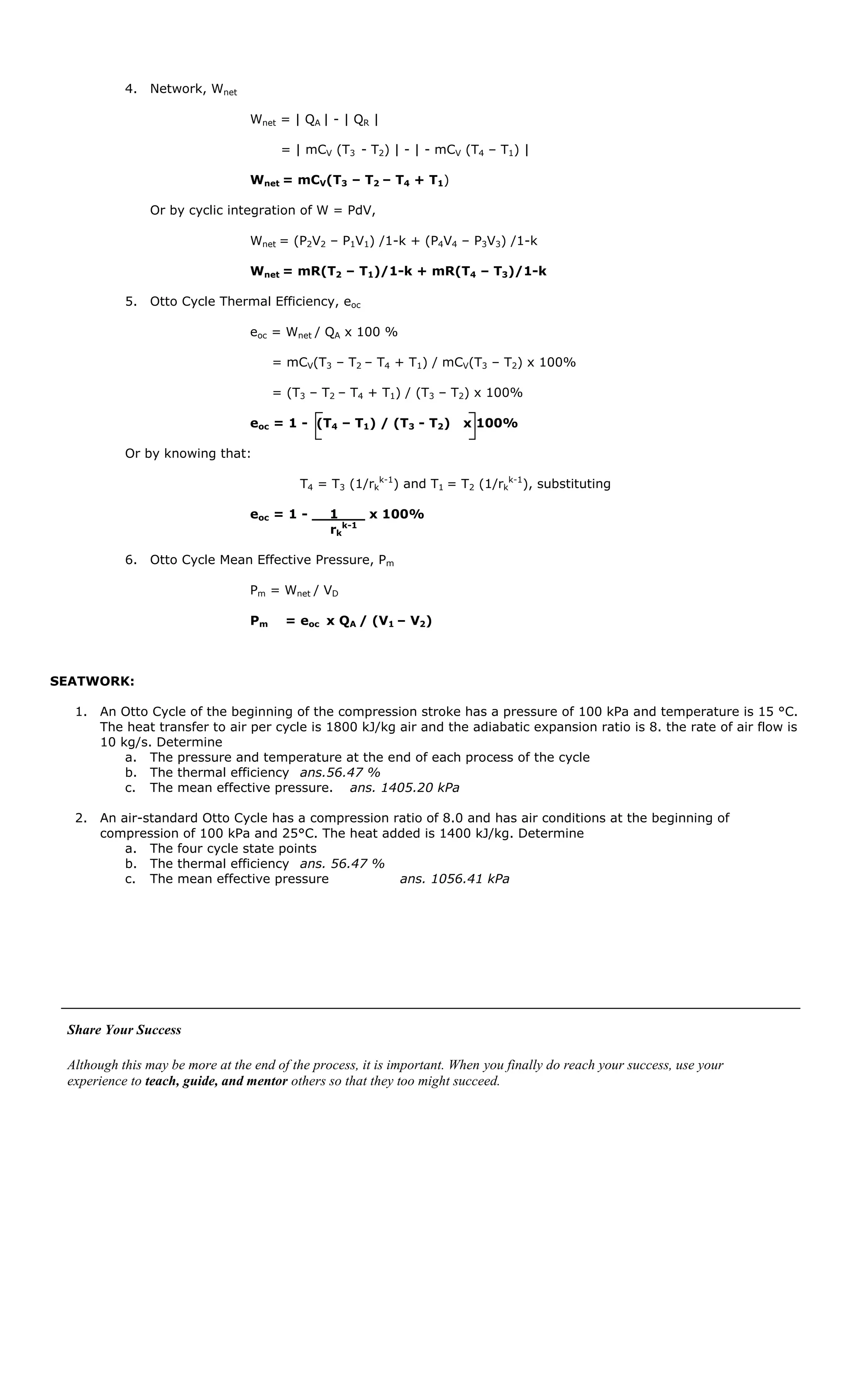
4. Network, Wnet

                                 Wnet = | QA | - | QR |

                                       = | mCV (T3 - T2) | - | - mCV (T4 – T1) |

                                 Wnet = mCV(T3 – T2 – T4 + T1)

               Or by cyclic integration of W = PdV,

                                 Wnet = (P2V2 – P1V1) /1-k + (P4V4 – P3V3) /1-k

                                 Wnet = mR(T2 – T1)/1-k + mR(T4 – T3)/1-k

           5. Otto Cycle Thermal Efficiency, eoc

                                 eoc = Wnet / QA x 100 %

                                      = mCV(T3 – T2 – T4 + T1) / mCV(T3 – T2) x 100%

                                      = (T3 – T2 – T4 + T1) / (T3 – T2) x 100%

                                 eoc = 1 - (T4 – T1) / (T3 - T2)        x 100%

           Or by knowing that:

                                          T4 = T3 (1/rkk-1) and T1 = T2 (1/rkk-1), substituting

                                 eoc = 1 - __1___ x 100%
                                             rkk-1

           6. Otto Cycle Mean Effective Pressure, Pm

                                 Pm = Wnet / VD

                                 Pm     = eoc x QA / (V1 – V2)


SEATWORK:

  1. An Otto Cycle of the beginning of the compression stroke has a pressure of 100 kPa and temperature is 15 °C.
     The heat transfer to air per cycle is 1800 kJ/kg air and the adiabatic expansion ratio is 8. the rate of air flow is
     10 kg/s. Determine
         a. The pressure and temperature at the end of each process of the cycle
         b. The thermal efficiency ans.56.47 %
         c. The mean effective pressure. ans. 1405.20 kPa

  2. An air-standard Otto Cycle has a compression ratio of 8.0 and has air conditions at the beginning of
     compression of 100 kPa and 25°C. The heat added is 1400 kJ/kg. Determine
         a. The four cycle state points
         b. The thermal efficiency ans. 56.47 %
         c. The mean effective pressure            ans. 1056.41 kPa


 Share Your Success

 Although this may be more at the end of the process, it is important. When you finally do reach your success, use your
 experience to teach, guide, and mentor others so that they too might succeed.

002 otto cycle

  • 1.
    LECTURE UNIT NO.2 I. Otto Cycle (SVSV) - Basis of comparison for spark-ignition engines (Gasoline engines) Flow Diagram: QA QA QR QR V=C V=C ma 2 ma 3 TDC ma ma ma L S=C S=C 1 4 5 BDC PV diagram: VC TDC L BDC P 3 2 4 1 Pm V V2=V3 VD=V1 – V2 V1 – V4 VC = Clearance Volume = V2 = V3 = cVD Where: c = % clearance Clearance Ratio = c = V2 / VD = V3 / VD = VC / VD TS diagram: 3 4 2 1 Have Courage Depending on what your specific success is, it may take courage to arrive at your desired destination.
  • 2.
    EQUATIONS: 1. PVT Relationships: Process: 1 – 2 Isentropic Compression Process (S = C) T2 / T1 = (P2 / P1) k-1 / k = (V1 / V2) k-1 (T2 / T1) 1/ k-1 = (P2 / P1) 1 / k = V1 / V2 = rk (S=C) Isentropic compression ratio rk (S=C) = V1 / V2 = (V2 + VD) / V2 = (cVD + VD) / cVD rk (S=C) = (c + 1) / c Process: 2 - 3 Constant Volume Heat Addition Process (V = C) P3V3 / T3 = P2V2 / T2 T3 / T2 = P3 / P2 = rP (V=C) Process: 3 - 4 Isentropic Expansion Process (S = C) T4 / T3 = (P4 / P3) k-1 / k = (V3 / V4) k-1 (T4 / T3) 1/ k-1 = (P4 / P3) 1 / k = V3 / V4 (T3 / T4) 1/ k-1 = (P3 / P4) 1 / k = V4 / V3 = re (S=C) But: V3 = V2 and V4 = V1 re (S=C) = V4 / V3 = V1 / V2 = rk (S=C) Isentropic Expansion Ratio = Isentropic Compression Ratio re (S=C) = rk (S=C) Process: 4 – 1 Constant Volume Heat Rejection Process (V = C) P1V1 / T1 = P4V4 / T4 T4 / T1 = P4 / P1 = rP (V=C) 2. Heat Added, QA = Σ + Q Process: 2 – 3 (V=C) Q2-3 = mCV ΔT Q2-3 = mCV (T3 – T2) Note: CV air = 0.7186 kJ/kg-K 3. Heat Rejected, QR = Σ - Q Process: 4 – 1 (V=C) Q4-1 = mCV ΔT = mCV (T1 – T4) Q4-1 = - mCV (T4 – T1) Be Excited To Learn Referring back to the analogy of Edison, when asked about his failures by a young boy, Edison commented, "Young man, I didn't fail 9,999 times, I discovered 9,999 ways not to invent the light bulb." As you work toward your specific success, always enjoy opportunities to learn, even if it takes longer than you think it should. better, more educated decisions from the lessons learned.
  • 3.
    4. Network, Wnet Wnet = | QA | - | QR | = | mCV (T3 - T2) | - | - mCV (T4 – T1) | Wnet = mCV(T3 – T2 – T4 + T1) Or by cyclic integration of W = PdV, Wnet = (P2V2 – P1V1) /1-k + (P4V4 – P3V3) /1-k Wnet = mR(T2 – T1)/1-k + mR(T4 – T3)/1-k 5. Otto Cycle Thermal Efficiency, eoc eoc = Wnet / QA x 100 % = mCV(T3 – T2 – T4 + T1) / mCV(T3 – T2) x 100% = (T3 – T2 – T4 + T1) / (T3 – T2) x 100% eoc = 1 - (T4 – T1) / (T3 - T2) x 100% Or by knowing that: T4 = T3 (1/rkk-1) and T1 = T2 (1/rkk-1), substituting eoc = 1 - __1___ x 100% rkk-1 6. Otto Cycle Mean Effective Pressure, Pm Pm = Wnet / VD Pm = eoc x QA / (V1 – V2) SEATWORK: 1. An Otto Cycle of the beginning of the compression stroke has a pressure of 100 kPa and temperature is 15 °C. The heat transfer to air per cycle is 1800 kJ/kg air and the adiabatic expansion ratio is 8. the rate of air flow is 10 kg/s. Determine a. The pressure and temperature at the end of each process of the cycle b. The thermal efficiency ans.56.47 % c. The mean effective pressure. ans. 1405.20 kPa 2. An air-standard Otto Cycle has a compression ratio of 8.0 and has air conditions at the beginning of compression of 100 kPa and 25°C. The heat added is 1400 kJ/kg. Determine a. The four cycle state points b. The thermal efficiency ans. 56.47 % c. The mean effective pressure ans. 1056.41 kPa Share Your Success Although this may be more at the end of the process, it is important. When you finally do reach your success, use your experience to teach, guide, and mentor others so that they too might succeed.