ENGINE CONSTRUCTION
AND CLASSIFICATION
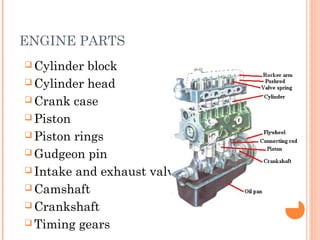
ENGINE PARTS
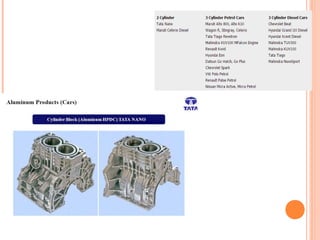
 Cylinder block
 Cylinder head
 Crank case
 Piston
 Piston rings
 Gudgeon pin
 Intake and exhaust valve
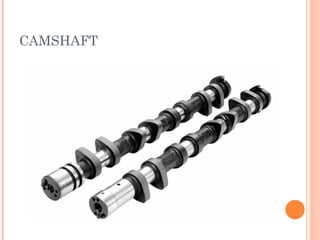
 Camshaft
 Crankshaft
 Timing gears
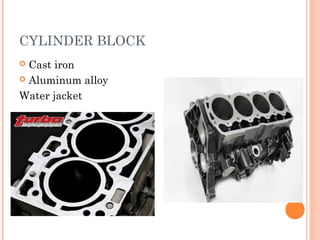
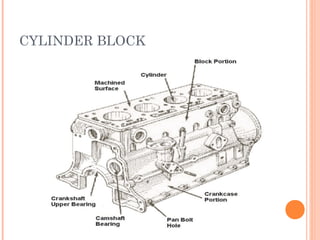
CYLINDER BLOCK
 Cast iron
 Aluminum alloy
Water jacket
CYLINDER BLOCK
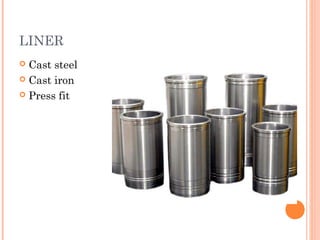
LINER
 Cast steel
 Cast iron
 Press fit
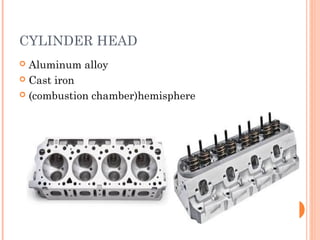
CYLINDER HEAD
 Aluminum alloy
 Cast iron
 (combustion chamber)hemisphere
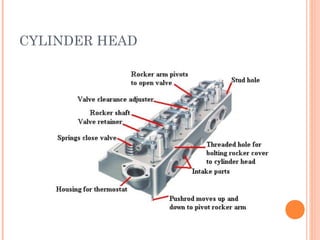
CYLINDER HEAD
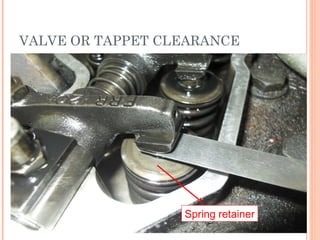
VALVE OR TAPPET CLEARANCE
Spring retainer
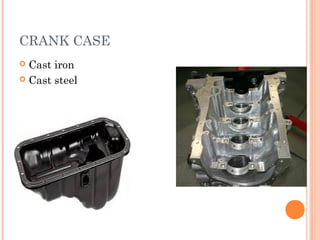
CRANK CASE
 Cast iron
 Cast steel
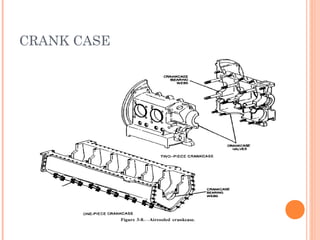
CRANK CASE
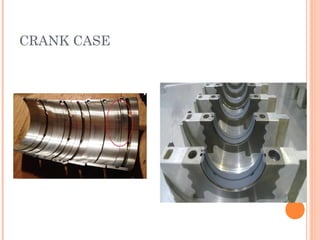
CRANK CASE
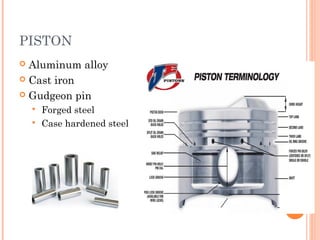
PISTON
 Aluminum alloy
 Cast iron
 Gudgeon pin
 Forged steel
 Case hardened steel
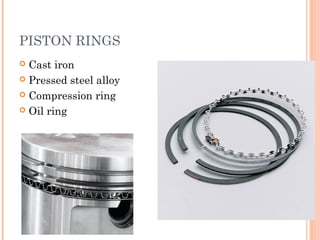
PISTON RINGS
 Cast iron
 Pressed steel alloy
 Compression ring
 Oil ring
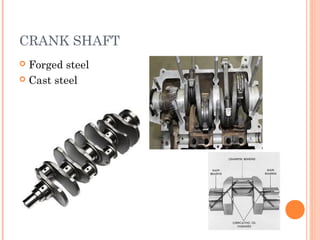
CRANK SHAFT
 Forged steel
 Cast steel
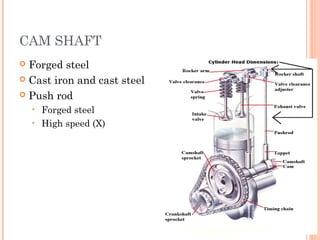
CAM SHAFT
 Forged steel
 Cast iron and cast steel
 Push rod
• Forged steel
• High speed (X)
CAMSHAFT
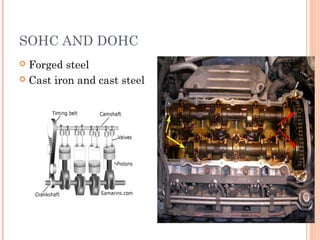
SOHC AND DOHC
 Forged steel
 Cast iron and cast steel
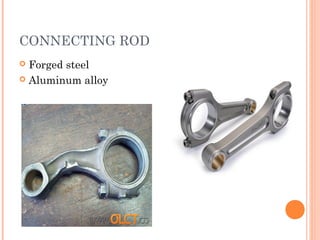
CONNECTING ROD
 Forged steel
 Aluminum alloy
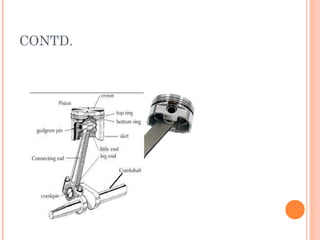
CONTD.
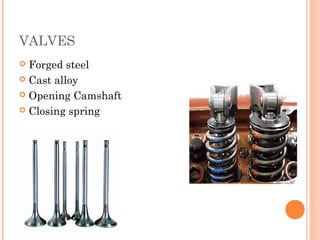
VALVES
 Forged steel
 Cast alloy
 Opening Camshaft
 Closing spring
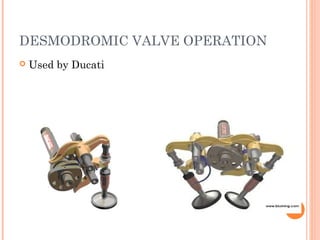
DESMODROMIC VALVE OPERATION
 Used by Ducati
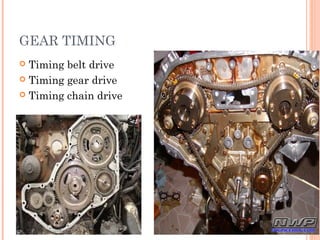
GEAR TIMING
 Timing belt drive
 Timing gear drive
 Timing chain drive
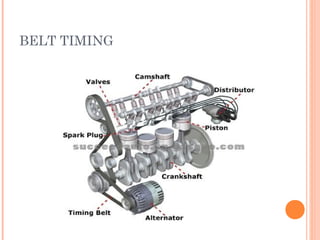
BELT TIMING
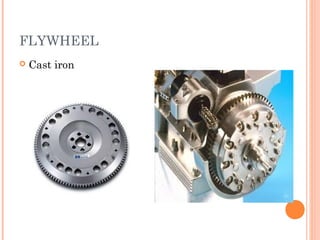
FLYWHEEL
 Cast iron
ENGINE CLASSIFICATION
 No of strokes per cycle(Two
or Four)
 Type of fuel burned
 Method of ignition
 Firing order
 Reciprocating or rotary
 No of cylinders
 Arrangement of cylinders
 Arrangement of valves and
valve trains
 Type of cooling
POSITION ARRANGEMENT &
NUMBER OF CYLINDERS
 Single Cylinder
 Inline Cylinders
 V Engine
 ‰Opposed Cylinder Engine
 ‰W Engine
 ‰Opposed Piston Engine
 ‰Radial Engine
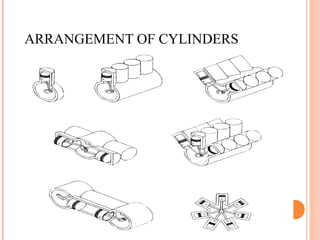
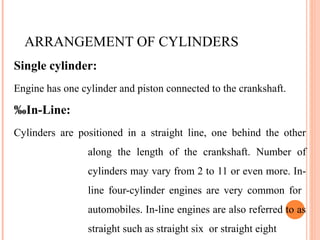
ARRANGEMENT OF CYLINDERS
Single cylinder:
Engine has one cylinder and piston connected to the crankshaft.
‰In-Line:
Cylinders are positioned in a straight line, one behind the other
along the length of the crankshaft. Number of
cylinders may vary from 2 to 11 or even more. In-
line four-cylinder engines are very common for
automobiles. In-line engines are also referred to as
straight such as straight six or straight eight
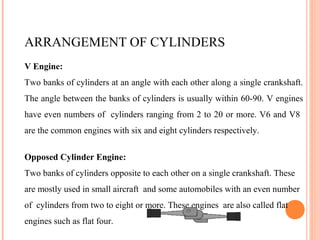
ARRANGEMENT OF CYLINDERS
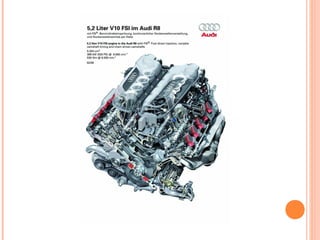
V Engine:
Two banks of cylinders at an angle with each other along a single crankshaft.
The angle between the banks of cylinders is usually within 60-90. V engines
have even numbers of cylinders ranging from 2 to 20 or more. V6 and V8
are the common engines with six and eight cylinders respectively.
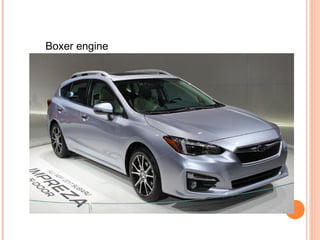
Opposed Cylinder Engine:
Two banks of cylinders opposite to each other on a single crankshaft. These
are mostly used in small aircraft and some automobiles with an even number
of cylinders from two to eight or more. These engines are also called flat
engines such as flat four.
Boxer engine
ARRANGEMENT OF CYLINDERS
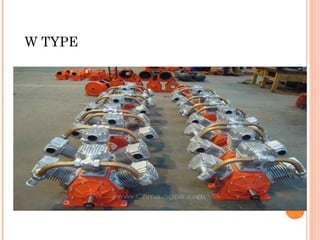
W Engine:
Similar to that of V engine except with three banks of cylinders on the
same crankshaft. This type of arrangement has been used in some
racing cars.
Opposed Piston Engine:
Two pistons in each cylinder with the combustion chamber located
centrally between the pistons. A single-combustion process causes
two power strokes at the same time, with each piston being pushed
away from the center and delivering power to a separate crankshaft
at each end of the cylinder Engine output is either on two rotating
crankshafts or on one crankshaft incorporating a complex
mechanic linkage.
ARRANGEMENT OF CYLINDERS
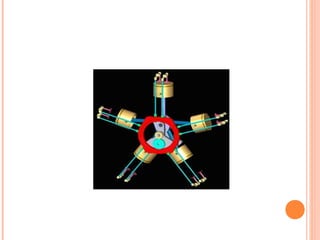
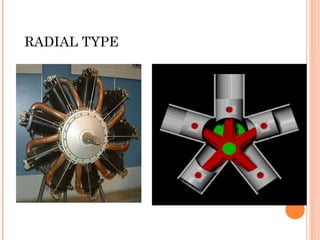
Radial Engine:
Engine with pistons positioned in a circular plane around the central
crankshaft. The connecting rods of the pistons are connected to
the crankshaft through a master rod. A bank of cylinders on a
radial engine always has an odd number of cylinders ranging from
3 to 13 or more Many medium-and large-size propeller-driven
aircraft use radial engines. For large aircraft, two or more banks
of cylinders are mounted together, one behind the other on a
single crankshaft, making a powerful and smooth engine.
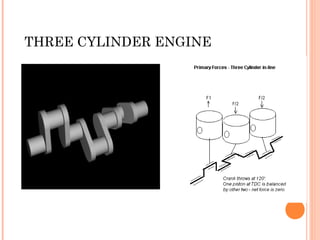
THREE CYLINDER ENGINE
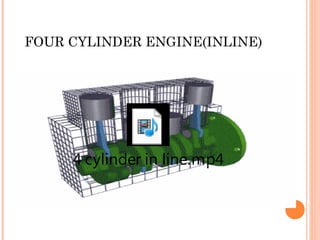
FOUR CYLINDER ENGINE(INLINE)
4 cylinder in line.mp4
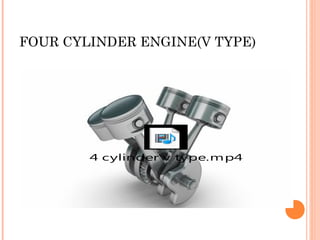
FOUR CYLINDER ENGINE(V TYPE)
4 cylinder v type.mp4
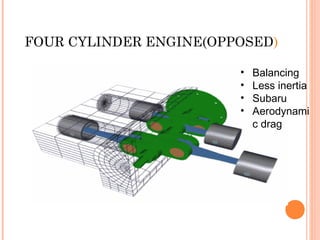
FOUR CYLINDER ENGINE(OPPOSED)
• Balancing
• Less inertia
• Subaru
• Aerodynami
c drag
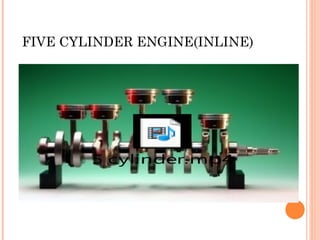
FIVE CYLINDER ENGINE(INLINE)
5 cylinder.mp4
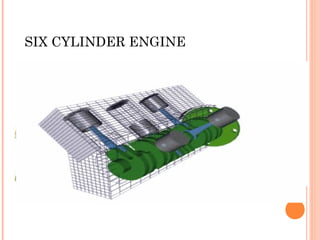
SIX CYLINDER ENGINE
8 CYLINDER ENGINE(V TYPE)
8 cylinder.mp4
W TYPE
RADIAL TYPE
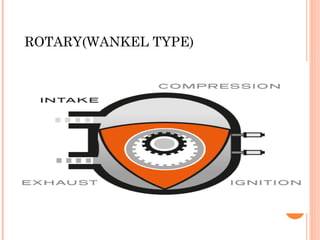
ROTARY(WANKEL TYPE)
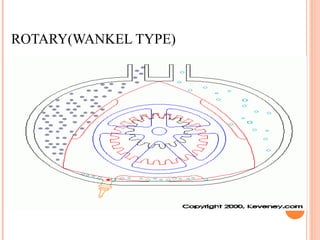
ROTARY(WANKEL TYPE)
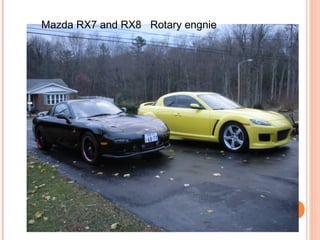
Mazda RX7 and RX8 Rotary engnie
VALVE LOCATIONS
 ‰
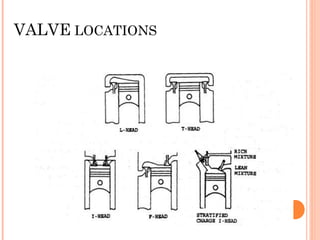
Valves in head (overhead valve), also called I-head engine
.
‰
Valves in block (flat head), also called L-head engine. Some historic
engines with valves in block had the intake valve on one side of the
cylinder, and the exhaust valve on the other side. These were called T-
head engines.
‰
One valve in head (usually intake) and one in
block, also called F-head engine
.
VALVE LOCATIONS
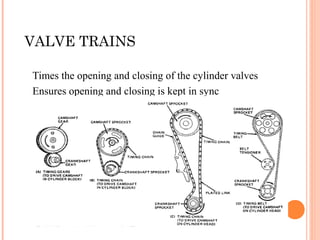
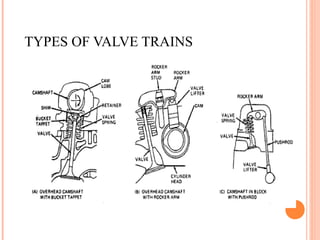
VALVE TRAINS
Times the opening and closing of the cylinder valves
Ensures opening and closing is kept in sync
TYPES OF VALVE TRAINS
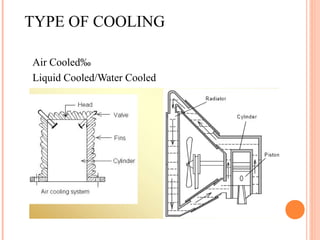
TYPE OF COOLING
Air Cooled‰
Liquid Cooled/Water Cooled
NO OF STROKES
‰
Four Stroke Cycle Experiences 4 strokes
of the Piston movements over 2 revolutions
of the crankshaft
‰
Two Stroke Cycle Experiences 2 strokes
of the Piston movements over 1 revolution
of the crankshaft
FUEL USED
Using volatile fuels like gasoline, alcohol, kerosene ‰
Using gaseous fuels like natural gas, biogas
‰
Using viscous fuels like diesel
‰
Using dual fuel
methanol (suction stroke) + diesel (comp. stroke) –CI
Engine
–gasoline + alcohol (gasohol)
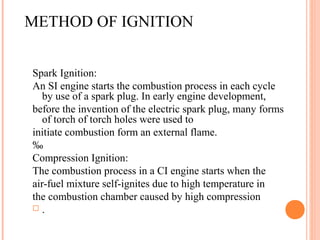
METHOD OF IGNITION
Spark Ignition:
An SI engine starts the combustion process in each cycle
by use of a spark plug. In early engine development,
before the invention of the electric spark plug, many forms
of torch of torch holes were used to
initiate combustion form an external flame.
‰
Compression Ignition:
The combustion process in a CI engine starts when the
air-fuel mixture self-ignites due to high temperature in
the combustion chamber caused by high compression
 .
FIRING ORDER
Firing order 1 3 4 2
4 cylinder in line.mp4

Engine classification,components and fuels

  • 1.
  • 2.
    ENGINE PARTS  Cylinderblock  Cylinder head  Crank case  Piston  Piston rings  Gudgeon pin  Intake and exhaust valve  Camshaft  Crankshaft  Timing gears
  • 3.
    CYLINDER BLOCK  Castiron  Aluminum alloy Water jacket
  • 4.
  • 5.
    LINER  Cast steel Cast iron  Press fit
  • 6.
    CYLINDER HEAD  Aluminumalloy  Cast iron  (combustion chamber)hemisphere
  • 7.
  • 8.
    VALVE OR TAPPETCLEARANCE Spring retainer
  • 9.
    CRANK CASE  Castiron  Cast steel
  • 10.
  • 11.
  • 12.
    PISTON  Aluminum alloy Cast iron  Gudgeon pin  Forged steel  Case hardened steel
  • 13.
    PISTON RINGS  Castiron  Pressed steel alloy  Compression ring  Oil ring
  • 14.
    CRANK SHAFT  Forgedsteel  Cast steel
  • 15.
    CAM SHAFT  Forgedsteel  Cast iron and cast steel  Push rod • Forged steel • High speed (X)
  • 16.
  • 17.
    SOHC AND DOHC Forged steel  Cast iron and cast steel
  • 18.
    CONNECTING ROD  Forgedsteel  Aluminum alloy
  • 19.
  • 20.
    VALVES  Forged steel Cast alloy  Opening Camshaft  Closing spring
  • 21.
  • 22.
    GEAR TIMING  Timingbelt drive  Timing gear drive  Timing chain drive
  • 23.
  • 24.
  • 25.
    ENGINE CLASSIFICATION  Noof strokes per cycle(Two or Four)  Type of fuel burned  Method of ignition  Firing order  Reciprocating or rotary  No of cylinders  Arrangement of cylinders  Arrangement of valves and valve trains  Type of cooling
  • 26.
    POSITION ARRANGEMENT & NUMBEROF CYLINDERS  Single Cylinder  Inline Cylinders  V Engine  ‰Opposed Cylinder Engine  ‰W Engine  ‰Opposed Piston Engine  ‰Radial Engine
  • 27.
  • 28.
    ARRANGEMENT OF CYLINDERS Singlecylinder: Engine has one cylinder and piston connected to the crankshaft. ‰In-Line: Cylinders are positioned in a straight line, one behind the other along the length of the crankshaft. Number of cylinders may vary from 2 to 11 or even more. In- line four-cylinder engines are very common for automobiles. In-line engines are also referred to as straight such as straight six or straight eight
  • 30.
    ARRANGEMENT OF CYLINDERS VEngine: Two banks of cylinders at an angle with each other along a single crankshaft. The angle between the banks of cylinders is usually within 60-90. V engines have even numbers of cylinders ranging from 2 to 20 or more. V6 and V8 are the common engines with six and eight cylinders respectively. Opposed Cylinder Engine: Two banks of cylinders opposite to each other on a single crankshaft. These are mostly used in small aircraft and some automobiles with an even number of cylinders from two to eight or more. These engines are also called flat engines such as flat four.
  • 32.
  • 33.
    ARRANGEMENT OF CYLINDERS WEngine: Similar to that of V engine except with three banks of cylinders on the same crankshaft. This type of arrangement has been used in some racing cars. Opposed Piston Engine: Two pistons in each cylinder with the combustion chamber located centrally between the pistons. A single-combustion process causes two power strokes at the same time, with each piston being pushed away from the center and delivering power to a separate crankshaft at each end of the cylinder Engine output is either on two rotating crankshafts or on one crankshaft incorporating a complex mechanic linkage.
  • 34.
    ARRANGEMENT OF CYLINDERS RadialEngine: Engine with pistons positioned in a circular plane around the central crankshaft. The connecting rods of the pistons are connected to the crankshaft through a master rod. A bank of cylinders on a radial engine always has an odd number of cylinders ranging from 3 to 13 or more Many medium-and large-size propeller-driven aircraft use radial engines. For large aircraft, two or more banks of cylinders are mounted together, one behind the other on a single crankshaft, making a powerful and smooth engine.
  • 36.
  • 37.
    FOUR CYLINDER ENGINE(INLINE) 4cylinder in line.mp4
  • 38.
    FOUR CYLINDER ENGINE(VTYPE) 4 cylinder v type.mp4
  • 39.
    FOUR CYLINDER ENGINE(OPPOSED) •Balancing • Less inertia • Subaru • Aerodynami c drag
  • 40.
  • 41.
  • 42.
    8 CYLINDER ENGINE(VTYPE) 8 cylinder.mp4
  • 43.
  • 44.
  • 45.
  • 46.
  • 47.
    Mazda RX7 andRX8 Rotary engnie
  • 48.
    VALVE LOCATIONS  ‰ Valvesin head (overhead valve), also called I-head engine . ‰ Valves in block (flat head), also called L-head engine. Some historic engines with valves in block had the intake valve on one side of the cylinder, and the exhaust valve on the other side. These were called T- head engines. ‰ One valve in head (usually intake) and one in block, also called F-head engine .
  • 49.
  • 51.
    VALVE TRAINS Times theopening and closing of the cylinder valves Ensures opening and closing is kept in sync
  • 52.
  • 53.
    TYPE OF COOLING AirCooled‰ Liquid Cooled/Water Cooled
  • 54.
    NO OF STROKES ‰ FourStroke Cycle Experiences 4 strokes of the Piston movements over 2 revolutions of the crankshaft ‰ Two Stroke Cycle Experiences 2 strokes of the Piston movements over 1 revolution of the crankshaft
  • 55.
    FUEL USED Using volatilefuels like gasoline, alcohol, kerosene ‰ Using gaseous fuels like natural gas, biogas ‰ Using viscous fuels like diesel ‰ Using dual fuel methanol (suction stroke) + diesel (comp. stroke) –CI Engine –gasoline + alcohol (gasohol)
  • 56.
    METHOD OF IGNITION SparkIgnition: An SI engine starts the combustion process in each cycle by use of a spark plug. In early engine development, before the invention of the electric spark plug, many forms of torch of torch holes were used to initiate combustion form an external flame. ‰ Compression Ignition: The combustion process in a CI engine starts when the air-fuel mixture self-ignites due to high temperature in the combustion chamber caused by high compression  .
  • 57.
    FIRING ORDER Firing order1 3 4 2 4 cylinder in line.mp4