SRIJAN SINGH TUDU, EEE-C1, B310055
CONTENTS
 Introduction.
 What an Embedded System Is.
 Creating an Embedded Application.
 Applications of Embedded System.
 Intelligent Traffic Light Control Using
Embedded Systems.
 Conclusion.
INTRODUCTION
 A House that recognizes your
fingerprint, and opens doors.
 A Fridge that checks food
supplies and orders to replenish
them.
 Could you ever imagine a person
traveling in a driver-less car?
Impossible?
“RTOS and Embedded System”
makes this possible.
WHAT AN EMBEDDED SYSTEM
IS
Generally “Devices used to
control, monitor or assist
the operation of
equipment, machinery or
plant.”
 Any device that includes a
programmable computer
but is not itself a general-
purpose computer is an
embedded system.
EMBEDDED SYSTEM DIFFER
COMPUTERS
 A computer is a general-
purpose device capable of
performing several types of
tasks like word processing,
internet-access, gaming etc.
 A computer uses a general
purpose Microprocessor like
Pentium, Athlon.
 A general purpose computer
produces result, but they are
not strictly bound by time-
constraints.
 On the other hand an
Embedded System usually
performs one or few specific
tasks.
 Whereas Embedded System
uses a Microprocessor/Micro-
controller like 8951, Z80, 8051.
 Embedded systems are also
known as real time systems
since they respond to an event
and produce the result with in a
guaranteed time period.
REALTIME SYSTEMS
 Real-time and embedded systems technology
is a key enabling technology for the future
in an ever-growing domain of important
applications.
 A real time system is a system, which
requires a “timely” response from the
computer system to prevent failures.
CREATING EMBEDDED
APPLICATIONS
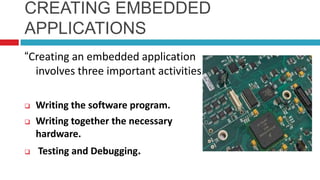
“Creating an embedded application
involves three important activities.”
 Writing the software program.
 Writing together the necessary
hardware.
 Testing and Debugging.
WRITING SOFTWARE
 The software for an embedded system can be
written in Assembly Language, C, C++ or Java
(usually called “FIRMWARE”)
 We are using different processors for each new
application, then Assembly Language is the
most suited.
 However if we are using the same processor and
similar hardware configuration for each new
application, it is advisable to create in C.
WRITING HARDWARE
 A System designer has to study the data sheet of
a Microprocessor/Micro controller for pin
configurations, operating voltage, input/output
current capabilities, temperature resistance etc
and connect it to the system to be controlled.
TESTING AND DEBUGGING
 This is what makes an embedded system crash
proof.
 Debugging involves defining a suitable, predefine
response to all possible operation scenarios that
may be faced by the embedded system.
APPLICATIONS
 Building Systems.
 Manufacturing and
Process Control.
 Medical Diagnostics.
 Transport Systems.
 Communication
Systems.
 Banking, Finance and
Commerce.
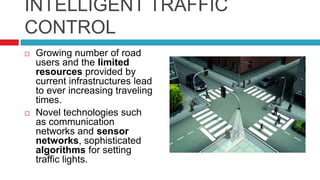
INTELLIGENT TRAFFIC
CONTROL
 Growing number of road
users and the limited
resources provided by
current infrastructures lead
to ever increasing traveling
times.
 Novel technologies such
as communication
networks and sensor
networks, sophisticated
algorithms for setting
traffic lights.
 we are coping with a complex multi-agent
system, where communication and
coordination play essential roles.
 The research has led to a novel system in
which traffic light controllers and the behavior
of car drivers are optimized using machine-
learning methods.
CONCEPT
 Suppose there are a number of cars with their
destination address standing before a crossing.
 All vehicles communicate to the traffic light with
their specific place in the queue and their
destination address.
 To minimize the long-term average waiting time
until all vehicles have arrived at their destination
address.
 The learning traffic light controllers solve this
problem by estimating how long it would take for
a car to arrive at its destination address (for which
the vehicle may need to pass many different traffic
lights) when currently the light would be put on
green, and how long it would take if the light
would be put on red.
 To estimate the waiting times, we use
'reinforcement learning’.
 One nice feature is that the system is very fair;
it never lets one car wait for a very long time,
since then its gain of setting its own light to
green becomes very large, and the optimal
decision of the traffic light will set his light to
green.
 We solve the traffic light control problem by
using a distributed multi-agent system, where
cooperation and coordination are done by
communication, learning, and voting
mechanisms.
RESULT
 The results indicate that the learning
controllers can reduce average waiting times
with at least 70% in semi-busy traffic
situations, and even much more when high
congestion of the traffic occurs.
CONCLUSION
 The “Intelligent Traffic Light Control Using Embedded
System” is more reliable, highly accurate and offers
higher performance over the traffic light controllers that
were used earlier.
 The easy availability of good design tools and
software engineers has been two key factors in fuelling
the growth of embedded systems.
 The Intelligent traffic control is just a small part, looking
at the bigger picture it has large-scale application in
ITS(Intelligent Transportation System).
“This not only help’s solve the notion
of Traffic Gridlock, but also the
Environmental Issues.”
Thank You
Any Queries!

Intelligent Traffic Light control using Embedded Systems

  • 1.
    SRIJAN SINGH TUDU,EEE-C1, B310055
  • 2.
    CONTENTS  Introduction.  Whatan Embedded System Is.  Creating an Embedded Application.  Applications of Embedded System.  Intelligent Traffic Light Control Using Embedded Systems.  Conclusion.
  • 3.
    INTRODUCTION  A Housethat recognizes your fingerprint, and opens doors.  A Fridge that checks food supplies and orders to replenish them.  Could you ever imagine a person traveling in a driver-less car? Impossible? “RTOS and Embedded System” makes this possible.
  • 4.
    WHAT AN EMBEDDEDSYSTEM IS Generally “Devices used to control, monitor or assist the operation of equipment, machinery or plant.”  Any device that includes a programmable computer but is not itself a general- purpose computer is an embedded system.
  • 5.
    EMBEDDED SYSTEM DIFFER COMPUTERS A computer is a general- purpose device capable of performing several types of tasks like word processing, internet-access, gaming etc.  A computer uses a general purpose Microprocessor like Pentium, Athlon.  A general purpose computer produces result, but they are not strictly bound by time- constraints.  On the other hand an Embedded System usually performs one or few specific tasks.  Whereas Embedded System uses a Microprocessor/Micro- controller like 8951, Z80, 8051.  Embedded systems are also known as real time systems since they respond to an event and produce the result with in a guaranteed time period.
  • 6.
    REALTIME SYSTEMS  Real-timeand embedded systems technology is a key enabling technology for the future in an ever-growing domain of important applications.  A real time system is a system, which requires a “timely” response from the computer system to prevent failures.
  • 7.
    CREATING EMBEDDED APPLICATIONS “Creating anembedded application involves three important activities.”  Writing the software program.  Writing together the necessary hardware.  Testing and Debugging.
  • 8.
    WRITING SOFTWARE  Thesoftware for an embedded system can be written in Assembly Language, C, C++ or Java (usually called “FIRMWARE”)  We are using different processors for each new application, then Assembly Language is the most suited.  However if we are using the same processor and similar hardware configuration for each new application, it is advisable to create in C.
  • 9.
    WRITING HARDWARE  ASystem designer has to study the data sheet of a Microprocessor/Micro controller for pin configurations, operating voltage, input/output current capabilities, temperature resistance etc and connect it to the system to be controlled.
  • 10.
    TESTING AND DEBUGGING This is what makes an embedded system crash proof.  Debugging involves defining a suitable, predefine response to all possible operation scenarios that may be faced by the embedded system.
  • 11.
    APPLICATIONS  Building Systems. Manufacturing and Process Control.  Medical Diagnostics.  Transport Systems.  Communication Systems.  Banking, Finance and Commerce.
  • 12.
    INTELLIGENT TRAFFIC CONTROL  Growingnumber of road users and the limited resources provided by current infrastructures lead to ever increasing traveling times.  Novel technologies such as communication networks and sensor networks, sophisticated algorithms for setting traffic lights.
  • 13.
     we arecoping with a complex multi-agent system, where communication and coordination play essential roles.  The research has led to a novel system in which traffic light controllers and the behavior of car drivers are optimized using machine- learning methods.
  • 14.
    CONCEPT  Suppose thereare a number of cars with their destination address standing before a crossing.  All vehicles communicate to the traffic light with their specific place in the queue and their destination address.  To minimize the long-term average waiting time until all vehicles have arrived at their destination address.
  • 15.
     The learningtraffic light controllers solve this problem by estimating how long it would take for a car to arrive at its destination address (for which the vehicle may need to pass many different traffic lights) when currently the light would be put on green, and how long it would take if the light would be put on red.  To estimate the waiting times, we use 'reinforcement learning’.
  • 16.
     One nicefeature is that the system is very fair; it never lets one car wait for a very long time, since then its gain of setting its own light to green becomes very large, and the optimal decision of the traffic light will set his light to green.
  • 18.
     We solvethe traffic light control problem by using a distributed multi-agent system, where cooperation and coordination are done by communication, learning, and voting mechanisms.
  • 19.
    RESULT  The resultsindicate that the learning controllers can reduce average waiting times with at least 70% in semi-busy traffic situations, and even much more when high congestion of the traffic occurs.
  • 20.
    CONCLUSION  The “IntelligentTraffic Light Control Using Embedded System” is more reliable, highly accurate and offers higher performance over the traffic light controllers that were used earlier.  The easy availability of good design tools and software engineers has been two key factors in fuelling the growth of embedded systems.  The Intelligent traffic control is just a small part, looking at the bigger picture it has large-scale application in ITS(Intelligent Transportation System).
  • 21.
    “This not onlyhelp’s solve the notion of Traffic Gridlock, but also the Environmental Issues.”
  • 22.