FABRIKAM
RECENT TRENDS OF EMBEDDED SYSTEM
Presented by: Kaushik Gupta
Lavesh Lalwani
Dept: Electronics and Telecommunication
Thakur Polytechnic, Mumbai
With advancements and
growth in the field of
technology, devices
around us communicate
in more ways than we
ever imagined.
2
Embedded Systems have
become an essential
part of our day to day
life.
3
What is Embedded System?
o An embedded system is a combination of computer
hardware and software.
o It can range from having no User Interface (UI)
o Or have a complex Graphical User Interface (GUI)
o Embedded system hardware can be microprocessor- or
microcontroller-based.
o The embedded system is expected to continue rapidly
growing.
o IoT being the major subset of it, we also discuss it with an
idea of project.
4
o The future of embedded systems lies in the advancement
of technologies that enable faster communications, heavy
data storage capacities and highly interwoven connections
among the devices.
o Following are some of the trends we discuss about:
o Multi-core Processors
o Wireless Technology
o Open Source Technology
o Device Convergence
o Internationalization
o Smart Devices
o Security
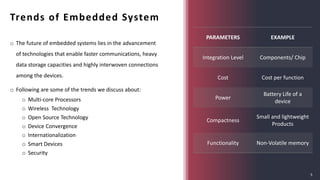
PARAMETERS EXAMPLE
Integration Level Components/ Chip
Cost Cost per function
Power
Battery Life of a
device
Compactness
Small and lightweight
Products
Functionality Non-Volatile memory
5
Trends of Embedded System
Multi-core Processors
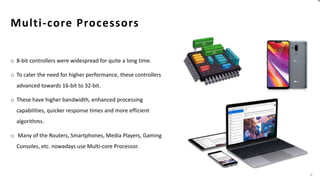
o 8-bit controllers were widespread for quite a long time.
o To cater the need for higher performance, these controllers
advanced towards 16-bit to 32-bit.
o These have higher bandwidth, enhanced processing
capabilities, quicker response times and more efficient
algorithms.
o Many of the Routers, Smartphones, Media Players, Gaming
Consoles, etc. nowadays use Multi-core Processor.
6
Open Source Technology
o Embedded systems have traditionally employed proprietary
hardware, software, communication protocols.
o Embedded devices were mostly operating as stand-alone
systems for a long time. A royalty had to be paid to the
vendors for using a particular software .
o However, this scenario is changing.
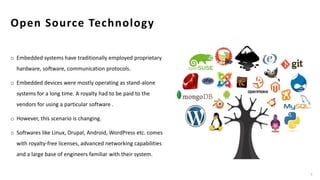
o Softwares like Linux, Drupal, Android, WordPress etc. comes
with royalty-free licenses, advanced networking capabilities
and a large base of engineers familiar with their system.
7
Security
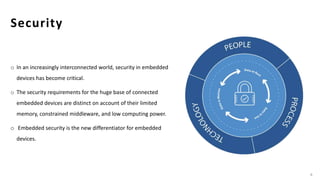
o In an increasingly interconnected world, security in embedded
devices has become critical.
o The security requirements for the huge base of connected
embedded devices are distinct on account of their limited
memory, constrained middleware, and low computing power.
o Embedded security is the new differentiator for embedded
devices.
8
Smart Devices
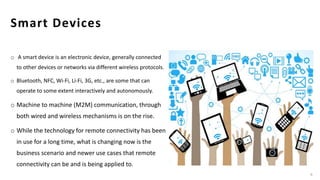
o A smart device is an electronic device, generally connected
to other devices or networks via different wireless protocols.
o Bluetooth, NFC, Wi-Fi, Li-Fi, 3G, etc., are some that can
operate to some extent interactively and autonomously.
o Machine to machine (M2M) communication, through
both wired and wireless mechanisms is on the rise.
o While the technology for remote connectivity has been
in use for a long time, what is changing now is the
business scenario and newer use cases that remote
connectivity can be and is being applied to.
9
Device Convergence
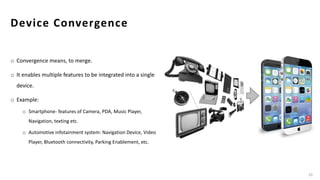
o Convergence means, to merge.
o It enables multiple features to be integrated into a single
device.
o Example:
o Smartphone- features of Camera, PDA, Music Player,
Navigation, texting etc.
o Automotive infotainment system: Navigation Device, Video
Player, Bluetooth connectivity, Parking Enablement, etc.
10
Wireless Technology
o Embedded devices were mostly operating as stand-alone
systems for a long time.
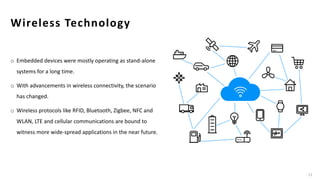
o With advancements in wireless connectivity, the scenario
has changed.
o Wireless protocols like RFID, Bluetooth, Zigbee, NFC and
WLAN, LTE and cellular communications are bound to
witness more wide-spread applications in the near future.
11
Water
Management
and Supervision
System
12
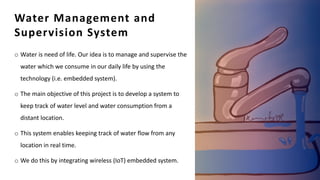
Water Management and
Supervision System
o Water is need of life. Our idea is to manage and supervise the
water which we consume in our daily life by using the
technology (i.e. embedded system).
o The main objective of this project is to develop a system to
keep track of water level and water consumption from a
distant location.
o This system enables keeping track of water flow from any
location in real time.
o We do this by integrating wireless (IoT) embedded system.
13
Working of System
o The main aim of our system is to detect the water level in the tank
in real time with the help of ultrasonic sensor.
o The ultrasonic sensor will be displayed on the smart phone app,
the Wi-Fi module and cloud server will help to transmit the data
of level.
o According to the level of water in the tank the motor functioning
will be automatically controlled (ON at low level of water; OFF at
high level). It can also be controlled by the app.
o The flow sensor will be used to sense or calculate the water
consumption.
14
FABRIKAMFABRIKAM
Layout of system
15
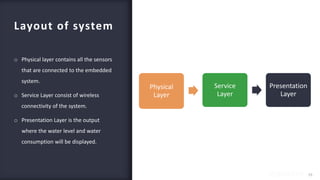
o Physical layer contains all the sensors
that are connected to the embedded
system.
o Service Layer consist of wireless
connectivity of the system.
o Presentation Layer is the output
where the water level and water
consumption will be displayed.
Physical
Layer
Service
Layer
Presentation
Layer
16
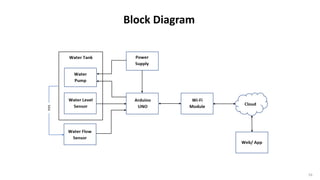
Block Diagram
FABRIKAMFABRIKAM
Hardware
Requirements
17
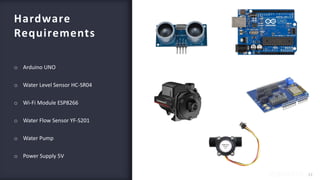
o Arduino UNO
o Water Level Sensor HC-SR04
o Wi-Fi Module ESP8266
o Water Flow Sensor YF-S201
o Water Pump
o Power Supply 5V
FABRIKAMFABRIKAM
Software
Requirements
18
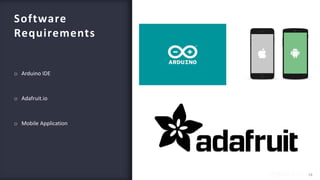
o Arduino IDE
o Adafruit.io
o Mobile Application
ADVANTAGES AND LIMITATION
|
|
|
|
|
|
|
|
|
|
|
|
|
|
|
|
|
|
|
|
|
|
|
|
|
|
o Can be controlled from anywhere in the world.
o Beneficial for both Rural and Urban Areas.
o Helpful in saving water. (using Water flow Sensor)
o Easier to compute water consumption.
o Helpful to cease water overflow.
o Saves electricity in long run.
o Easy to install and operate.
o Cannot be operated without an internet connection.
o Periodic maintenance of the connected sensors.
o Only 1 user can operate the system (via app) at a
time.
o Limited UX Design.
19
FABRIKAM
THANK YOU!
Dhanyawaad!

Future Trends of Embedded Systems - Technical Paper Presentation

  • 1.
    FABRIKAM RECENT TRENDS OFEMBEDDED SYSTEM Presented by: Kaushik Gupta Lavesh Lalwani Dept: Electronics and Telecommunication Thakur Polytechnic, Mumbai
  • 2.
    With advancements and growthin the field of technology, devices around us communicate in more ways than we ever imagined. 2
  • 3.
    Embedded Systems have becomean essential part of our day to day life. 3
  • 4.
    What is EmbeddedSystem? o An embedded system is a combination of computer hardware and software. o It can range from having no User Interface (UI) o Or have a complex Graphical User Interface (GUI) o Embedded system hardware can be microprocessor- or microcontroller-based. o The embedded system is expected to continue rapidly growing. o IoT being the major subset of it, we also discuss it with an idea of project. 4
  • 5.
    o The futureof embedded systems lies in the advancement of technologies that enable faster communications, heavy data storage capacities and highly interwoven connections among the devices. o Following are some of the trends we discuss about: o Multi-core Processors o Wireless Technology o Open Source Technology o Device Convergence o Internationalization o Smart Devices o Security PARAMETERS EXAMPLE Integration Level Components/ Chip Cost Cost per function Power Battery Life of a device Compactness Small and lightweight Products Functionality Non-Volatile memory 5 Trends of Embedded System
  • 6.
    Multi-core Processors o 8-bitcontrollers were widespread for quite a long time. o To cater the need for higher performance, these controllers advanced towards 16-bit to 32-bit. o These have higher bandwidth, enhanced processing capabilities, quicker response times and more efficient algorithms. o Many of the Routers, Smartphones, Media Players, Gaming Consoles, etc. nowadays use Multi-core Processor. 6
  • 7.
    Open Source Technology oEmbedded systems have traditionally employed proprietary hardware, software, communication protocols. o Embedded devices were mostly operating as stand-alone systems for a long time. A royalty had to be paid to the vendors for using a particular software . o However, this scenario is changing. o Softwares like Linux, Drupal, Android, WordPress etc. comes with royalty-free licenses, advanced networking capabilities and a large base of engineers familiar with their system. 7
  • 8.
    Security o In anincreasingly interconnected world, security in embedded devices has become critical. o The security requirements for the huge base of connected embedded devices are distinct on account of their limited memory, constrained middleware, and low computing power. o Embedded security is the new differentiator for embedded devices. 8
  • 9.
    Smart Devices o Asmart device is an electronic device, generally connected to other devices or networks via different wireless protocols. o Bluetooth, NFC, Wi-Fi, Li-Fi, 3G, etc., are some that can operate to some extent interactively and autonomously. o Machine to machine (M2M) communication, through both wired and wireless mechanisms is on the rise. o While the technology for remote connectivity has been in use for a long time, what is changing now is the business scenario and newer use cases that remote connectivity can be and is being applied to. 9
  • 10.
    Device Convergence o Convergencemeans, to merge. o It enables multiple features to be integrated into a single device. o Example: o Smartphone- features of Camera, PDA, Music Player, Navigation, texting etc. o Automotive infotainment system: Navigation Device, Video Player, Bluetooth connectivity, Parking Enablement, etc. 10
  • 11.
    Wireless Technology o Embeddeddevices were mostly operating as stand-alone systems for a long time. o With advancements in wireless connectivity, the scenario has changed. o Wireless protocols like RFID, Bluetooth, Zigbee, NFC and WLAN, LTE and cellular communications are bound to witness more wide-spread applications in the near future. 11
  • 12.
  • 13.
    Water Management and SupervisionSystem o Water is need of life. Our idea is to manage and supervise the water which we consume in our daily life by using the technology (i.e. embedded system). o The main objective of this project is to develop a system to keep track of water level and water consumption from a distant location. o This system enables keeping track of water flow from any location in real time. o We do this by integrating wireless (IoT) embedded system. 13
  • 14.
    Working of System oThe main aim of our system is to detect the water level in the tank in real time with the help of ultrasonic sensor. o The ultrasonic sensor will be displayed on the smart phone app, the Wi-Fi module and cloud server will help to transmit the data of level. o According to the level of water in the tank the motor functioning will be automatically controlled (ON at low level of water; OFF at high level). It can also be controlled by the app. o The flow sensor will be used to sense or calculate the water consumption. 14
  • 15.
    FABRIKAMFABRIKAM Layout of system 15 oPhysical layer contains all the sensors that are connected to the embedded system. o Service Layer consist of wireless connectivity of the system. o Presentation Layer is the output where the water level and water consumption will be displayed. Physical Layer Service Layer Presentation Layer
  • 16.
  • 17.
    FABRIKAMFABRIKAM Hardware Requirements 17 o Arduino UNO oWater Level Sensor HC-SR04 o Wi-Fi Module ESP8266 o Water Flow Sensor YF-S201 o Water Pump o Power Supply 5V
  • 18.
  • 19.
    ADVANTAGES AND LIMITATION | | | | | | | | | | | | | | | | | | | | | | | | | | oCan be controlled from anywhere in the world. o Beneficial for both Rural and Urban Areas. o Helpful in saving water. (using Water flow Sensor) o Easier to compute water consumption. o Helpful to cease water overflow. o Saves electricity in long run. o Easy to install and operate. o Cannot be operated without an internet connection. o Periodic maintenance of the connected sensors. o Only 1 user can operate the system (via app) at a time. o Limited UX Design. 19
  • 20.