TRAFFIC CONTROL
USING IMAGE PROCESSING
SUBMITTED BY
KAMRAN
SHAHID BAIG
AMBER DEEP
SINGH
CONTENTS
1.Introduction
2.TRAFFIC CONTROL USING IMAGE PROCESSING
3.Block Diagram
4.MATLAB
5.Results
6.Conlusion
7.Future Scope
8.References
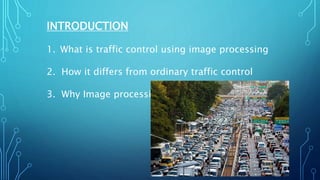
INTRODUCTION
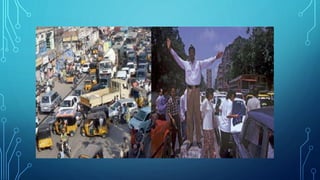
1. What is traffic control using image processing
2. How it differs from ordinary traffic control
3. Why Image processing
TRAFFIC CONTROL USING IMAGE PROCESSING
Image Processing: Processing images using digital
computers
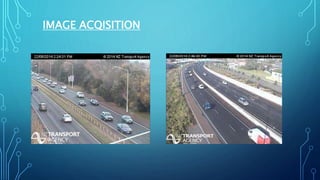
1.Image Acquisition: Camera etc
2.Image Pre-processing
Image Rescaling
RGB to Gray conversion
3.Edge Detection
Canny
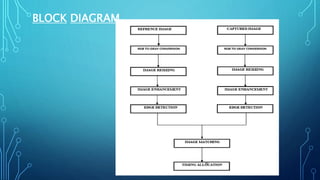
BLOCK DIAGRAM
IMAGE ACQISITION
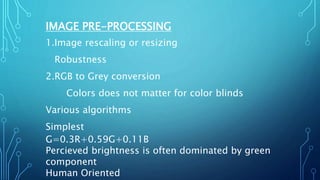
IMAGE PRE-PROCESSING
1.Image rescaling or resizing
Robustness
2.RGB to Grey conversion
Colors does not matter for color blinds
Various algorithms
Simplest
G=0.3R+0.59G+0.11B
Percieved brightness is often dominated by green
component
Human Oriented
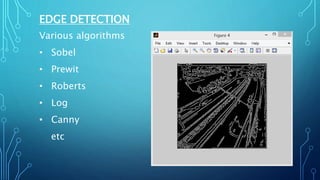
EDGE DETECTION
Various algorithms
• Sobel
• Prewit
• Roberts
• Log
• Canny
etc
CANNY
Steps
1. Smooth the input with Gaussian filter.
2. Compute the gradient magnitude and angle
images.
3. Apply nonmaxima suppression to the gradient
magnitude image.
4. Use double thresholding and connectivity analysis
to detect and link images.
MATCHING
Matching is the most important step in various image
processing applications.
Pattern Vector
Matric defining pattern vectors
One example: Minimum distance
Euclidean distance
MATLAB
1. Matrix Laboratories
2. It integrates computation, visualization, and
programming environment.
3. Exciting features
1. Simulink.
2. GUI
>> We have used GUIDE to make GUI.
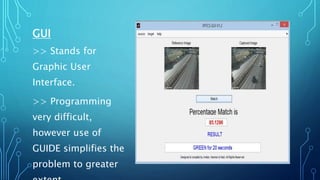
GUI
>> Stands for
Graphic User
Interface.
>> Programming
very difficult,
however use of
GUIDE simplifies the
problem to greater
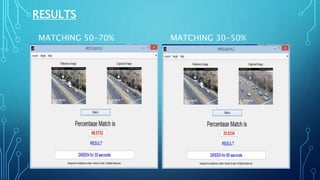
RESULTS
MATCHING 50-70% MATCHING 30-50%
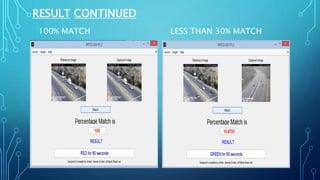
RESULT CONTINUED
100% MATCH LESS THAN 30% MATCH
CONCLUSION
Drawback of earlier methods
>> Wastage of time by lighting green signal even when
road is empty.
Image processing removes such problem.
Slight difficult to implement in real time because the
accuracy of time calculation depends on relative
position of camera.
FUTURE WORK
The focus shall be to implement the controller using
DSP as it can avoid heavy investment in industrial
control computer while obtaining improved
computational power and optimized system structure.
The hardware implementation would enable the
project to be used in real-time practical conditions. In
addition, we propose a system to identify the vehicles
as they pass by, giving preference to emergency
vehicles and assisting in surveillance on a large scale.
REFERENCES
1. Digital image processing by Rafael C. Gonzalez
and Richard E. Woods.
2. M. Siyal, and J. Ahmed, “A novel morphological
edge detection and window based approach for
real-time road data control and management,”
Fifth IEEE Int. Conf. on Information,
Communications and Signal Processing,
Bangkok, July 2005, pp. 324-328.
3. Y. Wu, F. Lian, and T. Chang, “Traffic
monitoring and vehicle tracking using roadside
camera,” IEEE Int. Conf. on Robotics and
Automation, Taipei, Oct 2006, pp. 4631– 4636
THANK YOU

Final Project presentation on Image processing based intelligent traffic control system+matlab gui

  • 1.
    TRAFFIC CONTROL USING IMAGEPROCESSING SUBMITTED BY KAMRAN SHAHID BAIG AMBER DEEP SINGH
  • 2.
    CONTENTS 1.Introduction 2.TRAFFIC CONTROL USINGIMAGE PROCESSING 3.Block Diagram 4.MATLAB 5.Results 6.Conlusion 7.Future Scope 8.References
  • 3.
    INTRODUCTION 1. What istraffic control using image processing 2. How it differs from ordinary traffic control 3. Why Image processing
  • 6.
    TRAFFIC CONTROL USINGIMAGE PROCESSING Image Processing: Processing images using digital computers 1.Image Acquisition: Camera etc 2.Image Pre-processing Image Rescaling RGB to Gray conversion 3.Edge Detection Canny
  • 7.
  • 8.
  • 9.
    IMAGE PRE-PROCESSING 1.Image rescalingor resizing Robustness 2.RGB to Grey conversion Colors does not matter for color blinds Various algorithms Simplest G=0.3R+0.59G+0.11B Percieved brightness is often dominated by green component Human Oriented
  • 10.
    EDGE DETECTION Various algorithms •Sobel • Prewit • Roberts • Log • Canny etc
  • 11.
    CANNY Steps 1. Smooth theinput with Gaussian filter. 2. Compute the gradient magnitude and angle images. 3. Apply nonmaxima suppression to the gradient magnitude image. 4. Use double thresholding and connectivity analysis to detect and link images.
  • 12.
    MATCHING Matching is themost important step in various image processing applications. Pattern Vector Matric defining pattern vectors One example: Minimum distance Euclidean distance
  • 13.
    MATLAB 1. Matrix Laboratories 2.It integrates computation, visualization, and programming environment. 3. Exciting features 1. Simulink. 2. GUI >> We have used GUIDE to make GUI.
  • 14.
    GUI >> Stands for GraphicUser Interface. >> Programming very difficult, however use of GUIDE simplifies the problem to greater
  • 15.
  • 16.
    RESULT CONTINUED 100% MATCHLESS THAN 30% MATCH
  • 17.
    CONCLUSION Drawback of earliermethods >> Wastage of time by lighting green signal even when road is empty. Image processing removes such problem. Slight difficult to implement in real time because the accuracy of time calculation depends on relative position of camera.
  • 18.
    FUTURE WORK The focusshall be to implement the controller using DSP as it can avoid heavy investment in industrial control computer while obtaining improved computational power and optimized system structure. The hardware implementation would enable the project to be used in real-time practical conditions. In addition, we propose a system to identify the vehicles as they pass by, giving preference to emergency vehicles and assisting in surveillance on a large scale.
  • 19.
    REFERENCES 1. Digital imageprocessing by Rafael C. Gonzalez and Richard E. Woods. 2. M. Siyal, and J. Ahmed, “A novel morphological edge detection and window based approach for real-time road data control and management,” Fifth IEEE Int. Conf. on Information, Communications and Signal Processing, Bangkok, July 2005, pp. 324-328. 3. Y. Wu, F. Lian, and T. Chang, “Traffic monitoring and vehicle tracking using roadside camera,” IEEE Int. Conf. on Robotics and Automation, Taipei, Oct 2006, pp. 4631– 4636
  • 20.