TRAFFIC LIGHT PRIORITY
CONTROL FOR EMERGENCY
VEHICLES
P. RAGHUVEER REDDY
(09831A0489)
P. SAI PRANAY RAJ
(09831A0491)
Project Guide :
Ms. SANDHYA PATEL
CONTENTS:
 INTRODUCTION
 BLOCK DIAGRAM
 TRANSMITTER SECTION
 POWER SUPPLY
 RECIEVER SECTION
INTRODUCTION:
 Traffic control has become a major problem on the roads of many
cities in India.
 Some emergency vehicles like Ambulances, Fire Brigades
and some important Security conveys get stuck in the traffic and
have to wait which is not desirable.
 The main aim of the project is to provide a wireless control
system to these emergency vehicles which controls the traffic
light signals.
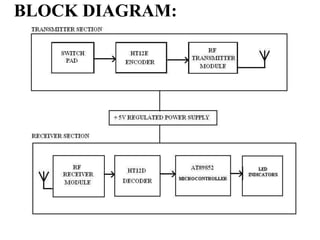
BLOCK DIAGRAM:
BLOCK DIAGRAM:
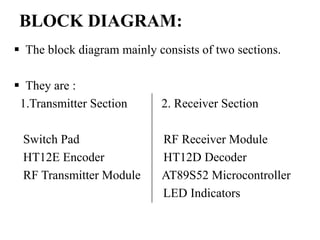
 The block diagram mainly consists of two sections.
 They are :
1.Transmitter Section 2. Receiver Section
Switch Pad RF Receiver Module
HT12E Encoder HT12D Decoder
RF Transmitter Module AT89S52 Microcontroller
LED Indicators
TRANSMITTER SECTION:
 The transmitter section mainly consists of
a) Switch Pad b) HT12E Encoder c) RF Transmitter module.
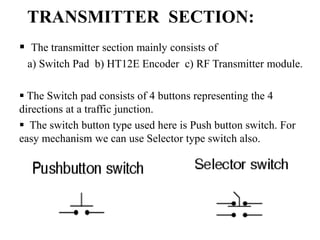
 The Switch pad consists of 4 buttons representing the 4
directions at a traffic junction.
 The switch button type used here is Push button switch. For
easy mechanism we can use Selector type switch also.
TRANSMITTER SECTION:
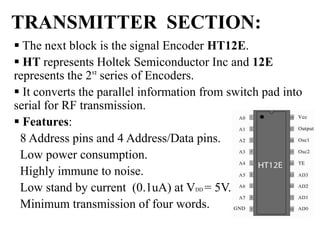
 The next block is the signal Encoder HT12E.
 HT represents Holtek Semiconductor Inc and 12E
represents the 212
series of Encoders.
 It converts the parallel information from switch pad into
serial for RF transmission.
 Features:
8 Address pins and 4 Address/Data pins.
Low power consumption.
Highly immune to noise.
Low stand by current (0.1uA) at VDD = 5V. .
Minimum transmission of four words.
TRANSMITTER SECTION
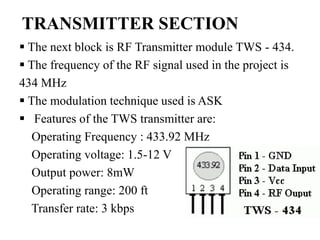
 The next block is RF Transmitter module TWS - 434.
 The frequency of the RF signal used in the project is
434 MHz
 The modulation technique used is ASK
 Features of the TWS transmitter are:
Operating Frequency : 433.92 MHz
Operating voltage: 1.5-12 V
Output power: 8mW
Operating range: 200 ft
Transfer rate: 3 kbps
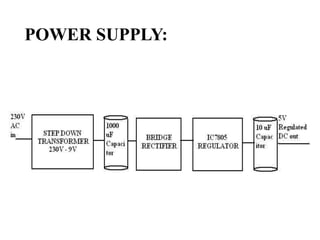
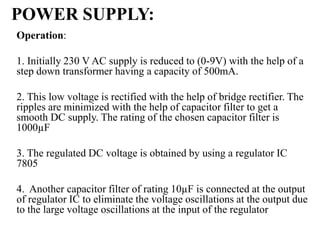
POWER SUPPLY:
POWER SUPPLY:
Operation:
1. Initially 230 V AC supply is reduced to (0-9V) with the help of a
step down transformer having a capacity of 500mA.
2. This low voltage is rectified with the help of bridge rectifier. The
ripples are minimized with the help of capacitor filter to get a
smooth DC supply. The rating of the chosen capacitor filter is
1000µF
3. The regulated DC voltage is obtained by using a regulator IC
7805
4. Another capacitor filter of rating 10µF is connected at the output
of regulator IC to eliminate the voltage oscillations at the output due
to the large voltage oscillations at the input of the regulator
RECEIVER SECTION:
 The RF signal transmitted reaches the receiver section
and controls the traffic lights.
 The receiver section works on 5V DC output of the power
supply block.
 The receiver section has got 4 main components.
They are :
a) RF Receiver Module.
b) HT12D Decoder.
c) AT89S52 uC .
d) LED Indicators.
RECEIVER SECTION:
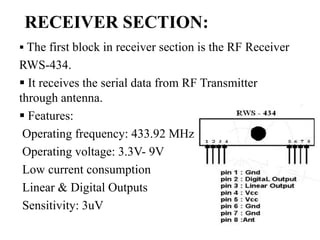
 The first block in receiver section is the RF Receiver
RWS-434.
 It receives the serial data from RF Transmitter
through antenna.
 Features:
Operating frequency: 433.92 MHz
Operating voltage: 3.3V- 9V
Low current consumption
Linear & Digital Outputs
Sensitivity: 3uV
RECEIVER SECTION:
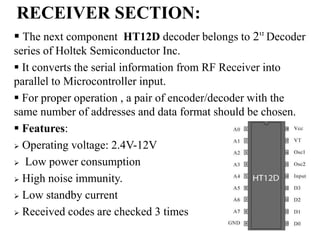
 The next component HT12D decoder belongs to 212
Decoder
series of Holtek Semiconductor Inc.
 It converts the serial information from RF Receiver into
parallel to Microcontroller input.
 For proper operation , a pair of encoder/decoder with the
same number of addresses and data format should be chosen.
 Features:
 Operating voltage: 2.4V-12V
 Low power consumption
 High noise immunity.
 Low standby current
 Received codes are checked 3 times
AT89S52 MC
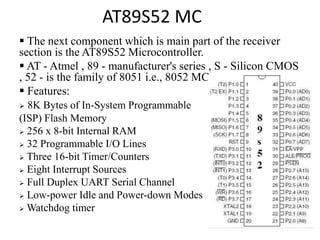
 The next component which is main part of the receiver
section is the AT89S52 Microcontroller.
 AT - Atmel , 89 - manufacturer's series , S - Silicon CMOS
, 52 - is the family of 8051 i.e., 8052 MC.
 Features:
 8K Bytes of In-System Programmable
(ISP) Flash Memory
 256 x 8-bit Internal RAM
 32 Programmable I/O Lines
 Three 16-bit Timer/Counters
 Eight Interrupt Sources
 Full Duplex UART Serial Channel
 Low-power Idle and Power-down Modes
 Watchdog timer
RECEIVER SECTION:
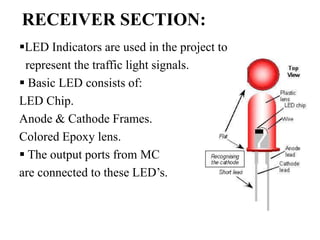
LED Indicators are used in the project to
represent the traffic light signals.
 Basic LED consists of:
LED Chip.
Anode & Cathode Frames.
Colored Epoxy lens.
 The output ports from MC
are connected to these LED’s.
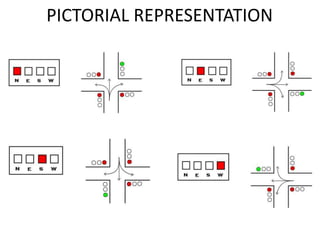
PICTORIAL REPRESENTATION
QUERIES..???
THANK YOU

TRAFFIC LIGHT CONTROL USING RF TECH

  • 1.
    TRAFFIC LIGHT PRIORITY CONTROLFOR EMERGENCY VEHICLES P. RAGHUVEER REDDY (09831A0489) P. SAI PRANAY RAJ (09831A0491) Project Guide : Ms. SANDHYA PATEL
  • 2.
    CONTENTS:  INTRODUCTION  BLOCKDIAGRAM  TRANSMITTER SECTION  POWER SUPPLY  RECIEVER SECTION
  • 3.
    INTRODUCTION:  Traffic controlhas become a major problem on the roads of many cities in India.  Some emergency vehicles like Ambulances, Fire Brigades and some important Security conveys get stuck in the traffic and have to wait which is not desirable.  The main aim of the project is to provide a wireless control system to these emergency vehicles which controls the traffic light signals.
  • 4.
  • 5.
    BLOCK DIAGRAM:  Theblock diagram mainly consists of two sections.  They are : 1.Transmitter Section 2. Receiver Section Switch Pad RF Receiver Module HT12E Encoder HT12D Decoder RF Transmitter Module AT89S52 Microcontroller LED Indicators
  • 6.
    TRANSMITTER SECTION:  Thetransmitter section mainly consists of a) Switch Pad b) HT12E Encoder c) RF Transmitter module.  The Switch pad consists of 4 buttons representing the 4 directions at a traffic junction.  The switch button type used here is Push button switch. For easy mechanism we can use Selector type switch also.
  • 7.
    TRANSMITTER SECTION:  Thenext block is the signal Encoder HT12E.  HT represents Holtek Semiconductor Inc and 12E represents the 212 series of Encoders.  It converts the parallel information from switch pad into serial for RF transmission.  Features: 8 Address pins and 4 Address/Data pins. Low power consumption. Highly immune to noise. Low stand by current (0.1uA) at VDD = 5V. . Minimum transmission of four words.
  • 8.
    TRANSMITTER SECTION  Thenext block is RF Transmitter module TWS - 434.  The frequency of the RF signal used in the project is 434 MHz  The modulation technique used is ASK  Features of the TWS transmitter are: Operating Frequency : 433.92 MHz Operating voltage: 1.5-12 V Output power: 8mW Operating range: 200 ft Transfer rate: 3 kbps
  • 9.
  • 10.
    POWER SUPPLY: Operation: 1. Initially230 V AC supply is reduced to (0-9V) with the help of a step down transformer having a capacity of 500mA. 2. This low voltage is rectified with the help of bridge rectifier. The ripples are minimized with the help of capacitor filter to get a smooth DC supply. The rating of the chosen capacitor filter is 1000µF 3. The regulated DC voltage is obtained by using a regulator IC 7805 4. Another capacitor filter of rating 10µF is connected at the output of regulator IC to eliminate the voltage oscillations at the output due to the large voltage oscillations at the input of the regulator
  • 11.
    RECEIVER SECTION:  TheRF signal transmitted reaches the receiver section and controls the traffic lights.  The receiver section works on 5V DC output of the power supply block.  The receiver section has got 4 main components. They are : a) RF Receiver Module. b) HT12D Decoder. c) AT89S52 uC . d) LED Indicators.
  • 12.
    RECEIVER SECTION:  Thefirst block in receiver section is the RF Receiver RWS-434.  It receives the serial data from RF Transmitter through antenna.  Features: Operating frequency: 433.92 MHz Operating voltage: 3.3V- 9V Low current consumption Linear & Digital Outputs Sensitivity: 3uV
  • 13.
    RECEIVER SECTION:  Thenext component HT12D decoder belongs to 212 Decoder series of Holtek Semiconductor Inc.  It converts the serial information from RF Receiver into parallel to Microcontroller input.  For proper operation , a pair of encoder/decoder with the same number of addresses and data format should be chosen.  Features:  Operating voltage: 2.4V-12V  Low power consumption  High noise immunity.  Low standby current  Received codes are checked 3 times
  • 14.
    AT89S52 MC  Thenext component which is main part of the receiver section is the AT89S52 Microcontroller.  AT - Atmel , 89 - manufacturer's series , S - Silicon CMOS , 52 - is the family of 8051 i.e., 8052 MC.  Features:  8K Bytes of In-System Programmable (ISP) Flash Memory  256 x 8-bit Internal RAM  32 Programmable I/O Lines  Three 16-bit Timer/Counters  Eight Interrupt Sources  Full Duplex UART Serial Channel  Low-power Idle and Power-down Modes  Watchdog timer
  • 15.
    RECEIVER SECTION: LED Indicatorsare used in the project to represent the traffic light signals.  Basic LED consists of: LED Chip. Anode & Cathode Frames. Colored Epoxy lens.  The output ports from MC are connected to these LED’s.
  • 16.
  • 17.
  • 18.