Un sistema embebido es un sistema basado en microcontroladores o microprocesadores diseñado para realizar tareas específicas, integrado en dispositivos más amplios como electrodomésticos y sistemas médicos. Se caracteriza por su bajo consumo energético, procesamiento en tiempo real y debe cumplir con restricciones de tamaño y complejidad. Los sistemas embebidos son fundamentales en diversas aplicaciones, desde electrónica de consumo hasta sistemas de transporte y médicos, proporcionando flexibilidad y eficiencia.
Embedded System
Anembedded system is a microcontroller or microprocessor based system
which is designed to perform a specific task.
It is a computer system with a dedicated function within a larger mechanical
or electrical system
It is embedded as part of a complete device often including hardware and
mechanical parts
Microcontroller based, software driven, reliable, real-time control system.
Embedded systems control many devices in common use today.
Ninety-eight percent of all microprocessors are manufactured as components
of embedded systems
3.
Embedded system
Embeddedsystems range from portable devices such as digital watches and
MP3 players, to large stationary installations like traffic lights, factory
controllers, and largely complex systems like hybrid vehicles, MRI, and
avionics.
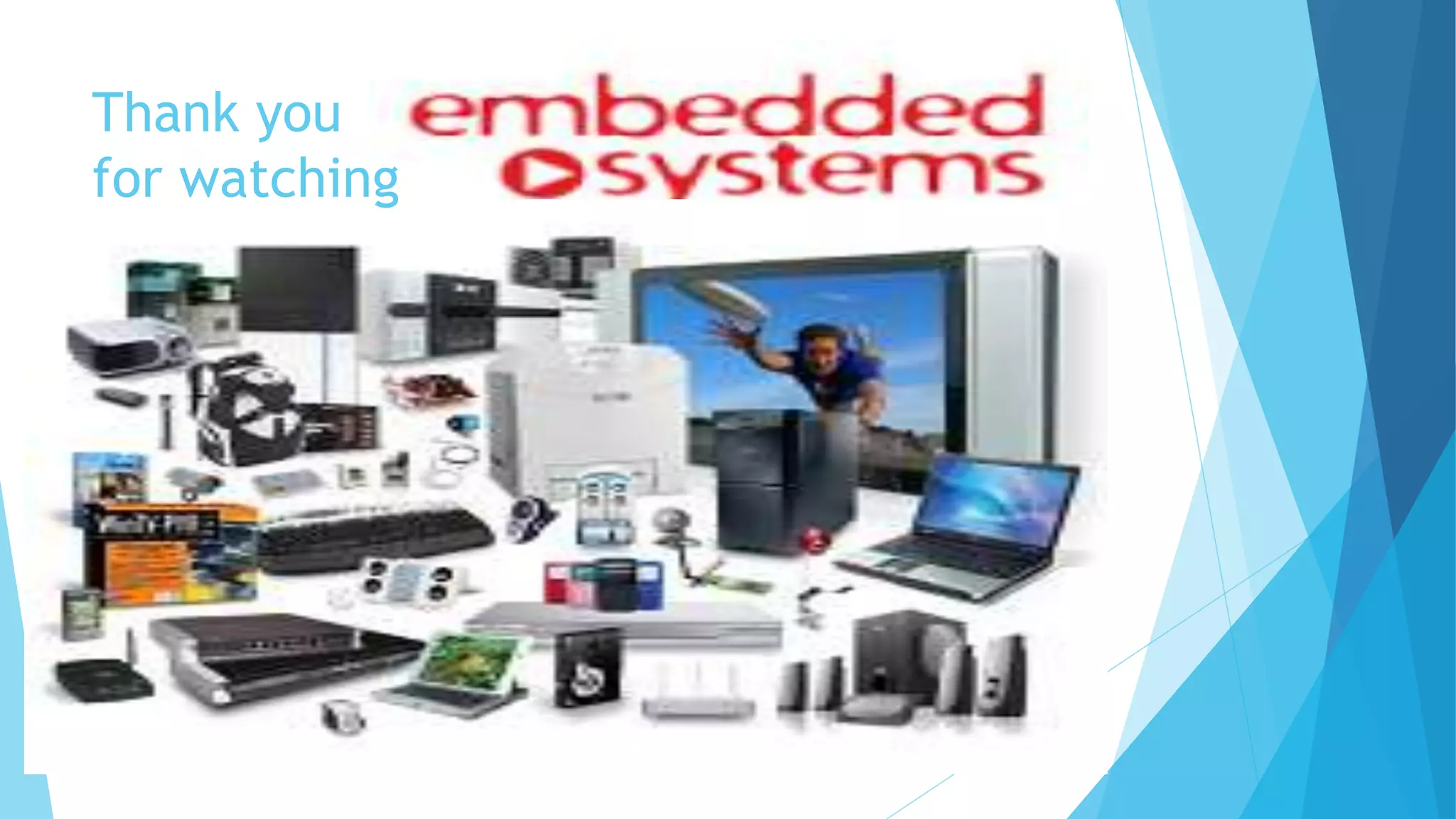
Embedded systems are commonly found in consumer, cooking, industrial,
automotive, medical applications. Some example of embedded systems are
MP3 players, mobile phones, videogame consoles, digital cameras, DVD
players, and GPS.
Household appliances, such as microwave ovens, washing machines and
dishwashers, include embedded systems to provide flexibility and efficiency.
Its complexity varies from low, with a single microcontroller chip, to very high
with multiple units, peripherals and networks mounted inside a large
enclosure.
4.
Embedded systems
Anembedded system usually performs a specialized operation
It must be of a size to fit on a single chip, must perform fast enough to
process data in real time and consume minimum power to extend battery life
Many embedded systems must continually react to changes in the system's
environment and must compute certain results without any delay
It must be microprocessor or microcontroller based
Tightly constrained (Tight constraints on embedded systems
a. Ability to fit on a single chip
b. Low power consumption
c. Fast data processing for
5.
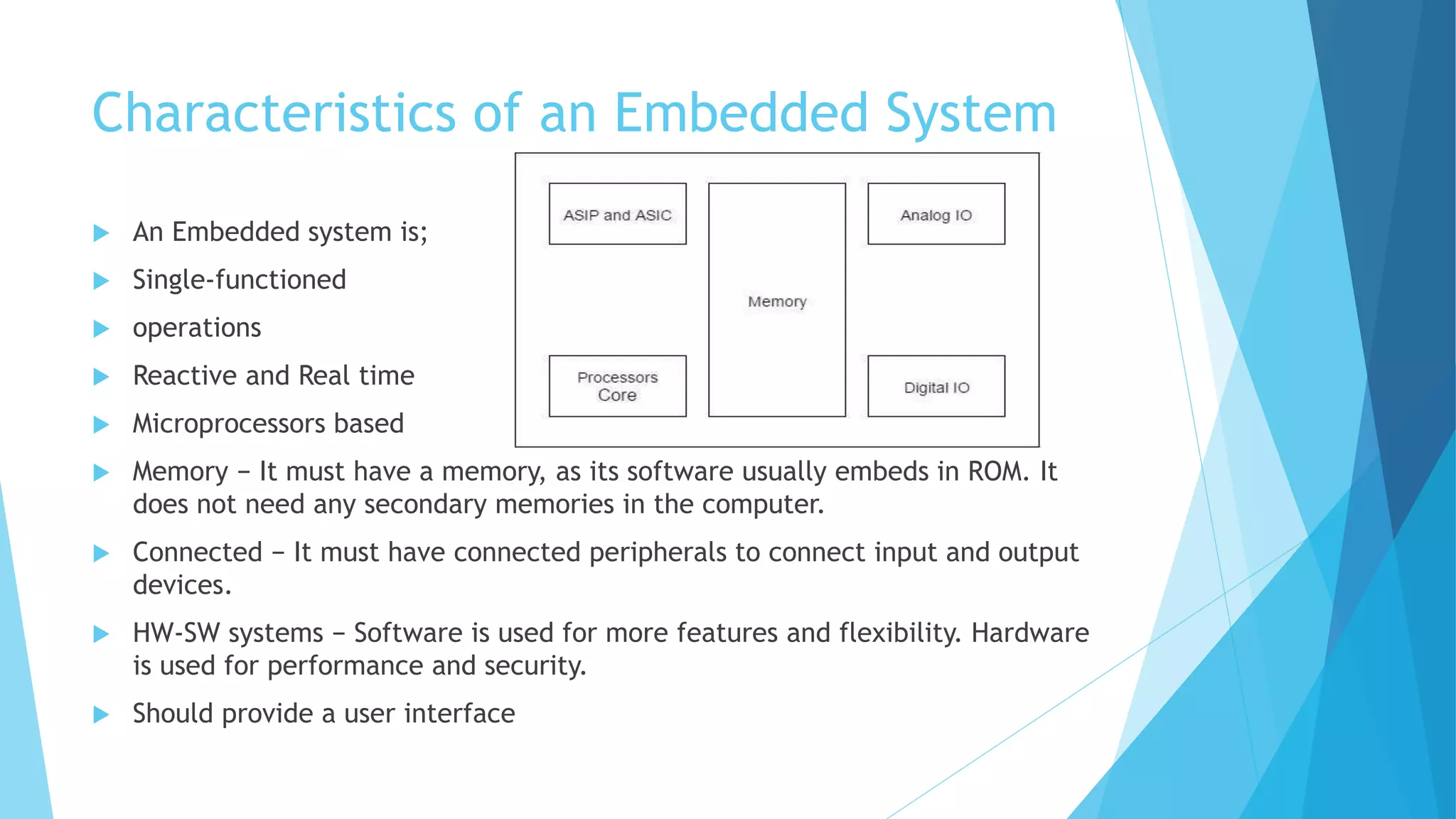
Characteristics of anEmbedded System
An Embedded system is;
Single-functioned
operations
Reactive and Real time
Microprocessors based
Memory − It must have a memory, as its software usually embeds in ROM. It
does not need any secondary memories in the computer.
Connected − It must have connected peripherals to connect input and output
devices.
HW-SW systems − Software is used for more features and flexibility. Hardware
is used for performance and security.
Should provide a user interface
6.
Characteristics of EmbeddedSystems
Embedded systems are designed to do some specific task, rather than be a
general-purpose computer for multiple tasks.
Embedded systems are not always standalone devices. Many embedded
systems consist of small parts within a larger device that serves a more
general purpose.
The program instructions written for embedded systems are referred to as
firmware, and are stored in read-only memory or flash memory chips. They
run with limited computer hardware resources: little memory, small or non-
existent keyboard or screen.
7.
Components of EmbeddedSystem
An Embedded system has 3 components:
1. Hardware
2. Application Software
3. Real time operating system
Real time operating system supervises the application software and provide
mechanism to let the processor run a process as per scheduling by following a
plan to control the latencies.
RTOS defines the way the system works.
It sets the rules during the execution of application program.
A small scale embedded system may not have RTOS.
8.
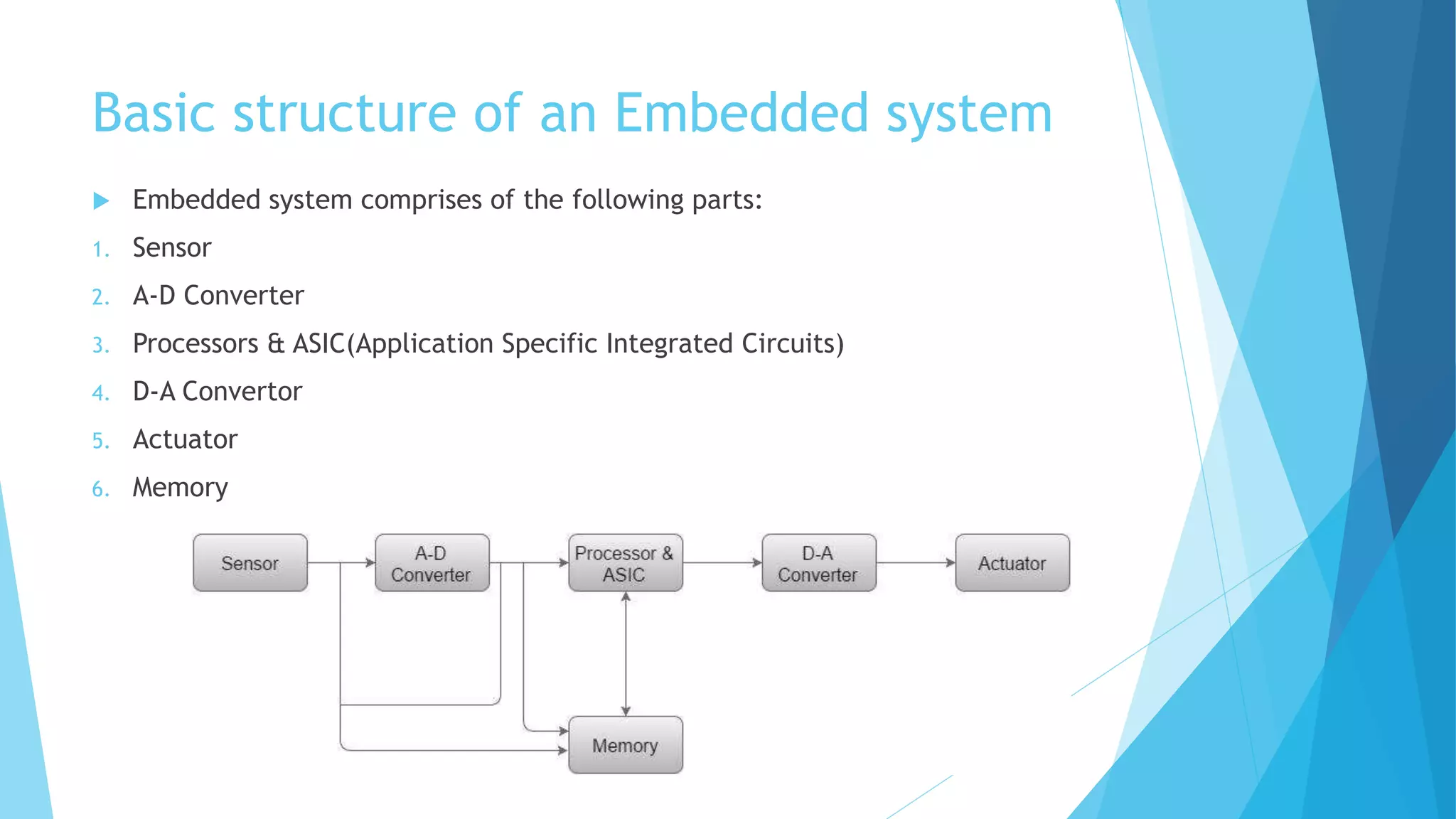
Basic structure ofan Embedded system
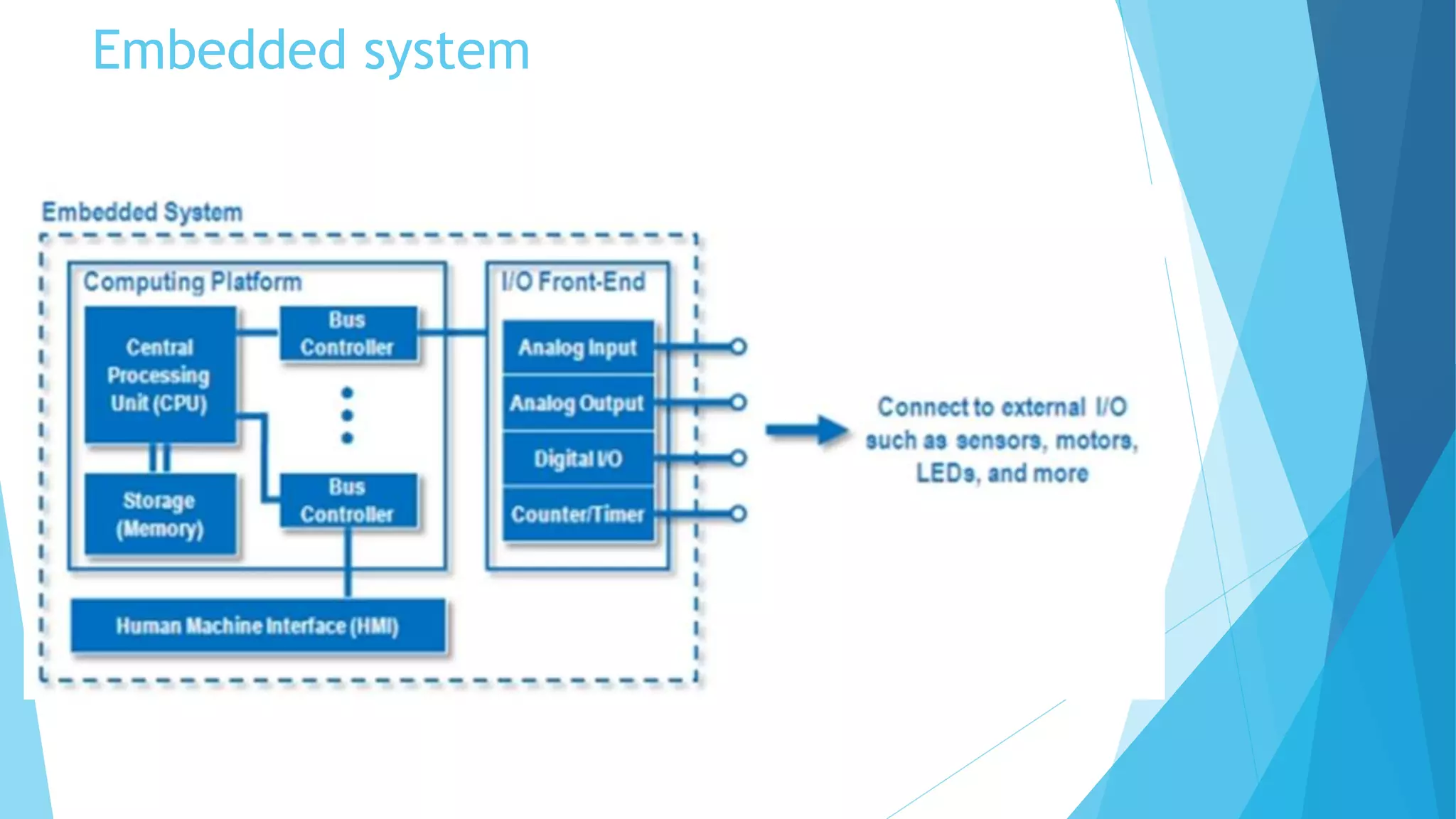
Embedded system comprises of the following parts:
1. Sensor
2. A-D Converter
3. Processors & ASIC(Application Specific Integrated Circuits)
4. D-A Convertor
5. Actuator
6. Memory
9.
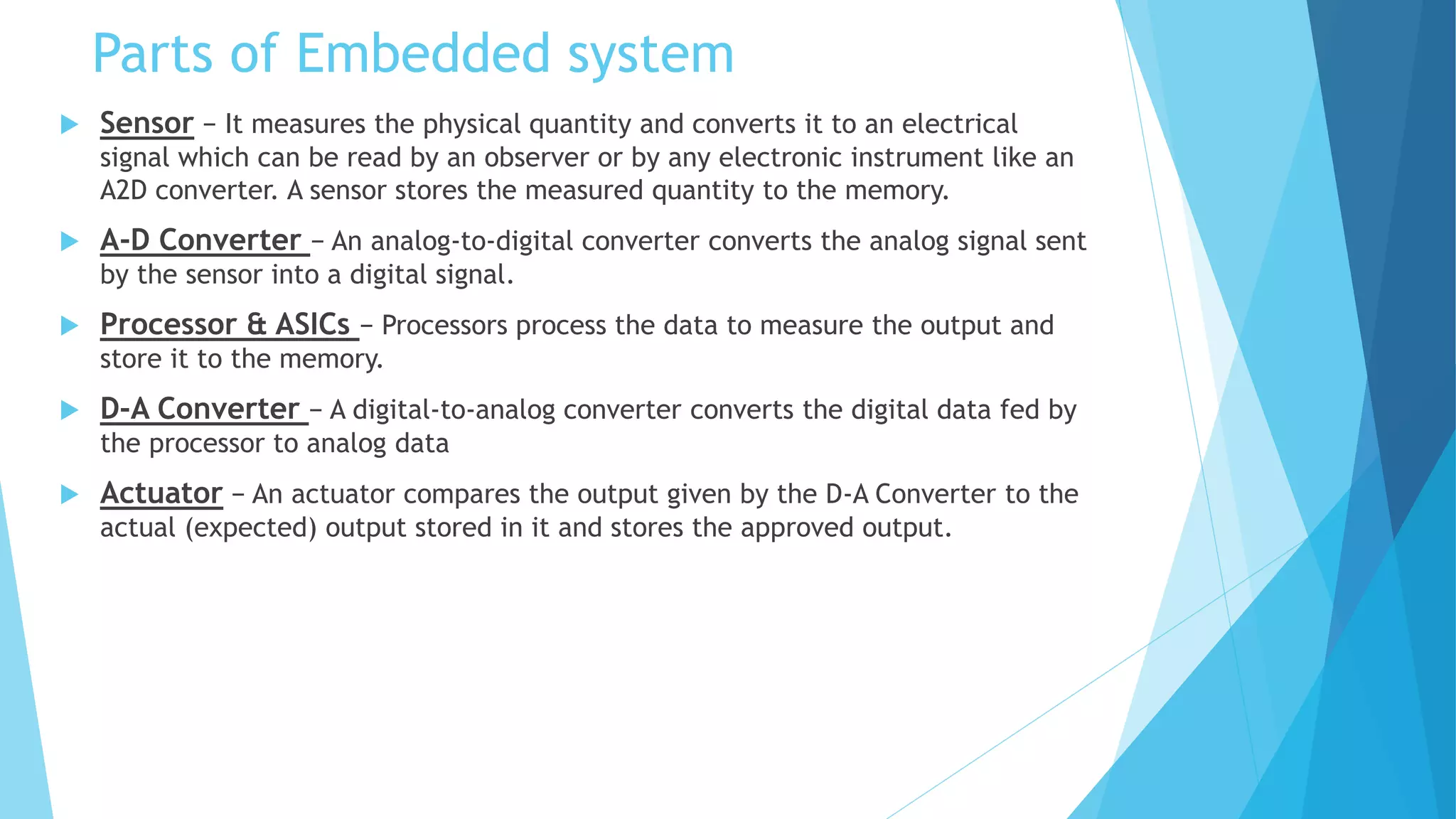
Parts of Embeddedsystem
Sensor − It measures the physical quantity and converts it to an electrical
signal which can be read by an observer or by any electronic instrument like an
A2D converter. A sensor stores the measured quantity to the memory.
A-D Converter − An analog-to-digital converter converts the analog signal sent
by the sensor into a digital signal.
Processor & ASICs − Processors process the data to measure the output and
store it to the memory.
D-A Converter − A digital-to-analog converter converts the digital data fed by
the processor to analog data
Actuator − An actuator compares the output given by the D-A Converter to the
actual (expected) output stored in it and stores the approved output.
10.
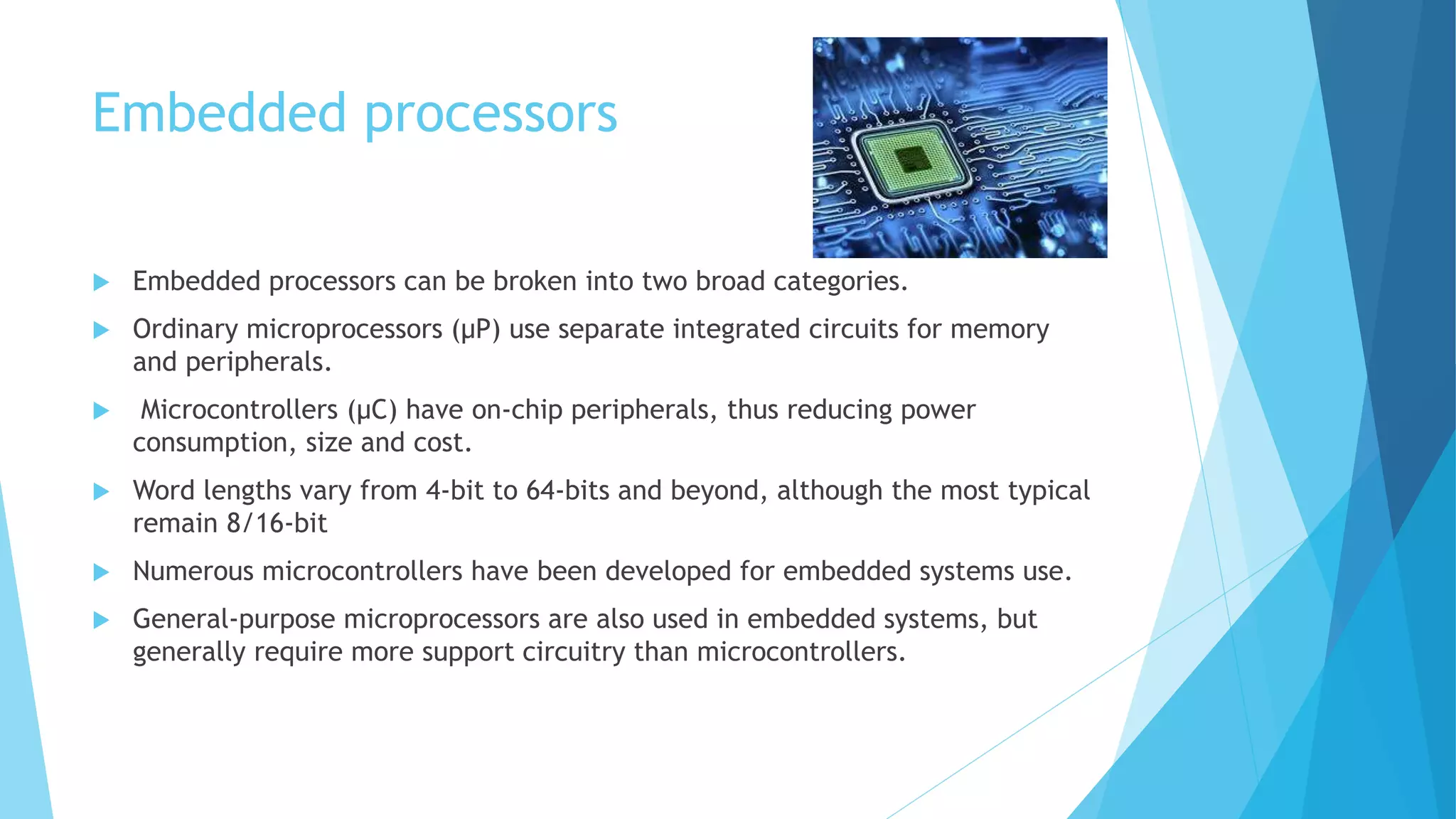
Embedded processors
Embeddedprocessors can be broken into two broad categories.
Ordinary microprocessors (μP) use separate integrated circuits for memory
and peripherals.
Microcontrollers (μC) have on-chip peripherals, thus reducing power
consumption, size and cost.
Word lengths vary from 4-bit to 64-bits and beyond, although the most typical
remain 8/16-bit
Numerous microcontrollers have been developed for embedded systems use.
General-purpose microprocessors are also used in embedded systems, but
generally require more support circuitry than microcontrollers.
11.
Applications of Embeddedsystems
Embedded systems are commonly found in consumer, industrial, telecommunication, automotive,
medical, commercial and military applications.
Telecommunications systems employ numerous embedded systems from telephone switches for the
network to cell phones at the end user. Computer networking uses dedicated routers and network
bridges to route data.
Embedded Wi-Fi modules provide a simple means of wirelessly enabling any device which
communicates via a serial port.
A new class of miniature wireless devices called motes are networked wireless sensors. These motes
are completely self-contained, and will typically run off a battery source for years before the
batteries need to be changed or charged.
12.
Applications of Embeddedsystems
Various electric motors — brushless DC motors, induction motors and DC
motors — use electric/electronic motor controllers
Embedded systems are used in transportation, fire safety, safety and security,
medical applications and life critical systems, as these systems can be
isolated from hacking and thus, be more reliable.
For fire safety, the systems can be designed to have greater ability to handle
higher temperatures and continue to operate.
In dealing with security, the embedded systems can be self-sufficient and be
able to deal with cut electrical and communication systems
13.
Consumer Applications
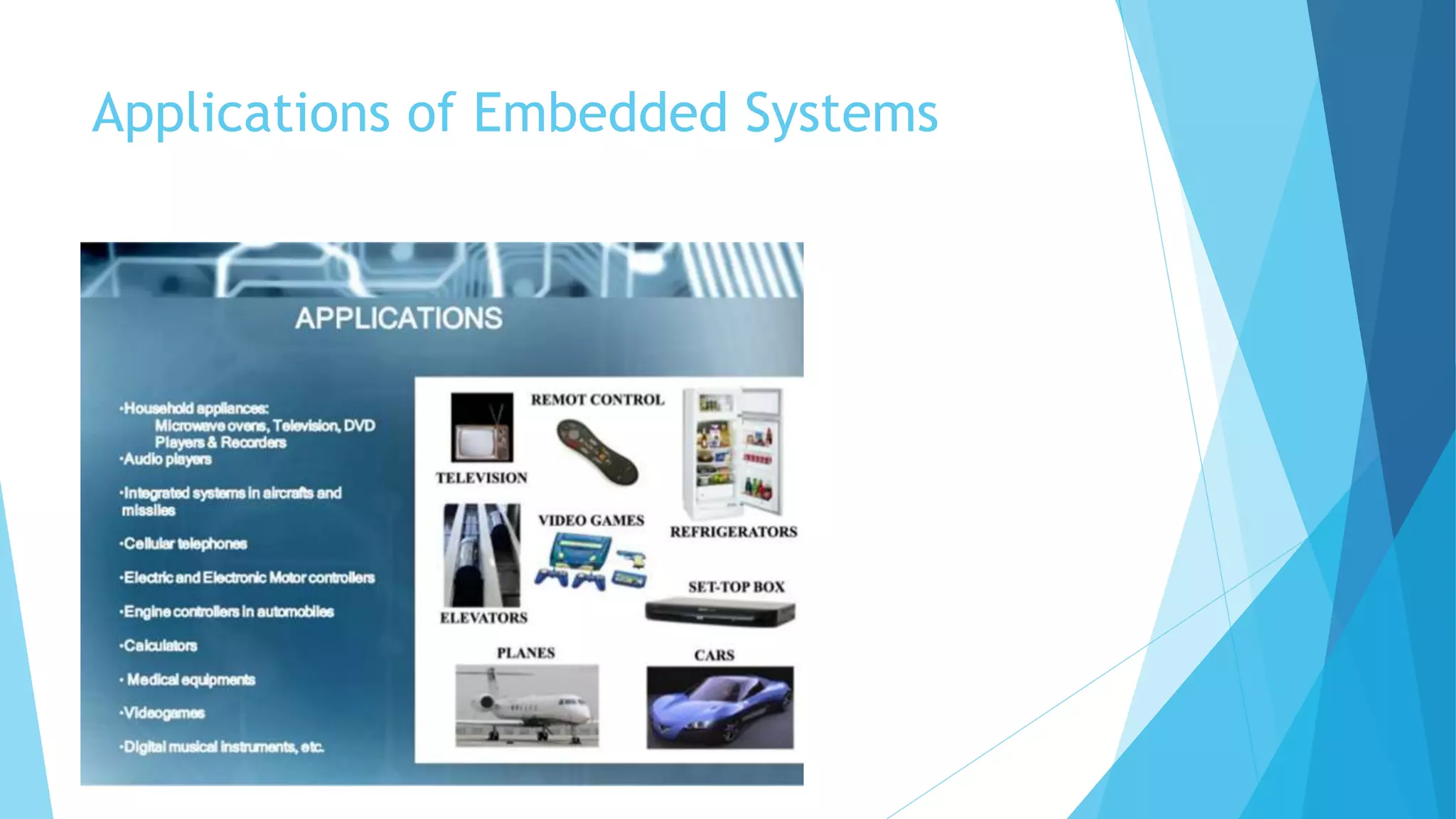
Consumerelectronics include personal digital assistants (PDAs), MP3 players,
mobile phones, videogame consoles, digital cameras, DVD players, GPS
receivers, and printers.
Household appliances, such as microwave ovens, washing machines and
dishwashers, include embedded systems to provide flexibility, efficiency and
features.
Advanced HVAC(Heating Ventilation & Air Conditioning) systems use
networked thermostats to more accurately and efficiently control
temperature that can change by time of day and season.
Home automation uses wired- and wireless-networking that can be used to
control lights, climate, security, audio/visual, surveillance, etc., all of which
use embedded devices for sensing and controlling.
14.
Transportation
Transportation systemsfrom flight to automobiles increasingly use embedded
systems.
New airplanes contain advanced avionics such as inertial guidance systems
and GPS receivers that also have considerable safety requirements.
Automobiles, electric vehicles, and hybrid vehicles increasingly use
embedded systems to maximize efficiency and reduce pollution.
Other automotive safety systems include anti-lock braking system (ABS),
Electronic Stability Control (ESC/ESP), traction control (TCS) and automatic
four-wheel drive.
15.
Medical Equipment
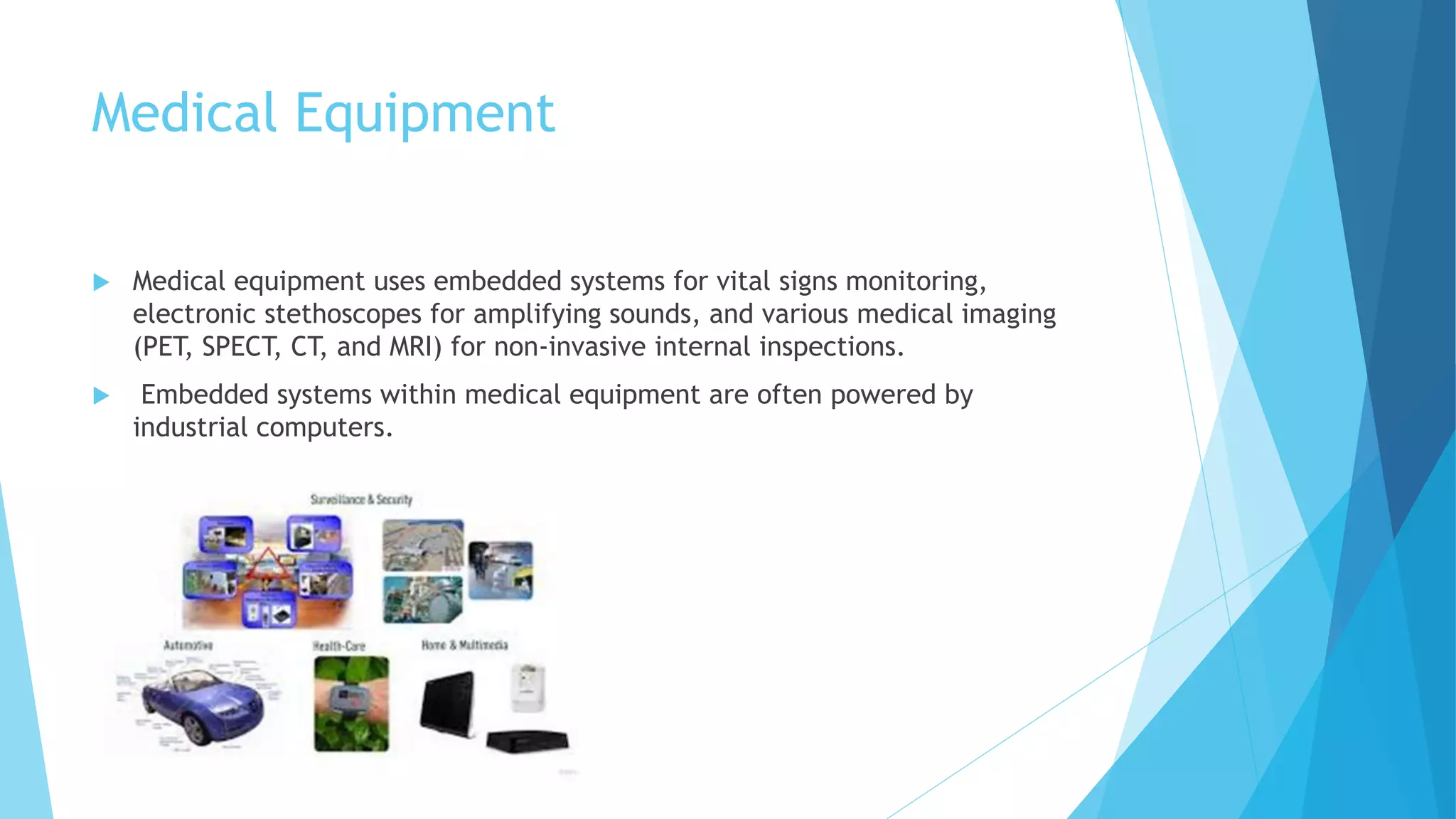
Medicalequipment uses embedded systems for vital signs monitoring,
electronic stethoscopes for amplifying sounds, and various medical imaging
(PET, SPECT, CT, and MRI) for non-invasive internal inspections.
Embedded systems within medical equipment are often powered by
industrial computers.
16.
Advantages & Disadvantages
Advantages:
1. Easily Customizable
2. Low power consumption
3. Low cost
4. Enhanced performance
Disadvantages:
1. High development effort
2. Larger time to market
17.
Reliability
Embedded systemsoften reside in machines that are expected to run continuously for years without
errors, and in some cases recover by themselves if an error occurs. Therefore, the software is
usually developed and tested more carefully than that for personal computers, and unreliable
mechanical moving parts such as disk drives, switches or buttons are avoided
Specific reliability issues may include:
1. The system cannot safely be shut down for repair, or it is too inaccessible to repair.
Examples include space systems, undersea cables, navigational beacons, bore-hole systems, and
automobiles.
2. The system must be kept running for safety reasons. Often backups are selected by an
operator. Examples include aircraft navigation, reactor control systems, safety-critical chemical
factory controls, train signals.
3. The system will lose large amounts of money when shut down: Telephone switches,
factory controls, bridge and elevator controls, funds transfer and market making, automated sales
and service.
18.
Recovery from errors
A variety of techniques are used, sometimes in combination, to recover from
errors—both software bugs such as memory leaks, and also soft errors in the
hardware:
1. Watchdog timer that resets the computer
2. Designing with a Trusted Computing Base (TCB) architecture ensures
a highly secure & reliable system environment
3. A hypervisor designed for embedded systems, is able to provide
secure encapsulation for any subsystem component
Peripherals
Serial CommunicationInterfaces (SCI):
Synchronous Serial Communication Interface: I2C, SPI, SSC and ESSI (Enhanced
Synchronous Serial Interface)
Universal Serial Bus (USB)
Multi Media Cards (SD cards, Compact Flash, etc.)
Networks: Ethernet, LonWorks, etc.
Fieldbuses: CAN-Bus, LIN-Bus, PROFIBUS, etc.
Timers: PLL(s), Capture/Compare and Time Processing Units
Discrete IO: aka General Purpose Input/output (GPIO)
Analog to Digital/Digital to Analog (ADC/DAC)
Debugging: JTAG, ISP, ICSP, BDM Port, BITP, and DB9 ports.
23.
Tools used inEmbedded systems
As with other software, embedded system designers use compilers,
assemblers, and debuggers to develop embedded system software. However,
they may also use some more specific tools;
1. Circuit debuggers or emulators
2. Utilities to add a checksum or CRC(cyclic redundancy check) to a
program, so the embedded system can check if the program is valid.
3. For systems using digital signal processing, developers may use a
math workbench such as MATLAB
4. System level modeling and simulation tools
5. A model-based development tool
6. Custom compilers and linkers
7. An embedded system may have its own special language or design
tool, or add enhancements to an existing language
8. Another alternative is to add a real-time operating system or
embedded operating system, which may have DSP(Digital Signal
Processing) capabilities
9. Modeling and code generating tools often based on state machines
#5 real-time(Real time is a level of computer responsiveness that enables the computer to keep up with some external process (for example, to present visualizations of the weather as it constantly changes)
#19 A hypervisor is designed so that a compromised software component cannot interfere with other subsystems. This encapsulation keeps faults from propagating from one subsystem to another, improving reliability. This may also allow a subsystem to be automatically shut down and restarted on fault detection