Batch 5
MICRO PROCESSOR ASSIGN.
PRESENTATION. - 2
OUR TOPIC IS:

TRAFFIC LIGHT
CONTROL
SYSTEM
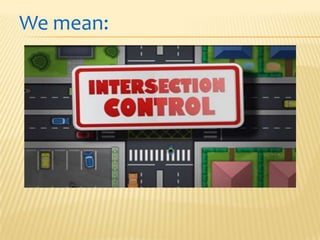
We mean:
NEED FOR THE SYSTEM :
Traffic lightsstoplights/ traffic lamps/
traffic signals/ signal lights/ robots/
semaphore
 signaling devices
 positioned at road intersections,
pedestrian crossings and other locations
 to control competing flows of traffic.
 Preventing accidents
 Improving safety
 Minimize travel time

ABOUT THE COLORS OF TRAFFIC LIGHT
CONTROL
Traffic lights alternate the right of way of road
users by displaying lights of a standard color
(red, yellow/amber, and green)
 By using a universal color code (and a
precise sequence to enable comprehension
by those who are color blind

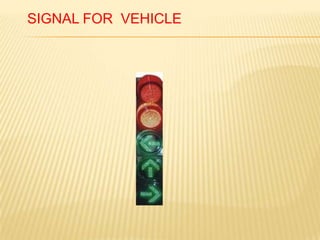
SIGNAL FOR VEHICLE
SIGNAL FOR PEDESTRIAN
PROCESSOR USED:

8085
Microprocessor
WHY 8085?
 Sufficient

memory for the given scenario
 Basic units to be interfaced are supported by
8085
 Less complicated in the aspect of coding
 Supports the necessary instruction sets
 Simple and robust
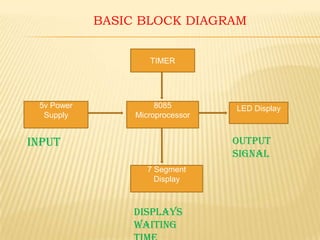
BASIC BLOCK DIAGRAM
TIMER

5v Power
Supply

8085
Microprocessor

LED Display

OUTPUT
SIGNAL

INPUT
7 Segment
Display

DISPLAYS
WAITING
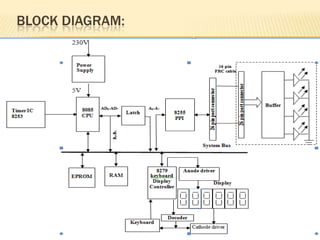
BLOCK DIAGRAM:
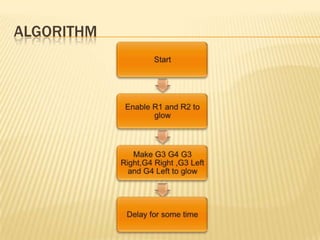
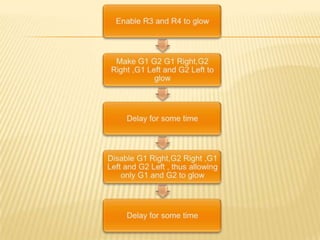
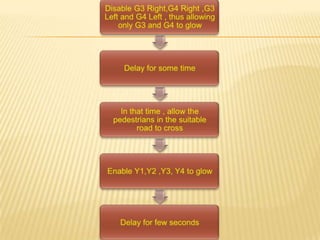
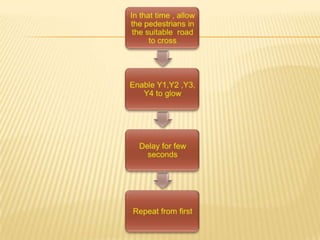
ALGORITHM
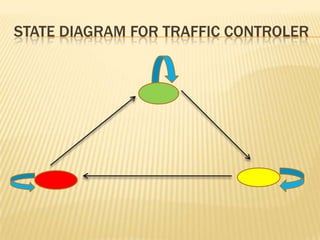
STATE DIAGRAM FOR TRAFFIC CONTROLER
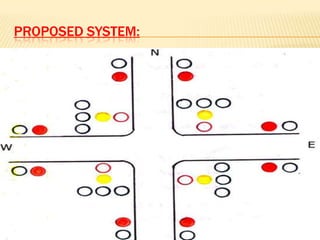
PROPOSED SYSTEM:
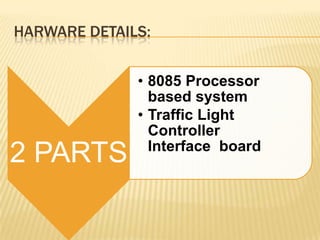
HARWARE DETAILS:

2 PARTS

• 8085 Processor
based system
• Traffic Light
Controller
Interface board
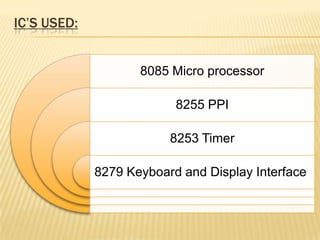
IC’S USED:

8085 Micro processor
8255 PPI
8253 Timer
8279 Keyboard and Display Interface
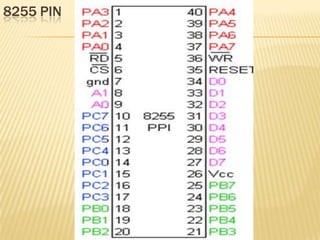
8255 PIN
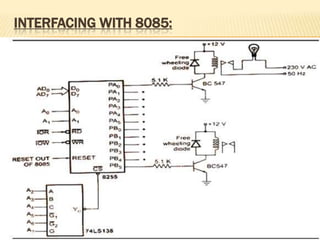
INTERFACING WITH 8085:
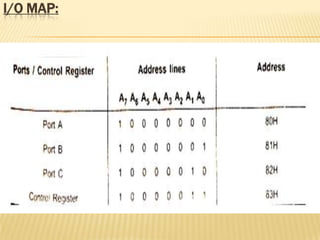
I/O MAP:
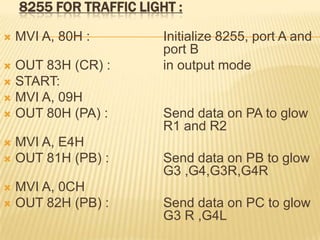
8255 FOR TRAFFIC LIGHT :


MVI A, 80H :

OUT 83H (CR) :
 START:
 MVI A, 09H
 OUT 80H (PA) :


MVI A, E4H
 OUT 81H (PB) :

Initialize 8255, port A and
port B
in output mode

Send data on PA to glow
R1 and R2



MVI A, 0CH
 OUT 82H (PB) :

Send data on PB to glow
G3 ,G4,G3R,G4R



Send data on PC to glow
G3 R ,G4L













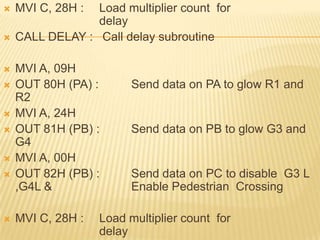
MVI C, 28H :

Load multiplier count for
delay
CALL DELAY : Call delay subroutine
MVI A, 09H
OUT 80H (PA) :
R2
MVI A, 24H
OUT 81H (PB) :
G4
MVI A, 00H
OUT 82H (PB) :
,G4L &
MVI C, 28H :

Send data on PA to glow R1 and

Send data on PB to glow G3 and

Send data on PC to disable G3 L
Enable Pedestrian Crossing

Load multiplier count for
delay
















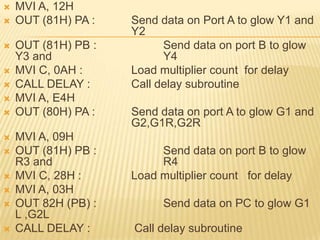
MVI A, 12H
OUT (81H) PA :
OUT (81H) PB :
Y3 and
MVI C, 0AH :
CALL DELAY :
MVI A, E4H
OUT (80H) PA :

MVI A, 09H
OUT (81H) PB :
R3 and
MVI C, 28H :
MVI A, 03H
OUT 82H (PB) :
L ,G2L
CALL DELAY :

Send data on Port A to glow Y1 and
Y2
Send data on port B to glow
Y4
Load multiplier count for delay
Call delay subroutine
Send data on port A to glow G1 and
G2,G1R,G2R
Send data on port B to glow
R4
Load multiplier count for delay
Send data on PC to glow G1
Call delay subroutine















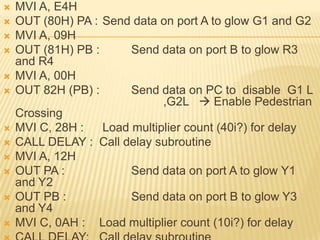
MVI A, E4H
OUT (80H) PA : Send data on port A to glow G1 and G2
MVI A, 09H
OUT (81H) PB :
Send data on port B to glow R3
and R4
MVI A, 00H
OUT 82H (PB) :
Send data on PC to disable G1 L
,G2L  Enable Pedestrian
Crossing
MVI C, 28H :
Load multiplier count (40i?) for delay
CALL DELAY : Call delay subroutine
MVI A, 12H
OUT PA :
Send data on port A to glow Y1
and Y2
OUT PB :
Send data on port B to glow Y3
and Y4
MVI C, 0AH : Load multiplier count (10i?) for delay
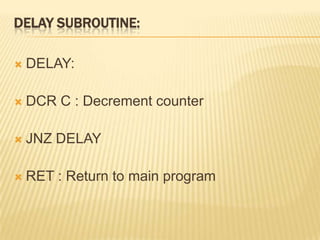
DELAY SUBROUTINE:


DELAY:



DCR C : Decrement counter



JNZ DELAY



RET : Return to main program
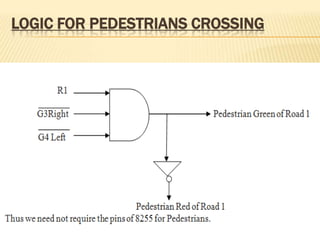
LOGIC FOR PEDESTRIANS CROSSING
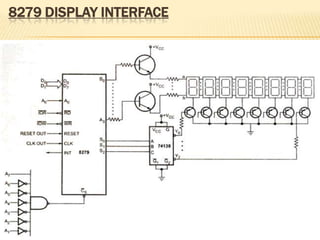
8279 DISPLAY INTERFACE
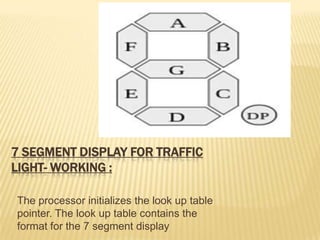
7 SEGMENT DISPLAY FOR TRAFFIC
LIGHT- WORKING :
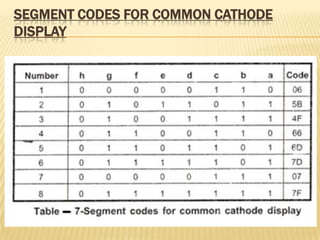
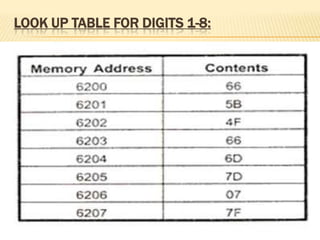
The processor initializes the look up table
pointer. The look up table contains the
format for the 7 segment display
SEGMENT CODES FOR COMMON CATHODE
DISPLAY
LOOK UP TABLE FOR DIGITS 1-8:
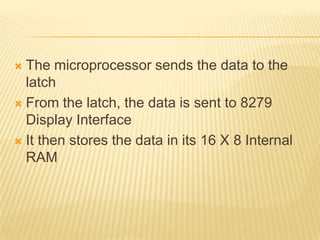
The microprocessor sends the data to the
latch
 From the latch, the data is sent to 8279
Display Interface
 It then stores the data in its 16 X 8 Internal
RAM

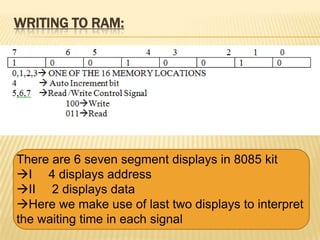
WRITING TO RAM:

There are 6 seven segment displays in 8085 kit
I 4 displays address
II 2 displays data
Here we make use of last two displays to interpret
the waiting time in each signal



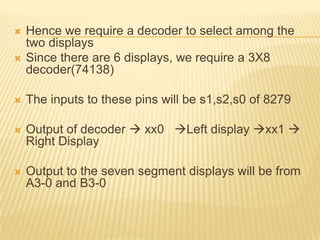
Hence we require a decoder to select among the
two displays
Since there are 6 displays, we require a 3X8
decoder(74138)



The inputs to these pins will be s1,s2,s0 of 8279



Output of decoder  xx0 Left display xx1 
Right Display



Output to the seven segment displays will be from
A3-0 and B3-0
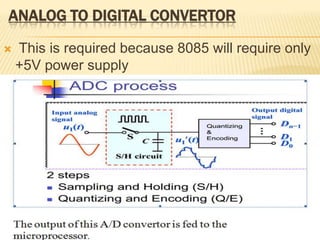
ANALOG TO DIGITAL CONVERTOR


This is required because 8085 will require only
+5V power supply
REFERENCES:


rbinnovations.com



gobookee.net



seminarprojects.com



eprlabs.blogspot.com


Batch members

DINESH .S
(11I309)
MARIA JERIN .J
(11I324)
SARATHY .K
(11I340)
SRINIVASAN .R
(11I347)
SUBASH .S
(11I348)
MURALI KRISHNAN .P (12I469)
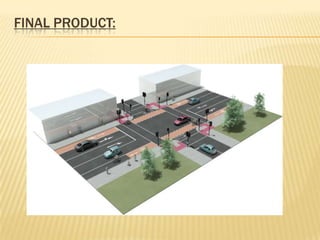
FINAL PRODUCT:
TRAFFIC LIGHT CONTROL SYSTEM USING 8085 MICROPROCESSOR

TRAFFIC LIGHT CONTROL SYSTEM USING 8085 MICROPROCESSOR

  • 1.
    Batch 5 MICRO PROCESSORASSIGN. PRESENTATION. - 2
  • 2.
    OUR TOPIC IS: TRAFFICLIGHT CONTROL SYSTEM
  • 3.
  • 4.
    NEED FOR THESYSTEM : Traffic lightsstoplights/ traffic lamps/ traffic signals/ signal lights/ robots/ semaphore  signaling devices  positioned at road intersections, pedestrian crossings and other locations  to control competing flows of traffic.  Preventing accidents  Improving safety  Minimize travel time 
  • 5.
    ABOUT THE COLORSOF TRAFFIC LIGHT CONTROL Traffic lights alternate the right of way of road users by displaying lights of a standard color (red, yellow/amber, and green)  By using a universal color code (and a precise sequence to enable comprehension by those who are color blind 
  • 6.
  • 7.
  • 8.
  • 9.
    WHY 8085?  Sufficient memoryfor the given scenario  Basic units to be interfaced are supported by 8085  Less complicated in the aspect of coding  Supports the necessary instruction sets  Simple and robust
  • 10.
    BASIC BLOCK DIAGRAM TIMER 5vPower Supply 8085 Microprocessor LED Display OUTPUT SIGNAL INPUT 7 Segment Display DISPLAYS WAITING
  • 11.
  • 12.
  • 16.
    STATE DIAGRAM FORTRAFFIC CONTROLER
  • 17.
  • 18.
    HARWARE DETAILS: 2 PARTS •8085 Processor based system • Traffic Light Controller Interface board
  • 19.
    IC’S USED: 8085 Microprocessor 8255 PPI 8253 Timer 8279 Keyboard and Display Interface
  • 20.
  • 21.
  • 22.
  • 23.
    8255 FOR TRAFFICLIGHT :  MVI A, 80H : OUT 83H (CR) :  START:  MVI A, 09H  OUT 80H (PA) :  MVI A, E4H  OUT 81H (PB) : Initialize 8255, port A and port B in output mode Send data on PA to glow R1 and R2  MVI A, 0CH  OUT 82H (PB) : Send data on PB to glow G3 ,G4,G3R,G4R  Send data on PC to glow G3 R ,G4L
  • 24.
             MVI C, 28H: Load multiplier count for delay CALL DELAY : Call delay subroutine MVI A, 09H OUT 80H (PA) : R2 MVI A, 24H OUT 81H (PB) : G4 MVI A, 00H OUT 82H (PB) : ,G4L & MVI C, 28H : Send data on PA to glow R1 and Send data on PB to glow G3 and Send data on PC to disable G3 L Enable Pedestrian Crossing Load multiplier count for delay
  • 25.
                 MVI A, 12H OUT(81H) PA : OUT (81H) PB : Y3 and MVI C, 0AH : CALL DELAY : MVI A, E4H OUT (80H) PA : MVI A, 09H OUT (81H) PB : R3 and MVI C, 28H : MVI A, 03H OUT 82H (PB) : L ,G2L CALL DELAY : Send data on Port A to glow Y1 and Y2 Send data on port B to glow Y4 Load multiplier count for delay Call delay subroutine Send data on port A to glow G1 and G2,G1R,G2R Send data on port B to glow R4 Load multiplier count for delay Send data on PC to glow G1 Call delay subroutine
  • 26.
                MVI A, E4H OUT(80H) PA : Send data on port A to glow G1 and G2 MVI A, 09H OUT (81H) PB : Send data on port B to glow R3 and R4 MVI A, 00H OUT 82H (PB) : Send data on PC to disable G1 L ,G2L  Enable Pedestrian Crossing MVI C, 28H : Load multiplier count (40i?) for delay CALL DELAY : Call delay subroutine MVI A, 12H OUT PA : Send data on port A to glow Y1 and Y2 OUT PB : Send data on port B to glow Y3 and Y4 MVI C, 0AH : Load multiplier count (10i?) for delay
  • 27.
    DELAY SUBROUTINE:  DELAY:  DCR C: Decrement counter  JNZ DELAY  RET : Return to main program
  • 28.
  • 29.
  • 30.
    7 SEGMENT DISPLAYFOR TRAFFIC LIGHT- WORKING : The processor initializes the look up table pointer. The look up table contains the format for the 7 segment display
  • 31.
    SEGMENT CODES FORCOMMON CATHODE DISPLAY
  • 32.
    LOOK UP TABLEFOR DIGITS 1-8:
  • 33.
    The microprocessor sendsthe data to the latch  From the latch, the data is sent to 8279 Display Interface  It then stores the data in its 16 X 8 Internal RAM 
  • 34.
    WRITING TO RAM: Thereare 6 seven segment displays in 8085 kit I 4 displays address II 2 displays data Here we make use of last two displays to interpret the waiting time in each signal
  • 35.
      Hence we requirea decoder to select among the two displays Since there are 6 displays, we require a 3X8 decoder(74138)  The inputs to these pins will be s1,s2,s0 of 8279  Output of decoder  xx0 Left display xx1  Right Display  Output to the seven segment displays will be from A3-0 and B3-0
  • 36.
    ANALOG TO DIGITALCONVERTOR  This is required because 8085 will require only +5V power supply
  • 37.
  • 38.
     Batch members DINESH .S (11I309) MARIAJERIN .J (11I324) SARATHY .K (11I340) SRINIVASAN .R (11I347) SUBASH .S (11I348) MURALI KRISHNAN .P (12I469)
  • 39.