MADAN MOHAN MALAVIYA
ENGINEERING COLLEGE GORAKHPUR
SESSION – 2011-12
SEMINAR REPORT ON
UNDERWATER WIRELESS COMMUNICATION
SHUBHAM SRIVASTAVA
ELECTRONICS & COMMUNICATION ENGG.
B.TECH. 3RD YEAR
ROLL NO. 0904231065
INTRODUCTION
Underwater wireless communication is the
wireless communication in which acoustic signals
(waves) carry digital information through an
underwater channel. Electromagnetic waves are
not used as they propogate over short distances.
Over the past decades, heavy cables were used
to establish a high speed communication
between remote end and the surface. To
overcome such difficulties, underwater wireless
communication has come into existence.
NECESSITY OF UNDERWATER WIRELESS
COMMUNICATION
Wired underwater is not feasible in all situations as
shown below-:
• Temporary experiments
• Breaking of wires
• Significant cost of deployment
• Experiment over long distances.
To cope up with above situations, we require
underwater wireless communication.
FACTORS INFLUENCING ACOUSTIC
COMMUNICATION
• Path loss: Due to attenuation and geometric
spreading.
• Noise: Man-made noise and ambient noise(due to
hydrodynamics)
• Multi-path propogation
• High propogation delay
• Doppler frequency spread.
HARDWARE PLATFORM INTERFACES
• Sensor Interface:
– Must develop common interface with different sensors (chemical,
optical, etc.) and communication elements (transducer) .
– Wide (constantly changing) variety of sensors, sampling strategies
• Communication Interface:
Amplifiers, Transducers
Signal modulation
Hardware:
 Software Defined Acoustic Modem (SDAM)
 Reconfigurable hardware known to provide, flexible, high
performance implementations for DSP applications
ACOUSTIC MODEM
• Employ advanced modulation scheme and channel
equalization for improved signal to noise ratio.
• Employ high performance error detection and correction
coding scheme which reduces bit error rate to less than 10-
7
Parts of an acoustic modem:
• DSP Board
• AFE(Analog Front End) Board
• DC/DC Converter
DATA TRANSMISSION IN MODEM
When no data is being transmitted, the modem stays in
sleep mode, it periodically wakes up to receive possible
data being transmitted by far end modem. This results in
low power consumption. Similarly when the data is to be
transmitted , the modem receives data from its link in
sleep mode and then switches to transmit mode and
transmit the data.
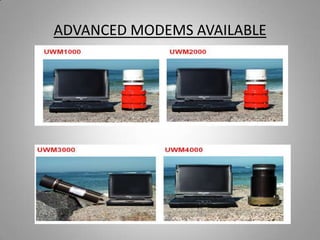
ADVANCED MODEMS AVAILABLE
UNDERWATER ACOUSTIC SENSOR NETWORKS
(UW-ASN)
• Group of sensors and vehicles deployed
underwater and networked via acoustic links,
performing collaborative tasks.
• Equipment
– Autonomous Underwater Vehicles (AUVs)
– Underwater sensors (UW-ASN)
UW-ASN COMMUNICATION ARCHITECTURE
2-D ARCHITECTURE
3-D ARCHITECTURE
APPLICATIONS
• Seismic monitoring.
• Pollution monitoring
• Ocean currents monitoring
• Equipment monitoring and control
• Autonomous Underwater Vehicles (AUV)
• Remotely operated vehicle(ROV)
• Acoustic navigation technology for multiple AUVs.
• Solar Powered AUVs
LIMITATIONS
• Battery power is limited and usually batteries can
not be recharged easily.
• The available bandwidth is severely limited.
• Underwater sensors are prone to failures because
of fouling, corrosion, etc.
• Highly affected by environmental and natural
factors such as heterogeneities of the water
column, variations of sound velocity versus
depth, temperature and salinity, multiple and
random sea reflections and significant scattering
by fish, bubble clouds and plankton.
CONCLUSION
Despite much development in this area of the
underwater wireless communication, there is still
an immense scope so more research as major part
of the ocean bottom yet remains unexploded. The
main objective is to overcome the present
limitations and implement advanced technology
for oceanographic research and cope up with the
environmental effects on the noise performance of
acoustic systems to compete with the future
challenges like effective transmission of audio and
video signals etc.
References
• www.ieee.org/organizations/pubs/newslette
rs/oes/html/spring06/underwater.html
• www.link-quest.com/html/oceans2000.pdf/
• www.gleonrcn.org/pgm-
download_media.php?name=Aquanode.pps
• www.cs.virginia.edu/sigbed/archives/akyildiz.
pdf
THANK YOU
QUERIES??

Underwater Wireless Communication

  • 1.
    MADAN MOHAN MALAVIYA ENGINEERINGCOLLEGE GORAKHPUR SESSION – 2011-12 SEMINAR REPORT ON UNDERWATER WIRELESS COMMUNICATION SHUBHAM SRIVASTAVA ELECTRONICS & COMMUNICATION ENGG. B.TECH. 3RD YEAR ROLL NO. 0904231065
  • 2.
    INTRODUCTION Underwater wireless communicationis the wireless communication in which acoustic signals (waves) carry digital information through an underwater channel. Electromagnetic waves are not used as they propogate over short distances. Over the past decades, heavy cables were used to establish a high speed communication between remote end and the surface. To overcome such difficulties, underwater wireless communication has come into existence.
  • 3.
    NECESSITY OF UNDERWATERWIRELESS COMMUNICATION Wired underwater is not feasible in all situations as shown below-: • Temporary experiments • Breaking of wires • Significant cost of deployment • Experiment over long distances. To cope up with above situations, we require underwater wireless communication.
  • 4.
    FACTORS INFLUENCING ACOUSTIC COMMUNICATION •Path loss: Due to attenuation and geometric spreading. • Noise: Man-made noise and ambient noise(due to hydrodynamics) • Multi-path propogation • High propogation delay • Doppler frequency spread.
  • 5.
    HARDWARE PLATFORM INTERFACES •Sensor Interface: – Must develop common interface with different sensors (chemical, optical, etc.) and communication elements (transducer) . – Wide (constantly changing) variety of sensors, sampling strategies • Communication Interface: Amplifiers, Transducers Signal modulation Hardware:  Software Defined Acoustic Modem (SDAM)  Reconfigurable hardware known to provide, flexible, high performance implementations for DSP applications
  • 6.
    ACOUSTIC MODEM • Employadvanced modulation scheme and channel equalization for improved signal to noise ratio. • Employ high performance error detection and correction coding scheme which reduces bit error rate to less than 10- 7 Parts of an acoustic modem: • DSP Board • AFE(Analog Front End) Board • DC/DC Converter
  • 7.
    DATA TRANSMISSION INMODEM When no data is being transmitted, the modem stays in sleep mode, it periodically wakes up to receive possible data being transmitted by far end modem. This results in low power consumption. Similarly when the data is to be transmitted , the modem receives data from its link in sleep mode and then switches to transmit mode and transmit the data.
  • 8.
  • 9.
    UNDERWATER ACOUSTIC SENSORNETWORKS (UW-ASN) • Group of sensors and vehicles deployed underwater and networked via acoustic links, performing collaborative tasks. • Equipment – Autonomous Underwater Vehicles (AUVs) – Underwater sensors (UW-ASN)
  • 10.
  • 11.
  • 12.
    APPLICATIONS • Seismic monitoring. •Pollution monitoring • Ocean currents monitoring • Equipment monitoring and control • Autonomous Underwater Vehicles (AUV) • Remotely operated vehicle(ROV) • Acoustic navigation technology for multiple AUVs. • Solar Powered AUVs
  • 13.
    LIMITATIONS • Battery poweris limited and usually batteries can not be recharged easily. • The available bandwidth is severely limited. • Underwater sensors are prone to failures because of fouling, corrosion, etc. • Highly affected by environmental and natural factors such as heterogeneities of the water column, variations of sound velocity versus depth, temperature and salinity, multiple and random sea reflections and significant scattering by fish, bubble clouds and plankton.
  • 14.
    CONCLUSION Despite much developmentin this area of the underwater wireless communication, there is still an immense scope so more research as major part of the ocean bottom yet remains unexploded. The main objective is to overcome the present limitations and implement advanced technology for oceanographic research and cope up with the environmental effects on the noise performance of acoustic systems to compete with the future challenges like effective transmission of audio and video signals etc.
  • 15.
    References • www.ieee.org/organizations/pubs/newslette rs/oes/html/spring06/underwater.html • www.link-quest.com/html/oceans2000.pdf/ •www.gleonrcn.org/pgm- download_media.php?name=Aquanode.pps • www.cs.virginia.edu/sigbed/archives/akyildiz. pdf
  • 16.
  • 17.