Integrals by Trigonometric Substitution
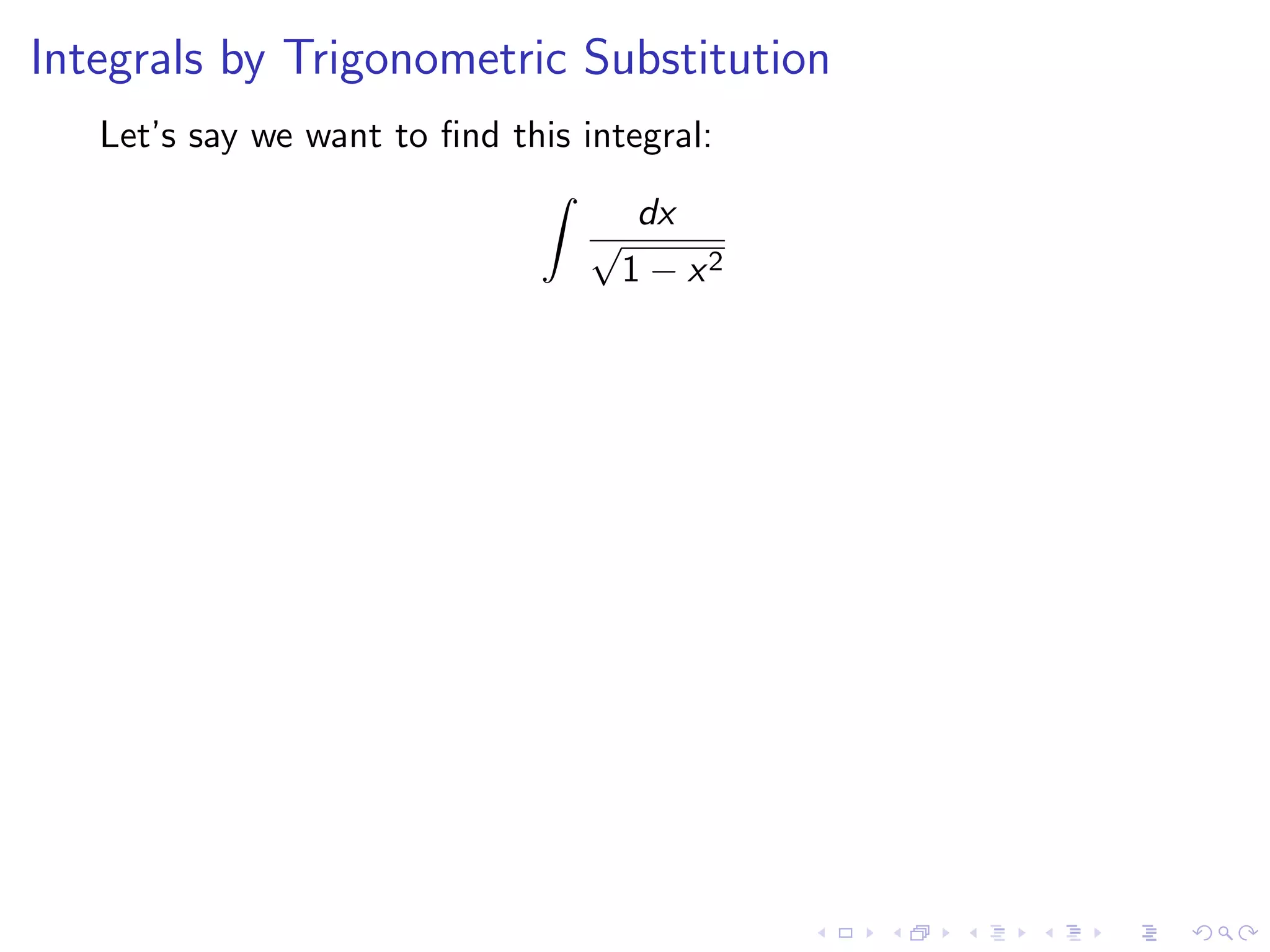
Let’s say we want to find this integral:
Integrals by Trigonometric Substitution
Let’s say we want to find this integral:
dx
√
1 − x2
Integrals by Trigonometric Substitution
Let’s say we want to find this integral:
dx
√
1 − x2
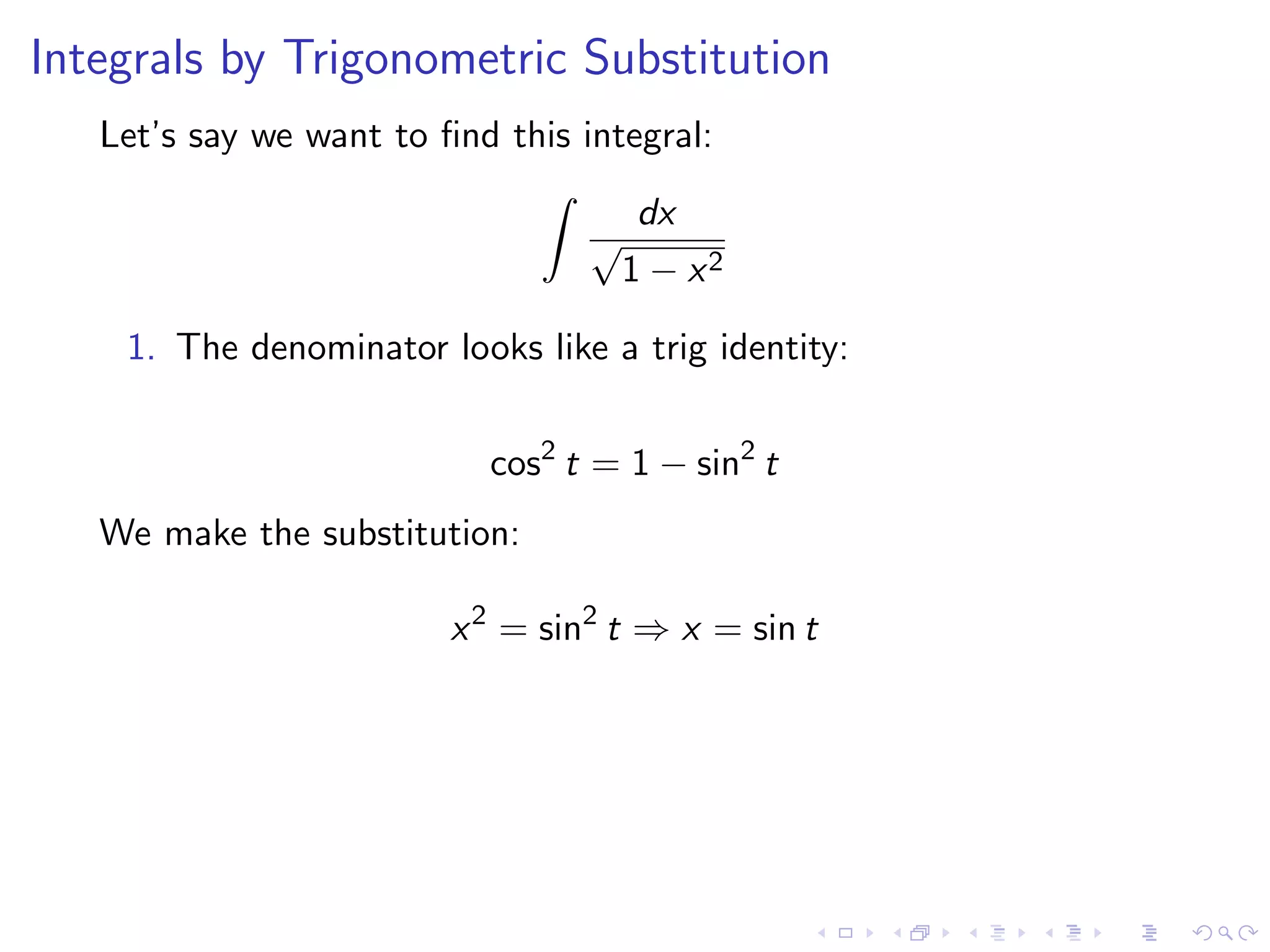
1. The denominator looks like a trig identity:
Integrals by Trigonometric Substitution
Let’s say we want to find this integral:
dx
√
1 − x2
1. The denominator looks like a trig identity:
cos2
t = 1 − sin2
t
Integrals by Trigonometric Substitution
Let’s say we want to find this integral:
dx
√
1 − x2
1. The denominator looks like a trig identity:
cos2
t = 1 − sin2
t
We make the substitution:
Integrals by Trigonometric Substitution
Let’s say we want to find this integral:
dx
√
1 − x2
1. The denominator looks like a trig identity:
cos2
t = 1 − sin2
t
We make the substitution:
x2
= sin2
t
Integrals by Trigonometric Substitution
Let’s say we want to find this integral:
dx
√
1 − x2
1. The denominator looks like a trig identity:
cos2
t = 1 − sin2
t
We make the substitution:
x2
= sin2
t ⇒ x = sin t
Integrals by Trigonometric Substitution
Let’s say we want to find this integral:
dx
√
1 − x2
1. The denominator looks like a trig identity:
cos2
t = 1 − sin2
t
We make the substitution:
x2
= sin2
t ⇒ x = sin t
We need to find dx:
Integrals by Trigonometric Substitution
Let’s say we want to find this integral:
dx
√
1 − x2
1. The denominator looks like a trig identity:
cos2
t = 1 − sin2
t
We make the substitution:
x2
= sin2
t ⇒ x = sin t
We need to find dx:
dx
dt
=
d
dt
(sin t)
Integrals by Trigonometric Substitution
Let’s say we want to find this integral:
dx
√
1 − x2
1. The denominator looks like a trig identity:
cos2
t = 1 − sin2
t
We make the substitution:
x2
= sin2
t ⇒ x = sin t
We need to find dx:
dx
dt
=
d
dt
(sin t) = cos t
Integrals by Trigonometric Substitution
Let’s say we want to find this integral:
dx
√
1 − x2
1. The denominator looks like a trig identity:
cos2
t = 1 − sin2
t
We make the substitution:
x2
= sin2
t ⇒ x = sin t
We need to find dx:
dx
dt
=
d
dt
(sin t) = cos t
dx = cos tdt
Integrals by Trigonometric Substitution
So, we can make the substitution:
Integrals by Trigonometric Substitution
So, we can make the substitution:
x = sin t dx = cos tdt
Integrals by Trigonometric Substitution
So, we can make the substitution:
x = sin t dx = cos tdt
dx
√
1 − x2
Integrals by Trigonometric Substitution
So, we can make the substitution:
x = sin t dx = cos tdt
dx
√
1 − x2
dx =
cos tdt
1 − sin2
t
Integrals by Trigonometric Substitution
So, we can make the substitution:
x = sin t dx = cos tdt
dx
√
1 − x2
dx =
cos tdt
:cos t
1 − sin2
t
Integrals by Trigonometric Substitution
So, we can make the substitution:
x = sin t dx = cos tdt
dx
√
1 − x2
dx =
cos tdt
:cos t
1 − sin2
t
=
cos t
cos t
dt
Integrals by Trigonometric Substitution
So, we can make the substitution:
x = sin t dx = cos tdt
dx
√
1 − x2
dx =
cos tdt
:cos t
1 − sin2
t
=
cos t
cos t
dt =
Integrals by Trigonometric Substitution
So, we can make the substitution:
x = sin t dx = cos tdt
dx
√
1 − x2
dx =
cos tdt
:cos t
1 − sin2
t
=
cos t
cos t
dt = dt
Integrals by Trigonometric Substitution
So, we can make the substitution:
x = sin t dx = cos tdt
dx
√
1 − x2
dx =
cos tdt
:cos t
1 − sin2
t
=
cos t
cos t
dt = dt = t + C
Integrals by Trigonometric Substitution
So, we can make the substitution:
x = sin t dx = cos tdt
dx
√
1 − x2
dx =
cos tdt
:cos t
1 − sin2
t
=
cos t
cos t
dt = dt = t + C
Now we need to substitute back:
Integrals by Trigonometric Substitution
So, we can make the substitution:
x = sin t dx = cos tdt
dx
√
1 − x2
dx =
cos tdt
:cos t
1 − sin2
t
=
cos t
cos t
dt = dt = t + C
Now we need to substitute back:
x = sin t
Integrals by Trigonometric Substitution
So, we can make the substitution:
x = sin t dx = cos tdt
dx
√
1 − x2
dx =
cos tdt
:cos t
1 − sin2
t
=
cos t
cos t
dt = dt = t + C
Now we need to substitute back:
x = sin t ⇒ t = arcsin x
Integrals by Trigonometric Substitution
So, we can make the substitution:
x = sin t dx = cos tdt
dx
√
1 − x2
dx =
cos tdt
:cos t
1 − sin2
t
=
cos t
cos t
dt = dt = t + C
Now we need to substitute back:
x = sin t ⇒ t = arcsin x
So:
Integrals by Trigonometric Substitution
So, we can make the substitution:
x = sin t dx = cos tdt
dx
√
1 − x2
dx =
cos tdt
:cos t
1 − sin2
t
=
cos t
cos t
dt = dt = t + C
Now we need to substitute back:
x = sin t ⇒ t = arcsin x
So:
dx
√
1 − x2
dx = arcsin x + C
Integrals by Trigonometric Substitution
So, we can make the substitution:
x = sin t dx = cos tdt
dx
√
1 − x2
dx =
cos tdt
:cos t
1 − sin2
t
=
cos t
cos t
dt = dt = t + C
Now we need to substitute back:
x = sin t ⇒ t = arcsin x
So:
dx
√
1 − x2
dx = arcsin x + C
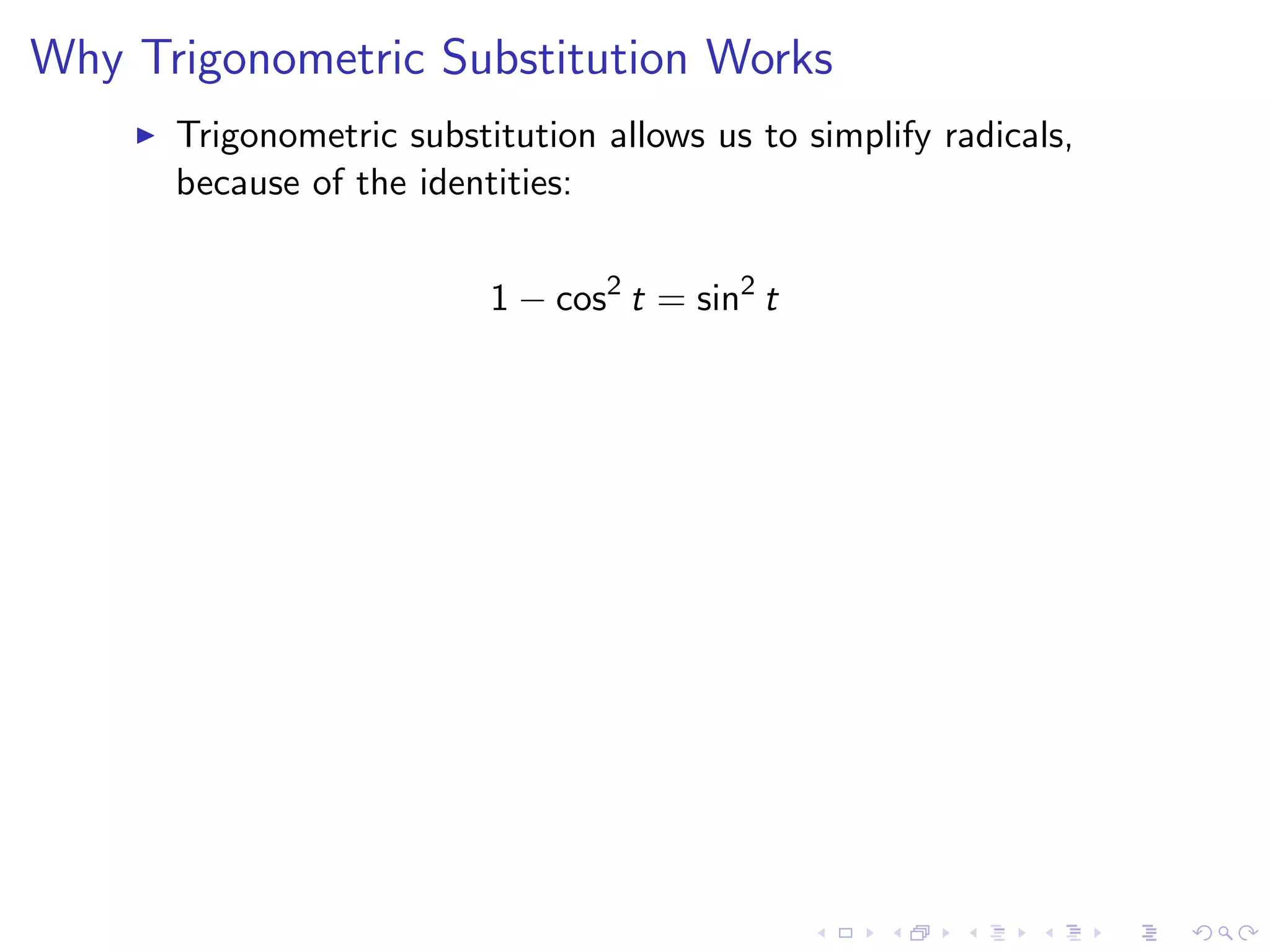
Why Trigonometric Substitution Works
Trigonometric substitution allows us to simplify radicals,
because of the identities:
Why Trigonometric Substitution Works
Trigonometric substitution allows us to simplify radicals,
because of the identities:
1 − cos2
t = sin2
t
Why Trigonometric Substitution Works
Trigonometric substitution allows us to simplify radicals,
because of the identities:
1 − cos2
t = sin2
t
1 + tan2
t = sec2
t
Why Trigonometric Substitution Works
Trigonometric substitution allows us to simplify radicals,
because of the identities:
1 − cos2
t = sin2
t
1 + tan2
t = sec2
t
When you have an expression of the form:
Why Trigonometric Substitution Works
Trigonometric substitution allows us to simplify radicals,
because of the identities:
1 − cos2
t = sin2
t
1 + tan2
t = sec2
t
When you have an expression of the form:
a2
− x2
⇒ Use x = a sin t
Why Trigonometric Substitution Works
Trigonometric substitution allows us to simplify radicals,
because of the identities:
1 − cos2
t = sin2
t
1 + tan2
t = sec2
t
When you have an expression of the form:
a2
− x2
⇒ Use x = a sin t And you’ll get:
a2
− x2
= a2
(1 − sin2
t) = a2
cos2
t
Why Trigonometric Substitution Works
Trigonometric substitution allows us to simplify radicals,
because of the identities:
1 − cos2
t = sin2
t
1 + tan2
t = sec2
t
When you have an expression of the form:
a2
− x2
⇒ Use x = a sin t And you’ll get:
a2
− x2
= a2
(1 − sin2
t) = a2
cos2
t
a2
+ x2
⇒ Use x = a tan t
Why Trigonometric Substitution Works
Trigonometric substitution allows us to simplify radicals,
because of the identities:
1 − cos2
t = sin2
t
1 + tan2
t = sec2
t
When you have an expression of the form:
a2
− x2
⇒ Use x = a sin t And you’ll get:
a2
− x2
= a2
(1 − sin2
t) = a2
cos2
t
a2
+ x2
⇒ Use x = a tan t And you’ll get:
a2
+ x2
= a2
(1 + tan2
t) = a2
sec2
t
Why Trigonometric Substitution Works
Trigonometric substitution allows us to simplify radicals,
because of the identities:
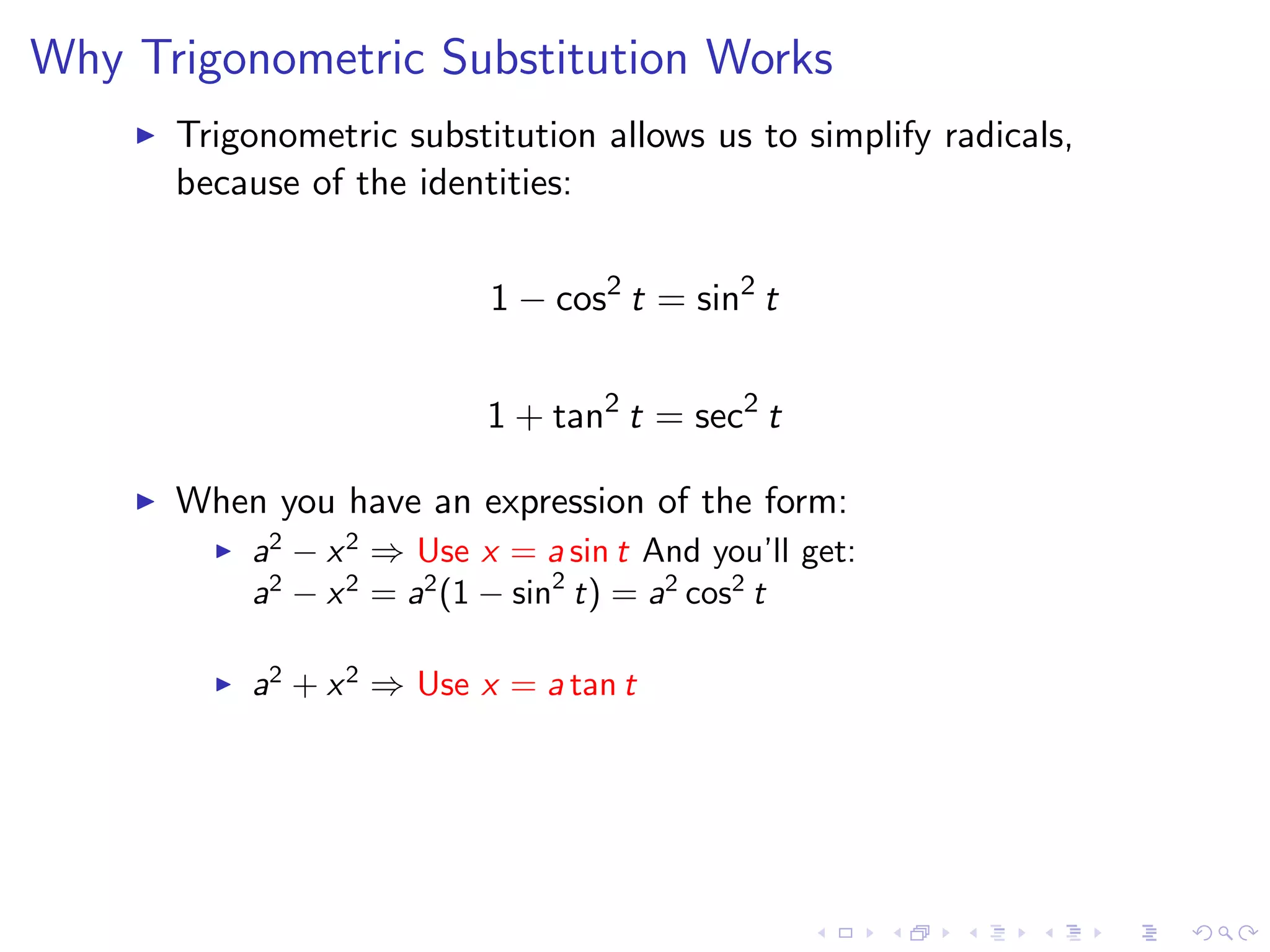
1 − cos2
t = sin2
t
1 + tan2
t = sec2
t
When you have an expression of the form:
a2
− x2
⇒ Use x = a sin t And you’ll get:
a2
− x2
= a2
(1 − sin2
t) = a2
cos2
t
a2
+ x2
⇒ Use x = a tan t And you’ll get:
a2
+ x2
= a2
(1 + tan2
t) = a2
sec2
t
x2
− a2
⇒ Use x = a sec t
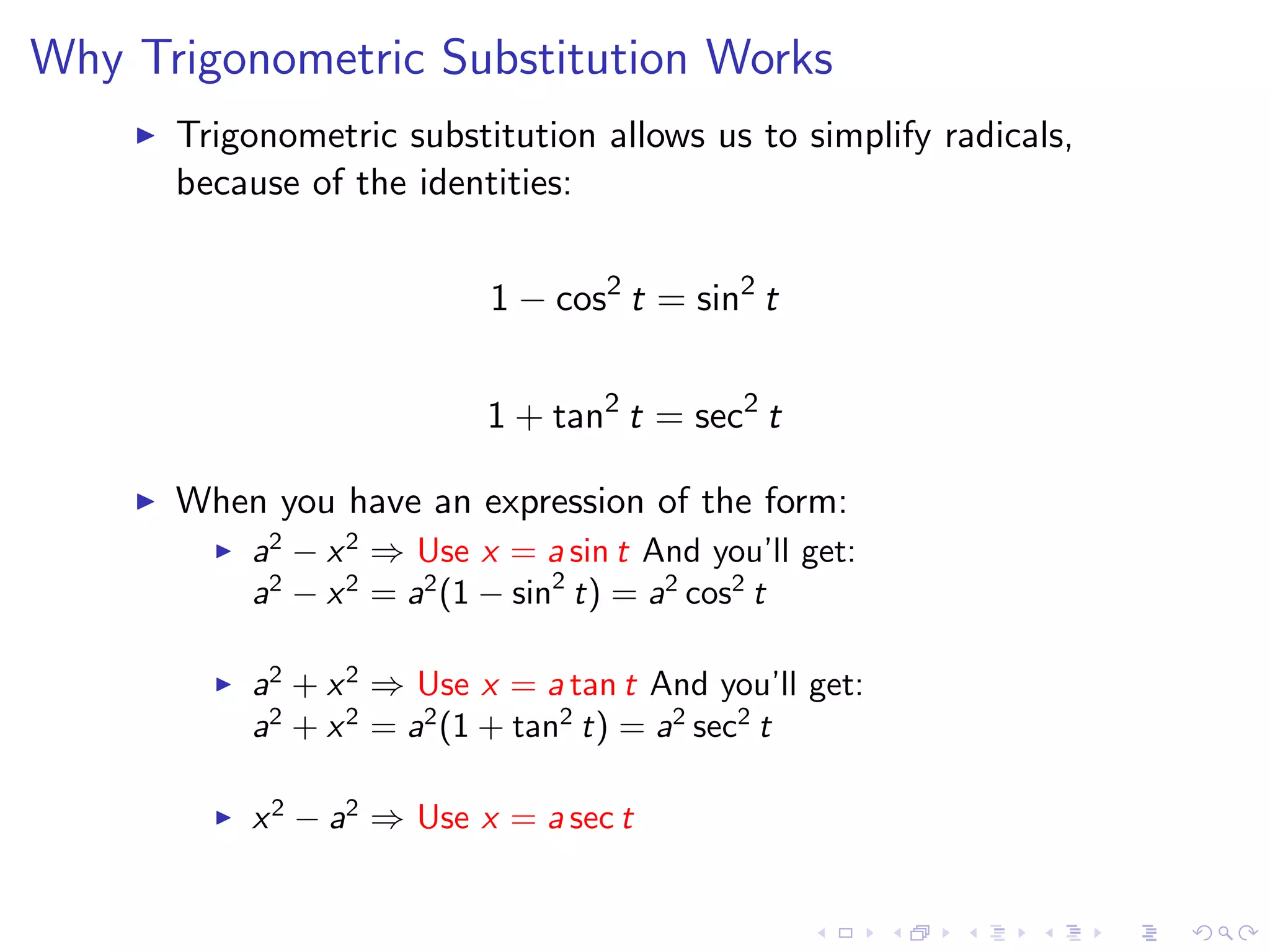
Why Trigonometric Substitution Works
Trigonometric substitution allows us to simplify radicals,
because of the identities:
1 − cos2
t = sin2
t
1 + tan2
t = sec2
t
When you have an expression of the form:
a2
− x2
⇒ Use x = a sin t And you’ll get:
a2
− x2
= a2
(1 − sin2
t) = a2
cos2
t
a2
+ x2
⇒ Use x = a tan t And you’ll get:
a2
+ x2
= a2
(1 + tan2
t) = a2
sec2
t
x2
− a2
⇒ Use x = a sec t And you’ll get:
x2
− a2
= a2
(sec2
t − 1) = a2
tan2
t
Integrals by Trigonometric Substitution

Integrals by Trigonometric Substitution

  • 3.
    Integrals by TrigonometricSubstitution Let’s say we want to find this integral:
  • 4.
    Integrals by TrigonometricSubstitution Let’s say we want to find this integral: dx √ 1 − x2
  • 5.
    Integrals by TrigonometricSubstitution Let’s say we want to find this integral: dx √ 1 − x2 1. The denominator looks like a trig identity:
  • 6.
    Integrals by TrigonometricSubstitution Let’s say we want to find this integral: dx √ 1 − x2 1. The denominator looks like a trig identity: cos2 t = 1 − sin2 t
  • 7.
    Integrals by TrigonometricSubstitution Let’s say we want to find this integral: dx √ 1 − x2 1. The denominator looks like a trig identity: cos2 t = 1 − sin2 t We make the substitution:
  • 8.
    Integrals by TrigonometricSubstitution Let’s say we want to find this integral: dx √ 1 − x2 1. The denominator looks like a trig identity: cos2 t = 1 − sin2 t We make the substitution: x2 = sin2 t
  • 9.
    Integrals by TrigonometricSubstitution Let’s say we want to find this integral: dx √ 1 − x2 1. The denominator looks like a trig identity: cos2 t = 1 − sin2 t We make the substitution: x2 = sin2 t ⇒ x = sin t
  • 10.
    Integrals by TrigonometricSubstitution Let’s say we want to find this integral: dx √ 1 − x2 1. The denominator looks like a trig identity: cos2 t = 1 − sin2 t We make the substitution: x2 = sin2 t ⇒ x = sin t We need to find dx:
  • 11.
    Integrals by TrigonometricSubstitution Let’s say we want to find this integral: dx √ 1 − x2 1. The denominator looks like a trig identity: cos2 t = 1 − sin2 t We make the substitution: x2 = sin2 t ⇒ x = sin t We need to find dx: dx dt = d dt (sin t)
  • 12.
    Integrals by TrigonometricSubstitution Let’s say we want to find this integral: dx √ 1 − x2 1. The denominator looks like a trig identity: cos2 t = 1 − sin2 t We make the substitution: x2 = sin2 t ⇒ x = sin t We need to find dx: dx dt = d dt (sin t) = cos t
  • 13.
    Integrals by TrigonometricSubstitution Let’s say we want to find this integral: dx √ 1 − x2 1. The denominator looks like a trig identity: cos2 t = 1 − sin2 t We make the substitution: x2 = sin2 t ⇒ x = sin t We need to find dx: dx dt = d dt (sin t) = cos t dx = cos tdt
  • 14.
    Integrals by TrigonometricSubstitution So, we can make the substitution:
  • 15.
    Integrals by TrigonometricSubstitution So, we can make the substitution: x = sin t dx = cos tdt
  • 16.
    Integrals by TrigonometricSubstitution So, we can make the substitution: x = sin t dx = cos tdt dx √ 1 − x2
  • 17.
    Integrals by TrigonometricSubstitution So, we can make the substitution: x = sin t dx = cos tdt dx √ 1 − x2 dx = cos tdt 1 − sin2 t
  • 18.
    Integrals by TrigonometricSubstitution So, we can make the substitution: x = sin t dx = cos tdt dx √ 1 − x2 dx = cos tdt :cos t 1 − sin2 t
  • 19.
    Integrals by TrigonometricSubstitution So, we can make the substitution: x = sin t dx = cos tdt dx √ 1 − x2 dx = cos tdt :cos t 1 − sin2 t = cos t cos t dt
  • 20.
    Integrals by TrigonometricSubstitution So, we can make the substitution: x = sin t dx = cos tdt dx √ 1 − x2 dx = cos tdt :cos t 1 − sin2 t = cos t cos t dt =
  • 21.
    Integrals by TrigonometricSubstitution So, we can make the substitution: x = sin t dx = cos tdt dx √ 1 − x2 dx = cos tdt :cos t 1 − sin2 t = cos t cos t dt = dt
  • 22.
    Integrals by TrigonometricSubstitution So, we can make the substitution: x = sin t dx = cos tdt dx √ 1 − x2 dx = cos tdt :cos t 1 − sin2 t = cos t cos t dt = dt = t + C
  • 23.
    Integrals by TrigonometricSubstitution So, we can make the substitution: x = sin t dx = cos tdt dx √ 1 − x2 dx = cos tdt :cos t 1 − sin2 t = cos t cos t dt = dt = t + C Now we need to substitute back:
  • 24.
    Integrals by TrigonometricSubstitution So, we can make the substitution: x = sin t dx = cos tdt dx √ 1 − x2 dx = cos tdt :cos t 1 − sin2 t = cos t cos t dt = dt = t + C Now we need to substitute back: x = sin t
  • 25.
    Integrals by TrigonometricSubstitution So, we can make the substitution: x = sin t dx = cos tdt dx √ 1 − x2 dx = cos tdt :cos t 1 − sin2 t = cos t cos t dt = dt = t + C Now we need to substitute back: x = sin t ⇒ t = arcsin x
  • 26.
    Integrals by TrigonometricSubstitution So, we can make the substitution: x = sin t dx = cos tdt dx √ 1 − x2 dx = cos tdt :cos t 1 − sin2 t = cos t cos t dt = dt = t + C Now we need to substitute back: x = sin t ⇒ t = arcsin x So:
  • 27.
    Integrals by TrigonometricSubstitution So, we can make the substitution: x = sin t dx = cos tdt dx √ 1 − x2 dx = cos tdt :cos t 1 − sin2 t = cos t cos t dt = dt = t + C Now we need to substitute back: x = sin t ⇒ t = arcsin x So: dx √ 1 − x2 dx = arcsin x + C
  • 28.
    Integrals by TrigonometricSubstitution So, we can make the substitution: x = sin t dx = cos tdt dx √ 1 − x2 dx = cos tdt :cos t 1 − sin2 t = cos t cos t dt = dt = t + C Now we need to substitute back: x = sin t ⇒ t = arcsin x So: dx √ 1 − x2 dx = arcsin x + C
  • 29.
  • 30.
    Why Trigonometric SubstitutionWorks Trigonometric substitution allows us to simplify radicals, because of the identities:
  • 31.
    Why Trigonometric SubstitutionWorks Trigonometric substitution allows us to simplify radicals, because of the identities: 1 − cos2 t = sin2 t
  • 32.
    Why Trigonometric SubstitutionWorks Trigonometric substitution allows us to simplify radicals, because of the identities: 1 − cos2 t = sin2 t 1 + tan2 t = sec2 t
  • 33.
    Why Trigonometric SubstitutionWorks Trigonometric substitution allows us to simplify radicals, because of the identities: 1 − cos2 t = sin2 t 1 + tan2 t = sec2 t When you have an expression of the form:
  • 34.
    Why Trigonometric SubstitutionWorks Trigonometric substitution allows us to simplify radicals, because of the identities: 1 − cos2 t = sin2 t 1 + tan2 t = sec2 t When you have an expression of the form: a2 − x2 ⇒ Use x = a sin t
  • 35.
    Why Trigonometric SubstitutionWorks Trigonometric substitution allows us to simplify radicals, because of the identities: 1 − cos2 t = sin2 t 1 + tan2 t = sec2 t When you have an expression of the form: a2 − x2 ⇒ Use x = a sin t And you’ll get: a2 − x2 = a2 (1 − sin2 t) = a2 cos2 t
  • 36.
    Why Trigonometric SubstitutionWorks Trigonometric substitution allows us to simplify radicals, because of the identities: 1 − cos2 t = sin2 t 1 + tan2 t = sec2 t When you have an expression of the form: a2 − x2 ⇒ Use x = a sin t And you’ll get: a2 − x2 = a2 (1 − sin2 t) = a2 cos2 t a2 + x2 ⇒ Use x = a tan t
  • 37.
    Why Trigonometric SubstitutionWorks Trigonometric substitution allows us to simplify radicals, because of the identities: 1 − cos2 t = sin2 t 1 + tan2 t = sec2 t When you have an expression of the form: a2 − x2 ⇒ Use x = a sin t And you’ll get: a2 − x2 = a2 (1 − sin2 t) = a2 cos2 t a2 + x2 ⇒ Use x = a tan t And you’ll get: a2 + x2 = a2 (1 + tan2 t) = a2 sec2 t
  • 38.
    Why Trigonometric SubstitutionWorks Trigonometric substitution allows us to simplify radicals, because of the identities: 1 − cos2 t = sin2 t 1 + tan2 t = sec2 t When you have an expression of the form: a2 − x2 ⇒ Use x = a sin t And you’ll get: a2 − x2 = a2 (1 − sin2 t) = a2 cos2 t a2 + x2 ⇒ Use x = a tan t And you’ll get: a2 + x2 = a2 (1 + tan2 t) = a2 sec2 t x2 − a2 ⇒ Use x = a sec t
  • 39.
    Why Trigonometric SubstitutionWorks Trigonometric substitution allows us to simplify radicals, because of the identities: 1 − cos2 t = sin2 t 1 + tan2 t = sec2 t When you have an expression of the form: a2 − x2 ⇒ Use x = a sin t And you’ll get: a2 − x2 = a2 (1 − sin2 t) = a2 cos2 t a2 + x2 ⇒ Use x = a tan t And you’ll get: a2 + x2 = a2 (1 + tan2 t) = a2 sec2 t x2 − a2 ⇒ Use x = a sec t And you’ll get: x2 − a2 = a2 (sec2 t − 1) = a2 tan2 t