2.1 QUADRATIC FUNCTIONS AND MODELS
Copyright © Cengage Learning. All rights reserved.
2
• Analyze graphs of quadratic functions.
• Write quadratic functions in standard form and
use the results to sketch graphs of functions.
• Find minimum and maximum values of quadratic
functions in real-life applications.
What You Should Learn
3
The Graph of a Quadratic Function
4
The Graph of a Quadratic Function
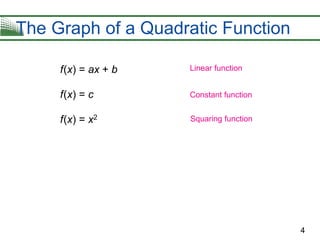
f(x) = ax + b
f(x) = c
f(x) = x2
Linear function
Squaring function
Constant function
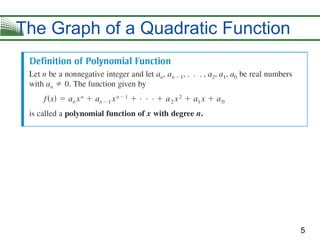
5
The Graph of a Quadratic Function
6
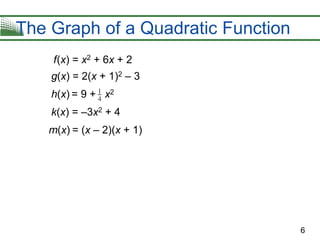
The Graph of a Quadratic Function
f(x) = x2 + 6x + 2
g(x) = 2(x + 1)2 – 3
h(x) = 9 + x2
k(x) = –3x2 + 4
m(x) = (x – 2)(x + 1)
7
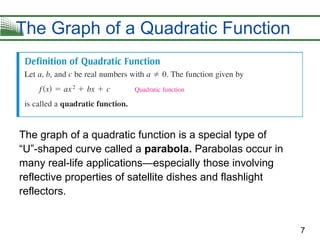
The Graph of a Quadratic Function
The graph of a quadratic function is a special type of
“U”-shaped curve called a parabola. Parabolas occur in
many real-life applications—especially those involving
reflective properties of satellite dishes and flashlight
reflectors.
8
The Graph of a Quadratic Function
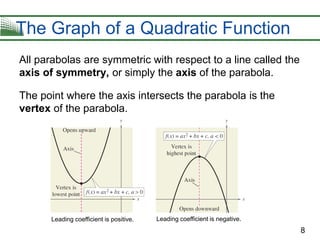
All parabolas are symmetric with respect to a line called the
axis of symmetry, or simply the axis of the parabola.
The point where the axis intersects the parabola is the
vertex of the parabola.
Leading coefficient is positive. Leading coefficient is negative.
9
The Graph of a Quadratic Function
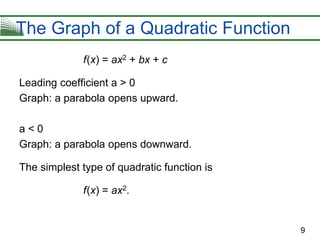
f(x) = ax2 + bx + c
Leading coefficient a > 0
Graph: a parabola opens upward.
a < 0
Graph: a parabola opens downward.
The simplest type of quadratic function is
f(x) = ax2.
10
The Graph of a Quadratic Function
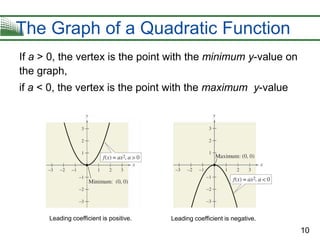
If a > 0, the vertex is the point with the minimum y-value on
the graph,
if a < 0, the vertex is the point with the maximum y-value
Leading coefficient is positive. Leading coefficient is negative.
11
Example 1 – Sketching Graphs of Quadratic Functions
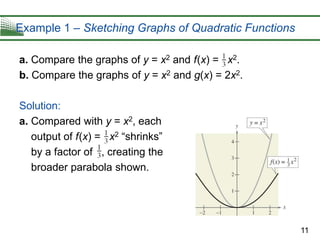
a. Compare the graphs of y = x2 and f(x) = x2.
b. Compare the graphs of y = x2 and g(x) = 2x2.
Solution:
a. Compared with y = x2, each
output of f(x) = x2 “shrinks”
by a factor of , creating the
broader parabola shown.
12
Example 1 – Solution
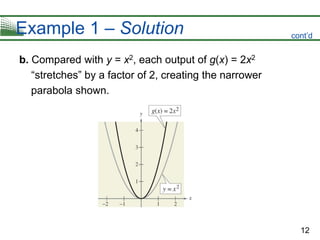
b. Compared with y = x2, each output of g(x) = 2x2
“stretches” by a factor of 2, creating the narrower
parabola shown.
cont’d
13
The Graph of a Quadratic Function
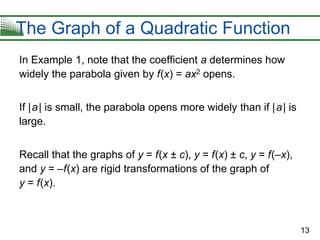
In Example 1, note that the coefficient a determines how
widely the parabola given by f(x) = ax2 opens.
If |a| is small, the parabola opens more widely than if |a| is
large.
Recall that the graphs of y = f(x ± c), y = f(x) ± c, y = f(–x),
and y = –f(x) are rigid transformations of the graph of
y = f(x).
14
The Graph of a Quadratic Function
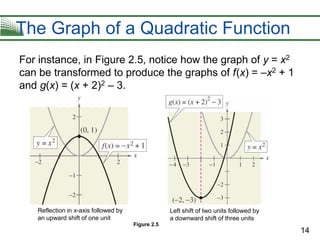
For instance, in Figure 2.5, notice how the graph of y = x2
can be transformed to produce the graphs of f(x) = –x2 + 1
and g(x) = (x + 2)2 – 3.
Reflection in x-axis followed by
an upward shift of one unit
Left shift of two units followed by
a downward shift of three units
Figure 2.5
15
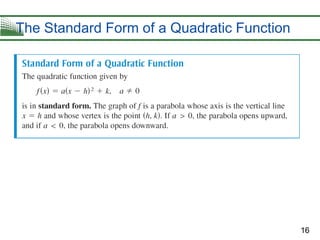
The Standard Form of a Quadratic
Function
16
The Standard Form of a Quadratic Function
17
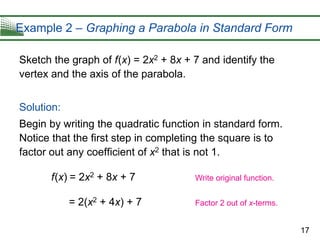
Example 2 – Graphing a Parabola in Standard Form
Sketch the graph of f(x) = 2x2 + 8x + 7 and identify the
vertex and the axis of the parabola.
Solution:
Begin by writing the quadratic function in standard form.
Notice that the first step in completing the square is to
factor out any coefficient of x2 that is not 1.
f(x) = 2x2 + 8x + 7
= 2(x2 + 4x) + 7
Write original function.
Factor 2 out of x-terms.
18
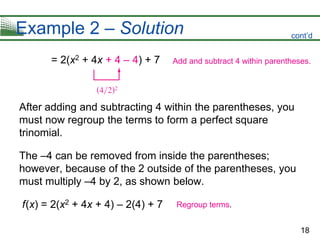
Example 2 – Solution
= 2(x2 + 4x + 4 – 4) + 7
After adding and subtracting 4 within the parentheses, you
must now regroup the terms to form a perfect square
trinomial.
The –4 can be removed from inside the parentheses;
however, because of the 2 outside of the parentheses, you
must multiply –4 by 2, as shown below.
f(x) = 2(x2 + 4x + 4) – 2(4) + 7
Add and subtract 4 within parentheses.
Regroup terms.
cont’d
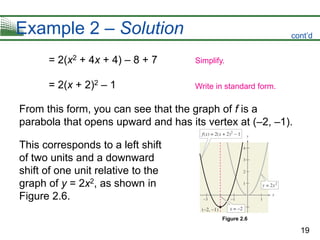
19
Example 2 – Solution
= 2(x2 + 4x + 4) – 8 + 7
= 2(x + 2)2 – 1
From this form, you can see that the graph of f is a
parabola that opens upward and has its vertex at (–2, –1).
This corresponds to a left shift
of two units and a downward
shift of one unit relative to the
graph of y = 2x2, as shown in
Figure 2.6.
Simplify.
Write in standard form.
Figure 2.6
cont’d
20
Example 2 – Solution
In the figure, you can see that the axis of the parabola is
the vertical line through the vertex, x = –2.
cont’d
21
The Standard Form of a Quadratic Function
To find the x-intercepts of the graph of f(x) = ax2 + bx + c,
you must solve the equation ax2 + bx + c = 0.
If ax2 + bx + c does not factor, you can use the Quadratic
Formula to find the x-intercepts.
Remember, however, that a parabola may not have
x-intercepts.
22
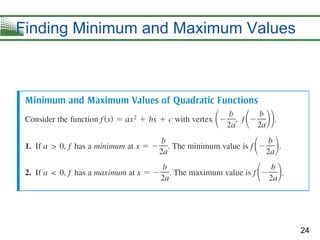
Finding Minimum and Maximum Values
23
Finding Minimum and Maximum Values
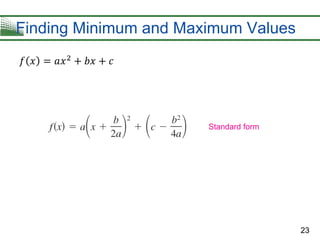
𝑓 𝑥 = 𝑎𝑥2 + 𝑏𝑥 + 𝑐
Standard form
24
Finding Minimum and Maximum Values
25
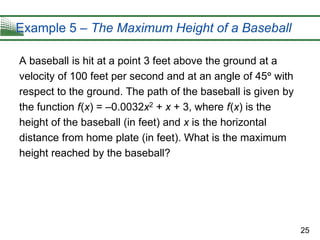
Example 5 – The Maximum Height of a Baseball
A baseball is hit at a point 3 feet above the ground at a
velocity of 100 feet per second and at an angle of 45 with
respect to the ground. The path of the baseball is given by
the function f(x) = –0.0032x2 + x + 3, where f(x) is the
height of the baseball (in feet) and x is the horizontal
distance from home plate (in feet). What is the maximum
height reached by the baseball?
26
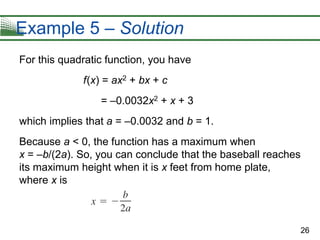
Example 5 – Solution
For this quadratic function, you have
f(x) = ax2 + bx + c
= –0.0032x2 + x + 3
which implies that a = –0.0032 and b = 1.
Because a < 0, the function has a maximum when
x = –b/(2a). So, you can conclude that the baseball reaches
its maximum height when it is x feet from home plate,
where x is
27
Example 5 – Solution
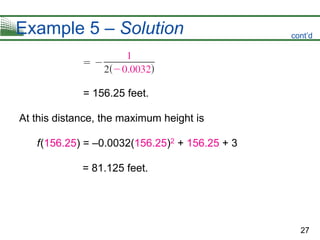
= 156.25 feet.
At this distance, the maximum height is
f(156.25) = –0.0032(156.25)2 + 156.25 + 3
= 81.125 feet.
cont’d

Modeling with Quadratics

  • 1.
    2.1 QUADRATIC FUNCTIONSAND MODELS Copyright © Cengage Learning. All rights reserved.
  • 2.
    2 • Analyze graphsof quadratic functions. • Write quadratic functions in standard form and use the results to sketch graphs of functions. • Find minimum and maximum values of quadratic functions in real-life applications. What You Should Learn
  • 3.
    3 The Graph ofa Quadratic Function
  • 4.
    4 The Graph ofa Quadratic Function f(x) = ax + b f(x) = c f(x) = x2 Linear function Squaring function Constant function
  • 5.
    5 The Graph ofa Quadratic Function
  • 6.
    6 The Graph ofa Quadratic Function f(x) = x2 + 6x + 2 g(x) = 2(x + 1)2 – 3 h(x) = 9 + x2 k(x) = –3x2 + 4 m(x) = (x – 2)(x + 1)
  • 7.
    7 The Graph ofa Quadratic Function The graph of a quadratic function is a special type of “U”-shaped curve called a parabola. Parabolas occur in many real-life applications—especially those involving reflective properties of satellite dishes and flashlight reflectors.
  • 8.
    8 The Graph ofa Quadratic Function All parabolas are symmetric with respect to a line called the axis of symmetry, or simply the axis of the parabola. The point where the axis intersects the parabola is the vertex of the parabola. Leading coefficient is positive. Leading coefficient is negative.
  • 9.
    9 The Graph ofa Quadratic Function f(x) = ax2 + bx + c Leading coefficient a > 0 Graph: a parabola opens upward. a < 0 Graph: a parabola opens downward. The simplest type of quadratic function is f(x) = ax2.
  • 10.
    10 The Graph ofa Quadratic Function If a > 0, the vertex is the point with the minimum y-value on the graph, if a < 0, the vertex is the point with the maximum y-value Leading coefficient is positive. Leading coefficient is negative.
  • 11.
    11 Example 1 –Sketching Graphs of Quadratic Functions a. Compare the graphs of y = x2 and f(x) = x2. b. Compare the graphs of y = x2 and g(x) = 2x2. Solution: a. Compared with y = x2, each output of f(x) = x2 “shrinks” by a factor of , creating the broader parabola shown.
  • 12.
    12 Example 1 –Solution b. Compared with y = x2, each output of g(x) = 2x2 “stretches” by a factor of 2, creating the narrower parabola shown. cont’d
  • 13.
    13 The Graph ofa Quadratic Function In Example 1, note that the coefficient a determines how widely the parabola given by f(x) = ax2 opens. If |a| is small, the parabola opens more widely than if |a| is large. Recall that the graphs of y = f(x ± c), y = f(x) ± c, y = f(–x), and y = –f(x) are rigid transformations of the graph of y = f(x).
  • 14.
    14 The Graph ofa Quadratic Function For instance, in Figure 2.5, notice how the graph of y = x2 can be transformed to produce the graphs of f(x) = –x2 + 1 and g(x) = (x + 2)2 – 3. Reflection in x-axis followed by an upward shift of one unit Left shift of two units followed by a downward shift of three units Figure 2.5
  • 15.
    15 The Standard Formof a Quadratic Function
  • 16.
    16 The Standard Formof a Quadratic Function
  • 17.
    17 Example 2 –Graphing a Parabola in Standard Form Sketch the graph of f(x) = 2x2 + 8x + 7 and identify the vertex and the axis of the parabola. Solution: Begin by writing the quadratic function in standard form. Notice that the first step in completing the square is to factor out any coefficient of x2 that is not 1. f(x) = 2x2 + 8x + 7 = 2(x2 + 4x) + 7 Write original function. Factor 2 out of x-terms.
  • 18.
    18 Example 2 –Solution = 2(x2 + 4x + 4 – 4) + 7 After adding and subtracting 4 within the parentheses, you must now regroup the terms to form a perfect square trinomial. The –4 can be removed from inside the parentheses; however, because of the 2 outside of the parentheses, you must multiply –4 by 2, as shown below. f(x) = 2(x2 + 4x + 4) – 2(4) + 7 Add and subtract 4 within parentheses. Regroup terms. cont’d
  • 19.
    19 Example 2 –Solution = 2(x2 + 4x + 4) – 8 + 7 = 2(x + 2)2 – 1 From this form, you can see that the graph of f is a parabola that opens upward and has its vertex at (–2, –1). This corresponds to a left shift of two units and a downward shift of one unit relative to the graph of y = 2x2, as shown in Figure 2.6. Simplify. Write in standard form. Figure 2.6 cont’d
  • 20.
    20 Example 2 –Solution In the figure, you can see that the axis of the parabola is the vertical line through the vertex, x = –2. cont’d
  • 21.
    21 The Standard Formof a Quadratic Function To find the x-intercepts of the graph of f(x) = ax2 + bx + c, you must solve the equation ax2 + bx + c = 0. If ax2 + bx + c does not factor, you can use the Quadratic Formula to find the x-intercepts. Remember, however, that a parabola may not have x-intercepts.
  • 22.
    22 Finding Minimum andMaximum Values
  • 23.
    23 Finding Minimum andMaximum Values 𝑓 𝑥 = 𝑎𝑥2 + 𝑏𝑥 + 𝑐 Standard form
  • 24.
    24 Finding Minimum andMaximum Values
  • 25.
    25 Example 5 –The Maximum Height of a Baseball A baseball is hit at a point 3 feet above the ground at a velocity of 100 feet per second and at an angle of 45 with respect to the ground. The path of the baseball is given by the function f(x) = –0.0032x2 + x + 3, where f(x) is the height of the baseball (in feet) and x is the horizontal distance from home plate (in feet). What is the maximum height reached by the baseball?
  • 26.
    26 Example 5 –Solution For this quadratic function, you have f(x) = ax2 + bx + c = –0.0032x2 + x + 3 which implies that a = –0.0032 and b = 1. Because a < 0, the function has a maximum when x = –b/(2a). So, you can conclude that the baseball reaches its maximum height when it is x feet from home plate, where x is
  • 27.
    27 Example 5 –Solution = 156.25 feet. At this distance, the maximum height is f(156.25) = –0.0032(156.25)2 + 156.25 + 3 = 81.125 feet. cont’d