Example 1
Example 1
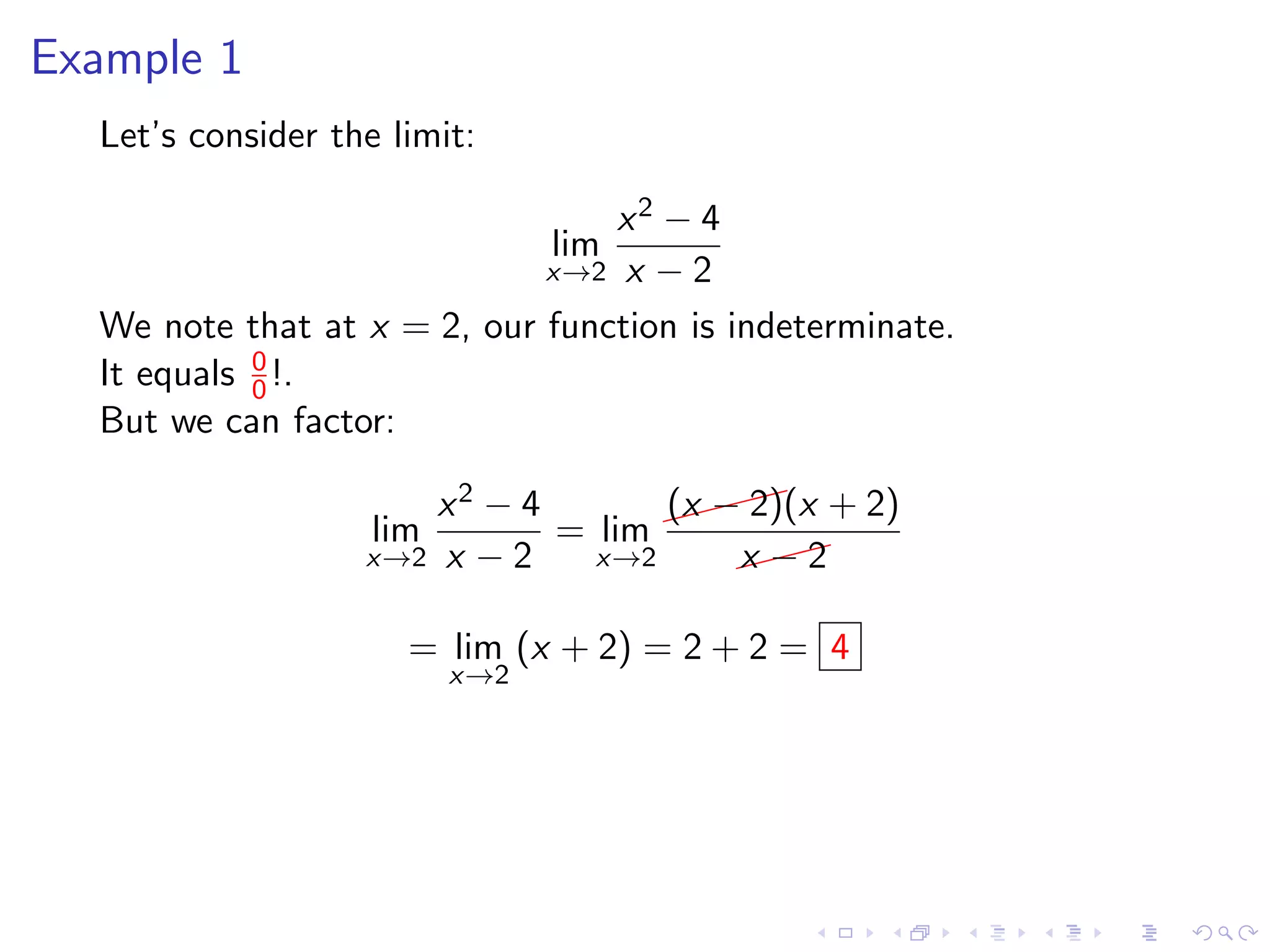
Let’s consider the limit:
Example 1
Let’s consider the limit:
lim
x→2
x2 − 4
x − 2
Example 1
Let’s consider the limit:
lim
x→2
x2 − 4
x − 2
We note that at x = 2, our function is indeterminate.
Example 1
Let’s consider the limit:
lim
x→2
x2 − 4
x − 2
We note that at x = 2, our function is indeterminate.
It equals 0
0!.
Example 1
Let’s consider the limit:
lim
x→2
x2 − 4
x − 2
We note that at x = 2, our function is indeterminate.
It equals 0
0!.
But we can factor:
Example 1
Let’s consider the limit:
lim
x→2
x2 − 4
x − 2
We note that at x = 2, our function is indeterminate.
It equals 0
0!.
But we can factor:
lim
x→2
x2 − 4
x − 2
=
Example 1
Let’s consider the limit:
lim
x→2
x2 − 4
x − 2
We note that at x = 2, our function is indeterminate.
It equals 0
0!.
But we can factor:
lim
x→2
x2 − 4
x − 2
= lim
x→2
Example 1
Let’s consider the limit:
lim
x→2
x2 − 4
x − 2
We note that at x = 2, our function is indeterminate.
It equals 0
0!.
But we can factor:
lim
x→2
x2 − 4
x − 2
= lim
x→2
(x − 2)(x + 2)
x − 2
Example 1
Let’s consider the limit:
lim
x→2
x2 − 4
x − 2
We note that at x = 2, our function is indeterminate.
It equals 0
0!.
But we can factor:
lim
x→2
x2 − 4
x − 2
= lim
x→2
$$$$(x − 2)(x + 2)
$$$x − 2
Example 1
Let’s consider the limit:
lim
x→2
x2 − 4
x − 2
We note that at x = 2, our function is indeterminate.
It equals 0
0!.
But we can factor:
lim
x→2
x2 − 4
x − 2
= lim
x→2
$$$$(x − 2)(x + 2)
$$$x − 2
= lim
x→2
(x + 2)
Example 1
Let’s consider the limit:
lim
x→2
x2 − 4
x − 2
We note that at x = 2, our function is indeterminate.
It equals 0
0!.
But we can factor:
lim
x→2
x2 − 4
x − 2
= lim
x→2
$$$$(x − 2)(x + 2)
$$$x − 2
= lim
x→2
(x + 2) = 2 + 2 =
Example 1
Let’s consider the limit:
lim
x→2
x2 − 4
x − 2
We note that at x = 2, our function is indeterminate.
It equals 0
0!.
But we can factor:
lim
x→2
x2 − 4
x − 2
= lim
x→2
$$$$(x − 2)(x + 2)
$$$x − 2
= lim
x→2
(x + 2) = 2 + 2 = 4
Example 1
Example 1
What is the graph of this function?
Example 1
What is the graph of this function?
f (x) =
x2 − 2
x + 2
Example 1
What is the graph of this function?
f (x) =
x2 − 2
x + 2
Example 1
What is the graph of this function?
f (x) =
x2 − 2
x + 2
It is the graph of x + 2, but with a hole!
Example 2
Example 2
lim
x→1
x3 − 1
x − 1
Example 2
lim
x→1
x3 − 1
x − 1
Remember how to factor the numerator?
Example 2
lim
x→1
x3 − 1
x − 1
Remember how to factor the numerator?
lim
x→1
x3 − 1
x − 1
=
Example 2
lim
x→1
x3 − 1
x − 1
Remember how to factor the numerator?
lim
x→1
x3 − 1
x − 1
= lim
x→1
Example 2
lim
x→1
x3 − 1
x − 1
Remember how to factor the numerator?
lim
x→1
x3 − 1
x − 1
= lim
x→1
(x − 1)(x2 + x + 1)
x − 1
Example 2
lim
x→1
x3 − 1
x − 1
Remember how to factor the numerator?
lim
x→1
x3 − 1
x − 1
= lim
x→1
$$$$(x − 1)(x2 + x + 1)
$$$x − 1
Example 2
lim
x→1
x3 − 1
x − 1
Remember how to factor the numerator?
lim
x→1
x3 − 1
x − 1
= lim
x→1
$$$$(x − 1)(x2 + x + 1)
$$$x − 1
= lim
x→1
x2
+ x + 1
Example 2
lim
x→1
x3 − 1
x − 1
Remember how to factor the numerator?
lim
x→1
x3 − 1
x − 1
= lim
x→1
$$$$(x − 1)(x2 + x + 1)
$$$x − 1
= lim
x→1
x2
+ x + 1 = 12
+ 1 + 1
Example 2
lim
x→1
x3 − 1
x − 1
Remember how to factor the numerator?
lim
x→1
x3 − 1
x − 1
= lim
x→1
$$$$(x − 1)(x2 + x + 1)
$$$x − 1
= lim
x→1
x2
+ x + 1 = 12
+ 1 + 1 = 3
Example 3
Example 3
lim
h→0
(a + h)3 − a3
h
Example 3
lim
h→0
(a + h)3 − a3
h
Here a is a constant. Let’s expand (a + h)3:
Example 3
lim
h→0
(a + h)3 − a3
h
Here a is a constant. Let’s expand (a + h)3:
lim
h→0
a3 + 3a2h + 3ah2 + h3 − a3
h
Example 3
lim
h→0
(a + h)3 − a3
h
Here a is a constant. Let’s expand (a + h)3:
lim
h→0
  a3 + 3a2h + 3ah2 + h3 −  a3
h
=
Example 3
lim
h→0
(a + h)3 − a3
h
Here a is a constant. Let’s expand (a + h)3:
lim
h→0
  a3 + 3a2h + 3ah2 + h3 −  a3
h
=
lim
h→0
3a2h + 3ah2 + h3
h
Example 3
lim
h→0
(a + h)3 − a3
h
Here a is a constant. Let’s expand (a + h)3:
lim
h→0
  a3 + 3a2h + 3ah2 + h3 −  a3
h
=
lim
h→0
3a2h + 3ah2 + h3
h
= lim
h→0
Example 3
lim
h→0
(a + h)3 − a3
h
Here a is a constant. Let’s expand (a + h)3:
lim
h→0
  a3 + 3a2h + 3ah2 + h3 −  a3
h
=
lim
h→0
3a2h + 3ah2 + h3
h
= lim
h→0
h 3a2 + 3ah + h2
h
Example 3
lim
h→0
(a + h)3 − a3
h
Here a is a constant. Let’s expand (a + h)3:
lim
h→0
  a3 + 3a2h + 3ah2 + h3 −  a3
h
=
lim
h→0
3a2h + 3ah2 + h3
h
= lim
h→0
¡h 3a2 + 3ah + h2
¡h
Example 3
lim
h→0
(a + h)3 − a3
h
Here a is a constant. Let’s expand (a + h)3:
lim
h→0
  a3 + 3a2h + 3ah2 + h3 −  a3
h
=
lim
h→0
3a2h + 3ah2 + h3
h
= lim
h→0
¡h 3a2 + 3ah + h2
¡h
= lim
h→0
3a2
+ 3ah + h2
Example 3
lim
h→0
(a + h)3 − a3
h
Here a is a constant. Let’s expand (a + h)3:
lim
h→0
  a3 + 3a2h + 3ah2 + h3 −  a3
h
=
lim
h→0
3a2h + 3ah2 + h3
h
= lim
h→0
¡h 3a2 + 3ah + h2
¡h
= lim
h→0
3a2
+ 3ah + h2
= 3a2
+ 3a.0 + 02
Example 3
lim
h→0
(a + h)3 − a3
h
Here a is a constant. Let’s expand (a + h)3:
lim
h→0
  a3 + 3a2h + 3ah2 + h3 −  a3
h
=
lim
h→0
3a2h + 3ah2 + h3
h
= lim
h→0
¡h 3a2 + 3ah + h2
¡h
= lim
h→0
3a2
+ 3ah + h2
= 3a2
+ 3a.0 + 02
= 3a2
Limits by Factoring

Limits by Factoring

  • 3.
  • 4.
  • 5.
    Example 1 Let’s considerthe limit: lim x→2 x2 − 4 x − 2
  • 6.
    Example 1 Let’s considerthe limit: lim x→2 x2 − 4 x − 2 We note that at x = 2, our function is indeterminate.
  • 7.
    Example 1 Let’s considerthe limit: lim x→2 x2 − 4 x − 2 We note that at x = 2, our function is indeterminate. It equals 0 0!.
  • 8.
    Example 1 Let’s considerthe limit: lim x→2 x2 − 4 x − 2 We note that at x = 2, our function is indeterminate. It equals 0 0!. But we can factor:
  • 9.
    Example 1 Let’s considerthe limit: lim x→2 x2 − 4 x − 2 We note that at x = 2, our function is indeterminate. It equals 0 0!. But we can factor: lim x→2 x2 − 4 x − 2 =
  • 10.
    Example 1 Let’s considerthe limit: lim x→2 x2 − 4 x − 2 We note that at x = 2, our function is indeterminate. It equals 0 0!. But we can factor: lim x→2 x2 − 4 x − 2 = lim x→2
  • 11.
    Example 1 Let’s considerthe limit: lim x→2 x2 − 4 x − 2 We note that at x = 2, our function is indeterminate. It equals 0 0!. But we can factor: lim x→2 x2 − 4 x − 2 = lim x→2 (x − 2)(x + 2) x − 2
  • 12.
    Example 1 Let’s considerthe limit: lim x→2 x2 − 4 x − 2 We note that at x = 2, our function is indeterminate. It equals 0 0!. But we can factor: lim x→2 x2 − 4 x − 2 = lim x→2 $$$$(x − 2)(x + 2) $$$x − 2
  • 13.
    Example 1 Let’s considerthe limit: lim x→2 x2 − 4 x − 2 We note that at x = 2, our function is indeterminate. It equals 0 0!. But we can factor: lim x→2 x2 − 4 x − 2 = lim x→2 $$$$(x − 2)(x + 2) $$$x − 2 = lim x→2 (x + 2)
  • 14.
    Example 1 Let’s considerthe limit: lim x→2 x2 − 4 x − 2 We note that at x = 2, our function is indeterminate. It equals 0 0!. But we can factor: lim x→2 x2 − 4 x − 2 = lim x→2 $$$$(x − 2)(x + 2) $$$x − 2 = lim x→2 (x + 2) = 2 + 2 =
  • 15.
    Example 1 Let’s considerthe limit: lim x→2 x2 − 4 x − 2 We note that at x = 2, our function is indeterminate. It equals 0 0!. But we can factor: lim x→2 x2 − 4 x − 2 = lim x→2 $$$$(x − 2)(x + 2) $$$x − 2 = lim x→2 (x + 2) = 2 + 2 = 4
  • 16.
  • 17.
    Example 1 What isthe graph of this function?
  • 18.
    Example 1 What isthe graph of this function? f (x) = x2 − 2 x + 2
  • 19.
    Example 1 What isthe graph of this function? f (x) = x2 − 2 x + 2
  • 20.
    Example 1 What isthe graph of this function? f (x) = x2 − 2 x + 2 It is the graph of x + 2, but with a hole!
  • 21.
  • 22.
  • 23.
    Example 2 lim x→1 x3 −1 x − 1 Remember how to factor the numerator?
  • 24.
    Example 2 lim x→1 x3 −1 x − 1 Remember how to factor the numerator? lim x→1 x3 − 1 x − 1 =
  • 25.
    Example 2 lim x→1 x3 −1 x − 1 Remember how to factor the numerator? lim x→1 x3 − 1 x − 1 = lim x→1
  • 26.
    Example 2 lim x→1 x3 −1 x − 1 Remember how to factor the numerator? lim x→1 x3 − 1 x − 1 = lim x→1 (x − 1)(x2 + x + 1) x − 1
  • 27.
    Example 2 lim x→1 x3 −1 x − 1 Remember how to factor the numerator? lim x→1 x3 − 1 x − 1 = lim x→1 $$$$(x − 1)(x2 + x + 1) $$$x − 1
  • 28.
    Example 2 lim x→1 x3 −1 x − 1 Remember how to factor the numerator? lim x→1 x3 − 1 x − 1 = lim x→1 $$$$(x − 1)(x2 + x + 1) $$$x − 1 = lim x→1 x2 + x + 1
  • 29.
    Example 2 lim x→1 x3 −1 x − 1 Remember how to factor the numerator? lim x→1 x3 − 1 x − 1 = lim x→1 $$$$(x − 1)(x2 + x + 1) $$$x − 1 = lim x→1 x2 + x + 1 = 12 + 1 + 1
  • 30.
    Example 2 lim x→1 x3 −1 x − 1 Remember how to factor the numerator? lim x→1 x3 − 1 x − 1 = lim x→1 $$$$(x − 1)(x2 + x + 1) $$$x − 1 = lim x→1 x2 + x + 1 = 12 + 1 + 1 = 3
  • 31.
  • 32.
  • 33.
    Example 3 lim h→0 (a +h)3 − a3 h Here a is a constant. Let’s expand (a + h)3:
  • 34.
    Example 3 lim h→0 (a +h)3 − a3 h Here a is a constant. Let’s expand (a + h)3: lim h→0 a3 + 3a2h + 3ah2 + h3 − a3 h
  • 35.
    Example 3 lim h→0 (a +h)3 − a3 h Here a is a constant. Let’s expand (a + h)3: lim h→0   a3 + 3a2h + 3ah2 + h3 −  a3 h =
  • 36.
    Example 3 lim h→0 (a +h)3 − a3 h Here a is a constant. Let’s expand (a + h)3: lim h→0   a3 + 3a2h + 3ah2 + h3 −  a3 h = lim h→0 3a2h + 3ah2 + h3 h
  • 37.
    Example 3 lim h→0 (a +h)3 − a3 h Here a is a constant. Let’s expand (a + h)3: lim h→0   a3 + 3a2h + 3ah2 + h3 −  a3 h = lim h→0 3a2h + 3ah2 + h3 h = lim h→0
  • 38.
    Example 3 lim h→0 (a +h)3 − a3 h Here a is a constant. Let’s expand (a + h)3: lim h→0   a3 + 3a2h + 3ah2 + h3 −  a3 h = lim h→0 3a2h + 3ah2 + h3 h = lim h→0 h 3a2 + 3ah + h2 h
  • 39.
    Example 3 lim h→0 (a +h)3 − a3 h Here a is a constant. Let’s expand (a + h)3: lim h→0   a3 + 3a2h + 3ah2 + h3 −  a3 h = lim h→0 3a2h + 3ah2 + h3 h = lim h→0 ¡h 3a2 + 3ah + h2 ¡h
  • 40.
    Example 3 lim h→0 (a +h)3 − a3 h Here a is a constant. Let’s expand (a + h)3: lim h→0   a3 + 3a2h + 3ah2 + h3 −  a3 h = lim h→0 3a2h + 3ah2 + h3 h = lim h→0 ¡h 3a2 + 3ah + h2 ¡h = lim h→0 3a2 + 3ah + h2
  • 41.
    Example 3 lim h→0 (a +h)3 − a3 h Here a is a constant. Let’s expand (a + h)3: lim h→0   a3 + 3a2h + 3ah2 + h3 −  a3 h = lim h→0 3a2h + 3ah2 + h3 h = lim h→0 ¡h 3a2 + 3ah + h2 ¡h = lim h→0 3a2 + 3ah + h2 = 3a2 + 3a.0 + 02
  • 42.
    Example 3 lim h→0 (a +h)3 − a3 h Here a is a constant. Let’s expand (a + h)3: lim h→0   a3 + 3a2h + 3ah2 + h3 −  a3 h = lim h→0 3a2h + 3ah2 + h3 h = lim h→0 ¡h 3a2 + 3ah + h2 ¡h = lim h→0 3a2 + 3ah + h2 = 3a2 + 3a.0 + 02 = 3a2