The LIATE Rule
The LIATE Rule
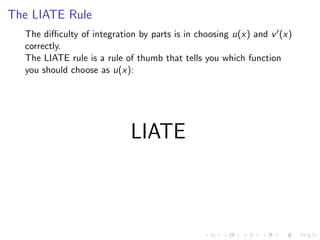
The difficulty of integration by parts is in choosing u(x) and v (x)
correctly.
The LIATE Rule
The difficulty of integration by parts is in choosing u(x) and v (x)
correctly.
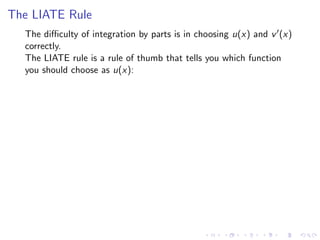
The LIATE rule is a rule of thumb that tells you which function
you should choose as u(x):
The LIATE Rule
The difficulty of integration by parts is in choosing u(x) and v (x)
correctly.
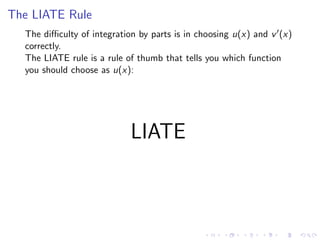
The LIATE rule is a rule of thumb that tells you which function
you should choose as u(x):
LIATE
The LIATE Rule
The difficulty of integration by parts is in choosing u(x) and v (x)
correctly.
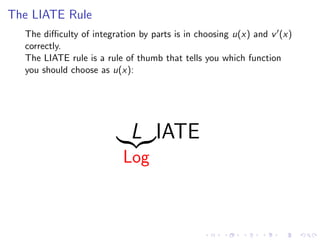
The LIATE rule is a rule of thumb that tells you which function
you should choose as u(x):
L
Log
IATE
The LIATE Rule
The difficulty of integration by parts is in choosing u(x) and v (x)
correctly.
The LIATE rule is a rule of thumb that tells you which function
you should choose as u(x):
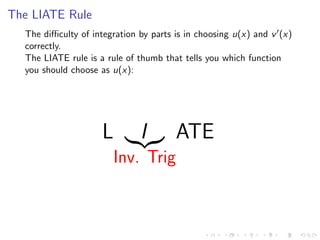
L I
Inv. Trig
ATE
The LIATE Rule
The difficulty of integration by parts is in choosing u(x) and v (x)
correctly.
The LIATE rule is a rule of thumb that tells you which function
you should choose as u(x):
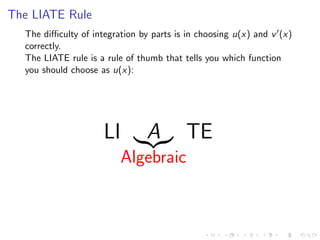
LI A
Algebraic
TE
The LIATE Rule
The difficulty of integration by parts is in choosing u(x) and v (x)
correctly.
The LIATE rule is a rule of thumb that tells you which function
you should choose as u(x):
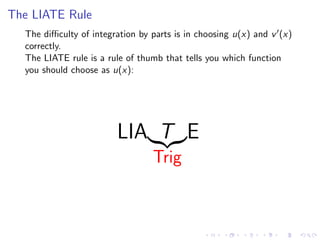
LIA T
Trig
E
The LIATE Rule
The difficulty of integration by parts is in choosing u(x) and v (x)
correctly.
The LIATE rule is a rule of thumb that tells you which function
you should choose as u(x):
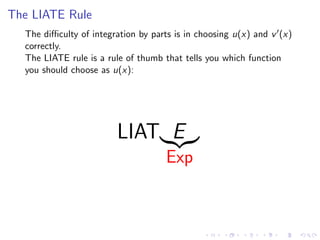
LIAT E
Exp
The LIATE Rule
The difficulty of integration by parts is in choosing u(x) and v (x)
correctly.
The LIATE rule is a rule of thumb that tells you which function
you should choose as u(x):
LIATE
The LIATE Rule
The difficulty of integration by parts is in choosing u(x) and v (x)
correctly.
The LIATE rule is a rule of thumb that tells you which function
you should choose as u(x):
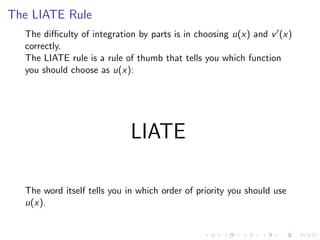
LIATE
The word itself tells you in which order of priority you should use
u(x).
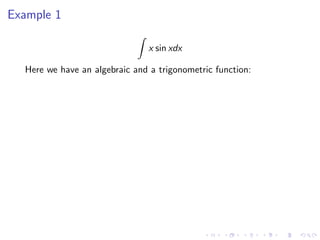
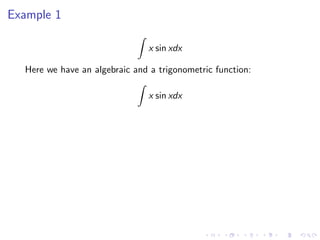
Example 1
Example 1
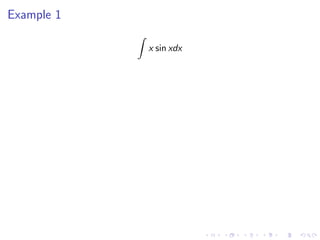
x sin xdx
Example 1
x sin xdx
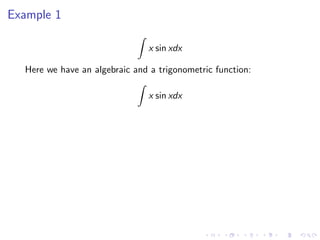
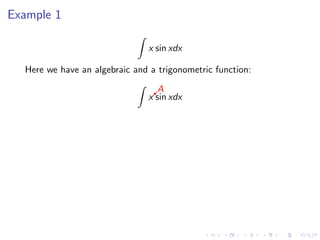
Here we have an algebraic and a trigonometric function:
Example 1
x sin xdx
Here we have an algebraic and a trigonometric function:
x sin xdx
Example 1
x sin xdx
Here we have an algebraic and a trigonometric function:
 
A
x sin xdx
Example 1
x sin xdx
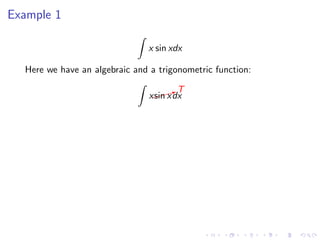
Here we have an algebraic and a trigonometric function:
x$$$XT
sin xdx
Example 1
x sin xdx
Here we have an algebraic and a trigonometric function:
x sin xdx
Example 1
x sin xdx
Here we have an algebraic and a trigonometric function:
x sin xdx
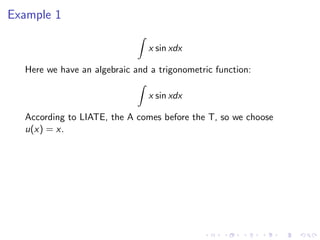
According to LIATE, the A comes before the T, so we choose
u(x) = x.
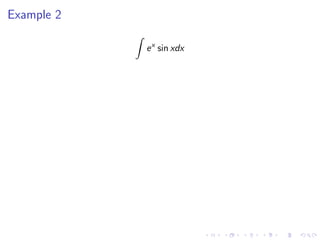
Example 2
Example 2
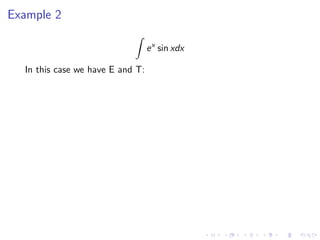
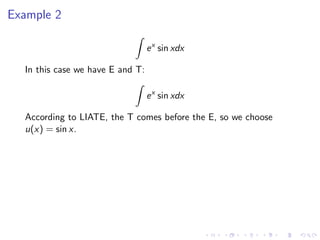
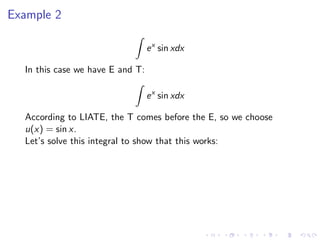
ex
sin xdx
Example 2
ex
sin xdx
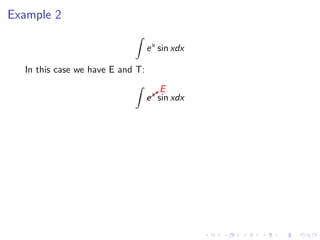
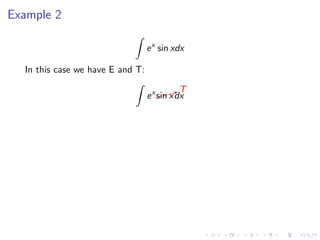
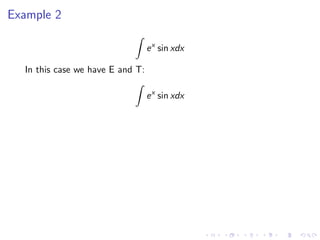
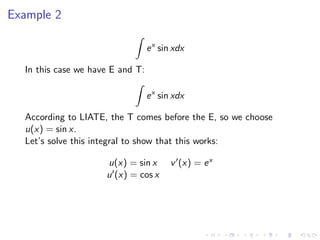
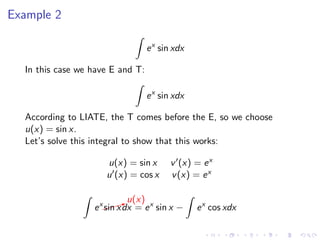
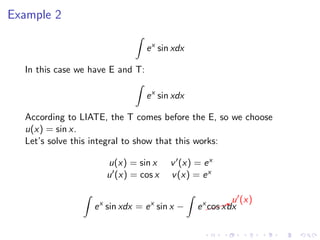
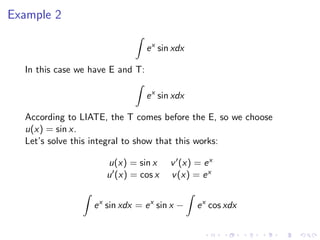
In this case we have E and T:
Example 2
ex
sin xdx
In this case we have E and T:
b
E
ex
sin xdx
Example 2
ex
sin xdx
In this case we have E and T:
ex$$$XT
sin xdx
Example 2
ex
sin xdx
In this case we have E and T:
ex
sin xdx
Example 2
ex
sin xdx
In this case we have E and T:
ex
sin xdx
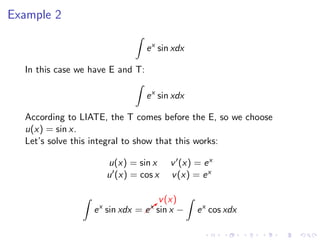
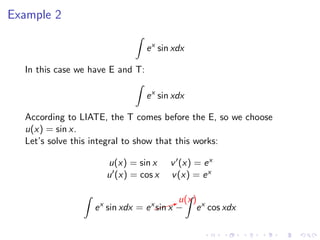
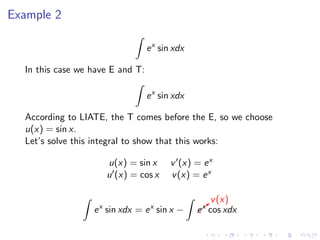
According to LIATE, the T comes before the E, so we choose
u(x) = sin x.
Example 2
ex
sin xdx
In this case we have E and T:
ex
sin xdx
According to LIATE, the T comes before the E, so we choose
u(x) = sin x.
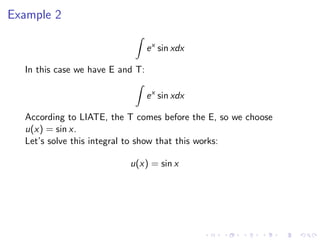
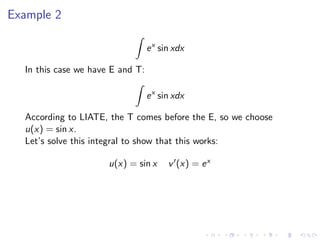
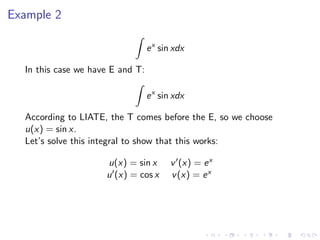
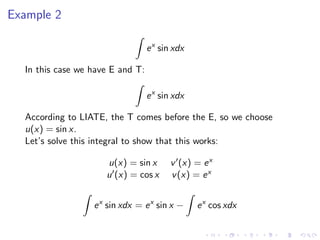
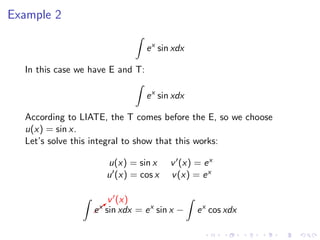
Let’s solve this integral to show that this works:
Example 2
ex
sin xdx
In this case we have E and T:
ex
sin xdx
According to LIATE, the T comes before the E, so we choose
u(x) = sin x.
Let’s solve this integral to show that this works:
u(x) = sin x
Example 2
ex
sin xdx
In this case we have E and T:
ex
sin xdx
According to LIATE, the T comes before the E, so we choose
u(x) = sin x.
Let’s solve this integral to show that this works:
u(x) = sin x v (x) = ex
Example 2
ex
sin xdx
In this case we have E and T:
ex
sin xdx
According to LIATE, the T comes before the E, so we choose
u(x) = sin x.
Let’s solve this integral to show that this works:
u(x) = sin x v (x) = ex
u (x) = cos x
Example 2
ex
sin xdx
In this case we have E and T:
ex
sin xdx
According to LIATE, the T comes before the E, so we choose
u(x) = sin x.
Let’s solve this integral to show that this works:
u(x) = sin x v (x) = ex
u (x) = cos x v(x) = ex
Example 2
ex
sin xdx
In this case we have E and T:
ex
sin xdx
According to LIATE, the T comes before the E, so we choose
u(x) = sin x.
Let’s solve this integral to show that this works:
u(x) = sin x v (x) = ex
u (x) = cos x v(x) = ex
ex
sin xdx = ex
sin x − ex
cos xdx
Example 2
ex
sin xdx
In this case we have E and T:
ex
sin xdx
According to LIATE, the T comes before the E, so we choose
u(x) = sin x.
Let’s solve this integral to show that this works:
u(x) = sin x v (x) = ex
u (x) = cos x v(x) = ex
b
v (x)
ex
sin xdx = ex
sin x − ex
cos xdx
Example 2
ex
sin xdx
In this case we have E and T:
ex
sin xdx
According to LIATE, the T comes before the E, so we choose
u(x) = sin x.
Let’s solve this integral to show that this works:
u(x) = sin x v (x) = ex
u (x) = cos x v(x) = ex
ex$$$Xu(x)
sin xdx = ex
sin x − ex
cos xdx
Example 2
ex
sin xdx
In this case we have E and T:
ex
sin xdx
According to LIATE, the T comes before the E, so we choose
u(x) = sin x.
Let’s solve this integral to show that this works:
u(x) = sin x v (x) = ex
u (x) = cos x v(x) = ex
ex
sin xdx = b
v(x)
ex
sin x − ex
cos xdx
Example 2
ex
sin xdx
In this case we have E and T:
ex
sin xdx
According to LIATE, the T comes before the E, so we choose
u(x) = sin x.
Let’s solve this integral to show that this works:
u(x) = sin x v (x) = ex
u (x) = cos x v(x) = ex
ex
sin xdx = ex$$$Xu(x)
sin x − ex
cos xdx
Example 2
ex
sin xdx
In this case we have E and T:
ex
sin xdx
According to LIATE, the T comes before the E, so we choose
u(x) = sin x.
Let’s solve this integral to show that this works:
u(x) = sin x v (x) = ex
u (x) = cos x v(x) = ex
ex
sin xdx = ex
sin x − b
v(x)
ex
cos xdx
Example 2
ex
sin xdx
In this case we have E and T:
ex
sin xdx
According to LIATE, the T comes before the E, so we choose
u(x) = sin x.
Let’s solve this integral to show that this works:
u(x) = sin x v (x) = ex
u (x) = cos x v(x) = ex
ex
sin xdx = ex
sin x − ex
$$$Xu (x)
cos xdx
Example 2
ex
sin xdx
In this case we have E and T:
ex
sin xdx
According to LIATE, the T comes before the E, so we choose
u(x) = sin x.
Let’s solve this integral to show that this works:
u(x) = sin x v (x) = ex
u (x) = cos x v(x) = ex
ex
sin xdx = ex
sin x − ex
cos xdx
Example 2
Example 2
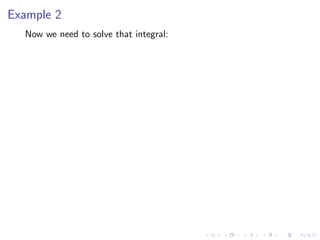
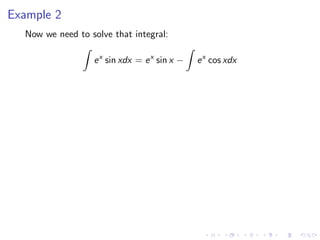
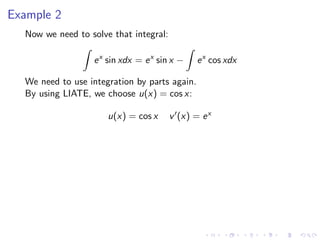
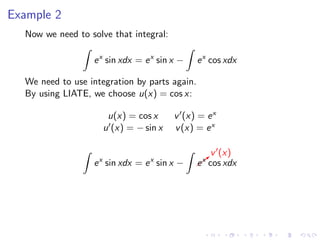
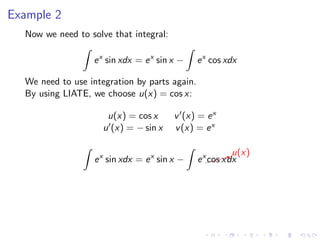
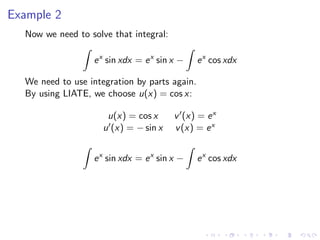
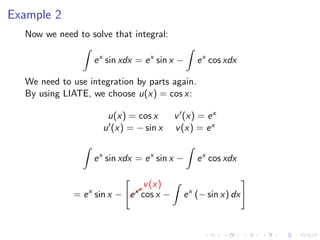
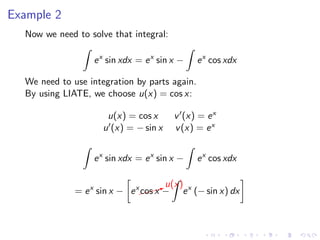
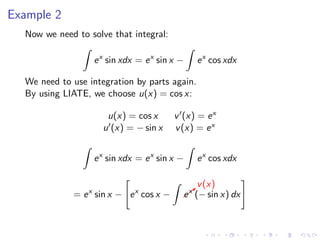
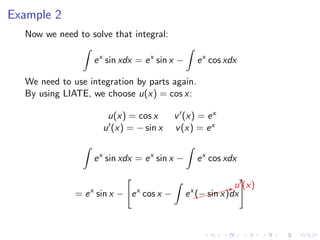
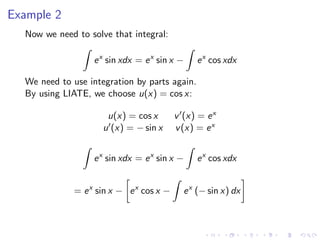
Now we need to solve that integral:
Example 2
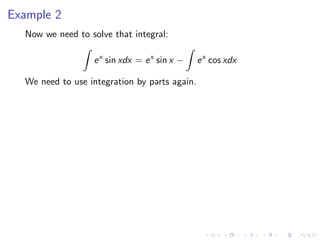
Now we need to solve that integral:
ex
sin xdx = ex
sin x − ex
cos xdx
Example 2
Now we need to solve that integral:
ex
sin xdx = ex
sin x − ex
cos xdx
We need to use integration by parts again.
Example 2
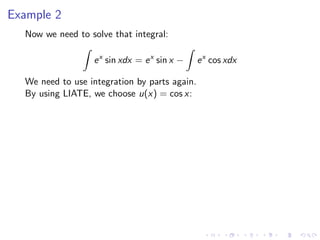
Now we need to solve that integral:
ex
sin xdx = ex
sin x − ex
cos xdx
We need to use integration by parts again.
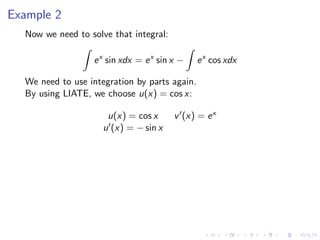
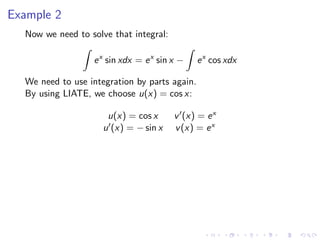
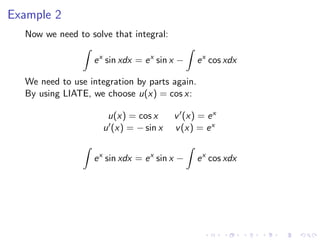
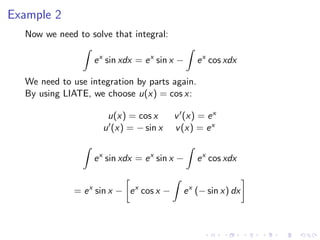
By using LIATE, we choose u(x) = cos x:
Example 2
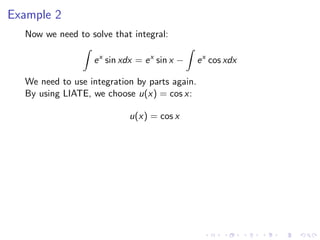
Now we need to solve that integral:
ex
sin xdx = ex
sin x − ex
cos xdx
We need to use integration by parts again.
By using LIATE, we choose u(x) = cos x:
u(x) = cos x
Example 2
Now we need to solve that integral:
ex
sin xdx = ex
sin x − ex
cos xdx
We need to use integration by parts again.
By using LIATE, we choose u(x) = cos x:
u(x) = cos x v (x) = ex
Example 2
Now we need to solve that integral:
ex
sin xdx = ex
sin x − ex
cos xdx
We need to use integration by parts again.
By using LIATE, we choose u(x) = cos x:
u(x) = cos x v (x) = ex
u (x) = − sin x
Example 2
Now we need to solve that integral:
ex
sin xdx = ex
sin x − ex
cos xdx
We need to use integration by parts again.
By using LIATE, we choose u(x) = cos x:
u(x) = cos x v (x) = ex
u (x) = − sin x v(x) = ex
Example 2
Now we need to solve that integral:
ex
sin xdx = ex
sin x − ex
cos xdx
We need to use integration by parts again.
By using LIATE, we choose u(x) = cos x:
u(x) = cos x v (x) = ex
u (x) = − sin x v(x) = ex
ex
sin xdx = ex
sin x − ex
cos xdx
Example 2
Now we need to solve that integral:
ex
sin xdx = ex
sin x − ex
cos xdx
We need to use integration by parts again.
By using LIATE, we choose u(x) = cos x:
u(x) = cos x v (x) = ex
u (x) = − sin x v(x) = ex
ex
sin xdx = ex
sin x − b
v (x)
ex
cos xdx
Example 2
Now we need to solve that integral:
ex
sin xdx = ex
sin x − ex
cos xdx
We need to use integration by parts again.
By using LIATE, we choose u(x) = cos x:
u(x) = cos x v (x) = ex
u (x) = − sin x v(x) = ex
ex
sin xdx = ex
sin x − ex
$$$Xu(x)
cos xdx
Example 2
Now we need to solve that integral:
ex
sin xdx = ex
sin x − ex
cos xdx
We need to use integration by parts again.
By using LIATE, we choose u(x) = cos x:
u(x) = cos x v (x) = ex
u (x) = − sin x v(x) = ex
ex
sin xdx = ex
sin x − ex
cos xdx
Example 2
Now we need to solve that integral:
ex
sin xdx = ex
sin x − ex
cos xdx
We need to use integration by parts again.
By using LIATE, we choose u(x) = cos x:
u(x) = cos x v (x) = ex
u (x) = − sin x v(x) = ex
ex
sin xdx = ex
sin x − ex
cos xdx
= ex
sin x − ex
cos x − ex
(− sin x) dx
Example 2
Now we need to solve that integral:
ex
sin xdx = ex
sin x − ex
cos xdx
We need to use integration by parts again.
By using LIATE, we choose u(x) = cos x:
u(x) = cos x v (x) = ex
u (x) = − sin x v(x) = ex
ex
sin xdx = ex
sin x − ex
cos xdx
= ex
sin x − b
v(x)
ex
cos x − ex
(− sin x) dx
Example 2
Now we need to solve that integral:
ex
sin xdx = ex
sin x − ex
cos xdx
We need to use integration by parts again.
By using LIATE, we choose u(x) = cos x:
u(x) = cos x v (x) = ex
u (x) = − sin x v(x) = ex
ex
sin xdx = ex
sin x − ex
cos xdx
= ex
sin x − ex
$$$Xu(x)
cos x − ex
(− sin x) dx
Example 2
Now we need to solve that integral:
ex
sin xdx = ex
sin x − ex
cos xdx
We need to use integration by parts again.
By using LIATE, we choose u(x) = cos x:
u(x) = cos x v (x) = ex
u (x) = − sin x v(x) = ex
ex
sin xdx = ex
sin x − ex
cos xdx
= ex
sin x − ex
cos x − b
v(x)
ex
(− sin x) dx
Example 2
Now we need to solve that integral:
ex
sin xdx = ex
sin x − ex
cos xdx
We need to use integration by parts again.
By using LIATE, we choose u(x) = cos x:
u(x) = cos x v (x) = ex
u (x) = − sin x v(x) = ex
ex
sin xdx = ex
sin x − ex
cos xdx
= ex
sin x − ex
cos x − ex
$$$$$Xu (x)
(− sin x)dx
Example 2
Now we need to solve that integral:
ex
sin xdx = ex
sin x − ex
cos xdx
We need to use integration by parts again.
By using LIATE, we choose u(x) = cos x:
u(x) = cos x v (x) = ex
u (x) = − sin x v(x) = ex
ex
sin xdx = ex
sin x − ex
cos xdx
= ex
sin x − ex
cos x − ex
(− sin x) dx
Example 2
Example 2
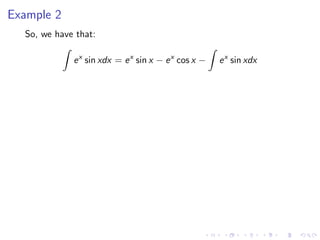
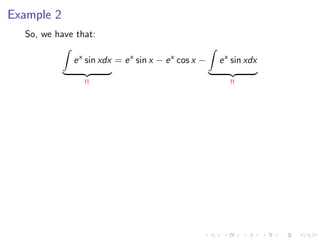
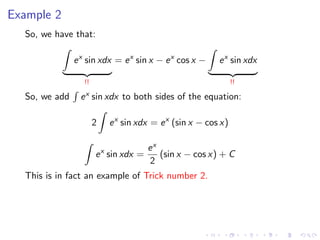
So, we have that:
Example 2
So, we have that:
ex
sin xdx = ex
sin x − ex
cos x − ex
sin xdx
Example 2
So, we have that:
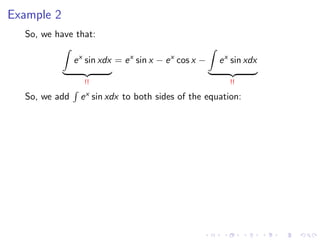
ex
sin xdx
!!
= ex
sin x − ex
cos x − ex
sin xdx
!!
Example 2
So, we have that:
ex
sin xdx
!!
= ex
sin x − ex
cos x − ex
sin xdx
!!
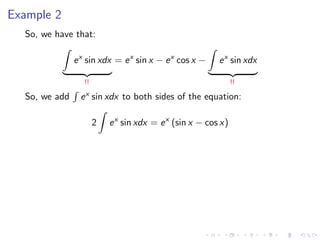
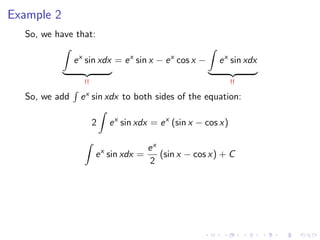
So, we add ex sin xdx to both sides of the equation:
Example 2
So, we have that:
ex
sin xdx
!!
= ex
sin x − ex
cos x − ex
sin xdx
!!
So, we add ex sin xdx to both sides of the equation:
2 ex
sin xdx = ex
(sin x − cos x)
Example 2
So, we have that:
ex
sin xdx
!!
= ex
sin x − ex
cos x − ex
sin xdx
!!
So, we add ex sin xdx to both sides of the equation:
2 ex
sin xdx = ex
(sin x − cos x)
ex
sin xdx =
ex
2
(sin x − cos x) + C
Example 2
So, we have that:
ex
sin xdx
!!
= ex
sin x − ex
cos x − ex
sin xdx
!!
So, we add ex sin xdx to both sides of the equation:
2 ex
sin xdx = ex
(sin x − cos x)
ex
sin xdx =
ex
2
(sin x − cos x) + C
This is in fact an example of Trick number 2.
Example 3
Example 3
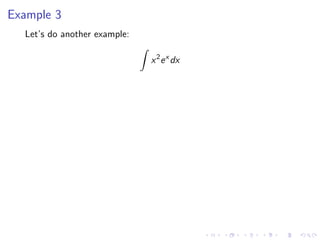
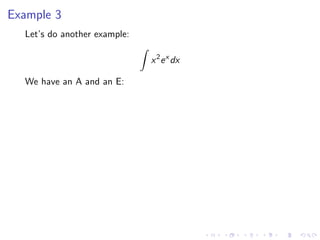
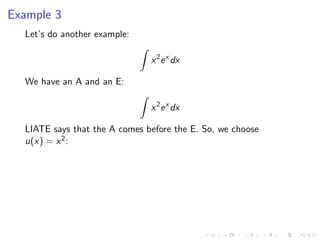
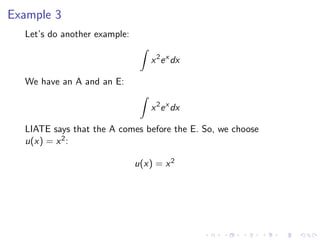
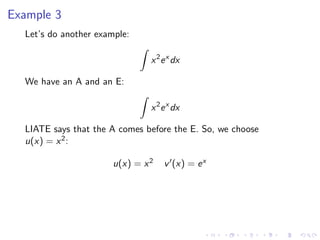
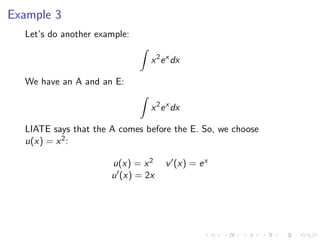
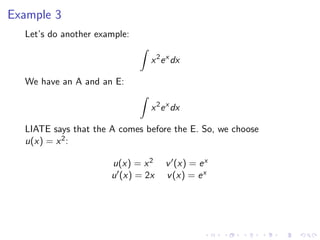
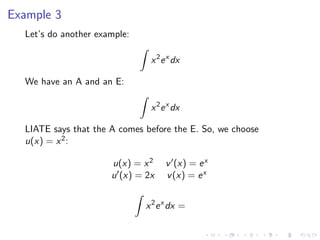
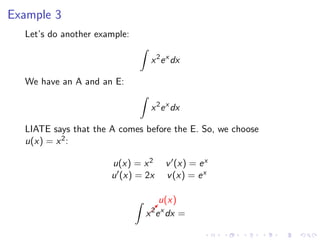
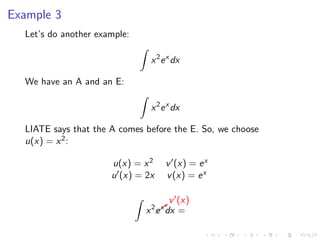
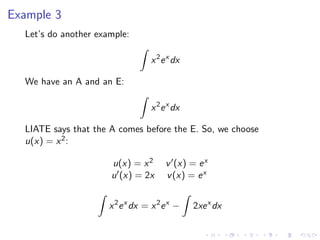
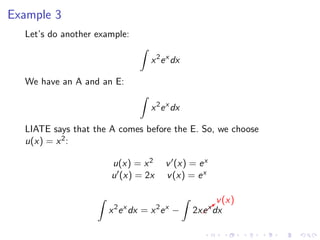
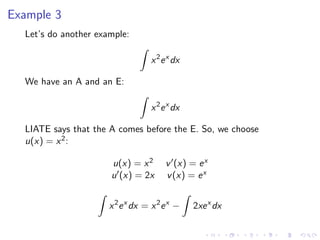
Let’s do another example:
Example 3
Let’s do another example:
x2
ex
dx
Example 3
Let’s do another example:
x2
ex
dx
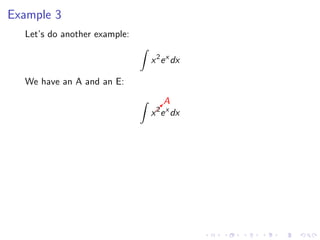
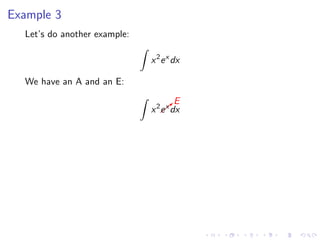
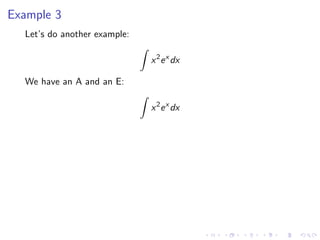
We have an A and an E:
Example 3
Let’s do another example:
x2
ex
dx
We have an A and an E:
  
A
x2
ex
dx
Example 3
Let’s do another example:
x2
ex
dx
We have an A and an E:
x2
b
E
ex
dx
Example 3
Let’s do another example:
x2
ex
dx
We have an A and an E:
x2
ex
dx
Example 3
Let’s do another example:
x2
ex
dx
We have an A and an E:
x2
ex
dx
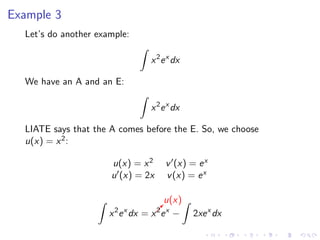
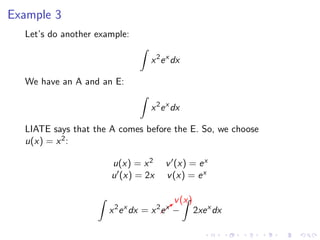
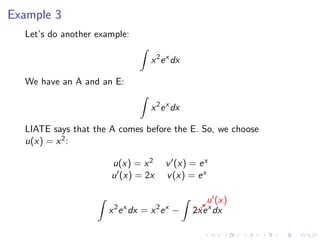
LIATE says that the A comes before the E. So, we choose
u(x) = x2:
Example 3
Let’s do another example:
x2
ex
dx
We have an A and an E:
x2
ex
dx
LIATE says that the A comes before the E. So, we choose
u(x) = x2:
u(x) = x2
Example 3
Let’s do another example:
x2
ex
dx
We have an A and an E:
x2
ex
dx
LIATE says that the A comes before the E. So, we choose
u(x) = x2:
u(x) = x2 v (x) = ex
Example 3
Let’s do another example:
x2
ex
dx
We have an A and an E:
x2
ex
dx
LIATE says that the A comes before the E. So, we choose
u(x) = x2:
u(x) = x2 v (x) = ex
u (x) = 2x
Example 3
Let’s do another example:
x2
ex
dx
We have an A and an E:
x2
ex
dx
LIATE says that the A comes before the E. So, we choose
u(x) = x2:
u(x) = x2 v (x) = ex
u (x) = 2x v(x) = ex
Example 3
Let’s do another example:
x2
ex
dx
We have an A and an E:
x2
ex
dx
LIATE says that the A comes before the E. So, we choose
u(x) = x2:
u(x) = x2 v (x) = ex
u (x) = 2x v(x) = ex
x2
ex
dx =
Example 3
Let’s do another example:
x2
ex
dx
We have an A and an E:
x2
ex
dx
LIATE says that the A comes before the E. So, we choose
u(x) = x2:
u(x) = x2 v (x) = ex
u (x) = 2x v(x) = ex
  
u(x)
x2
ex
dx =
Example 3
Let’s do another example:
x2
ex
dx
We have an A and an E:
x2
ex
dx
LIATE says that the A comes before the E. So, we choose
u(x) = x2:
u(x) = x2 v (x) = ex
u (x) = 2x v(x) = ex
x2
b
v (x)
ex
dx =
Example 3
Let’s do another example:
x2
ex
dx
We have an A and an E:
x2
ex
dx
LIATE says that the A comes before the E. So, we choose
u(x) = x2:
u(x) = x2 v (x) = ex
u (x) = 2x v(x) = ex
x2
ex
dx = x2
ex
− 2xex
dx
Example 3
Let’s do another example:
x2
ex
dx
We have an A and an E:
x2
ex
dx
LIATE says that the A comes before the E. So, we choose
u(x) = x2:
u(x) = x2 v (x) = ex
u (x) = 2x v(x) = ex
x2
ex
dx =   
u(x)
x2
ex
− 2xex
dx
Example 3
Let’s do another example:
x2
ex
dx
We have an A and an E:
x2
ex
dx
LIATE says that the A comes before the E. So, we choose
u(x) = x2:
u(x) = x2 v (x) = ex
u (x) = 2x v(x) = ex
x2
ex
dx = x2
b
v(x)
ex
− 2xex
dx
Example 3
Let’s do another example:
x2
ex
dx
We have an A and an E:
x2
ex
dx
LIATE says that the A comes before the E. So, we choose
u(x) = x2:
u(x) = x2 v (x) = ex
u (x) = 2x v(x) = ex
x2
ex
dx = x2
ex
− b
u (x)
2xex
dx
Example 3
Let’s do another example:
x2
ex
dx
We have an A and an E:
x2
ex
dx
LIATE says that the A comes before the E. So, we choose
u(x) = x2:
u(x) = x2 v (x) = ex
u (x) = 2x v(x) = ex
x2
ex
dx = x2
ex
− 2xb
v(x)
ex
dx
Example 3
Let’s do another example:
x2
ex
dx
We have an A and an E:
x2
ex
dx
LIATE says that the A comes before the E. So, we choose
u(x) = x2:
u(x) = x2 v (x) = ex
u (x) = 2x v(x) = ex
x2
ex
dx = x2
ex
− 2xex
dx
Example 3
Example 3
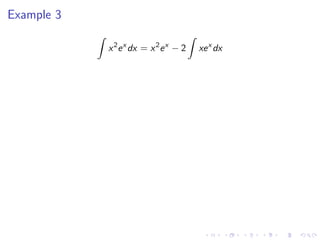
x2
ex
dx = x2
ex
− 2 xex
dx
Example 3
x2
ex
dx = x2
ex
− 2 xex
dx
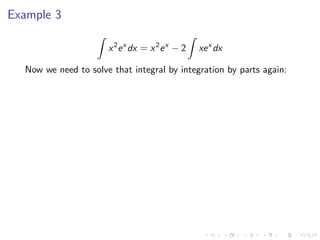
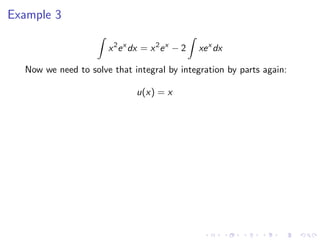
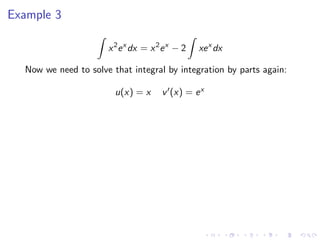
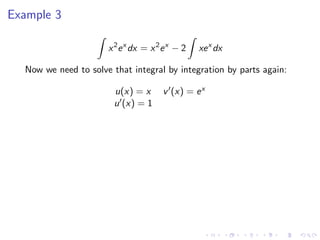
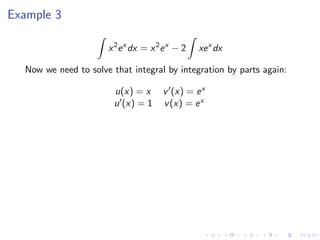
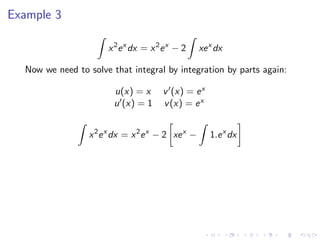
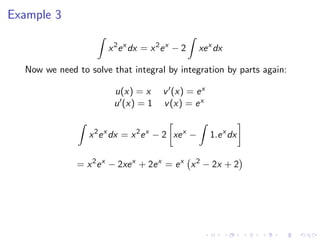
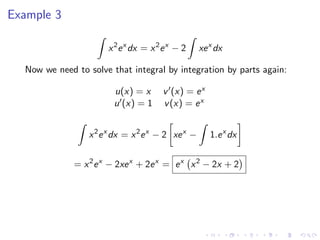
Now we need to solve that integral by integration by parts again:
Example 3
x2
ex
dx = x2
ex
− 2 xex
dx
Now we need to solve that integral by integration by parts again:
u(x) = x
Example 3
x2
ex
dx = x2
ex
− 2 xex
dx
Now we need to solve that integral by integration by parts again:
u(x) = x v (x) = ex
Example 3
x2
ex
dx = x2
ex
− 2 xex
dx
Now we need to solve that integral by integration by parts again:
u(x) = x v (x) = ex
u (x) = 1
Example 3
x2
ex
dx = x2
ex
− 2 xex
dx
Now we need to solve that integral by integration by parts again:
u(x) = x v (x) = ex
u (x) = 1 v(x) = ex
Example 3
x2
ex
dx = x2
ex
− 2 xex
dx
Now we need to solve that integral by integration by parts again:
u(x) = x v (x) = ex
u (x) = 1 v(x) = ex
x2
ex
dx = x2
ex
− 2 xex
− 1.ex
dx
Example 3
x2
ex
dx = x2
ex
− 2 xex
dx
Now we need to solve that integral by integration by parts again:
u(x) = x v (x) = ex
u (x) = 1 v(x) = ex
x2
ex
dx = x2
ex
− 2 xex
− 1.ex
dx
= x2
ex
− 2xex
+ 2ex
= ex
x2
− 2x + 2
Example 3
x2
ex
dx = x2
ex
− 2 xex
dx
Now we need to solve that integral by integration by parts again:
u(x) = x v (x) = ex
u (x) = 1 v(x) = ex
x2
ex
dx = x2
ex
− 2 xex
− 1.ex
dx
= x2
ex
− 2xex
+ 2ex
= ex
x2
− 2x + 2
Integration by Parts, Part 3

Integration by Parts, Part 3

  • 3.
  • 4.
    The LIATE Rule Thedifficulty of integration by parts is in choosing u(x) and v (x) correctly.
  • 5.
    The LIATE Rule Thedifficulty of integration by parts is in choosing u(x) and v (x) correctly. The LIATE rule is a rule of thumb that tells you which function you should choose as u(x):
  • 6.
    The LIATE Rule Thedifficulty of integration by parts is in choosing u(x) and v (x) correctly. The LIATE rule is a rule of thumb that tells you which function you should choose as u(x): LIATE
  • 7.
    The LIATE Rule Thedifficulty of integration by parts is in choosing u(x) and v (x) correctly. The LIATE rule is a rule of thumb that tells you which function you should choose as u(x): L Log IATE
  • 8.
    The LIATE Rule Thedifficulty of integration by parts is in choosing u(x) and v (x) correctly. The LIATE rule is a rule of thumb that tells you which function you should choose as u(x): L I Inv. Trig ATE
  • 9.
    The LIATE Rule Thedifficulty of integration by parts is in choosing u(x) and v (x) correctly. The LIATE rule is a rule of thumb that tells you which function you should choose as u(x): LI A Algebraic TE
  • 10.
    The LIATE Rule Thedifficulty of integration by parts is in choosing u(x) and v (x) correctly. The LIATE rule is a rule of thumb that tells you which function you should choose as u(x): LIA T Trig E
  • 11.
    The LIATE Rule Thedifficulty of integration by parts is in choosing u(x) and v (x) correctly. The LIATE rule is a rule of thumb that tells you which function you should choose as u(x): LIAT E Exp
  • 12.
    The LIATE Rule Thedifficulty of integration by parts is in choosing u(x) and v (x) correctly. The LIATE rule is a rule of thumb that tells you which function you should choose as u(x): LIATE
  • 13.
    The LIATE Rule Thedifficulty of integration by parts is in choosing u(x) and v (x) correctly. The LIATE rule is a rule of thumb that tells you which function you should choose as u(x): LIATE The word itself tells you in which order of priority you should use u(x).
  • 14.
  • 15.
  • 16.
    Example 1 x sinxdx Here we have an algebraic and a trigonometric function:
  • 17.
    Example 1 x sinxdx Here we have an algebraic and a trigonometric function: x sin xdx
  • 18.
    Example 1 x sinxdx Here we have an algebraic and a trigonometric function:   A x sin xdx
  • 19.
    Example 1 x sinxdx Here we have an algebraic and a trigonometric function: x$$$XT sin xdx
  • 20.
    Example 1 x sinxdx Here we have an algebraic and a trigonometric function: x sin xdx
  • 21.
    Example 1 x sinxdx Here we have an algebraic and a trigonometric function: x sin xdx According to LIATE, the A comes before the T, so we choose u(x) = x.
  • 22.
  • 23.
  • 24.
    Example 2 ex sin xdx Inthis case we have E and T:
  • 25.
    Example 2 ex sin xdx Inthis case we have E and T: b E ex sin xdx
  • 26.
    Example 2 ex sin xdx Inthis case we have E and T: ex$$$XT sin xdx
  • 27.
    Example 2 ex sin xdx Inthis case we have E and T: ex sin xdx
  • 28.
    Example 2 ex sin xdx Inthis case we have E and T: ex sin xdx According to LIATE, the T comes before the E, so we choose u(x) = sin x.
  • 29.
    Example 2 ex sin xdx Inthis case we have E and T: ex sin xdx According to LIATE, the T comes before the E, so we choose u(x) = sin x. Let’s solve this integral to show that this works:
  • 30.
    Example 2 ex sin xdx Inthis case we have E and T: ex sin xdx According to LIATE, the T comes before the E, so we choose u(x) = sin x. Let’s solve this integral to show that this works: u(x) = sin x
  • 31.
    Example 2 ex sin xdx Inthis case we have E and T: ex sin xdx According to LIATE, the T comes before the E, so we choose u(x) = sin x. Let’s solve this integral to show that this works: u(x) = sin x v (x) = ex
  • 32.
    Example 2 ex sin xdx Inthis case we have E and T: ex sin xdx According to LIATE, the T comes before the E, so we choose u(x) = sin x. Let’s solve this integral to show that this works: u(x) = sin x v (x) = ex u (x) = cos x
  • 33.
    Example 2 ex sin xdx Inthis case we have E and T: ex sin xdx According to LIATE, the T comes before the E, so we choose u(x) = sin x. Let’s solve this integral to show that this works: u(x) = sin x v (x) = ex u (x) = cos x v(x) = ex
  • 34.
    Example 2 ex sin xdx Inthis case we have E and T: ex sin xdx According to LIATE, the T comes before the E, so we choose u(x) = sin x. Let’s solve this integral to show that this works: u(x) = sin x v (x) = ex u (x) = cos x v(x) = ex ex sin xdx = ex sin x − ex cos xdx
  • 35.
    Example 2 ex sin xdx Inthis case we have E and T: ex sin xdx According to LIATE, the T comes before the E, so we choose u(x) = sin x. Let’s solve this integral to show that this works: u(x) = sin x v (x) = ex u (x) = cos x v(x) = ex b v (x) ex sin xdx = ex sin x − ex cos xdx
  • 36.
    Example 2 ex sin xdx Inthis case we have E and T: ex sin xdx According to LIATE, the T comes before the E, so we choose u(x) = sin x. Let’s solve this integral to show that this works: u(x) = sin x v (x) = ex u (x) = cos x v(x) = ex ex$$$Xu(x) sin xdx = ex sin x − ex cos xdx
  • 37.
    Example 2 ex sin xdx Inthis case we have E and T: ex sin xdx According to LIATE, the T comes before the E, so we choose u(x) = sin x. Let’s solve this integral to show that this works: u(x) = sin x v (x) = ex u (x) = cos x v(x) = ex ex sin xdx = b v(x) ex sin x − ex cos xdx
  • 38.
    Example 2 ex sin xdx Inthis case we have E and T: ex sin xdx According to LIATE, the T comes before the E, so we choose u(x) = sin x. Let’s solve this integral to show that this works: u(x) = sin x v (x) = ex u (x) = cos x v(x) = ex ex sin xdx = ex$$$Xu(x) sin x − ex cos xdx
  • 39.
    Example 2 ex sin xdx Inthis case we have E and T: ex sin xdx According to LIATE, the T comes before the E, so we choose u(x) = sin x. Let’s solve this integral to show that this works: u(x) = sin x v (x) = ex u (x) = cos x v(x) = ex ex sin xdx = ex sin x − b v(x) ex cos xdx
  • 40.
    Example 2 ex sin xdx Inthis case we have E and T: ex sin xdx According to LIATE, the T comes before the E, so we choose u(x) = sin x. Let’s solve this integral to show that this works: u(x) = sin x v (x) = ex u (x) = cos x v(x) = ex ex sin xdx = ex sin x − ex $$$Xu (x) cos xdx
  • 41.
    Example 2 ex sin xdx Inthis case we have E and T: ex sin xdx According to LIATE, the T comes before the E, so we choose u(x) = sin x. Let’s solve this integral to show that this works: u(x) = sin x v (x) = ex u (x) = cos x v(x) = ex ex sin xdx = ex sin x − ex cos xdx
  • 42.
  • 43.
    Example 2 Now weneed to solve that integral:
  • 44.
    Example 2 Now weneed to solve that integral: ex sin xdx = ex sin x − ex cos xdx
  • 45.
    Example 2 Now weneed to solve that integral: ex sin xdx = ex sin x − ex cos xdx We need to use integration by parts again.
  • 46.
    Example 2 Now weneed to solve that integral: ex sin xdx = ex sin x − ex cos xdx We need to use integration by parts again. By using LIATE, we choose u(x) = cos x:
  • 47.
    Example 2 Now weneed to solve that integral: ex sin xdx = ex sin x − ex cos xdx We need to use integration by parts again. By using LIATE, we choose u(x) = cos x: u(x) = cos x
  • 48.
    Example 2 Now weneed to solve that integral: ex sin xdx = ex sin x − ex cos xdx We need to use integration by parts again. By using LIATE, we choose u(x) = cos x: u(x) = cos x v (x) = ex
  • 49.
    Example 2 Now weneed to solve that integral: ex sin xdx = ex sin x − ex cos xdx We need to use integration by parts again. By using LIATE, we choose u(x) = cos x: u(x) = cos x v (x) = ex u (x) = − sin x
  • 50.
    Example 2 Now weneed to solve that integral: ex sin xdx = ex sin x − ex cos xdx We need to use integration by parts again. By using LIATE, we choose u(x) = cos x: u(x) = cos x v (x) = ex u (x) = − sin x v(x) = ex
  • 51.
    Example 2 Now weneed to solve that integral: ex sin xdx = ex sin x − ex cos xdx We need to use integration by parts again. By using LIATE, we choose u(x) = cos x: u(x) = cos x v (x) = ex u (x) = − sin x v(x) = ex ex sin xdx = ex sin x − ex cos xdx
  • 52.
    Example 2 Now weneed to solve that integral: ex sin xdx = ex sin x − ex cos xdx We need to use integration by parts again. By using LIATE, we choose u(x) = cos x: u(x) = cos x v (x) = ex u (x) = − sin x v(x) = ex ex sin xdx = ex sin x − b v (x) ex cos xdx
  • 53.
    Example 2 Now weneed to solve that integral: ex sin xdx = ex sin x − ex cos xdx We need to use integration by parts again. By using LIATE, we choose u(x) = cos x: u(x) = cos x v (x) = ex u (x) = − sin x v(x) = ex ex sin xdx = ex sin x − ex $$$Xu(x) cos xdx
  • 54.
    Example 2 Now weneed to solve that integral: ex sin xdx = ex sin x − ex cos xdx We need to use integration by parts again. By using LIATE, we choose u(x) = cos x: u(x) = cos x v (x) = ex u (x) = − sin x v(x) = ex ex sin xdx = ex sin x − ex cos xdx
  • 55.
    Example 2 Now weneed to solve that integral: ex sin xdx = ex sin x − ex cos xdx We need to use integration by parts again. By using LIATE, we choose u(x) = cos x: u(x) = cos x v (x) = ex u (x) = − sin x v(x) = ex ex sin xdx = ex sin x − ex cos xdx = ex sin x − ex cos x − ex (− sin x) dx
  • 56.
    Example 2 Now weneed to solve that integral: ex sin xdx = ex sin x − ex cos xdx We need to use integration by parts again. By using LIATE, we choose u(x) = cos x: u(x) = cos x v (x) = ex u (x) = − sin x v(x) = ex ex sin xdx = ex sin x − ex cos xdx = ex sin x − b v(x) ex cos x − ex (− sin x) dx
  • 57.
    Example 2 Now weneed to solve that integral: ex sin xdx = ex sin x − ex cos xdx We need to use integration by parts again. By using LIATE, we choose u(x) = cos x: u(x) = cos x v (x) = ex u (x) = − sin x v(x) = ex ex sin xdx = ex sin x − ex cos xdx = ex sin x − ex $$$Xu(x) cos x − ex (− sin x) dx
  • 58.
    Example 2 Now weneed to solve that integral: ex sin xdx = ex sin x − ex cos xdx We need to use integration by parts again. By using LIATE, we choose u(x) = cos x: u(x) = cos x v (x) = ex u (x) = − sin x v(x) = ex ex sin xdx = ex sin x − ex cos xdx = ex sin x − ex cos x − b v(x) ex (− sin x) dx
  • 59.
    Example 2 Now weneed to solve that integral: ex sin xdx = ex sin x − ex cos xdx We need to use integration by parts again. By using LIATE, we choose u(x) = cos x: u(x) = cos x v (x) = ex u (x) = − sin x v(x) = ex ex sin xdx = ex sin x − ex cos xdx = ex sin x − ex cos x − ex $$$$$Xu (x) (− sin x)dx
  • 60.
    Example 2 Now weneed to solve that integral: ex sin xdx = ex sin x − ex cos xdx We need to use integration by parts again. By using LIATE, we choose u(x) = cos x: u(x) = cos x v (x) = ex u (x) = − sin x v(x) = ex ex sin xdx = ex sin x − ex cos xdx = ex sin x − ex cos x − ex (− sin x) dx
  • 61.
  • 62.
    Example 2 So, wehave that:
  • 63.
    Example 2 So, wehave that: ex sin xdx = ex sin x − ex cos x − ex sin xdx
  • 64.
    Example 2 So, wehave that: ex sin xdx !! = ex sin x − ex cos x − ex sin xdx !!
  • 65.
    Example 2 So, wehave that: ex sin xdx !! = ex sin x − ex cos x − ex sin xdx !! So, we add ex sin xdx to both sides of the equation:
  • 66.
    Example 2 So, wehave that: ex sin xdx !! = ex sin x − ex cos x − ex sin xdx !! So, we add ex sin xdx to both sides of the equation: 2 ex sin xdx = ex (sin x − cos x)
  • 67.
    Example 2 So, wehave that: ex sin xdx !! = ex sin x − ex cos x − ex sin xdx !! So, we add ex sin xdx to both sides of the equation: 2 ex sin xdx = ex (sin x − cos x) ex sin xdx = ex 2 (sin x − cos x) + C
  • 68.
    Example 2 So, wehave that: ex sin xdx !! = ex sin x − ex cos x − ex sin xdx !! So, we add ex sin xdx to both sides of the equation: 2 ex sin xdx = ex (sin x − cos x) ex sin xdx = ex 2 (sin x − cos x) + C This is in fact an example of Trick number 2.
  • 69.
  • 70.
    Example 3 Let’s doanother example:
  • 71.
    Example 3 Let’s doanother example: x2 ex dx
  • 72.
    Example 3 Let’s doanother example: x2 ex dx We have an A and an E:
  • 73.
    Example 3 Let’s doanother example: x2 ex dx We have an A and an E:    A x2 ex dx
  • 74.
    Example 3 Let’s doanother example: x2 ex dx We have an A and an E: x2 b E ex dx
  • 75.
    Example 3 Let’s doanother example: x2 ex dx We have an A and an E: x2 ex dx
  • 76.
    Example 3 Let’s doanother example: x2 ex dx We have an A and an E: x2 ex dx LIATE says that the A comes before the E. So, we choose u(x) = x2:
  • 77.
    Example 3 Let’s doanother example: x2 ex dx We have an A and an E: x2 ex dx LIATE says that the A comes before the E. So, we choose u(x) = x2: u(x) = x2
  • 78.
    Example 3 Let’s doanother example: x2 ex dx We have an A and an E: x2 ex dx LIATE says that the A comes before the E. So, we choose u(x) = x2: u(x) = x2 v (x) = ex
  • 79.
    Example 3 Let’s doanother example: x2 ex dx We have an A and an E: x2 ex dx LIATE says that the A comes before the E. So, we choose u(x) = x2: u(x) = x2 v (x) = ex u (x) = 2x
  • 80.
    Example 3 Let’s doanother example: x2 ex dx We have an A and an E: x2 ex dx LIATE says that the A comes before the E. So, we choose u(x) = x2: u(x) = x2 v (x) = ex u (x) = 2x v(x) = ex
  • 81.
    Example 3 Let’s doanother example: x2 ex dx We have an A and an E: x2 ex dx LIATE says that the A comes before the E. So, we choose u(x) = x2: u(x) = x2 v (x) = ex u (x) = 2x v(x) = ex x2 ex dx =
  • 82.
    Example 3 Let’s doanother example: x2 ex dx We have an A and an E: x2 ex dx LIATE says that the A comes before the E. So, we choose u(x) = x2: u(x) = x2 v (x) = ex u (x) = 2x v(x) = ex    u(x) x2 ex dx =
  • 83.
    Example 3 Let’s doanother example: x2 ex dx We have an A and an E: x2 ex dx LIATE says that the A comes before the E. So, we choose u(x) = x2: u(x) = x2 v (x) = ex u (x) = 2x v(x) = ex x2 b v (x) ex dx =
  • 84.
    Example 3 Let’s doanother example: x2 ex dx We have an A and an E: x2 ex dx LIATE says that the A comes before the E. So, we choose u(x) = x2: u(x) = x2 v (x) = ex u (x) = 2x v(x) = ex x2 ex dx = x2 ex − 2xex dx
  • 85.
    Example 3 Let’s doanother example: x2 ex dx We have an A and an E: x2 ex dx LIATE says that the A comes before the E. So, we choose u(x) = x2: u(x) = x2 v (x) = ex u (x) = 2x v(x) = ex x2 ex dx =    u(x) x2 ex − 2xex dx
  • 86.
    Example 3 Let’s doanother example: x2 ex dx We have an A and an E: x2 ex dx LIATE says that the A comes before the E. So, we choose u(x) = x2: u(x) = x2 v (x) = ex u (x) = 2x v(x) = ex x2 ex dx = x2 b v(x) ex − 2xex dx
  • 87.
    Example 3 Let’s doanother example: x2 ex dx We have an A and an E: x2 ex dx LIATE says that the A comes before the E. So, we choose u(x) = x2: u(x) = x2 v (x) = ex u (x) = 2x v(x) = ex x2 ex dx = x2 ex − b u (x) 2xex dx
  • 88.
    Example 3 Let’s doanother example: x2 ex dx We have an A and an E: x2 ex dx LIATE says that the A comes before the E. So, we choose u(x) = x2: u(x) = x2 v (x) = ex u (x) = 2x v(x) = ex x2 ex dx = x2 ex − 2xb v(x) ex dx
  • 89.
    Example 3 Let’s doanother example: x2 ex dx We have an A and an E: x2 ex dx LIATE says that the A comes before the E. So, we choose u(x) = x2: u(x) = x2 v (x) = ex u (x) = 2x v(x) = ex x2 ex dx = x2 ex − 2xex dx
  • 90.
  • 91.
    Example 3 x2 ex dx =x2 ex − 2 xex dx
  • 92.
    Example 3 x2 ex dx =x2 ex − 2 xex dx Now we need to solve that integral by integration by parts again:
  • 93.
    Example 3 x2 ex dx =x2 ex − 2 xex dx Now we need to solve that integral by integration by parts again: u(x) = x
  • 94.
    Example 3 x2 ex dx =x2 ex − 2 xex dx Now we need to solve that integral by integration by parts again: u(x) = x v (x) = ex
  • 95.
    Example 3 x2 ex dx =x2 ex − 2 xex dx Now we need to solve that integral by integration by parts again: u(x) = x v (x) = ex u (x) = 1
  • 96.
    Example 3 x2 ex dx =x2 ex − 2 xex dx Now we need to solve that integral by integration by parts again: u(x) = x v (x) = ex u (x) = 1 v(x) = ex
  • 97.
    Example 3 x2 ex dx =x2 ex − 2 xex dx Now we need to solve that integral by integration by parts again: u(x) = x v (x) = ex u (x) = 1 v(x) = ex x2 ex dx = x2 ex − 2 xex − 1.ex dx
  • 98.
    Example 3 x2 ex dx =x2 ex − 2 xex dx Now we need to solve that integral by integration by parts again: u(x) = x v (x) = ex u (x) = 1 v(x) = ex x2 ex dx = x2 ex − 2 xex − 1.ex dx = x2 ex − 2xex + 2ex = ex x2 − 2x + 2
  • 99.
    Example 3 x2 ex dx =x2 ex − 2 xex dx Now we need to solve that integral by integration by parts again: u(x) = x v (x) = ex u (x) = 1 v(x) = ex x2 ex dx = x2 ex − 2 xex − 1.ex dx = x2 ex − 2xex + 2ex = ex x2 − 2x + 2