INTAKE WORKS AT
DIVERSION

PRESENTED BY:
RAJ KUMAR BAIRWA
13512026
M.TECH Ist YEAR
A.H.E.S, IIT ROORKEE
WHAT IS INTAKE?
“A structure to divert water into a conduit
leading to the power plant” is called
Intake.- The glossary of Hydropower
Terms-1989.
POSITION OF INTAKES  Factors governing the arrangement of an intake include the following:

•

The intake should be aligned so that the trash and ice tends to float past and not collect at the
intake screens.

•

The intake should be arranged so that the effect of such movement (movement of boulders,
stones and sand) will not lead to a partial restriction or blockage of the intake.

•

The intake can often be located so as to enable it to be constructed before the level of the
reservoir is raised.

•

Give minimum hydraulic losses.

•

Prevent formation of air entraining vortices.
COMPONENTS OF INTAKES:
•
•
•
•
•
•
•
•

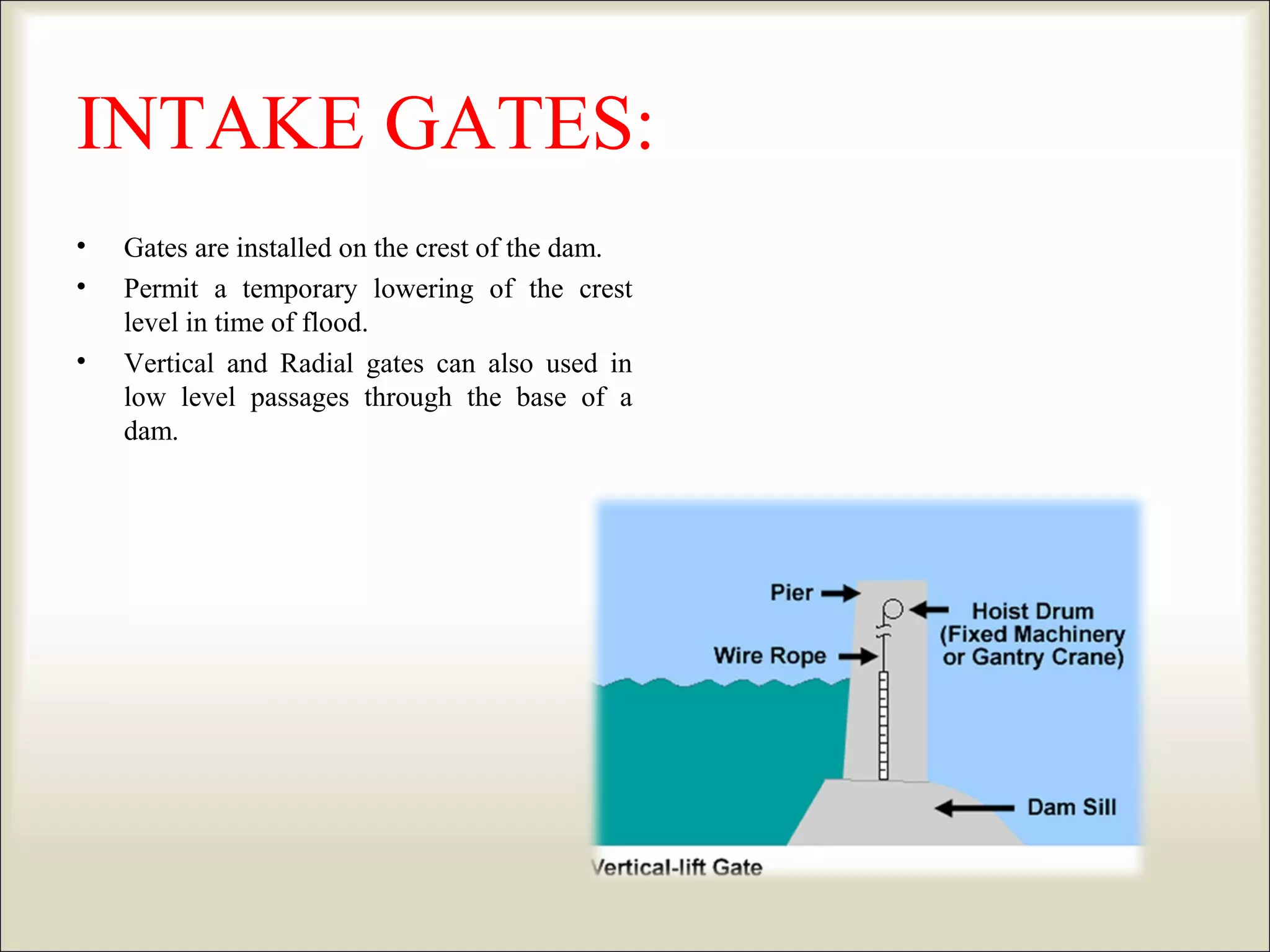
Intake Gates
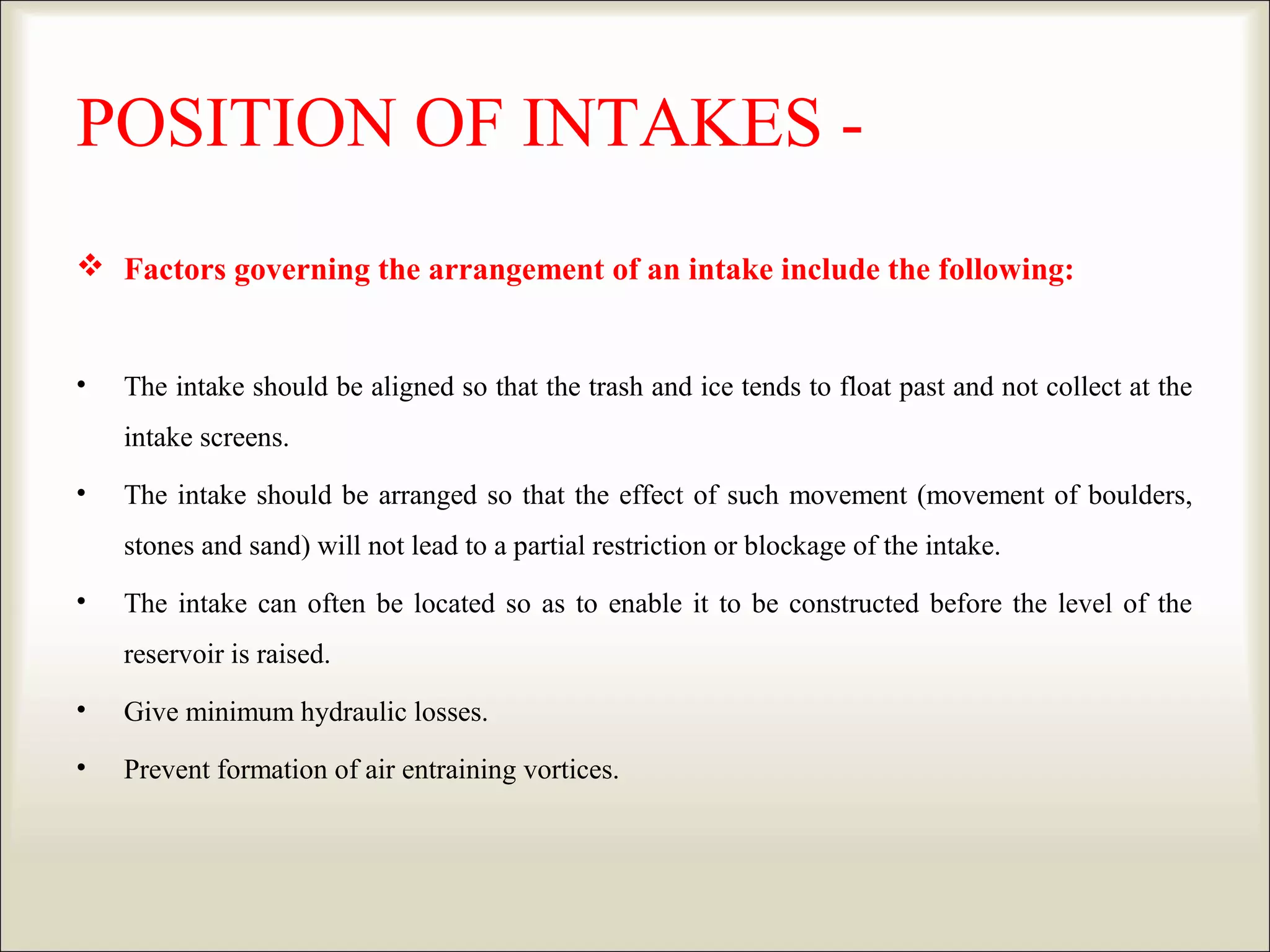
Trash rakes & screens
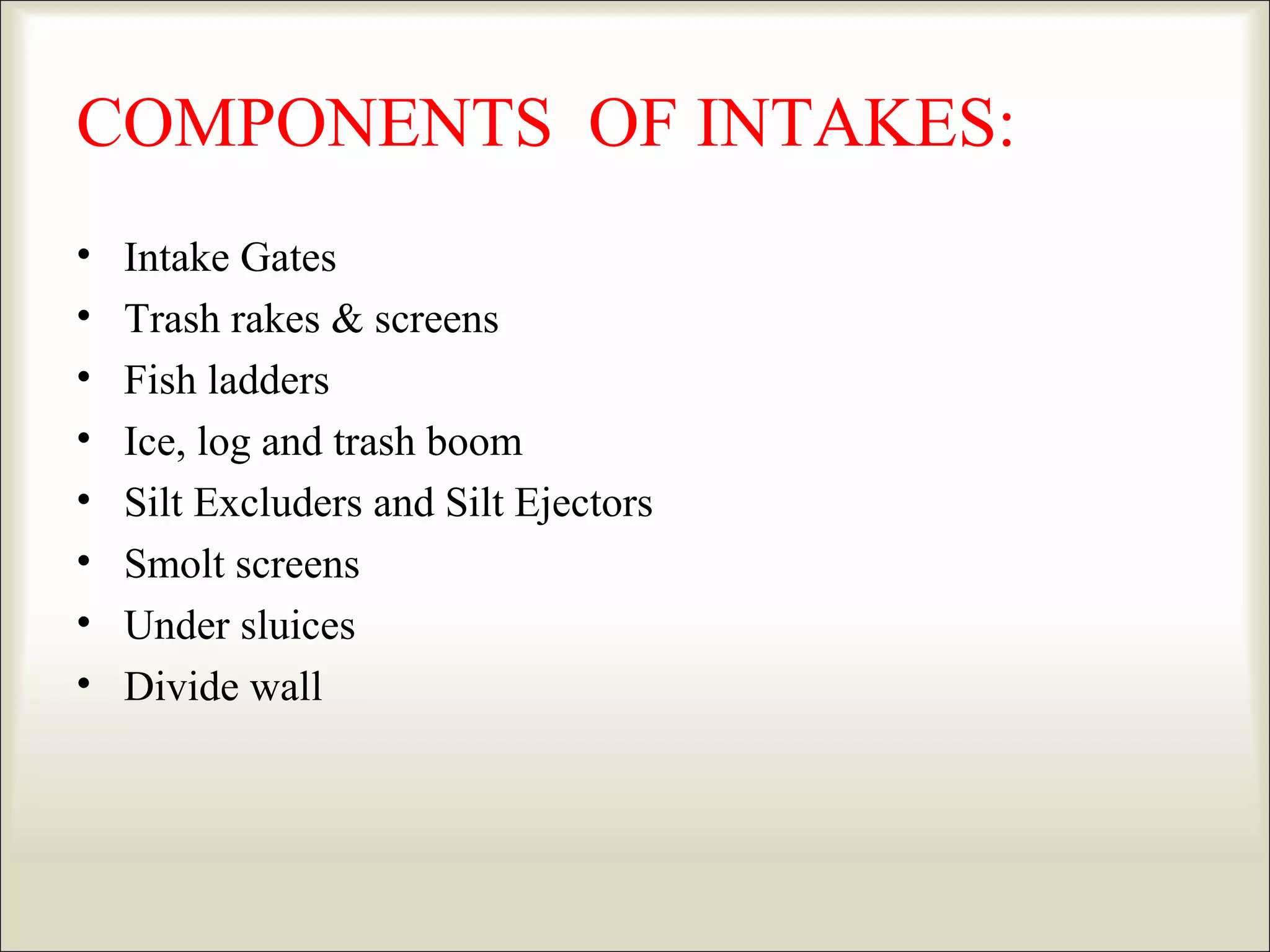
Fish ladders
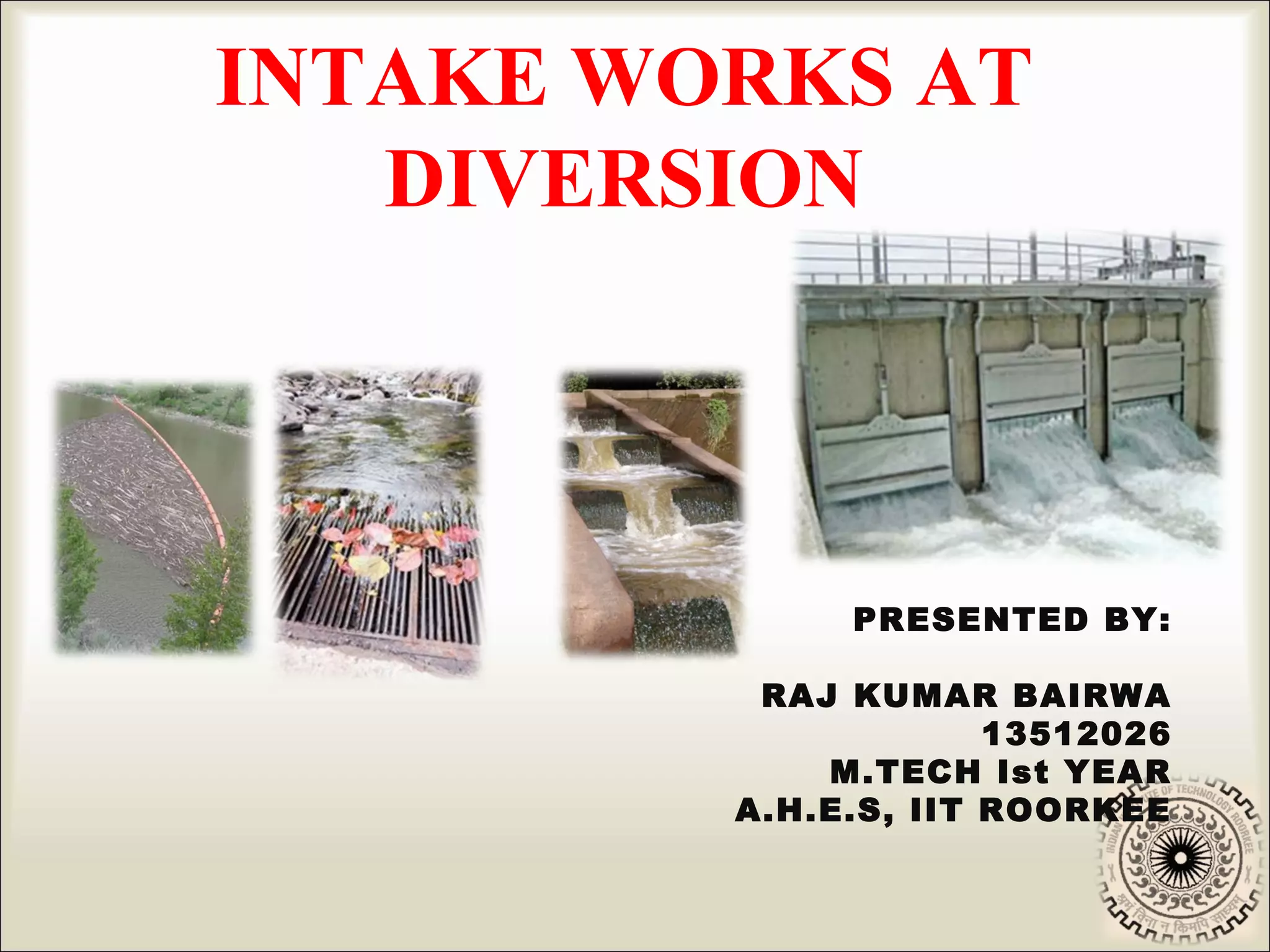
Ice, log and trash boom
Silt Excluders and Silt Ejectors
Smolt screens
Under sluices
Divide wall
INTAKE GATES:
•
•
•

Gates are installed on the crest of the dam.
Permit a temporary lowering of the crest
level in time of flood.
Vertical and Radial gates can also used in
low level passages through the base of a
dam.
INTAKE GATES:
VERTICAL-LIFT GATES
•

•

•
•

The vertical-lift gate, with wheels (rollers)
at each end, moves vertically in slots
formed in the piers and consists of a skin
plate and horizontal girders that transmit
the water load into the piers
Lift gates can be operated under moderate
heads, but not under reverse head
conditions.
Vertical-lift gates have been designed for
spans in excess of 100 ft.
High vertical-lift gates may consist of two
or more sections in order to facilitate
storage or ease passing of ice and debris.

RADIAL ARM (Tainter) GATES
•
•
•
•
•
•
•

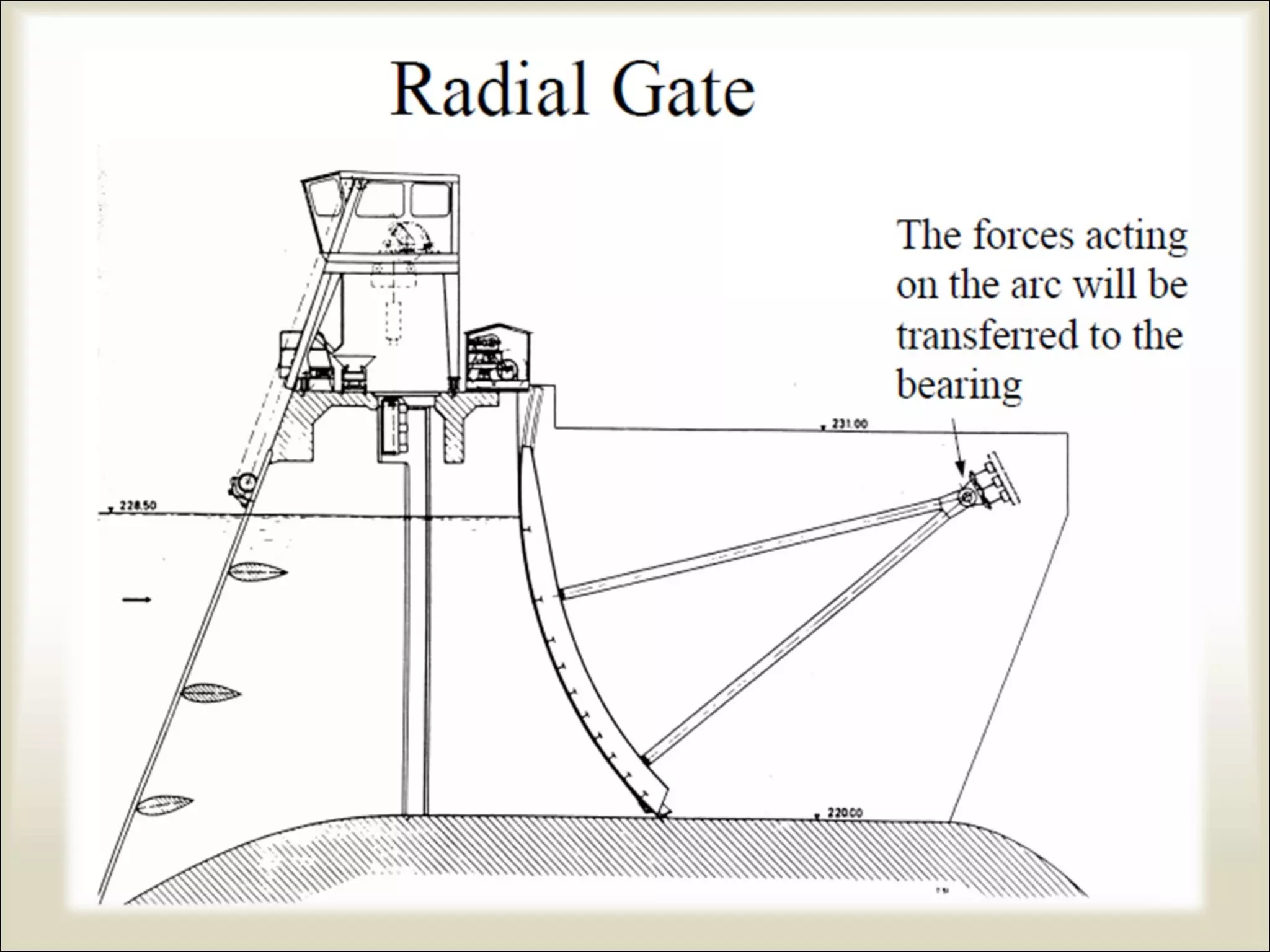
Consist of a moveable framework is the
form of a sector of a circle.
Economical to install, operate, and
maintain.
More efficient at partial openings than
vertical-lift gates.
Less liable to vibration than vertical-lift
gates.
No capacity of passing trash except in their
fully open position.
Frictional resistance is less as compare to
vertical-lift gate of equivalent size.
Generally used for head range of 200-250
feet.
Radial Gates at Älvkarleby, Sweden

Jhimruk Power Plant, Nepal
TRASH RACKES & SCREENS :
•Trashracks are usually positioned in forebay or intake structure as a means of excluding floating and submerged
debris, thereby preventing damage to the power plant, plant equipment, or waterway.
• secondary benefits of trashrackes include the protection of boaters, swimmers, and operation personnel .
•Trashrackes have been used as a method of fish exclusion.
•A trash rack is made up of one or more panels, fabricated from a series of evenly spaced parallel metal bars. bars
(from 100 mm to 300 mm between bars) used to reduce the work of the automatic trash rack cleaning
equipment.
•Trashrack bar sizes should not be less than 2 inches X 0.5 inch. This size is based on minimum section
required to resist corrosion.
•The trashrack bars are slightly off vertical and with the flow with slope of 1 horizontal to 4 vertical.
•The maximum possible spacing between the bars is generally specified by the turbine manufacturers. Typical
values are :
20-30 mm for Pelton turbines,
40-50 mm for Francis turbines and
80-100 mm for Kaplan turbines.
Smolt Screens At Cruachan Power Station, Scotland

Fig:-Panauti power plant, nepal
Fish ladder :
•

Provided just by the side of the divide wall for the
free movement of fishes.

•

The tendency of fish is to move from upstream to
downstream in winters and from downstream to
upstream in monsoons.This movement is essential
for their survival.

•

Due to construction of weir or barrage, this
movement gets obstructed, and is detrimental to the
fishes.

•

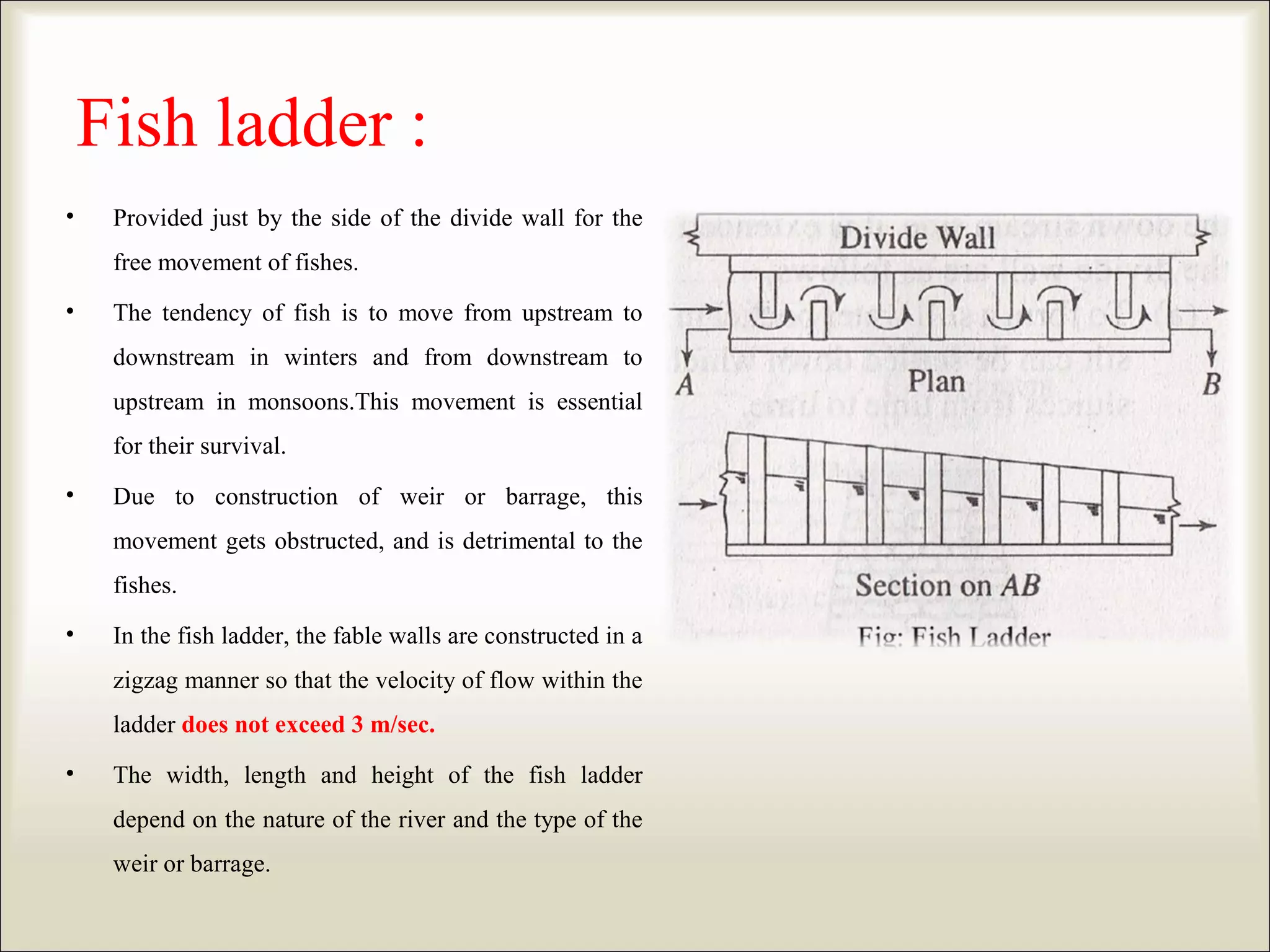
In the fish ladder, the fable walls are constructed in a
zigzag manner so that the velocity of flow within the
ladder does not exceed 3 m/sec.

•

The width, length and height of the fish ladder
depend on the nature of the river and the type of the
weir or barrage.
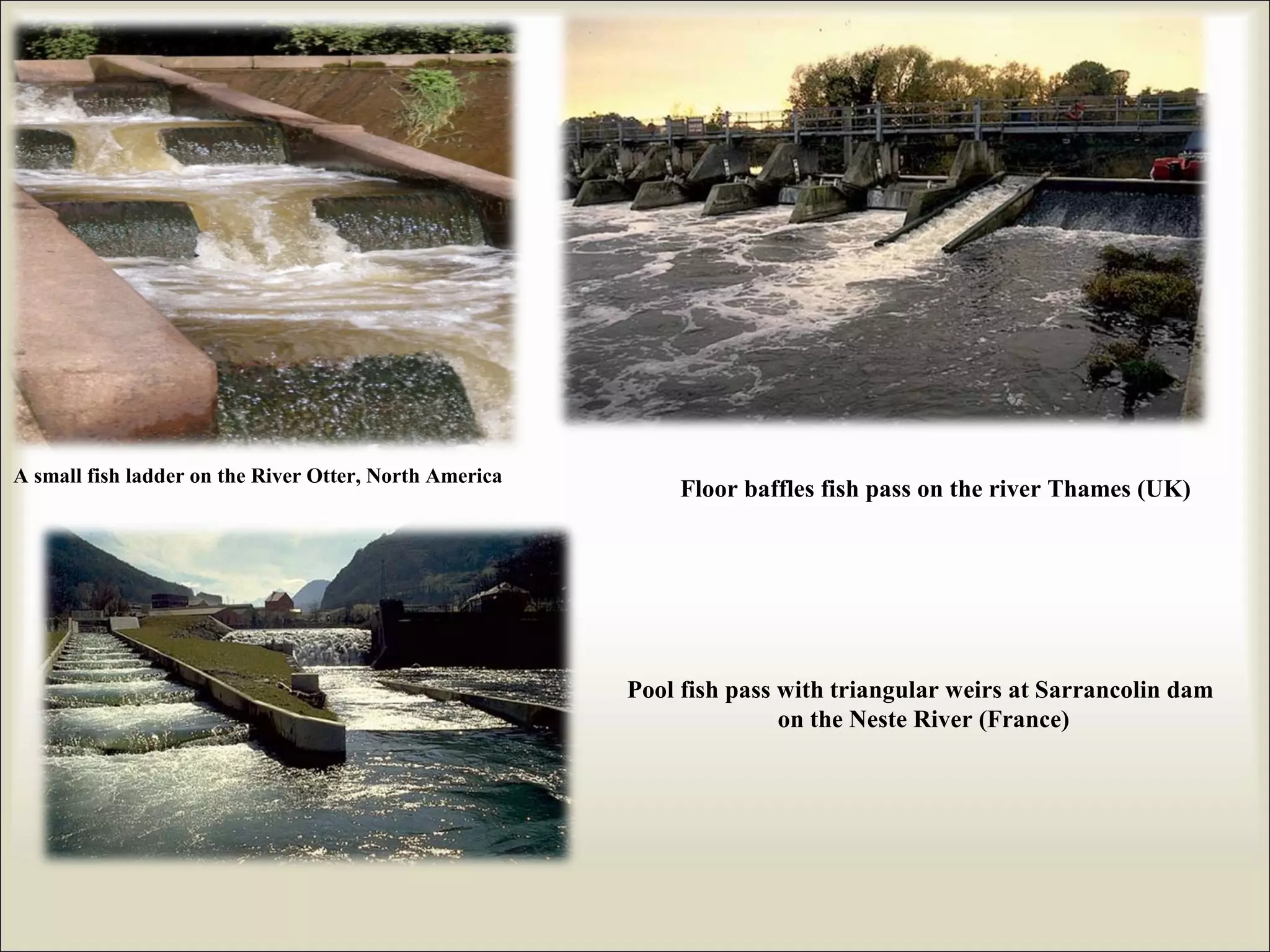
A small fish ladder on the River Otter, North America

Floor baffles fish pass on the river Thames (UK)

Pool fish pass with triangular weirs at Sarrancolin dam
on the Neste River (France)
The Kotri Barrage on river Indus near Hyderabad
ICE,LOG,AND TRASH BOOMS:
Floating boom use to perform one or more of the following functions:
• Deflection of logs and trash from the intake screens.
• Deflection of ice away from the intake.
• Prevention of the boats from being carried into the intake.
 ICE BOOMS:
• Ice booms are generally required to prevent blockage of intakes resulting in increased head
loss and possible damage to screens.
 BOAT RESTRAINING BARRIERS:
• The primary purpose of boat barriers is to physically restrain boaters from entering
hazardous water near power intakes.
• Restraining barriers should be placed at the upstream end of such channels, preferably at least
300 feet from the channel entrance (Federal Energy Regulatory Commission,1992).
 Where possible , the boom should be planned to facilitate trash removal out of the water, the
boom should be angled between 30° to 45° to the direction of flow.
Steel pontoons link to form the ice boom.

The ice boom from above.

A boom that catches garbage in the Bronx River catches plenty
SILT REGULATING WORKS:
Silt Excluders :
• Silt excluders are those works which are constructed on the bed of the river,
upstream of the head regulator. The clearer water enters the head regulator and
silted water enters the silt excluder. In this type of works, the silt is, therefore,,
removed from the water before in enters the canal.
•

Designed such that the top and bottom layers of flow are separated with the least
possible disturbance
Silt Ejectors :
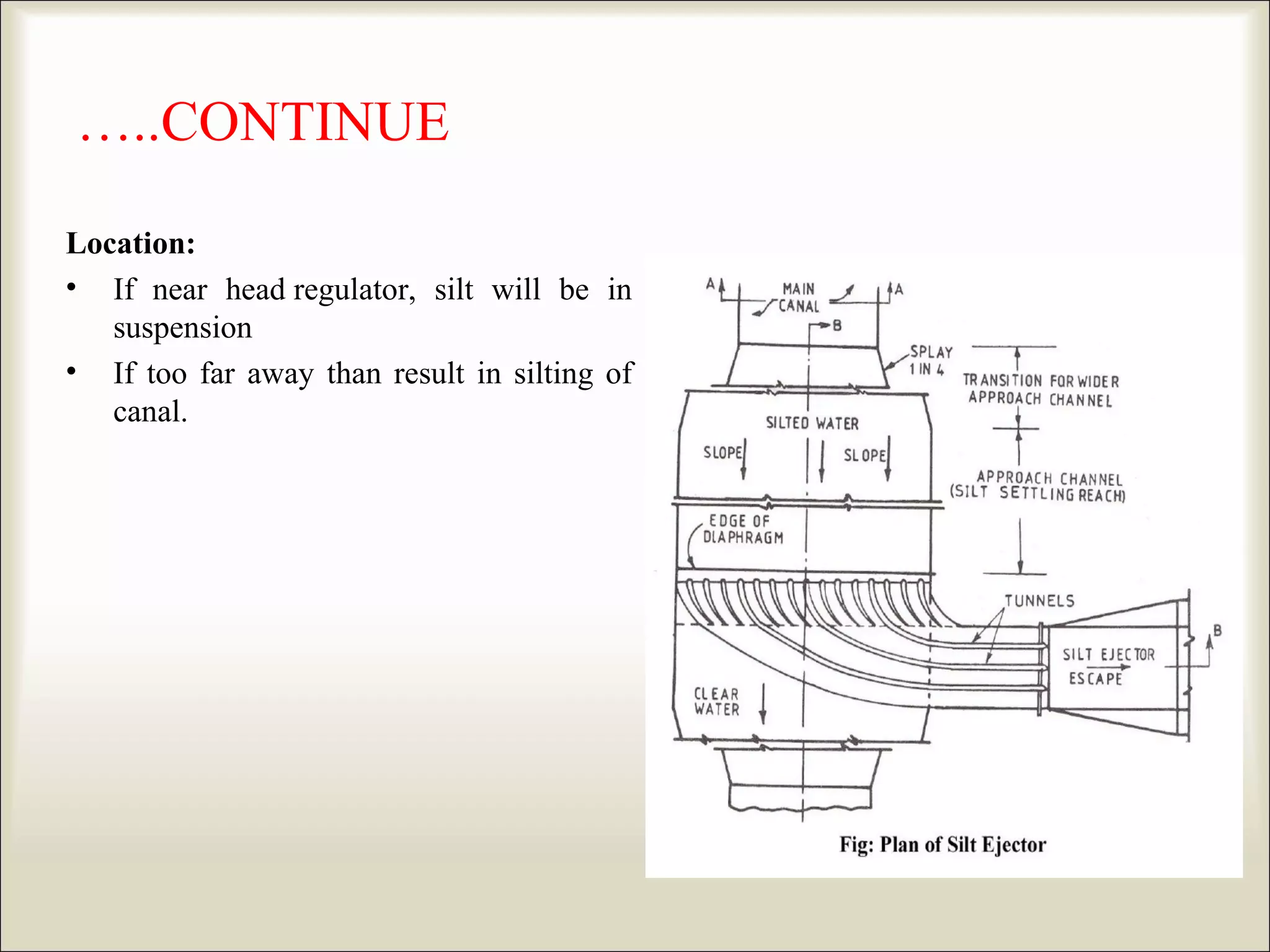
• Silt ejectors, also called silt extractors, are those devices which extract the silt from
the canal water after the silted water has traveled a certain distance in the off-take
canal. These works are, therefore, constructed on the bed of the canal, and little
distance downstream from the head regulator.
…..CONTINUE
Location:
• If near head regulator, silt will be in
suspension
• If too far away than result in silting of
canal.
UNDER SLUICES :
•
•

Also known as scouring sluices.
The under sluices are the openings
provided at the base of the weir or barrage.

•

These

openings

are

provided

with

The main functions of under-sluices are:
•

approaching the canal head regulator.

adjustable gates. Normally, the gates are
•
•

kept closed.
The suspended silt goes on depositing in
front of the canal head regulator.
When

the

silt

deposition

becomes

appreciable the gates are opened and the
deposited silt is loosened with an agitator
•
•

mounting on a boat.
The muddy water flows towards the
downstream through the scouring sluices.
The gates are then closed. But, at the
period of flood, the gates are kept opened.

To maintain a well defined deep channel

•

To ensure easy diversion of water into the
canal through the canal head regulator even
during low flow.

•

To control the entry of silt into the canal

•

To help scouring and of the silt deposited
over the under-sluice floor and removing
towards the downstream side.
Obra Dam & Power House,Mirzapur district, Uttar pradesh,india

Sanjay Vidyut Pariyojna Bhaba,Kinnaur District, HP,India
DIVIDE WALL :
•

The divide wall is a long wall constructed

The functions of the divide wall are as follows:
•

To form a still water pocket in front of the

at right angles in the weir or barrage, it

canal head so that the suspended silt can

may be constructed with stone masonry or

be settled down which then later be
cleaned through the scouring sluices from

cement concrete.
•

On the upstream side, the wall is extended

time to time.
•

in front of the canal head.

just to cover the canal head regulator and
on the downstream side, it is extended up
to the launching apron.

It controls the eddy current or cross current

•

It provides a straight approach in front of
the canal head.

•

It resists the overturning effect on the weir
or barrage caused by the pressure of the
impounding water.
Verbadra barrage , haridwar - Google Maps
REFERENCES:
•
•
•
•
•
•
•
•
•
•
•

A.A. Fulton, “Civil engineering aspects of Hydro-Electric Development in Scotland”,
Journal of institution of civil engineers, jan. 1952.
Hydroelectric engineering practice, Vol-I, Civil engineering, by J.Guthrie Brown.
Guidelines for design of Intakes for Hydroelectric Plants, by ASCE.
www.google.co.in
https://maps.google.co.in
http://ccpro.in/obra%20dam%20and%20power%20house.aspx
http://ccpro.in/SanjayVidyutPariyojna.aspx
http://www.indiamart.com/godbole-gates-limited/products.html
http://library.water-resources.us/docs/MMDL/FLD/Feature.cfm?ID=7
http://fixthepumps.blogspot.in/2010/08/gates.html
http://civilthought.com/wp-content/uploads/2012/09/Typical-layout-of-diversion-headworks.jpg

Intake works at diversion

  • 1.
    INTAKE WORKS AT DIVERSION PRESENTEDBY: RAJ KUMAR BAIRWA 13512026 M.TECH Ist YEAR A.H.E.S, IIT ROORKEE
  • 2.
    WHAT IS INTAKE? “Astructure to divert water into a conduit leading to the power plant” is called Intake.- The glossary of Hydropower Terms-1989.
  • 3.
    POSITION OF INTAKES Factors governing the arrangement of an intake include the following: • The intake should be aligned so that the trash and ice tends to float past and not collect at the intake screens. • The intake should be arranged so that the effect of such movement (movement of boulders, stones and sand) will not lead to a partial restriction or blockage of the intake. • The intake can often be located so as to enable it to be constructed before the level of the reservoir is raised. • Give minimum hydraulic losses. • Prevent formation of air entraining vortices.
  • 4.
    COMPONENTS OF INTAKES: • • • • • • • • IntakeGates Trash rakes & screens Fish ladders Ice, log and trash boom Silt Excluders and Silt Ejectors Smolt screens Under sluices Divide wall
  • 5.
    INTAKE GATES: • • • Gates areinstalled on the crest of the dam. Permit a temporary lowering of the crest level in time of flood. Vertical and Radial gates can also used in low level passages through the base of a dam.
  • 6.
    INTAKE GATES: VERTICAL-LIFT GATES • • • • Thevertical-lift gate, with wheels (rollers) at each end, moves vertically in slots formed in the piers and consists of a skin plate and horizontal girders that transmit the water load into the piers Lift gates can be operated under moderate heads, but not under reverse head conditions. Vertical-lift gates have been designed for spans in excess of 100 ft. High vertical-lift gates may consist of two or more sections in order to facilitate storage or ease passing of ice and debris. RADIAL ARM (Tainter) GATES • • • • • • • Consist of a moveable framework is the form of a sector of a circle. Economical to install, operate, and maintain. More efficient at partial openings than vertical-lift gates. Less liable to vibration than vertical-lift gates. No capacity of passing trash except in their fully open position. Frictional resistance is less as compare to vertical-lift gate of equivalent size. Generally used for head range of 200-250 feet.
  • 8.
    Radial Gates atÄlvkarleby, Sweden Jhimruk Power Plant, Nepal
  • 9.
    TRASH RACKES &SCREENS : •Trashracks are usually positioned in forebay or intake structure as a means of excluding floating and submerged debris, thereby preventing damage to the power plant, plant equipment, or waterway. • secondary benefits of trashrackes include the protection of boaters, swimmers, and operation personnel . •Trashrackes have been used as a method of fish exclusion. •A trash rack is made up of one or more panels, fabricated from a series of evenly spaced parallel metal bars. bars (from 100 mm to 300 mm between bars) used to reduce the work of the automatic trash rack cleaning equipment. •Trashrack bar sizes should not be less than 2 inches X 0.5 inch. This size is based on minimum section required to resist corrosion. •The trashrack bars are slightly off vertical and with the flow with slope of 1 horizontal to 4 vertical. •The maximum possible spacing between the bars is generally specified by the turbine manufacturers. Typical values are : 20-30 mm for Pelton turbines, 40-50 mm for Francis turbines and 80-100 mm for Kaplan turbines.
  • 10.
    Smolt Screens AtCruachan Power Station, Scotland Fig:-Panauti power plant, nepal
  • 11.
    Fish ladder : • Providedjust by the side of the divide wall for the free movement of fishes. • The tendency of fish is to move from upstream to downstream in winters and from downstream to upstream in monsoons.This movement is essential for their survival. • Due to construction of weir or barrage, this movement gets obstructed, and is detrimental to the fishes. • In the fish ladder, the fable walls are constructed in a zigzag manner so that the velocity of flow within the ladder does not exceed 3 m/sec. • The width, length and height of the fish ladder depend on the nature of the river and the type of the weir or barrage.
  • 12.
    A small fishladder on the River Otter, North America Floor baffles fish pass on the river Thames (UK) Pool fish pass with triangular weirs at Sarrancolin dam on the Neste River (France)
  • 13.
    The Kotri Barrageon river Indus near Hyderabad
  • 14.
    ICE,LOG,AND TRASH BOOMS: Floatingboom use to perform one or more of the following functions: • Deflection of logs and trash from the intake screens. • Deflection of ice away from the intake. • Prevention of the boats from being carried into the intake.  ICE BOOMS: • Ice booms are generally required to prevent blockage of intakes resulting in increased head loss and possible damage to screens.  BOAT RESTRAINING BARRIERS: • The primary purpose of boat barriers is to physically restrain boaters from entering hazardous water near power intakes. • Restraining barriers should be placed at the upstream end of such channels, preferably at least 300 feet from the channel entrance (Federal Energy Regulatory Commission,1992).  Where possible , the boom should be planned to facilitate trash removal out of the water, the boom should be angled between 30° to 45° to the direction of flow.
  • 15.
    Steel pontoons linkto form the ice boom. The ice boom from above. A boom that catches garbage in the Bronx River catches plenty
  • 16.
    SILT REGULATING WORKS: SiltExcluders : • Silt excluders are those works which are constructed on the bed of the river, upstream of the head regulator. The clearer water enters the head regulator and silted water enters the silt excluder. In this type of works, the silt is, therefore,, removed from the water before in enters the canal. • Designed such that the top and bottom layers of flow are separated with the least possible disturbance Silt Ejectors : • Silt ejectors, also called silt extractors, are those devices which extract the silt from the canal water after the silted water has traveled a certain distance in the off-take canal. These works are, therefore, constructed on the bed of the canal, and little distance downstream from the head regulator.
  • 17.
    …..CONTINUE Location: • If nearhead regulator, silt will be in suspension • If too far away than result in silting of canal.
  • 18.
    UNDER SLUICES : • • Alsoknown as scouring sluices. The under sluices are the openings provided at the base of the weir or barrage. • These openings are provided with The main functions of under-sluices are: • approaching the canal head regulator. adjustable gates. Normally, the gates are • • kept closed. The suspended silt goes on depositing in front of the canal head regulator. When the silt deposition becomes appreciable the gates are opened and the deposited silt is loosened with an agitator • • mounting on a boat. The muddy water flows towards the downstream through the scouring sluices. The gates are then closed. But, at the period of flood, the gates are kept opened. To maintain a well defined deep channel • To ensure easy diversion of water into the canal through the canal head regulator even during low flow. • To control the entry of silt into the canal • To help scouring and of the silt deposited over the under-sluice floor and removing towards the downstream side.
  • 19.
    Obra Dam &Power House,Mirzapur district, Uttar pradesh,india Sanjay Vidyut Pariyojna Bhaba,Kinnaur District, HP,India
  • 20.
    DIVIDE WALL : • Thedivide wall is a long wall constructed The functions of the divide wall are as follows: • To form a still water pocket in front of the at right angles in the weir or barrage, it canal head so that the suspended silt can may be constructed with stone masonry or be settled down which then later be cleaned through the scouring sluices from cement concrete. • On the upstream side, the wall is extended time to time. • in front of the canal head. just to cover the canal head regulator and on the downstream side, it is extended up to the launching apron. It controls the eddy current or cross current • It provides a straight approach in front of the canal head. • It resists the overturning effect on the weir or barrage caused by the pressure of the impounding water.
  • 21.
    Verbadra barrage ,haridwar - Google Maps
  • 22.
    REFERENCES: • • • • • • • • • • • A.A. Fulton, “Civilengineering aspects of Hydro-Electric Development in Scotland”, Journal of institution of civil engineers, jan. 1952. Hydroelectric engineering practice, Vol-I, Civil engineering, by J.Guthrie Brown. Guidelines for design of Intakes for Hydroelectric Plants, by ASCE. www.google.co.in https://maps.google.co.in http://ccpro.in/obra%20dam%20and%20power%20house.aspx http://ccpro.in/SanjayVidyutPariyojna.aspx http://www.indiamart.com/godbole-gates-limited/products.html http://library.water-resources.us/docs/MMDL/FLD/Feature.cfm?ID=7 http://fixthepumps.blogspot.in/2010/08/gates.html http://civilthought.com/wp-content/uploads/2012/09/Typical-layout-of-diversion-headworks.jpg