LECTURE – 1
General Classification &
Introduction to
Manufacturing processes
By: Raj Kumar Bairwa,
Mechanical Engineering.
Assistant Professor (NPIU),
UD RTU, Kota.
Email : rkumar.npiu.me@rtu.ac.in
Manufacturing process
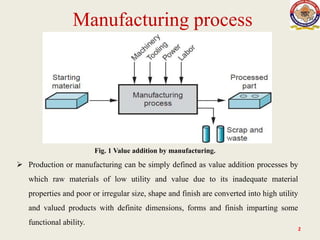
➢ Production or manufacturing can be simply defined as value addition processes by
which raw materials of low utility and value due to its inadequate material
properties and poor or irregular size, shape and finish are converted into high utility
and valued products with definite dimensions, forms and finish imparting some
functional ability.
2
Fig. 1 Value addition by manufacturing.
CLASSIFICATION OF MANUFACTURING PROCESSES
3
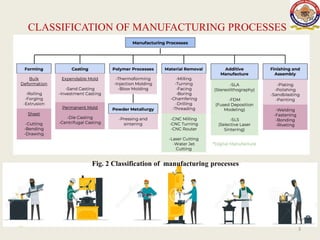
Fig. 2 Classification of manufacturing processes
4
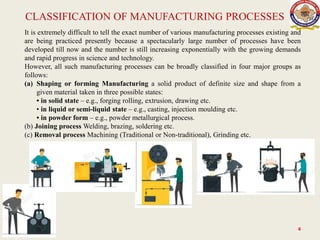
It is extremely difficult to tell the exact number of various manufacturing processes existing and
are being practiced presently because a spectacularly large number of processes have been
developed till now and the number is still increasing exponentially with the growing demands
and rapid progress in science and technology.
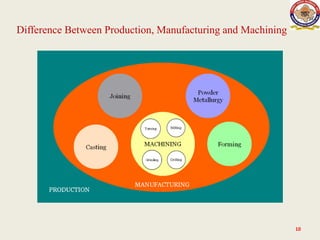
However, all such manufacturing processes can be broadly classified in four major groups as
follows:
(a) Shaping or forming Manufacturing a solid product of definite size and shape from a
given material taken in three possible states:
• in solid state – e.g., forging rolling, extrusion, drawing etc.
• in liquid or semi-liquid state – e.g., casting, injection moulding etc.
• in powder form – e.g., powder metallurgical process.
(b) Joining process Welding, brazing, soldering etc.
(c) Removal process Machining (Traditional or Non-traditional), Grinding etc.
CLASSIFICATION OF MANUFACTURING PROCESSES
5
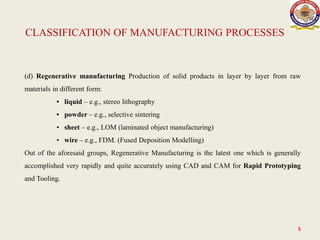
(d) Regenerative manufacturing Production of solid products in layer by layer from raw
materials in different form:
• liquid – e.g., stereo lithography
• powder – e.g., selective sintering
• sheet – e.g., LOM (laminated object manufacturing)
• wire – e.g., FDM. (Fused Deposition Modelling)
Out of the aforesaid groups, Regenerative Manufacturing is the latest one which is generally
accomplished very rapidly and quite accurately using CAD and CAM for Rapid Prototyping
and Tooling.
CLASSIFICATION OF MANUFACTURING PROCESSES
6
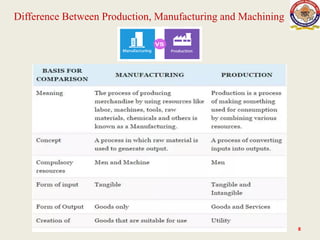
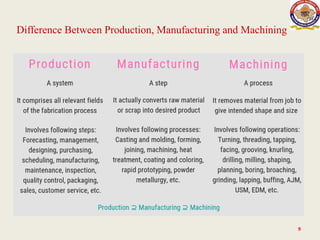
What is production?
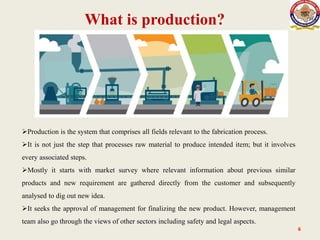
➢Production is the system that comprises all fields relevant to the fabrication process.
➢It is not just the step that processes raw material to produce intended item; but it involves
every associated steps.
➢Mostly it starts with market survey where relevant information about previous similar
products and new requirement are gathered directly from the customer and subsequently
analysed to dig out new idea.
➢It seeks the approval of management for finalizing the new product. However, management
team also go through the views of other sectors including safety and legal aspects.
7
What is Manufacturing?
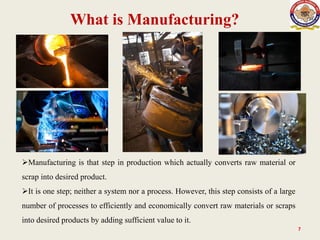
➢Manufacturing is that step in production which actually converts raw material or
scrap into desired product.
➢It is one step; neither a system nor a process. However, this step consists of a large
number of processes to efficiently and economically convert raw materials or scraps
into desired products by adding sufficient value to it.
8
Difference Between Production, Manufacturing and Machining
9
Difference Between Production, Manufacturing and Machining
10
Difference Between Production, Manufacturing and Machining
11

Lecture 1 manufacturing processes

  • 1.
    LECTURE – 1 GeneralClassification & Introduction to Manufacturing processes By: Raj Kumar Bairwa, Mechanical Engineering. Assistant Professor (NPIU), UD RTU, Kota. Email : rkumar.npiu.me@rtu.ac.in
  • 2.
    Manufacturing process ➢ Productionor manufacturing can be simply defined as value addition processes by which raw materials of low utility and value due to its inadequate material properties and poor or irregular size, shape and finish are converted into high utility and valued products with definite dimensions, forms and finish imparting some functional ability. 2 Fig. 1 Value addition by manufacturing.
  • 3.
    CLASSIFICATION OF MANUFACTURINGPROCESSES 3 Fig. 2 Classification of manufacturing processes
  • 4.
    4 It is extremelydifficult to tell the exact number of various manufacturing processes existing and are being practiced presently because a spectacularly large number of processes have been developed till now and the number is still increasing exponentially with the growing demands and rapid progress in science and technology. However, all such manufacturing processes can be broadly classified in four major groups as follows: (a) Shaping or forming Manufacturing a solid product of definite size and shape from a given material taken in three possible states: • in solid state – e.g., forging rolling, extrusion, drawing etc. • in liquid or semi-liquid state – e.g., casting, injection moulding etc. • in powder form – e.g., powder metallurgical process. (b) Joining process Welding, brazing, soldering etc. (c) Removal process Machining (Traditional or Non-traditional), Grinding etc. CLASSIFICATION OF MANUFACTURING PROCESSES
  • 5.
    5 (d) Regenerative manufacturingProduction of solid products in layer by layer from raw materials in different form: • liquid – e.g., stereo lithography • powder – e.g., selective sintering • sheet – e.g., LOM (laminated object manufacturing) • wire – e.g., FDM. (Fused Deposition Modelling) Out of the aforesaid groups, Regenerative Manufacturing is the latest one which is generally accomplished very rapidly and quite accurately using CAD and CAM for Rapid Prototyping and Tooling. CLASSIFICATION OF MANUFACTURING PROCESSES
  • 6.
    6 What is production? ➢Productionis the system that comprises all fields relevant to the fabrication process. ➢It is not just the step that processes raw material to produce intended item; but it involves every associated steps. ➢Mostly it starts with market survey where relevant information about previous similar products and new requirement are gathered directly from the customer and subsequently analysed to dig out new idea. ➢It seeks the approval of management for finalizing the new product. However, management team also go through the views of other sectors including safety and legal aspects.
  • 7.
    7 What is Manufacturing? ➢Manufacturingis that step in production which actually converts raw material or scrap into desired product. ➢It is one step; neither a system nor a process. However, this step consists of a large number of processes to efficiently and economically convert raw materials or scraps into desired products by adding sufficient value to it.
  • 8.
    8 Difference Between Production,Manufacturing and Machining
  • 9.
    9 Difference Between Production,Manufacturing and Machining
  • 10.
    10 Difference Between Production,Manufacturing and Machining
  • 11.