15CE5164
Advanced Water Resources Engineering
© 2016 KL University – The contents of this presentation are an intellectual and copyrighted property of KL University. ALL RIGHTS RESERVED 1
Reservoir Planning
•Water storage reservoirs may be created by
constructing a dam across a river, along with
suitable appurtenant structures.
•Reservoirs are also meant to absorb a part
of flood water and the excess is discharged
through a spillway.
© 2016 KL University – The contents of this presentation are an intellectual and copyrighted property of KL University. ALL RIGHTS RESERVED 2
Basic Reservoir Types:
• Impounding reservoirs, into which a river flows
naturally. Impounding or storage reservoirs are
intended to accumulate a part of the flood flow of the
river for use during the non-flood months.
• Service or balancing reservoirs, which receiving
supplies that are pumped or channeled into them
artificially. These are relatively small in volume
because the storage required by them is to balance
flows for a few hours or a few days at the most.
© 2016 KL University – The contents of this presentation are an intellectual and copyrighted property of KL University. ALL RIGHTS RESERVED 3
Investigations:
Engineering surveys
Geological investigations
Hydrological investigations
© 2016 KL University – The contents of this presentation are an intellectual and copyrighted property of KL University. ALL RIGHTS RESERVED. The
materials used in the ppt has been compiled from different sources
4
Engineering surveys-
Conducted for dam, reservoir and other associated work.
Topographic survey of the area is carried out and the contour
plan is prepared.
The horizontal control is usually provided by triangulation
survey, and the vertical control by precise levelling.
© 2016 KL University – The contents of this presentation are an intellectual and copyrighted property of KL University. ALL RIGHTS RESERVED. The
materials used in the ppt has been compiled from different sources
5
Geological investigation-
Geological investigations of the dam and reservoir site are done
for the following purposes.
(i) Suitability of foundation for the dam.
(ii) Watertightness of the reservoir basin
(iii)Location of the quarry sites for the construction materials.
© 2016 KL University – The contents of this presentation are an intellectual and copyrighted property of KL University. ALL RIGHTS RESERVED. The
materials used in the ppt has been compiled from different sources
6
Hydrological investigations-
The hydrological investigations are conducted for the
following purposes :
(i) To study the runoff pattern and storage capacity.
(ii) To determine the maximum discharge at the site.
© 2016 KL University – The contents of this presentation are an intellectual and copyrighted property of KL University. ALL RIGHTS RESERVED. The
materials used in the ppt has been compiled from different sources
7
Site selection:
Large storage capacity
River valley should be narrow, length of dam to constructed
is less.
Watertightness of reservoir.
Good hydrological conditions
Deep reservoir
© 2016 KL University – The contents of this presentation are an intellectual and copyrighted property of KL University. ALL RIGHTS RESERVED. The
materials used in the ppt has been compiled from different sources
8
Small submerged area
Low silt inflow
No objectionable minerals
Low cost of real estate
Site easily accessible
© 2016 KL University – The contents of this presentation are an intellectual and copyrighted property of KL University. ALL RIGHTS RESERVED. The
materials used in the ppt has been compiled from different sources
9
Site selection:
Reservoirs levels:
© 2016 KL University – The contents of this presentation are an intellectual and copyrighted property of KL University. ALL RIGHTS RESERVED 10
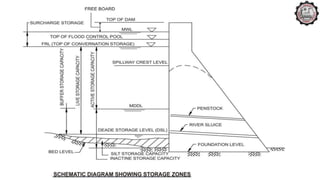
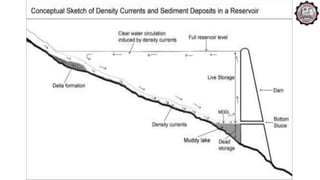
•Full Reservoir Level (FRL): It is the level
corresponding to the storage which includes
both inactive and active storages and also
the flood storage, if provided for.
•In fact, this is the highest reservoir level that
can be maintained without spillway
discharge or without passing water
downstream through sluice ways.
Reservoirs levels:
© 2016 KL University – The contents of this presentation are an intellectual and copyrighted property of KL University. ALL RIGHTS RESERVED 11
•Minimum Drawdown Level (MDDL): It is the
level below which the reservoir will not be
drawn down so as to maintain a minimum head
required in power projects.
•Dead Storage Level (DSL): Below the level, there
are no outlets to drain the water in the reservoir
by gravity.
Reservoirs levels:
© 2016 KL University – The contents of this presentation are an intellectual and copyrighted property of KL University. ALL RIGHTS RESERVED 12
•Maximum Water Level (MWL): This id the water
level that is ever likely to be attained during the
passage of the design flood.
•It depends upon the specified initial reservoir
level and the spillway gate operation rule.
•This level is also called sometimes as the Highest
Reservoir Level or the Highest Flood Level.
Reservoirs storage Zones:
© 2016 KL University – The contents of this presentation are an intellectual and copyrighted property of KL University. ALL RIGHTS RESERVED 14
• Live storage: This is the storage available for the intended
purpose between Full Supply Level and the Invert Level of
the lowest discharge outlet.
• The Full Supply Level is normally that level above which
over spill to waste would take place.
• This may also be termed as the volume of water actually
available at any time between the Dead Storage Level and
the lower of the actual water level and Full Reservoir Level.
Reservoirs storage Zones:
© 2016 KL University – The contents of this presentation are an intellectual and copyrighted property of KL University. ALL RIGHTS RESERVED 15
• Dead storage: It is the total storage below the invert level
of the lowest discharge outlet from the reservoir.
• It may be available to contain sedimentation, provided the
sediment does not adversely affect the lowest discharge.
• Outlet Surcharge or Flood storage: This is required as a
reserve between Full Reservoir Level and the Maximum
Water level to contain the peaks of floods that might occur
when there is insufficient storage capacity for them below
Full Reservoir Level.
Reservoirs storage Zones:
© 2016 KL University – The contents of this presentation are an intellectual and copyrighted property of KL University. ALL RIGHTS RESERVED 16
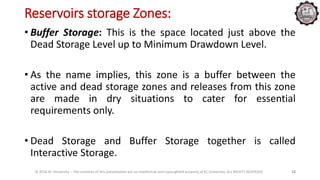
• Buffer Storage: This is the space located just above the
Dead Storage Level up to Minimum Drawdown Level.
• As the name implies, this zone is a buffer between the
active and dead storage zones and releases from this zone
are made in dry situations to cater for essential
requirements only.
• Dead Storage and Buffer Storage together is called
Interactive Storage.
Storage capacity and yield:
Yield – It is the amount of water that can be
supplied from the reservoir in a specified
interval of time which is chosen for the design
varies from a day for small distribution reservoirs
to a year for large conservation reservoirs.
Safe yield – It is the maximum quantity of water
that can be guaranteed during a critical dry
period.
© 2016 KL University – The contents of this presentation are an intellectual and copyrighted property of KL University. ALL RIGHTS RESERVED 17
Storage capacity and yield:
Secondary Yield – It is the quantity of
water available in excess of safe yield
during periods of high flood.
Average yield – It is the arithmetic
average of the firm and the secondary
yield over a long period of time.
© 2016 KL University – The contents of this presentation are an intellectual and copyrighted property of KL University. ALL RIGHTS RESERVED 18
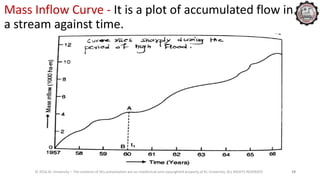
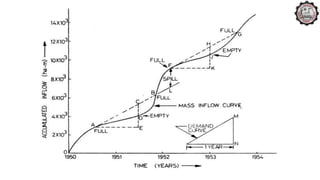
Mass Inflow Curve - It is a plot of accumulated flow in
a stream against time.
© 2016 KL University – The contents of this presentation are an intellectual and copyrighted property of KL University. ALL RIGHTS RESERVED 19
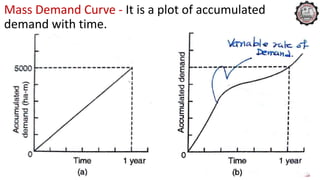
Mass Demand Curve - It is a plot of accumulated
demand with time.
© 2016 KL University – The contents of this presentation are an intellectual and copyrighted property of KL University. ALL RIGHTS RESERVED 20
Reservoir capacity:
Depends upon the inflow available and demand
Inflow in the river is always greater than the
demand, there is no storage required
If the inflow in the river is small but the demand
is high, a large reservoir capacity is required
The required capacity for a reservoir
can be determined by the following
methods:
1. Graphical method, using mass curves.
2. Analytical method
Graphical method-
1. Prepare a mass inflow curve from the flow hydrograph
of the site for a number of consecutive years including
the most critical years (or the driest years) when the
discharge is low.
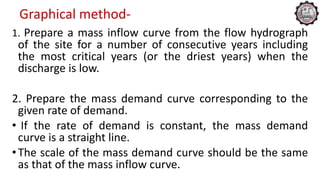
2. Prepare the mass demand curve corresponding to the
given rate of demand.
• If the rate of demand is constant, the mass demand
curve is a straight line.
•The scale of the mass demand curve should be the same
as that of the mass inflow curve.
3. Draw the lines AB, FG, etc. Such that
(I) they are parallel to the mass demand curve, and
(Ii) they are tangential to the crests A, F, etc. Of the mass
curve.
4. Determine the vertical intercepts CD, HJ, etc. between the
tangential lines and the mass inflow curve.
• These intercepts indicate the volumes by which the inflow
volumes fall short of demand.
•Assuming that the reservoir is full at point A, the inflow
volume during the period AE is equal to ordinate DE and
the demand is equal to ordinate CE.
• Thus the storage required is equal to the volume
indicated by the intercept CD.
5. Determine the largest of the vertical intercepts found
in step (4).
• The largest vertical intercept represents the storage
capacity required.
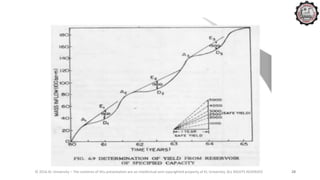
Determination of Safe yield from a reservoir of a
given capacity:
•Prepare the mass inflow curve. Draw st. lines
from a common origin, representing demands at
various rates, say ranging from 0 to 5000 ha-m
per year.
•From the apices A1, A2, A3, etc. of the mass curve
draw tangents in such a way that their maximum
departure from the mass curve does not exceed
the specified reservoir capacity.
© 2016 KL University – The contents of this presentation are an intellectual and copyrighted property of KL University. ALL RIGHTS RESERVED 27
© 2016 KL University – The contents of this presentation are an intellectual and copyrighted property of KL University. ALL RIGHTS RESERVED 28
Determination of Safe yield from a reservoir of a
given capacity:
•Thus in fig. the ordinates E1 D1, E2 D2, E3 D3 etc.
are all equal to the reservoir capacity (say 1500
ha-m).
•Measure the slopes of each of these tangents.
•The slopes indicate the yield which can be
attained in each year from the reservoir of given
capacity.
© 2016 KL University – The contents of this presentation are an intellectual and copyrighted property of KL University. ALL RIGHTS RESERVED 29
Procedure for calculation reservoir life:
•Knowing the inflow rate calculate the (capacity/inflow) ratio
and obtain the trap efficiency from the curve.
•Divide the total capacity into any suitable interval, say 10%.
Assuming the 10% capacity has been reduced due to
sediment deposit, find the trap efficiency for reduced
capacity (i.e. 90% of the original) and the inflow ratio.
•For this interval of 10% capacity, find the average trap
efficiency by taking average if η found in step 2 and 3.
•Determine the sediment inflow rate by taking
water samples and drying the sediment.
•Multiply the total annual sediment transported by
the trap efficiency found in step 3.
•Divide the volume interval by the sediment
deposited to get the number of years to fill this
volume interval of 10% capacity.
•Repeat the procedure for further intervals of the
capacity.
•The total life of the reservoir will be equal to the
total number of years required to fill each of the
volume intervals.
© 2016 KL University – The contents of this presentation are an intellectual and copyrighted property of KL University. ALL RIGHTS RESERVED 32
Reservoir Sedimentation:
It is a difficult problem for which an economical
solution has not yet been discovered, except by
providing a “dead storage” to accommodate the
deposits during the life of the dam.
Disintegration, erosion, transportation, and
sedimentation, are the different stages leading to
silting of reservoir.
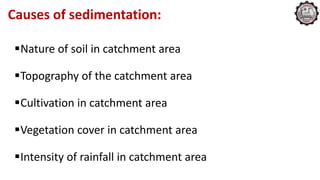
Causes of sedimentation:
Nature of soil in catchment area
Topography of the catchment area
Cultivation in catchment area
Vegetation cover in catchment area
Intensity of rainfall in catchment area
Sediment Management:
• Maximum efforts should water should be released so that less sediments
should retain in reservoir.
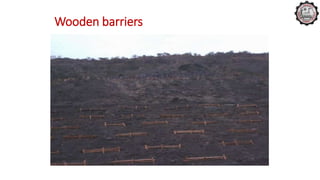
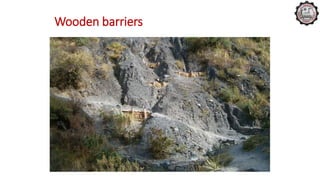
• Following options are:
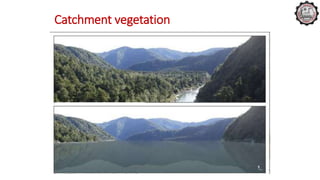
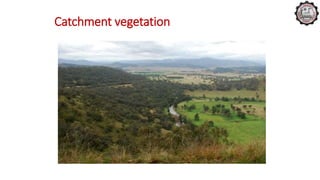
• Catchment vegetation
• Construction of coffer dams(a watertight enclosure pumped dry to
permit construction work below the waterline)/low height barriers
• Flushing and desilting of sediments
• Low level outlets / sediment sluicing (sliding gate)
Catchment vegetation
Wooden barriers
Wooden barriers
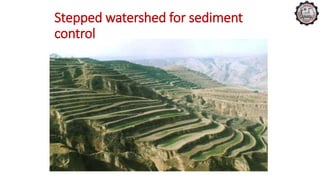
Stepped watershed for sediment
control
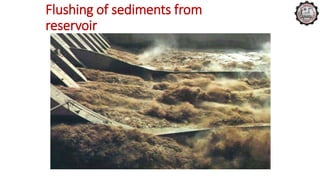
Flushing of sediments from
reservoir
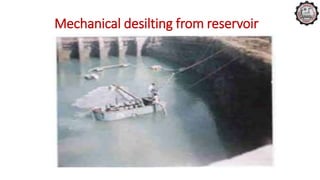
Mechanical desilting from reservoir
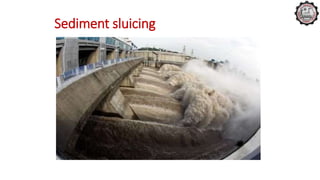
Sediment sluicing
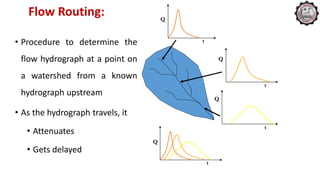
Flow Routing:
• Procedure to determine the
flow hydrograph at a point on
a watershed from a known
hydrograph upstream
• As the hydrograph travels, it
• Attenuates
• Gets delayed
Q
t
Q
t
Q
t
Q
t
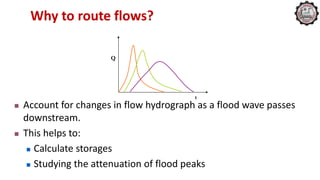
Why to route flows?
 Account for changes in flow hydrograph as a flood wave passes
downstream.
 This helps to:
 Calculate storages
 Studying the attenuation of flood peaks
Q
t
Method of flood routing:
• It is the process of calculating water levels in reservoir, the storage
quantities and outflow rates corresponding to a particular inflow
hydrograph at various instants.
• Flood routing is carried out in a reservoir to determine what will be
maximum rise in its water surface and what will be the discharge in
the downstream channel when particular flood passes through it.
Some of the important methods which have a more practical bearing
are:
• Calculus method
• step by step method: (1) Graphical method (2) Trial and error
method
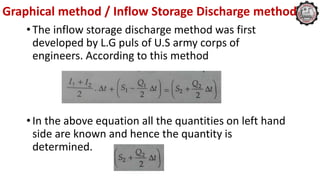
Graphical method / Inflow Storage Discharge method
•The inflow storage discharge method was first
developed by L.G puls of U.S army corps of
engineers. According to this method
•In the above equation all the quantities on left hand
side are known and hence the quantity is
determined.
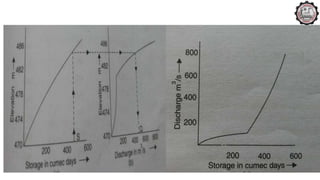
•From this quantity the value of Q2 can be
found out from the storage-discharge
relationship as explained below.
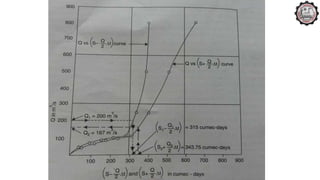
•From the available storage discharge curve,
the curves of (S-Q/2 ∆T) verses Q and
(S+Q/2 ∆T) verses Q are developed.
•Such curves are called routing curves.
•From the known value of Q1 , the value of (S1-
Q1/2∆T) is read from Q verses (S-Q/2 ∆T) curve.
•This value is added to (I1+I2/2)∆t to give
(S2+Q2/2∆T).
• Entering the graph with this value of (S2+Q2/2 ∆T)
, the value of Q2 is read out from Q verses
(S+Q/2∆t) curve.
• The value of Q2 thus determined becomes Q1 for
the next time interval.
•If the inflow and outflow hydrographs are now plotted on
the same time scale, it will be observed that the peak flow
of outflow hydrograph is less than the peak flow of the
inflow hydrograph.
•Similarly, the time to peak in the outflow hydrograph is
more than the time to peak in the inflow hydrograph.
•These are the effects of reservoir storage on the movement
of flood wave through the reservoir.
•The reduction of peak is known as the attenuation and the
difference in times to peak is known as the reservoir lag.
© 2016 KL University – The contents of this presentation are an intellectual and copyrighted property of KL University. ALL RIGHTS RESERVED. The
material used in the ppt has been compiled from different sources.
Spillways: Passages constructed either within a dam or in the
periphery of the reservoir to safely pass the excess of the river during
flood flows are called Spillways
The capacity of a spillway is seen to depend upon the following major factors:
• The inflow flood
• The volume of storage provided by the reservoir
• Crest height of the spillway
• Gated or ungated
© 2016 KL University – The contents of this presentation are an intellectual and copyrighted property of KL University. ALL RIGHTS RESERVED. The
material used in the ppt has been compiled from different sources.
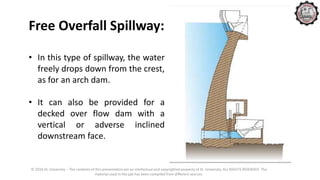
Free Overfall Spillway:
• In this type of spillway, the water
freely drops down from the crest,
as for an arch dam.
• It can also be provided for a
decked over flow dam with a
vertical or adverse inclined
downstream face.
© 2016 KL University – The contents of this presentation are an intellectual and copyrighted property of KL University. ALL RIGHTS RESERVED. The
material used in the ppt has been compiled from different sources.
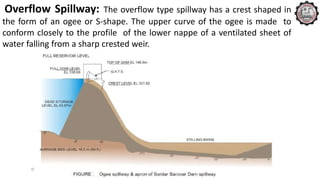
Overflow Spillway: The overflow type spillway has a crest shaped in
the form of an ogee or S-shape. The upper curve of the ogee is made to
conform closely to the profile of the lower nappe of a ventilated sheet of
water falling from a sharp crested weir.
© 2016 KL University – The contents of this presentation are an intellectual and copyrighted property of KL University. ALL RIGHTS RESERVED. The
material used in the ppt has been compiled from different sources.
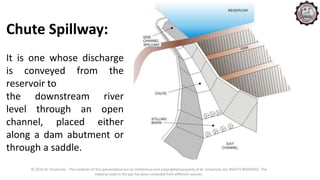
Chute Spillway:
It is one whose discharge
is conveyed from the
reservoir to
the downstream river
level through an open
channel, placed either
along a dam abutment or
through a saddle.
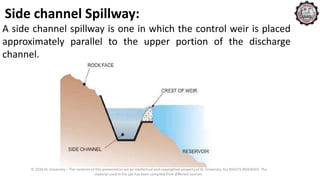
Side channel Spillway:
A side channel spillway is one in which the control weir is placed
approximately parallel to the upper portion of the discharge
channel.
© 2016 KL University – The contents of this presentation are an intellectual and copyrighted property of KL University. ALL RIGHTS RESERVED. The
material used in the ppt has been compiled from different sources.
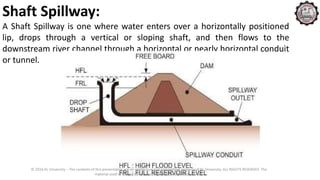
Shaft Spillway:
A Shaft Spillway is one where water enters over a horizontally positioned
lip, drops through a vertical or sloping shaft, and then flows to the
downstream river channel through a horizontal or nearly horizontal conduit
or tunnel.
© 2016 KL University – The contents of this presentation are an intellectual and copyrighted property of KL University. ALL RIGHTS RESERVED. The
material used in the ppt has been compiled from different sources.
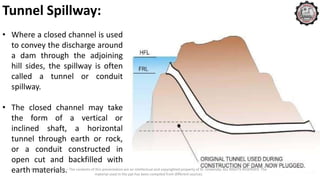
Tunnel Spillway:
• Where a closed channel is used
to convey the discharge around
a dam through the adjoining
hill sides, the spillway is often
called a tunnel or conduit
spillway.
• The closed channel may take
the form of a vertical or
inclined shaft, a horizontal
tunnel through earth or rock,
or a conduit constructed in
open cut and backfilled with
earth materials.© 2016 KL University – The contents of this presentation are an intellectual and copyrighted property of KL University. ALL RIGHTS RESERVED. The
material used in the ppt has been compiled from different sources.
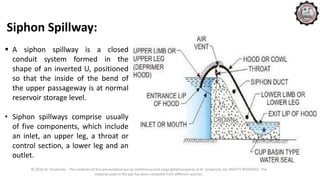
Siphon Spillway:
 A siphon spillway is a closed
conduit system formed in the
shape of an inverted U, positioned
so that the inside of the bend of
the upper passageway is at normal
reservoir storage level.
• Siphon spillways comprise usually
of five components, which include
an inlet, an upper leg, a throat or
control section, a lower leg and an
outlet.
© 2016 KL University – The contents of this presentation are an intellectual and copyrighted property of KL University. ALL RIGHTS RESERVED. The
material used in the ppt has been compiled from different sources.

Reservoir Planning

  • 1.
    15CE5164 Advanced Water ResourcesEngineering © 2016 KL University – The contents of this presentation are an intellectual and copyrighted property of KL University. ALL RIGHTS RESERVED 1
  • 2.
    Reservoir Planning •Water storagereservoirs may be created by constructing a dam across a river, along with suitable appurtenant structures. •Reservoirs are also meant to absorb a part of flood water and the excess is discharged through a spillway. © 2016 KL University – The contents of this presentation are an intellectual and copyrighted property of KL University. ALL RIGHTS RESERVED 2
  • 3.
    Basic Reservoir Types: •Impounding reservoirs, into which a river flows naturally. Impounding or storage reservoirs are intended to accumulate a part of the flood flow of the river for use during the non-flood months. • Service or balancing reservoirs, which receiving supplies that are pumped or channeled into them artificially. These are relatively small in volume because the storage required by them is to balance flows for a few hours or a few days at the most. © 2016 KL University – The contents of this presentation are an intellectual and copyrighted property of KL University. ALL RIGHTS RESERVED 3
  • 4.
    Investigations: Engineering surveys Geological investigations Hydrologicalinvestigations © 2016 KL University – The contents of this presentation are an intellectual and copyrighted property of KL University. ALL RIGHTS RESERVED. The materials used in the ppt has been compiled from different sources 4
  • 5.
    Engineering surveys- Conducted fordam, reservoir and other associated work. Topographic survey of the area is carried out and the contour plan is prepared. The horizontal control is usually provided by triangulation survey, and the vertical control by precise levelling. © 2016 KL University – The contents of this presentation are an intellectual and copyrighted property of KL University. ALL RIGHTS RESERVED. The materials used in the ppt has been compiled from different sources 5
  • 6.
    Geological investigation- Geological investigationsof the dam and reservoir site are done for the following purposes. (i) Suitability of foundation for the dam. (ii) Watertightness of the reservoir basin (iii)Location of the quarry sites for the construction materials. © 2016 KL University – The contents of this presentation are an intellectual and copyrighted property of KL University. ALL RIGHTS RESERVED. The materials used in the ppt has been compiled from different sources 6
  • 7.
    Hydrological investigations- The hydrologicalinvestigations are conducted for the following purposes : (i) To study the runoff pattern and storage capacity. (ii) To determine the maximum discharge at the site. © 2016 KL University – The contents of this presentation are an intellectual and copyrighted property of KL University. ALL RIGHTS RESERVED. The materials used in the ppt has been compiled from different sources 7
  • 8.
    Site selection: Large storagecapacity River valley should be narrow, length of dam to constructed is less. Watertightness of reservoir. Good hydrological conditions Deep reservoir © 2016 KL University – The contents of this presentation are an intellectual and copyrighted property of KL University. ALL RIGHTS RESERVED. The materials used in the ppt has been compiled from different sources 8
  • 9.
    Small submerged area Lowsilt inflow No objectionable minerals Low cost of real estate Site easily accessible © 2016 KL University – The contents of this presentation are an intellectual and copyrighted property of KL University. ALL RIGHTS RESERVED. The materials used in the ppt has been compiled from different sources 9 Site selection:
  • 10.
    Reservoirs levels: © 2016KL University – The contents of this presentation are an intellectual and copyrighted property of KL University. ALL RIGHTS RESERVED 10 •Full Reservoir Level (FRL): It is the level corresponding to the storage which includes both inactive and active storages and also the flood storage, if provided for. •In fact, this is the highest reservoir level that can be maintained without spillway discharge or without passing water downstream through sluice ways.
  • 11.
    Reservoirs levels: © 2016KL University – The contents of this presentation are an intellectual and copyrighted property of KL University. ALL RIGHTS RESERVED 11 •Minimum Drawdown Level (MDDL): It is the level below which the reservoir will not be drawn down so as to maintain a minimum head required in power projects. •Dead Storage Level (DSL): Below the level, there are no outlets to drain the water in the reservoir by gravity.
  • 12.
    Reservoirs levels: © 2016KL University – The contents of this presentation are an intellectual and copyrighted property of KL University. ALL RIGHTS RESERVED 12 •Maximum Water Level (MWL): This id the water level that is ever likely to be attained during the passage of the design flood. •It depends upon the specified initial reservoir level and the spillway gate operation rule. •This level is also called sometimes as the Highest Reservoir Level or the Highest Flood Level.
  • 14.
    Reservoirs storage Zones: ©2016 KL University – The contents of this presentation are an intellectual and copyrighted property of KL University. ALL RIGHTS RESERVED 14 • Live storage: This is the storage available for the intended purpose between Full Supply Level and the Invert Level of the lowest discharge outlet. • The Full Supply Level is normally that level above which over spill to waste would take place. • This may also be termed as the volume of water actually available at any time between the Dead Storage Level and the lower of the actual water level and Full Reservoir Level.
  • 15.
    Reservoirs storage Zones: ©2016 KL University – The contents of this presentation are an intellectual and copyrighted property of KL University. ALL RIGHTS RESERVED 15 • Dead storage: It is the total storage below the invert level of the lowest discharge outlet from the reservoir. • It may be available to contain sedimentation, provided the sediment does not adversely affect the lowest discharge. • Outlet Surcharge or Flood storage: This is required as a reserve between Full Reservoir Level and the Maximum Water level to contain the peaks of floods that might occur when there is insufficient storage capacity for them below Full Reservoir Level.
  • 16.
    Reservoirs storage Zones: ©2016 KL University – The contents of this presentation are an intellectual and copyrighted property of KL University. ALL RIGHTS RESERVED 16 • Buffer Storage: This is the space located just above the Dead Storage Level up to Minimum Drawdown Level. • As the name implies, this zone is a buffer between the active and dead storage zones and releases from this zone are made in dry situations to cater for essential requirements only. • Dead Storage and Buffer Storage together is called Interactive Storage.
  • 17.
    Storage capacity andyield: Yield – It is the amount of water that can be supplied from the reservoir in a specified interval of time which is chosen for the design varies from a day for small distribution reservoirs to a year for large conservation reservoirs. Safe yield – It is the maximum quantity of water that can be guaranteed during a critical dry period. © 2016 KL University – The contents of this presentation are an intellectual and copyrighted property of KL University. ALL RIGHTS RESERVED 17
  • 18.
    Storage capacity andyield: Secondary Yield – It is the quantity of water available in excess of safe yield during periods of high flood. Average yield – It is the arithmetic average of the firm and the secondary yield over a long period of time. © 2016 KL University – The contents of this presentation are an intellectual and copyrighted property of KL University. ALL RIGHTS RESERVED 18
  • 19.
    Mass Inflow Curve- It is a plot of accumulated flow in a stream against time. © 2016 KL University – The contents of this presentation are an intellectual and copyrighted property of KL University. ALL RIGHTS RESERVED 19
  • 20.
    Mass Demand Curve- It is a plot of accumulated demand with time. © 2016 KL University – The contents of this presentation are an intellectual and copyrighted property of KL University. ALL RIGHTS RESERVED 20
  • 21.
    Reservoir capacity: Depends uponthe inflow available and demand Inflow in the river is always greater than the demand, there is no storage required If the inflow in the river is small but the demand is high, a large reservoir capacity is required
  • 22.
    The required capacityfor a reservoir can be determined by the following methods: 1. Graphical method, using mass curves. 2. Analytical method
  • 23.
    Graphical method- 1. Preparea mass inflow curve from the flow hydrograph of the site for a number of consecutive years including the most critical years (or the driest years) when the discharge is low. 2. Prepare the mass demand curve corresponding to the given rate of demand. • If the rate of demand is constant, the mass demand curve is a straight line. •The scale of the mass demand curve should be the same as that of the mass inflow curve.
  • 25.
    3. Draw thelines AB, FG, etc. Such that (I) they are parallel to the mass demand curve, and (Ii) they are tangential to the crests A, F, etc. Of the mass curve. 4. Determine the vertical intercepts CD, HJ, etc. between the tangential lines and the mass inflow curve. • These intercepts indicate the volumes by which the inflow volumes fall short of demand.
  • 26.
    •Assuming that thereservoir is full at point A, the inflow volume during the period AE is equal to ordinate DE and the demand is equal to ordinate CE. • Thus the storage required is equal to the volume indicated by the intercept CD. 5. Determine the largest of the vertical intercepts found in step (4). • The largest vertical intercept represents the storage capacity required.
  • 27.
    Determination of Safeyield from a reservoir of a given capacity: •Prepare the mass inflow curve. Draw st. lines from a common origin, representing demands at various rates, say ranging from 0 to 5000 ha-m per year. •From the apices A1, A2, A3, etc. of the mass curve draw tangents in such a way that their maximum departure from the mass curve does not exceed the specified reservoir capacity. © 2016 KL University – The contents of this presentation are an intellectual and copyrighted property of KL University. ALL RIGHTS RESERVED 27
  • 28.
    © 2016 KLUniversity – The contents of this presentation are an intellectual and copyrighted property of KL University. ALL RIGHTS RESERVED 28
  • 29.
    Determination of Safeyield from a reservoir of a given capacity: •Thus in fig. the ordinates E1 D1, E2 D2, E3 D3 etc. are all equal to the reservoir capacity (say 1500 ha-m). •Measure the slopes of each of these tangents. •The slopes indicate the yield which can be attained in each year from the reservoir of given capacity. © 2016 KL University – The contents of this presentation are an intellectual and copyrighted property of KL University. ALL RIGHTS RESERVED 29
  • 30.
    Procedure for calculationreservoir life: •Knowing the inflow rate calculate the (capacity/inflow) ratio and obtain the trap efficiency from the curve. •Divide the total capacity into any suitable interval, say 10%. Assuming the 10% capacity has been reduced due to sediment deposit, find the trap efficiency for reduced capacity (i.e. 90% of the original) and the inflow ratio. •For this interval of 10% capacity, find the average trap efficiency by taking average if η found in step 2 and 3.
  • 31.
    •Determine the sedimentinflow rate by taking water samples and drying the sediment. •Multiply the total annual sediment transported by the trap efficiency found in step 3. •Divide the volume interval by the sediment deposited to get the number of years to fill this volume interval of 10% capacity.
  • 32.
    •Repeat the procedurefor further intervals of the capacity. •The total life of the reservoir will be equal to the total number of years required to fill each of the volume intervals. © 2016 KL University – The contents of this presentation are an intellectual and copyrighted property of KL University. ALL RIGHTS RESERVED 32
  • 33.
    Reservoir Sedimentation: It isa difficult problem for which an economical solution has not yet been discovered, except by providing a “dead storage” to accommodate the deposits during the life of the dam. Disintegration, erosion, transportation, and sedimentation, are the different stages leading to silting of reservoir.
  • 35.
    Causes of sedimentation: Natureof soil in catchment area Topography of the catchment area Cultivation in catchment area Vegetation cover in catchment area Intensity of rainfall in catchment area
  • 36.
    Sediment Management: • Maximumefforts should water should be released so that less sediments should retain in reservoir. • Following options are: • Catchment vegetation • Construction of coffer dams(a watertight enclosure pumped dry to permit construction work below the waterline)/low height barriers • Flushing and desilting of sediments • Low level outlets / sediment sluicing (sliding gate)
  • 37.
  • 38.
  • 39.
  • 40.
  • 41.
    Stepped watershed forsediment control
  • 42.
    Flushing of sedimentsfrom reservoir
  • 43.
  • 44.
  • 45.
    Flow Routing: • Procedureto determine the flow hydrograph at a point on a watershed from a known hydrograph upstream • As the hydrograph travels, it • Attenuates • Gets delayed Q t Q t Q t Q t
  • 46.
    Why to routeflows?  Account for changes in flow hydrograph as a flood wave passes downstream.  This helps to:  Calculate storages  Studying the attenuation of flood peaks Q t
  • 47.
    Method of floodrouting: • It is the process of calculating water levels in reservoir, the storage quantities and outflow rates corresponding to a particular inflow hydrograph at various instants. • Flood routing is carried out in a reservoir to determine what will be maximum rise in its water surface and what will be the discharge in the downstream channel when particular flood passes through it. Some of the important methods which have a more practical bearing are: • Calculus method • step by step method: (1) Graphical method (2) Trial and error method
  • 48.
    Graphical method /Inflow Storage Discharge method •The inflow storage discharge method was first developed by L.G puls of U.S army corps of engineers. According to this method •In the above equation all the quantities on left hand side are known and hence the quantity is determined.
  • 50.
    •From this quantitythe value of Q2 can be found out from the storage-discharge relationship as explained below. •From the available storage discharge curve, the curves of (S-Q/2 ∆T) verses Q and (S+Q/2 ∆T) verses Q are developed. •Such curves are called routing curves.
  • 51.
    •From the knownvalue of Q1 , the value of (S1- Q1/2∆T) is read from Q verses (S-Q/2 ∆T) curve. •This value is added to (I1+I2/2)∆t to give (S2+Q2/2∆T). • Entering the graph with this value of (S2+Q2/2 ∆T) , the value of Q2 is read out from Q verses (S+Q/2∆t) curve. • The value of Q2 thus determined becomes Q1 for the next time interval.
  • 53.
    •If the inflowand outflow hydrographs are now plotted on the same time scale, it will be observed that the peak flow of outflow hydrograph is less than the peak flow of the inflow hydrograph. •Similarly, the time to peak in the outflow hydrograph is more than the time to peak in the inflow hydrograph. •These are the effects of reservoir storage on the movement of flood wave through the reservoir. •The reduction of peak is known as the attenuation and the difference in times to peak is known as the reservoir lag.
  • 54.
    © 2016 KLUniversity – The contents of this presentation are an intellectual and copyrighted property of KL University. ALL RIGHTS RESERVED. The material used in the ppt has been compiled from different sources. Spillways: Passages constructed either within a dam or in the periphery of the reservoir to safely pass the excess of the river during flood flows are called Spillways The capacity of a spillway is seen to depend upon the following major factors: • The inflow flood • The volume of storage provided by the reservoir • Crest height of the spillway • Gated or ungated
  • 55.
    © 2016 KLUniversity – The contents of this presentation are an intellectual and copyrighted property of KL University. ALL RIGHTS RESERVED. The material used in the ppt has been compiled from different sources. Free Overfall Spillway: • In this type of spillway, the water freely drops down from the crest, as for an arch dam. • It can also be provided for a decked over flow dam with a vertical or adverse inclined downstream face.
  • 56.
    © 2016 KLUniversity – The contents of this presentation are an intellectual and copyrighted property of KL University. ALL RIGHTS RESERVED. The material used in the ppt has been compiled from different sources. Overflow Spillway: The overflow type spillway has a crest shaped in the form of an ogee or S-shape. The upper curve of the ogee is made to conform closely to the profile of the lower nappe of a ventilated sheet of water falling from a sharp crested weir.
  • 57.
    © 2016 KLUniversity – The contents of this presentation are an intellectual and copyrighted property of KL University. ALL RIGHTS RESERVED. The material used in the ppt has been compiled from different sources. Chute Spillway: It is one whose discharge is conveyed from the reservoir to the downstream river level through an open channel, placed either along a dam abutment or through a saddle.
  • 58.
    Side channel Spillway: Aside channel spillway is one in which the control weir is placed approximately parallel to the upper portion of the discharge channel. © 2016 KL University – The contents of this presentation are an intellectual and copyrighted property of KL University. ALL RIGHTS RESERVED. The material used in the ppt has been compiled from different sources.
  • 59.
    Shaft Spillway: A ShaftSpillway is one where water enters over a horizontally positioned lip, drops through a vertical or sloping shaft, and then flows to the downstream river channel through a horizontal or nearly horizontal conduit or tunnel. © 2016 KL University – The contents of this presentation are an intellectual and copyrighted property of KL University. ALL RIGHTS RESERVED. The material used in the ppt has been compiled from different sources.
  • 60.
    Tunnel Spillway: • Wherea closed channel is used to convey the discharge around a dam through the adjoining hill sides, the spillway is often called a tunnel or conduit spillway. • The closed channel may take the form of a vertical or inclined shaft, a horizontal tunnel through earth or rock, or a conduit constructed in open cut and backfilled with earth materials.© 2016 KL University – The contents of this presentation are an intellectual and copyrighted property of KL University. ALL RIGHTS RESERVED. The material used in the ppt has been compiled from different sources.
  • 61.
    Siphon Spillway:  Asiphon spillway is a closed conduit system formed in the shape of an inverted U, positioned so that the inside of the bend of the upper passageway is at normal reservoir storage level. • Siphon spillways comprise usually of five components, which include an inlet, an upper leg, a throat or control section, a lower leg and an outlet. © 2016 KL University – The contents of this presentation are an intellectual and copyrighted property of KL University. ALL RIGHTS RESERVED. The material used in the ppt has been compiled from different sources.