LECTURE – 1
QUALITY
By: Raj Kumar Bairwa,
Mechanical Engineering.
Assistant Professor (NPIU),
UD RTU, Kota.
Quality
 One of the most important decision
factor in selection of products/ services
from competing sets.
 Understanding and improving quality
leads to business success, growth and
competitiveness.
Can be defined as possession of one or more
desirable characteristics for a product/ services.
ISO 9000 Definition – a degree to which a set
of inherent characteristics that fulfils a need or
expectation that is stated, generally implied or is
obligatory.
2
What is Quality ?
Quality is what quality does.
 Any business that can't manage the quality of its
processes and products tends to fall apart.
Quality is critical to sales, cost control, productivity,
risk management and compliance.
 As important as quality is, there's little agreement
as to its definition.
The following definitions look at quality from a
management, quality assurance, product,
marketing, manufacturing and economic point
of view.
1. Fit for Purpose : A quality process or product
is fit for its purpose.
2. Conformance to Requirements : A quality
process or product conforms to requirements.
3. Quality Is Cost : A quality product costs more
to produce.
4. Quality is Price : Quality is the price
consumers are willing to pay for a product or
service.
5. Quality is a Standard : Quality is compliance
to best known standards, processes and
specifications.
6. Quality is Value for Performance : Quality is
value for price.
7. Quality is An Experience : Quality is a
satisfying experience.
3
THE FOLLOWING ADJECTIVES ARE COMMONLY USED TO DESCRIBE
QUALITY:
1. Usable - A quality website is usable.
2. Aesthetically Pleasing - Quality art is aesthetically pleasing.
3. Functional - A quality business process is functional and
efficient.
4. Secure - A quality mobile device is secure, usable and
aesthetically pleasing.
5. Reliable - A quality car is reliable, safe and fun to drive.
6. Defect (Bug) Free - Quality software is bug free, usable and
reliable.
7. Maintainable - Quality bicycles are easy to maintain.
8. Operable - Quality parachutes are easy to operate, safe and
reliable.
9. Accessible - Quality elevators are accessible, reliable and
safe.
10. Sustainable - Quality energy sources are sustainable.
11. Reusable - Quality packaging is reusable.
12. Stable - Quality tightropes are stable and reliable.
13. Interoperable - Quality memory cards are interoperable
(work in a wide variety of devices).
4
THE FOLLOWING ADJECTIVES ARE COMMONLY USED TO DESCRIBE
QUALITY:
14. Credible - Quality news programs are credible and
informative.
15. Available - Quality mobile services always have a signal
(availability).
16. Ethical - Quality medical clinics are professional and ethical.
17. Friendly - Quality service is friendly and diligent.
18. Durable - Quality luggage is durable.
19. Robust - A quality system is robust.
20. Fault Tolerant - Quality aircraft are fault tolerant.
21. Efficient - Quality air conditioners are efficient and reliable.
22. Profitable - Quality businesses are profitable and ethical.
23. Scalable - Quality web platforms are scalable.
5
DIMENSIONS OF QUALITY :
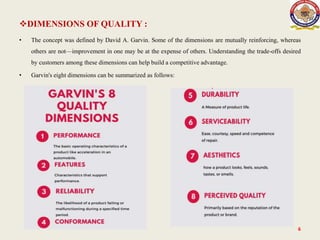
• The concept was defined by David A. Garvin. Some of the dimensions are mutually reinforcing, whereas
others are not—improvement in one may be at the expense of others. Understanding the trade-offs desired
by customers among these dimensions can help build a competitive advantage.
• Garvin's eight dimensions can be summarized as follows:
6
DIMENSIONS OF QUALITY :
1. Performance: Performance is one of the leading dimensions of quality and most customers judge the
product’s quality based upon performance.
7
 For example, if you want a television set, you will be looking for factors like sound, picture clarity, colors,
etc. This is what performance means in the case of a television set.
 However, in the case of an automobile, there are other factors that help you measure performance.
 Acceleration, mileage, handling, convenience, etc mean performance for an automobile. Nobody likes to
buy a noisy car and so low noise is also a sign of quality for an automobile.
 In the services industry, for example, the hospitality industry, performance often means prompt and
courteous service.
 Since the performance dimension of quality mainly involved measurable attributes, ranking brands based on
these attributes is not very difficult.
 Developing overall performance rankings is difficult because a product may involve benefits that matter for
one segment of consumers but not for the other. Moreover, each benefit does not weigh equally for all groups of
consumers.
DIMENSIONS OF QUALITY :
2. Features: Features are the second dimension of quality and often regarded as the second aspect of
performance. Features are the characteristics supporting the basic performance of a product or service.
8
For example, by adding free drinks flight services providers improve the appeal of their services.
Automatic updates or automatic light adjustment in a Smartphone improves its appeal to users.
Separating ‘features’ from ‘performance’ is difficult because drawing a clear line between the two is generally
not possible.
The crucial thing is that features involve objective and measurable attributes.
For many customers, superior quality means that they have a larger number of options.
Furniture stores often offer several varieties in terms of color and fabric quality.
DIMENSIONS OF QUALITY :
3. Reliability:
• This dimension of quality is also related to the functioning of the product and how likely it is to fail or malfunction during a
specific time period. Garvin has highlighted three measures of reliability which are:
– The mean time to the first failure
– The mean time between failures
– The failure rate per unit time
• Now, these measures of reliability require a product to stay functional for a given time period and therefore they apply mainly to
durable goods instead of the products that are consumed instantly. If downtime and maintenance are expensive, reliability
becomes even important for the customers.
9
For example, hosting services for websites and blogs. The hosts with the least downtime are considered the most reliable and
apart from it the ones which provide free CDN services like Kinsta are rated higher in terms of reliability.
Computers, printers and copiers also compete on this basis as well as farm equipment.
Even in the case of automobiles, reliability has become an important product attribute making products more or less attractive in
the eyes of the buyer.
DIMENSIONS OF QUALITY :
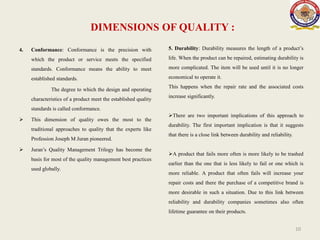
4. Conformance: Conformance is the precision with
which the product or service meets the specified
standards. Conformance means the ability to meet
established standards.
The degree to which the design and operating
characteristics of a product meet the established quality
standards is called conformance.
 This dimension of quality owes the most to the
traditional approaches to quality that the experts like
Profession Joseph M Juran pioneered.
 Juran’s Quality Management Trilogy has become the
basis for most of the quality management best practices
used globally.
10
5. Durability: Durability measures the length of a product’s
life. When the product can be repaired, estimating durability is
more complicated. The item will be used until it is no longer
economical to operate it.
This happens when the repair rate and the associated costs
increase significantly.
There are two important implications of this approach to
durability. The first important implication is that it suggests
that there is a close link between durability and reliability.
A product that fails more often is more likely to be trashed
earlier than the one that is less likely to fail or one which is
more reliable. A product that often fails will increase your
repair costs and there the purchase of a competitive brand is
more desirable in such a situation. Due to this link between
reliability and durability companies sometimes also often
lifetime guarantee on their products.
DIMENSIONS OF QUALITY :
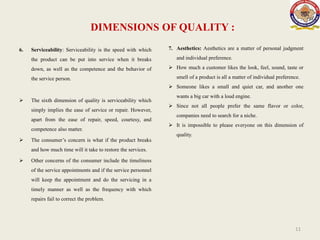
6. Serviceability: Serviceability is the speed with which
the product can be put into service when it breaks
down, as well as the competence and the behavior of
the service person.
 The sixth dimension of quality is serviceability which
simply implies the ease of service or repair. However,
apart from the ease of repair, speed, courtesy, and
competence also matter.
 The consumer’s concern is what if the product breaks
and how much time will it take to restore the services.
 Other concerns of the consumer include the timeliness
of the service appointments and if the service personnel
will keep the appointment and do the servicing in a
timely manner as well as the frequency with which
repairs fail to correct the problem.
11
7. Aesthetics: Aesthetics are a matter of personal judgment
and individual preference.
 How much a customer likes the look, feel, sound, taste or
smell of a product is all a matter of individual preference.
 Someone likes a small and quiet car, and another one
wants a big car with a loud engine.
 Since not all people prefer the same flavor or color,
companies need to search for a niche.
 It is impossible to please everyone on this dimension of
quality.
DIMENSIONS OF QUALITY :
12
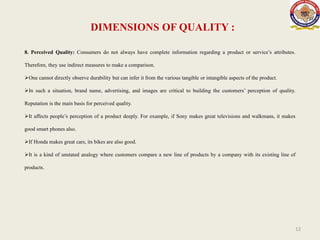
8. Perceived Quality: Consumers do not always have complete information regarding a product or service’s attributes.
Therefore, they use indirect measures to make a comparison.
One cannot directly observe durability but can infer it from the various tangible or intangible aspects of the product.
In such a situation, brand name, advertising, and images are critical to building the customers’ perception of quality.
Reputation is the main basis for perceived quality.
It affects people’s perception of a product deeply. For example, if Sony makes great televisions and walkmans, it makes
good smart phones also.
If Honda makes great cars, its bikes are also good.
It is a kind of unstated analogy where customers compare a new line of products by a company with its existing line of
products.
13

Lecture 1 (quality)

  • 1.
    LECTURE – 1 QUALITY By:Raj Kumar Bairwa, Mechanical Engineering. Assistant Professor (NPIU), UD RTU, Kota.
  • 2.
    Quality  One ofthe most important decision factor in selection of products/ services from competing sets.  Understanding and improving quality leads to business success, growth and competitiveness. Can be defined as possession of one or more desirable characteristics for a product/ services. ISO 9000 Definition – a degree to which a set of inherent characteristics that fulfils a need or expectation that is stated, generally implied or is obligatory. 2
  • 3.
    What is Quality? Quality is what quality does.  Any business that can't manage the quality of its processes and products tends to fall apart. Quality is critical to sales, cost control, productivity, risk management and compliance.  As important as quality is, there's little agreement as to its definition. The following definitions look at quality from a management, quality assurance, product, marketing, manufacturing and economic point of view. 1. Fit for Purpose : A quality process or product is fit for its purpose. 2. Conformance to Requirements : A quality process or product conforms to requirements. 3. Quality Is Cost : A quality product costs more to produce. 4. Quality is Price : Quality is the price consumers are willing to pay for a product or service. 5. Quality is a Standard : Quality is compliance to best known standards, processes and specifications. 6. Quality is Value for Performance : Quality is value for price. 7. Quality is An Experience : Quality is a satisfying experience. 3
  • 4.
    THE FOLLOWING ADJECTIVESARE COMMONLY USED TO DESCRIBE QUALITY: 1. Usable - A quality website is usable. 2. Aesthetically Pleasing - Quality art is aesthetically pleasing. 3. Functional - A quality business process is functional and efficient. 4. Secure - A quality mobile device is secure, usable and aesthetically pleasing. 5. Reliable - A quality car is reliable, safe and fun to drive. 6. Defect (Bug) Free - Quality software is bug free, usable and reliable. 7. Maintainable - Quality bicycles are easy to maintain. 8. Operable - Quality parachutes are easy to operate, safe and reliable. 9. Accessible - Quality elevators are accessible, reliable and safe. 10. Sustainable - Quality energy sources are sustainable. 11. Reusable - Quality packaging is reusable. 12. Stable - Quality tightropes are stable and reliable. 13. Interoperable - Quality memory cards are interoperable (work in a wide variety of devices). 4
  • 5.
    THE FOLLOWING ADJECTIVESARE COMMONLY USED TO DESCRIBE QUALITY: 14. Credible - Quality news programs are credible and informative. 15. Available - Quality mobile services always have a signal (availability). 16. Ethical - Quality medical clinics are professional and ethical. 17. Friendly - Quality service is friendly and diligent. 18. Durable - Quality luggage is durable. 19. Robust - A quality system is robust. 20. Fault Tolerant - Quality aircraft are fault tolerant. 21. Efficient - Quality air conditioners are efficient and reliable. 22. Profitable - Quality businesses are profitable and ethical. 23. Scalable - Quality web platforms are scalable. 5
  • 6.
    DIMENSIONS OF QUALITY: • The concept was defined by David A. Garvin. Some of the dimensions are mutually reinforcing, whereas others are not—improvement in one may be at the expense of others. Understanding the trade-offs desired by customers among these dimensions can help build a competitive advantage. • Garvin's eight dimensions can be summarized as follows: 6
  • 7.
    DIMENSIONS OF QUALITY: 1. Performance: Performance is one of the leading dimensions of quality and most customers judge the product’s quality based upon performance. 7  For example, if you want a television set, you will be looking for factors like sound, picture clarity, colors, etc. This is what performance means in the case of a television set.  However, in the case of an automobile, there are other factors that help you measure performance.  Acceleration, mileage, handling, convenience, etc mean performance for an automobile. Nobody likes to buy a noisy car and so low noise is also a sign of quality for an automobile.  In the services industry, for example, the hospitality industry, performance often means prompt and courteous service.  Since the performance dimension of quality mainly involved measurable attributes, ranking brands based on these attributes is not very difficult.  Developing overall performance rankings is difficult because a product may involve benefits that matter for one segment of consumers but not for the other. Moreover, each benefit does not weigh equally for all groups of consumers.
  • 8.
    DIMENSIONS OF QUALITY: 2. Features: Features are the second dimension of quality and often regarded as the second aspect of performance. Features are the characteristics supporting the basic performance of a product or service. 8 For example, by adding free drinks flight services providers improve the appeal of their services. Automatic updates or automatic light adjustment in a Smartphone improves its appeal to users. Separating ‘features’ from ‘performance’ is difficult because drawing a clear line between the two is generally not possible. The crucial thing is that features involve objective and measurable attributes. For many customers, superior quality means that they have a larger number of options. Furniture stores often offer several varieties in terms of color and fabric quality.
  • 9.
    DIMENSIONS OF QUALITY: 3. Reliability: • This dimension of quality is also related to the functioning of the product and how likely it is to fail or malfunction during a specific time period. Garvin has highlighted three measures of reliability which are: – The mean time to the first failure – The mean time between failures – The failure rate per unit time • Now, these measures of reliability require a product to stay functional for a given time period and therefore they apply mainly to durable goods instead of the products that are consumed instantly. If downtime and maintenance are expensive, reliability becomes even important for the customers. 9 For example, hosting services for websites and blogs. The hosts with the least downtime are considered the most reliable and apart from it the ones which provide free CDN services like Kinsta are rated higher in terms of reliability. Computers, printers and copiers also compete on this basis as well as farm equipment. Even in the case of automobiles, reliability has become an important product attribute making products more or less attractive in the eyes of the buyer.
  • 10.
    DIMENSIONS OF QUALITY: 4. Conformance: Conformance is the precision with which the product or service meets the specified standards. Conformance means the ability to meet established standards. The degree to which the design and operating characteristics of a product meet the established quality standards is called conformance.  This dimension of quality owes the most to the traditional approaches to quality that the experts like Profession Joseph M Juran pioneered.  Juran’s Quality Management Trilogy has become the basis for most of the quality management best practices used globally. 10 5. Durability: Durability measures the length of a product’s life. When the product can be repaired, estimating durability is more complicated. The item will be used until it is no longer economical to operate it. This happens when the repair rate and the associated costs increase significantly. There are two important implications of this approach to durability. The first important implication is that it suggests that there is a close link between durability and reliability. A product that fails more often is more likely to be trashed earlier than the one that is less likely to fail or one which is more reliable. A product that often fails will increase your repair costs and there the purchase of a competitive brand is more desirable in such a situation. Due to this link between reliability and durability companies sometimes also often lifetime guarantee on their products.
  • 11.
    DIMENSIONS OF QUALITY: 6. Serviceability: Serviceability is the speed with which the product can be put into service when it breaks down, as well as the competence and the behavior of the service person.  The sixth dimension of quality is serviceability which simply implies the ease of service or repair. However, apart from the ease of repair, speed, courtesy, and competence also matter.  The consumer’s concern is what if the product breaks and how much time will it take to restore the services.  Other concerns of the consumer include the timeliness of the service appointments and if the service personnel will keep the appointment and do the servicing in a timely manner as well as the frequency with which repairs fail to correct the problem. 11 7. Aesthetics: Aesthetics are a matter of personal judgment and individual preference.  How much a customer likes the look, feel, sound, taste or smell of a product is all a matter of individual preference.  Someone likes a small and quiet car, and another one wants a big car with a loud engine.  Since not all people prefer the same flavor or color, companies need to search for a niche.  It is impossible to please everyone on this dimension of quality.
  • 12.
    DIMENSIONS OF QUALITY: 12 8. Perceived Quality: Consumers do not always have complete information regarding a product or service’s attributes. Therefore, they use indirect measures to make a comparison. One cannot directly observe durability but can infer it from the various tangible or intangible aspects of the product. In such a situation, brand name, advertising, and images are critical to building the customers’ perception of quality. Reputation is the main basis for perceived quality. It affects people’s perception of a product deeply. For example, if Sony makes great televisions and walkmans, it makes good smart phones also. If Honda makes great cars, its bikes are also good. It is a kind of unstated analogy where customers compare a new line of products by a company with its existing line of products.
  • 13.