CONTENT
• HEAD WORK.
• LOCATION OF DIVERSION HEAD WORK
• TYPES OF HEAD WORKS.
• LAYOUT OF DIVERSION HEAD WORK.
• COMPONENTS OF DIVERSION HEADWORKS
• SILT CONTROL DEVICES.
HEAD WORK
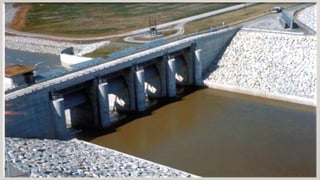
• Headworks is a civil engineering term for any structure at the head or
diversion point of a waterway. It is smaller than a barrage and is used to
divert water from a river into a canal or from a large canal into a smaller
canal.
• These are constructed on a river where adequate flow of river water is
available throughout the year.
• If the storage on upstream of diversion head works is significant, it is called
storage weir.
• If it is constructed on downstream of dam for purpose of diverting water
from upstream side of dam into canal, it is called pickup weir.
LOCATION OF DIVERSION HEAD WORK
• It should be near the command area. The site which gives economical
arrangement is usually selected.
Site selection for head work.
1. Good foundation should be available.
2. The site should be such that weir can be aligned at right angle to the
diversion of water in the river.
3. The site should be such that there should be sufficient space for location
of head regulator and other component of diversion headwork.
4. The overall cost should be less.
5. Proper approach way should be nearby site.
6. On the upstream side where water is retained, should not include costly
land.
7. The river should be perennial.
TYPES OF HEAD WORKS
• The diversion headworks may be classified into the following two types:
• Temporary diversion headworks consist of a spur or bund constructed
across the river to raise the water level in the river and divert it into the
canal. These bunds may be required to be constructed every year after the
floods, because they may be damaged by the floods.
• Permanent diversion headworks consists of a permanent structure such as
weir or barrage constructed across the river to raise the water level in the
river and divert it into the canal. Most of the diversion headworks for
important canal system in our country are permanent diversion headworks
and the same are described in the following sections.
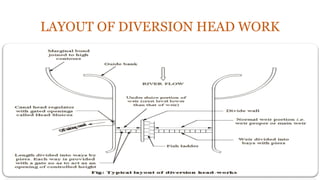
LAYOUT OF DIVERSION HEAD WORK
COMPONENTS OF DIVERSION
HEADWORKS
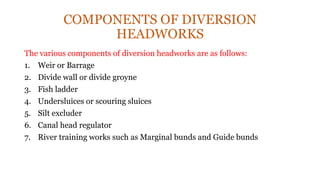
The various components of diversion headworks are as follows:
1. Weir or Barrage
2. Divide wall or divide groyne
3. Fish ladder
4. Undersluices or scouring sluices
5. Silt excluder
6. Canal head regulator
7. River training works such as Marginal bunds and Guide bunds
WEIR
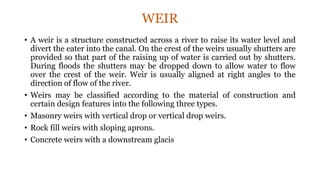
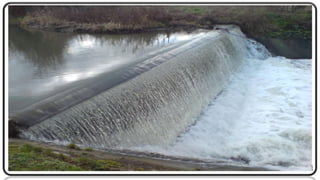
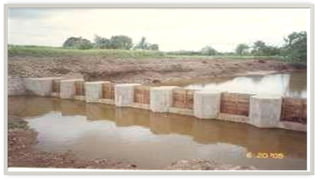
• A weir is a structure constructed across a river to raise its water level and
divert the eater into the canal. On the crest of the weirs usually shutters are
provided so that part of the raising up of water is carried out by shutters.
During floods the shutters may be dropped down to allow water to flow
over the crest of the weir. Weir is usually aligned at right angles to the
direction of flow of the river.
• Weirs may be classified according to the material of construction and
certain design features into the following three types.
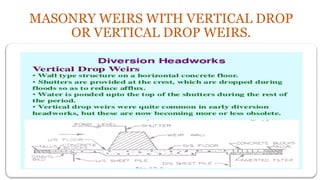
• Masonry weirs with vertical drop or vertical drop weirs.
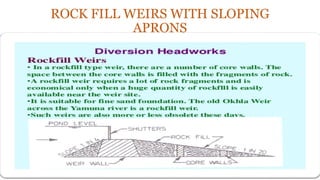
• Rock fill weirs with sloping aprons.
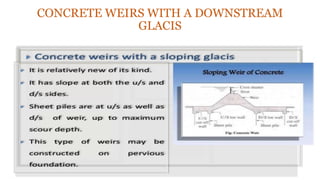
• Concrete weirs with a downstream glacis
MASONRY WEIRS WITH VERTICAL DROP
OR VERTICAL DROP WEIRS.
ROCK FILL WEIRS WITH SLOPING
APRONS
CONCRETE WEIRS WITH A DOWNSTREAM
GLACIS
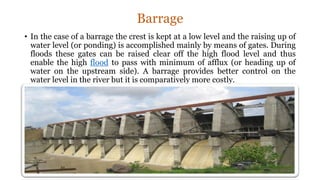
Barrage
• In the case of a barrage the crest is kept at a low level and the raising up of
water level (or ponding) is accomplished mainly by means of gates. During
floods these gates can be raised clear off the high flood level and thus
enable the high flood to pass with minimum of afflux (or heading up of
water on the upstream side). A barrage provides better control on the
water level in the river but it is comparatively more costly.
DIVIDE WALL OR DIVIDE GROYNE
• A divide wall is a long masonry or concrete wall or groyne (an
embankment protected on all sides by stone or concrete blocks) which is
constructed at right angles to the axis of the weir to separate the
undersluices from the rest of the weir. If two canals take off, one on either
side of the river, then two divide walls are required, one on each side. The
top width of the divide wall is about 1.5 to 2.5m. The divide wall extends on
the upstream side up to a distance little beyond the beginning of the canal
head regulator and on the downstream side up to the end of the loose
protection.
FISH LADDER & DIVERSION
HEADWORKS
• Large rivers have various types of fish, many of which are migratory. They
move from one part of the river to another according to the season. In our
country generally fish move from upstream to downstream in the
beginning of winter in search of warmth and return upstream before
monsoon for clearer water. Due to the construction of a weir or barrage
across the river such migration of the fish will be obstructed and if no
arrangement is made in the weir or barrage for this migration, large scale
destruction of the fish life may take place in the river.
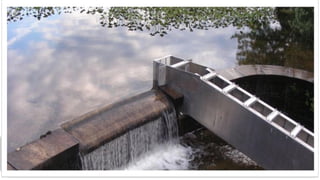
• Thus to enable the fish to migrate fish ladder is provided. Since most fish
can travel upstream only if the velocity of flow does not exceed 3 to 3.5
m/s, the design of the fish ladder should be such that it constantly releases
water at a velocity not exceeding this value.
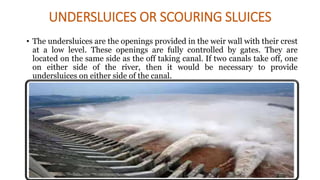
UNDERSLUICES OR SCOURING SLUICES
• The undersluices are the openings provided in the weir wall with their crest
at a low level. These openings are fully controlled by gates. They are
located on the same side as the off taking canal. If two canals take off, one
on either side of the river, then it would be necessary to provide
undersluices on either side of the canal.
SILT EXCLUDER
• Silt excluders are a type of silt control device which functions to exclude
silt from water to entering the canal. These devices are particularly
provided on the river bed in front of the head regulator. A silt excluder
usually consists of a number of rectangular tunnels resting on the floor of
the undersluice pocket. The bottom portion of the tunnels is formed by the
floor of undersluice pocket. The top level portion of the roof of tunnel is
kept same as the level of the crest or sill of the head regulator. The tunnels
are constructed with variable lengths. The tunnel nearest to the crest is of
same length as the length of the head regulator. But all other successive
tunnels have a decreasing length.
CANAL HEAD REGULATOR
• It is a structure constructed at the head of a canal from the upstream of the
weir or barrage constructed. It consists of number of spans separated by
piers which supports the gates provided for the regulation of water flow to
the canal. The spans ranging from 6 to 8 m are used with counterbalanced
steel gates which are operated manually by winches. Also larger spans are
used if necessary or the condition is economical.
RIVER TRAINING WORKS
• River training is defined as the various measure adopted on a river to
stabilize the river channel along a certain cross section for a particular
alignment. These measures are adopted because the rivers in alluvial plane
frequently alter their courses and subsequently cause damage to the land
and property adjacent to them. Some of the major river training works are
explained as below:
• Marginal bunds
• Marginal bunds or levees are the earthen embankments which are
provided to confine the flood water from the river within an allowable
cross-section and in between the embankments. Thus the spreading of
flood water beyond these marginal bunds is prevented.
GUIDE BANKS OR GUIDE BUNDS
• The guide bunds are also a type of earthen embankments provided to
confine the flood water of alluvial rivers within a reasonable length of
waterway and provide a straight and non-tortuous approach towards the
constructions works across the river. They are also used to prevent the
river from changing its course and outflanking the construction work. In
India the guide banks were first designed by Bell and hence these are also
known as Bell’s bunds. The initial design by Bell was later modified by
Spring and Gales and this modified design is commonly adopted these
days.
DIVERSION HEAD WORK

DIVERSION HEAD WORK

  • 2.
    CONTENT • HEAD WORK. •LOCATION OF DIVERSION HEAD WORK • TYPES OF HEAD WORKS. • LAYOUT OF DIVERSION HEAD WORK. • COMPONENTS OF DIVERSION HEADWORKS • SILT CONTROL DEVICES.
  • 3.
    HEAD WORK • Headworksis a civil engineering term for any structure at the head or diversion point of a waterway. It is smaller than a barrage and is used to divert water from a river into a canal or from a large canal into a smaller canal. • These are constructed on a river where adequate flow of river water is available throughout the year. • If the storage on upstream of diversion head works is significant, it is called storage weir. • If it is constructed on downstream of dam for purpose of diverting water from upstream side of dam into canal, it is called pickup weir.
  • 4.
    LOCATION OF DIVERSIONHEAD WORK • It should be near the command area. The site which gives economical arrangement is usually selected. Site selection for head work. 1. Good foundation should be available. 2. The site should be such that weir can be aligned at right angle to the diversion of water in the river. 3. The site should be such that there should be sufficient space for location of head regulator and other component of diversion headwork. 4. The overall cost should be less. 5. Proper approach way should be nearby site. 6. On the upstream side where water is retained, should not include costly land. 7. The river should be perennial.
  • 5.
    TYPES OF HEADWORKS • The diversion headworks may be classified into the following two types: • Temporary diversion headworks consist of a spur or bund constructed across the river to raise the water level in the river and divert it into the canal. These bunds may be required to be constructed every year after the floods, because they may be damaged by the floods. • Permanent diversion headworks consists of a permanent structure such as weir or barrage constructed across the river to raise the water level in the river and divert it into the canal. Most of the diversion headworks for important canal system in our country are permanent diversion headworks and the same are described in the following sections.
  • 6.
  • 7.
    COMPONENTS OF DIVERSION HEADWORKS Thevarious components of diversion headworks are as follows: 1. Weir or Barrage 2. Divide wall or divide groyne 3. Fish ladder 4. Undersluices or scouring sluices 5. Silt excluder 6. Canal head regulator 7. River training works such as Marginal bunds and Guide bunds
  • 8.
    WEIR • A weiris a structure constructed across a river to raise its water level and divert the eater into the canal. On the crest of the weirs usually shutters are provided so that part of the raising up of water is carried out by shutters. During floods the shutters may be dropped down to allow water to flow over the crest of the weir. Weir is usually aligned at right angles to the direction of flow of the river. • Weirs may be classified according to the material of construction and certain design features into the following three types. • Masonry weirs with vertical drop or vertical drop weirs. • Rock fill weirs with sloping aprons. • Concrete weirs with a downstream glacis
  • 10.
    MASONRY WEIRS WITHVERTICAL DROP OR VERTICAL DROP WEIRS.
  • 11.
    ROCK FILL WEIRSWITH SLOPING APRONS
  • 12.
    CONCRETE WEIRS WITHA DOWNSTREAM GLACIS
  • 13.
    Barrage • In thecase of a barrage the crest is kept at a low level and the raising up of water level (or ponding) is accomplished mainly by means of gates. During floods these gates can be raised clear off the high flood level and thus enable the high flood to pass with minimum of afflux (or heading up of water on the upstream side). A barrage provides better control on the water level in the river but it is comparatively more costly.
  • 14.
    DIVIDE WALL ORDIVIDE GROYNE • A divide wall is a long masonry or concrete wall or groyne (an embankment protected on all sides by stone or concrete blocks) which is constructed at right angles to the axis of the weir to separate the undersluices from the rest of the weir. If two canals take off, one on either side of the river, then two divide walls are required, one on each side. The top width of the divide wall is about 1.5 to 2.5m. The divide wall extends on the upstream side up to a distance little beyond the beginning of the canal head regulator and on the downstream side up to the end of the loose protection.
  • 16.
    FISH LADDER &DIVERSION HEADWORKS • Large rivers have various types of fish, many of which are migratory. They move from one part of the river to another according to the season. In our country generally fish move from upstream to downstream in the beginning of winter in search of warmth and return upstream before monsoon for clearer water. Due to the construction of a weir or barrage across the river such migration of the fish will be obstructed and if no arrangement is made in the weir or barrage for this migration, large scale destruction of the fish life may take place in the river. • Thus to enable the fish to migrate fish ladder is provided. Since most fish can travel upstream only if the velocity of flow does not exceed 3 to 3.5 m/s, the design of the fish ladder should be such that it constantly releases water at a velocity not exceeding this value.
  • 18.
    UNDERSLUICES OR SCOURINGSLUICES • The undersluices are the openings provided in the weir wall with their crest at a low level. These openings are fully controlled by gates. They are located on the same side as the off taking canal. If two canals take off, one on either side of the river, then it would be necessary to provide undersluices on either side of the canal.
  • 19.
    SILT EXCLUDER • Siltexcluders are a type of silt control device which functions to exclude silt from water to entering the canal. These devices are particularly provided on the river bed in front of the head regulator. A silt excluder usually consists of a number of rectangular tunnels resting on the floor of the undersluice pocket. The bottom portion of the tunnels is formed by the floor of undersluice pocket. The top level portion of the roof of tunnel is kept same as the level of the crest or sill of the head regulator. The tunnels are constructed with variable lengths. The tunnel nearest to the crest is of same length as the length of the head regulator. But all other successive tunnels have a decreasing length.
  • 21.
    CANAL HEAD REGULATOR •It is a structure constructed at the head of a canal from the upstream of the weir or barrage constructed. It consists of number of spans separated by piers which supports the gates provided for the regulation of water flow to the canal. The spans ranging from 6 to 8 m are used with counterbalanced steel gates which are operated manually by winches. Also larger spans are used if necessary or the condition is economical.
  • 23.
    RIVER TRAINING WORKS •River training is defined as the various measure adopted on a river to stabilize the river channel along a certain cross section for a particular alignment. These measures are adopted because the rivers in alluvial plane frequently alter their courses and subsequently cause damage to the land and property adjacent to them. Some of the major river training works are explained as below: • Marginal bunds • Marginal bunds or levees are the earthen embankments which are provided to confine the flood water from the river within an allowable cross-section and in between the embankments. Thus the spreading of flood water beyond these marginal bunds is prevented.
  • 25.
    GUIDE BANKS ORGUIDE BUNDS • The guide bunds are also a type of earthen embankments provided to confine the flood water of alluvial rivers within a reasonable length of waterway and provide a straight and non-tortuous approach towards the constructions works across the river. They are also used to prevent the river from changing its course and outflanking the construction work. In India the guide banks were first designed by Bell and hence these are also known as Bell’s bunds. The initial design by Bell was later modified by Spring and Gales and this modified design is commonly adopted these days.