Chapter 7 Conveyance of Water
Introduction to conveyance
• Transportation of water to treatment plant or reservoir or distribution through conduits.
• Transmission: Source – TP – Reservoir
• Distribution: Reservoir – Users Tap
• Conduits:
A. Gravity: Open channel flow
Canals, aqueducts, tunnels
B. Pressure
Pipes, pressure tunnels, pressure aqueducts etc.
Pipe, pipe materials and pipe types
Pipe:
• Circular conduit where fluid flows under pressure
• Designed to carry external and internal loads
Requirement of good pipe:
• Withstand external, internal and temperature stresses
• Smooth for minimum frictional losses
• Durable
• Light
• Noncorrosive
• Cheap
• Easy joint
Pipe types as per materials:
1. Cast Iron Pipes 2. Wrought Iron Pipes
3. Steel Pipes 4. Galvanized Iron Pipes
5. Concrete Pipes 6. Plastic Pipes
7. Asbestos Cement Pipes 8. Wooden Pipes
9. Vitrified Clay Pipes 10. Lead and copper Pipes
(a) Cast Iron (CI) Pipe:
• Manufactured by sand molding or centrifugal method
• Standard 1.8 m length but up to 3m for smaller diameter
• 50 mm to 1.2 m dia.
Advantages:
Easy to join, can withstand high pressure, resistance to corrosion, long life (> 100 yrs),
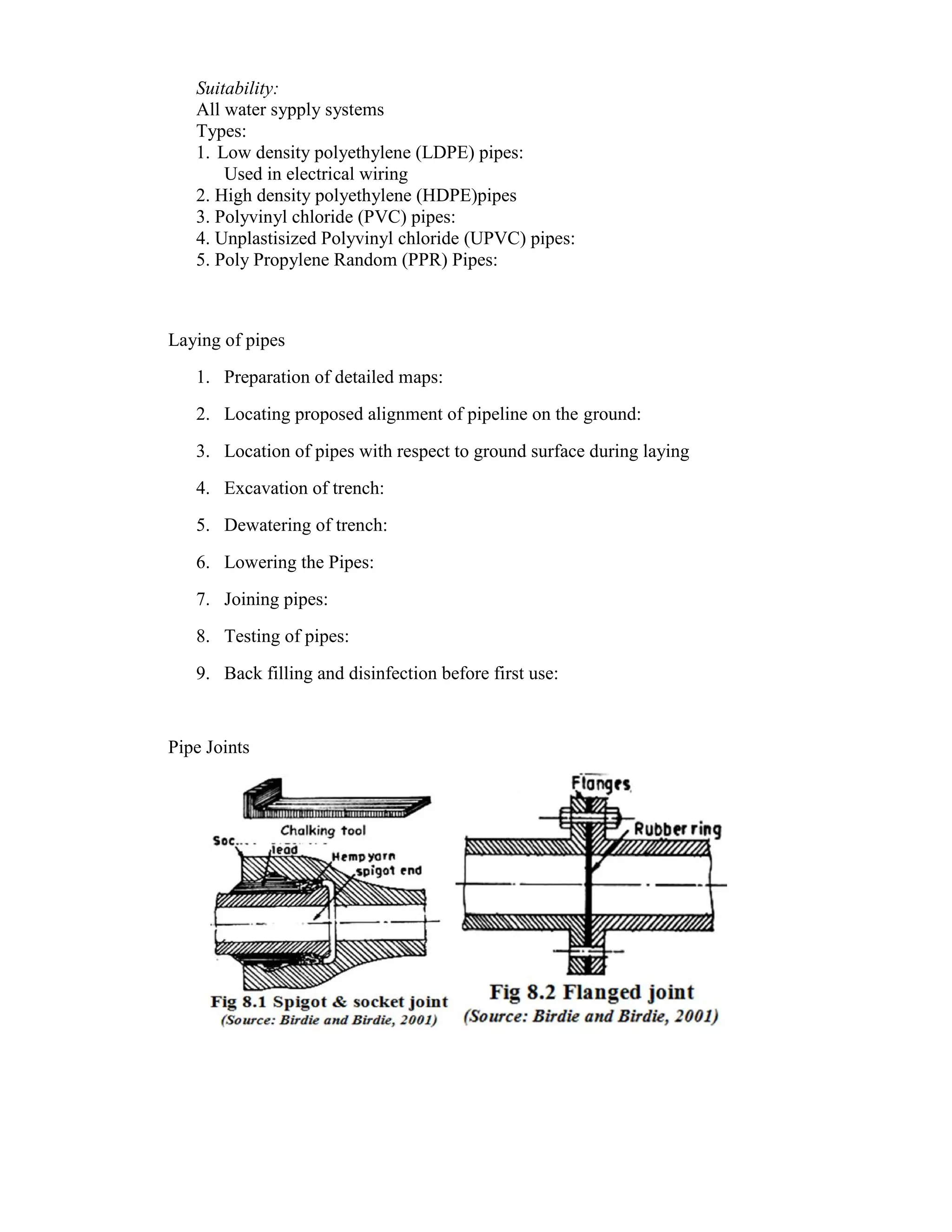
durable, strong and moderate in cost, joined by flanged or Spigot and socket joint, low
maintenance cost
.
Disadvantages:
Brittle and very heavy so difficult to transport and may be expensive.
Suitability: Suitable for distribution system
(b) Wrought Iron (WI) Pipe:
• Manufactured by rolling the flat plates of metal to proper diameter and welding to the
edges
Advantages:
Strong, light weight, can withstand high pressure (400 m) and cheaper than CI pipes
Disadvantages:
It can’t withstand external load and when there is no water inside, liable to corrosion and
costly to maintain. It is costlier than CI pipes
Suitability: Occasionally used for main lines where pressure is high
(c) Steel Pipe:
• Manufactured by WI or mild steel which are galvanized by providing a protective coating
of zinc on inner and outer surface
Advantages:
It is cheap, light, easy in handling and transport, easy in joining with screwed socket
joints and 20 years of life, resistant to corrosion when exposed to atmosphere
Disadvantages:
may get corroded by acidic and alkaline waters and liable to incrustation.
Suitability: main lines where pressure is high and when pipe is exposure in open
atmosphere
(d) Galvanized iron (GI) pipes:
• Manufactured similar as WI pipes
• 15,20,25,32,40,50,63,75,90,110,125,150, 200 mm inner dia
Advantages:
Light in weight, easy in transport, handling, cutting, threading, working, joining, and
gives neat appearance, joined couplings or screwed socket joint.
Disadvantages:
Costly, corrosive and less durable than CI pipes
Suitability: Inside plumbing in buildings but not used nowadays due to high cost.
(e) Concrete (GI) pipes:
• Made of cement concrete (precast or cast in site)
Advantages:
Withstand 150 m head of water, resist corrosion and life is above 75 years, maintenance
cost is low, least thermal expansion, can be laid under water and resist normal traffic load
Disadvantages:
Precast type is heavy to handle and transport, concrete pipes can’t resist high pressure
and difficult to repair, it may be affected by acids and alkali and salty waters, difficult to join and
liable to leak due to porosity
Suitability:
Where water does not flow under pressure (i.e. sewerage system)
(f) Asbestos cement (AC) pipes:
• Made of mixture of cement and asbestos fibers
Advantages:
not affected by salt water and corrosive materials, smooth, light so easy in handling
Disadvantages:
Affected by alkali and acid and also brittle so costlier in transport.
Suitability:
Small size distribution pipes
(g) Wooden pipes:
• made of wood by making channels or boring at center and used in ancient times
• not used in water supply nowadays
(h) Vitrified clay Pipes:
• made of vitrified clay so has smooth surface
• not used in water supply nowadays
(i) Lead and copper Pipes:
• Copper pipe is made of copper and can resist corrosion even if water contains some acids
and expensive so not used in water supply nowadays
• Leads are soluble in water so lead pipe causes lead poisoning hence it is not used in water
supply nowadays.
(j) Plastic Pipes:
Made of Plastic and common in nowadays
it is corrosion resistant, light in weight and economical
Advantages:
Light, cheap, available in longer length, electrical insulation, corrosion free, life
correspond to GI
Disadvantages:
Less resistant to hot water, may impart smell to water, can be easily cut.
Suitability:
All water sypply systems
Types:
1. Low density polyethylene (LDPE) pipes:
Used in electrical wiring
2. High density polyethylene (HDPE)pipes
3. Polyvinyl chloride (PVC) pipes:
4. Unplastisized Polyvinyl chloride (UPVC) pipes:
5. Poly Propylene Random (PPR) Pipes:
Laying of pipes
1. Preparation of detailed maps:
2. Locating proposed alignment of pipeline on the ground:
3. Location of pipes with respect to ground surface during laying
4. Excavation of trench:
5. Dewatering of trench:
6. Lowering the Pipes:
7. Joining pipes:
8. Testing of pipes:
9. Back filling and disinfection before first use:
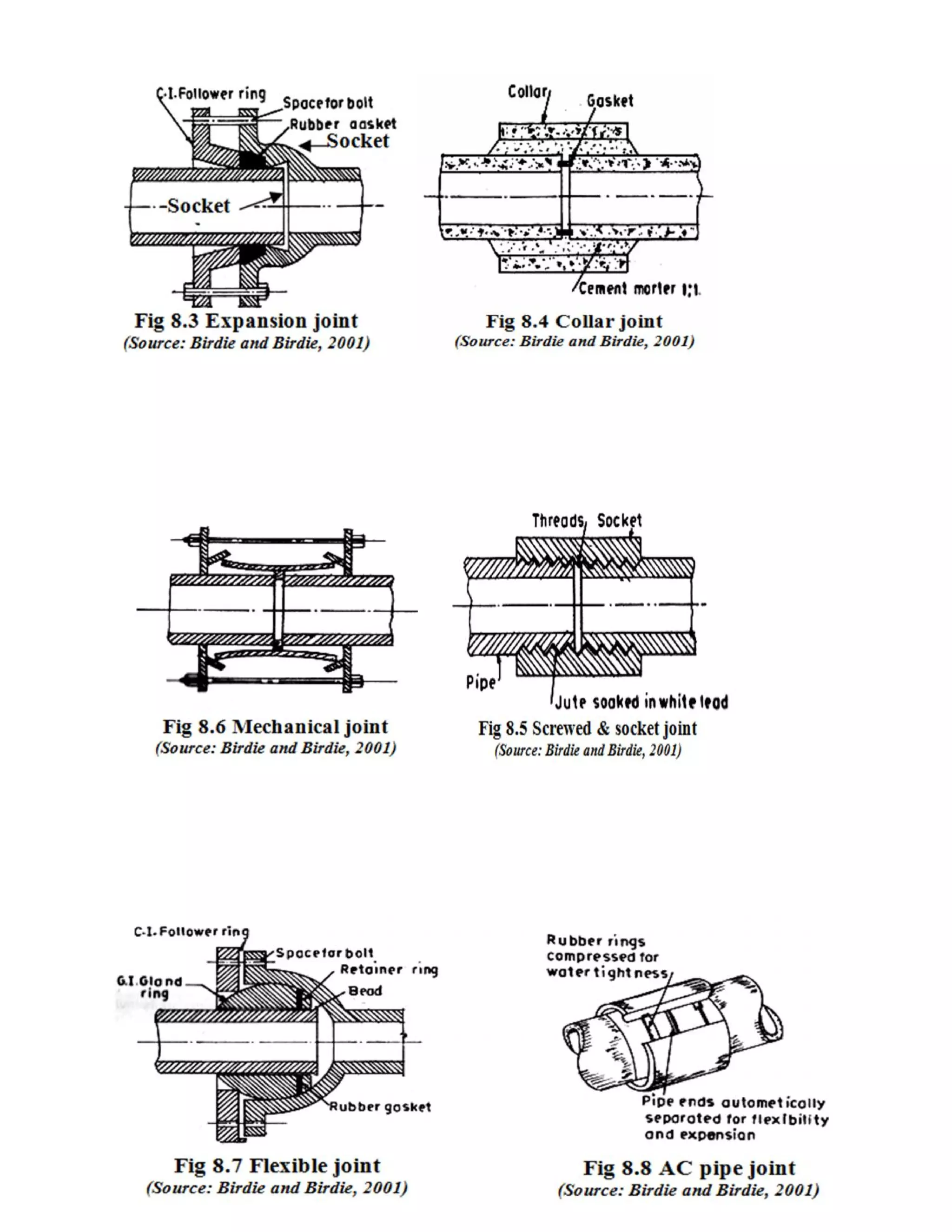
Pipe Joints
Chapter 7 conveyance of water

Chapter 7 conveyance of water

  • 1.
    Chapter 7 Conveyanceof Water Introduction to conveyance • Transportation of water to treatment plant or reservoir or distribution through conduits. • Transmission: Source – TP – Reservoir • Distribution: Reservoir – Users Tap • Conduits: A. Gravity: Open channel flow Canals, aqueducts, tunnels B. Pressure Pipes, pressure tunnels, pressure aqueducts etc. Pipe, pipe materials and pipe types Pipe: • Circular conduit where fluid flows under pressure • Designed to carry external and internal loads Requirement of good pipe: • Withstand external, internal and temperature stresses • Smooth for minimum frictional losses • Durable • Light • Noncorrosive • Cheap • Easy joint
  • 2.
    Pipe types asper materials: 1. Cast Iron Pipes 2. Wrought Iron Pipes 3. Steel Pipes 4. Galvanized Iron Pipes 5. Concrete Pipes 6. Plastic Pipes 7. Asbestos Cement Pipes 8. Wooden Pipes 9. Vitrified Clay Pipes 10. Lead and copper Pipes (a) Cast Iron (CI) Pipe: • Manufactured by sand molding or centrifugal method • Standard 1.8 m length but up to 3m for smaller diameter • 50 mm to 1.2 m dia. Advantages: Easy to join, can withstand high pressure, resistance to corrosion, long life (> 100 yrs), durable, strong and moderate in cost, joined by flanged or Spigot and socket joint, low maintenance cost . Disadvantages: Brittle and very heavy so difficult to transport and may be expensive. Suitability: Suitable for distribution system (b) Wrought Iron (WI) Pipe: • Manufactured by rolling the flat plates of metal to proper diameter and welding to the edges Advantages: Strong, light weight, can withstand high pressure (400 m) and cheaper than CI pipes Disadvantages: It can’t withstand external load and when there is no water inside, liable to corrosion and costly to maintain. It is costlier than CI pipes Suitability: Occasionally used for main lines where pressure is high
  • 3.
    (c) Steel Pipe: •Manufactured by WI or mild steel which are galvanized by providing a protective coating of zinc on inner and outer surface Advantages: It is cheap, light, easy in handling and transport, easy in joining with screwed socket joints and 20 years of life, resistant to corrosion when exposed to atmosphere Disadvantages: may get corroded by acidic and alkaline waters and liable to incrustation. Suitability: main lines where pressure is high and when pipe is exposure in open atmosphere (d) Galvanized iron (GI) pipes: • Manufactured similar as WI pipes • 15,20,25,32,40,50,63,75,90,110,125,150, 200 mm inner dia Advantages: Light in weight, easy in transport, handling, cutting, threading, working, joining, and gives neat appearance, joined couplings or screwed socket joint. Disadvantages: Costly, corrosive and less durable than CI pipes Suitability: Inside plumbing in buildings but not used nowadays due to high cost. (e) Concrete (GI) pipes: • Made of cement concrete (precast or cast in site) Advantages: Withstand 150 m head of water, resist corrosion and life is above 75 years, maintenance cost is low, least thermal expansion, can be laid under water and resist normal traffic load Disadvantages: Precast type is heavy to handle and transport, concrete pipes can’t resist high pressure and difficult to repair, it may be affected by acids and alkali and salty waters, difficult to join and liable to leak due to porosity
  • 4.
    Suitability: Where water doesnot flow under pressure (i.e. sewerage system) (f) Asbestos cement (AC) pipes: • Made of mixture of cement and asbestos fibers Advantages: not affected by salt water and corrosive materials, smooth, light so easy in handling Disadvantages: Affected by alkali and acid and also brittle so costlier in transport. Suitability: Small size distribution pipes (g) Wooden pipes: • made of wood by making channels or boring at center and used in ancient times • not used in water supply nowadays (h) Vitrified clay Pipes: • made of vitrified clay so has smooth surface • not used in water supply nowadays (i) Lead and copper Pipes: • Copper pipe is made of copper and can resist corrosion even if water contains some acids and expensive so not used in water supply nowadays • Leads are soluble in water so lead pipe causes lead poisoning hence it is not used in water supply nowadays. (j) Plastic Pipes: Made of Plastic and common in nowadays it is corrosion resistant, light in weight and economical Advantages: Light, cheap, available in longer length, electrical insulation, corrosion free, life correspond to GI Disadvantages: Less resistant to hot water, may impart smell to water, can be easily cut.
  • 5.
    Suitability: All water sypplysystems Types: 1. Low density polyethylene (LDPE) pipes: Used in electrical wiring 2. High density polyethylene (HDPE)pipes 3. Polyvinyl chloride (PVC) pipes: 4. Unplastisized Polyvinyl chloride (UPVC) pipes: 5. Poly Propylene Random (PPR) Pipes: Laying of pipes 1. Preparation of detailed maps: 2. Locating proposed alignment of pipeline on the ground: 3. Location of pipes with respect to ground surface during laying 4. Excavation of trench: 5. Dewatering of trench: 6. Lowering the Pipes: 7. Joining pipes: 8. Testing of pipes: 9. Back filling and disinfection before first use: Pipe Joints