Kingdom of Saudi Arabia
Al Imam Mohammad Ibn Saud Islamic University
College of Science
Department of Biology
Entomology
353 Bio
T. Amani Alsharidah
1441 – 2019
Lecture 12
Insect Reproductive System
The Reproductive System
 The reproductive organs of insects exhibit an incredible variety of forms, but
there is a basic design and function to each component.
 Reproductive system in insect:
1. Can vary in shape (e.g. of gonads and accessory glands)
2. Position (e.g. of the attachment of accessory glands),
3. Number (e.g. of ovarian or testicular tubes, or sperm storage organs)
Between different insect groups, and sometimes even between different species
in a genus.
The female system
 The main functions of the female reproductive system are:
1. Egg production, including the provision of a protective coating in many
insects.
2. The storage of the male’s spermatozoa until the eggs are ready to be
fertilized.
3. Transport of the spermatozoa to the female’s storage.
Female reproductive system
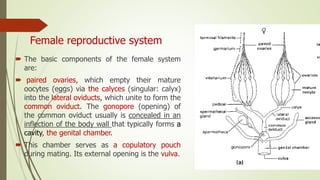
 The basic components of the female system
are:
 paired ovaries, which empty their mature
oocytes (eggs) via the calyces (singular: calyx)
into the lateral oviducts, which unite to form the
common oviduct. The gonopore (opening) of
the common oviduct usually is concealed in an
inflection of the body wall that typically forms a
cavity, the genital chamber.
 This chamber serves as a copulatory pouch
during mating. Its external opening is the vulva.
Female reproductive system
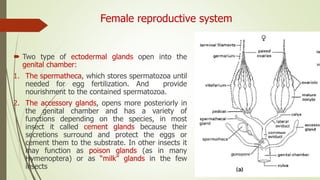
 Two type of ectodermal glands open into the
genital chamber:
1. The spermatheca, which stores spermatozoa until
needed for egg fertilization. And provide
nourishment to the contained spermatozoa.
2. The accessory glands, opens more posteriorly in
the genital chamber and has a variety of
functions depending on the species, in most
insect it called cement glands because their
secretions surround and protect the eggs or
cement them to the substrate. In other insects it
may function as poison glands (as in many
Hymenoptera) or as “milk” glands in the few
insects
The male system
 The main functions of the male reproductive system are:
 The production and storage of spermatozoa.
 Their transport in a viable state to the reproductive tract
of the female.
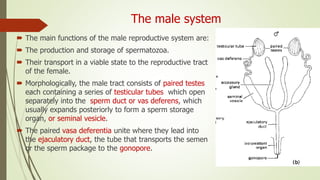
 Morphologically, the male tract consists of paired testes
each containing a series of testicular tubes which open
separately into the sperm duct or vas deferens, which
usually expands posteriorly to form a sperm storage
organ, or seminal vesicle.
 The paired vasa deferentia unite where they lead into
the ejaculatory duct, the tube that transports the semen
or the sperm package to the gonopore.
Method of reproduction
 Nearly all insects reproduce by sexual reproduction.
 This involves the formation and fusion of gametes (sperm from the testes
and eggs from the ovaries).
 There are some species of insects that can also reproduce asexually. They
do this by a process called parthenogenesis.
 During parthenogenesis, a female’s egg can produce a new organism
without being fertilized by sperm.
 This usually requires that the females can produce eggs that have two
copies of each chromosome (diploid) instead of the one copy that an egg
normally contains (haploid).
Method of reproduction
There are several forms of parthenogenesis found in some insect species.
 One of them is extremely interesting because it allows the female to choose
whether she will produce male or female offspring. In these species, including
some ants, bees, and wasps, females are diploid and are the result of sexual
reproduction (fusion of egg and sperm), whereas males are haploid and are the
result of parthenogenesis.
 The female produces haploid eggs, and she can choose whether or not to
fertilize them with sperm obtained from a male and stored in her body.
 If she fertilizes the eggs by allowing them to fuse with sperm, they will become
diploid and produce female progeny.
 If she chooses not to fertilize the eggs, they will still develop, but they will
produce haploid male progeny
Method of reproduction
 Aquatic organisms that can release their sperm into the open ocean where
they will swim to the eggs in the female’s body.
 Most insects have to either deliver sperm directly or indirectly into the
female’s body for internal fertilization.
 There are some species that package their sperm into sealed pouches that
they leave on the ground for females to find. The females then use the
packaged sperm to fertilize their eggs.

Insect Reproductive System

  • 1.
    Kingdom of SaudiArabia Al Imam Mohammad Ibn Saud Islamic University College of Science Department of Biology Entomology 353 Bio T. Amani Alsharidah 1441 – 2019
  • 2.
  • 3.
    The Reproductive System The reproductive organs of insects exhibit an incredible variety of forms, but there is a basic design and function to each component.  Reproductive system in insect: 1. Can vary in shape (e.g. of gonads and accessory glands) 2. Position (e.g. of the attachment of accessory glands), 3. Number (e.g. of ovarian or testicular tubes, or sperm storage organs) Between different insect groups, and sometimes even between different species in a genus.
  • 4.
    The female system The main functions of the female reproductive system are: 1. Egg production, including the provision of a protective coating in many insects. 2. The storage of the male’s spermatozoa until the eggs are ready to be fertilized. 3. Transport of the spermatozoa to the female’s storage.
  • 5.
    Female reproductive system The basic components of the female system are:  paired ovaries, which empty their mature oocytes (eggs) via the calyces (singular: calyx) into the lateral oviducts, which unite to form the common oviduct. The gonopore (opening) of the common oviduct usually is concealed in an inflection of the body wall that typically forms a cavity, the genital chamber.  This chamber serves as a copulatory pouch during mating. Its external opening is the vulva.
  • 6.
    Female reproductive system Two type of ectodermal glands open into the genital chamber: 1. The spermatheca, which stores spermatozoa until needed for egg fertilization. And provide nourishment to the contained spermatozoa. 2. The accessory glands, opens more posteriorly in the genital chamber and has a variety of functions depending on the species, in most insect it called cement glands because their secretions surround and protect the eggs or cement them to the substrate. In other insects it may function as poison glands (as in many Hymenoptera) or as “milk” glands in the few insects
  • 7.
    The male system The main functions of the male reproductive system are:  The production and storage of spermatozoa.  Their transport in a viable state to the reproductive tract of the female.  Morphologically, the male tract consists of paired testes each containing a series of testicular tubes which open separately into the sperm duct or vas deferens, which usually expands posteriorly to form a sperm storage organ, or seminal vesicle.  The paired vasa deferentia unite where they lead into the ejaculatory duct, the tube that transports the semen or the sperm package to the gonopore.
  • 8.
    Method of reproduction Nearly all insects reproduce by sexual reproduction.  This involves the formation and fusion of gametes (sperm from the testes and eggs from the ovaries).  There are some species of insects that can also reproduce asexually. They do this by a process called parthenogenesis.  During parthenogenesis, a female’s egg can produce a new organism without being fertilized by sperm.  This usually requires that the females can produce eggs that have two copies of each chromosome (diploid) instead of the one copy that an egg normally contains (haploid).
  • 9.
    Method of reproduction Thereare several forms of parthenogenesis found in some insect species.  One of them is extremely interesting because it allows the female to choose whether she will produce male or female offspring. In these species, including some ants, bees, and wasps, females are diploid and are the result of sexual reproduction (fusion of egg and sperm), whereas males are haploid and are the result of parthenogenesis.  The female produces haploid eggs, and she can choose whether or not to fertilize them with sperm obtained from a male and stored in her body.  If she fertilizes the eggs by allowing them to fuse with sperm, they will become diploid and produce female progeny.  If she chooses not to fertilize the eggs, they will still develop, but they will produce haploid male progeny
  • 10.
    Method of reproduction Aquatic organisms that can release their sperm into the open ocean where they will swim to the eggs in the female’s body.  Most insects have to either deliver sperm directly or indirectly into the female’s body for internal fertilization.  There are some species that package their sperm into sealed pouches that they leave on the ground for females to find. The females then use the packaged sperm to fertilize their eggs.