Suresh R. Jambagi
M.Sc. (Agri) Agril. Entomology
University of Agricultural Sciences
Dharwad, Karnataka-580005
Email: jambagisuru@gmail.com
GENERAL ENTOMOLOGY
Presentation: 9
Topic : Glandular system in insects
1
GLANDULAR SYSTEM IN INSECTS
 Synonym= Secretary system
 It is divided in to two major groups based on the presence or absence of
ducts.
A. Exocrine glands (glands with duct)
1. Salivary glands: Salivary glands are modified labial glands which secrete
saliva and open beneath hypopharynx.
2. Mandibular glands: Secrete saliva in caterpillars when salivary glands are
modified into silk glands. In queen bee it secretes queen substance.
3. Maxillary glands: Secretions are useful to lubricate mouth parts.
4. Pharyngeal glands: Secrete bee milk or royal jelly in nurse bee.
5. Frontal glands: Secrete sticky defensive fluid in nasute termites.
Mr. Suresh Jambagi, M.Sc (Agri) Entomology, UAS Dharwad 2
6. Setal glands: Glandular seta (Scoli) secretes irritant fluid in hairy/slug
caterpillar.
7. Tenant hairs: Secrete sticky fluid found in pulvilli of legs & helps in
ceiling walking in house flies.
8. Moulting glands: Modified glandular epidermal cells, secrete moulting
fluid necessary for moulting.
9. Stink glands (Repugnatorial glands): Secrete bad smelling substance.
e.g. Stink bugs, bed bugs.
10. Osmeteria (Forked gland): Eversible gland in the thorax of papilionid
larva with defense function. e.g. Citrus butterfly larva.
11. Androconia (Scented scales): Secretions of glandular scales of male
pierid butterflies to attract the opposite sex.
Mr. Suresh Jambagi, M.Sc (Agri) Entomology, UAS Dharwad 3
12. Pheromone glands: Found in abdominal terminalia of one sex and
its secretions are released outside to attract opposite sex of the same
species.
13. Wax glands: Dermal glands producing wax in bees and mealy bugs.
14. Sting glands: Modified accessory glands secreting venom in worker
bees and wasps.
15. Lac glands: Dermal glands secreting resinous substances in lac
insect.
16. Milk glands: Modified accessory gland nourishing larva developing
in uterus. e.g. Sheep ked.
Mr. Suresh Jambagi, M.Sc (Agri) Entomology, UAS Dharwad 4
B. Endocrine system (Endocrine system)
 Insect endocrine system is structurally and functionally integrated with
nervous system
 They secrete hormones which travel in the blood to various organs of
the body coordinating their long term activities.
 Endocrine organs are of two types-
1. Neuro-secretory cells in the central nervous system
2. Specialized endocrine glands such as
a) Corpora cardiaca
b) Corpora allata
c) Prothoracic glands
Mr. Suresh Jambagi, M.Sc (Agri) Entomology, UAS Dharwad 5
1. Neurosecretory cells: These are typical neurons with secretory
activity.
 They produce hormones which act directly on effector organs or they
may act on other endocrine glands
 Which in turn are stimulated to secrete hormones.
 They occur in the mid region of brain and central nervous system.
 Their axons lead out from the brain, posteriorly, most often cross each
other and emerge out of the brain to enter in to or lie apposed to the
corpora cardiaca.
 The secretions of neurosecretory cells are called brain hormone or
activator hormones.
 Large number of neuro-secretory cells may be present in the nervous
system and are three types.
Mr. Suresh Jambagi, M.Sc (Agri) Entomology, UAS Dharwad 6
• Large number of neuro-secretory cells may be present in the nervous
system and are three types.
A. Median NSC of the brain (PTTH hormone)
B. Lateral NSC of the brain-
- They Promote function of prothoracic glands
- Stimulate protein synthesis
- Possibly control water loss and
- Oocyte development and activity and
C. Ventral NSC of the other ganglia (ventral nerve cord): these secretions
are known to concern with activity, water regulation.
Mr. Suresh Jambagi, M.Sc (Agri) Entomology, UAS Dharwad 7
2. Specialized endocrine glands
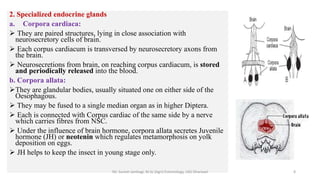
a. Corpora cardiaca:
 They are paired structures, lying in close association with
neurosecretory cells of brain.
 Each corpus cardiacum is transversed by neurosecretory axons from
the brain.
 Neurosecretions from brain, on reaching corpus cardiacum, is stored
and periodically released into the blood.
b. Corpora allata:
They are glandular bodies, usually situated one on either side of the
Oesophagous.
 They may be fused to a single median organ as in higher Diptera.
 Each is connected with Corpus cardiac of the same side by a nerve
which carries fibres from NSC.
 Under the influence of brain hormone, corpora allata secretes Juvenile
hormone (JH) or neotenin which regulates metamorphosis on yolk
deposition on eggs.
 JH helps to keep the insect in young stage only.
Mr. Suresh Jambagi, M.Sc (Agri) Entomology, UAS Dharwad 8
c. Prothoracic glands:
 They are two in number and placed mostly in thoracic region.
 Prothoracic glands secrete moulting hormone (MH), called Ecdysone
under the influence of brain hormone.
 Moulting hormone helps in insects in the initiation and process of
moulting.
 Except in Thysanura (which moult as adults) and solitary locusts, the
prothoracic glands break down soon after final moult to adults, so they
are seen only in immature forms but not in adults.
Mr. Suresh Jambagi, M.Sc (Agri) Entomology, UAS Dharwad 9

Glandular system in insects

  • 1.
    Suresh R. Jambagi M.Sc.(Agri) Agril. Entomology University of Agricultural Sciences Dharwad, Karnataka-580005 Email: jambagisuru@gmail.com GENERAL ENTOMOLOGY Presentation: 9 Topic : Glandular system in insects 1
  • 2.
    GLANDULAR SYSTEM ININSECTS  Synonym= Secretary system  It is divided in to two major groups based on the presence or absence of ducts. A. Exocrine glands (glands with duct) 1. Salivary glands: Salivary glands are modified labial glands which secrete saliva and open beneath hypopharynx. 2. Mandibular glands: Secrete saliva in caterpillars when salivary glands are modified into silk glands. In queen bee it secretes queen substance. 3. Maxillary glands: Secretions are useful to lubricate mouth parts. 4. Pharyngeal glands: Secrete bee milk or royal jelly in nurse bee. 5. Frontal glands: Secrete sticky defensive fluid in nasute termites. Mr. Suresh Jambagi, M.Sc (Agri) Entomology, UAS Dharwad 2
  • 3.
    6. Setal glands:Glandular seta (Scoli) secretes irritant fluid in hairy/slug caterpillar. 7. Tenant hairs: Secrete sticky fluid found in pulvilli of legs & helps in ceiling walking in house flies. 8. Moulting glands: Modified glandular epidermal cells, secrete moulting fluid necessary for moulting. 9. Stink glands (Repugnatorial glands): Secrete bad smelling substance. e.g. Stink bugs, bed bugs. 10. Osmeteria (Forked gland): Eversible gland in the thorax of papilionid larva with defense function. e.g. Citrus butterfly larva. 11. Androconia (Scented scales): Secretions of glandular scales of male pierid butterflies to attract the opposite sex. Mr. Suresh Jambagi, M.Sc (Agri) Entomology, UAS Dharwad 3
  • 4.
    12. Pheromone glands:Found in abdominal terminalia of one sex and its secretions are released outside to attract opposite sex of the same species. 13. Wax glands: Dermal glands producing wax in bees and mealy bugs. 14. Sting glands: Modified accessory glands secreting venom in worker bees and wasps. 15. Lac glands: Dermal glands secreting resinous substances in lac insect. 16. Milk glands: Modified accessory gland nourishing larva developing in uterus. e.g. Sheep ked. Mr. Suresh Jambagi, M.Sc (Agri) Entomology, UAS Dharwad 4
  • 5.
    B. Endocrine system(Endocrine system)  Insect endocrine system is structurally and functionally integrated with nervous system  They secrete hormones which travel in the blood to various organs of the body coordinating their long term activities.  Endocrine organs are of two types- 1. Neuro-secretory cells in the central nervous system 2. Specialized endocrine glands such as a) Corpora cardiaca b) Corpora allata c) Prothoracic glands Mr. Suresh Jambagi, M.Sc (Agri) Entomology, UAS Dharwad 5
  • 6.
    1. Neurosecretory cells:These are typical neurons with secretory activity.  They produce hormones which act directly on effector organs or they may act on other endocrine glands  Which in turn are stimulated to secrete hormones.  They occur in the mid region of brain and central nervous system.  Their axons lead out from the brain, posteriorly, most often cross each other and emerge out of the brain to enter in to or lie apposed to the corpora cardiaca.  The secretions of neurosecretory cells are called brain hormone or activator hormones.  Large number of neuro-secretory cells may be present in the nervous system and are three types. Mr. Suresh Jambagi, M.Sc (Agri) Entomology, UAS Dharwad 6
  • 7.
    • Large numberof neuro-secretory cells may be present in the nervous system and are three types. A. Median NSC of the brain (PTTH hormone) B. Lateral NSC of the brain- - They Promote function of prothoracic glands - Stimulate protein synthesis - Possibly control water loss and - Oocyte development and activity and C. Ventral NSC of the other ganglia (ventral nerve cord): these secretions are known to concern with activity, water regulation. Mr. Suresh Jambagi, M.Sc (Agri) Entomology, UAS Dharwad 7
  • 8.
    2. Specialized endocrineglands a. Corpora cardiaca:  They are paired structures, lying in close association with neurosecretory cells of brain.  Each corpus cardiacum is transversed by neurosecretory axons from the brain.  Neurosecretions from brain, on reaching corpus cardiacum, is stored and periodically released into the blood. b. Corpora allata: They are glandular bodies, usually situated one on either side of the Oesophagous.  They may be fused to a single median organ as in higher Diptera.  Each is connected with Corpus cardiac of the same side by a nerve which carries fibres from NSC.  Under the influence of brain hormone, corpora allata secretes Juvenile hormone (JH) or neotenin which regulates metamorphosis on yolk deposition on eggs.  JH helps to keep the insect in young stage only. Mr. Suresh Jambagi, M.Sc (Agri) Entomology, UAS Dharwad 8
  • 9.
    c. Prothoracic glands: They are two in number and placed mostly in thoracic region.  Prothoracic glands secrete moulting hormone (MH), called Ecdysone under the influence of brain hormone.  Moulting hormone helps in insects in the initiation and process of moulting.  Except in Thysanura (which moult as adults) and solitary locusts, the prothoracic glands break down soon after final moult to adults, so they are seen only in immature forms but not in adults. Mr. Suresh Jambagi, M.Sc (Agri) Entomology, UAS Dharwad 9