Animal Reproduction
            By: Madison Allen
   In sexual reproduction, the fusion of haploid
    gametes forms a diploid cell, the zygote. The
    animal that develops from a zygote can in turn
    give rise to gametes by meiosis. The female
    gamete, the egg, is a large, nonmotile cell. The
    male gamete, the sperm, is generally a much
    smaller, motile cell.
   Asexual reproduction is the generation of new
    individuals without the fusion of egg and sperm.
    In most asexual animals, reproduction relies
    entirely on mitotic cell division.


Asexual vs. Sexual Reproduction
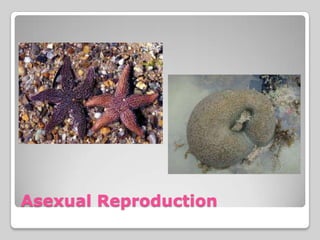
   Many invertebrates can reproduce asexually
    by fission, the separation of a parent
    organism into two individuals of
    approximately equal size.
   Also common among invertebrates is
    budding, in which new individuals arise from
    outgrowths of existing ones.
    ◦ Ex. In certain species of coral and hydra, new
      individuals grow out from the parents body.
   Parthenogenesis is a form of asexual
    reproduction in which an egg develops
    without being fertilized.


Asexual Reproduction
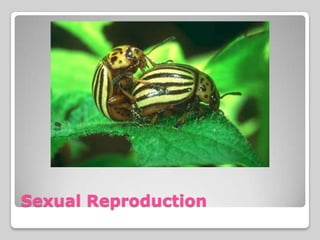
   The vast majority of eukaryotic species
    reproduce sexually.
   Most animals exhibit cycles in reproductive
    activity, often related to changing seasons. In
    this way, animals conserve
    resources, reproducing only when sufficient
    energy sources are available and when
    environmental conditions favor the survival of
    offspring.
    ◦ For example, ewes (female sheep) have a reproductive
      cycle lasting 15-17 days.
   Ovulation is the release of mature eggs and
    occurs at the midpoint of each cycle.
   Reproductive cycles are controlled by
    hormones, which in turn are regulated by
    environmental cues.
    ◦ Common environmental cues are changes in day
      length, seasonal temperature, rainfall, and lunar cycles.
Sexual Reproduction
Sexual Reproduction
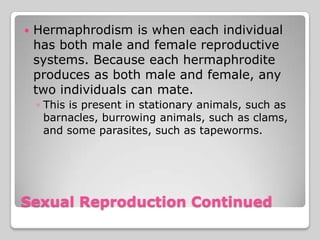
   Hermaphrodism is when each individual
    has both male and female reproductive
    systems. Because each hermaphrodite
    produces as both male and female, any
    two individuals can mate.
    ◦ This is present in stationary animals, such as
      barnacles, burrowing animals, such as clams,
      and some parasites, such as tapeworms.


Sexual Reproduction Continued
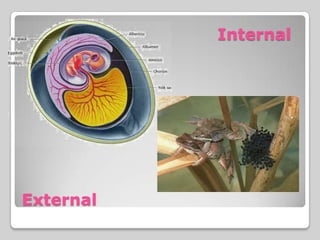
 Fertilization is the union of sperm and
  egg, which can be either external or
  internal.
 External fertilization – the female
  releases eggs into the
  environment, where the male fertilizes
  them
 Internal fertilization – sperm are
  deposited in or near the female
  reproductive tract, and fertilization occurs
  within the tract
External vs. Internal Fertilization
Internal


External
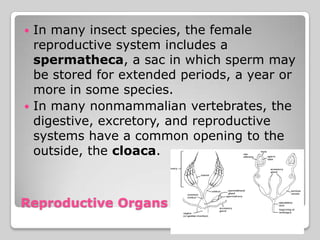
 In many insect species, the female
  reproductive system includes a
  spermatheca, a sac in which sperm may
  be stored for extended periods, a year or
  more in some species.
 In many nonmammalian vertebrates, the
  digestive, excretory, and reproductive
  systems have a common opening to the
  outside, the cloaca.


Reproductive Organs
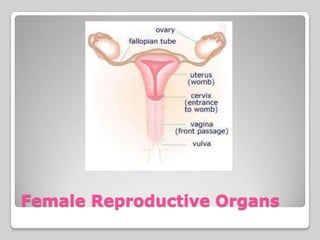
 Ovaries – the female gonads are a pair of
  ovaries that border the uterus and are
  held in place in the abdominal cavity by
  ligaments (ovaries produce eggs and
  reproductive hormones)
 Uterus – where eggs are fertilized and
  development of the young occurs


Female Reproductive Organs
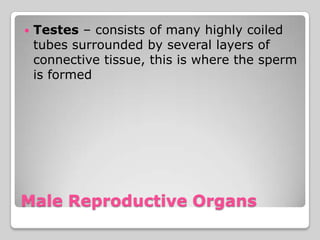
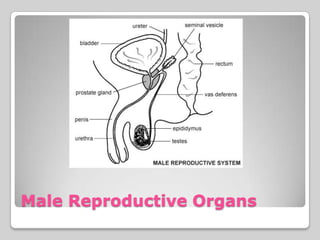
   Testes – consists of many highly coiled
    tubes surrounded by several layers of
    connective tissue, this is where the sperm
    is formed


Male Reproductive Organs
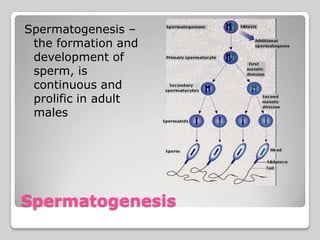
Spermatogenesis –
 the formation and
 development of
 sperm, is
 continuous and
 prolific in adult
 males


Spermatogenesis
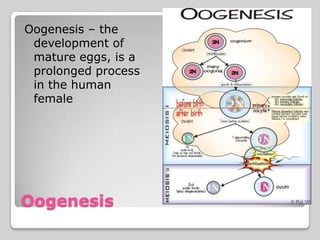
Oogenesis – the
 development of
 mature eggs, is a
 prolonged process
 in the human
 female


Oogenesis
   Human gestation is divided into three
    trimesters of about three months each.
    ◦ First, Second, and Third Trimester
   Placenta – a structure in the pregnant uterus
    for nourishing a viviparous fetus with
    mother’s blood supply; formed from the
    uterine lining and embryonic membranes
   Labor – the process by which childbirth
    occurs; a series of strong, rhythmic uterine
    contractions
   Of course, protection is always an option ;)

Conception and Birth

Animal reproduction ppt

  • 1.
    Animal Reproduction By: Madison Allen
  • 2.
    In sexual reproduction, the fusion of haploid gametes forms a diploid cell, the zygote. The animal that develops from a zygote can in turn give rise to gametes by meiosis. The female gamete, the egg, is a large, nonmotile cell. The male gamete, the sperm, is generally a much smaller, motile cell.  Asexual reproduction is the generation of new individuals without the fusion of egg and sperm. In most asexual animals, reproduction relies entirely on mitotic cell division. Asexual vs. Sexual Reproduction
  • 3.
    Many invertebrates can reproduce asexually by fission, the separation of a parent organism into two individuals of approximately equal size.  Also common among invertebrates is budding, in which new individuals arise from outgrowths of existing ones. ◦ Ex. In certain species of coral and hydra, new individuals grow out from the parents body.  Parthenogenesis is a form of asexual reproduction in which an egg develops without being fertilized. Asexual Reproduction
  • 4.
  • 5.
    The vast majority of eukaryotic species reproduce sexually.  Most animals exhibit cycles in reproductive activity, often related to changing seasons. In this way, animals conserve resources, reproducing only when sufficient energy sources are available and when environmental conditions favor the survival of offspring. ◦ For example, ewes (female sheep) have a reproductive cycle lasting 15-17 days.  Ovulation is the release of mature eggs and occurs at the midpoint of each cycle.  Reproductive cycles are controlled by hormones, which in turn are regulated by environmental cues. ◦ Common environmental cues are changes in day length, seasonal temperature, rainfall, and lunar cycles. Sexual Reproduction
  • 6.
  • 7.
    Hermaphrodism is when each individual has both male and female reproductive systems. Because each hermaphrodite produces as both male and female, any two individuals can mate. ◦ This is present in stationary animals, such as barnacles, burrowing animals, such as clams, and some parasites, such as tapeworms. Sexual Reproduction Continued
  • 8.
     Fertilization isthe union of sperm and egg, which can be either external or internal.  External fertilization – the female releases eggs into the environment, where the male fertilizes them  Internal fertilization – sperm are deposited in or near the female reproductive tract, and fertilization occurs within the tract External vs. Internal Fertilization
  • 9.
  • 10.
     In manyinsect species, the female reproductive system includes a spermatheca, a sac in which sperm may be stored for extended periods, a year or more in some species.  In many nonmammalian vertebrates, the digestive, excretory, and reproductive systems have a common opening to the outside, the cloaca. Reproductive Organs
  • 11.
     Ovaries –the female gonads are a pair of ovaries that border the uterus and are held in place in the abdominal cavity by ligaments (ovaries produce eggs and reproductive hormones)  Uterus – where eggs are fertilized and development of the young occurs Female Reproductive Organs
  • 12.
  • 13.
    Testes – consists of many highly coiled tubes surrounded by several layers of connective tissue, this is where the sperm is formed Male Reproductive Organs
  • 14.
  • 15.
    Spermatogenesis – theformation and development of sperm, is continuous and prolific in adult males Spermatogenesis
  • 16.
    Oogenesis – the development of mature eggs, is a prolonged process in the human female Oogenesis
  • 17.
    Human gestation is divided into three trimesters of about three months each. ◦ First, Second, and Third Trimester  Placenta – a structure in the pregnant uterus for nourishing a viviparous fetus with mother’s blood supply; formed from the uterine lining and embryonic membranes  Labor – the process by which childbirth occurs; a series of strong, rhythmic uterine contractions  Of course, protection is always an option ;) Conception and Birth