Metabolism and energy
supply
Student name : Amani Riyadh Alsharidah .
University number : 435203244
zoo 575
1436 – 1437
Content
• Introduction .
• Metabolism definition .
• The Structure and Hydrolysis of ATP .
• Nutrient Use in Cellular Metabolism .
• Fermentation ( anaerobic ) .
• Cellular respiration ( aerobic) .
• ATP synthesis .
• Metabolic rate .
• Energy budget .
• References .
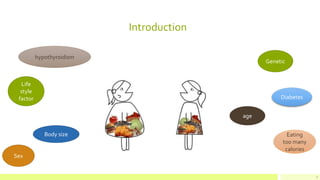
Introduction
3
Genetic
Body size
Sex
age
Life
style
factor
Eating
too many
calories
hypothyroidism
Diabetes
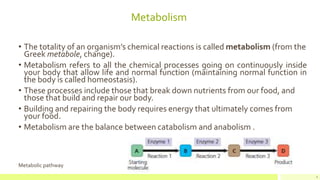
Metabolism
• The totality of an organism’s chemical reactions is called metabolism (from the
Greek metabole, change).
• Metabolism refers to all the chemical processes going on continuously inside
your body that allow life and normal function (maintaining normal function in
the body is called homeostasis).
• These processes include those that break down nutrients from our food, and
those that build and repair our body.
• Building and repairing the body requires energy that ultimately comes from
your food.
• Metabolism are the balance between catabolism and anabolism .
Metabolic pathway
4
5
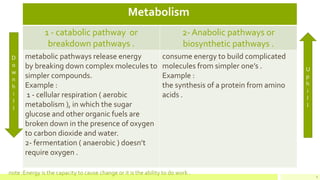
Metabolism
2- Anabolic pathways or
biosynthetic pathways .
1 - catabolic pathway or
breakdown pathways .
consume energy to build complicated
molecules from simpler one’s .
Example :
the synthesis of a protein from amino
acids .
metabolic pathways release energy
by breaking down complex molecules to
simpler compounds.
Example :
1 - cellular respiration ( aerobic
metabolism ), in which the sugar
glucose and other organic fuels are
broken down in the presence of oxygen
to carbon dioxide and water.
2- fermentation ( anaerobic ) doesn’t
require oxygen .
D
o
w
n
h
i
l
l
U
p
h
i
l
l
note :Energy is the capacity to cause change or it is the ability to do work .
6
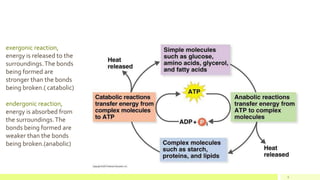
exergonic reaction,
energy is released to the
surroundings.The bonds
being formed are
stronger than the bonds
being broken.( catabolic)
endergonic reaction,
energy is absorbed from
the surroundings.The
bonds being formed are
weaker than the bonds
being broken.(anabolic)
The Structure and Hydrolysis of ATP
7
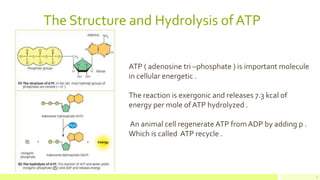
ATP ( adenosine tri –phosphate ) is important molecule
in cellular energetic .
The reaction is exergonic and releases 7.3 kcal of
energy per mole of ATP hydrolyzed .
An animal cell regenerate ATP fromADP by adding p .
Which is called ATP recycle .
Nutrient Use in Cellular Metabolism
8
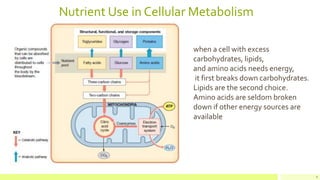
when a cell with excess
carbohydrates, lipids,
and amino acids needs energy,
it first breaks down carbohydrates.
Lipids are the second choice.
Amino acids are seldom broken
down if other energy sources are
available
Fermentation ( anaerobic )
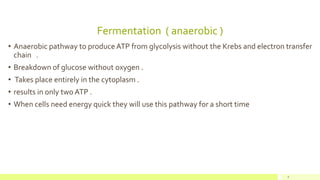
• Anaerobic pathway to produceATP from glycolysis without the Krebs and electron transfer
chain .
• Breakdown of glucose without oxygen .
• Takes place entirely in the cytoplasm .
• results in only two ATP .
• When cells need energy quick they will use this pathway for a short time
9
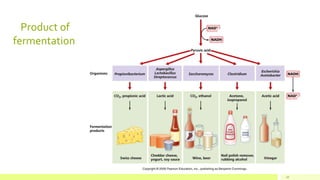
Product of
fermentation
10
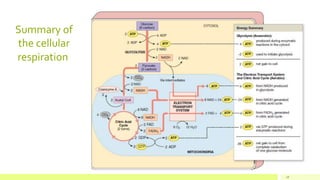
Cellular respiration
( aerobic)
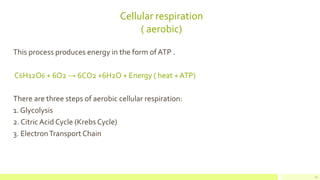
This process produces energy in the form ofATP .
C6H12O6 + 6O2 → 6CO2 +6H2O + Energy ( heat +ATP)
There are three steps of aerobic cellular respiration:
1. Glycolysis
2. Citric Acid Cycle (Krebs Cycle)
3. ElectronTransport Chain
11
1 – Glycolysis
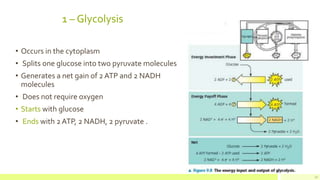
• Occurs in the cytoplasm
• Splits one glucose into two pyruvate molecules
• Generates a net gain of 2 ATP and 2 NADH
molecules
• Does not require oxygen
• Starts with glucose
• Ends with 2ATP, 2 NADH, 2 pyruvate .
12
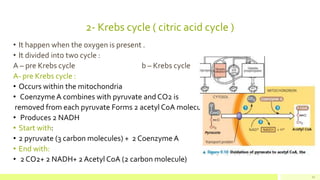
2- Krebs cycle ( citric acid cycle )
• It happen when the oxygen is present .
• It divided into two cycle :
A – pre Krebs cycle b – Krebs cycle
A- pre Krebs cycle :
• Occurs within the mitochondria
• CoenzymeA combines with pyruvate and CO2 is
removed from each pyruvate Forms 2 acetyl CoA molecules
• Produces 2 NADH
• Start with:
• 2 pyruvate (3 carbon molecules) + 2 CoenzymeA
• End with:
• 2 CO2+ 2 NADH+ 2 Acetyl CoA (2 carbon molecule)
13
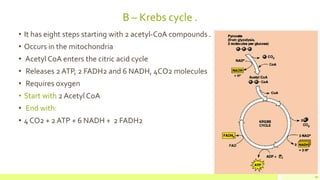
B – Krebs cycle .
• It has eight steps starting with 2 acetyl-CoA compounds .
• Occurs in the mitochondria
• Acetyl CoA enters the citric acid cycle
• Releases 2 ATP, 2 FADH2 and 6 NADH, 4CO2 molecules
• Requires oxygen
• Start with 2 Acetyl CoA
• End with:
• 4 CO2 + 2 ATP + 6 NADH + 2 FADH2
14
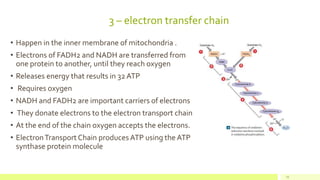
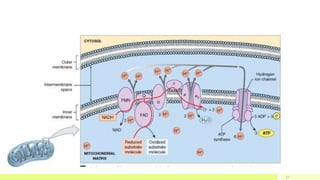
3 – electron transfer chain
• Happen in the inner membrane of mitochondria .
• Electrons of FADH2 and NADH are transferred from
one protein to another, until they reach oxygen
• Releases energy that results in 32 ATP
• Requires oxygen
• NADH and FADH2 are important carriers of electrons
• They donate electrons to the electron transport chain
• At the end of the chain oxygen accepts the electrons.
• ElectronTransport Chain producesATP using the ATP
synthase protein molecule
15
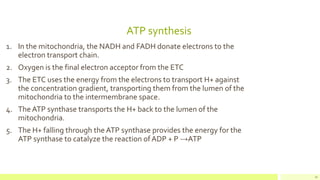
ATP synthesis
1. In the mitochondria, the NADH and FADH donate electrons to the
electron transport chain.
2. Oxygen is the final electron acceptor from the ETC
3. The ETC uses the energy from the electrons to transport H+ against
the concentration gradient, transporting them from the lumen of the
mitochondria to the intermembrane space.
4. The ATP synthase transports the H+ back to the lumen of the
mitochondria.
5. The H+ falling through the ATP synthase provides the energy for the
ATP synthase to catalyze the reaction of ADP + P →ATP
16
17
Summary of
the cellular
respiration
18
Metabolic rate
• Animals must maintain a minimum metabolic rate for basic functions such as
cell maintenance, breathing, and heartbeat. Researchers measure this
minimum metabolic rate differently for endotherms and ectotherms.
• The minimum metabolic rate of a non growing endotherm that is at rest, has
an empty stomach, and is not experiencing stress is called the basal
metabolic rate (BMR). BMR is measured under a “comfortable” temperature
range—a range that requires no generation or shedding of heat above the
minimum.
• The minimum metabolic rate of ectotherms is determined at a specific
temperature because changes in the environmental temperature alter body
temperature and therefore metabolic rate of a fasting, non stressed
ectotherm at rest at a particular temperature is called its standard metabolic
rate (SMR).
19
Cont…
• Metabolic rate is affected by many factors besides whether the animal is an
endotherm or an ectotherm. Some key factors are age, sex, size, activity,
temperature, and nutrition.
20
Metabolic rate measure
• Metabolic rate is one of the most commonly measured physiological variables,
and is a measure of the total energy metabolized by an animal in unit time.
• It has proved immensely useful in comparative studies of animal adaptation
and performance. But despite its wide usage, its value can be determined only
indirectly .
• four kinds of analysis:
1. The energy value of food taken in minus that of the wastes excreted.

2. The amount of oxygen used up (or carbon dioxide produced).
3. The amount of heat produced.

4. The amount of metabolic water produced.
21
Oxygen and heat production ..
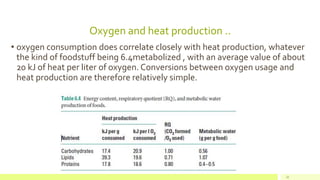
• oxygen consumption does correlate closely with heat production, whatever
the kind of foodstuff being 6.4metabolized , with an average value of about
20 kJ of heat per liter of oxygen. Conversions between oxygen usage and
heat production are therefore relatively simple.
22
Cont..
• the food value taken in, are less straightforward because we know that
different foodstuffs have different calorific values .
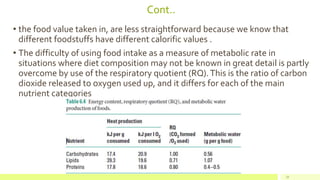
• The difficulty of using food intake as a measure of metabolic rate in
situations where diet composition may not be known in great detail is partly
overcome by use of the respiratory quotient (RQ).This is the ratio of carbon
dioxide released to oxygen used up, and it differs for each of the main
nutrient categories
23
Cont…
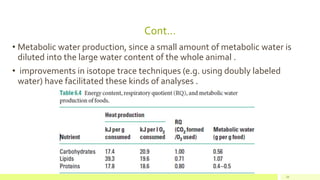
• Metabolic water production, since a small amount of metabolic water is
diluted into the large water content of the whole animal .
• improvements in isotope trace techniques (e.g. using doubly labeled
water) have facilitated these kinds of analyses .
24
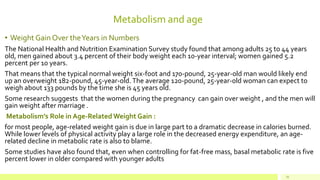
Metabolism and age
• Weight Gain Over theYears in Numbers
The National Health and Nutrition Examination Survey study found that among adults 25 to 44 years
old, men gained about 3.4 percent of their body weight each 10-year interval; women gained 5.2
percent per 10 years.
That means that the typical normal weight six-foot and 170-pound, 25-year-old man would likely end
up an overweight 182-pound, 45-year-old.The average 120-pound, 25-year-old woman can expect to
weigh about 133 pounds by the time she is 45 years old.
Some research suggests that the women during the pregnancy can gain over weight , and the men will
gain weight after marriage .
Metabolism’s Role in Age-Related Weight Gain :
for most people, age-related weight gain is due in large part to a dramatic decrease in calories burned.
While lower levels of physical activity play a large role in the decreased energy expenditure, an age-
related decline in metabolic rate is also to blame.
Some studies have also found that, even when controlling for fat-free mass, basal metabolic rate is five
percent lower in older compared with younger adults
25
26
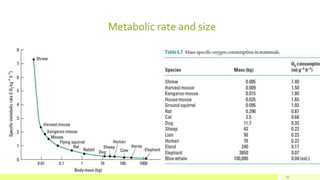
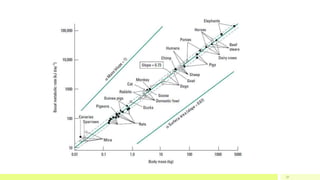
Metabolic rate and size
27
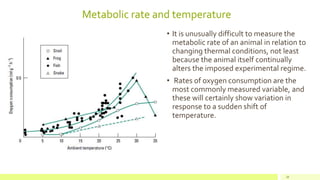
Metabolic rate and temperature
• It is unusually difficult to measure the
metabolic rate of an animal in relation to
changing thermal conditions, not least
because the animal itself continually
alters the imposed experimental regime.
• Rates of oxygen consumption are the
most commonly measured variable, and
these will certainly show variation in
response to a sudden shift of
temperature.
28
29
30
Metabolic rate and activity
31
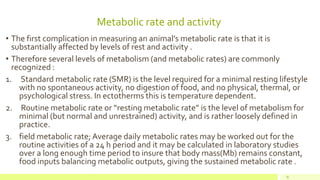
• The first complication in measuring an animal’s metabolic rate is that it is
substantially affected by levels of rest and activity .
• Therefore several levels of metabolism (and metabolic rates) are commonly
recognized :
1. Standard metabolic rate (SMR) is the level required for a minimal resting lifestyle
with no spontaneous activity, no digestion of food, and no physical, thermal, or
psychological stress. In ectotherms this is temperature dependent.
2. Routine metabolic rate or “resting metabolic rate” is the level of metabolism for
minimal (but normal and unrestrained) activity, and is rather loosely defined in
practice.
3. field metabolic rate; Average daily metabolic rates may be worked out for the
routine activities of a 24 h period and it may be calculated in laboratory studies
over a long enough time period to insure that body mass(Mb) remains constant,
food inputs balancing metabolic outputs, giving the sustained metabolic rate .
Cont…
32
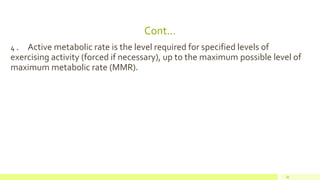
4 . Active metabolic rate is the level required for specified levels of
exercising activity (forced if necessary), up to the maximum possible level of
maximum metabolic rate (MMR).
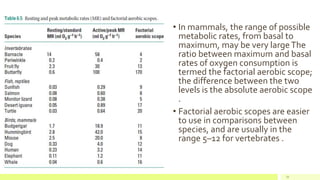
• In mammals, the range of possible
metabolic rates, from basal to
maximum, may be very largeThe
ratio between maximum and basal
rates of oxygen consumption is
termed the factorial aerobic scope;
the difference between the two
levels is the absolute aerobic scope
.
• Factorial aerobic scopes are easier
to use in comparisons between
species, and are usually in the
range 5–12 for vertebrates .
33
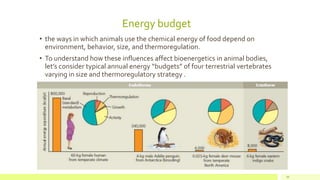
Energy budget
• the ways in which animals use the chemical energy of food depend on
environment, behavior, size, and thermoregulation.
• To understand how these influences affect bioenergetics in animal bodies,
let’s consider typical annual energy “budgets” of four terrestrial vertebrates
varying in size and thermoregulatory strategy .
34
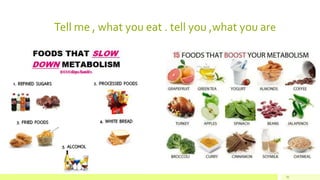
Tell me , what you eat . tell you ,what you are
35
Thank you
For
Your
Attention
Any questions ?
36
References
• Campbell biology 9th edition book , chapter 8 , chapter 9 , jane B. reece and others .
• Environmental physiology of animals , second edition , chapter 6 , pat willmer and
others .
• Fundamental of anatomy and physiology 9th edition , chapter 25 , martini .
• www.acefitness.org.
• session.masteringbiology.com
• hyperphysics.phy-astr.gsu.edu.
• www.snipview.com
37

Metabolism and energy supply

  • 1.
    Metabolism and energy supply Studentname : Amani Riyadh Alsharidah . University number : 435203244 zoo 575 1436 – 1437
  • 2.
    Content • Introduction . •Metabolism definition . • The Structure and Hydrolysis of ATP . • Nutrient Use in Cellular Metabolism . • Fermentation ( anaerobic ) . • Cellular respiration ( aerobic) . • ATP synthesis . • Metabolic rate . • Energy budget . • References .
  • 3.
  • 4.
    Metabolism • The totalityof an organism’s chemical reactions is called metabolism (from the Greek metabole, change). • Metabolism refers to all the chemical processes going on continuously inside your body that allow life and normal function (maintaining normal function in the body is called homeostasis). • These processes include those that break down nutrients from our food, and those that build and repair our body. • Building and repairing the body requires energy that ultimately comes from your food. • Metabolism are the balance between catabolism and anabolism . Metabolic pathway 4
  • 5.
    5 Metabolism 2- Anabolic pathwaysor biosynthetic pathways . 1 - catabolic pathway or breakdown pathways . consume energy to build complicated molecules from simpler one’s . Example : the synthesis of a protein from amino acids . metabolic pathways release energy by breaking down complex molecules to simpler compounds. Example : 1 - cellular respiration ( aerobic metabolism ), in which the sugar glucose and other organic fuels are broken down in the presence of oxygen to carbon dioxide and water. 2- fermentation ( anaerobic ) doesn’t require oxygen . D o w n h i l l U p h i l l note :Energy is the capacity to cause change or it is the ability to do work .
  • 6.
    6 exergonic reaction, energy isreleased to the surroundings.The bonds being formed are stronger than the bonds being broken.( catabolic) endergonic reaction, energy is absorbed from the surroundings.The bonds being formed are weaker than the bonds being broken.(anabolic)
  • 7.
    The Structure andHydrolysis of ATP 7 ATP ( adenosine tri –phosphate ) is important molecule in cellular energetic . The reaction is exergonic and releases 7.3 kcal of energy per mole of ATP hydrolyzed . An animal cell regenerate ATP fromADP by adding p . Which is called ATP recycle .
  • 8.
    Nutrient Use inCellular Metabolism 8 when a cell with excess carbohydrates, lipids, and amino acids needs energy, it first breaks down carbohydrates. Lipids are the second choice. Amino acids are seldom broken down if other energy sources are available
  • 9.
    Fermentation ( anaerobic) • Anaerobic pathway to produceATP from glycolysis without the Krebs and electron transfer chain . • Breakdown of glucose without oxygen . • Takes place entirely in the cytoplasm . • results in only two ATP . • When cells need energy quick they will use this pathway for a short time 9
  • 10.
  • 11.
    Cellular respiration ( aerobic) Thisprocess produces energy in the form ofATP . C6H12O6 + 6O2 → 6CO2 +6H2O + Energy ( heat +ATP) There are three steps of aerobic cellular respiration: 1. Glycolysis 2. Citric Acid Cycle (Krebs Cycle) 3. ElectronTransport Chain 11
  • 12.
    1 – Glycolysis •Occurs in the cytoplasm • Splits one glucose into two pyruvate molecules • Generates a net gain of 2 ATP and 2 NADH molecules • Does not require oxygen • Starts with glucose • Ends with 2ATP, 2 NADH, 2 pyruvate . 12
  • 13.
    2- Krebs cycle( citric acid cycle ) • It happen when the oxygen is present . • It divided into two cycle : A – pre Krebs cycle b – Krebs cycle A- pre Krebs cycle : • Occurs within the mitochondria • CoenzymeA combines with pyruvate and CO2 is removed from each pyruvate Forms 2 acetyl CoA molecules • Produces 2 NADH • Start with: • 2 pyruvate (3 carbon molecules) + 2 CoenzymeA • End with: • 2 CO2+ 2 NADH+ 2 Acetyl CoA (2 carbon molecule) 13
  • 14.
    B – Krebscycle . • It has eight steps starting with 2 acetyl-CoA compounds . • Occurs in the mitochondria • Acetyl CoA enters the citric acid cycle • Releases 2 ATP, 2 FADH2 and 6 NADH, 4CO2 molecules • Requires oxygen • Start with 2 Acetyl CoA • End with: • 4 CO2 + 2 ATP + 6 NADH + 2 FADH2 14
  • 15.
    3 – electrontransfer chain • Happen in the inner membrane of mitochondria . • Electrons of FADH2 and NADH are transferred from one protein to another, until they reach oxygen • Releases energy that results in 32 ATP • Requires oxygen • NADH and FADH2 are important carriers of electrons • They donate electrons to the electron transport chain • At the end of the chain oxygen accepts the electrons. • ElectronTransport Chain producesATP using the ATP synthase protein molecule 15
  • 16.
    ATP synthesis 1. Inthe mitochondria, the NADH and FADH donate electrons to the electron transport chain. 2. Oxygen is the final electron acceptor from the ETC 3. The ETC uses the energy from the electrons to transport H+ against the concentration gradient, transporting them from the lumen of the mitochondria to the intermembrane space. 4. The ATP synthase transports the H+ back to the lumen of the mitochondria. 5. The H+ falling through the ATP synthase provides the energy for the ATP synthase to catalyze the reaction of ADP + P →ATP 16
  • 17.
  • 18.
  • 19.
    Metabolic rate • Animalsmust maintain a minimum metabolic rate for basic functions such as cell maintenance, breathing, and heartbeat. Researchers measure this minimum metabolic rate differently for endotherms and ectotherms. • The minimum metabolic rate of a non growing endotherm that is at rest, has an empty stomach, and is not experiencing stress is called the basal metabolic rate (BMR). BMR is measured under a “comfortable” temperature range—a range that requires no generation or shedding of heat above the minimum. • The minimum metabolic rate of ectotherms is determined at a specific temperature because changes in the environmental temperature alter body temperature and therefore metabolic rate of a fasting, non stressed ectotherm at rest at a particular temperature is called its standard metabolic rate (SMR). 19
  • 20.
    Cont… • Metabolic rateis affected by many factors besides whether the animal is an endotherm or an ectotherm. Some key factors are age, sex, size, activity, temperature, and nutrition. 20
  • 21.
    Metabolic rate measure •Metabolic rate is one of the most commonly measured physiological variables, and is a measure of the total energy metabolized by an animal in unit time. • It has proved immensely useful in comparative studies of animal adaptation and performance. But despite its wide usage, its value can be determined only indirectly . • four kinds of analysis: 1. The energy value of food taken in minus that of the wastes excreted. 2. The amount of oxygen used up (or carbon dioxide produced). 3. The amount of heat produced. 4. The amount of metabolic water produced. 21
  • 22.
    Oxygen and heatproduction .. • oxygen consumption does correlate closely with heat production, whatever the kind of foodstuff being 6.4metabolized , with an average value of about 20 kJ of heat per liter of oxygen. Conversions between oxygen usage and heat production are therefore relatively simple. 22
  • 23.
    Cont.. • the foodvalue taken in, are less straightforward because we know that different foodstuffs have different calorific values . • The difficulty of using food intake as a measure of metabolic rate in situations where diet composition may not be known in great detail is partly overcome by use of the respiratory quotient (RQ).This is the ratio of carbon dioxide released to oxygen used up, and it differs for each of the main nutrient categories 23
  • 24.
    Cont… • Metabolic waterproduction, since a small amount of metabolic water is diluted into the large water content of the whole animal . • improvements in isotope trace techniques (e.g. using doubly labeled water) have facilitated these kinds of analyses . 24
  • 25.
    Metabolism and age •Weight Gain Over theYears in Numbers The National Health and Nutrition Examination Survey study found that among adults 25 to 44 years old, men gained about 3.4 percent of their body weight each 10-year interval; women gained 5.2 percent per 10 years. That means that the typical normal weight six-foot and 170-pound, 25-year-old man would likely end up an overweight 182-pound, 45-year-old.The average 120-pound, 25-year-old woman can expect to weigh about 133 pounds by the time she is 45 years old. Some research suggests that the women during the pregnancy can gain over weight , and the men will gain weight after marriage . Metabolism’s Role in Age-Related Weight Gain : for most people, age-related weight gain is due in large part to a dramatic decrease in calories burned. While lower levels of physical activity play a large role in the decreased energy expenditure, an age- related decline in metabolic rate is also to blame. Some studies have also found that, even when controlling for fat-free mass, basal metabolic rate is five percent lower in older compared with younger adults 25
  • 26.
  • 27.
  • 28.
    Metabolic rate andtemperature • It is unusually difficult to measure the metabolic rate of an animal in relation to changing thermal conditions, not least because the animal itself continually alters the imposed experimental regime. • Rates of oxygen consumption are the most commonly measured variable, and these will certainly show variation in response to a sudden shift of temperature. 28
  • 29.
  • 30.
  • 31.
    Metabolic rate andactivity 31 • The first complication in measuring an animal’s metabolic rate is that it is substantially affected by levels of rest and activity . • Therefore several levels of metabolism (and metabolic rates) are commonly recognized : 1. Standard metabolic rate (SMR) is the level required for a minimal resting lifestyle with no spontaneous activity, no digestion of food, and no physical, thermal, or psychological stress. In ectotherms this is temperature dependent. 2. Routine metabolic rate or “resting metabolic rate” is the level of metabolism for minimal (but normal and unrestrained) activity, and is rather loosely defined in practice. 3. field metabolic rate; Average daily metabolic rates may be worked out for the routine activities of a 24 h period and it may be calculated in laboratory studies over a long enough time period to insure that body mass(Mb) remains constant, food inputs balancing metabolic outputs, giving the sustained metabolic rate .
  • 32.
    Cont… 32 4 . Activemetabolic rate is the level required for specified levels of exercising activity (forced if necessary), up to the maximum possible level of maximum metabolic rate (MMR).
  • 33.
    • In mammals,the range of possible metabolic rates, from basal to maximum, may be very largeThe ratio between maximum and basal rates of oxygen consumption is termed the factorial aerobic scope; the difference between the two levels is the absolute aerobic scope . • Factorial aerobic scopes are easier to use in comparisons between species, and are usually in the range 5–12 for vertebrates . 33
  • 34.
    Energy budget • theways in which animals use the chemical energy of food depend on environment, behavior, size, and thermoregulation. • To understand how these influences affect bioenergetics in animal bodies, let’s consider typical annual energy “budgets” of four terrestrial vertebrates varying in size and thermoregulatory strategy . 34
  • 35.
    Tell me ,what you eat . tell you ,what you are 35
  • 36.
  • 37.
    References • Campbell biology9th edition book , chapter 8 , chapter 9 , jane B. reece and others . • Environmental physiology of animals , second edition , chapter 6 , pat willmer and others . • Fundamental of anatomy and physiology 9th edition , chapter 25 , martini . • www.acefitness.org. • session.masteringbiology.com • hyperphysics.phy-astr.gsu.edu. • www.snipview.com 37

Editor's Notes

  • #8 The three negatively charged phosphate group is un stable , energy storing . The energy be like heat .
  • #19 . For each glucose molecule broken down by glycolysis, only two molecules of ATP (net) are produced. However, glycolysis, the formation of acetyl-CoA, and the citric acid cycle all yield molecules of reduced coenzymes (NADH or FADH2). Many additional ATP molecules are produced when electrons from these coenzymes pass through the electron transport system. In most cells, each of the two NADH molecules produced in glycolysis provides another two ATP molecules. Each ofthe eight NADH molecules produced in the mitochondria yields three ATP molecules, for a total of 24. Another two ATP molecules are gained from each of the two FADH2 molecules generated in the mitochondria. The citric acid cycle generates an additional two ATP molecules in the form of GTP.
  • #35 The female human, an endothermic mammal, spends the largest fraction of her annual energy budget for BMR and comparatively less for activity and thermoregulation. The small amount of growth, about 1%, is equivalent to adding about 1 kg of body fat or 5–6 kg of other tissues. (Growth is not shown in the budgets for the penguin and deer mouse because these animals don’t typically gain weight year to year after they are adults.) The cost of nine months of pregnancy and several months of breast-feeding is only 5–8% of the mother’s energy requirements for a year. A male penguin spends the largest fraction of his energy for activity because he must swim to catch food. Being well insulated and fairly large, he has relatively low costs of thermoregulation in spite of living in the cold Antarctic. His reproductive costs, about 6% of annual energy expenditures, come mainly from incubating eggs (brooding) and bringing food to his chicks. Despite living in a temperate climate, the female deer mouse spends a large fraction of her energy budget for temperature regulation. Because of the high surface-to-volume ratio that goes with small size, deer mice lose body heat rapidly and must constantly generate metabolic heat to maintain body temperature. In contrast with these endothermic animals, the ectothermic snake has no thermoregulation costs. Like most snakes, she grows continuously throughout her life. In the example in Figure 40.20, the snake adds about 750 g of new body tissue in a year. She also produces about 650 g of eggs. The snake’s economical ectothermic strategy is revealed by her very low energy expenditure, only 1⁄40 the energy expended by the similarly sized endothermic penguin