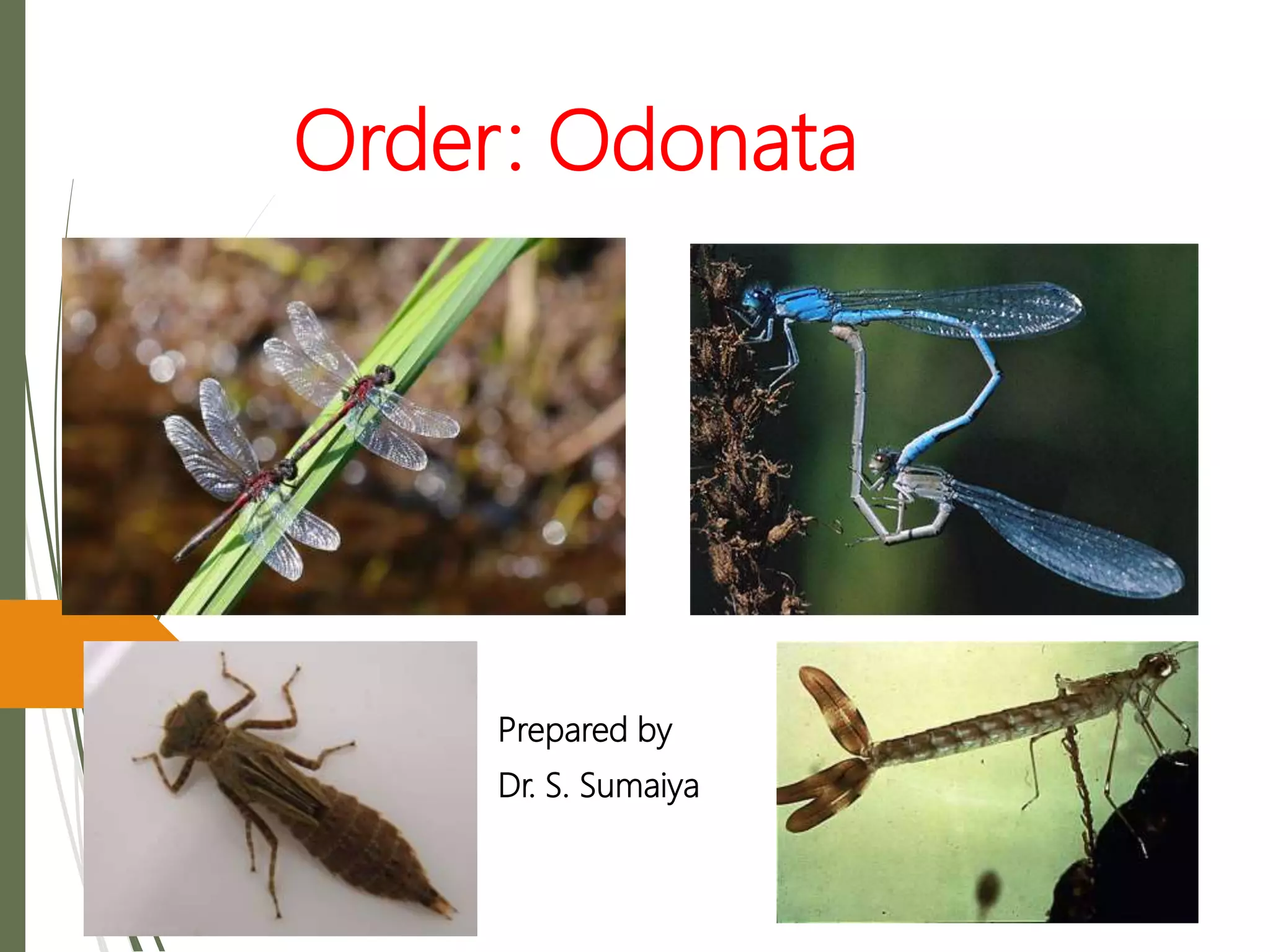
Order: Odonata
Prepared by
Dr. S. Sumaiya
Order: Odonata
Greek "odonto-", meaning tooth
 Characters
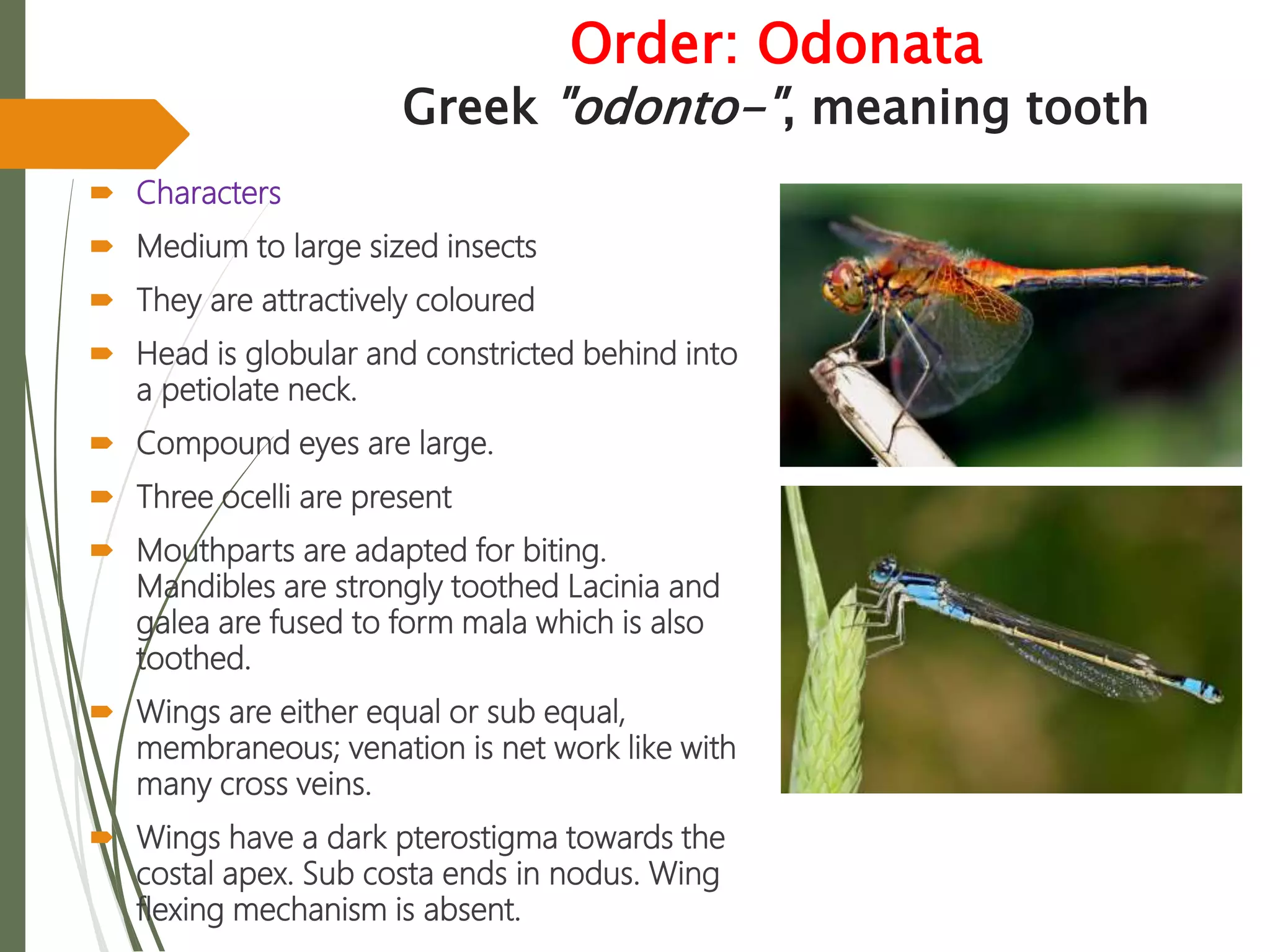
 Medium to large sized insects
 They are attractively coloured
 Head is globular and constricted behind into
a petiolate neck.
 Compound eyes are large.
 Three ocelli are present
 Mouthparts are adapted for biting.
Mandibles are strongly toothed Lacinia and
galea are fused to form mala which is also
toothed.
 Wings are either equal or sub equal,
membraneous; venation is net work like with
many cross veins.
 Wings have a dark pterostigma towards the
costal apex. Sub costa ends in nodus. Wing
flexing mechanism is absent.
Characters
 Legs are anteroventrally placed. They are suited
for grasping, holding and conveying the prey to
the mouth.
 Legs are held in such a way that a basket is
formed into which the food is scooped.
 Abdomen is long and slender. In male gonopore
is present on ninth abdominal segment.
 But the functional copulatory organ is present
on the second abdominal sternite.
 Before mating sperms are transferred to the
functional penis. Cercus is one segmented.
 Metamorphosis is incomplete with three life
stages.
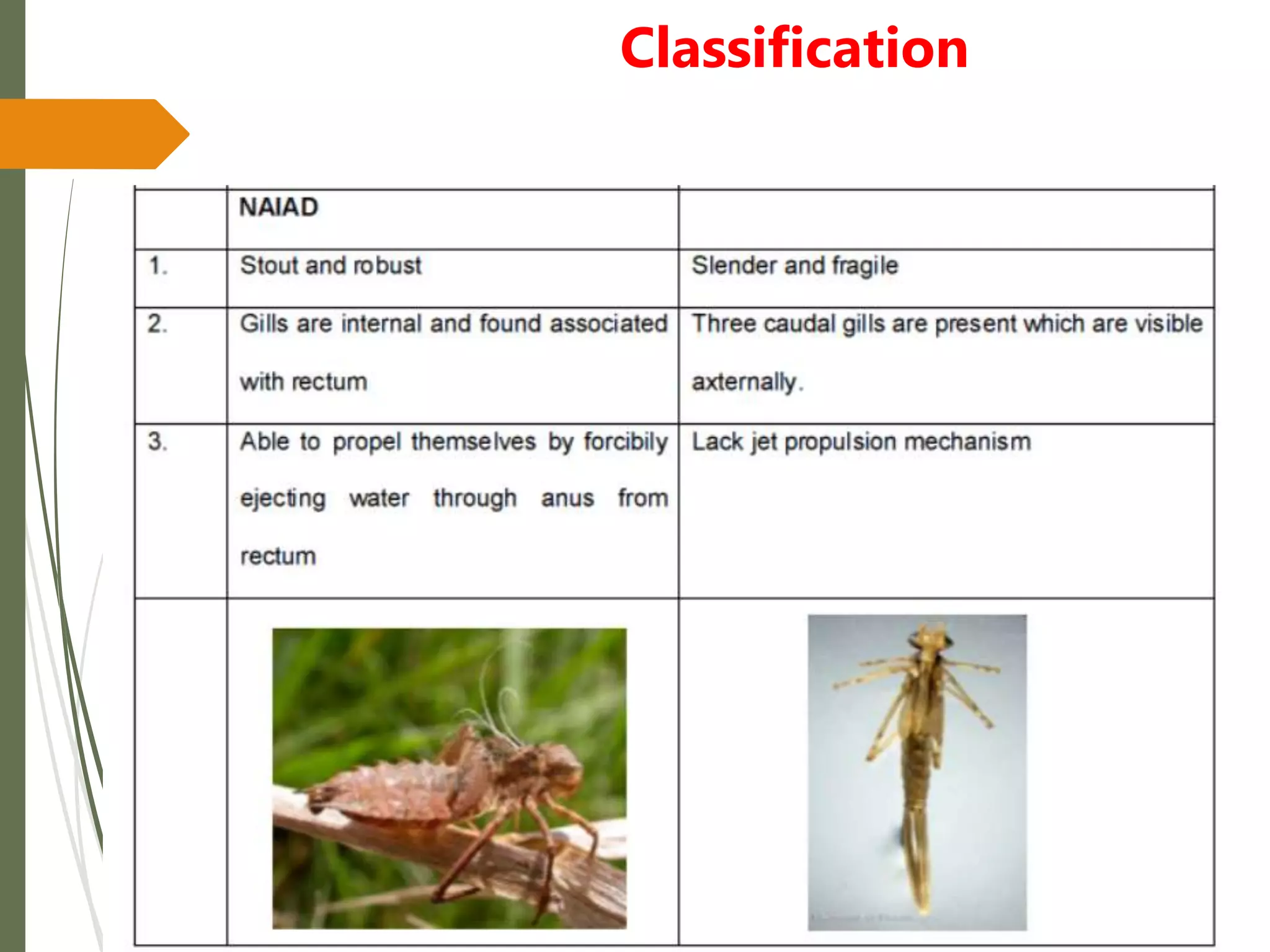
 The naiad is aquatic. Labium is greatly
elongated, jointed and bears two hooks at apex.
It is called mask. It is useful to capture the prey.
Classification
 There are two sub-orders. Dragonflies are classified under Anisoptera and
damselflies are grouped under Zygoptera.
Classification
Abdominal appendages
 Anisoptera : Dragonfly
 Male has three abdominal
appendages.
 Two superior and appendages (cerci)
and one inferior anal appendage (epi-
proct) are present.
 Zygoptera : Damselfly
 Four terminal abdominal appendages
are present.
 A pair of superior anal appendages
(cerci) and a pair of inferior anal
appendages (paraprocts) are present.
Oviposition
 Endophytic or Exophytic
 Exophytic – in anisoptera, drop the eggs freely into
water or attach superficially to aquatic plants
 Endophytic – in zygoptera & two families in anisoptera,
make slits in stems & leaves and insert the eggs

Insect Order odonata

  • 1.
  • 2.
    Order: Odonata Greek "odonto-",meaning tooth  Characters  Medium to large sized insects  They are attractively coloured  Head is globular and constricted behind into a petiolate neck.  Compound eyes are large.  Three ocelli are present  Mouthparts are adapted for biting. Mandibles are strongly toothed Lacinia and galea are fused to form mala which is also toothed.  Wings are either equal or sub equal, membraneous; venation is net work like with many cross veins.  Wings have a dark pterostigma towards the costal apex. Sub costa ends in nodus. Wing flexing mechanism is absent.
  • 3.
    Characters  Legs areanteroventrally placed. They are suited for grasping, holding and conveying the prey to the mouth.  Legs are held in such a way that a basket is formed into which the food is scooped.  Abdomen is long and slender. In male gonopore is present on ninth abdominal segment.  But the functional copulatory organ is present on the second abdominal sternite.  Before mating sperms are transferred to the functional penis. Cercus is one segmented.  Metamorphosis is incomplete with three life stages.  The naiad is aquatic. Labium is greatly elongated, jointed and bears two hooks at apex. It is called mask. It is useful to capture the prey.
  • 4.
    Classification  There aretwo sub-orders. Dragonflies are classified under Anisoptera and damselflies are grouped under Zygoptera.
  • 5.
  • 6.
    Abdominal appendages  Anisoptera: Dragonfly  Male has three abdominal appendages.  Two superior and appendages (cerci) and one inferior anal appendage (epi- proct) are present.  Zygoptera : Damselfly  Four terminal abdominal appendages are present.  A pair of superior anal appendages (cerci) and a pair of inferior anal appendages (paraprocts) are present.
  • 7.
    Oviposition  Endophytic orExophytic  Exophytic – in anisoptera, drop the eggs freely into water or attach superficially to aquatic plants  Endophytic – in zygoptera & two families in anisoptera, make slits in stems & leaves and insert the eggs