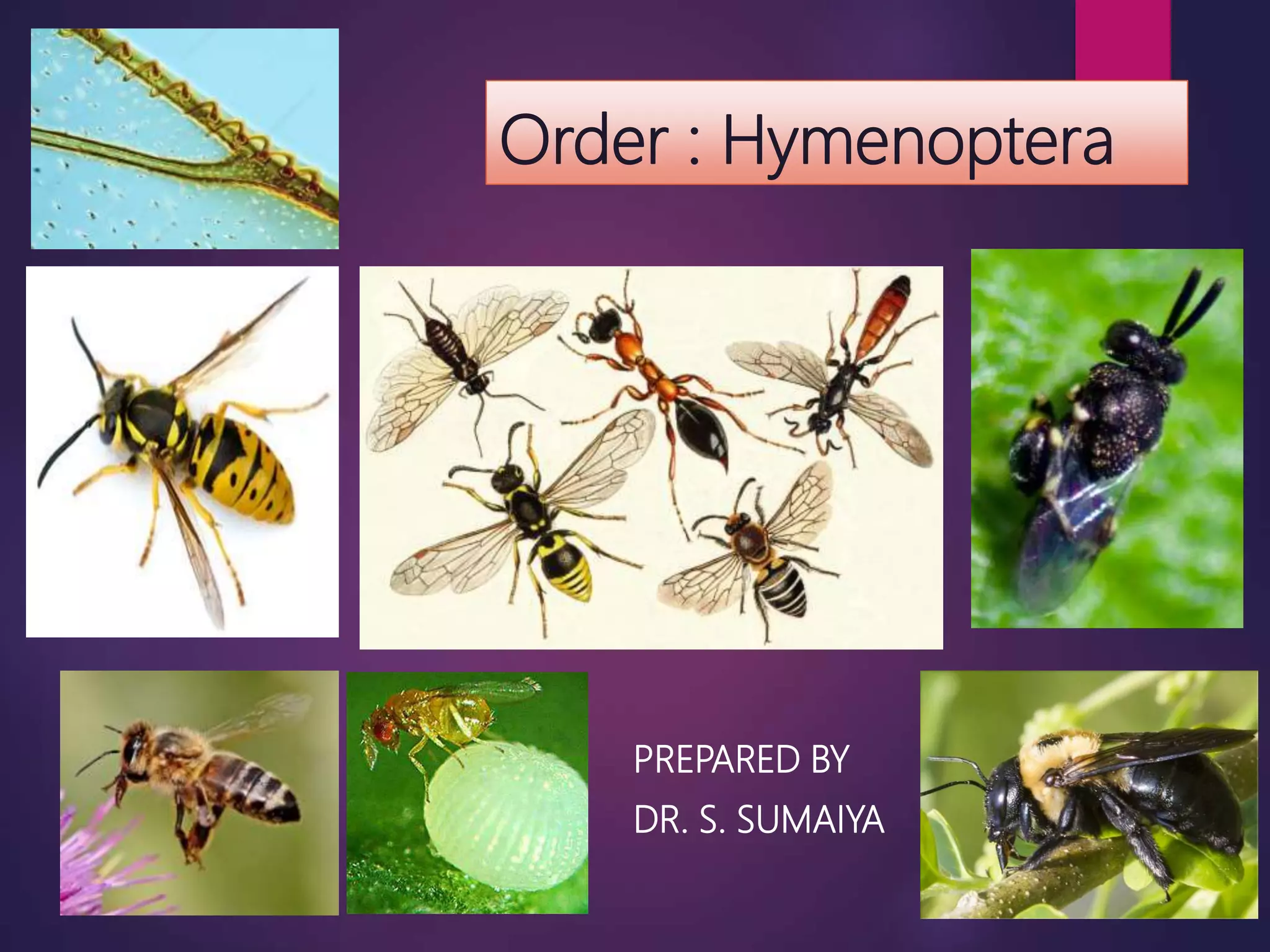
Order : Hymenoptera
PREPARED BY
DR. S. SUMAIYA
ORDER HYMENOPTERA
 Etymology: Hymen – membrane; Ptera –
wings
 Hymeno – god or marriage; Ptera –
wings, (Marriage on the wings) (union of
fore and hind wings by hamuli)
 Common names: Ichneumonflies, ants,
bees, wasps
Order characters
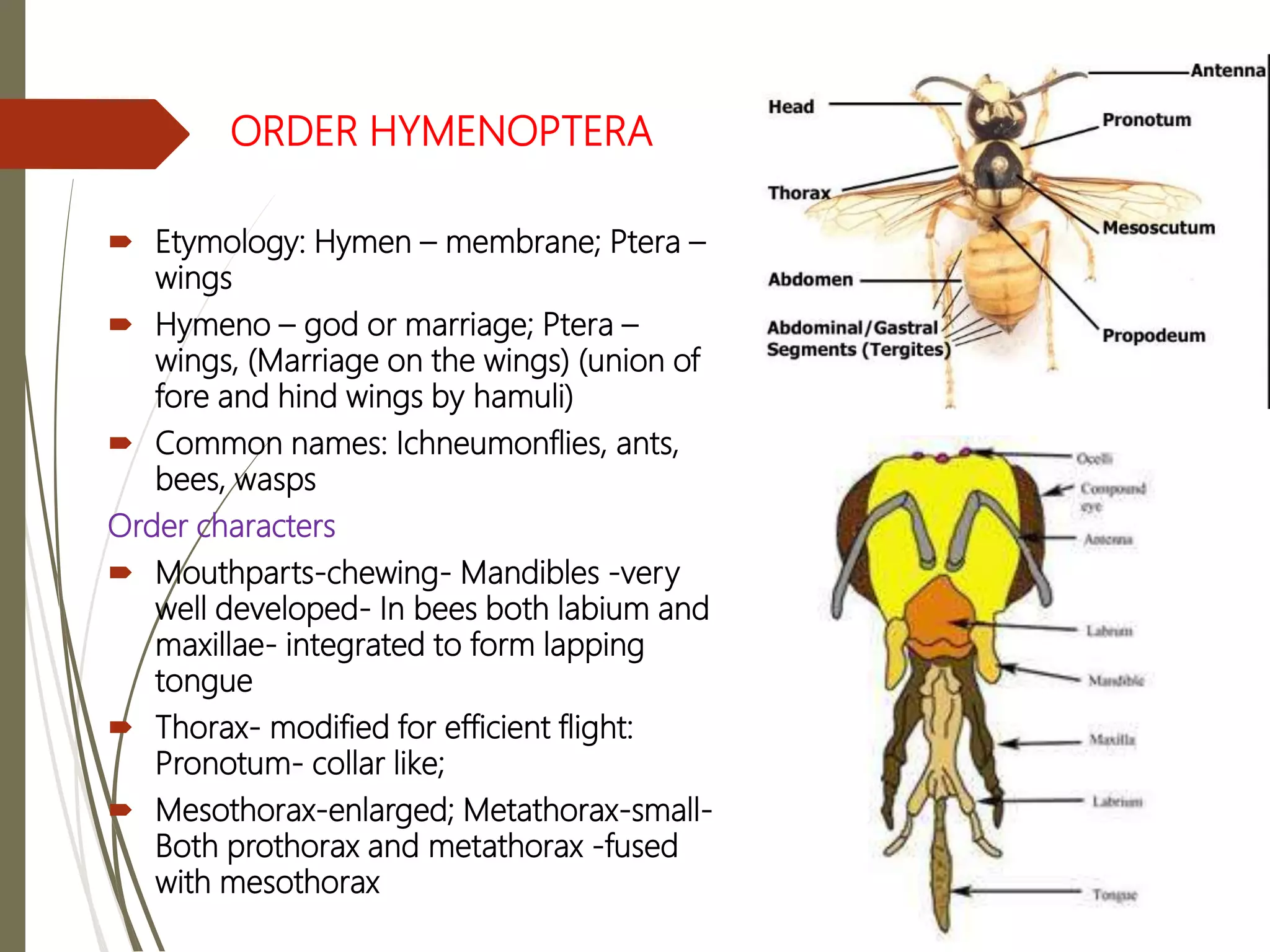
 Mouthparts-chewing- Mandibles -very
well developed- In bees both labium and
maxillae- integrated to form lapping
tongue
 Thorax- modified for efficient flight:
Pronotum- collar like;
 Mesothorax-enlarged; Metathorax-small-
Both prothorax and metathorax -fused
with mesothorax
 Characters
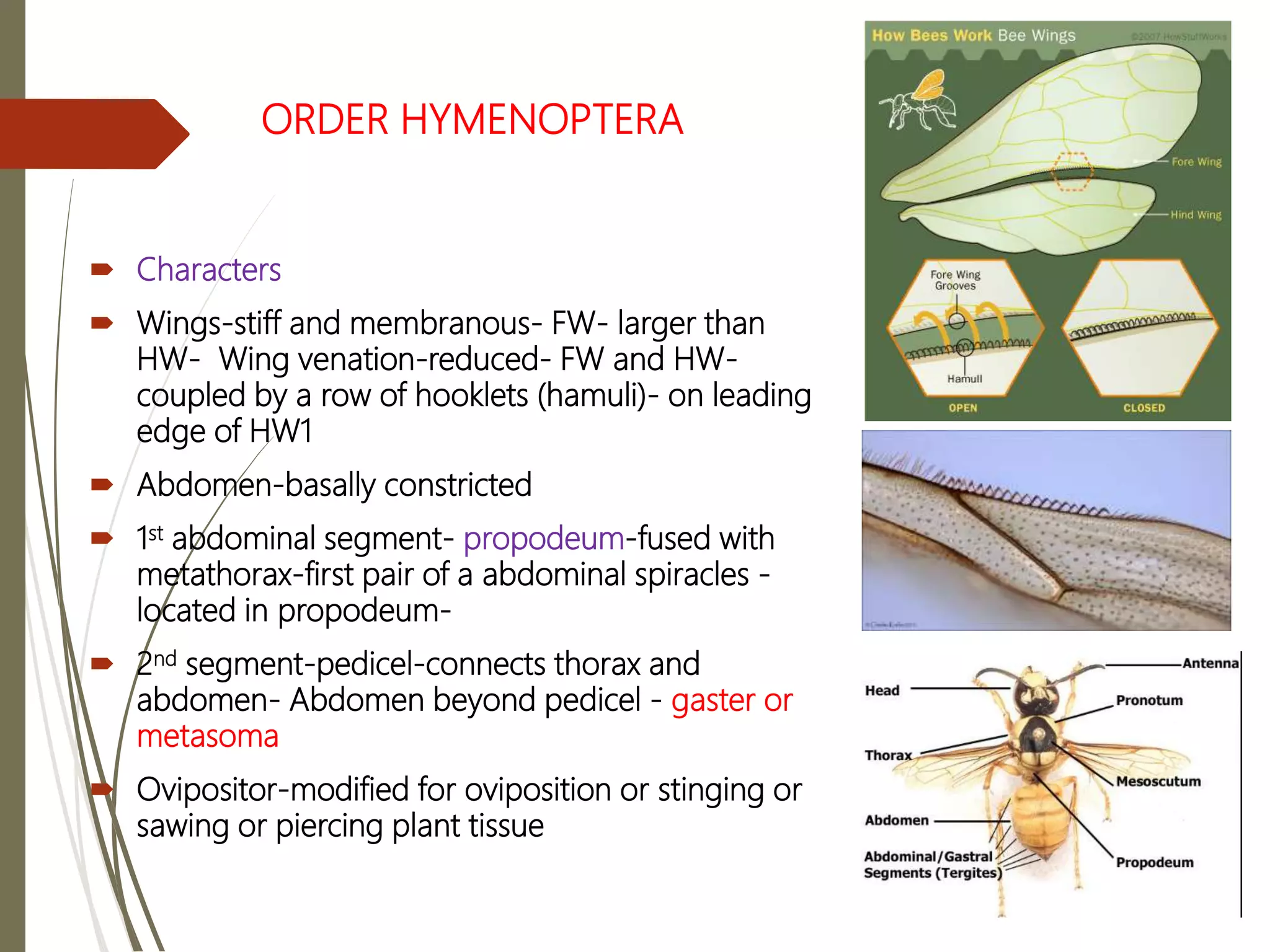
 Wings-stiff and membranous- FW- larger than
HW- Wing venation-reduced- FW and HW-
coupled by a row of hooklets (hamuli)- on leading
edge of HW1
 Abdomen-basally constricted
 1st abdominal segment- propodeum-fused with
metathorax-first pair of a abdominal spiracles -
located in propodeum-
 2nd segment-pedicel-connects thorax and
abdomen- Abdomen beyond pedicel - gaster or
metasoma
 Ovipositor-modified for oviposition or stinging or
sawing or piercing plant tissue
ORDER HYMENOPTERA
Order characters
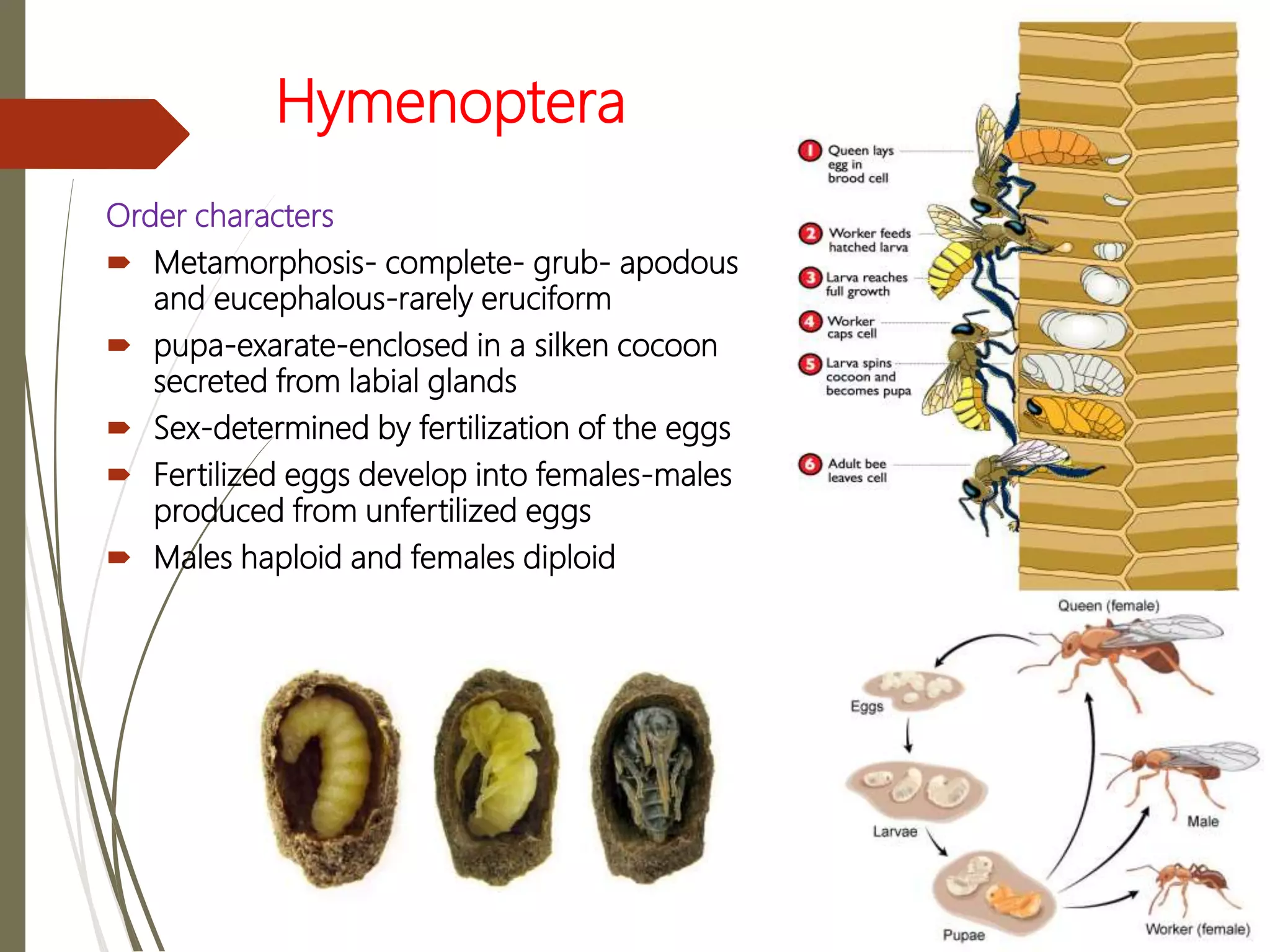
 Metamorphosis- complete- grub- apodous
and eucephalous-rarely eruciform
 pupa-exarate-enclosed in a silken cocoon
secreted from labial glands
 Sex-determined by fertilization of the eggs
 Fertilized eggs develop into females-males
produced from unfertilized eggs
 Males haploid and females diploid
Hymenoptera
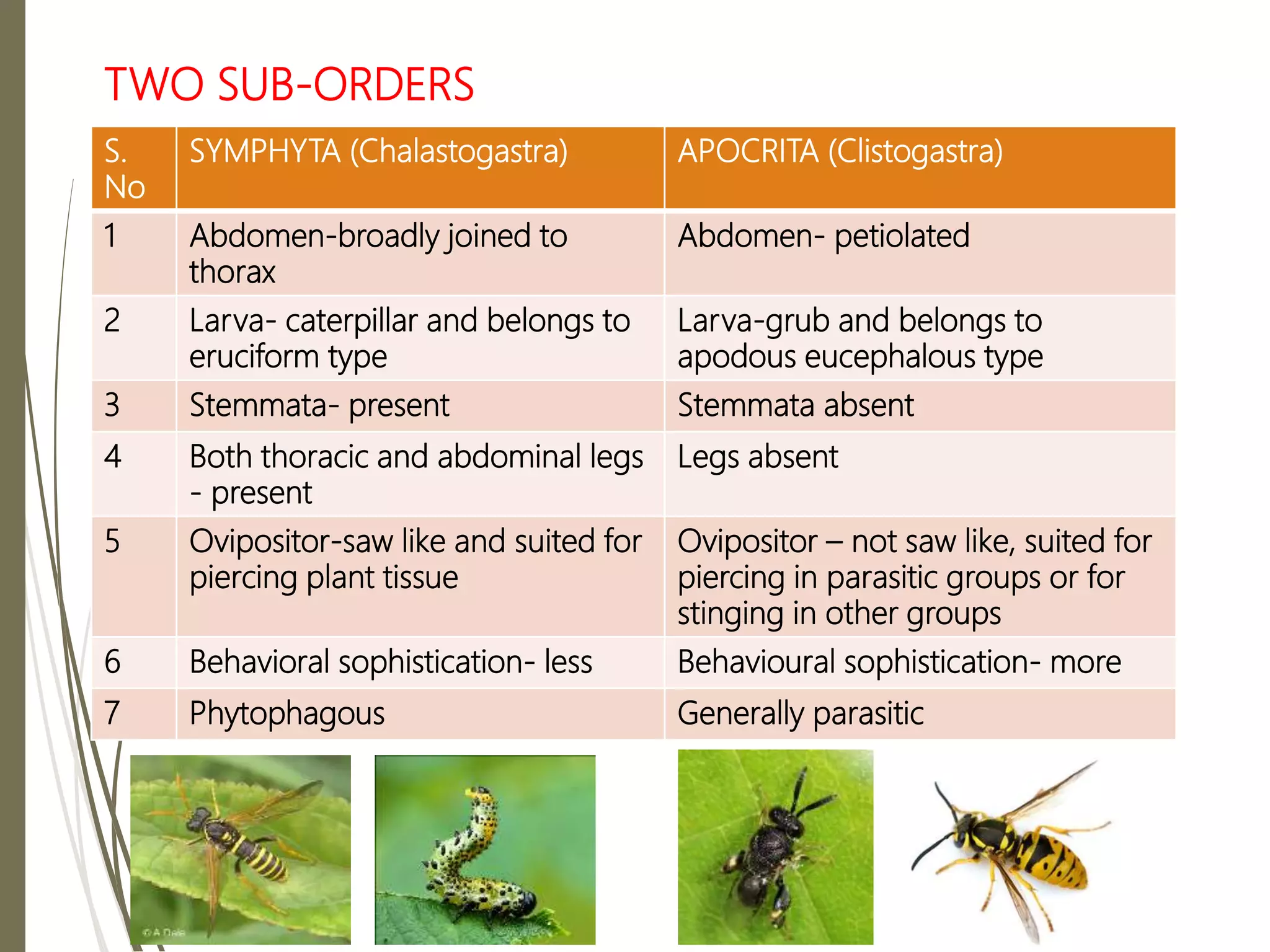
TWO SUB-ORDERS
S.
No
SYMPHYTA (Chalastogastra) APOCRITA (Clistogastra)
1 Abdomen-broadly joined to
thorax
Abdomen- petiolated
2 Larva- caterpillar and belongs to
eruciform type
Larva-grub and belongs to
apodous eucephalous type
3 Stemmata- present Stemmata absent
4 Both thoracic and abdominal legs
- present
Legs absent
5 Ovipositor-saw like and suited for
piercing plant tissue
Ovipositor – not saw like, suited for
piercing in parasitic groups or for
stinging in other groups
6 Behavioral sophistication- less Behavioural sophistication- more
7 Phytophagous Generally parasitic
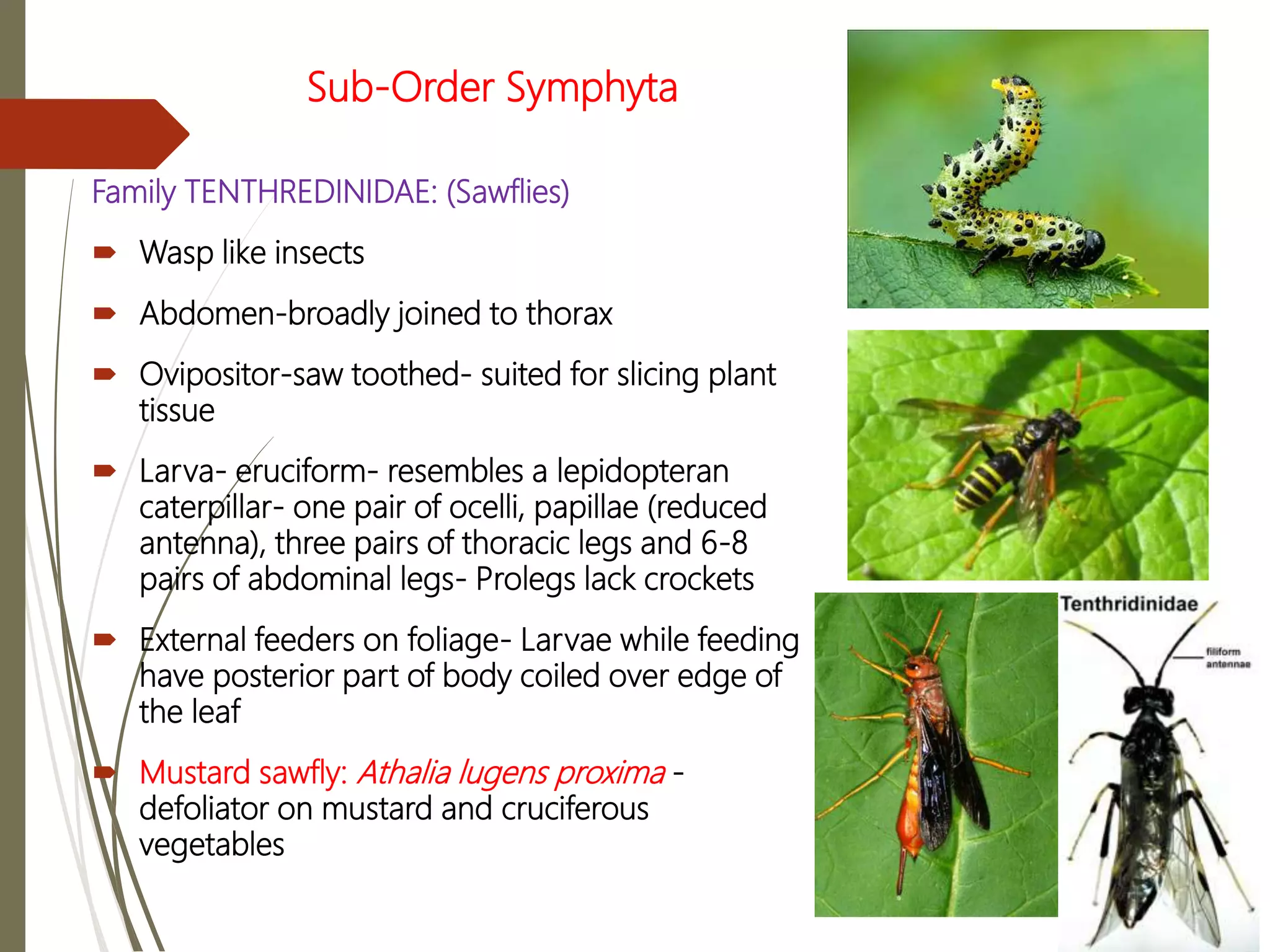
Sub-Order Symphyta
Family TENTHREDINIDAE: (Sawflies)
 Wasp like insects
 Abdomen-broadly joined to thorax
 Ovipositor-saw toothed- suited for slicing plant
tissue
 Larva- eruciform- resembles a lepidopteran
caterpillar- one pair of ocelli, papillae (reduced
antenna), three pairs of thoracic legs and 6-8
pairs of abdominal legs- Prolegs lack crockets
 External feeders on foliage- Larvae while feeding
have posterior part of body coiled over edge of
the leaf
 Mustard sawfly: Athalia lugens proxima -
defoliator on mustard and cruciferous
vegetables
Sub-Order APOCRITA
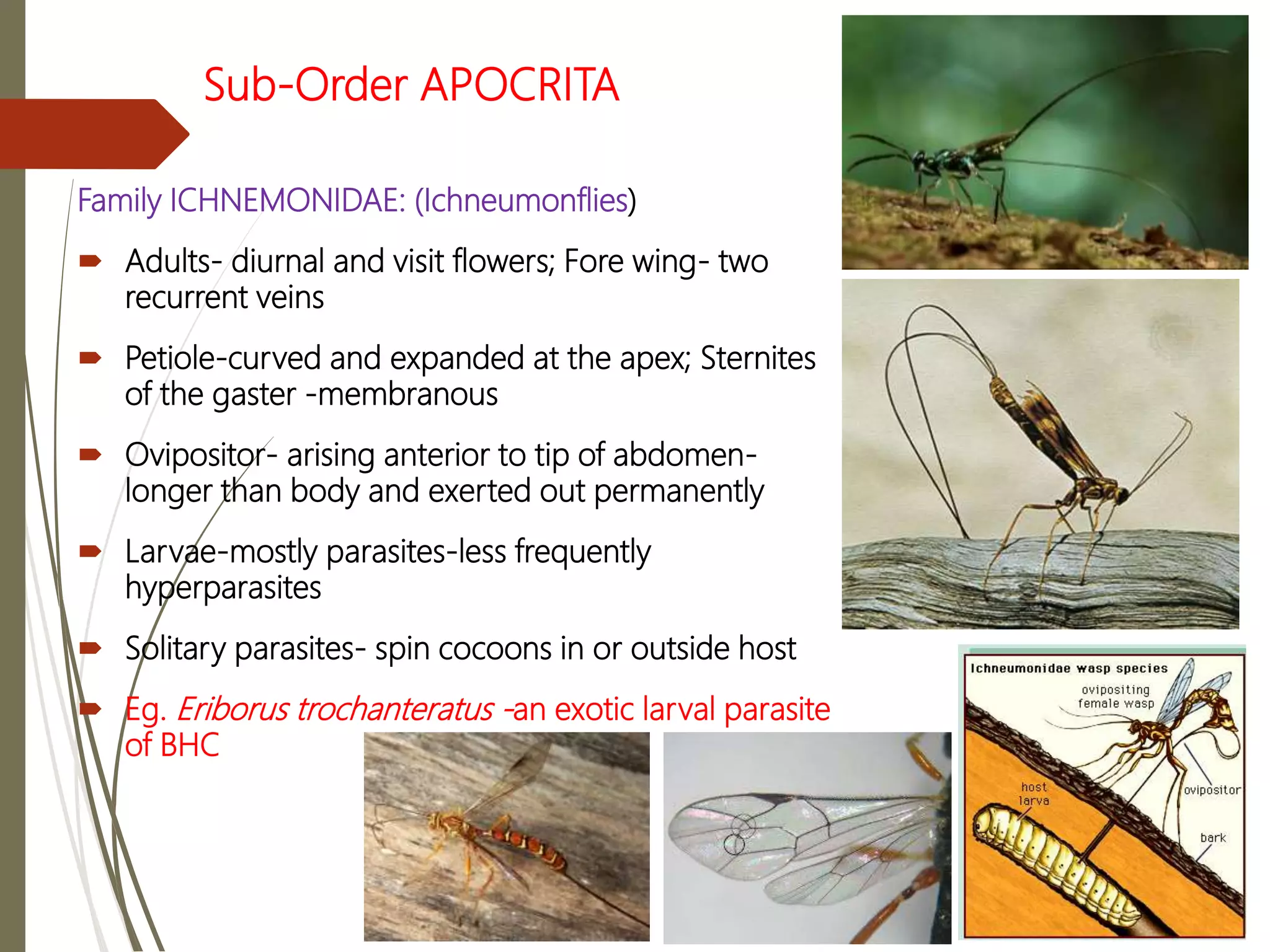
Family ICHNEMONIDAE: (Ichneumonflies)
 Adults- diurnal and visit flowers; Fore wing- two
recurrent veins
 Petiole-curved and expanded at the apex; Sternites
of the gaster -membranous
 Ovipositor- arising anterior to tip of abdomen-
longer than body and exerted out permanently
 Larvae-mostly parasites-less frequently
hyperparasites
 Solitary parasites- spin cocoons in or outside host
 Eg. Eriborus trochanteratus -an exotic larval parasite
of BHC
Sub-Order APOCRITA
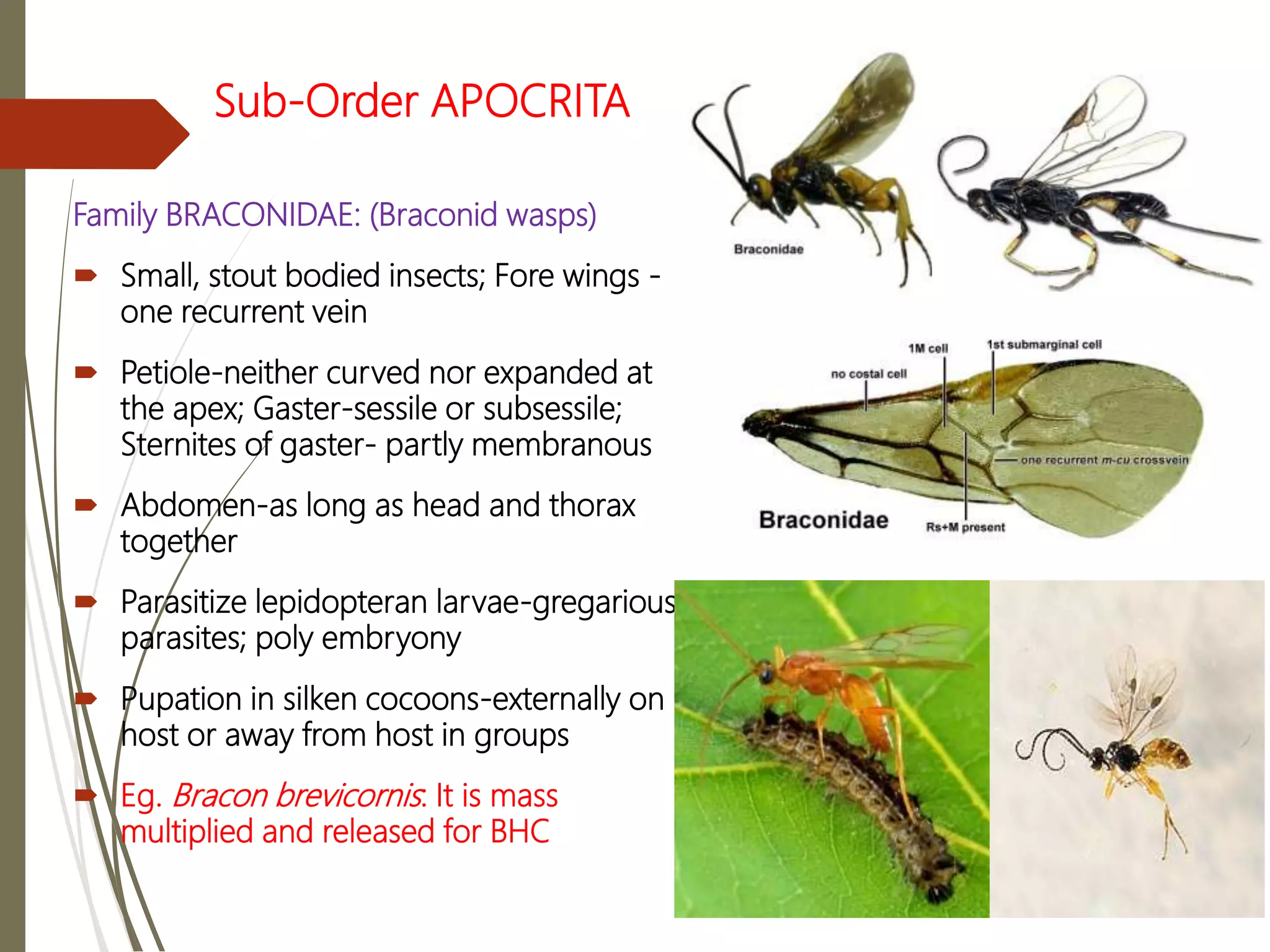
Family BRACONIDAE: (Braconid wasps)
 Small, stout bodied insects; Fore wings -
one recurrent vein
 Petiole-neither curved nor expanded at
the apex; Gaster-sessile or subsessile;
Sternites of gaster- partly membranous
 Abdomen-as long as head and thorax
together
 Parasitize lepidopteran larvae-gregarious
parasites; poly embryony
 Pupation in silken cocoons-externally on
host or away from host in groups
 Eg. Bracon brevicornis: It is mass
multiplied and released for BHC
Sub-Order APOCRITA
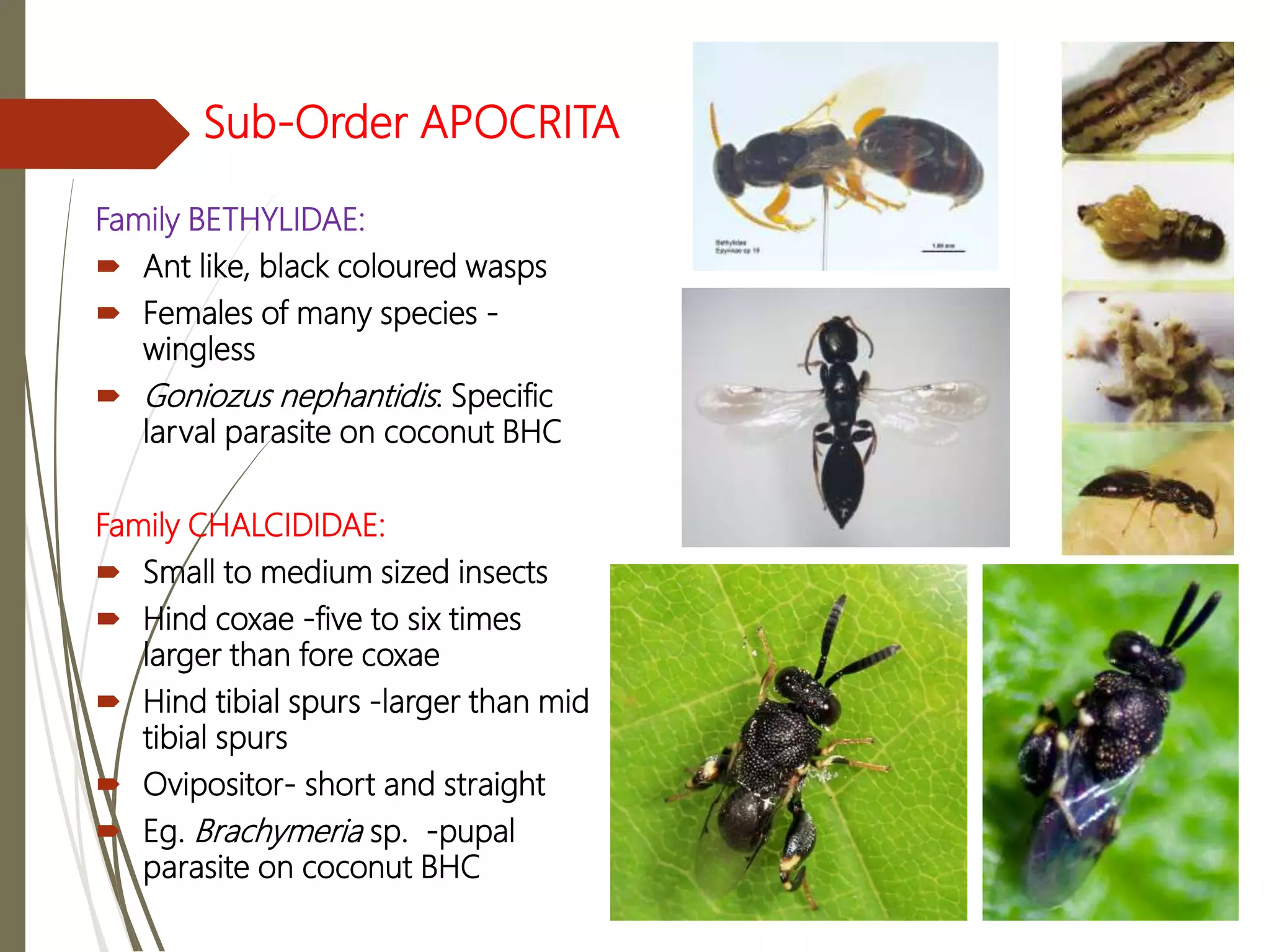
Family BETHYLIDAE:
 Ant like, black coloured wasps
 Females of many species -
wingless
 Goniozus nephantidis: Specific
larval parasite on coconut BHC
Family CHALCIDIDAE:
 Small to medium sized insects
 Hind coxae -five to six times
larger than fore coxae
 Hind tibial spurs -larger than mid
tibial spurs
 Ovipositor- short and straight
 Eg. Brachymeria sp. -pupal
parasite on coconut BHC
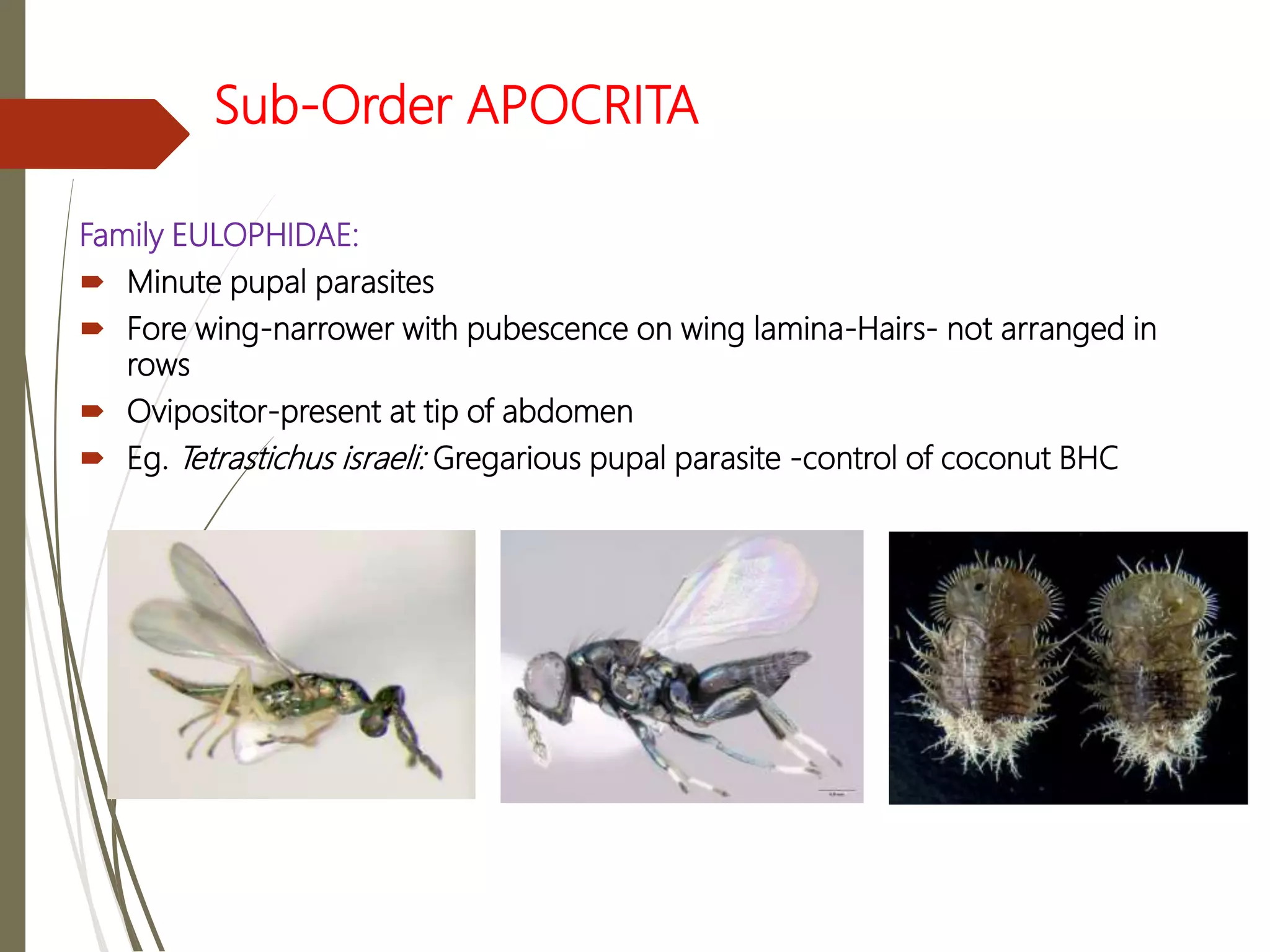
Family EULOPHIDAE:
 Minute pupal parasites
 Fore wing-narrower with pubescence on wing lamina-Hairs- not arranged in
rows
 Ovipositor-present at tip of abdomen
 Eg. Tetrastichus israeli: Gregarious pupal parasite -control of coconut BHC
Sub-Order APOCRITA
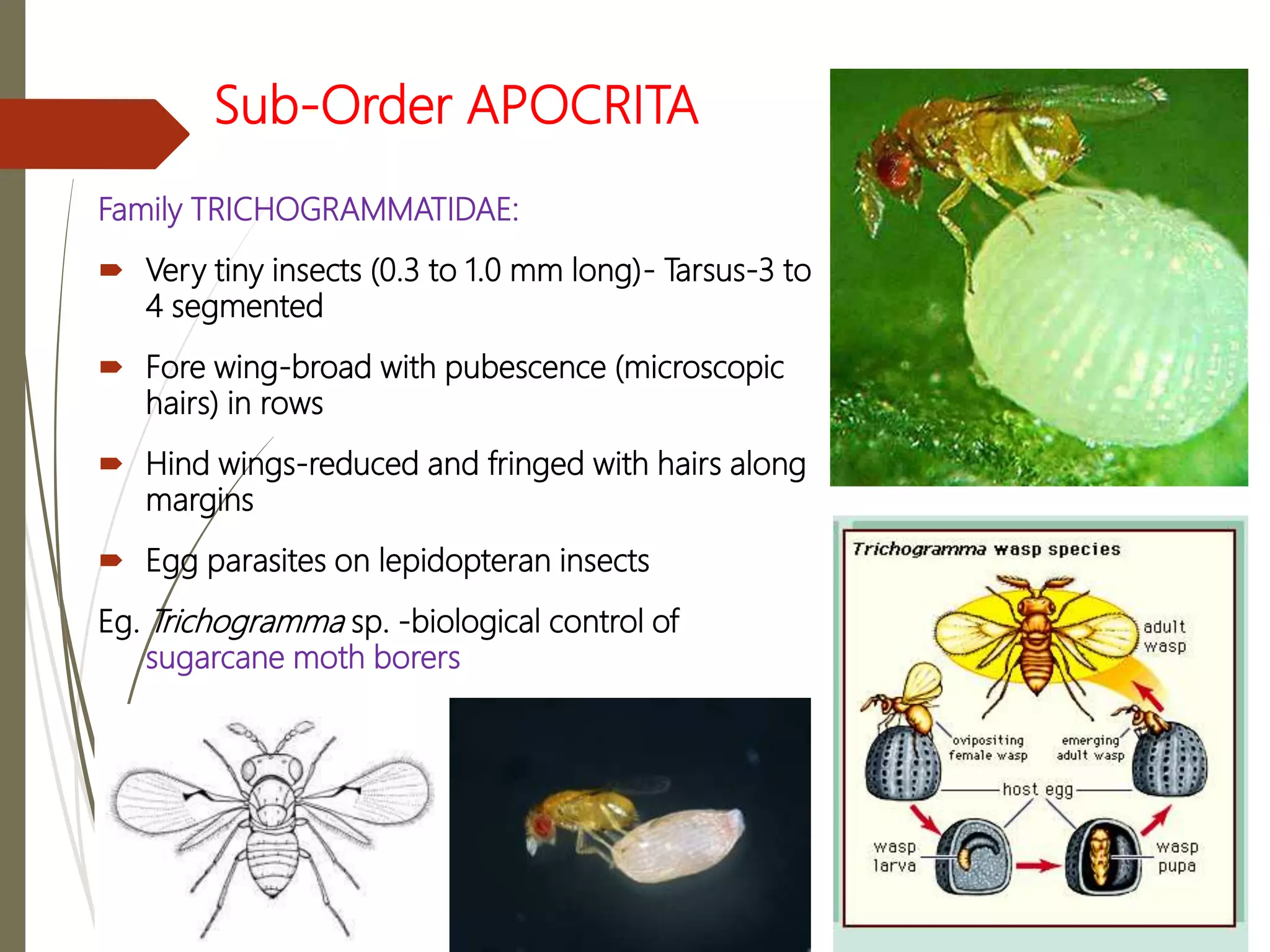
Family TRICHOGRAMMATIDAE:
 Very tiny insects (0.3 to 1.0 mm long)- Tarsus-3 to
4 segmented
 Fore wing-broad with pubescence (microscopic
hairs) in rows
 Hind wings-reduced and fringed with hairs along
margins
 Egg parasites on lepidopteran insects
Eg. Trichogramma sp. -biological control of
sugarcane moth borers
Sub-Order APOCRITA
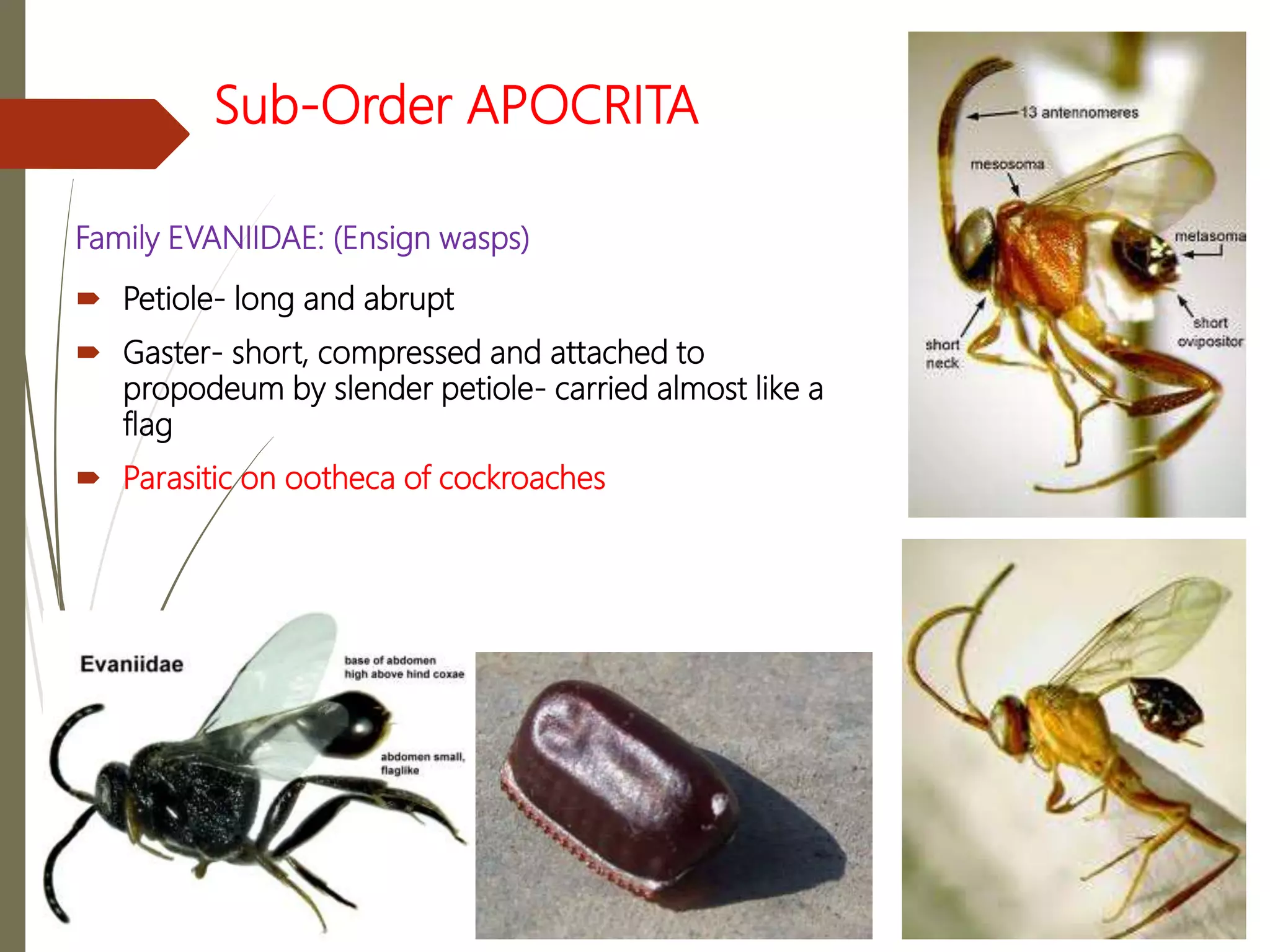
Family EVANIIDAE: (Ensign wasps)
 Petiole- long and abrupt
 Gaster- short, compressed and attached to
propodeum by slender petiole- carried almost like a
flag
 Parasitic on ootheca of cockroaches
Sub-Order APOCRITA
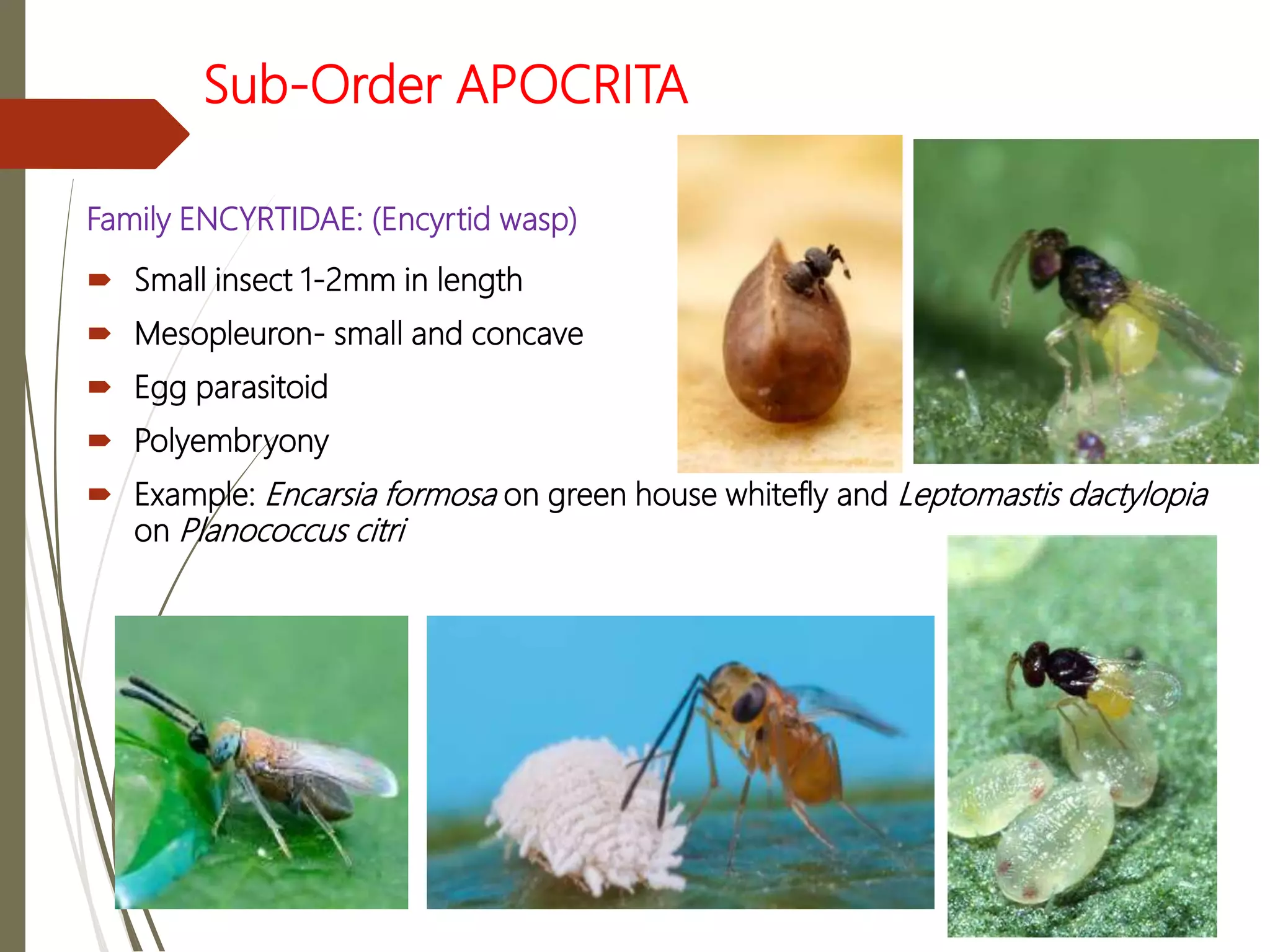
Family ENCYRTIDAE: (Encyrtid wasp)
 Small insect 1-2mm in length
 Mesopleuron- small and concave
 Egg parasitoid
 Polyembryony
 Example: Encarsia formosa on green house whitefly and Leptomastis dactylopia
on Planococcus citri
Sub-Order APOCRITA
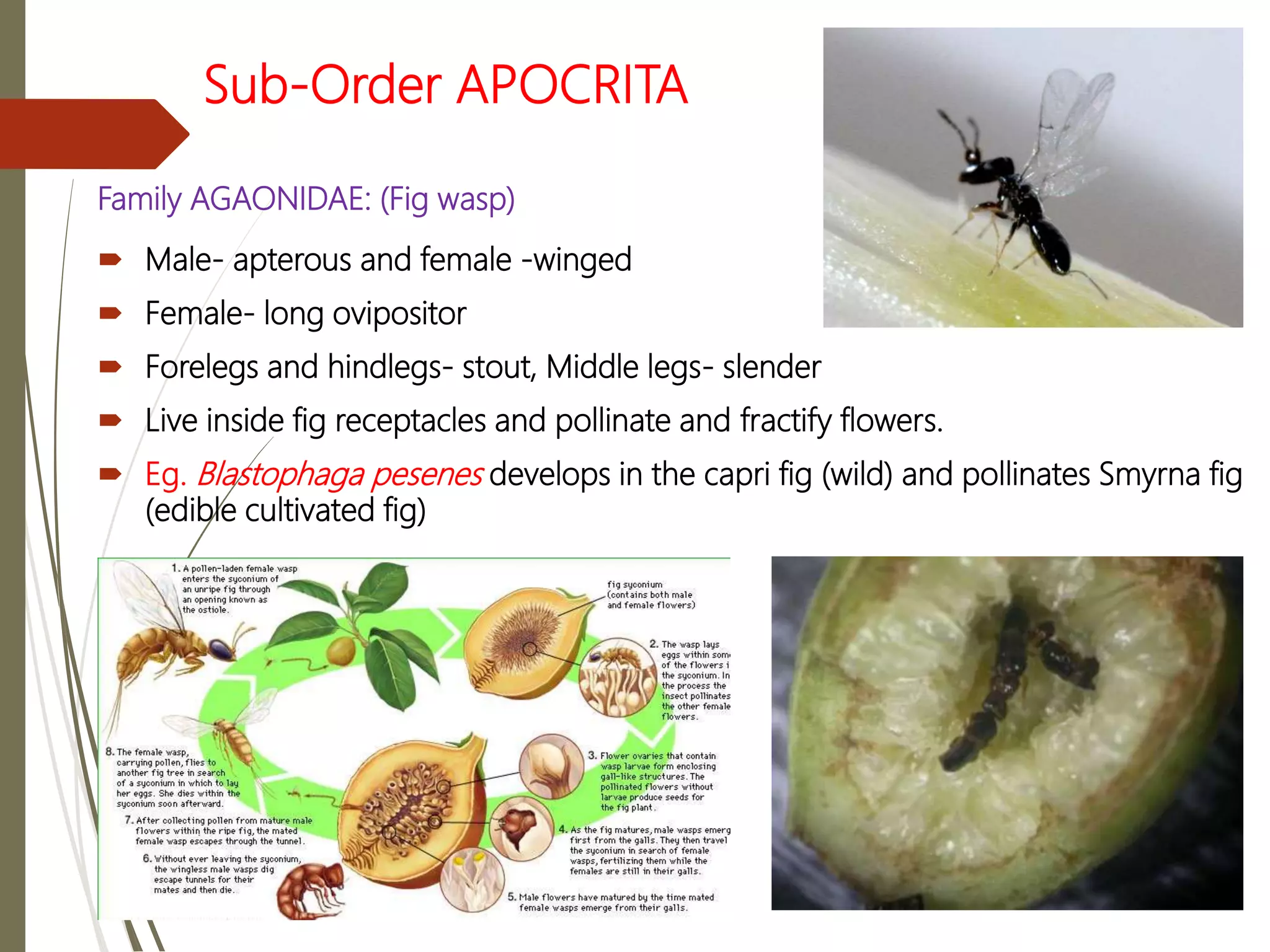
Family AGAONIDAE: (Fig wasp)
 Male- apterous and female -winged
 Female- long ovipositor
 Forelegs and hindlegs- stout, Middle legs- slender
 Live inside fig receptacles and pollinate and fractify flowers.
 Eg. Blastophaga pesenes develops in the capri fig (wild) and pollinates Smyrna fig
(edible cultivated fig)
Sub-Order APOCRITA
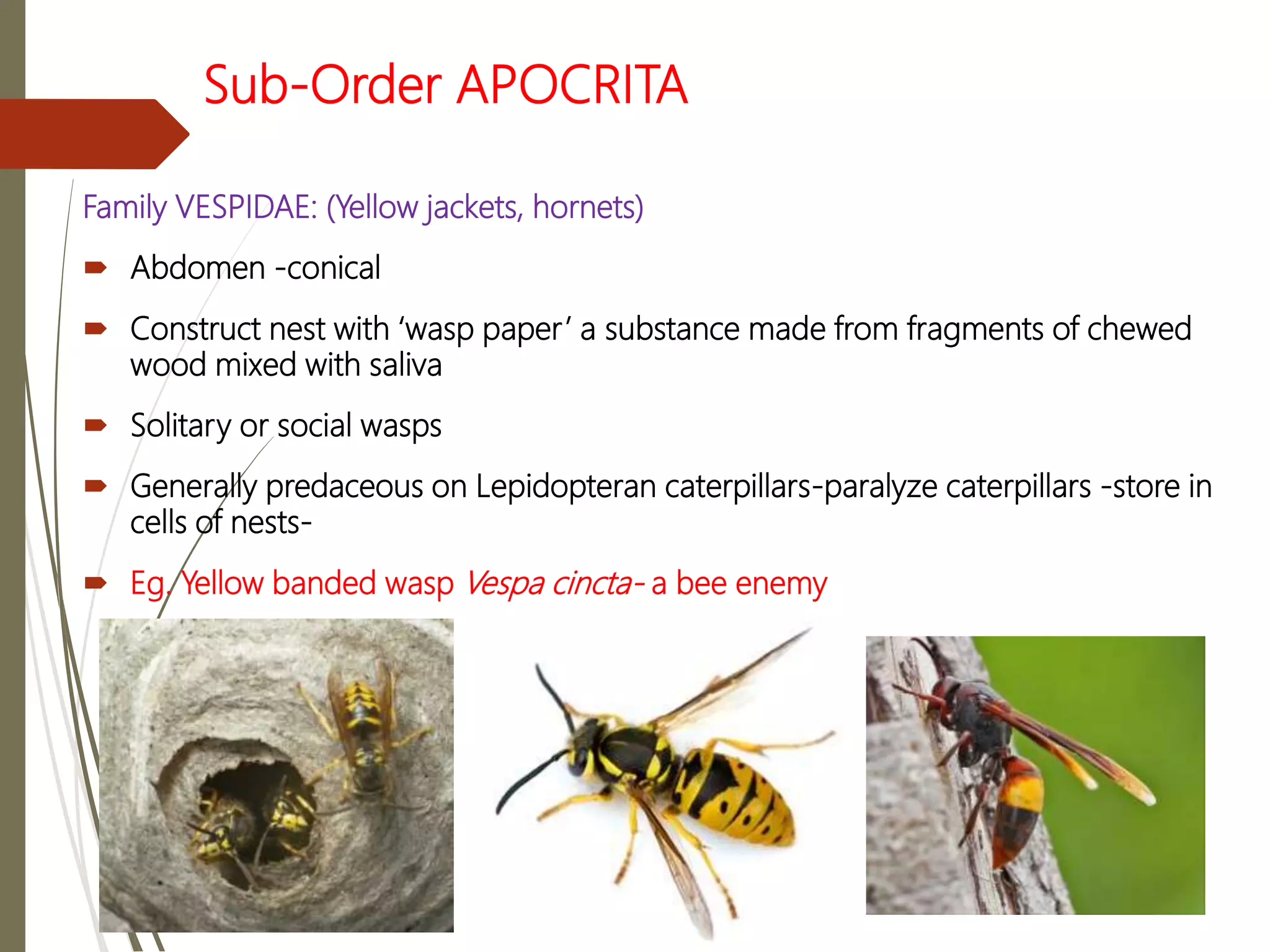
Family VESPIDAE: (Yellow jackets, hornets)
 Abdomen -conical
 Construct nest with ‘wasp paper’ a substance made from fragments of chewed
wood mixed with saliva
 Solitary or social wasps
 Generally predaceous on Lepidopteran caterpillars-paralyze caterpillars -store in
cells of nests-
 Eg. Yellow banded wasp Vespa cincta- a bee enemy
Sub-Order APOCRITA
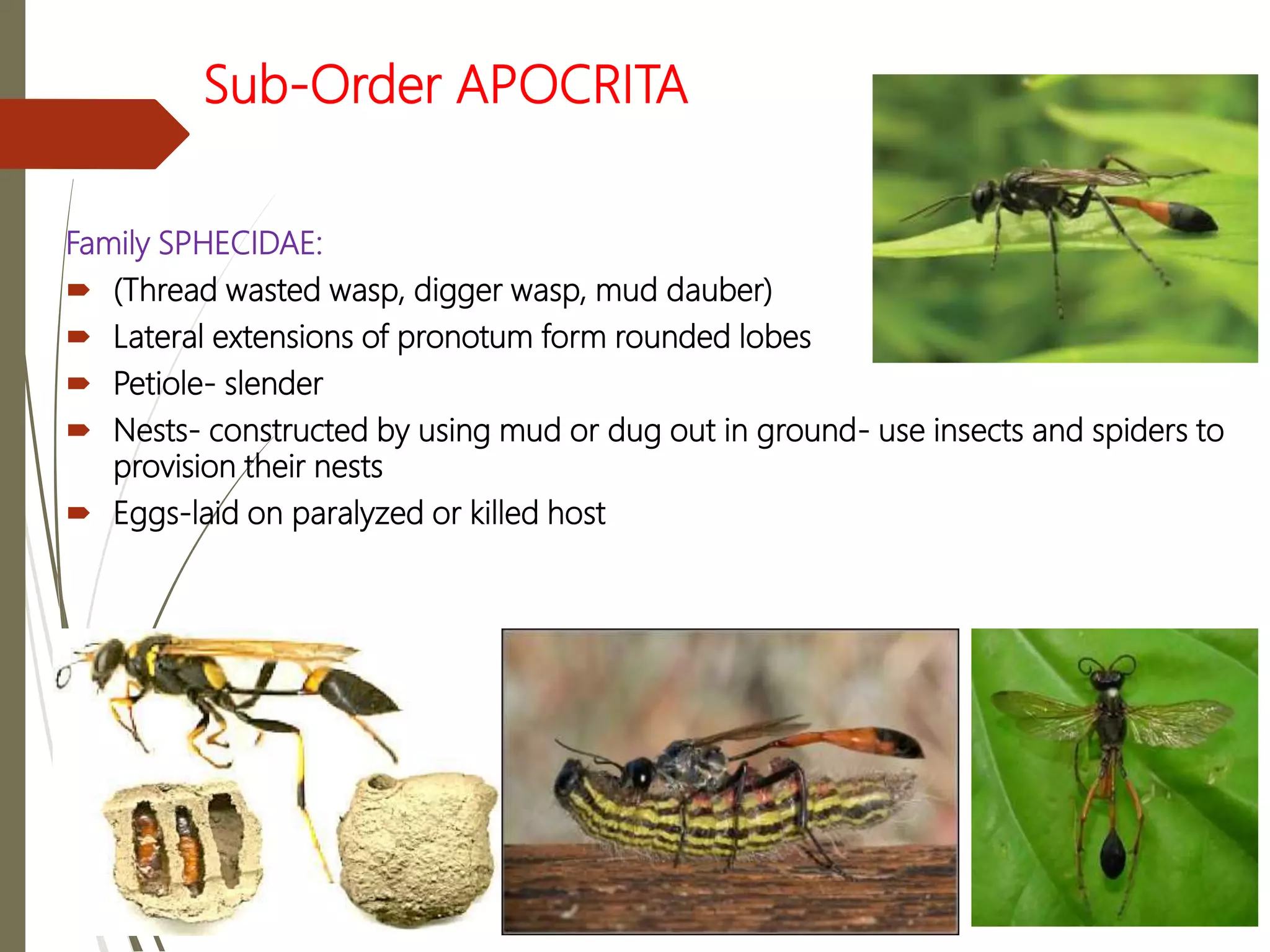
Family SPHECIDAE:
 (Thread wasted wasp, digger wasp, mud dauber)
 Lateral extensions of pronotum form rounded lobes
 Petiole- slender
 Nests- constructed by using mud or dug out in ground- use insects and spiders to
provision their nests
 Eggs-laid on paralyzed or killed host
Sub-Order APOCRITA
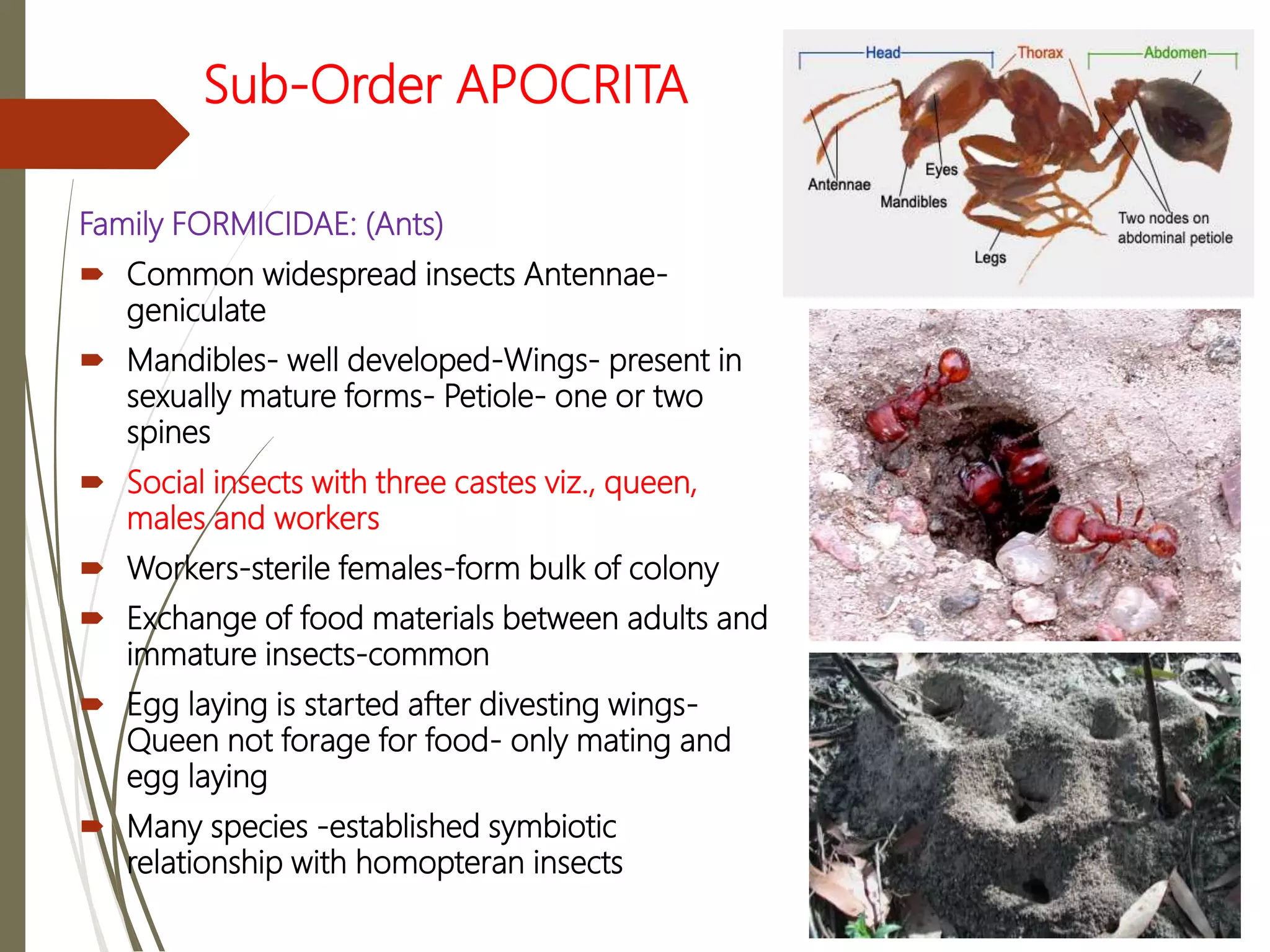
Family FORMICIDAE: (Ants)
 Common widespread insects Antennae-
geniculate
 Mandibles- well developed-Wings- present in
sexually mature forms- Petiole- one or two
spines
 Social insects with three castes viz., queen,
males and workers
 Workers-sterile females-form bulk of colony
 Exchange of food materials between adults and
immature insects-common
 Egg laying is started after divesting wings-
Queen not forage for food- only mating and
egg laying
 Many species -established symbiotic
relationship with homopteran insects
Sub-Order APOCRITA
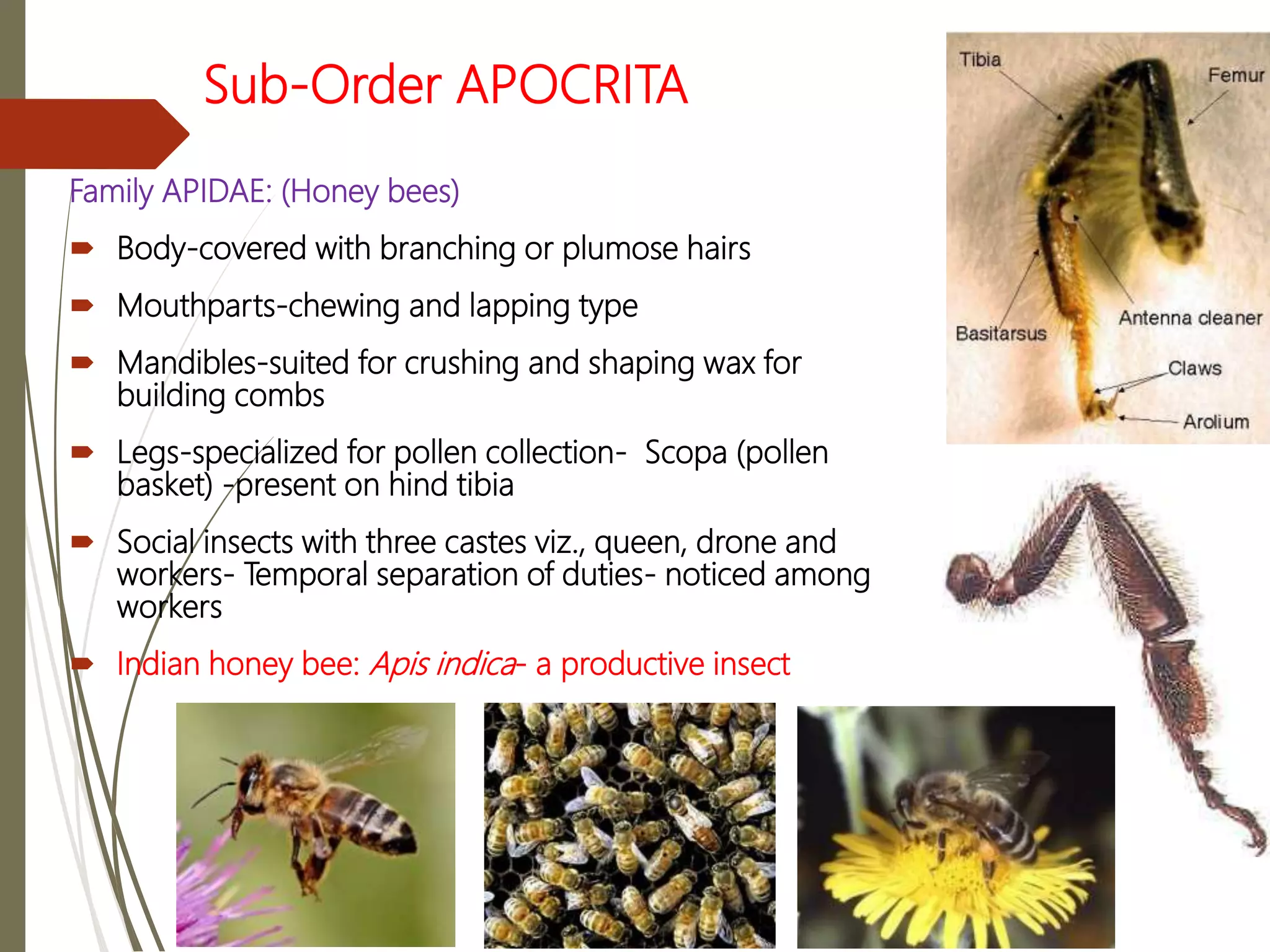
Family APIDAE: (Honey bees)
 Body-covered with branching or plumose hairs
 Mouthparts-chewing and lapping type
 Mandibles-suited for crushing and shaping wax for
building combs
 Legs-specialized for pollen collection- Scopa (pollen
basket) -present on hind tibia
 Social insects with three castes viz., queen, drone and
workers- Temporal separation of duties- noticed among
workers
 Indian honey bee: Apis indica- a productive insect
Sub-Order APOCRITA
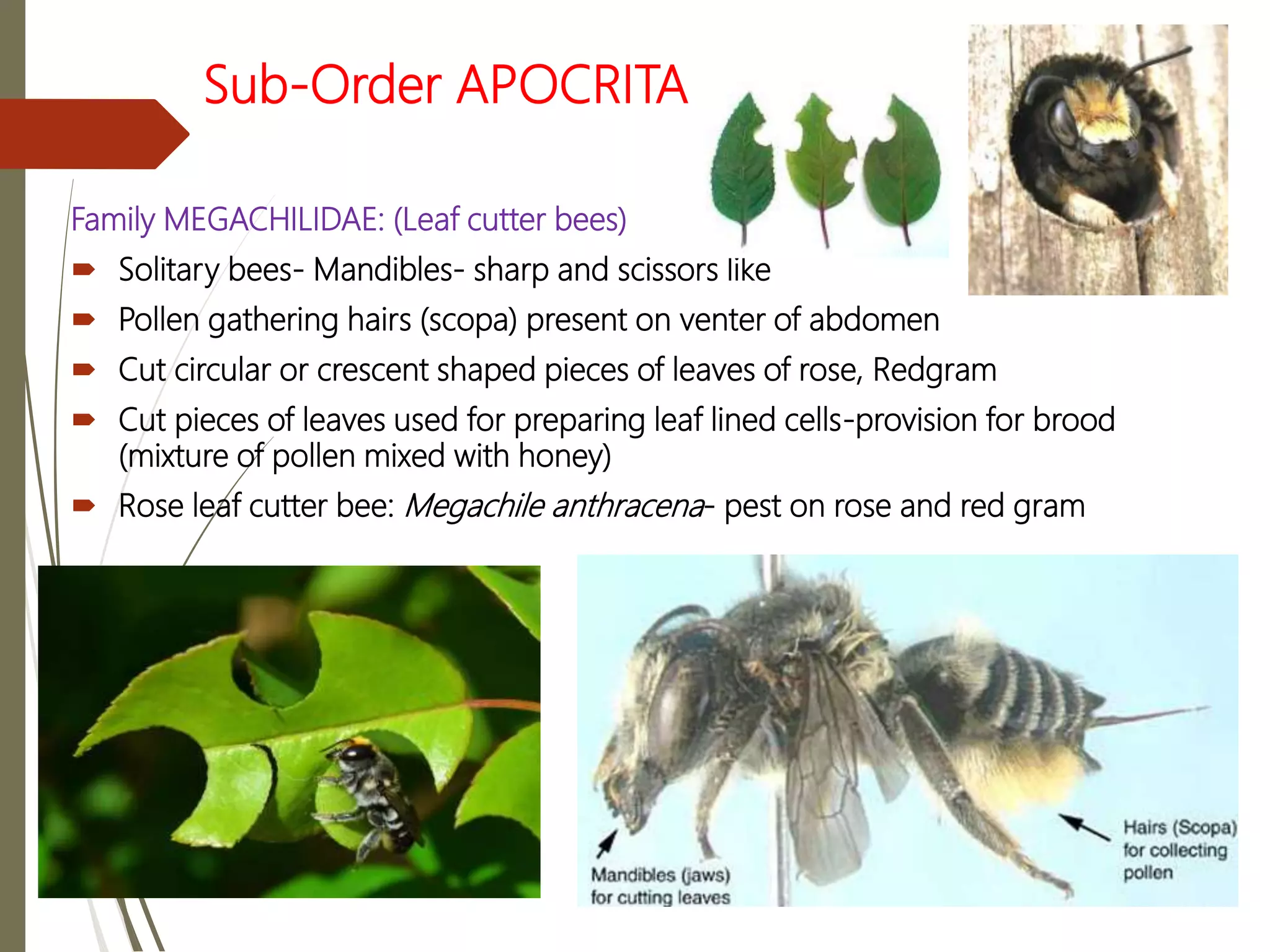
Family MEGACHILIDAE: (Leaf cutter bees)
 Solitary bees- Mandibles- sharp and scissors like
 Pollen gathering hairs (scopa) present on venter of abdomen
 Cut circular or crescent shaped pieces of leaves of rose, Redgram
 Cut pieces of leaves used for preparing leaf lined cells-provision for brood
(mixture of pollen mixed with honey)
 Rose leaf cutter bee: Megachile anthracena- pest on rose and red gram
Sub-Order APOCRITA
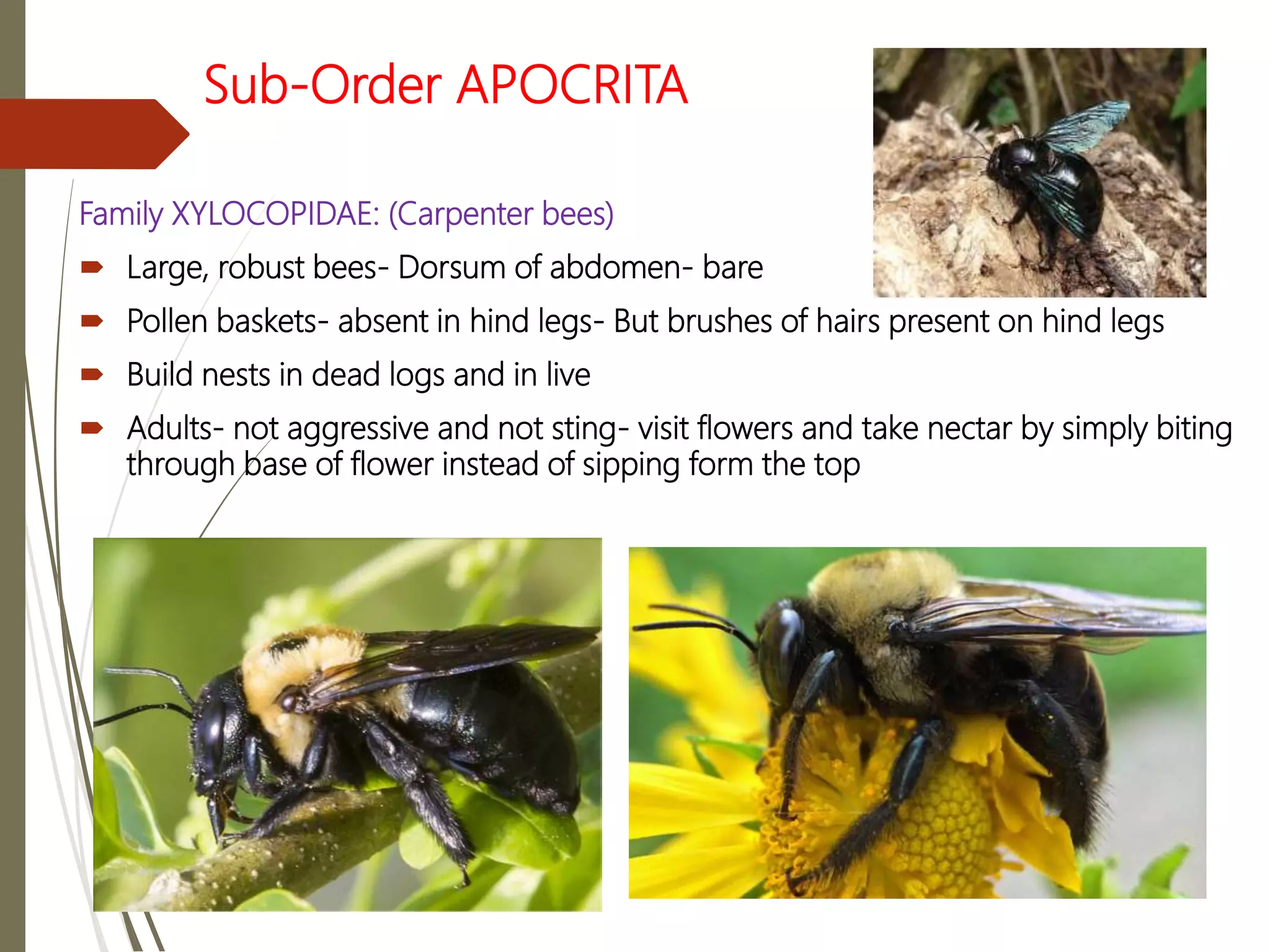
Family XYLOCOPIDAE: (Carpenter bees)
 Large, robust bees- Dorsum of abdomen- bare
 Pollen baskets- absent in hind legs- But brushes of hairs present on hind legs
 Build nests in dead logs and in live
 Adults- not aggressive and not sting- visit flowers and take nectar by simply biting
through base of flower instead of sipping form the top
Sub-Order APOCRITA

Insects Order hymenoptera

  • 1.
  • 2.
    ORDER HYMENOPTERA  Etymology:Hymen – membrane; Ptera – wings  Hymeno – god or marriage; Ptera – wings, (Marriage on the wings) (union of fore and hind wings by hamuli)  Common names: Ichneumonflies, ants, bees, wasps Order characters  Mouthparts-chewing- Mandibles -very well developed- In bees both labium and maxillae- integrated to form lapping tongue  Thorax- modified for efficient flight: Pronotum- collar like;  Mesothorax-enlarged; Metathorax-small- Both prothorax and metathorax -fused with mesothorax
  • 3.
     Characters  Wings-stiffand membranous- FW- larger than HW- Wing venation-reduced- FW and HW- coupled by a row of hooklets (hamuli)- on leading edge of HW1  Abdomen-basally constricted  1st abdominal segment- propodeum-fused with metathorax-first pair of a abdominal spiracles - located in propodeum-  2nd segment-pedicel-connects thorax and abdomen- Abdomen beyond pedicel - gaster or metasoma  Ovipositor-modified for oviposition or stinging or sawing or piercing plant tissue ORDER HYMENOPTERA
  • 4.
    Order characters  Metamorphosis-complete- grub- apodous and eucephalous-rarely eruciform  pupa-exarate-enclosed in a silken cocoon secreted from labial glands  Sex-determined by fertilization of the eggs  Fertilized eggs develop into females-males produced from unfertilized eggs  Males haploid and females diploid Hymenoptera
  • 5.
    TWO SUB-ORDERS S. No SYMPHYTA (Chalastogastra)APOCRITA (Clistogastra) 1 Abdomen-broadly joined to thorax Abdomen- petiolated 2 Larva- caterpillar and belongs to eruciform type Larva-grub and belongs to apodous eucephalous type 3 Stemmata- present Stemmata absent 4 Both thoracic and abdominal legs - present Legs absent 5 Ovipositor-saw like and suited for piercing plant tissue Ovipositor – not saw like, suited for piercing in parasitic groups or for stinging in other groups 6 Behavioral sophistication- less Behavioural sophistication- more 7 Phytophagous Generally parasitic
  • 6.
    Sub-Order Symphyta Family TENTHREDINIDAE:(Sawflies)  Wasp like insects  Abdomen-broadly joined to thorax  Ovipositor-saw toothed- suited for slicing plant tissue  Larva- eruciform- resembles a lepidopteran caterpillar- one pair of ocelli, papillae (reduced antenna), three pairs of thoracic legs and 6-8 pairs of abdominal legs- Prolegs lack crockets  External feeders on foliage- Larvae while feeding have posterior part of body coiled over edge of the leaf  Mustard sawfly: Athalia lugens proxima - defoliator on mustard and cruciferous vegetables
  • 7.
    Sub-Order APOCRITA Family ICHNEMONIDAE:(Ichneumonflies)  Adults- diurnal and visit flowers; Fore wing- two recurrent veins  Petiole-curved and expanded at the apex; Sternites of the gaster -membranous  Ovipositor- arising anterior to tip of abdomen- longer than body and exerted out permanently  Larvae-mostly parasites-less frequently hyperparasites  Solitary parasites- spin cocoons in or outside host  Eg. Eriborus trochanteratus -an exotic larval parasite of BHC
  • 8.
    Sub-Order APOCRITA Family BRACONIDAE:(Braconid wasps)  Small, stout bodied insects; Fore wings - one recurrent vein  Petiole-neither curved nor expanded at the apex; Gaster-sessile or subsessile; Sternites of gaster- partly membranous  Abdomen-as long as head and thorax together  Parasitize lepidopteran larvae-gregarious parasites; poly embryony  Pupation in silken cocoons-externally on host or away from host in groups  Eg. Bracon brevicornis: It is mass multiplied and released for BHC
  • 9.
    Sub-Order APOCRITA Family BETHYLIDAE: Ant like, black coloured wasps  Females of many species - wingless  Goniozus nephantidis: Specific larval parasite on coconut BHC Family CHALCIDIDAE:  Small to medium sized insects  Hind coxae -five to six times larger than fore coxae  Hind tibial spurs -larger than mid tibial spurs  Ovipositor- short and straight  Eg. Brachymeria sp. -pupal parasite on coconut BHC
  • 10.
    Family EULOPHIDAE:  Minutepupal parasites  Fore wing-narrower with pubescence on wing lamina-Hairs- not arranged in rows  Ovipositor-present at tip of abdomen  Eg. Tetrastichus israeli: Gregarious pupal parasite -control of coconut BHC Sub-Order APOCRITA
  • 11.
    Family TRICHOGRAMMATIDAE:  Verytiny insects (0.3 to 1.0 mm long)- Tarsus-3 to 4 segmented  Fore wing-broad with pubescence (microscopic hairs) in rows  Hind wings-reduced and fringed with hairs along margins  Egg parasites on lepidopteran insects Eg. Trichogramma sp. -biological control of sugarcane moth borers Sub-Order APOCRITA
  • 12.
    Family EVANIIDAE: (Ensignwasps)  Petiole- long and abrupt  Gaster- short, compressed and attached to propodeum by slender petiole- carried almost like a flag  Parasitic on ootheca of cockroaches Sub-Order APOCRITA
  • 13.
    Family ENCYRTIDAE: (Encyrtidwasp)  Small insect 1-2mm in length  Mesopleuron- small and concave  Egg parasitoid  Polyembryony  Example: Encarsia formosa on green house whitefly and Leptomastis dactylopia on Planococcus citri Sub-Order APOCRITA
  • 14.
    Family AGAONIDAE: (Figwasp)  Male- apterous and female -winged  Female- long ovipositor  Forelegs and hindlegs- stout, Middle legs- slender  Live inside fig receptacles and pollinate and fractify flowers.  Eg. Blastophaga pesenes develops in the capri fig (wild) and pollinates Smyrna fig (edible cultivated fig) Sub-Order APOCRITA
  • 15.
    Family VESPIDAE: (Yellowjackets, hornets)  Abdomen -conical  Construct nest with ‘wasp paper’ a substance made from fragments of chewed wood mixed with saliva  Solitary or social wasps  Generally predaceous on Lepidopteran caterpillars-paralyze caterpillars -store in cells of nests-  Eg. Yellow banded wasp Vespa cincta- a bee enemy Sub-Order APOCRITA
  • 16.
    Family SPHECIDAE:  (Threadwasted wasp, digger wasp, mud dauber)  Lateral extensions of pronotum form rounded lobes  Petiole- slender  Nests- constructed by using mud or dug out in ground- use insects and spiders to provision their nests  Eggs-laid on paralyzed or killed host Sub-Order APOCRITA
  • 17.
    Family FORMICIDAE: (Ants) Common widespread insects Antennae- geniculate  Mandibles- well developed-Wings- present in sexually mature forms- Petiole- one or two spines  Social insects with three castes viz., queen, males and workers  Workers-sterile females-form bulk of colony  Exchange of food materials between adults and immature insects-common  Egg laying is started after divesting wings- Queen not forage for food- only mating and egg laying  Many species -established symbiotic relationship with homopteran insects Sub-Order APOCRITA
  • 18.
    Family APIDAE: (Honeybees)  Body-covered with branching or plumose hairs  Mouthparts-chewing and lapping type  Mandibles-suited for crushing and shaping wax for building combs  Legs-specialized for pollen collection- Scopa (pollen basket) -present on hind tibia  Social insects with three castes viz., queen, drone and workers- Temporal separation of duties- noticed among workers  Indian honey bee: Apis indica- a productive insect Sub-Order APOCRITA
  • 19.
    Family MEGACHILIDAE: (Leafcutter bees)  Solitary bees- Mandibles- sharp and scissors like  Pollen gathering hairs (scopa) present on venter of abdomen  Cut circular or crescent shaped pieces of leaves of rose, Redgram  Cut pieces of leaves used for preparing leaf lined cells-provision for brood (mixture of pollen mixed with honey)  Rose leaf cutter bee: Megachile anthracena- pest on rose and red gram Sub-Order APOCRITA
  • 20.
    Family XYLOCOPIDAE: (Carpenterbees)  Large, robust bees- Dorsum of abdomen- bare  Pollen baskets- absent in hind legs- But brushes of hairs present on hind legs  Build nests in dead logs and in live  Adults- not aggressive and not sting- visit flowers and take nectar by simply biting through base of flower instead of sipping form the top Sub-Order APOCRITA