INNOVATIVE 
PROJECT MANAGEMENT PRACTICES 
FOR WORKING PROFESSIONALS 
by Prof. Sanjeev Bahadur 
Program Director 
Institute of Advanced Management and Research 
Approved by AICTE, Ministry of HRD, Govt. of India. 
www.iamrindia.com
Scope of “Project Management” 
The topics proposed to be covered in this Project Management 
Program are: 
Introduction / 
Overview/Importance 
Project Management 
Concepts & Standards 
Project Formulation and 
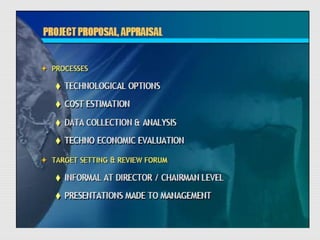
Appraisal / Approval Processes 
Environment Impact 
Assessment (EIA) 
Human Resources: Issues, 
Challenges and Solutions 
Strategic Project Financial 
Management 
Tips and Techniques for Cost 
Estimation in Project 
Management 
Analyzing Risks in Project 
Management 
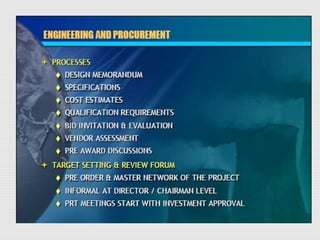
EPC: Engineering, 
Procurement, Construction 
Procurement Management 
and e-procurement 
Quality Assurance and 
Innovation 
Microsoft Project 
Demonstration 
(CPM/PERT/GANTT Charts) 
Productivity, Efficiency and 
Time Management 
Live Case Study and 
discussions 
References
Project Delays Cost Rs 1,24,000 Cr 
Consequences of Time Delays 
 Total projects delays cost Rs 1,24,000 Crores., informs 
Sh M.S Gill MoS, Ministry of Statistics & Program 
Implementation. 
 Out of 567 projects costing more than Rs 150 crores 
each, 375 projects reported delays from 1 month to 
72 months. 
 Causes are Land acquisition, getting Environment 
clearances, protest by Local people, incomplete Land 
Records, lack of coordination between different 
agencies. 
 Cost of delay is one third of India Plan Budget 2011-12 
 Sectors reviewed are Coal, Steel, Power, Petroleum, 
Railways, Road transport/Highways, Telecommunications 
 Original cost of these projects was Rs 5,92,535 crores. 
(Source :Hindustan Times, 04 April 2011)
Objectives of Project Management 
 Definition, Meaning and examples of Projects 
 What does Project Management involve? 
 What are the qualities of a Project Manager ? 
 Reasons for Time and Cost overruns (Govt. of India 
agencies studies) 
 Solutions for cutting Time/Cost Overruns 
 Role of Consultants/Engg. Contractors in Tendering 
 Brief overview of the Program (incl. PERT/CPM) 
 Research on the Power /Infrastructure Sector 
 Focus on NTPC, Tata Power, Reliance Infrastructure 
(Ratio Analysis) 
 References
Project Definition (ANSI/PMI 99-001-2004) 
 Project is a temporary endeavour undertaken to create a 
unique product or service or result. 
 ISO 10006 defines project as unique process, comprising 
of a set of controlled and coordinated activities with start 
and finish dates, undertaken to achieve an objective 
conforming to specific project requirements including 
constraints of resources, cost and time. 
 Project refers to a high value, time bound, mission of 
creating a product/facility with predetermined 
performance objectives in terms of quality specifications, 
completion time, resource constraints and budgeted 
cost.
Project Management 
Project Management is the discipline of planning, organizing, 
securing and managing resources to bring about successful 
completion of specific project goals and objectives. 
A project is a short term undertaking/endeavor, having a 
defined beginning and end (usually constrained by date, or by 
funding or deliverables), undertaken to meet unique goals and 
objectives usually to bring about beneficial change or value 
addition. 
The temporary nature of projects stands in contrast to regular 
operations, which are repetitive, permanent or semi-permanent 
functional work to produce products or services. In practice, the 
management of these two systems is generally found to be 
different, and requires the development of unique technical 
skills and the adoption of separate management practices.
Project Management (Meaning) 
 To understand project management, one must 
understand what a project really is. 
 Different types of Projects are cement projects, 
power projects, refinery projects, fertilizer projects 
etc. 
 In each case, the project is for setting up a 
manufacturing plant, but as soon as the plant is 
operational, the project is deemed to have been 
completed. 
 A project, is not a physical objective, nor is it the 
end-result.
Project Performance Objectives 
 SCOPE defines the deliverables 
 QUALITY of Product stated in terms of design, 
drawings and specifications 
 RESOURCES includes manpower, materials and 
machinery required to perform the work. 
 COMPLETION TIME is the speed with which project 
is executed. 
 COST is the budgeted expenditure.
Examples of Complex Projects 
involving Technology 
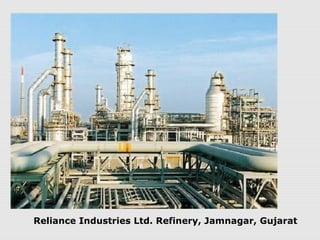
 Reliance Industries Ltd., Jamnagar 
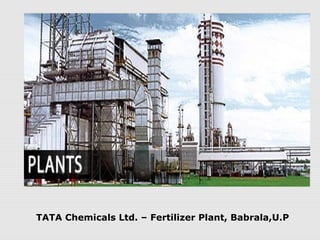
 Tata Chemicals Ltd., Babrala 
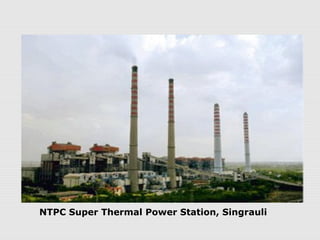
 NTPC Super Thermal Power Station 
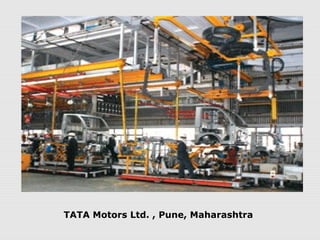
 Tata Motors Ltd., Pune 
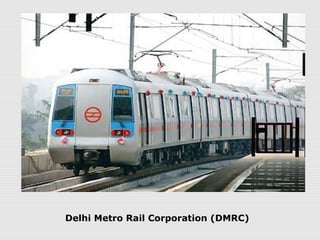
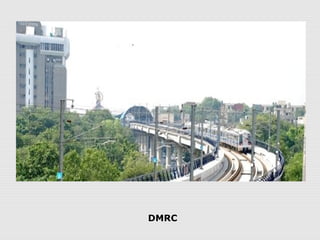
 Delhi Metro Rail Corporation 
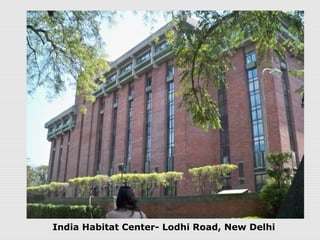
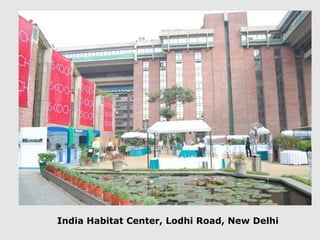
 India Habitat Centre 
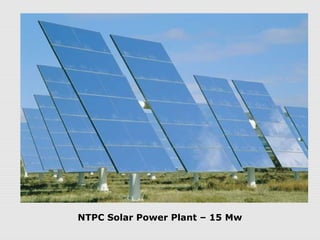
 NTPC Solar Power Project.
Reliance Industries Ltd. Refinery, Jamnagar, Gujarat
TATA Chemicals Ltd. – Fertilizer Plant, Babrala,U.P
NTPC Super Thermal Power Station, Singrauli
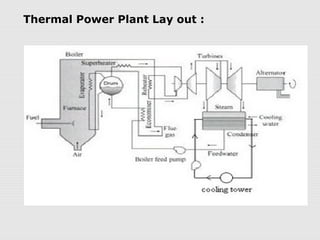
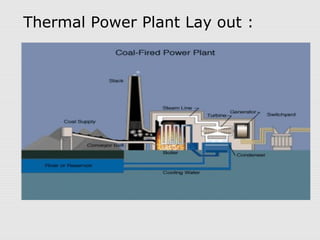
Thermal Power Plant Lay out :
TATA Motors Ltd. , Pune, Maharashtra
Delhi Metro Rail Corporation (DMRC)
DMRC
India Habitat Center- Lodhi Road, New Delhi
India Habitat Center, Lodhi Road, New Delhi
NTPC Solar Power Plant – 15 Mw
What does a Project Involve 1 
 A Competent/Decisive and Experienced Team with Integrity. 
 Identify Right Project Manager/GM (Project) with proven track record of 
successful execution of Projects 
 Clear Focused Goals (Cost of generation of one Unit should be the Lowest) 
 Create clear Mission, Vision, Quality Policy and Organization Chart. 
 Benchmark/Research the Project with worlds best 3 similar/better executed 
projects (Ratio Analysis). 
 Identify how much time and cost went into those projects (eg Reliance Refinery) 
Reduce it by 20% on the cost of manpower ,cost of Raw Materials, Cost of 
marketing, cost of manufacturing etc 
 Estimate the targeted project cost and time required after benchmarking by 
appointing proven Consultants such as MECON , EIL,TCE,PDIL etc. 
 Get project funding sanction/approval/disbursement. Benchmark Interest rates 
with International Rates to reduce cost of capital. 
 Responsibility, authority, resources, team, time and processes are required for 
successful execution of Project. 
 Identify proper project site location considering the right seismic zone, 
Road/Highway/Rail/Airport, connectivity, Alternative Fuel/Raw material supplies 
(eg Tata Chemicals Babrala), clean water, 24*7 electricity, sewage, internet, 
medical facilities, availability of Engineers/Managers/skilled/unskilled 
manpower, Tax benefits.
What does a Project Involve 2 
 Dealing/Negotiation with Suppliers/contracts, Contractors, Architects, Facility 
providers, District officials Local Politicians, Press, Insurance, Consultants, 
Service Providers , CA’s, Cost Accountants, IT specialists, bankers, 
Environmentalists, Accountants, Taxation specialists, Energy Economists, 
Security , Maintenance Specialists,Horticulturists etc 
 Defining the scope of various tenders, deadlines of execution, terms/conditions, 
penalty for late execution, inspection, testing and commissioning criteria. 
 Use of Computers/Telecom, PERT/CPM , CAD/CAM tools , SAP,DBMS,MIS for 
Monitoring and Control. 
 Use correct tools, equipment, Govt. approvals, people and management 
processes to execute the project both in targeted time and cost. 
 Maintain quality of project execution. 
 Maintain high levels of Productivity, Efficiency and Transparent Monitoring. 
 Identify Critical Success Factors and Causes for Delays. 
 Success of the Project depends on proven technology, Control of Proven sources 
for delays and Factor all of them in your estimated time and cost of your project. 
Target your project finishing time to be less by 30% 
 E procurement can reduce purchasing costs and time. 
 List all activities, people responsible and classify them into A/B/C in order of 
importance/cost 
 Plan an Incentive scheme for actual achievers who achieve targeted or better 
the Time/cost parameters planned and desired,
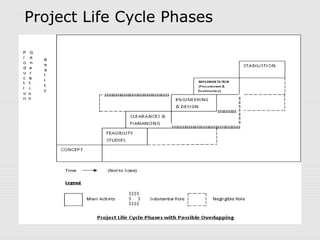
Project Life Cycle Phases
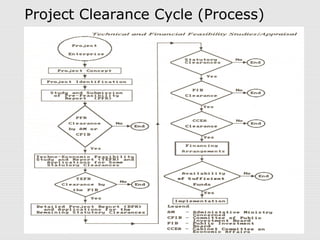
Project Clearance Cycle (Process)
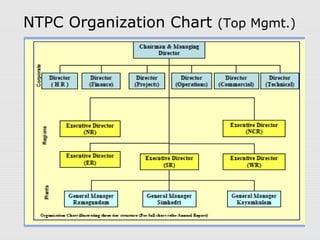
NTPC Organization Chart (Top Mgmt.)
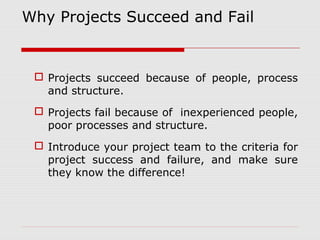
Why Projects Succeed and Fail 
 Projects succeed because of people, process 
and structure. 
 Projects fail because of inexperienced people, 
poor processes and structure. 
 Introduce your project team to the criteria for 
project success and failure, and make sure 
they know the difference!
Project Appraisal 
 Project appraisal is a generic term that refers 
to the process of assessing, in a structured 
way, the case for proceeding with a project or 
proposal. Project appraisal is the effort of 
calculating a project's viability. It often involves 
comparing various options, using 
economic appraisal or some other 
decision analysis technique
Project Formulation 
Points to be considered: 
 The type and level of industrial activity. 
 To match financial resources available with 
required amount. 
 Prepare a sensible project report.
Broad Heads of Project Report 
 General Information 
 Project Description 
 Market potential 
 Capital Costs and Sources of Finance 
 Assessment of Working Capital 
 Other Financial Aspects 
 Economic and Social Variables
India Infrastructure Projects 
 In the last decade or so, development of India Infrastructure 
Projects have been propelled specially in transport sector with 
adequate intervention of Central and State Governments 
aided by a host of private investments from within and outside 
the country. 
 From independence, India Infrastructure Projects bear 
testimony of the inability of policymakers to transform ambitious 
plans into action. The issues responsible for this were: 
 Counter guarantees 
 State level issues 
 Delay in financial closure 
 Ability and willingness of the end customers to pay 
 Need to develop independent regulators who can monitor and 
guide development of the sector 
Source : India Business Directory
Cost Overrun 
 A cost overrun, known as a cost increase or budget 
overrun, is an unexpected cost incurred in excess of a 
budgeted amount due to an under-estimation of the actual 
cost during budgeting. Cost overrun should be distinguished 
from cost escalation, which is used to express an 
anticipated growth in a budgeted cost due to factors such as 
inflation. 
 Cost overrun is common in infrastructure, building, and 
technology projects. A comprehensive study of cost overrun 
published in the Journal of the American Planning 
Association in 2002 found that 9 out of ten construction 
projects had underestimated costs. Overruns of 50 to one 
hundred percent were common.
Time/Cost overrun 
Table 1: Sector-wise comparison of project implementation data 
Source : NCAER, Govt. of India
Summary of NCAER Findings 
 Infrastructure projects are hugely complex, due to 
multiplicity of direct stake holders; intense market 
and non-market interface; development in a setting 
where there are shortages of critical inputs; and weak 
governance. 
 There has been an enormous increase in the scale of 
operations. While many things can be outsourced, the 
basic initiating, regulatory, supervisory and 
governance functions are within the government, so 
capacity becomes a constraint. 
 The evolving nature of policy is unavoidable but leads 
to uncertainty and may slowdown the process of 
investment.
Summary of NCAER Findings (Cont.) 
 Opening up the sectors for private investment and 
operation can speed up the process of execution once the 
policy framework is in place. However, the need for 
government intervention at different stages would require 
equal capacity for decisions within the government. 
 There is a need for prioritizing building up capacity. For 
example, building regulatory capacity for individual 
sectors and across states is not easy. 
 The experience in project execution has varied across 
sectors and across states as well as between private and 
public sector project. Some high profile projects have met 
the target levels of performance metrics while the others 
have not. 
 The Chinese experience highlights the need for strong 
accountability mechanisms.
Time and cost overruns in infra 
projects declining: Govt 
 In a move that could encourage many big investments in 
the sector, the government has stated that time and 
cost overruns in the infrastructure projects has improved 
significantly in 2010 compared to 1991. 
 The overall cost overrun in projects (worth Rs 150 crore 
or more) has come down from 61.6 per cent in March 
1991 to astonishing 21.10 per cent in September 2010, 
a review by Ministry of Statistics and Programme 
Implementation said. 
 This became possible due to tightening of procedures 
and monitoring and feedback to the ministries and 
departments implementing the projects, it said. 
Source : Indian Express
Project Roles and Responsibilities 
There are many groups of people involved in both the project 
and project management lifecycles. 
 The Project Team is the group responsible for planning and 
executing the project. It consists of a Project Manager and a 
variable number of Project Team members, who are brought to 
deliver their tasks according to the project schedule. 
 Project Manager/GM (Projects) is the person responsible for 
ensuring that the Project Team completes the project. The 
Project Manager/GM (Projects) develops the Project Plan with the 
team and manages the team’s performance of project tasks. It is 
the responsibility of the GM/Project Manager to secure 
acceptance and approval of deliverables from the Project Owners 
and Stakeholders. The Project Manager is responsible for 
communication, including status reporting, risk management, 
escalation of issues that cannot be resolved within the team, 
ensuring the project is delivered in budget, on schedule and 
within scope.
Role of a GM-Projects / 
Project Manager 
 Leadership Role 
 Monitoring Role 
 Resource allocation Role 
 Negotiation Role 
 Liaisoning Role 
 Disturbance handling Role 
 Legal Representative Role 
 Entrepreneurial Activity 
 Communication dissemination Role 
 Decision making Role
Essential Soft Skills for Project 
Managers 
12 essential skills required for good Project Managers are: 
 Effective Communication and Consultation 
 Conflict and Crisis Management 
 Flexibility, Adaptability and Creativity 
 Selfless Leadership 
 Efficient Teamwork 
 Good Negotiation /Techno- commercial skills 
 Organizational Effectiveness 
 Problem Solving and Prompt Decision Making 
 Professionalism and Ethics 
 Trustworthiness 
 Self-control 
 Learning and Development
Critical Success Factors (1 of 2 ) 
 Based on Review of 187 Centre Funded Projects- 
Planning Commission states causes of delays to be 
avoided for Success of the Projects, are: 
 Poor Project Formulation 
 Changes in Design or Scope Midway 
 Inability of Project Mgmt to take Quick decisions 
 Mgmt Problems such as Personnel, Labour - 
Contractor disputes, Mismatch of Eqpt. Specifications 
 Poor Monitoring (Ideal - Weekly monitoring) 
 According to Sh N Vittal, former CVC, Corruption 
increases project costs
Critical Success Factors (2 of 2 ) 
 Inadequate/Untimely Release of Funds unforseen 
factors/ Natural Calamities. 
 Some cost overruns due to Inflation 
 Due to Contracts incompleteness, some Delays/cost 
overruns are inevitable 
 Percentage cost overruns also escalate with length of 
Implementation 
 Bigger projects lead to much higher Cost overruns 
 Defective Planning leads to Time/Cost Overruns 
 Southern States have marginally shorter delays/ lesser 
Cost escalation. 
 Changes in Duty structure/Exchange Rates during 
project execution. 
Delhi School of Economics (DSE)
Contracts and Projects Risk 
Management 
 One of the critical outcomes of contract and project management is 
to ensure that risks to owners and contractor are identified and 
controlled in a proactive way so that both parties are satisfied with 
the project outcome. While world class project and contract 
management cannot, of itself, make risk “go away”, it can, and 
should, identify the risks and opportunities, determine who is 
responsible for managing each individual risk, and for the 
consequences should the risk occur. 
 Knowledge to move contracts and project management from the 
tactical/reactive to the more important proactive/strategic focus. 
 Critical understanding of the risk minimization process. 
 How to examine both the threats and opportunities facing contracts 
and projects from both a top-down and bottom-up perspective. 
 Skills in allocating contract and procurement risk. 
 Ability to identify the warning signs of cost overruns, schedule 
delays, and poor quality, as early as possible in the project to 
minimize or mitigate the likely impact.
10 Golden Rules of 
Project Risk Management 
 Rule 1: Make Risk Management Part of Your Project 
 Rule 2: Identify Risks Early in Your Project 
 Rule 3: Communicate About Risks 
 Rule 4: Consider Both Threats and Opportunities 
 Rule 5: Clarify Ownership Issues 
 Rule 6: Prioritize Risks 
 Rule 7: Analyze Risks 
 Rule 8: Plan and Implement Risk Responses 
 Rule 9: Register Project Risks 
 Rule 10: Track Risks and Associated Tasks 
By Bart Jutte
Cutting Time/Cost Overruns (1 of 2) 
 Wherever possible, Fixed price rather than unit price EPC 
contracts be used. 
 Suitable changes in Standard Organization Structure 
required to minimize established causes of delays. 
 Contract Management during Construction phase is 
important 
 Both contracts and weekly progress monitoring may be 
done transparently thru webserver with Passwords. 
 Increased Competition can bring down Project costs by 
5-7% 
 Standard capacities and Proven technologies can reduce 
Project Costs by 5-10%. Arbitration instead of Litigation 
can reduce Time delays 
 E-Procurement can cut costs by 5-10% (eg. SAIL CMO)
Cutting Time/Cost Overruns ( 2 of 2) 
 Penalties for delayed delivery/commissioning/poor Quality 
of workmanship should be incorporated in the Rs 100 cr 
plus B2B Contracts with suppliers. 
 Organizational failures are statistical cause of delays/cost 
overruns 
 Change in ownership cannot mitigate problems 
 Last 10% should be released after integrated plant/ Project 
shows production. 
 Payment thru L/C on measurable Milestones basis/ against 
security/BG can reduce Project Costs and reduce time 
delays. 
 An Incentive scheme to be given to project team/members 
for timely installation/commissioning can also cut delays. 
 Good administration of Infra facilities improves execution 
of project.
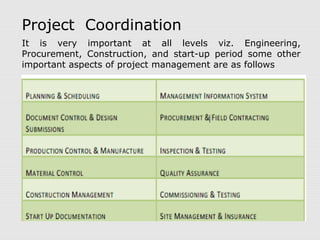
Project Coordination 
It is very important at all levels viz. Engineering, 
Procurement, Construction, and start-up period some other 
important aspects of project management are as follows
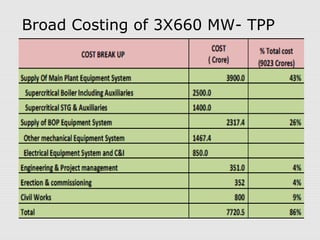
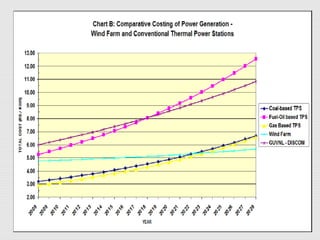
Broad Costing of 3X660 MW- TPP
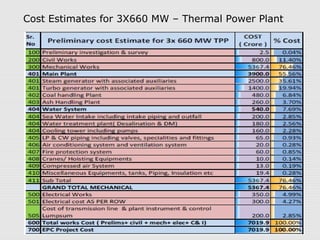
Cost Estimates for 3X660 MW – Thermal Power Plant
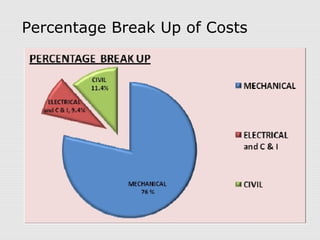
Percentage Break Up of Costs
TCE/EIL/PDIL/MECON as Consultants 
Competent services in diverse roles 
 The services provided by TCE for thermal power projects are wide 
ranging. 
 TCE meets the diverse requirements of different participating 
agencies- the Utility, the Independent Power Producer (IPP), the 
EPC contractor 
 and the lending institutions. 
 TCE's comprehensive range of services for power projects include : 
 Site selection Techno-economic feasibility studies Financial 
 analysis Power system studies Site surveys Site specific 
 studies Environmental impact assessment IPP bid solicitation and 
 selection EPC bid solicitation and selection Pre-tender support to 
 EPC bidders Owner’s Engineer services to utilities and IPPs O & M 
 contractor bid solicitation and selection Concept-to-commissioning 
 A-E services to utilities and IPPs Post-award detailed engineering 
 services to EPC contractors Technical due diligence
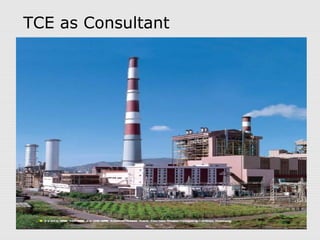
TCE as Consultant
Thermal Power Station (TPS) 
A Thermal Power Station is a power plant in which the 
prime mover is steam driven. Water is heated, turns 
into steam and spins a steam turbine which drives an 
electrical generator. After it passes through the turbine, 
the steam is condensed in a condenser and recycled to 
where it was heated; this is known as a Rankine cycle. 
The greatest variation in the design of thermal power 
stations is due to the different fuel sources. Some 
prefer to use the term energy center because such 
facilities convert forms of heat energy into electrical 
energy. Some thermal power plants also deliver heat 
energy for industrial purposes, for district heating, or 
for desalination of water as well as delivering electrical 
power. A large proportion of CO2 is produced by the 
worlds fossil fired thermal power plants; efforts to 
reduce these outputs are various and widespread. 
Source : Wikipedia
L&T Power Project Development 
L&T develops grid-linked independent Power Plant and Cogeneration and 
Captive Power Plants on Build-Own Operate (BOO), Build-Own-Operate- 
Transfer (BOOT), Build-Lease-Operate (BLO). build-Lease-Operate (BLO). 
Build -Own-Operate-Maintain (BOOM) basis. 
Activities: 
 Identification of new opportunities for grid-connected & captive power 
plants. 
 Evaluation of risks and strategies for mitigation of these risks. 
 Ensuring various clearances. 
 Evaluation of various financing structures. 
 Arranging the requisite financial package for investment. 
 Establishing partnering relationship with existing power plants to set up 
joint ventures with equity participation - with or without reconstruction. 
Projects Executed: 
 116 naphtha -fire combined cycle cogeneration power plant, on BOO basis, 
to generate 116 MW of power and 480 TPH of process steam, for Haldia 
Petrochemicals Limited, Haldia. 
 90 MW naphtha/natural-gas-fired cogeneration power plant, on BLO basis, 
to deliver 90 MW of power and 240 TPH of process steam, for Indian 
Petrochemicals Corporation Limited, Gandhar.
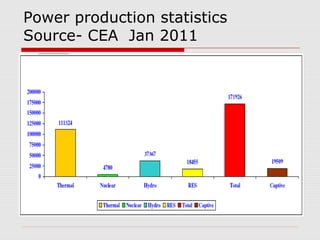
Power production statistics 
Source- CEA Jan 2011
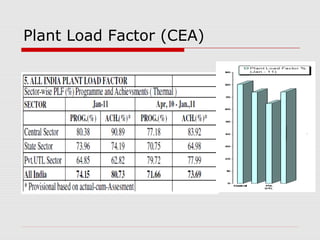
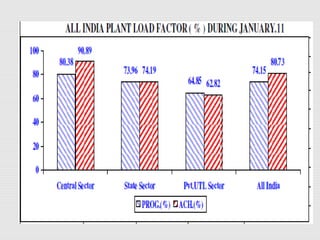
Plant Load Factor (CEA)
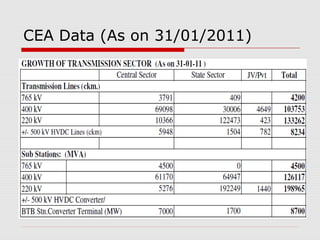
CEA Data (As on 31/01/2011)
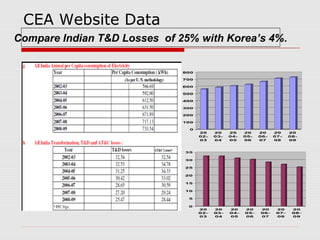
CEA Website Data 
800 
700 
600 
500 
400 
300 
200 
100 
0 
20 
02- 
03 
20 
03- 
04 
20 
04- 
05 
20 
05- 
06 
20 
06- 
07 
20 
07- 
08 
20 
08- 
09 
35 
30 
25 
20 
15 
10 
5 
0 
20 
02- 
03 
20 
03- 
04 
20 
04- 
05 
20 
05- 
06 
20 
06- 
07 
20 
07- 
08 
20 
08- 
09 
Compare Indian T&D Losses of 25% with Korea’s 4%.
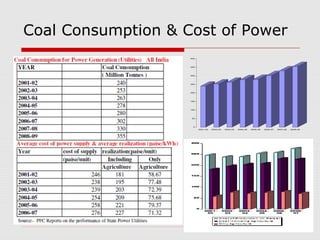
Coal Consumption & Cost of Power 
400 
350 
300 
250 
200 
150 
100 
50 
0 
2001-02 2002-03 2003-04 2004-05 2005-06 2006-07 2007-08 2008-09
Special CAD/CAM Tools 
for Power Sector 
Geo-facilities Management System 
for Electric Industry 
 Based on Intergraph’s G/Technology™, G/Electric is a 
multidimensional solution that provides powerful tools to 
support the facilities/asset management needs of electric 
transmission and distribution companies. 
 It was created specifically for the electric industry and 
incorporates input from clients and industry partners, 
combined with Intergraph’s extensive project 
implementation experience. 
 G/Electric fits into the comprehensive information 
technology (IT) environment we call Geospatial Resource 
Management (GRM).
Special CAD/CAM Tools 
for Infrastructure 
Water Infrastructure Management 
 Water infrastructure management (WIM) is an 
Intergraph software solution that supports all the details 
of a municipal or private water and wastewater 
distribution system. 
 With it, you can plan, conduct engineering analysis, 
design work orders, and manage mapping, asset, and 
maintenance records. The fundamental feature of WIM is 
a geospatial network asset database of the distribution 
assets of the system, such as water mains and sewers, 
storage reservoirs, pumps, pipelines, valves, and 
meters.
Save 5-10 % Using E-procurement ! 
 E-procurement (electronic procurement, sometimes also 
known as supplier exchange) is the business-to-business or 
business-to-consumer or Business-to-government purchase 
and sale of supplies, Work and services through the Internet as 
well as other information and networking systems, such as 
Electronic Data Interchange and Enterprise Resource Planning. 
 E-procurement Web sites allow qualified and registered users 
to look for buyers or sellers of goods and services. Depending 
on the approach, buyers or sellers may specify costs or invite 
bids. Transactions can be initiated and completed. Ongoing 
purchases may qualify customers for volume discounts or 
special offers. E-procurement software may make it possible to 
automate some buying and selling. Companies participating 
expect to be able to control parts inventories more effectively, 
reduce purchasing agent overhead, and improve Supply Chain 
Management.
HR-Issues, Challenges, Solutions 
 To visualize skilled/unskilled manpower planning after 
benchmarking with similar/better executed projects 
 To prepare organization chart 
 Identify the key project staff with their job descriptions and 
experience requirements 
 To organize Recruitment and selection of talented staff with 
proven track record. 
 To prepare detailed HR policies/promotion guidelines 
 To comply with Ministry of Labour guidelines 
 To create Performance Appraisal system on Objective criteria 
 To create comprehensive database of current staff 
 To use SAP as tool for organization wide working 
 To plan for Safety/quality monitoring/Disaster Management/Energy 
Audit 
 To improve productivity, efficiency of the system as a whole thru 
Incentives/rewards/punishment of delibrate violation of HR policies 
 To keep manpower costs competitive.
Gantt Chart 
 A Gantt chart is a type of bar chart that 
illustrates a project schedule. Gantt charts 
illustrate the start and finish dates of the 
terminal elements and summary elements of a 
project. Terminal elements and summary 
elements comprise the work breakdown 
structure of the project. Some Gantt charts 
also show the dependency (i.e., precedence 
network) relationships between activities
PERT and CPM 
PERT= Project Evaluation Review Technique 
CPM = Critical Path Method 
 A PERT chart is a project management tool used to 
schedule, organize, and coordinate tasks within a 
project. PERT is a methodology developed by the U.S. 
Navy in the 1950s to manage the Polaris submarine 
missile program. 
 A similar methodology, the CPM was developed for 
project management in the private sector at about the 
same time.
Why PERT/CPM? 
 Prediction of deliverables 
 Planning resource requirements 
 Controlling resource allocation 
 Internal program review 
 External program review 
 Performance evaluation 
 Uniform wide acceptance
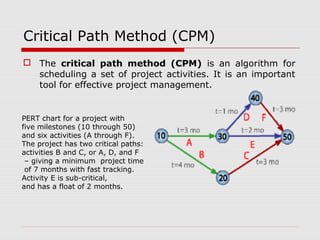
Critical Path Method (CPM) 
 The critical path method (CPM) is an algorithm for 
scheduling a set of project activities. It is an important 
tool for effective project management. 
PERT chart for a project with 
five milestones (10 through 50) 
and six activities (A through F). 
The project has two critical paths: 
activities B and C, or A, D, and F 
– giving a minimum project time 
of 7 months with fast tracking. 
Activity E is sub-critical, 
and has a float of 2 months.
Determine Critical Path 
 All Tasks with zero Total Float are Critical. 
 Any delay in these Tasks will delay Project Completion. 
 Darken these Tasks to finish CPM Diagram. 
 If a task seems too complex or involved to easily 
determine primary properties . . . 
Break the task up into simpler tasks . . . 
Or create a CPM sub-project.
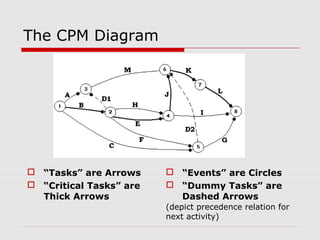
The CPM Diagram 
 “Tasks” are Arrows 
 “Critical Tasks” are 
Thick Arrows 
 “Events” are Circles 
 “Dummy Tasks” are 
Dashed Arrows 
(depict precedence relation for 
next activity)
Innovation 
 Innovation is creativity plus productivity 
 Business Innovation is Creativity plus 
Commercialization 
 Innovation is Idea selection, Development 
and commercialization 
 Requires Competencies and knowledge of a 
team 
 Different competencies, 
structure,processes, 
 resources and time scales are required
Innovative Organizations(Traits) 
 Drive to stay ahead 
 Acceptance of risks. 
 Growth Orientation 
 Commitment to Technology 
 Vigilance 
 Diverse range of skills 
 Adaptability 
 Enthusiasm for knowledge 
 Receptivity
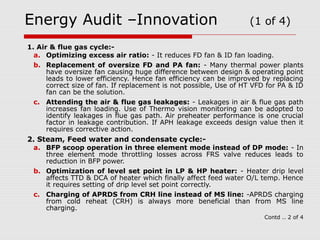
Energy Audit -Innovation 
(Reliance Energy Limited) 
 Thermal power consist of various sub cycles / systems 
like air & flue gas cycle, main steam, feed water & 
condensate cycle , fuel & ash cycle, Equipment cooling 
water (ECW), auxiliary cooling water (ACW) system, 
Compressed air system, Electrical auxiliary power & 
lighting system, HVAC system etc.. There is 
tremendous scope of energy saving potential in each 
system/cycle which is given below. 
 Thermal power plant is designated sector as per EC 
Act 2001. Most thermal power plant uses 30-40% of 
energy value of primary fuels. 
 The remaining 60-70% is lost during generation, is in 
the form of heat. 
 Transmission and distribution also add to major loss.
Energy Audit –Innovation (1 of 4) 
1. Air & flue gas cycle:- 
a. Optimizing excess air ratio: - It reduces FD fan & ID fan loading. 
b. Replacement of oversize FD and PA fan: - Many thermal power plants 
have oversize fan causing huge difference between design & operating point 
leads to lower efficiency. Hence fan efficiency can be improved by replacing 
correct size of fan. If replacement is not possible, Use of HT VFD for PA & ID 
fan can be the solution. 
c. Attending the air & flue gas leakages: - Leakages in air & flue gas path 
increases fan loading. Use of Thermo vision monitoring can be adopted to 
identify leakages in flue gas path. Air preheater performance is one crucial 
factor in leakage contribution. If APH leakage exceeds design value then it 
requires corrective action. 
2. Steam, Feed water and condensate cycle:- 
a. BFP scoop operation in three element mode instead of DP mode: - In 
three element mode throttling losses across FRS valve reduces leads to 
reduction in BFP power. 
b. Optimization of level set point in LP & HP heater: - Heater drip level 
affects TTD & DCA of heater which finally affect feed water O/L temp. Hence 
it requires setting of drip level set point correctly. 
c. Charging of APRDS from CRH line instead of MS line: -APRDS charging 
from cold reheat (CRH) is always more beneficial than from MS line 
charging. 
Contd .. 2 of 4
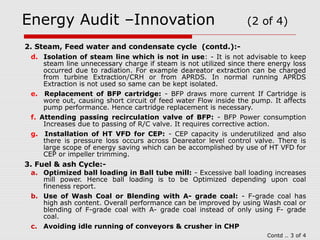
Energy Audit –Innovation (2 of 4) 
2. Steam, Feed water and condensate cycle (contd.):- 
d. Isolation of steam line which is not in use: - It is not advisable to keep 
steam line unnecessary charge if steam is not utilized since there energy loss 
occurred due to radiation. For example deareator extraction can be charged 
from turbine Extraction/CRH or from APRDS. In normal running APRDS 
Extraction is not used so same can be kept isolated. 
e. Replacement of BFP cartridge: - BFP draws more current If Cartridge is 
wore out, causing short circuit of feed water Flow inside the pump. It affects 
pump performance. Hence cartridge replacement is necessary. 
f. Attending passing recirculation valve of BFP: - BFP Power consumption 
Increases due to passing of R/C valve. It requires corrective action. 
g. Installation of HT VFD for CEP: - CEP capacity is underutilized and also 
there is pressure loss occurs across Deareator level control valve. There is 
large scope of energy saving which can be accomplished by use of HT VFD for 
CEP or impeller trimming. 
3. Fuel & ash Cycle:- 
a. Optimized ball loading in Ball tube mill: - Excessive ball loading increases 
mill power. Hence ball loading is to be Optimized depending upon coal 
fineness report. 
b. Use of Wash Coal or Blending with A- grade coal: - F-grade coal has 
high ash content. Overall performance can be improved by using Wash coal or 
blending of F-grade coal with A- grade coal instead of only using F- grade 
coal. 
c. Avoiding idle running of conveyors & crusher in CHP 
Contd .. 3 of 4
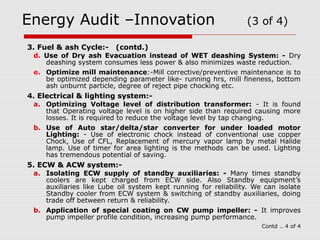
Energy Audit –Innovation (3 of 4) 
3. Fuel & ash Cycle:- (contd.) 
d. Use of Dry ash Evacuation instead of WET deashing System: - Dry 
deashing system consumes less power & also minimizes waste reduction. 
e. Optimize mill maintenance:-Mill corrective/preventive maintenance is to 
be optimized depending parameter like- running hrs, mill fineness, bottom 
ash unburnt particle, degree of reject pipe chocking etc. 
4. Electrical & lighting system:- 
a. Optimizing Voltage level of distribution transformer: - It is found 
that Operating voltage level is on higher side than required causing more 
losses. It is required to reduce the voltage level by tap changing. 
b. Use of Auto star/delta/star converter for under loaded motor 
Lighting: - Use of electronic chock instead of conventional use copper 
Chock, Use of CFL, Replacement of mercury vapor lamp by metal Halide 
lamp. Use of timer for area lighting is the methods can be used. Lighting 
has tremendous potential of saving. 
5. ECW & ACW system:- 
a. Isolating ECW supply of standby auxiliaries: - Many times standby 
coolers are kept charged from ECW side. Also Standby equipment’s 
auxiliaries like Lube oil system kept running for reliability. We can isolate 
Standby cooler from ECW system & switching of standby auxiliaries, doing 
trade off between return & reliability. 
b. Application of special coating on CW pump impeller: - It improves 
pump impeller profile condition, increasing pump performance. 
Contd .. 4 of 4
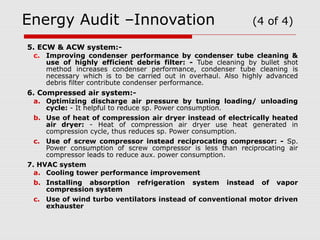
Energy Audit –Innovation (4 of 4) 
5. ECW & ACW system:- 
c. Improving condenser performance by condenser tube cleaning & 
use of highly efficient debris filter: - Tube cleaning by bullet shot 
method increases condenser performance, condenser tube cleaning is 
necessary which is to be carried out in overhaul. Also highly advanced 
debris filter contribute condenser performance. 
6. Compressed air system:- 
a. Optimizing discharge air pressure by tuning loading/ unloading 
cycle: - It helpful to reduce sp. Power consumption. 
b. Use of heat of compression air dryer instead of electrically heated 
air dryer: - Heat of compression air dryer use heat generated in 
compression cycle, thus reduces sp. Power consumption. 
c. Use of screw compressor instead reciprocating compressor: - Sp. 
Power consumption of screw compressor is less than reciprocating air 
compressor leads to reduce aux. power consumption. 
7. HVAC system 
a. Cooling tower performance improvement 
b. Installing absorption refrigeration system instead of vapor 
compression system 
c. Use of wind turbo ventilators instead of conventional motor driven 
exhauster
CONTROL & DIAGNOSTIC FEATURES 
OF 500 MW TURBO GENERATORS (BHEL) 
With the increase in the power rating of generating sets, 
the issue of availability has become very important. The 
outage of even one large capacity machine from the grid 
causes a significant shortfall in power generation. High 
availability and reliability are therefore fundamental 
requirements of power generating units. To achieve this, 
the health of machines needs to be monitored 
continuously. Over and above this, we also require 
techniques for forecasting imminent problems. 
Diagnostic tools are therefore gaining increasing 
importance by the day. This paper gives details of the 
control and diagnostic tools used in 500 MW generators 
manufactured by BHEL. 
(Refer BHEL Journal)
Government Clearances Required (1/4) 
 Advance action / clearance for feasibility report 
 Investment approval 
 Funds 
 Domestic funds / loans / bonds / debentures / equity 
 Raising money in the foreign market 
 Foreign direct investment 
 Foreign collaboration 
 Engaging foreign consultants 
 Global tenders 
 Foreign assistance
Government Clearances Required (2/4) 
 Location 
 Pollution Control 
 Environment 
 Forest 
 Telecommunication 
 Port angle 
 Mining lease 
 Mines safety 
 Commissioning boiler 
 Steam and condensate 
piping 
 Fire protection system 
 Labour laws 
 Inspection certification 
of electrical system 
 Statutory clearance for 
power projects 
 Techno-economic clearance 
for power projects/captive 
power plants 
 Chimney/tall buildings near 
airport 
 Defense angle / proximity to 
defense installations 
 Railway siding construction / 
operation 
 Safety against explosion 
 Fire protection system 
 Equipment lay-out under 
Factory Act / approval before 
commissioning
Government Clearances Required (3/4) 
 Tenders specifications 
 Tender Approval 
 Shipment arrangements 
 Letter of Intent 
 Industrial license 
 Coal linkage 
 Oil / Gas linkage 
 Power linkage 
 Water 
 Appointing foreign technicians / engineers
Government Clearances Required (4/4) 
 Building plans/no objection 
 Land acquisition 
 Right of way clearance 
 Formation of company 
 Appointment of Managing Director/ Director(s) 
 Sales tax/VAT/GST (when applicable) registration 
 Discounts in insurance rates 
 Registration under Excise Act 
 Approval under Service /Sales Act. 
 Registration under Shop & Establishment Act 
 Movement of over-dimensional equipment on roads 
 Movement of over-dimensional equipment on barges etc. 
 Income tax registration / income tax clearance regarding 
foreign technicians
INDIAN STANDARDS ON 
EARTHQUAKE ENGINEERING 
 Bureau of Indian standards, the National Standard Body of 
India, is a Statutory Organization under the Bureau of 
Indian Standards Act 1986. One of the activity is 
formulation of Indian Standards on different subjects of 
Engineering through various Division Councils. 
 The Civil Engineering Division Council is responsible for 
standardization in the field of Civil Engineering including 
Structural Engineering, Building materials and 
components, Planning Design, Construction and 
Maintenance of Civil Engineering Structures, Construction 
Practices, Safety in Building etc. 
 These standards are evolved based on consensus principle 
through a net work of technical committee comprising 
representatives from Research and Development 
Organizations, Consumers, Industry, Testing Labs and 
Govt. Organizations etc.
Environmental Impact Assessment 
 An environmental impact assessment is an 
assessment of the possible positive or negative impact 
that a proposed project may have on the 
environment, together consisting of the natural, social 
and economic aspects. 
 The purpose of the assessment is to ensure that 
decision makers consider the ensuing environmental 
impacts while deciding whether to proceed with a 
project. The International Association for Impact 
Assessment (IAIA) defines an environmental impact 
assessment as "the process of identifying, predicting, 
evaluating and mitigating the biophysical, social, and 
other relevant effects of development proposals prior 
to major decisions being taken and commitments 
made."
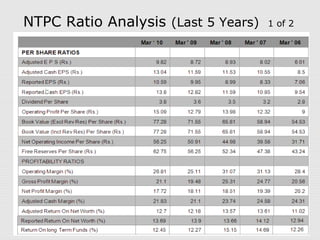
NTPC Ratio Analysis (Last 5 Years) 1 of 2 
Mar ‘ 10 Mar ' 09 Mar ' 08 Mar ' 07 Mar ' 06 
PER SHARE RATIOS 
Adjusted E P S (Rs.) 9.82 8.72 8.93 8.02 6.01 
Adjusted Cash EPS (Rs.) 13.04 11.59 11.53 10.55 8.5 
Reported EPS (Rs.) 10.59 9.95 8.99 8.33 7.06 
Reported Cash EPS (Rs.) 13.8 12.82 11.59 10.85 9.54 
Dividend Per Share 3.8 3.6 3.5 3.2 2.8 
Operating Profit Per Share (Rs.) 15.09 12.79 13.98 12.32 9 
Book Value (Excl Rev Res) Per Share (Rs.) 77.28 71.55 65.81 58.94 54.53 
Book Value (Incl Rev Res) Per Share (Rs.) 77.28 71.55 65.81 58.94 54.53 
Net Operating Income Per Share (Rs.) 56.25 50.91 44.98 39.58 31.71 
Free Reserves Per Share (Rs.) 62.75 56.25 52.34 47.38 43.24 
PROFITABILITY RATIOS 
Operating Margin (%) 26.81 25.11 31.07 31.13 28.4 
Gross Profit Margin (%) 21.1 19.48 25.31 24.77 20.56 
Net Profit Margin (%) 17.72 18.11 18.51 19.39 20.2 
Adjusted Cash Margin (%) 21.83 21.1 23.74 24.58 24.31 
Adjusted Return On Net Worth (%) 12.7 12.18 13.57 13.61 11.02 
Reported Return On Net Worth (%) 13.69 13.9 13.66 14.12 12.94 
Return On long Term Funds (%) 12.45 12.27 15.15 14.69 12.26
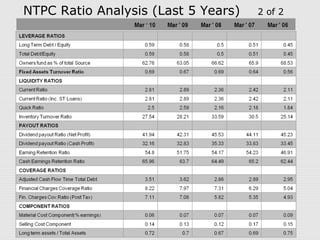
NTPC Ratio Analysis (Last 5 Years) 2 of 2
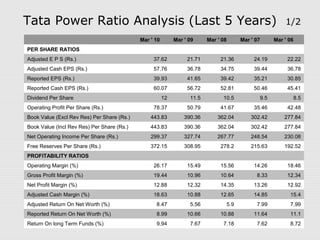
Tata Power Ratio Analysis (Last 5 Years) 1/2 
Mar ' 10 Mar ' 09 Mar ' 08 Mar ' 07 Mar ' 06 
PER SHARE RATIOS 
Adjusted E P S (Rs.) 37.62 21.71 21.36 24.19 22.22 
Adjusted Cash EPS (Rs.) 57.76 36.78 34.75 39.44 36.78 
Reported EPS (Rs.) 39.93 41.65 39.42 35.21 30.85 
Reported Cash EPS (Rs.) 60.07 56.72 52.81 50.46 45.41 
Dividend Per Share 12 11.5 10.5 9.5 8.5 
Operating Profit Per Share (Rs.) 78.37 50.79 41.67 35.46 42.48 
Book Value (Excl Rev Res) Per Share (Rs.) 443.83 390.36 362.04 302.42 277.84 
Book Value (Incl Rev Res) Per Share (Rs.) 443.83 390.36 362.04 302.42 277.84 
Net Operating Income Per Share (Rs.) 299.37 327.74 267.77 248.54 230.08 
Free Reserves Per Share (Rs.) 372.15 308.95 278.2 215.63 192.52 
PROFITABILITY RATIOS 
Operating Margin (%) 26.17 15.49 15.56 14.26 18.46 
Gross Profit Margin (%) 19.44 10.96 10.64 8.33 12.34 
Net Profit Margin (%) 12.88 12.32 14.35 13.26 12.92 
Adjusted Cash Margin (%) 18.63 10.88 12.65 14.85 15.4 
Adjusted Return On Net Worth (%) 8.47 5.56 5.9 7.99 7.99 
Reported Return On Net Worth (%) 8.99 10.66 10.88 11.64 11.1 
Return On long Term Funds (%) 9.94 7.67 7.18 7.62 8.72
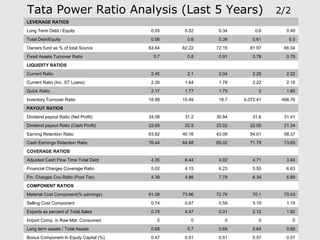
Tata Power Ratio Analysis (Last 5 Years) 2/2 
LEVERAGE RATIOS 
Long Term Debt / Equity 0.55 0.52 0.34 0.6 0.49 
Total Debt/Equity 0.56 0.6 0.38 0.61 0.5 
Owners fund as % of total Source 63.84 62.22 72.15 61.97 66.34 
Fixed Assets Turnover Ratio 0.7 0.8 0.91 0.78 0.76 
LIQUIDITY RATIOS 
Current Ratio 2.45 2.1 2.04 2.25 2.22 
Current Ratio (Inc. ST Loans) 2.39 1.64 1.78 2.22 2.18 
Quick Ratio 2.17 1.77 1.75 2 1.85 
Inventory Turnover Ratio 18.98 15.49 18.7 6,072.41 498.76 
PAYOUT RATIOS 
Dividend payout Ratio (Net Profit) 34.08 31.2 30.84 31.6 31.41 
Dividend payout Ratio (Cash Profit) 22.65 22.9 23.02 22.05 21.34 
Earning Retention Ratio 63.82 40.16 43.09 54.01 56.37 
Cash Earnings Retention Ratio 76.44 64.68 65.02 71.79 73.65 
COVERAGE RATIOS 
Adjusted Cash Flow Time Total Debt 4.35 6.44 4.02 4.71 3.84 
Financial Charges Coverage Ratio 5.02 4.15 6.23 5.55 6.63 
Fin. Charges Cov.Ratio (Post Tax) 4.39 4.86 7.78 6.34 6.89 
COMPONENT RATIOS 
Material Cost Component(% earnings) 61.28 73.86 72.76 70.1 70.43 
Selling Cost Component 0.74 0.67 0.59 5.19 1.19 
Exports as percent of Total Sales 0.78 4.47 0.31 2.12 1.82 
Import Comp. in Raw Mat. Consumed 0 0 0 0 0 
Long term assets / Total Assets 0.68 0.7 0.69 0.64 0.68 
Bonus Component In Equity Capital (%) 0.47 0.51 0.51 0.57 0.57
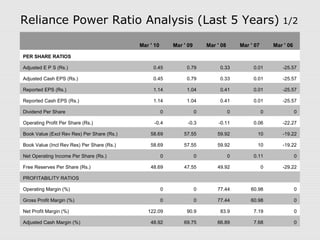
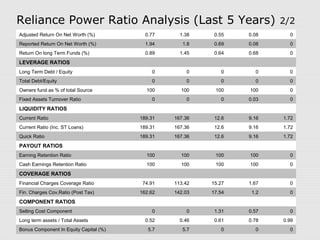
Reliance Power Ratio Analysis (Last 5 Years) 1/2 
Mar ' 10 Mar ' 09 Mar ' 08 Mar ' 07 Mar ' 06 
PER SHARE RATIOS 
Adjusted E P S (Rs.) 0.45 0.79 0.33 0.01 -25.57 
Adjusted Cash EPS (Rs.) 0.45 0.79 0.33 0.01 -25.57 
Reported EPS (Rs.) 1.14 1.04 0.41 0.01 -25.57 
Reported Cash EPS (Rs.) 1.14 1.04 0.41 0.01 -25.57 
Dividend Per Share 0 0 0 0 0 
Operating Profit Per Share (Rs.) -0.4 -0.3 -0.11 0.06 -22.27 
Book Value (Excl Rev Res) Per Share (Rs.) 58.69 57.55 59.92 10 -19.22 
Book Value (Incl Rev Res) Per Share (Rs.) 58.69 57.55 59.92 10 -19.22 
Net Operating Income Per Share (Rs.) 0 0 0 0.11 0 
Free Reserves Per Share (Rs.) 48.69 47.55 49.92 0 -29.22 
PROFITABILITY RATIOS 
Operating Margin (%) 0 0 77.44 60.98 0 
Gross Profit Margin (%) 0 0 77.44 60.98 0 
Net Profit Margin (%) 122.09 90.9 83.9 7.19 0 
Adjusted Cash Margin (%) 48.92 69.75 66.89 7.68 0
Reliance Power Ratio Analysis (Last 5 Years) 2/2 
Adjusted Return On Net Worth (%) 0.77 1.38 0.55 0.08 0 
Reported Return On Net Worth (%) 1.94 1.8 0.69 0.08 0 
Return On long Term Funds (%) 0.89 1.45 0.64 0.68 0 
LEVERAGE RATIOS 
Long Term Debt / Equity 0 0 0 0 0 
Total Debt/Equity 0 0 0 0 0 
Owners fund as % of total Source 100 100 100 100 0 
Fixed Assets Turnover Ratio 0 0 0 0.03 0 
LIQUIDITY RATIOS 
Current Ratio 189.31 167.36 12.6 9.16 1.72 
Current Ratio (Inc. ST Loans) 189.31 167.36 12.6 9.16 1.72 
Quick Ratio 189.31 167.36 12.6 9.16 1.72 
PAYOUT RATIOS 
Earning Retention Ratio 100 100 100 100 0 
Cash Earnings Retention Ratio 100 100 100 100 0 
COVERAGE RATIOS 
Financial Charges Coverage Ratio 74.91 113.42 15.27 1.67 0 
Fin. Charges Cov.Ratio (Post Tax) 162.62 142.03 17.54 1.2 0 
COMPONENT RATIOS 
Selling Cost Component 0 0 1.31 0.57 0 
Long term assets / Total Assets 0.52 0.46 0.61 0.78 0.99 
Bonus Component In Equity Capital (%) 5.7 5.7 0 0 0
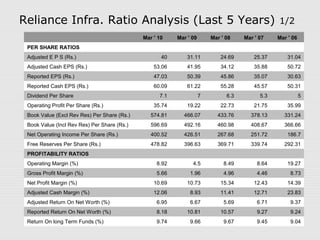
Reliance Infra. Ratio Analysis (Last 5 Years) 1/2 
Mar ' 10 Mar ' 09 Mar ' 08 Mar ' 07 Mar ' 06 
PER SHARE RATIOS 
Adjusted E P S (Rs.) 40 31.11 24.69 25.37 31.04 
Adjusted Cash EPS (Rs.) 53.06 41.95 34.12 35.88 50.72 
Reported EPS (Rs.) 47.03 50.39 45.86 35.07 30.63 
Reported Cash EPS (Rs.) 60.09 61.22 55.28 45.57 50.31 
Dividend Per Share 7.1 7 6.3 5.3 5 
Operating Profit Per Share (Rs.) 35.74 19.22 22.73 21.75 35.99 
Book Value (Excl Rev Res) Per Share (Rs.) 574.81 466.07 433.76 378.13 331.24 
Book Value (Incl Rev Res) Per Share (Rs.) 596.69 492.16 460.98 408.67 366.66 
Net Operating Income Per Share (Rs.) 400.52 426.51 267.68 251.72 186.7 
Free Reserves Per Share (Rs.) 478.82 396.63 369.71 339.74 292.31 
PROFITABILITY RATIOS 
Operating Margin (%) 8.92 4.5 8.49 8.64 19.27 
Gross Profit Margin (%) 5.66 1.96 4.96 4.46 8.73 
Net Profit Margin (%) 10.69 10.73 15.34 12.43 14.39 
Adjusted Cash Margin (%) 12.06 8.93 11.41 12.71 23.83 
Adjusted Return On Net Worth (%) 6.95 6.67 5.69 6.71 9.37 
Reported Return On Net Worth (%) 8.18 10.81 10.57 9.27 9.24 
Return On long Term Funds (%) 9.74 9.66 9.67 9.45 9.04
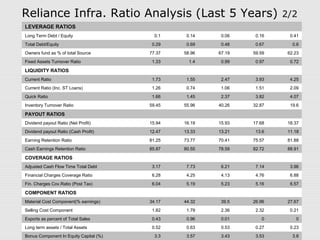
Reliance Infra. Ratio Analysis (Last 5 Years) 2/2 
LEVERAGE RATIOS 
Long Term Debt / Equity 0.1 0.14 0.06 0.16 0.41 
Total Debt/Equity 0.29 0.69 0.48 0.67 0.6 
Owners fund as % of total Source 77.37 58.96 67.19 59.59 62.23 
Fixed Assets Turnover Ratio 1.33 1.4 0.99 0.97 0.72 
LIQUIDITY RATIOS 
Current Ratio 1.73 1.55 2.47 3.93 4.25 
Current Ratio (Inc. ST Loans) 1.26 0.74 1.06 1.51 2.09 
Quick Ratio 1.66 1.45 2.37 3.82 4.07 
Inventory Turnover Ratio 59.45 55.96 40.26 32.87 19.6 
PAYOUT RATIOS 
Dividend payout Ratio (Net Profit) 15.94 16.19 15.93 17.68 18.37 
Dividend payout Ratio (Cash Profit) 12.47 13.33 13.21 13.6 11.18 
Earning Retention Ratio 81.25 73.77 70.41 75.57 81.88 
Cash Earnings Retention Ratio 85.87 80.55 78.59 82.72 88.91 
COVERAGE RATIOS 
Adjusted Cash Flow Time Total Debt 3.17 7.73 6.21 7.14 3.96 
Financial Charges Coverage Ratio 6.28 4.25 4.13 4.76 6.88 
Fin. Charges Cov.Ratio (Post Tax) 6.04 5.19 5.23 5.16 6.57 
COMPONENT RATIOS 
Material Cost Component(% earnings) 34.17 44.32 39.5 26.96 27.67 
Selling Cost Component 1.82 1.79 2.36 2.32 0.21 
Exports as percent of Total Sales 0.43 0.96 0.01 0 0 
Long term assets / Total Assets 0.52 0.63 0.53 0.27 0.23 
Bonus Component In Equity Capital (%) 3.3 3.57 3.43 3.53 3.8
References 
 Planning Commission, Govt. of 
India 
 Ministry of Statistics and 
Programme Implementation 
 Ministry of Power ,Govt. of India 
 NCAER , Govt. of India 
 Central Electricity Authority, Govt. 
of India 
 Delhi School of Economics, Delhi 
University 
 National Thermal Power 
Corporation (PSU) 
 Mckensie Report 
 Tata Consulting Engineers/Tata 
Power 
 EIL/PDIL/Mecon/MN Dastur 
 Reliance Industries Ltd 
 India Habitat Center 
 Tata Chemicals Ltd 
 Delhi Metro Rail Corporation 
Total Project Management P K Joy, 
McMillan publishers 
Project Management by Rory Burke, 
Wiley 
Project Management by Jack R 
Meredith/Samuel J Mantel ,Wiley 
Energy Audit: Reliance Energy Ltd 
BHEL Innovations 
Ministry of Environment & Forest, 
Government of India 
Innovation Management Dr R Lalitha, 
Himalaya Publishing 
Larsen and Toubro (L&T) 
Ministry of Labour ,Govt. of India 
Dion Global Solutions Limited, 
Insight (Research Data Base) 
TERI, New Delhi 
Wikipedia 
Hindustan Times / Indian Express 
Vijayant Consultants, Ahemadabad
Acknowledgement 
 The Author / Presenter thankfully acknowledges the 
contribution of the following IAMR Staff members in 
the creation of this Power Point Presentation on 
‘Innovative Project Management Practices for 
working professionals’. 
1. Mr. Rajendra Yadav 
2. Mr. Avadesh Mishra 
3. Mr. Mayur Sharma 
 Mr. Rakesh Bhatia, with his rich experience of 25 
years in execution & marketing of EPC Projects, has 
been a great help in validating and correlating the 
inputs & streamlining the flow.
Thank you all the participants for patient 
listening, your valuable contribution by making 
the session interactive and value added . 
It was a great experience sharing platform to 
cut time & cost overruns in major projects in the 
power, infrastructure, construction sectors.

Innovative project management practices for large power sector projects.

  • 1.
    INNOVATIVE PROJECT MANAGEMENTPRACTICES FOR WORKING PROFESSIONALS by Prof. Sanjeev Bahadur Program Director Institute of Advanced Management and Research Approved by AICTE, Ministry of HRD, Govt. of India. www.iamrindia.com
  • 2.
    Scope of “ProjectManagement” The topics proposed to be covered in this Project Management Program are: Introduction / Overview/Importance Project Management Concepts & Standards Project Formulation and Appraisal / Approval Processes Environment Impact Assessment (EIA) Human Resources: Issues, Challenges and Solutions Strategic Project Financial Management Tips and Techniques for Cost Estimation in Project Management Analyzing Risks in Project Management EPC: Engineering, Procurement, Construction Procurement Management and e-procurement Quality Assurance and Innovation Microsoft Project Demonstration (CPM/PERT/GANTT Charts) Productivity, Efficiency and Time Management Live Case Study and discussions References
  • 3.
    Project Delays CostRs 1,24,000 Cr Consequences of Time Delays  Total projects delays cost Rs 1,24,000 Crores., informs Sh M.S Gill MoS, Ministry of Statistics & Program Implementation.  Out of 567 projects costing more than Rs 150 crores each, 375 projects reported delays from 1 month to 72 months.  Causes are Land acquisition, getting Environment clearances, protest by Local people, incomplete Land Records, lack of coordination between different agencies.  Cost of delay is one third of India Plan Budget 2011-12  Sectors reviewed are Coal, Steel, Power, Petroleum, Railways, Road transport/Highways, Telecommunications  Original cost of these projects was Rs 5,92,535 crores. (Source :Hindustan Times, 04 April 2011)
  • 4.
    Objectives of ProjectManagement  Definition, Meaning and examples of Projects  What does Project Management involve?  What are the qualities of a Project Manager ?  Reasons for Time and Cost overruns (Govt. of India agencies studies)  Solutions for cutting Time/Cost Overruns  Role of Consultants/Engg. Contractors in Tendering  Brief overview of the Program (incl. PERT/CPM)  Research on the Power /Infrastructure Sector  Focus on NTPC, Tata Power, Reliance Infrastructure (Ratio Analysis)  References
  • 5.
    Project Definition (ANSI/PMI99-001-2004)  Project is a temporary endeavour undertaken to create a unique product or service or result.  ISO 10006 defines project as unique process, comprising of a set of controlled and coordinated activities with start and finish dates, undertaken to achieve an objective conforming to specific project requirements including constraints of resources, cost and time.  Project refers to a high value, time bound, mission of creating a product/facility with predetermined performance objectives in terms of quality specifications, completion time, resource constraints and budgeted cost.
  • 6.
    Project Management ProjectManagement is the discipline of planning, organizing, securing and managing resources to bring about successful completion of specific project goals and objectives. A project is a short term undertaking/endeavor, having a defined beginning and end (usually constrained by date, or by funding or deliverables), undertaken to meet unique goals and objectives usually to bring about beneficial change or value addition. The temporary nature of projects stands in contrast to regular operations, which are repetitive, permanent or semi-permanent functional work to produce products or services. In practice, the management of these two systems is generally found to be different, and requires the development of unique technical skills and the adoption of separate management practices.
  • 7.
    Project Management (Meaning)  To understand project management, one must understand what a project really is.  Different types of Projects are cement projects, power projects, refinery projects, fertilizer projects etc.  In each case, the project is for setting up a manufacturing plant, but as soon as the plant is operational, the project is deemed to have been completed.  A project, is not a physical objective, nor is it the end-result.
  • 8.
    Project Performance Objectives  SCOPE defines the deliverables  QUALITY of Product stated in terms of design, drawings and specifications  RESOURCES includes manpower, materials and machinery required to perform the work.  COMPLETION TIME is the speed with which project is executed.  COST is the budgeted expenditure.
  • 9.
    Examples of ComplexProjects involving Technology  Reliance Industries Ltd., Jamnagar  Tata Chemicals Ltd., Babrala  NTPC Super Thermal Power Station  Tata Motors Ltd., Pune  Delhi Metro Rail Corporation  India Habitat Centre  NTPC Solar Power Project.
  • 10.
    Reliance Industries Ltd.Refinery, Jamnagar, Gujarat
  • 11.
    TATA Chemicals Ltd.– Fertilizer Plant, Babrala,U.P
  • 12.
    NTPC Super ThermalPower Station, Singrauli
  • 13.
  • 14.
  • 15.
    TATA Motors Ltd., Pune, Maharashtra
  • 16.
    Delhi Metro RailCorporation (DMRC)
  • 17.
  • 18.
    India Habitat Center-Lodhi Road, New Delhi
  • 19.
    India Habitat Center,Lodhi Road, New Delhi
  • 20.
    NTPC Solar PowerPlant – 15 Mw
  • 21.
    What does aProject Involve 1  A Competent/Decisive and Experienced Team with Integrity.  Identify Right Project Manager/GM (Project) with proven track record of successful execution of Projects  Clear Focused Goals (Cost of generation of one Unit should be the Lowest)  Create clear Mission, Vision, Quality Policy and Organization Chart.  Benchmark/Research the Project with worlds best 3 similar/better executed projects (Ratio Analysis).  Identify how much time and cost went into those projects (eg Reliance Refinery) Reduce it by 20% on the cost of manpower ,cost of Raw Materials, Cost of marketing, cost of manufacturing etc  Estimate the targeted project cost and time required after benchmarking by appointing proven Consultants such as MECON , EIL,TCE,PDIL etc.  Get project funding sanction/approval/disbursement. Benchmark Interest rates with International Rates to reduce cost of capital.  Responsibility, authority, resources, team, time and processes are required for successful execution of Project.  Identify proper project site location considering the right seismic zone, Road/Highway/Rail/Airport, connectivity, Alternative Fuel/Raw material supplies (eg Tata Chemicals Babrala), clean water, 24*7 electricity, sewage, internet, medical facilities, availability of Engineers/Managers/skilled/unskilled manpower, Tax benefits.
  • 22.
    What does aProject Involve 2  Dealing/Negotiation with Suppliers/contracts, Contractors, Architects, Facility providers, District officials Local Politicians, Press, Insurance, Consultants, Service Providers , CA’s, Cost Accountants, IT specialists, bankers, Environmentalists, Accountants, Taxation specialists, Energy Economists, Security , Maintenance Specialists,Horticulturists etc  Defining the scope of various tenders, deadlines of execution, terms/conditions, penalty for late execution, inspection, testing and commissioning criteria.  Use of Computers/Telecom, PERT/CPM , CAD/CAM tools , SAP,DBMS,MIS for Monitoring and Control.  Use correct tools, equipment, Govt. approvals, people and management processes to execute the project both in targeted time and cost.  Maintain quality of project execution.  Maintain high levels of Productivity, Efficiency and Transparent Monitoring.  Identify Critical Success Factors and Causes for Delays.  Success of the Project depends on proven technology, Control of Proven sources for delays and Factor all of them in your estimated time and cost of your project. Target your project finishing time to be less by 30%  E procurement can reduce purchasing costs and time.  List all activities, people responsible and classify them into A/B/C in order of importance/cost  Plan an Incentive scheme for actual achievers who achieve targeted or better the Time/cost parameters planned and desired,
  • 23.
  • 24.
  • 28.
  • 29.
    Why Projects Succeedand Fail  Projects succeed because of people, process and structure.  Projects fail because of inexperienced people, poor processes and structure.  Introduce your project team to the criteria for project success and failure, and make sure they know the difference!
  • 30.
    Project Appraisal Project appraisal is a generic term that refers to the process of assessing, in a structured way, the case for proceeding with a project or proposal. Project appraisal is the effort of calculating a project's viability. It often involves comparing various options, using economic appraisal or some other decision analysis technique
  • 31.
    Project Formulation Pointsto be considered:  The type and level of industrial activity.  To match financial resources available with required amount.  Prepare a sensible project report.
  • 32.
    Broad Heads ofProject Report  General Information  Project Description  Market potential  Capital Costs and Sources of Finance  Assessment of Working Capital  Other Financial Aspects  Economic and Social Variables
  • 33.
    India Infrastructure Projects  In the last decade or so, development of India Infrastructure Projects have been propelled specially in transport sector with adequate intervention of Central and State Governments aided by a host of private investments from within and outside the country.  From independence, India Infrastructure Projects bear testimony of the inability of policymakers to transform ambitious plans into action. The issues responsible for this were:  Counter guarantees  State level issues  Delay in financial closure  Ability and willingness of the end customers to pay  Need to develop independent regulators who can monitor and guide development of the sector Source : India Business Directory
  • 34.
    Cost Overrun A cost overrun, known as a cost increase or budget overrun, is an unexpected cost incurred in excess of a budgeted amount due to an under-estimation of the actual cost during budgeting. Cost overrun should be distinguished from cost escalation, which is used to express an anticipated growth in a budgeted cost due to factors such as inflation.  Cost overrun is common in infrastructure, building, and technology projects. A comprehensive study of cost overrun published in the Journal of the American Planning Association in 2002 found that 9 out of ten construction projects had underestimated costs. Overruns of 50 to one hundred percent were common.
  • 35.
    Time/Cost overrun Table1: Sector-wise comparison of project implementation data Source : NCAER, Govt. of India
  • 36.
    Summary of NCAERFindings  Infrastructure projects are hugely complex, due to multiplicity of direct stake holders; intense market and non-market interface; development in a setting where there are shortages of critical inputs; and weak governance.  There has been an enormous increase in the scale of operations. While many things can be outsourced, the basic initiating, regulatory, supervisory and governance functions are within the government, so capacity becomes a constraint.  The evolving nature of policy is unavoidable but leads to uncertainty and may slowdown the process of investment.
  • 37.
    Summary of NCAERFindings (Cont.)  Opening up the sectors for private investment and operation can speed up the process of execution once the policy framework is in place. However, the need for government intervention at different stages would require equal capacity for decisions within the government.  There is a need for prioritizing building up capacity. For example, building regulatory capacity for individual sectors and across states is not easy.  The experience in project execution has varied across sectors and across states as well as between private and public sector project. Some high profile projects have met the target levels of performance metrics while the others have not.  The Chinese experience highlights the need for strong accountability mechanisms.
  • 38.
    Time and costoverruns in infra projects declining: Govt  In a move that could encourage many big investments in the sector, the government has stated that time and cost overruns in the infrastructure projects has improved significantly in 2010 compared to 1991.  The overall cost overrun in projects (worth Rs 150 crore or more) has come down from 61.6 per cent in March 1991 to astonishing 21.10 per cent in September 2010, a review by Ministry of Statistics and Programme Implementation said.  This became possible due to tightening of procedures and monitoring and feedback to the ministries and departments implementing the projects, it said. Source : Indian Express
  • 39.
    Project Roles andResponsibilities There are many groups of people involved in both the project and project management lifecycles.  The Project Team is the group responsible for planning and executing the project. It consists of a Project Manager and a variable number of Project Team members, who are brought to deliver their tasks according to the project schedule.  Project Manager/GM (Projects) is the person responsible for ensuring that the Project Team completes the project. The Project Manager/GM (Projects) develops the Project Plan with the team and manages the team’s performance of project tasks. It is the responsibility of the GM/Project Manager to secure acceptance and approval of deliverables from the Project Owners and Stakeholders. The Project Manager is responsible for communication, including status reporting, risk management, escalation of issues that cannot be resolved within the team, ensuring the project is delivered in budget, on schedule and within scope.
  • 40.
    Role of aGM-Projects / Project Manager  Leadership Role  Monitoring Role  Resource allocation Role  Negotiation Role  Liaisoning Role  Disturbance handling Role  Legal Representative Role  Entrepreneurial Activity  Communication dissemination Role  Decision making Role
  • 41.
    Essential Soft Skillsfor Project Managers 12 essential skills required for good Project Managers are:  Effective Communication and Consultation  Conflict and Crisis Management  Flexibility, Adaptability and Creativity  Selfless Leadership  Efficient Teamwork  Good Negotiation /Techno- commercial skills  Organizational Effectiveness  Problem Solving and Prompt Decision Making  Professionalism and Ethics  Trustworthiness  Self-control  Learning and Development
  • 42.
    Critical Success Factors(1 of 2 )  Based on Review of 187 Centre Funded Projects- Planning Commission states causes of delays to be avoided for Success of the Projects, are:  Poor Project Formulation  Changes in Design or Scope Midway  Inability of Project Mgmt to take Quick decisions  Mgmt Problems such as Personnel, Labour - Contractor disputes, Mismatch of Eqpt. Specifications  Poor Monitoring (Ideal - Weekly monitoring)  According to Sh N Vittal, former CVC, Corruption increases project costs
  • 43.
    Critical Success Factors(2 of 2 )  Inadequate/Untimely Release of Funds unforseen factors/ Natural Calamities.  Some cost overruns due to Inflation  Due to Contracts incompleteness, some Delays/cost overruns are inevitable  Percentage cost overruns also escalate with length of Implementation  Bigger projects lead to much higher Cost overruns  Defective Planning leads to Time/Cost Overruns  Southern States have marginally shorter delays/ lesser Cost escalation.  Changes in Duty structure/Exchange Rates during project execution. Delhi School of Economics (DSE)
  • 44.
    Contracts and ProjectsRisk Management  One of the critical outcomes of contract and project management is to ensure that risks to owners and contractor are identified and controlled in a proactive way so that both parties are satisfied with the project outcome. While world class project and contract management cannot, of itself, make risk “go away”, it can, and should, identify the risks and opportunities, determine who is responsible for managing each individual risk, and for the consequences should the risk occur.  Knowledge to move contracts and project management from the tactical/reactive to the more important proactive/strategic focus.  Critical understanding of the risk minimization process.  How to examine both the threats and opportunities facing contracts and projects from both a top-down and bottom-up perspective.  Skills in allocating contract and procurement risk.  Ability to identify the warning signs of cost overruns, schedule delays, and poor quality, as early as possible in the project to minimize or mitigate the likely impact.
  • 45.
    10 Golden Rulesof Project Risk Management  Rule 1: Make Risk Management Part of Your Project  Rule 2: Identify Risks Early in Your Project  Rule 3: Communicate About Risks  Rule 4: Consider Both Threats and Opportunities  Rule 5: Clarify Ownership Issues  Rule 6: Prioritize Risks  Rule 7: Analyze Risks  Rule 8: Plan and Implement Risk Responses  Rule 9: Register Project Risks  Rule 10: Track Risks and Associated Tasks By Bart Jutte
  • 46.
    Cutting Time/Cost Overruns(1 of 2)  Wherever possible, Fixed price rather than unit price EPC contracts be used.  Suitable changes in Standard Organization Structure required to minimize established causes of delays.  Contract Management during Construction phase is important  Both contracts and weekly progress monitoring may be done transparently thru webserver with Passwords.  Increased Competition can bring down Project costs by 5-7%  Standard capacities and Proven technologies can reduce Project Costs by 5-10%. Arbitration instead of Litigation can reduce Time delays  E-Procurement can cut costs by 5-10% (eg. SAIL CMO)
  • 47.
    Cutting Time/Cost Overruns( 2 of 2)  Penalties for delayed delivery/commissioning/poor Quality of workmanship should be incorporated in the Rs 100 cr plus B2B Contracts with suppliers.  Organizational failures are statistical cause of delays/cost overruns  Change in ownership cannot mitigate problems  Last 10% should be released after integrated plant/ Project shows production.  Payment thru L/C on measurable Milestones basis/ against security/BG can reduce Project Costs and reduce time delays.  An Incentive scheme to be given to project team/members for timely installation/commissioning can also cut delays.  Good administration of Infra facilities improves execution of project.
  • 48.
    Project Coordination Itis very important at all levels viz. Engineering, Procurement, Construction, and start-up period some other important aspects of project management are as follows
  • 49.
    Broad Costing of3X660 MW- TPP
  • 50.
    Cost Estimates for3X660 MW – Thermal Power Plant
  • 51.
  • 53.
    TCE/EIL/PDIL/MECON as Consultants Competent services in diverse roles  The services provided by TCE for thermal power projects are wide ranging.  TCE meets the diverse requirements of different participating agencies- the Utility, the Independent Power Producer (IPP), the EPC contractor  and the lending institutions.  TCE's comprehensive range of services for power projects include :  Site selection Techno-economic feasibility studies Financial  analysis Power system studies Site surveys Site specific  studies Environmental impact assessment IPP bid solicitation and  selection EPC bid solicitation and selection Pre-tender support to  EPC bidders Owner’s Engineer services to utilities and IPPs O & M  contractor bid solicitation and selection Concept-to-commissioning  A-E services to utilities and IPPs Post-award detailed engineering  services to EPC contractors Technical due diligence
  • 54.
  • 55.
    Thermal Power Station(TPS) A Thermal Power Station is a power plant in which the prime mover is steam driven. Water is heated, turns into steam and spins a steam turbine which drives an electrical generator. After it passes through the turbine, the steam is condensed in a condenser and recycled to where it was heated; this is known as a Rankine cycle. The greatest variation in the design of thermal power stations is due to the different fuel sources. Some prefer to use the term energy center because such facilities convert forms of heat energy into electrical energy. Some thermal power plants also deliver heat energy for industrial purposes, for district heating, or for desalination of water as well as delivering electrical power. A large proportion of CO2 is produced by the worlds fossil fired thermal power plants; efforts to reduce these outputs are various and widespread. Source : Wikipedia
  • 56.
    L&T Power ProjectDevelopment L&T develops grid-linked independent Power Plant and Cogeneration and Captive Power Plants on Build-Own Operate (BOO), Build-Own-Operate- Transfer (BOOT), Build-Lease-Operate (BLO). build-Lease-Operate (BLO). Build -Own-Operate-Maintain (BOOM) basis. Activities:  Identification of new opportunities for grid-connected & captive power plants.  Evaluation of risks and strategies for mitigation of these risks.  Ensuring various clearances.  Evaluation of various financing structures.  Arranging the requisite financial package for investment.  Establishing partnering relationship with existing power plants to set up joint ventures with equity participation - with or without reconstruction. Projects Executed:  116 naphtha -fire combined cycle cogeneration power plant, on BOO basis, to generate 116 MW of power and 480 TPH of process steam, for Haldia Petrochemicals Limited, Haldia.  90 MW naphtha/natural-gas-fired cogeneration power plant, on BLO basis, to deliver 90 MW of power and 240 TPH of process steam, for Indian Petrochemicals Corporation Limited, Gandhar.
  • 57.
    Power production statistics Source- CEA Jan 2011
  • 58.
  • 60.
    CEA Data (Ason 31/01/2011)
  • 61.
    CEA Website Data 800 700 600 500 400 300 200 100 0 20 02- 03 20 03- 04 20 04- 05 20 05- 06 20 06- 07 20 07- 08 20 08- 09 35 30 25 20 15 10 5 0 20 02- 03 20 03- 04 20 04- 05 20 05- 06 20 06- 07 20 07- 08 20 08- 09 Compare Indian T&D Losses of 25% with Korea’s 4%.
  • 62.
    Coal Consumption &Cost of Power 400 350 300 250 200 150 100 50 0 2001-02 2002-03 2003-04 2004-05 2005-06 2006-07 2007-08 2008-09
  • 63.
    Special CAD/CAM Tools for Power Sector Geo-facilities Management System for Electric Industry  Based on Intergraph’s G/Technology™, G/Electric is a multidimensional solution that provides powerful tools to support the facilities/asset management needs of electric transmission and distribution companies.  It was created specifically for the electric industry and incorporates input from clients and industry partners, combined with Intergraph’s extensive project implementation experience.  G/Electric fits into the comprehensive information technology (IT) environment we call Geospatial Resource Management (GRM).
  • 64.
    Special CAD/CAM Tools for Infrastructure Water Infrastructure Management  Water infrastructure management (WIM) is an Intergraph software solution that supports all the details of a municipal or private water and wastewater distribution system.  With it, you can plan, conduct engineering analysis, design work orders, and manage mapping, asset, and maintenance records. The fundamental feature of WIM is a geospatial network asset database of the distribution assets of the system, such as water mains and sewers, storage reservoirs, pumps, pipelines, valves, and meters.
  • 65.
    Save 5-10 %Using E-procurement !  E-procurement (electronic procurement, sometimes also known as supplier exchange) is the business-to-business or business-to-consumer or Business-to-government purchase and sale of supplies, Work and services through the Internet as well as other information and networking systems, such as Electronic Data Interchange and Enterprise Resource Planning.  E-procurement Web sites allow qualified and registered users to look for buyers or sellers of goods and services. Depending on the approach, buyers or sellers may specify costs or invite bids. Transactions can be initiated and completed. Ongoing purchases may qualify customers for volume discounts or special offers. E-procurement software may make it possible to automate some buying and selling. Companies participating expect to be able to control parts inventories more effectively, reduce purchasing agent overhead, and improve Supply Chain Management.
  • 66.
    HR-Issues, Challenges, Solutions  To visualize skilled/unskilled manpower planning after benchmarking with similar/better executed projects  To prepare organization chart  Identify the key project staff with their job descriptions and experience requirements  To organize Recruitment and selection of talented staff with proven track record.  To prepare detailed HR policies/promotion guidelines  To comply with Ministry of Labour guidelines  To create Performance Appraisal system on Objective criteria  To create comprehensive database of current staff  To use SAP as tool for organization wide working  To plan for Safety/quality monitoring/Disaster Management/Energy Audit  To improve productivity, efficiency of the system as a whole thru Incentives/rewards/punishment of delibrate violation of HR policies  To keep manpower costs competitive.
  • 67.
    Gantt Chart A Gantt chart is a type of bar chart that illustrates a project schedule. Gantt charts illustrate the start and finish dates of the terminal elements and summary elements of a project. Terminal elements and summary elements comprise the work breakdown structure of the project. Some Gantt charts also show the dependency (i.e., precedence network) relationships between activities
  • 68.
    PERT and CPM PERT= Project Evaluation Review Technique CPM = Critical Path Method  A PERT chart is a project management tool used to schedule, organize, and coordinate tasks within a project. PERT is a methodology developed by the U.S. Navy in the 1950s to manage the Polaris submarine missile program.  A similar methodology, the CPM was developed for project management in the private sector at about the same time.
  • 69.
    Why PERT/CPM? Prediction of deliverables  Planning resource requirements  Controlling resource allocation  Internal program review  External program review  Performance evaluation  Uniform wide acceptance
  • 70.
    Critical Path Method(CPM)  The critical path method (CPM) is an algorithm for scheduling a set of project activities. It is an important tool for effective project management. PERT chart for a project with five milestones (10 through 50) and six activities (A through F). The project has two critical paths: activities B and C, or A, D, and F – giving a minimum project time of 7 months with fast tracking. Activity E is sub-critical, and has a float of 2 months.
  • 71.
    Determine Critical Path  All Tasks with zero Total Float are Critical.  Any delay in these Tasks will delay Project Completion.  Darken these Tasks to finish CPM Diagram.  If a task seems too complex or involved to easily determine primary properties . . . Break the task up into simpler tasks . . . Or create a CPM sub-project.
  • 72.
    The CPM Diagram  “Tasks” are Arrows  “Critical Tasks” are Thick Arrows  “Events” are Circles  “Dummy Tasks” are Dashed Arrows (depict precedence relation for next activity)
  • 73.
    Innovation  Innovationis creativity plus productivity  Business Innovation is Creativity plus Commercialization  Innovation is Idea selection, Development and commercialization  Requires Competencies and knowledge of a team  Different competencies, structure,processes,  resources and time scales are required
  • 74.
    Innovative Organizations(Traits) Drive to stay ahead  Acceptance of risks.  Growth Orientation  Commitment to Technology  Vigilance  Diverse range of skills  Adaptability  Enthusiasm for knowledge  Receptivity
  • 75.
    Energy Audit -Innovation (Reliance Energy Limited)  Thermal power consist of various sub cycles / systems like air & flue gas cycle, main steam, feed water & condensate cycle , fuel & ash cycle, Equipment cooling water (ECW), auxiliary cooling water (ACW) system, Compressed air system, Electrical auxiliary power & lighting system, HVAC system etc.. There is tremendous scope of energy saving potential in each system/cycle which is given below.  Thermal power plant is designated sector as per EC Act 2001. Most thermal power plant uses 30-40% of energy value of primary fuels.  The remaining 60-70% is lost during generation, is in the form of heat.  Transmission and distribution also add to major loss.
  • 76.
    Energy Audit –Innovation(1 of 4) 1. Air & flue gas cycle:- a. Optimizing excess air ratio: - It reduces FD fan & ID fan loading. b. Replacement of oversize FD and PA fan: - Many thermal power plants have oversize fan causing huge difference between design & operating point leads to lower efficiency. Hence fan efficiency can be improved by replacing correct size of fan. If replacement is not possible, Use of HT VFD for PA & ID fan can be the solution. c. Attending the air & flue gas leakages: - Leakages in air & flue gas path increases fan loading. Use of Thermo vision monitoring can be adopted to identify leakages in flue gas path. Air preheater performance is one crucial factor in leakage contribution. If APH leakage exceeds design value then it requires corrective action. 2. Steam, Feed water and condensate cycle:- a. BFP scoop operation in three element mode instead of DP mode: - In three element mode throttling losses across FRS valve reduces leads to reduction in BFP power. b. Optimization of level set point in LP & HP heater: - Heater drip level affects TTD & DCA of heater which finally affect feed water O/L temp. Hence it requires setting of drip level set point correctly. c. Charging of APRDS from CRH line instead of MS line: -APRDS charging from cold reheat (CRH) is always more beneficial than from MS line charging. Contd .. 2 of 4
  • 77.
    Energy Audit –Innovation(2 of 4) 2. Steam, Feed water and condensate cycle (contd.):- d. Isolation of steam line which is not in use: - It is not advisable to keep steam line unnecessary charge if steam is not utilized since there energy loss occurred due to radiation. For example deareator extraction can be charged from turbine Extraction/CRH or from APRDS. In normal running APRDS Extraction is not used so same can be kept isolated. e. Replacement of BFP cartridge: - BFP draws more current If Cartridge is wore out, causing short circuit of feed water Flow inside the pump. It affects pump performance. Hence cartridge replacement is necessary. f. Attending passing recirculation valve of BFP: - BFP Power consumption Increases due to passing of R/C valve. It requires corrective action. g. Installation of HT VFD for CEP: - CEP capacity is underutilized and also there is pressure loss occurs across Deareator level control valve. There is large scope of energy saving which can be accomplished by use of HT VFD for CEP or impeller trimming. 3. Fuel & ash Cycle:- a. Optimized ball loading in Ball tube mill: - Excessive ball loading increases mill power. Hence ball loading is to be Optimized depending upon coal fineness report. b. Use of Wash Coal or Blending with A- grade coal: - F-grade coal has high ash content. Overall performance can be improved by using Wash coal or blending of F-grade coal with A- grade coal instead of only using F- grade coal. c. Avoiding idle running of conveyors & crusher in CHP Contd .. 3 of 4
  • 78.
    Energy Audit –Innovation(3 of 4) 3. Fuel & ash Cycle:- (contd.) d. Use of Dry ash Evacuation instead of WET deashing System: - Dry deashing system consumes less power & also minimizes waste reduction. e. Optimize mill maintenance:-Mill corrective/preventive maintenance is to be optimized depending parameter like- running hrs, mill fineness, bottom ash unburnt particle, degree of reject pipe chocking etc. 4. Electrical & lighting system:- a. Optimizing Voltage level of distribution transformer: - It is found that Operating voltage level is on higher side than required causing more losses. It is required to reduce the voltage level by tap changing. b. Use of Auto star/delta/star converter for under loaded motor Lighting: - Use of electronic chock instead of conventional use copper Chock, Use of CFL, Replacement of mercury vapor lamp by metal Halide lamp. Use of timer for area lighting is the methods can be used. Lighting has tremendous potential of saving. 5. ECW & ACW system:- a. Isolating ECW supply of standby auxiliaries: - Many times standby coolers are kept charged from ECW side. Also Standby equipment’s auxiliaries like Lube oil system kept running for reliability. We can isolate Standby cooler from ECW system & switching of standby auxiliaries, doing trade off between return & reliability. b. Application of special coating on CW pump impeller: - It improves pump impeller profile condition, increasing pump performance. Contd .. 4 of 4
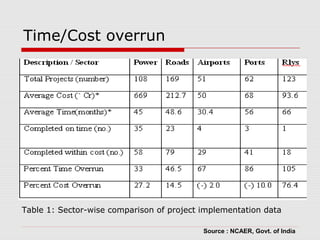
  • 79.
    Energy Audit –Innovation(4 of 4) 5. ECW & ACW system:- c. Improving condenser performance by condenser tube cleaning & use of highly efficient debris filter: - Tube cleaning by bullet shot method increases condenser performance, condenser tube cleaning is necessary which is to be carried out in overhaul. Also highly advanced debris filter contribute condenser performance. 6. Compressed air system:- a. Optimizing discharge air pressure by tuning loading/ unloading cycle: - It helpful to reduce sp. Power consumption. b. Use of heat of compression air dryer instead of electrically heated air dryer: - Heat of compression air dryer use heat generated in compression cycle, thus reduces sp. Power consumption. c. Use of screw compressor instead reciprocating compressor: - Sp. Power consumption of screw compressor is less than reciprocating air compressor leads to reduce aux. power consumption. 7. HVAC system a. Cooling tower performance improvement b. Installing absorption refrigeration system instead of vapor compression system c. Use of wind turbo ventilators instead of conventional motor driven exhauster
  • 80.
    CONTROL & DIAGNOSTICFEATURES OF 500 MW TURBO GENERATORS (BHEL) With the increase in the power rating of generating sets, the issue of availability has become very important. The outage of even one large capacity machine from the grid causes a significant shortfall in power generation. High availability and reliability are therefore fundamental requirements of power generating units. To achieve this, the health of machines needs to be monitored continuously. Over and above this, we also require techniques for forecasting imminent problems. Diagnostic tools are therefore gaining increasing importance by the day. This paper gives details of the control and diagnostic tools used in 500 MW generators manufactured by BHEL. (Refer BHEL Journal)
  • 81.
    Government Clearances Required(1/4)  Advance action / clearance for feasibility report  Investment approval  Funds  Domestic funds / loans / bonds / debentures / equity  Raising money in the foreign market  Foreign direct investment  Foreign collaboration  Engaging foreign consultants  Global tenders  Foreign assistance
  • 82.
    Government Clearances Required(2/4)  Location  Pollution Control  Environment  Forest  Telecommunication  Port angle  Mining lease  Mines safety  Commissioning boiler  Steam and condensate piping  Fire protection system  Labour laws  Inspection certification of electrical system  Statutory clearance for power projects  Techno-economic clearance for power projects/captive power plants  Chimney/tall buildings near airport  Defense angle / proximity to defense installations  Railway siding construction / operation  Safety against explosion  Fire protection system  Equipment lay-out under Factory Act / approval before commissioning
  • 83.
    Government Clearances Required(3/4)  Tenders specifications  Tender Approval  Shipment arrangements  Letter of Intent  Industrial license  Coal linkage  Oil / Gas linkage  Power linkage  Water  Appointing foreign technicians / engineers
  • 84.
    Government Clearances Required(4/4)  Building plans/no objection  Land acquisition  Right of way clearance  Formation of company  Appointment of Managing Director/ Director(s)  Sales tax/VAT/GST (when applicable) registration  Discounts in insurance rates  Registration under Excise Act  Approval under Service /Sales Act.  Registration under Shop & Establishment Act  Movement of over-dimensional equipment on roads  Movement of over-dimensional equipment on barges etc.  Income tax registration / income tax clearance regarding foreign technicians
  • 85.
    INDIAN STANDARDS ON EARTHQUAKE ENGINEERING  Bureau of Indian standards, the National Standard Body of India, is a Statutory Organization under the Bureau of Indian Standards Act 1986. One of the activity is formulation of Indian Standards on different subjects of Engineering through various Division Councils.  The Civil Engineering Division Council is responsible for standardization in the field of Civil Engineering including Structural Engineering, Building materials and components, Planning Design, Construction and Maintenance of Civil Engineering Structures, Construction Practices, Safety in Building etc.  These standards are evolved based on consensus principle through a net work of technical committee comprising representatives from Research and Development Organizations, Consumers, Industry, Testing Labs and Govt. Organizations etc.
  • 86.
    Environmental Impact Assessment  An environmental impact assessment is an assessment of the possible positive or negative impact that a proposed project may have on the environment, together consisting of the natural, social and economic aspects.  The purpose of the assessment is to ensure that decision makers consider the ensuing environmental impacts while deciding whether to proceed with a project. The International Association for Impact Assessment (IAIA) defines an environmental impact assessment as "the process of identifying, predicting, evaluating and mitigating the biophysical, social, and other relevant effects of development proposals prior to major decisions being taken and commitments made."
  • 87.
    NTPC Ratio Analysis(Last 5 Years) 1 of 2 Mar ‘ 10 Mar ' 09 Mar ' 08 Mar ' 07 Mar ' 06 PER SHARE RATIOS Adjusted E P S (Rs.) 9.82 8.72 8.93 8.02 6.01 Adjusted Cash EPS (Rs.) 13.04 11.59 11.53 10.55 8.5 Reported EPS (Rs.) 10.59 9.95 8.99 8.33 7.06 Reported Cash EPS (Rs.) 13.8 12.82 11.59 10.85 9.54 Dividend Per Share 3.8 3.6 3.5 3.2 2.8 Operating Profit Per Share (Rs.) 15.09 12.79 13.98 12.32 9 Book Value (Excl Rev Res) Per Share (Rs.) 77.28 71.55 65.81 58.94 54.53 Book Value (Incl Rev Res) Per Share (Rs.) 77.28 71.55 65.81 58.94 54.53 Net Operating Income Per Share (Rs.) 56.25 50.91 44.98 39.58 31.71 Free Reserves Per Share (Rs.) 62.75 56.25 52.34 47.38 43.24 PROFITABILITY RATIOS Operating Margin (%) 26.81 25.11 31.07 31.13 28.4 Gross Profit Margin (%) 21.1 19.48 25.31 24.77 20.56 Net Profit Margin (%) 17.72 18.11 18.51 19.39 20.2 Adjusted Cash Margin (%) 21.83 21.1 23.74 24.58 24.31 Adjusted Return On Net Worth (%) 12.7 12.18 13.57 13.61 11.02 Reported Return On Net Worth (%) 13.69 13.9 13.66 14.12 12.94 Return On long Term Funds (%) 12.45 12.27 15.15 14.69 12.26
  • 88.
    NTPC Ratio Analysis(Last 5 Years) 2 of 2
  • 89.
    Tata Power RatioAnalysis (Last 5 Years) 1/2 Mar ' 10 Mar ' 09 Mar ' 08 Mar ' 07 Mar ' 06 PER SHARE RATIOS Adjusted E P S (Rs.) 37.62 21.71 21.36 24.19 22.22 Adjusted Cash EPS (Rs.) 57.76 36.78 34.75 39.44 36.78 Reported EPS (Rs.) 39.93 41.65 39.42 35.21 30.85 Reported Cash EPS (Rs.) 60.07 56.72 52.81 50.46 45.41 Dividend Per Share 12 11.5 10.5 9.5 8.5 Operating Profit Per Share (Rs.) 78.37 50.79 41.67 35.46 42.48 Book Value (Excl Rev Res) Per Share (Rs.) 443.83 390.36 362.04 302.42 277.84 Book Value (Incl Rev Res) Per Share (Rs.) 443.83 390.36 362.04 302.42 277.84 Net Operating Income Per Share (Rs.) 299.37 327.74 267.77 248.54 230.08 Free Reserves Per Share (Rs.) 372.15 308.95 278.2 215.63 192.52 PROFITABILITY RATIOS Operating Margin (%) 26.17 15.49 15.56 14.26 18.46 Gross Profit Margin (%) 19.44 10.96 10.64 8.33 12.34 Net Profit Margin (%) 12.88 12.32 14.35 13.26 12.92 Adjusted Cash Margin (%) 18.63 10.88 12.65 14.85 15.4 Adjusted Return On Net Worth (%) 8.47 5.56 5.9 7.99 7.99 Reported Return On Net Worth (%) 8.99 10.66 10.88 11.64 11.1 Return On long Term Funds (%) 9.94 7.67 7.18 7.62 8.72
  • 90.
    Tata Power RatioAnalysis (Last 5 Years) 2/2 LEVERAGE RATIOS Long Term Debt / Equity 0.55 0.52 0.34 0.6 0.49 Total Debt/Equity 0.56 0.6 0.38 0.61 0.5 Owners fund as % of total Source 63.84 62.22 72.15 61.97 66.34 Fixed Assets Turnover Ratio 0.7 0.8 0.91 0.78 0.76 LIQUIDITY RATIOS Current Ratio 2.45 2.1 2.04 2.25 2.22 Current Ratio (Inc. ST Loans) 2.39 1.64 1.78 2.22 2.18 Quick Ratio 2.17 1.77 1.75 2 1.85 Inventory Turnover Ratio 18.98 15.49 18.7 6,072.41 498.76 PAYOUT RATIOS Dividend payout Ratio (Net Profit) 34.08 31.2 30.84 31.6 31.41 Dividend payout Ratio (Cash Profit) 22.65 22.9 23.02 22.05 21.34 Earning Retention Ratio 63.82 40.16 43.09 54.01 56.37 Cash Earnings Retention Ratio 76.44 64.68 65.02 71.79 73.65 COVERAGE RATIOS Adjusted Cash Flow Time Total Debt 4.35 6.44 4.02 4.71 3.84 Financial Charges Coverage Ratio 5.02 4.15 6.23 5.55 6.63 Fin. Charges Cov.Ratio (Post Tax) 4.39 4.86 7.78 6.34 6.89 COMPONENT RATIOS Material Cost Component(% earnings) 61.28 73.86 72.76 70.1 70.43 Selling Cost Component 0.74 0.67 0.59 5.19 1.19 Exports as percent of Total Sales 0.78 4.47 0.31 2.12 1.82 Import Comp. in Raw Mat. Consumed 0 0 0 0 0 Long term assets / Total Assets 0.68 0.7 0.69 0.64 0.68 Bonus Component In Equity Capital (%) 0.47 0.51 0.51 0.57 0.57
  • 91.
    Reliance Power RatioAnalysis (Last 5 Years) 1/2 Mar ' 10 Mar ' 09 Mar ' 08 Mar ' 07 Mar ' 06 PER SHARE RATIOS Adjusted E P S (Rs.) 0.45 0.79 0.33 0.01 -25.57 Adjusted Cash EPS (Rs.) 0.45 0.79 0.33 0.01 -25.57 Reported EPS (Rs.) 1.14 1.04 0.41 0.01 -25.57 Reported Cash EPS (Rs.) 1.14 1.04 0.41 0.01 -25.57 Dividend Per Share 0 0 0 0 0 Operating Profit Per Share (Rs.) -0.4 -0.3 -0.11 0.06 -22.27 Book Value (Excl Rev Res) Per Share (Rs.) 58.69 57.55 59.92 10 -19.22 Book Value (Incl Rev Res) Per Share (Rs.) 58.69 57.55 59.92 10 -19.22 Net Operating Income Per Share (Rs.) 0 0 0 0.11 0 Free Reserves Per Share (Rs.) 48.69 47.55 49.92 0 -29.22 PROFITABILITY RATIOS Operating Margin (%) 0 0 77.44 60.98 0 Gross Profit Margin (%) 0 0 77.44 60.98 0 Net Profit Margin (%) 122.09 90.9 83.9 7.19 0 Adjusted Cash Margin (%) 48.92 69.75 66.89 7.68 0
  • 92.
    Reliance Power RatioAnalysis (Last 5 Years) 2/2 Adjusted Return On Net Worth (%) 0.77 1.38 0.55 0.08 0 Reported Return On Net Worth (%) 1.94 1.8 0.69 0.08 0 Return On long Term Funds (%) 0.89 1.45 0.64 0.68 0 LEVERAGE RATIOS Long Term Debt / Equity 0 0 0 0 0 Total Debt/Equity 0 0 0 0 0 Owners fund as % of total Source 100 100 100 100 0 Fixed Assets Turnover Ratio 0 0 0 0.03 0 LIQUIDITY RATIOS Current Ratio 189.31 167.36 12.6 9.16 1.72 Current Ratio (Inc. ST Loans) 189.31 167.36 12.6 9.16 1.72 Quick Ratio 189.31 167.36 12.6 9.16 1.72 PAYOUT RATIOS Earning Retention Ratio 100 100 100 100 0 Cash Earnings Retention Ratio 100 100 100 100 0 COVERAGE RATIOS Financial Charges Coverage Ratio 74.91 113.42 15.27 1.67 0 Fin. Charges Cov.Ratio (Post Tax) 162.62 142.03 17.54 1.2 0 COMPONENT RATIOS Selling Cost Component 0 0 1.31 0.57 0 Long term assets / Total Assets 0.52 0.46 0.61 0.78 0.99 Bonus Component In Equity Capital (%) 5.7 5.7 0 0 0
  • 93.
    Reliance Infra. RatioAnalysis (Last 5 Years) 1/2 Mar ' 10 Mar ' 09 Mar ' 08 Mar ' 07 Mar ' 06 PER SHARE RATIOS Adjusted E P S (Rs.) 40 31.11 24.69 25.37 31.04 Adjusted Cash EPS (Rs.) 53.06 41.95 34.12 35.88 50.72 Reported EPS (Rs.) 47.03 50.39 45.86 35.07 30.63 Reported Cash EPS (Rs.) 60.09 61.22 55.28 45.57 50.31 Dividend Per Share 7.1 7 6.3 5.3 5 Operating Profit Per Share (Rs.) 35.74 19.22 22.73 21.75 35.99 Book Value (Excl Rev Res) Per Share (Rs.) 574.81 466.07 433.76 378.13 331.24 Book Value (Incl Rev Res) Per Share (Rs.) 596.69 492.16 460.98 408.67 366.66 Net Operating Income Per Share (Rs.) 400.52 426.51 267.68 251.72 186.7 Free Reserves Per Share (Rs.) 478.82 396.63 369.71 339.74 292.31 PROFITABILITY RATIOS Operating Margin (%) 8.92 4.5 8.49 8.64 19.27 Gross Profit Margin (%) 5.66 1.96 4.96 4.46 8.73 Net Profit Margin (%) 10.69 10.73 15.34 12.43 14.39 Adjusted Cash Margin (%) 12.06 8.93 11.41 12.71 23.83 Adjusted Return On Net Worth (%) 6.95 6.67 5.69 6.71 9.37 Reported Return On Net Worth (%) 8.18 10.81 10.57 9.27 9.24 Return On long Term Funds (%) 9.74 9.66 9.67 9.45 9.04
  • 94.
    Reliance Infra. RatioAnalysis (Last 5 Years) 2/2 LEVERAGE RATIOS Long Term Debt / Equity 0.1 0.14 0.06 0.16 0.41 Total Debt/Equity 0.29 0.69 0.48 0.67 0.6 Owners fund as % of total Source 77.37 58.96 67.19 59.59 62.23 Fixed Assets Turnover Ratio 1.33 1.4 0.99 0.97 0.72 LIQUIDITY RATIOS Current Ratio 1.73 1.55 2.47 3.93 4.25 Current Ratio (Inc. ST Loans) 1.26 0.74 1.06 1.51 2.09 Quick Ratio 1.66 1.45 2.37 3.82 4.07 Inventory Turnover Ratio 59.45 55.96 40.26 32.87 19.6 PAYOUT RATIOS Dividend payout Ratio (Net Profit) 15.94 16.19 15.93 17.68 18.37 Dividend payout Ratio (Cash Profit) 12.47 13.33 13.21 13.6 11.18 Earning Retention Ratio 81.25 73.77 70.41 75.57 81.88 Cash Earnings Retention Ratio 85.87 80.55 78.59 82.72 88.91 COVERAGE RATIOS Adjusted Cash Flow Time Total Debt 3.17 7.73 6.21 7.14 3.96 Financial Charges Coverage Ratio 6.28 4.25 4.13 4.76 6.88 Fin. Charges Cov.Ratio (Post Tax) 6.04 5.19 5.23 5.16 6.57 COMPONENT RATIOS Material Cost Component(% earnings) 34.17 44.32 39.5 26.96 27.67 Selling Cost Component 1.82 1.79 2.36 2.32 0.21 Exports as percent of Total Sales 0.43 0.96 0.01 0 0 Long term assets / Total Assets 0.52 0.63 0.53 0.27 0.23 Bonus Component In Equity Capital (%) 3.3 3.57 3.43 3.53 3.8
  • 95.
    References  PlanningCommission, Govt. of India  Ministry of Statistics and Programme Implementation  Ministry of Power ,Govt. of India  NCAER , Govt. of India  Central Electricity Authority, Govt. of India  Delhi School of Economics, Delhi University  National Thermal Power Corporation (PSU)  Mckensie Report  Tata Consulting Engineers/Tata Power  EIL/PDIL/Mecon/MN Dastur  Reliance Industries Ltd  India Habitat Center  Tata Chemicals Ltd  Delhi Metro Rail Corporation Total Project Management P K Joy, McMillan publishers Project Management by Rory Burke, Wiley Project Management by Jack R Meredith/Samuel J Mantel ,Wiley Energy Audit: Reliance Energy Ltd BHEL Innovations Ministry of Environment & Forest, Government of India Innovation Management Dr R Lalitha, Himalaya Publishing Larsen and Toubro (L&T) Ministry of Labour ,Govt. of India Dion Global Solutions Limited, Insight (Research Data Base) TERI, New Delhi Wikipedia Hindustan Times / Indian Express Vijayant Consultants, Ahemadabad
  • 96.
    Acknowledgement  TheAuthor / Presenter thankfully acknowledges the contribution of the following IAMR Staff members in the creation of this Power Point Presentation on ‘Innovative Project Management Practices for working professionals’. 1. Mr. Rajendra Yadav 2. Mr. Avadesh Mishra 3. Mr. Mayur Sharma  Mr. Rakesh Bhatia, with his rich experience of 25 years in execution & marketing of EPC Projects, has been a great help in validating and correlating the inputs & streamlining the flow.
  • 97.
    Thank you allthe participants for patient listening, your valuable contribution by making the session interactive and value added . It was a great experience sharing platform to cut time & cost overruns in major projects in the power, infrastructure, construction sectors.