Prof. Mrs. D.A. Latthe
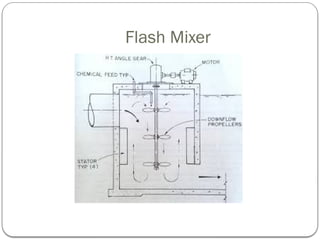
Flash Mixer
 The flash (or rapid) mixing and coagulation stages consist in
adding chemicals to raw water to foster coagulation while
attracting particles that doesn’t settle or cannot be filtered.
 Coagulants, such as ferric chloride (FeCl3), PAC (poly
aluminium chloride Al2Cl(OH)5), aluminium sulphate
(Al2(SO4)3), attract these particles, so it will be easier to
agglomerate them during flocculation.
Flash Mixer
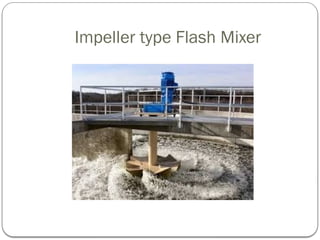
Impeller type Flash Mixer
 The duration of the flash mixing and coagulation stages
determines the quality of the whole process.
 For example, a short retention time won’t allow the
homogeneous distribution of the chemicals within the basin,
making the reaction unsuccessful.
 Therefore, the residence and contact time must be calculated
accurately, considering the main parameters, such as the
basin’s volume and the water’s flow rate.
 vertical agitators are efficient during the flash mixing and
coagulation stages as they quickly and thoroughly agitate the
chemicals in raw water before releasing them into the
flocculation chamber.
Types of Flash Mixers:
1. Mechanical Flash Mixer
* Uses an impeller or turbine rotating at high speed.
* Provides high energy input for rapid mixing.
2. Hydraulic Flash Mixer
* Mixing achieved by hydraulic turbulence (e.g., through a
baffled channel, jet mixing, or hydraulic jump).
* Economical as it avoids mechanical equipment.
Purpose
*To disperse the coagulant quickly and
uniformly in water.
*To avoid localized high concentration of
chemicals.
*To initiate destabilization of colloidal particles
for floc formation
Design Considerations
 Retention time:
 30 to 60 seconds (very short).
 Velocity gradient (G-value):700 – 1000 s ¹.
⁻
 Power requirement: 1–2 hp per million liters per day (MLD)
of flow.
 Tank volume:Small (since detention time is very low).
Process Flow
1. Raw water enters the flash mixer.
2. Coagulant is dosed just before or at the entry point.
3. Rapid mixing disperses the chemical uniformly.
4.Water then flows to the **Flocculator**, where slow mixing
promotes floc formation.
ThankYou!

Flash Mixer- Definition, Types and Design Criteria

  • 1.
    Prof. Mrs. D.A.Latthe Flash Mixer
  • 2.
     The flash(or rapid) mixing and coagulation stages consist in adding chemicals to raw water to foster coagulation while attracting particles that doesn’t settle or cannot be filtered.  Coagulants, such as ferric chloride (FeCl3), PAC (poly aluminium chloride Al2Cl(OH)5), aluminium sulphate (Al2(SO4)3), attract these particles, so it will be easier to agglomerate them during flocculation.
  • 3.
  • 4.
  • 5.
     The durationof the flash mixing and coagulation stages determines the quality of the whole process.  For example, a short retention time won’t allow the homogeneous distribution of the chemicals within the basin, making the reaction unsuccessful.  Therefore, the residence and contact time must be calculated accurately, considering the main parameters, such as the basin’s volume and the water’s flow rate.
  • 6.
     vertical agitatorsare efficient during the flash mixing and coagulation stages as they quickly and thoroughly agitate the chemicals in raw water before releasing them into the flocculation chamber.
  • 7.
    Types of FlashMixers: 1. Mechanical Flash Mixer * Uses an impeller or turbine rotating at high speed. * Provides high energy input for rapid mixing. 2. Hydraulic Flash Mixer * Mixing achieved by hydraulic turbulence (e.g., through a baffled channel, jet mixing, or hydraulic jump). * Economical as it avoids mechanical equipment.
  • 8.
    Purpose *To disperse thecoagulant quickly and uniformly in water. *To avoid localized high concentration of chemicals. *To initiate destabilization of colloidal particles for floc formation
  • 9.
    Design Considerations  Retentiontime:  30 to 60 seconds (very short).  Velocity gradient (G-value):700 – 1000 s ¹. ⁻  Power requirement: 1–2 hp per million liters per day (MLD) of flow.  Tank volume:Small (since detention time is very low).
  • 10.
    Process Flow 1. Rawwater enters the flash mixer. 2. Coagulant is dosed just before or at the entry point. 3. Rapid mixing disperses the chemical uniformly. 4.Water then flows to the **Flocculator**, where slow mixing promotes floc formation.
  • 11.