ASSOSA UNIVERSITY
SCHOOL OF POST GRADUATE STUDIES
FACULTY OF BUSINESS AND ECONOMICS
DEPT. OF MANAGEMENT
Project Management
Degree : MBA (General )
Subject In-charge
Dr.A.Gajendran
M.com.,M.Phil.,MBA.,HDSM.,PGDCA.,Ph.D.,LL.B.,
Associate Professor
School of Post Graduate Studies
Assosa University
Commencement of Class / Date : 6.12.2015
UNIT – I
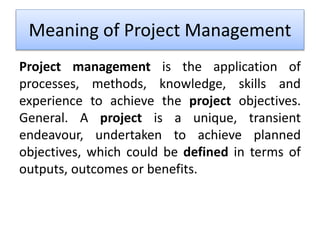
Meaning of Project Management
Project management is the application of
processes, methods, knowledge, skills and
experience to achieve the project objectives.
General. A project is a unique, transient
endeavour, undertaken to achieve planned
objectives, which could be defined in terms of
outputs, outcomes or benefits.
Definition of 'Project Management'
The planning and organization of an organization's resources in
order to move a specific task, event or duty toward completion.
It typically involves a one-time project rather than an on-
going activity, and resources managed include both human and
financial capital.
It is the discipline of carefully projecting or planning,
organizing, motivating and controlling resources to achieve
specific goals and meet specific success criteria.
Tools for Project management
Project management is often closely associated with
engineering projects, which typically have a complex set of
components that have to be completed and assembled in a set fashion in
order to create a functioning product.
Project managers use visual representations of workflow, such
as Gantt charts and PERT charts, to determine which tasks are to be
completed by which departments.
Definition of 'Gantt Chart'
A Gantt chart is a visual representation of a project
schedule. A type of bar chart, a Gantt charts show the
start and finish dates of the different required elements
of a project.
Henry Laurence Gantt, an American mechanical
engineer, is recognized for developing the Gantt chart.
Definition of 'Critical Path Analysis'
A project-management technique that lays out all the activities
needed to complete a task, the time it will take to complete each
activity and the relationships between the activities. Also called
the "critical path method“.
Critical path analysis can help predict whether a project can be
completed on time and can be used to reorganize the project
both before starting it, and as it progresses, to keep the project's
completion on track and ensure that deliverables are ready on
time.
Challenges of Project Management
Primary : To attain Project related goals and objectives such
as maximising profit , minimising cost , reducing wastages ,
defectives , abnormal loss, facing constraints like scope,
time, quality and budget
Secondary : Optimize and allocate necessary inputs and
integrate them to meet pre-defined objectives.
Scope of Project management
Initialization
Planning and development
Project execution
Project monitoring
Project closing
Communicating requirement
Decision making process
Managing the workforce
Building project team
Negotiating with the members of the Project team
Allocating resources according to the requirements
Project control mechanism
Appropriate level of control on time , cost and resources
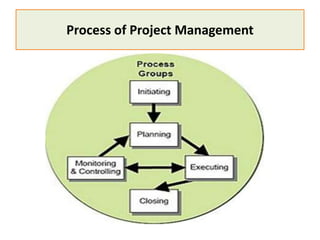
Process of Project Management
Step 1: Initiation process
• Analyzing the business needs/requirements in
measurable goals
• Reviewing of the current operations
• Financial analysis of the costs and benefits including
a budget
• Stakeholder analysis, including users, and support
personnel for the project
• Project charter including costs, tasks, deliverables,
and schedules
Step :2. Project Planning
Project planning generally consists of……..
• determining how to plan;
• developing the scope statement;
• selecting the planning team;
• identifying deliverables and creating the work breakdown structure;
• identifying the activities needed to complete ;
• estimating the resource requirements for the activities;
• estimating time and cost for activities;
• developing the schedule;
• developing the budget;
• risk planning;
• gaining formal approval to begin work.
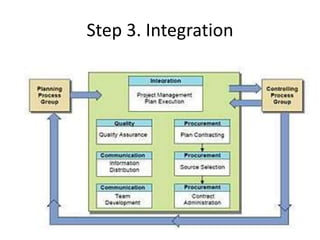
Step 3. Integration
Step 4. Execution Process
It includes :
 Proper allocation
 Co-ordination and management of human
resources
 Any other resources such as material and
budgets.
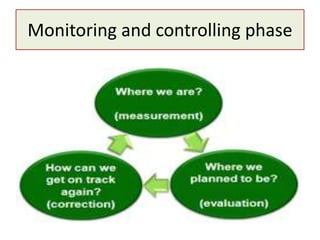
Step : 5 Monitoring and controlling process
• Measuring the on-going project activities ('where we
are')
• Monitoring the project variables (cost, effort, scope,
etc.) against the project management plan and the
project performance baseline (where we should be)
• Identify corrective actions to address issues and risks
properly (How can we get on track again);
• Influencing the factors that could circumvent
integrated change control so only approved changes
are implemented.
Monitoring and controlling phase
Step 6: Project closing
Closing includes the formal acceptance of the project and the ending thereof.
Administrative activities include the archiving of the files and documenting
lessons learned.
This phase consists of:
• Contract closure: Complete and settle each contract and close each
contract applicable to the project or project phase.
• Project close: Finalize all activities across all of the process groups
to formally close the project or a project phase
What is Project ?
 Project is scientifically evolved work plan to
achieve a specific objectives within a specified
period of time.
 It is a blue print for action oriented activities
of an organisation , projection oriented like a
film.
 It has beginning , middle and an end
 Example for Projects :
Power Projects , Cement manufacturing ,
educational , Social Projects, Construction
projects , Refinery , Health.
Meaning of Project
According to J. Price Gittinger , Project means
“ A specific activity with specific starting point
and ending point intended to achieve a specific
objectives”.
Requirement of Projects
Skills, Resource , Limited time , One shot , goal
oriented , commitment
Features of project
 It can be identified by its special feature
 It should have a specific period
 Once the objective achieved , the project cease to
exit.
 Team work needed
 Project has a life cycle reflected by growth ,
maturity and decline.
 Uniqueness is a special feature for any project
 Risk and uncertainty
 Project needs feasibility and appraisal studies
Factors affecting projects
 Location
 Type
 Size
 Technology
 Scope
 Speed
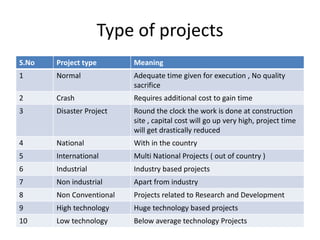
Type of projects
S.No Project type Meaning
1 Normal Adequate time given for execution , No quality
sacrifice
2 Crash Requires additional cost to gain time
3 Disaster Project Round the clock the work is done at construction
site , capital cost will go up very high, project time
will get drastically reduced
4 National With in the country
5 International Multi National Projects ( out of country )
6 Industrial Industry based projects
7 Non industrial Apart from industry
8 Non Conventional Projects related to Research and Development
9 High technology Huge technology based projects
10 Low technology Below average technology Projects
Other types of projects
Gross route projects
Expansion projects ( Normal – Normal Cost ,
Crash – Additional Cost , Disaster - High cost
and less time )
Modification Projects
Classification of projects
We can classify projects based on the following
criteria :
 Expansion – Capacity , Supply of Knowledge
 Resources – Big , Medium , Small
 Sector – Industry , Agriculture , Educational ,
Health , social
 Objective based – Social objective & Economic
Objective
 Benefit - quantified , non quantified
 Productivity – Direct or indirect productivity
 Government Priority Based - with or without priorities
 Dependency based - Dependent or Independent
 Ownership ( Public , Private , Joint Sector )
 Location ( Rural or Urban )
 Value ( Present / future impact )
 Risk ( High , Moderate , Low )
 National Policy ( Inward /outward looking )
 Economic Life ( Long , Medium and short term )
 Technology ( highly sophisticated , Advanced , foreign , indigenous )
 Resource ( Domestic , foreign Resource )
 Management of Project ( High degree , Normal degree , Low degree
decision making )
 Source of finance ( domestic , foreign , mixed financing institutions )
 Speed ( Normal , Crash , Disaster
Overview of project management
1. Managing resources – 5 M ( Men , Money , Material ,
Machines , Matters / information )
2. Planning , organising , coordinating, controlling resources
to achieve goals.
3. Good customers relationship
4. Division of Work
5. Centralisation , Building commitment , Maintaining
Integrity , directing , achieving objectives
6. Time
7. Cost
8. Resource
9. Performance
Benefits of project management
 Early identification of problems
 Corrective action at the right time
 Increasing Profitability and Capability
Problems of Project Management
 Project Risk
 Change in technology
 Forward Planning and Pricing
Qualities of Project Manager
 Flexible and adaptable
 Leadership qualities
 Confidence and commitment
 Verbal fluency and communication skill
 Integrator
 Personal interest
Role of Project manager
 Identifying problems
 Taking corrective decision
 Interacting with internal and external factors
 Monitoring and supervision
 Implementation and evaluation
 Applying control over Member of the project
 Directing and Leading the participants
Project consultants
 The people who gives guidance and direction
to the project form formulation stage to post
project evaluation stage is called as project
consultants
 Consultants is a project management team
 They will give Managerial / administrative ,
Technical , financial advice and assistance to
the projects for its smooth flow.
MBA UNIT 1.pptx

MBA UNIT 1.pptx

  • 1.
    ASSOSA UNIVERSITY SCHOOL OFPOST GRADUATE STUDIES FACULTY OF BUSINESS AND ECONOMICS DEPT. OF MANAGEMENT Project Management Degree : MBA (General ) Subject In-charge Dr.A.Gajendran M.com.,M.Phil.,MBA.,HDSM.,PGDCA.,Ph.D.,LL.B., Associate Professor School of Post Graduate Studies Assosa University Commencement of Class / Date : 6.12.2015
  • 2.
  • 4.
    Meaning of ProjectManagement Project management is the application of processes, methods, knowledge, skills and experience to achieve the project objectives. General. A project is a unique, transient endeavour, undertaken to achieve planned objectives, which could be defined in terms of outputs, outcomes or benefits.
  • 5.
    Definition of 'ProjectManagement' The planning and organization of an organization's resources in order to move a specific task, event or duty toward completion. It typically involves a one-time project rather than an on- going activity, and resources managed include both human and financial capital. It is the discipline of carefully projecting or planning, organizing, motivating and controlling resources to achieve specific goals and meet specific success criteria.
  • 6.
    Tools for Projectmanagement Project management is often closely associated with engineering projects, which typically have a complex set of components that have to be completed and assembled in a set fashion in order to create a functioning product. Project managers use visual representations of workflow, such as Gantt charts and PERT charts, to determine which tasks are to be completed by which departments.
  • 7.
    Definition of 'GanttChart' A Gantt chart is a visual representation of a project schedule. A type of bar chart, a Gantt charts show the start and finish dates of the different required elements of a project. Henry Laurence Gantt, an American mechanical engineer, is recognized for developing the Gantt chart.
  • 8.
    Definition of 'CriticalPath Analysis' A project-management technique that lays out all the activities needed to complete a task, the time it will take to complete each activity and the relationships between the activities. Also called the "critical path method“. Critical path analysis can help predict whether a project can be completed on time and can be used to reorganize the project both before starting it, and as it progresses, to keep the project's completion on track and ensure that deliverables are ready on time.
  • 9.
    Challenges of ProjectManagement Primary : To attain Project related goals and objectives such as maximising profit , minimising cost , reducing wastages , defectives , abnormal loss, facing constraints like scope, time, quality and budget Secondary : Optimize and allocate necessary inputs and integrate them to meet pre-defined objectives.
  • 10.
    Scope of Projectmanagement Initialization Planning and development Project execution Project monitoring Project closing Communicating requirement Decision making process Managing the workforce Building project team Negotiating with the members of the Project team Allocating resources according to the requirements Project control mechanism Appropriate level of control on time , cost and resources
  • 11.
  • 12.
    Step 1: Initiationprocess • Analyzing the business needs/requirements in measurable goals • Reviewing of the current operations • Financial analysis of the costs and benefits including a budget • Stakeholder analysis, including users, and support personnel for the project • Project charter including costs, tasks, deliverables, and schedules
  • 13.
    Step :2. ProjectPlanning Project planning generally consists of…….. • determining how to plan; • developing the scope statement; • selecting the planning team; • identifying deliverables and creating the work breakdown structure; • identifying the activities needed to complete ; • estimating the resource requirements for the activities; • estimating time and cost for activities; • developing the schedule; • developing the budget; • risk planning; • gaining formal approval to begin work.
  • 14.
  • 15.
    Step 4. ExecutionProcess It includes :  Proper allocation  Co-ordination and management of human resources  Any other resources such as material and budgets.
  • 16.
    Step : 5Monitoring and controlling process • Measuring the on-going project activities ('where we are') • Monitoring the project variables (cost, effort, scope, etc.) against the project management plan and the project performance baseline (where we should be) • Identify corrective actions to address issues and risks properly (How can we get on track again); • Influencing the factors that could circumvent integrated change control so only approved changes are implemented.
  • 17.
  • 18.
    Step 6: Projectclosing Closing includes the formal acceptance of the project and the ending thereof. Administrative activities include the archiving of the files and documenting lessons learned. This phase consists of: • Contract closure: Complete and settle each contract and close each contract applicable to the project or project phase. • Project close: Finalize all activities across all of the process groups to formally close the project or a project phase
  • 19.
    What is Project?  Project is scientifically evolved work plan to achieve a specific objectives within a specified period of time.  It is a blue print for action oriented activities of an organisation , projection oriented like a film.  It has beginning , middle and an end  Example for Projects : Power Projects , Cement manufacturing , educational , Social Projects, Construction projects , Refinery , Health.
  • 20.
    Meaning of Project Accordingto J. Price Gittinger , Project means “ A specific activity with specific starting point and ending point intended to achieve a specific objectives”. Requirement of Projects Skills, Resource , Limited time , One shot , goal oriented , commitment
  • 21.
    Features of project It can be identified by its special feature  It should have a specific period  Once the objective achieved , the project cease to exit.  Team work needed  Project has a life cycle reflected by growth , maturity and decline.  Uniqueness is a special feature for any project  Risk and uncertainty  Project needs feasibility and appraisal studies
  • 22.
    Factors affecting projects Location  Type  Size  Technology  Scope  Speed
  • 23.
    Type of projects S.NoProject type Meaning 1 Normal Adequate time given for execution , No quality sacrifice 2 Crash Requires additional cost to gain time 3 Disaster Project Round the clock the work is done at construction site , capital cost will go up very high, project time will get drastically reduced 4 National With in the country 5 International Multi National Projects ( out of country ) 6 Industrial Industry based projects 7 Non industrial Apart from industry 8 Non Conventional Projects related to Research and Development 9 High technology Huge technology based projects 10 Low technology Below average technology Projects
  • 24.
    Other types ofprojects Gross route projects Expansion projects ( Normal – Normal Cost , Crash – Additional Cost , Disaster - High cost and less time ) Modification Projects
  • 25.
    Classification of projects Wecan classify projects based on the following criteria :  Expansion – Capacity , Supply of Knowledge  Resources – Big , Medium , Small  Sector – Industry , Agriculture , Educational , Health , social  Objective based – Social objective & Economic Objective  Benefit - quantified , non quantified  Productivity – Direct or indirect productivity
  • 26.
     Government PriorityBased - with or without priorities  Dependency based - Dependent or Independent  Ownership ( Public , Private , Joint Sector )  Location ( Rural or Urban )  Value ( Present / future impact )  Risk ( High , Moderate , Low )  National Policy ( Inward /outward looking )  Economic Life ( Long , Medium and short term )  Technology ( highly sophisticated , Advanced , foreign , indigenous )  Resource ( Domestic , foreign Resource )  Management of Project ( High degree , Normal degree , Low degree decision making )  Source of finance ( domestic , foreign , mixed financing institutions )  Speed ( Normal , Crash , Disaster
  • 27.
    Overview of projectmanagement 1. Managing resources – 5 M ( Men , Money , Material , Machines , Matters / information ) 2. Planning , organising , coordinating, controlling resources to achieve goals. 3. Good customers relationship 4. Division of Work 5. Centralisation , Building commitment , Maintaining Integrity , directing , achieving objectives 6. Time 7. Cost 8. Resource 9. Performance
  • 28.
    Benefits of projectmanagement  Early identification of problems  Corrective action at the right time  Increasing Profitability and Capability Problems of Project Management  Project Risk  Change in technology  Forward Planning and Pricing
  • 29.
    Qualities of ProjectManager  Flexible and adaptable  Leadership qualities  Confidence and commitment  Verbal fluency and communication skill  Integrator  Personal interest
  • 30.
    Role of Projectmanager  Identifying problems  Taking corrective decision  Interacting with internal and external factors  Monitoring and supervision  Implementation and evaluation  Applying control over Member of the project  Directing and Leading the participants
  • 31.
    Project consultants  Thepeople who gives guidance and direction to the project form formulation stage to post project evaluation stage is called as project consultants  Consultants is a project management team  They will give Managerial / administrative , Technical , financial advice and assistance to the projects for its smooth flow.