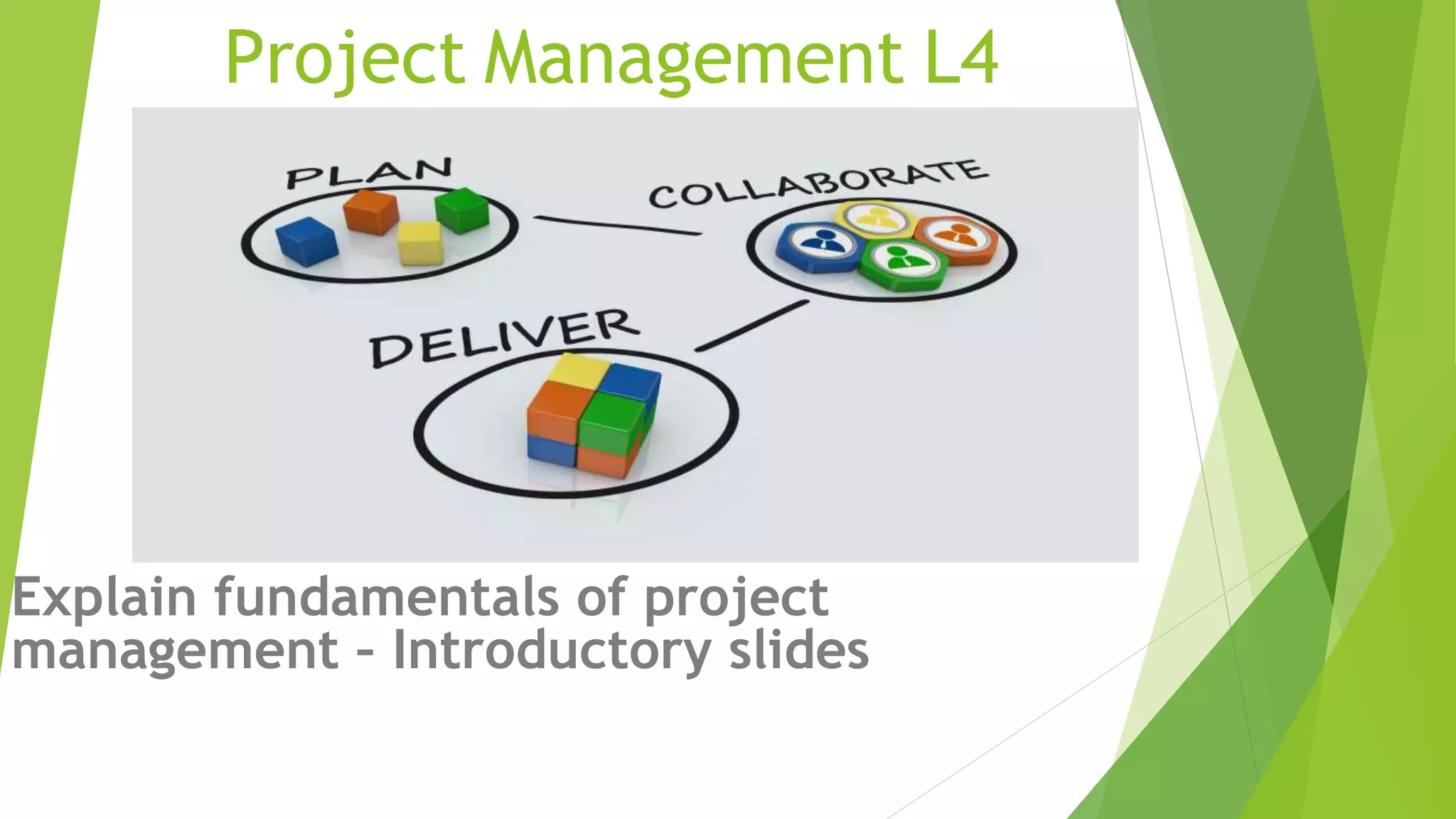
Project Management L4
Explain fundamentals of project
management – Introductory slides
 Mute and switch off video
 Only unmute when presenting
 Only one person speaks at a time.
 This is a facilitated training not a teaching class
 Responsibility for learning lies with all of us
 Participation, not domination or instruction
 Constructive challenging of ideas and views
 Stay on not stray from the Topic.
 English will be our preferable medium of interaction
 No side conversations one meeting all the time.
 Respect others’ points of view.
 Switch off/silence mobile phones/,
What is project management
 Project management can be defined as a technique that is used to attain
planned goals in the most cost-effective way by the optimal use of resources
 PMI ( project management institute ) defines project management as “the use
of specific knowledge, skills, tools, and techniques to deliver something of
value to people
 Project management involves project documentation, planning, tracking, and
communication—all with the goal of delivering work successfully within
the constraints of time, scope, and budget.
 Project management is the discipline of organising and managing
resources (e.g., people) in such a way that the project is completed
within defined scope, quality, time and cost constraints.
Importance of project management
 Project management is needed in almost any situation
especially those which require strategic planning so that a
goal or set of objectives can be completed by a certain
date .Project management helps to achieve the following
 Eliminate or reduce uncertainty
 Improve efficiency in achieving the objective/s set out
 Clarify set goals and objectives
 Become aware of alternatives
 Provide the basis for controlling the process of fulfilling
the objectives set
Importance studying of project management
This skills program provides an excellent introduction to project management,
introducing you to the first steps of project management, such as how to build
your business case, effectively scope your project, and proven methods to
identify and mitigate potential risks. Below are some of the reasons it is
important to study this project management skills program
1.There is a strong demand/ skills shortage
Learning how to effectively manage a project is becoming an essential and
transferable skill and is becoming increasingly in-demand across all industries.
2. Applies to a variety of industries (e.g., IT, manufacturing, construction)
Project managers are required in every industry, including in the Government
sector and small-to-medium enterprises, covering a wide range of job roles that
require project management skills.
Continued
3. It is a skill highlighted by employers
 Most employees are asked at some point to work on a specific activity
that has a deadline – project management knowledge and
methodologies ensure you meet the employer’s requirements. Having
the capacity to manage projects as they arise shows initiative and can
give you the edge when in the increasingly competitive job market.
4. Improves your productivity at work
 Project management provides you with a range of tools and techniques
that you can apply in your work role to ensure that you are more
productive and more able to meet the required deadlines. It doesn't
have to relate directly to projects, it could be improving your day-to-day
organisation with new tools and tricks taught in the skills program
Continued
 5. Improves your career advancement opportunities
 Project management is a skill that enables you to operate at a higher
level, as it incorporates aspects of teamwork and leadership. Being
able to effectively organise and carry out high level projects and
holding qualifications in this area can help you advance your career.
 6. Provides an opportunity to be at the forefront of exciting
projects
 Your knowledge of project management means that your employer
can look to you to be part of, or deliver, the various workplace
projects that are necessary in organisations. Project management
gives you the skills to identify and spearhead projects, meaning you
have the capacity to improve your workplace and outputs.
What Is a Project?
 All projects are work, but not all work is a project.
 Projects are undertakings that are time-bound (have an end),
produce a unique output/deliverable, and are executed under
agreed-upon constraints (i.e., scope, timeline, budget/resources).
 Everything else is work, but not a project. These efforts include:
• Business-as-usual activities (e.g., responding to email, daily tasks,
ongoing work)
• Communicating/collaborating with co-workers
• Low-effort ad-hoc requests
• Process management
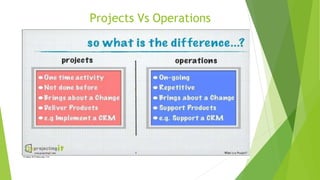
Projects Vs Operations
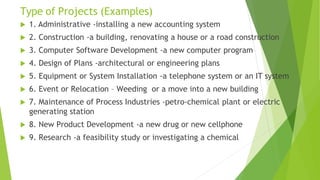
Type of Projects (Examples)
 1. Administrative -installing a new accounting system
 2. Construction -a building, renovating a house or a road construction
 3. Computer Software Development -a new computer program
 4. Design of Plans -architectural or engineering plans
 5. Equipment or System Installation -a telephone system or an IT system
 6. Event or Relocation – Weeding or a move into a new building
 7. Maintenance of Process Industries -petro-chemical plant or electric
generating station
 8. New Product Development -a new drug or new cellphone
 9. Research -a feasibility study or investigating a chemical
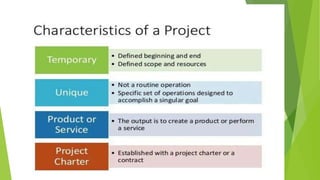
The characteristics of a project
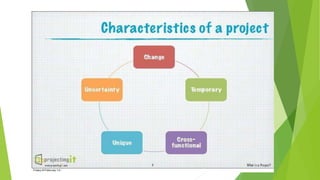
 A single definable purpose, end-item or result. This is usually
specified in terms of cost, schedule and performance requirements.
 Every project is unique. It requires the doing of something different,
something that was not done previously. Even in what are often called
“routine” projects such as home construction, the variables such as
terrain, access, zoning laws, labour market, public services and local
utilities make each project different. A project is a one-time, once-off
activity, never to be repeated exactly the same way again.
 Projects are temporary activities. A project is an ad hoc organization
of staff, material, equipment and facilities that is put together to
accomplish a goal. This goal is within a specific time-frame. Once the
goal is achieved, the organization created for it is disbanded or
sometimes it is reconstituted to begin work on a new goal (project).
Continued
 Projects cut across organizational lines. Projects always cut across the
regular organizational lines and structures within a firm. They do this
because the project needs to draw from the skills and the talents of
multiple professions and departments within the firm and sometimes
even from other organizations. The complexity of advanced technology
often leads to additional project difficulties, as they create task
interdependencies that may introduce new and unique problems.
 Projects involve unfamiliarity. Because a project differs from what was
previously done, it also involves unfamiliarity. And oft time a project
also encompasses new technology and, for the organization/firm
undertaking the project, these bring into play significant elements of
uncertainty and risk.
Continued
 The organization usually has something at stake when
undertaking a project. The unique project “activity” may
call for special scrutiny or effort because failure would
jeopardize the organization/firm or its goals.
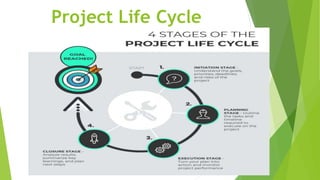
 A project is the process of working to achieve a goal. During
the process, projects pass through several distinct phases,
which form and are called the project life cycle. The tasks,
people, organizations, and other resources will change as the
project moves from one phase to the next. The organizational
structure and the resource expenditures build with each
succeeding phase; peak; and then decline as the project
nears completion.
Project Specification
 In project management, a project specification document
(also called the project charter) is a valuable tool when
starting any kind of project, from construction to
software development.
 In short, a project specification is a detailed description
of objectives for any given development project. It lists
goals, functionality, and any other information that is
required for the developers to successfully complete the
project.
 A specification is the definition of your project: a statement of
the problem, not the solution
Benefits of a project specification
 the clarity will reveal misunderstandings
 the completeness will remove contradictory
assumptions
 the rigour of the analysis will expose technical
and practical details which are normally glossed
over through ignorance or fear
 the agreement forces all concerned to actually
read and think about the details
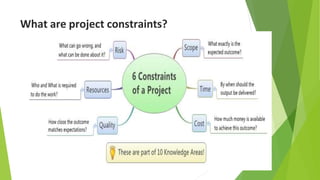
What are project constraints?
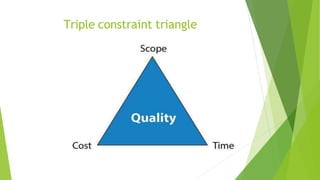
Triple constraint triangle
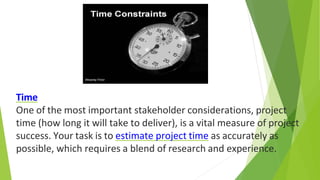
Time
One of the most important stakeholder considerations, project
time (how long it will take to deliver), is a vital measure of project
success. Your task is to estimate project time as accurately as
possible, which requires a blend of research and experience.
Cost
 Equally important to stakeholders is how much a project will cost. As with
time constraints, your budget estimates need to be presented in a range.
Some key research will lead you to accurate numbers:
• Estimate costs with thoroughly researched market rates for goods and services you
need
• Estimate costs with vendor bids and ranges
• If providing hourly cost estimates, be sure to estimate your time accurately in the
first place
• Estimate your budget by considering all costs: labor, material, factory, equipment,
administrative, software, contractors, etc.
• Look at costs and budgets for similar past projects inside and outside your
organization
Scope
 Since a project scope is not an estimate but a guaranteed
set of deliverables, it’s difficult to imagine creating a range
for this project constraint. However, you can consider that
stakeholders may be invested in scope risk and scope
tolerance ranges.
 For example, you may list a set of deliverables that could be
created if budget and schedule allow, a wish list that your
stakeholders can choose from if there’s money and time left
over after mandatory deliverables are completed.
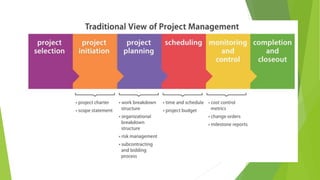
Project Life Cycle
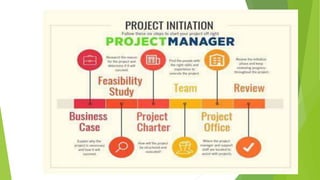
project initiation phase
 The project initiation phase is the first phase
within the project management life cycle, as it
involves starting up a new project. Within the
initiation phase, the business problem or
opportunity is identified, a solution is defined,
a project is formed, and a project team is
appointed to build and deliver the solution to
the customer.
Project Planning Phase
 The project planning phase of the project management life cycle
defines the scope and objective of a project. Proper project
planning is one of the most important steps in ensuring a project
is delivered on-time and on-budget.
 The project planning phase of project management is where a
project manager builds the project roadmap, including the
project plan, project scope, project schedule, project constraints,
work breakdown structure, and risk analysis.
 It doesn’t matter if the project is a new website or a new
building—the project planning phase serves as a roadmap and
acts as a control tool throughout the project. Project planning
provides guidance by answering questions like:
• What product(s) or service(s) will we deliver?
• How much will the project cost?
• How can we meet the needs of our stakeholders?
• How will progress be measured?
A project plan is a set of documents that can change over the course of a
project. The plan provides an overall direction for the project. If
unexpected issues arise (e.g. delivery delays), the plan can be adjusted by
the project manager.
Execution stage
 The execution phase of the Project Management
Lifecycle is literally where we do the work of building
the project. Whether it is the building of a house
project, changing a process project, or anything kind of
project in between, we need a place to say that the
work has begun.
 It is possible to start Execution while still doing some of
the Phase 2 planning, but the risk of changes and mis-
communication needs to be weighed.
Closure stage
The closing phase of project
management is the final phase of
the project lifecycle. This is the
stage where all deliverables are
finalized and formally transferred,
and all documentation is signed
off, approved, and archived.

Project Management online sample (1) (1).pptx

  • 1.
    Project Management L4 Explainfundamentals of project management – Introductory slides
  • 2.
     Mute andswitch off video  Only unmute when presenting  Only one person speaks at a time.  This is a facilitated training not a teaching class  Responsibility for learning lies with all of us  Participation, not domination or instruction  Constructive challenging of ideas and views  Stay on not stray from the Topic.  English will be our preferable medium of interaction  No side conversations one meeting all the time.  Respect others’ points of view.  Switch off/silence mobile phones/,
  • 3.
    What is projectmanagement  Project management can be defined as a technique that is used to attain planned goals in the most cost-effective way by the optimal use of resources  PMI ( project management institute ) defines project management as “the use of specific knowledge, skills, tools, and techniques to deliver something of value to people  Project management involves project documentation, planning, tracking, and communication—all with the goal of delivering work successfully within the constraints of time, scope, and budget.  Project management is the discipline of organising and managing resources (e.g., people) in such a way that the project is completed within defined scope, quality, time and cost constraints.
  • 4.
    Importance of projectmanagement  Project management is needed in almost any situation especially those which require strategic planning so that a goal or set of objectives can be completed by a certain date .Project management helps to achieve the following  Eliminate or reduce uncertainty  Improve efficiency in achieving the objective/s set out  Clarify set goals and objectives  Become aware of alternatives  Provide the basis for controlling the process of fulfilling the objectives set
  • 5.
    Importance studying ofproject management This skills program provides an excellent introduction to project management, introducing you to the first steps of project management, such as how to build your business case, effectively scope your project, and proven methods to identify and mitigate potential risks. Below are some of the reasons it is important to study this project management skills program 1.There is a strong demand/ skills shortage Learning how to effectively manage a project is becoming an essential and transferable skill and is becoming increasingly in-demand across all industries. 2. Applies to a variety of industries (e.g., IT, manufacturing, construction) Project managers are required in every industry, including in the Government sector and small-to-medium enterprises, covering a wide range of job roles that require project management skills.
  • 6.
    Continued 3. It isa skill highlighted by employers  Most employees are asked at some point to work on a specific activity that has a deadline – project management knowledge and methodologies ensure you meet the employer’s requirements. Having the capacity to manage projects as they arise shows initiative and can give you the edge when in the increasingly competitive job market. 4. Improves your productivity at work  Project management provides you with a range of tools and techniques that you can apply in your work role to ensure that you are more productive and more able to meet the required deadlines. It doesn't have to relate directly to projects, it could be improving your day-to-day organisation with new tools and tricks taught in the skills program
  • 7.
    Continued  5. Improvesyour career advancement opportunities  Project management is a skill that enables you to operate at a higher level, as it incorporates aspects of teamwork and leadership. Being able to effectively organise and carry out high level projects and holding qualifications in this area can help you advance your career.  6. Provides an opportunity to be at the forefront of exciting projects  Your knowledge of project management means that your employer can look to you to be part of, or deliver, the various workplace projects that are necessary in organisations. Project management gives you the skills to identify and spearhead projects, meaning you have the capacity to improve your workplace and outputs.
  • 8.
    What Is aProject?  All projects are work, but not all work is a project.  Projects are undertakings that are time-bound (have an end), produce a unique output/deliverable, and are executed under agreed-upon constraints (i.e., scope, timeline, budget/resources).  Everything else is work, but not a project. These efforts include: • Business-as-usual activities (e.g., responding to email, daily tasks, ongoing work) • Communicating/collaborating with co-workers • Low-effort ad-hoc requests • Process management
  • 9.
  • 10.
    Type of Projects(Examples)  1. Administrative -installing a new accounting system  2. Construction -a building, renovating a house or a road construction  3. Computer Software Development -a new computer program  4. Design of Plans -architectural or engineering plans  5. Equipment or System Installation -a telephone system or an IT system  6. Event or Relocation – Weeding or a move into a new building  7. Maintenance of Process Industries -petro-chemical plant or electric generating station  8. New Product Development -a new drug or new cellphone  9. Research -a feasibility study or investigating a chemical
  • 13.
    The characteristics ofa project  A single definable purpose, end-item or result. This is usually specified in terms of cost, schedule and performance requirements.  Every project is unique. It requires the doing of something different, something that was not done previously. Even in what are often called “routine” projects such as home construction, the variables such as terrain, access, zoning laws, labour market, public services and local utilities make each project different. A project is a one-time, once-off activity, never to be repeated exactly the same way again.  Projects are temporary activities. A project is an ad hoc organization of staff, material, equipment and facilities that is put together to accomplish a goal. This goal is within a specific time-frame. Once the goal is achieved, the organization created for it is disbanded or sometimes it is reconstituted to begin work on a new goal (project).
  • 14.
    Continued  Projects cutacross organizational lines. Projects always cut across the regular organizational lines and structures within a firm. They do this because the project needs to draw from the skills and the talents of multiple professions and departments within the firm and sometimes even from other organizations. The complexity of advanced technology often leads to additional project difficulties, as they create task interdependencies that may introduce new and unique problems.  Projects involve unfamiliarity. Because a project differs from what was previously done, it also involves unfamiliarity. And oft time a project also encompasses new technology and, for the organization/firm undertaking the project, these bring into play significant elements of uncertainty and risk.
  • 15.
    Continued  The organizationusually has something at stake when undertaking a project. The unique project “activity” may call for special scrutiny or effort because failure would jeopardize the organization/firm or its goals.  A project is the process of working to achieve a goal. During the process, projects pass through several distinct phases, which form and are called the project life cycle. The tasks, people, organizations, and other resources will change as the project moves from one phase to the next. The organizational structure and the resource expenditures build with each succeeding phase; peak; and then decline as the project nears completion.
  • 16.
    Project Specification  Inproject management, a project specification document (also called the project charter) is a valuable tool when starting any kind of project, from construction to software development.  In short, a project specification is a detailed description of objectives for any given development project. It lists goals, functionality, and any other information that is required for the developers to successfully complete the project.  A specification is the definition of your project: a statement of the problem, not the solution
  • 17.
    Benefits of aproject specification  the clarity will reveal misunderstandings  the completeness will remove contradictory assumptions  the rigour of the analysis will expose technical and practical details which are normally glossed over through ignorance or fear  the agreement forces all concerned to actually read and think about the details
  • 18.
    What are projectconstraints?
  • 19.
  • 20.
    Time One of themost important stakeholder considerations, project time (how long it will take to deliver), is a vital measure of project success. Your task is to estimate project time as accurately as possible, which requires a blend of research and experience.
  • 21.
    Cost  Equally importantto stakeholders is how much a project will cost. As with time constraints, your budget estimates need to be presented in a range. Some key research will lead you to accurate numbers: • Estimate costs with thoroughly researched market rates for goods and services you need • Estimate costs with vendor bids and ranges • If providing hourly cost estimates, be sure to estimate your time accurately in the first place • Estimate your budget by considering all costs: labor, material, factory, equipment, administrative, software, contractors, etc. • Look at costs and budgets for similar past projects inside and outside your organization
  • 22.
    Scope  Since aproject scope is not an estimate but a guaranteed set of deliverables, it’s difficult to imagine creating a range for this project constraint. However, you can consider that stakeholders may be invested in scope risk and scope tolerance ranges.  For example, you may list a set of deliverables that could be created if budget and schedule allow, a wish list that your stakeholders can choose from if there’s money and time left over after mandatory deliverables are completed.
  • 24.
  • 25.
    project initiation phase The project initiation phase is the first phase within the project management life cycle, as it involves starting up a new project. Within the initiation phase, the business problem or opportunity is identified, a solution is defined, a project is formed, and a project team is appointed to build and deliver the solution to the customer.
  • 27.
    Project Planning Phase The project planning phase of the project management life cycle defines the scope and objective of a project. Proper project planning is one of the most important steps in ensuring a project is delivered on-time and on-budget.  The project planning phase of project management is where a project manager builds the project roadmap, including the project plan, project scope, project schedule, project constraints, work breakdown structure, and risk analysis.  It doesn’t matter if the project is a new website or a new building—the project planning phase serves as a roadmap and acts as a control tool throughout the project. Project planning provides guidance by answering questions like:
  • 28.
    • What product(s)or service(s) will we deliver? • How much will the project cost? • How can we meet the needs of our stakeholders? • How will progress be measured? A project plan is a set of documents that can change over the course of a project. The plan provides an overall direction for the project. If unexpected issues arise (e.g. delivery delays), the plan can be adjusted by the project manager.
  • 29.
    Execution stage  Theexecution phase of the Project Management Lifecycle is literally where we do the work of building the project. Whether it is the building of a house project, changing a process project, or anything kind of project in between, we need a place to say that the work has begun.  It is possible to start Execution while still doing some of the Phase 2 planning, but the risk of changes and mis- communication needs to be weighed.
  • 31.
    Closure stage The closingphase of project management is the final phase of the project lifecycle. This is the stage where all deliverables are finalized and formally transferred, and all documentation is signed off, approved, and archived.