Project Planning & Scheduling Saurabh Naik
Project Planning A Plan is a Blue Print for Goal Achievement. Projects Often do not succeed without careful planning. Planning allows project teams to address 5 critical factors that determine success & failure of project. Quality  Cost  Schedule Performance Supportability
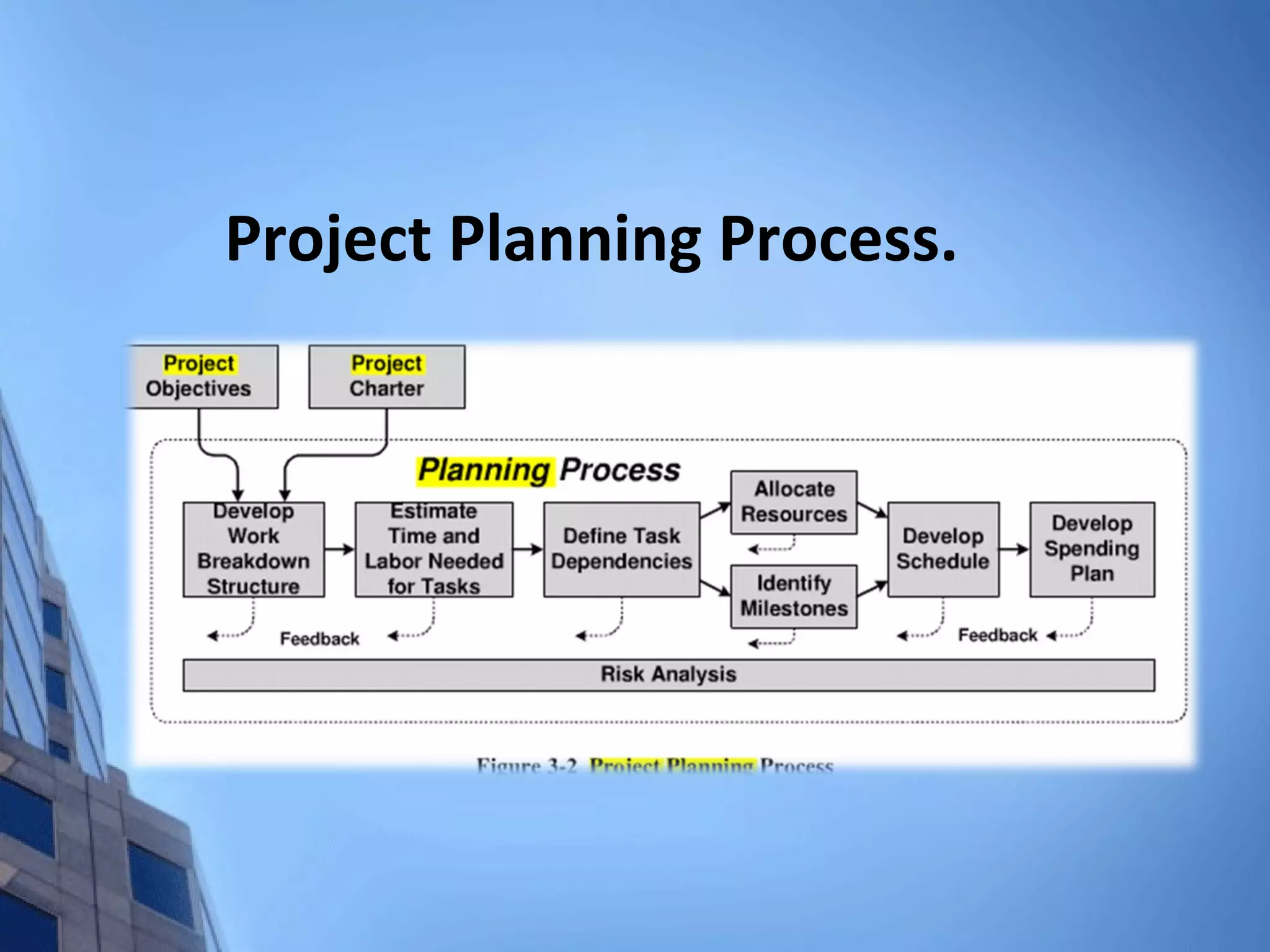
Some Important Terms Project  Charter:- Serves as the starting point of project, it includes title ,purpose ,statement of need ,expected results, signature of the stakeholders. WBS(Work Breakdown Structure):-It identifies the work to done to complete the project. The purpose of WBS is to describe the whole project and the strategy for completing the project by dividing it into logical components. Task Dependencies: Task Dependency is a relationship in which a task or milestone relies on other tasks to be performed (completely or partially) before it can be performed.
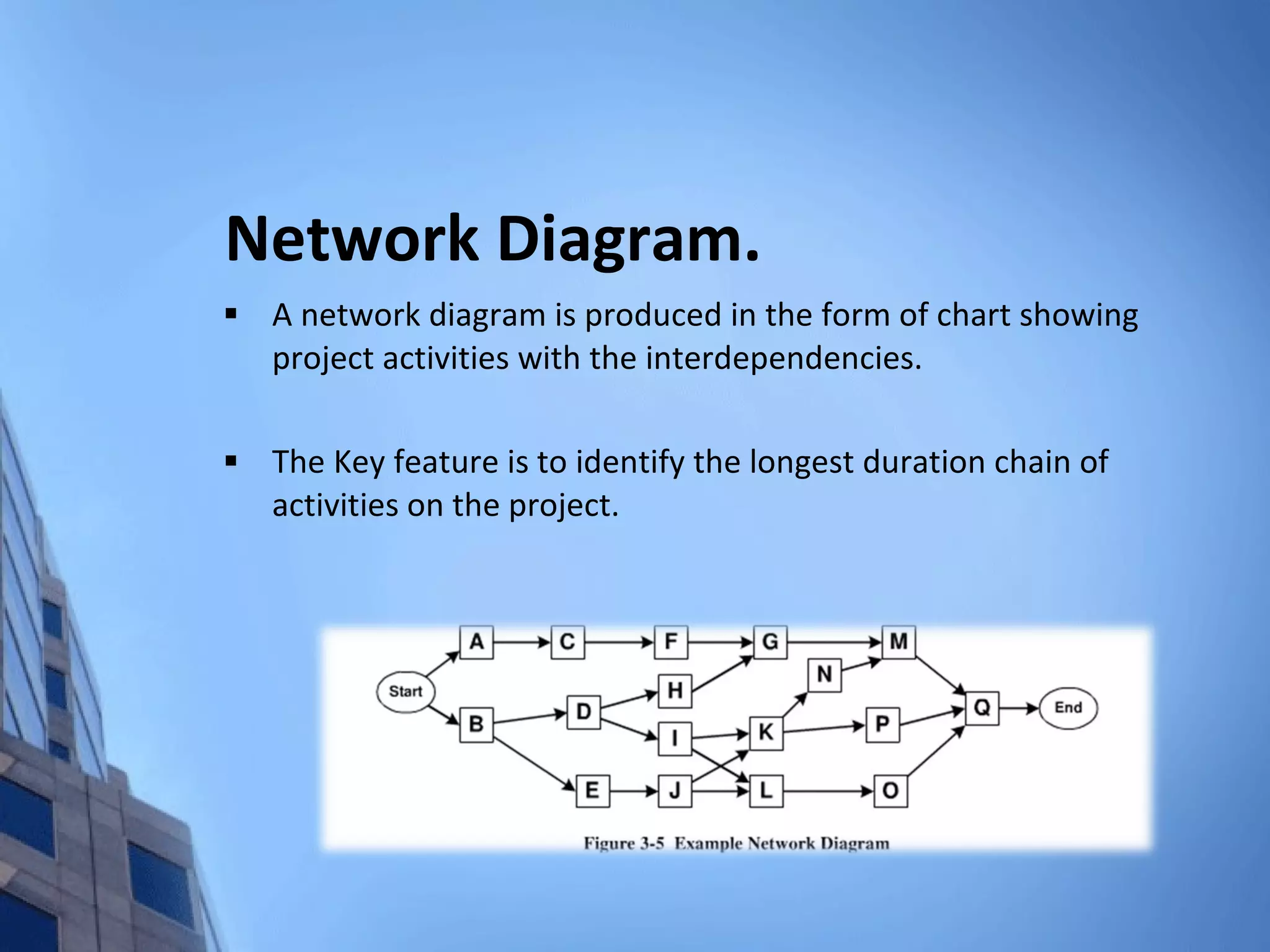
Network Diagram. A network diagram is produced in the form of chart showing project activities with the interdependencies. The Key feature is to identify the longest duration chain of activities on the project.
Schedule The project schedules tell when the project activities start, how long they last, and when they should be finished. Key to develop a perfect schedule is Work packages and task dependencies. This two inputs allow scheduler to develop accurate schedule. The schedule in usually in the form of Gantt chart ,Milestone chart.
Project Planning Process.
Production planning It is the function of establishing an overall level of output, called the production plan. The process also includes other activities needed to satisfy current planned levels of sales, while meeting the firm’s general objectives regarding profit, productivity, lead times, and customer satisfaction, as expressed in overall business plan. The managerial objective of production planning is to develop an integral game plan where the operations portion is production plan.
What is Production Planning? At its core, production planning represents the beating heart of any manufacturing process. Its purpose is to minimize production time and costs, efficiently organize the use of resources and maximize efficiency in the workplace. The primary purpose is to establish the production rates that will achieve management objective of satisfying customer demand.Demand satisfaction can be achieved through the maintaining ,raising,or lowering of inventories or backlogs,while keeping the workforce relatively stable.
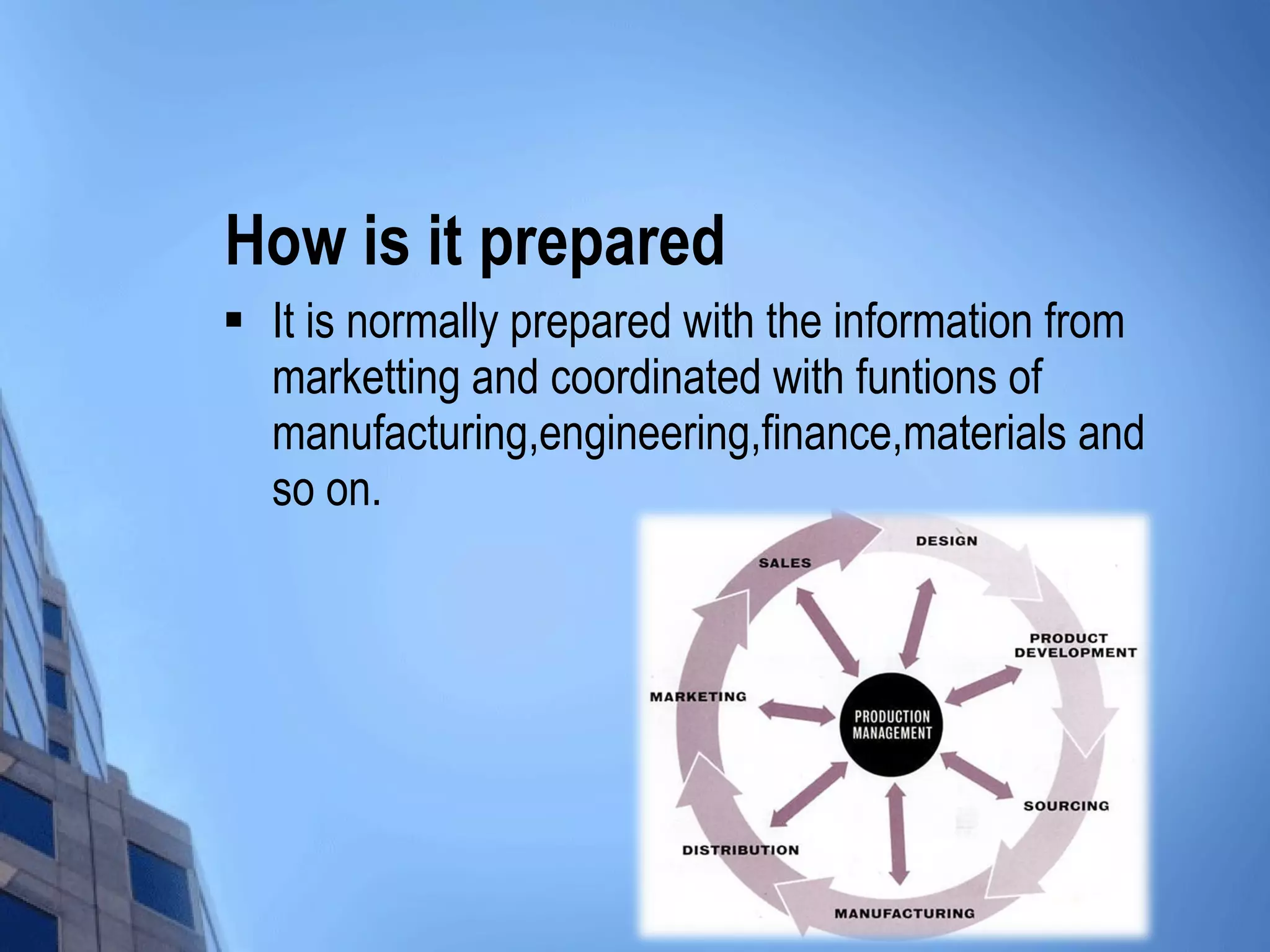
How is it prepared It is normally prepared with the information from marketting and coordinated with funtions of manufacturing,engineering,finance,materials and so on.
Process The production planning process begins with an updated sales forecast covering the next 6 to 18 months. Any desired increase or decrease in inventory and backlog levels can be added or subtracted,resulting in the production plan However ,the production plan is not a forecast of demands.It is planned production,stated on an aggregate basis.An effective production planning process will typically utilize explicit time fences for when the aggregate plan can be changed(increased or decreased).Also there may be constraints on the degree of change(amount of increase or decrease)

Project planning and Scheduling

  • 1.
    Project Planning &Scheduling Saurabh Naik
  • 2.
    Project Planning APlan is a Blue Print for Goal Achievement. Projects Often do not succeed without careful planning. Planning allows project teams to address 5 critical factors that determine success & failure of project. Quality Cost Schedule Performance Supportability
  • 3.
    Some Important TermsProject Charter:- Serves as the starting point of project, it includes title ,purpose ,statement of need ,expected results, signature of the stakeholders. WBS(Work Breakdown Structure):-It identifies the work to done to complete the project. The purpose of WBS is to describe the whole project and the strategy for completing the project by dividing it into logical components. Task Dependencies: Task Dependency is a relationship in which a task or milestone relies on other tasks to be performed (completely or partially) before it can be performed.
  • 4.
    Network Diagram. Anetwork diagram is produced in the form of chart showing project activities with the interdependencies. The Key feature is to identify the longest duration chain of activities on the project.
  • 5.
    Schedule The projectschedules tell when the project activities start, how long they last, and when they should be finished. Key to develop a perfect schedule is Work packages and task dependencies. This two inputs allow scheduler to develop accurate schedule. The schedule in usually in the form of Gantt chart ,Milestone chart.
  • 6.
  • 7.
    Production planning Itis the function of establishing an overall level of output, called the production plan. The process also includes other activities needed to satisfy current planned levels of sales, while meeting the firm’s general objectives regarding profit, productivity, lead times, and customer satisfaction, as expressed in overall business plan. The managerial objective of production planning is to develop an integral game plan where the operations portion is production plan.
  • 8.
    What is ProductionPlanning? At its core, production planning represents the beating heart of any manufacturing process. Its purpose is to minimize production time and costs, efficiently organize the use of resources and maximize efficiency in the workplace. The primary purpose is to establish the production rates that will achieve management objective of satisfying customer demand.Demand satisfaction can be achieved through the maintaining ,raising,or lowering of inventories or backlogs,while keeping the workforce relatively stable.
  • 9.
    How is itprepared It is normally prepared with the information from marketting and coordinated with funtions of manufacturing,engineering,finance,materials and so on.
  • 10.
    Process The productionplanning process begins with an updated sales forecast covering the next 6 to 18 months. Any desired increase or decrease in inventory and backlog levels can be added or subtracted,resulting in the production plan However ,the production plan is not a forecast of demands.It is planned production,stated on an aggregate basis.An effective production planning process will typically utilize explicit time fences for when the aggregate plan can be changed(increased or decreased).Also there may be constraints on the degree of change(amount of increase or decrease)