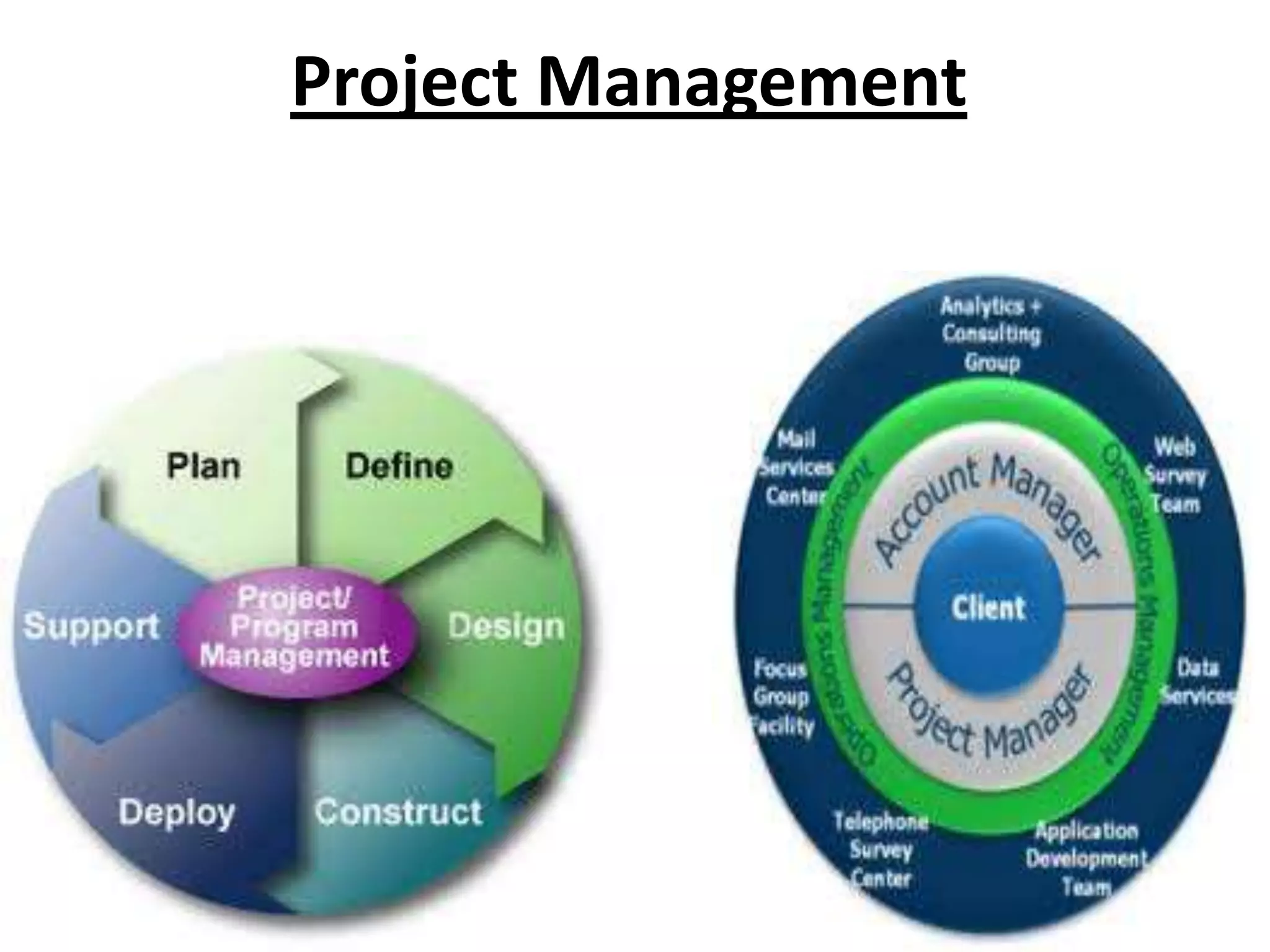

Project Management
Meaning
Project management is the discipline of
planning, organizing, securing, and managing
resources to achieve specific goals.
A project is a temporary endeavour with a
defined beginning and end (usually time-
constrained, and often constrained by funding
or deliverables), undertaken to meet unique
goals and objectives, typically to bring about
beneficial change or added value.
Characteristics
•   Investment pattern
•   Benefits or gain
•   Time Limit
•   Location
Classification
• Quantifiable and Non- Quantifiable Projects
• Sectoral Projects:-
Agricultural and allied sector
Irrigation and power sector
Industry and mining sector
Transportation and communication sector
Social service sector
Miscellaneous
Classification
• Techno – Economic Projects
 Factor intensity- oriented classification
 Capital intensive
 Lab our intensive
 Causation oriented classification
 Demand Based
 Raw material based
 Magnitude oriented classification
Large scale
Medium Scale
Small Scale
Classification
• Financial Institutions Classification
 New project
Expansion Project
Modernization Projects
Diversification Projects
• Service Project
 Welfare Project
Service Project
Research and Development Project
Educational Project
Importance
• Catalytic agent for economic development
• They have consequences which are long term in
  nature
• Projects provide the framework for the future
  activities of the enterprise
• Shape future pattern of service
• Involve substantial financial outlay
• Projects commitments cannot be easily reversed
• Brings necessary changes in society in course of
  time
• Accelerates the process of socio-cultural
  development
Features
• Simplicity and clarity
• Availability of attractive technology to
  promote the project
• Integration of basic production
  services, especially those of inputs
  supply, credit, marketing and extension
• Compatibility of the project within the
  existing administrative mix
Phases Of Project Management
•   Identification
•   Formulation
•   Appraisal
•   Selection
•   Implementation
•   Management
Identification
• Selection of a project after a careful scanning
  of the environment of investment
  opportunity and its likely return
Formulation
• Translation of the idea into a concrete project
  with scrutiny of its important preliminary
  aspects. Preparation of feasibility report
Appraisal
• Searching, scrutiny, analysis and evaluation
  of market technical, financial and economic
  variables. Assessing the profitability, return
  on investment and break even point
Selection
• Rational choice of a project in the light of
  objectives and inherent constraints
Implementation
• Expeditious completion within the allocated
  resources
Management
• Judicious operation of a project/ enterprise
  with objectives like maximization of net
  present value, maximization of return and
  return in the rate of return at low risk
Sources
• Project management ( Second Revised Edition
  1999) Vasant Desai
• http://en.wikipedia.org/wiki/Project_manage
  ment
Utsav Mahendra : Project management

Utsav Mahendra : Project management

  • 1.
  • 2.
    Meaning Project management isthe discipline of planning, organizing, securing, and managing resources to achieve specific goals. A project is a temporary endeavour with a defined beginning and end (usually time- constrained, and often constrained by funding or deliverables), undertaken to meet unique goals and objectives, typically to bring about beneficial change or added value.
  • 3.
    Characteristics • Investment pattern • Benefits or gain • Time Limit • Location
  • 4.
    Classification • Quantifiable andNon- Quantifiable Projects • Sectoral Projects:- Agricultural and allied sector Irrigation and power sector Industry and mining sector Transportation and communication sector Social service sector Miscellaneous
  • 5.
    Classification • Techno –Economic Projects  Factor intensity- oriented classification  Capital intensive  Lab our intensive  Causation oriented classification  Demand Based  Raw material based  Magnitude oriented classification Large scale Medium Scale Small Scale
  • 6.
    Classification • Financial InstitutionsClassification  New project Expansion Project Modernization Projects Diversification Projects • Service Project  Welfare Project Service Project Research and Development Project Educational Project
  • 7.
    Importance • Catalytic agentfor economic development • They have consequences which are long term in nature • Projects provide the framework for the future activities of the enterprise • Shape future pattern of service • Involve substantial financial outlay • Projects commitments cannot be easily reversed • Brings necessary changes in society in course of time • Accelerates the process of socio-cultural development
  • 8.
    Features • Simplicity andclarity • Availability of attractive technology to promote the project • Integration of basic production services, especially those of inputs supply, credit, marketing and extension • Compatibility of the project within the existing administrative mix
  • 9.
    Phases Of ProjectManagement • Identification • Formulation • Appraisal • Selection • Implementation • Management
  • 10.
    Identification • Selection ofa project after a careful scanning of the environment of investment opportunity and its likely return
  • 11.
    Formulation • Translation ofthe idea into a concrete project with scrutiny of its important preliminary aspects. Preparation of feasibility report
  • 12.
    Appraisal • Searching, scrutiny,analysis and evaluation of market technical, financial and economic variables. Assessing the profitability, return on investment and break even point
  • 13.
    Selection • Rational choiceof a project in the light of objectives and inherent constraints
  • 14.
    Implementation • Expeditious completionwithin the allocated resources
  • 15.
    Management • Judicious operationof a project/ enterprise with objectives like maximization of net present value, maximization of return and return in the rate of return at low risk
  • 16.
    Sources • Project management( Second Revised Edition 1999) Vasant Desai • http://en.wikipedia.org/wiki/Project_manage ment