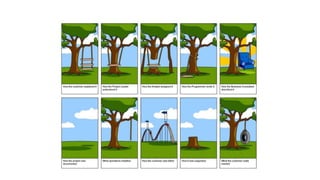
Introduction
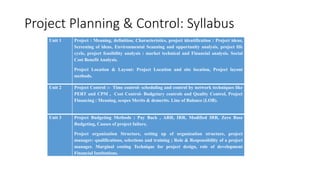
Project Planning & Control: Syllabus
Unit 1 Project : Meaning, definition, Characteristics, project identification : Project ideas,
Screening of ideas, Environmental Scanning and opportunity analysis, project life
cycle, project feasibility analysis : market technical and Financial analysis. Social
Cost Benefit Analysis.
Project Location & Layout: Project Location and site location, Project layout
methods.
Unit 2 Project Control :- Time control- scheduling and control by network techniques like
PERT and CPM , Cost Control- Budgetary controls and Quality Control, Project
Financing : Meaning, scopes Merits & demerits. Line of Balance (LOB).
Unit 3 Project Budgeting Methods : Pay Back , ARR, IRR, Modified IRR, Zero Base
Budgeting, Causes of project failure,
Project organization Structure, setting up of organization structure, project
manager: qualifications, selections and training ; Role & Responsibility of a project
manager. Marginal costing Technique for project design, role of development
Financial Institutions.
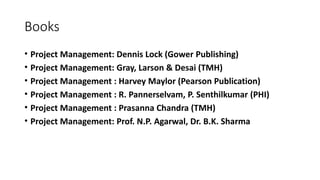
Books
• Project Management: Dennis Lock (Gower Publishing)
• Project Management: Gray, Larson & Desai (TMH)
• Project Management : Harvey Maylor (Pearson Publication)
• Project Management : R. Pannerselvam, P. Senthilkumar (PHI)
• Project Management : Prasanna Chandra (TMH)
• Project Management: Prof. N.P. Agarwal, Dr. B.K. Sharma
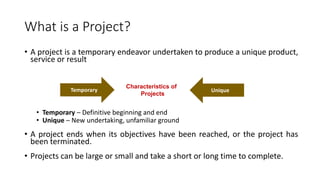
What is a Project?
• A project is a temporary endeavor undertaken to produce a unique product,
service or result
• Temporary – Definitive beginning and end
• Unique – New undertaking, unfamiliar ground
• A project ends when its objectives have been reached, or the project has
been terminated.
• Projects can be large or small and take a short or long time to complete.
Temporary Unique
Characteristics of
Projects
Project Attributes
• A project:
• Has a unique purpose.
• Is temporary.
• Is developed using progressive elaboration.
• Requires resources, often from various areas.
• Should have a primary customer or sponsor.
• The project sponsor usually provides the direction and funding for
the project.
• Involves uncertainty.
Examples of projects
Personal projects:
 obtain an MBA
 write a report
 plan a wedding
 plant a garden
 build a house extension
Industrial projects:
 construct a building
 provide a gas supply to an industrial estate
 build a motorway
 design a new car
Business projects:
 develop a new course
 develop a computer system
 introduce a new product
 prepare an annual report
 set up a new office
8
Definitions include:
• Any non-repetitive activity
• A low-volume, high variety activity
• A temporary endeavor undertaken to create a unique product or
service
• Any activity with a start and a finish
• A unique set of coordinated activities, with definite starting and
finishing points, undertaken by an individual or organization to meet
specific performance objectives within defined schedule, cost and
performance parameters
CHARACTERISTICS OF PROJECT
Objectives : A project has a set of objectives or a mission. Once the objectives
are achieved the project is treated as completed.
Life cycle : A project has a life cycle. The life cycle consists of five stages i.e.
conception stage, definition stage, planning & organizing stage, implementation
stage and commissioning stage.
Uniqueness : Every project is unique and no two projects are similar. Setting up
a cement plant and construction of a highway are two different projects having
unique features.
Team Work : Project is a team work and it normally consists of diverse areas.
There will be personnel specialized in their respective areas and co-ordination
among the diverse areas calls for team work.
• Complexity : A project is a complex set of activities relating to diverse
areas.
• Risk and uncertainty : Risk and uncertainty go hand in hand with
project. A risk-free, it only means that the element is not apparently
visible on the surface and it will be hidden underneath.
• Customer specific nature : A project is always customer specific. It is
the customer who decides upon the product to be produced or
services to be offered
• Change : Changes occur through out the life span of a project as a
natural outcome of many environmental factors. The changes may
very from minor to major
• Optimality : A project is always aimed at optimum utilization of
resources for the overall development of the economy.
• Sub-contracting : A high level of work in a project is done through
contractors. The more the complexity of the project, the more will be
the extent of contracting.
• Unity in diversity : A project is a complex set of thousands of
varieties. The varieties are in terms of technology, equipment and
materials, machinery and people, work, culture and others.
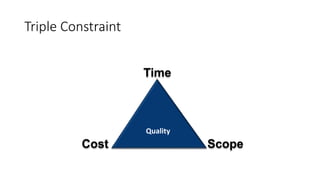
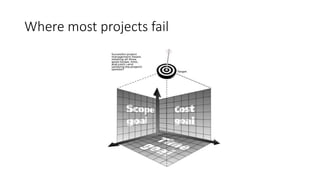
The Triple Constraint
• Every project is constrained in different ways by its:
• Scope goals: What work will be done?
• Time goals: How long should it take to complete?
• Cost goals: What should it cost?
• It is the project manager’s duty to balance these
three often-competing goals.
Triple Constraint
Quality
Scope
Time
Cost
Triple Constraint
• Increased Scope = increased time + increased cost
• Tight Time = increased costs + reduced scope
• Tight Budget = increased time + reduced scope.
What is Project Management
• Project Management is the application of skills, knowledge, tools and
techniques to meet the needs and expectations of stakeholders for a
project.
• The purpose of project management is prediction and prevention,
NOT recognition and reaction
What does Project Management Entail?
• Planning: is the most critical
• Organizing: Orderly fashion
(Contingent/Prerequisites)
• Controlling: is critical if we are to use our
limited resources wisely
• Measuring: To determine if we accomplished
the goal or met the target?
Objectives of Project Management
• Timely completion of the project
• Avoidance of delay, technical flaws and drawing
defects
• Proper flow of funds
• Proper tooling and techniques
• Proper control over chain reaction activities
Where most projects fail
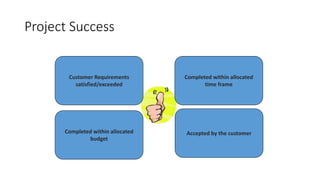
Project Success
Customer Requirements
satisfied/exceeded
Completed within allocated
time frame
Completed within allocated
budget
Accepted by the customer

Project planning and control

  • 1.
  • 2.
    Project Planning &Control: Syllabus Unit 1 Project : Meaning, definition, Characteristics, project identification : Project ideas, Screening of ideas, Environmental Scanning and opportunity analysis, project life cycle, project feasibility analysis : market technical and Financial analysis. Social Cost Benefit Analysis. Project Location & Layout: Project Location and site location, Project layout methods. Unit 2 Project Control :- Time control- scheduling and control by network techniques like PERT and CPM , Cost Control- Budgetary controls and Quality Control, Project Financing : Meaning, scopes Merits & demerits. Line of Balance (LOB). Unit 3 Project Budgeting Methods : Pay Back , ARR, IRR, Modified IRR, Zero Base Budgeting, Causes of project failure, Project organization Structure, setting up of organization structure, project manager: qualifications, selections and training ; Role & Responsibility of a project manager. Marginal costing Technique for project design, role of development Financial Institutions.
  • 3.
    Books • Project Management:Dennis Lock (Gower Publishing) • Project Management: Gray, Larson & Desai (TMH) • Project Management : Harvey Maylor (Pearson Publication) • Project Management : R. Pannerselvam, P. Senthilkumar (PHI) • Project Management : Prasanna Chandra (TMH) • Project Management: Prof. N.P. Agarwal, Dr. B.K. Sharma
  • 4.
    What is aProject? • A project is a temporary endeavor undertaken to produce a unique product, service or result • Temporary – Definitive beginning and end • Unique – New undertaking, unfamiliar ground • A project ends when its objectives have been reached, or the project has been terminated. • Projects can be large or small and take a short or long time to complete. Temporary Unique Characteristics of Projects
  • 6.
    Project Attributes • Aproject: • Has a unique purpose. • Is temporary. • Is developed using progressive elaboration. • Requires resources, often from various areas. • Should have a primary customer or sponsor. • The project sponsor usually provides the direction and funding for the project. • Involves uncertainty.
  • 7.
    Examples of projects Personalprojects:  obtain an MBA  write a report  plan a wedding  plant a garden  build a house extension Industrial projects:  construct a building  provide a gas supply to an industrial estate  build a motorway  design a new car Business projects:  develop a new course  develop a computer system  introduce a new product  prepare an annual report  set up a new office
  • 8.
    8 Definitions include: • Anynon-repetitive activity • A low-volume, high variety activity • A temporary endeavor undertaken to create a unique product or service • Any activity with a start and a finish • A unique set of coordinated activities, with definite starting and finishing points, undertaken by an individual or organization to meet specific performance objectives within defined schedule, cost and performance parameters
  • 9.
    CHARACTERISTICS OF PROJECT Objectives: A project has a set of objectives or a mission. Once the objectives are achieved the project is treated as completed. Life cycle : A project has a life cycle. The life cycle consists of five stages i.e. conception stage, definition stage, planning & organizing stage, implementation stage and commissioning stage. Uniqueness : Every project is unique and no two projects are similar. Setting up a cement plant and construction of a highway are two different projects having unique features. Team Work : Project is a team work and it normally consists of diverse areas. There will be personnel specialized in their respective areas and co-ordination among the diverse areas calls for team work.
  • 10.
    • Complexity :A project is a complex set of activities relating to diverse areas. • Risk and uncertainty : Risk and uncertainty go hand in hand with project. A risk-free, it only means that the element is not apparently visible on the surface and it will be hidden underneath. • Customer specific nature : A project is always customer specific. It is the customer who decides upon the product to be produced or services to be offered • Change : Changes occur through out the life span of a project as a natural outcome of many environmental factors. The changes may very from minor to major
  • 11.
    • Optimality :A project is always aimed at optimum utilization of resources for the overall development of the economy. • Sub-contracting : A high level of work in a project is done through contractors. The more the complexity of the project, the more will be the extent of contracting. • Unity in diversity : A project is a complex set of thousands of varieties. The varieties are in terms of technology, equipment and materials, machinery and people, work, culture and others.
  • 12.
    The Triple Constraint •Every project is constrained in different ways by its: • Scope goals: What work will be done? • Time goals: How long should it take to complete? • Cost goals: What should it cost? • It is the project manager’s duty to balance these three often-competing goals.
  • 13.
  • 14.
    Triple Constraint • IncreasedScope = increased time + increased cost • Tight Time = increased costs + reduced scope • Tight Budget = increased time + reduced scope.
  • 15.
    What is ProjectManagement • Project Management is the application of skills, knowledge, tools and techniques to meet the needs and expectations of stakeholders for a project. • The purpose of project management is prediction and prevention, NOT recognition and reaction
  • 16.
    What does ProjectManagement Entail? • Planning: is the most critical • Organizing: Orderly fashion (Contingent/Prerequisites) • Controlling: is critical if we are to use our limited resources wisely • Measuring: To determine if we accomplished the goal or met the target?
  • 17.
    Objectives of ProjectManagement • Timely completion of the project • Avoidance of delay, technical flaws and drawing defects • Proper flow of funds • Proper tooling and techniques • Proper control over chain reaction activities
  • 18.
  • 19.
    Project Success Customer Requirements satisfied/exceeded Completedwithin allocated time frame Completed within allocated budget Accepted by the customer

Editor's Notes

  • #9 University of Calgary/APEGGA