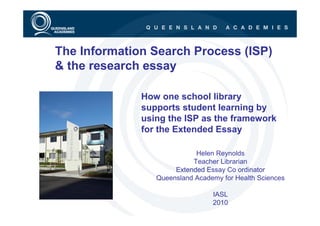
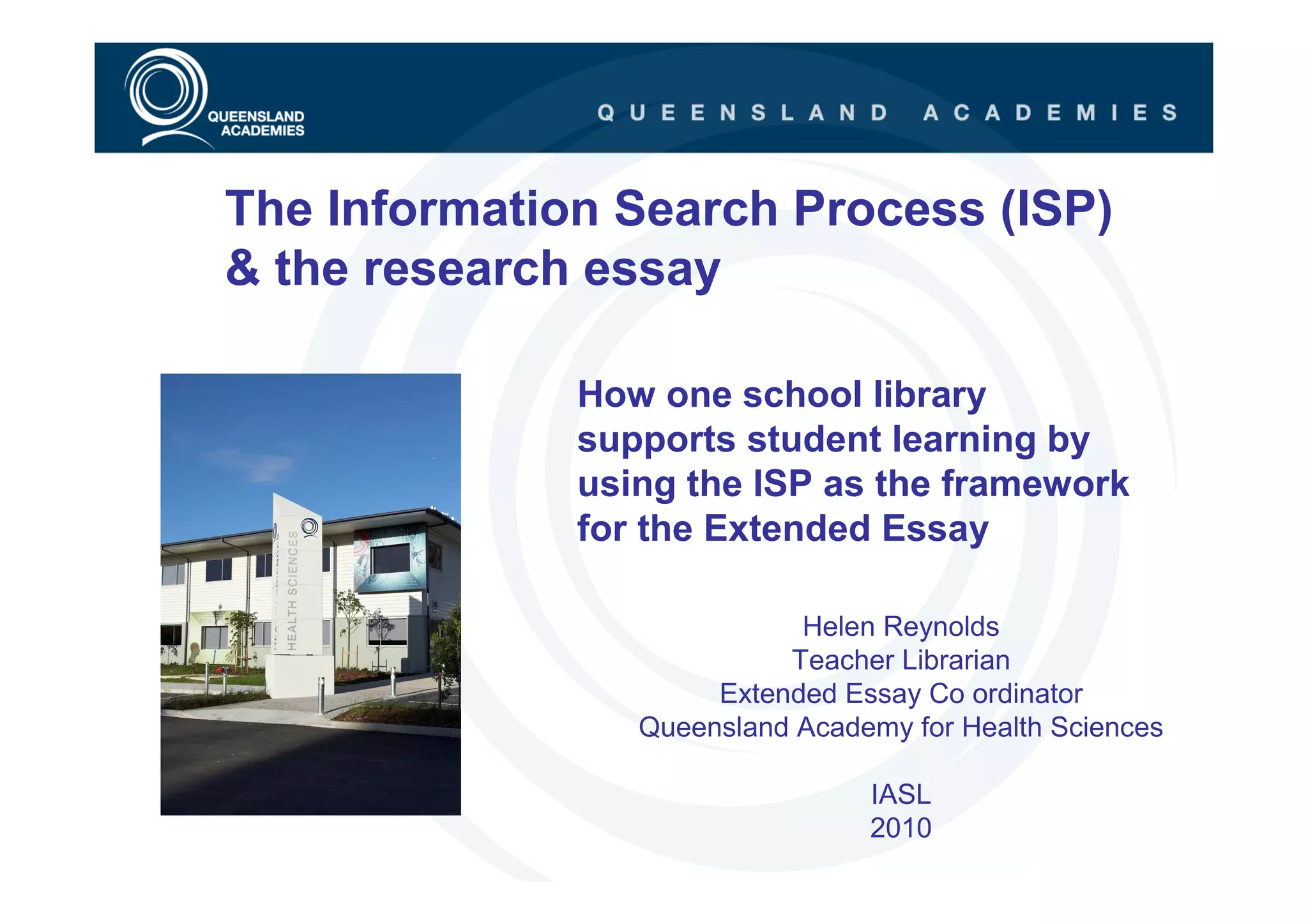
The Information Search Process (ISP)
& the research essay

              How one school library
              supports student learning by
              using the ISP as the framework
              for the Extended Essay

                            Helen Reynolds
                           Teacher Librarian
                      Extended Essay Co ordinator
                 Queensland Academy for Health Sciences

                                 IASL
                                 2010
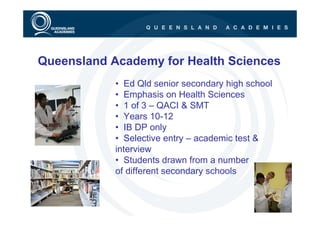
Queensland Academy for Health Sciences
            • Ed Qld senior secondary high school
            • Emphasis on Health Sciences
            • 1 of 3 – QACI & SMT
            • Years 10-12
            • IB DP only
            • Selective entry – academic test &
            interview
            • Students drawn from a number
            of different secondary schools
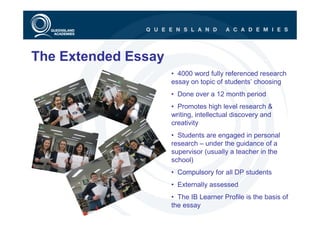
The Extended Essay
                     • 4000 word fully referenced research
                     essay on topic of students’ choosing
                     • Done over a 12 month period
                     • Promotes high level research &
                     writing, intellectual discovery and
                     creativity
                     • Students are engaged in personal
                     research – under the guidance of a
                     supervisor (usually a teacher in the
                     school)
                     • Compulsory for all DP students
                     • Externally assessed
                     • The IB Learner Profile is the basis of
                     the essay
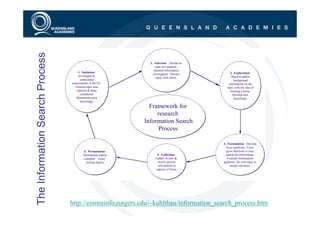
The Information Search Process
                                                                2. Selection : Decide on
                                                                    topic for research.
                                                                   General information
                                      1. Initiation:                                            3. Exploration :
                                                                  investigated. Discuss
                                      Investigate &                                              Begin to gather
                                                                     topic with others
                                        understand                                                background
                                 requirements of the EE.                                       information on the
                                    General topic area                                       topic with the idea of
                                     selected & ideas                                           forming a focus.
                                        considered.                                               Develop new
                                    Brainstorm prior                                               knowledge.
                                        knowledge.
                                                                Framework for
                                                                   research
                                                              Information Search
                                                                   Process

                                                                                           4. Formulation : Develop
                                                                                             focus questions. Focus
                                          6. Presentation:                                   gives direction to your
                                         Information search         5. Collection :          search for information.
                                          complete . Essay         Gather, review &           Evaluate information
                                           writing begins.          record specific        gathered. Re visit topic to
                                                                    information in              ensure relevance
                                                                   support of focus


                                 http://comminfo.rutgers.edu/~kuhlthau/information_search_process.htm
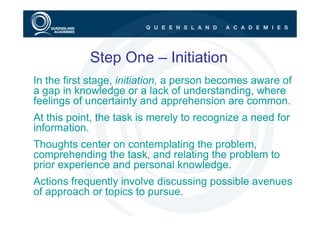
Step One – Initiation
In the first stage, initiation, a person becomes aware of
a gap in knowledge or a lack of understanding, where
feelings of uncertainty and apprehension are common.
At this point, the task is merely to recognize a need for
information.
Thoughts center on contemplating the problem,
comprehending the task, and relating the problem to
prior experience and personal knowledge.
Actions frequently involve discussing possible avenues
of approach or topics to pursue.
Step One – Initiation
                      [Inquirers, Thinkers, Risk-takers]
• Investigate & understand requirements of the EE

• Clarify the expectations and different tasks needed to complete the EE

• Relate the task to your personal knowledge

• Select your general subject area

• Establish & map your prior knowledge

• Develop an understanding of the real world relevance of your investigation

• Task organisation

• Recognise what information may be needed
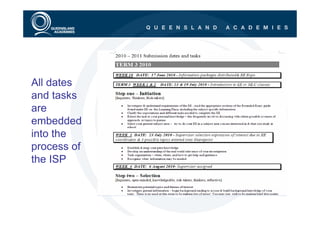
All dates
and tasks
are
embedded
into the
process of
the ISP
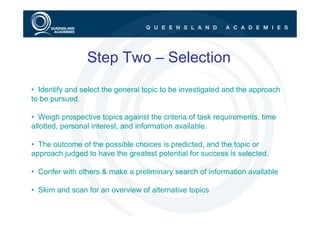
Step Two – Selection
• Identify and select the general topic to be investigated and the approach
to be pursued.

• Weigh prospective topics against the criteria of task requirements, time
allotted, personal interest, and information available.

• The outcome of the possible choices is predicted, and the topic or
approach judged to have the greatest potential for success is selected.

• Confer with others & make a preliminary search of information available

• Skim and scan for an overview of alternative topics
Step Two – Selection
           [Inquirers, Open- minded, Knowledgeable, Reflective,
                           Thinkers, Risk-takers]


• Brainstorm potential topics and themes of interest

• Investigate general information – begin background reading to access &
  build background knowledge of your topic
  There is no need at this stage to be making lots of notes! You may just
  wish to be making brief dots points

• Meet with supervisor to identify, justify & decide on topic for research

• Discuss topic with others
Step Three – Exploration
         [Inquirers, knowledgeable, thinkers, open-mined, reflective]

• Gather background information to form a focus & develop new
knowledge [this is often called an annotated bibliography] - use a graphic
organiser to record your ideas

• Relate new information to what you already know

• Verify and clarify any existing ideas you may have & the accuracy and
bias of these ideas

• Look at quality of your sources & the quality of any websites you might
find

• Begin framing the essential questions that will guide your essay
Step Four – Formulation
             [Thinkers, communicators, open-minded, reflective]

• Form focused perspective - factual platform on which to being to
develop and frame your focus questions

• What questions spring to mind as you do your reading – note these
down

• Develop focus questions

• Evaluate information gathered

• Personalised plan for the structure of your investigation

• Begin detailed list of references – reference list on the Library homepage
Step Five – Collection
       [Inquirers, knowledgeable, open-minded, reflective]

• Gather, review & record specific information in support of focus- make
detailed notes

• Ensure that these notes answer your research questions and are not
just fact gathering

• Develop conclusions and your position on the topic
Step Six – Presentation
      [Thinkers, communicators, open-minded, reflective]


In this stage you will be ready to begin writing your essay or
you may be ready to begin your experimental work.
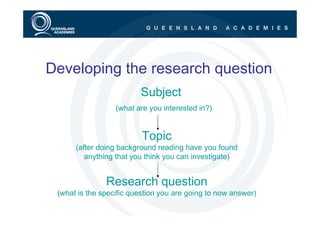
Developing the research question
                         Subject
                  (what are you interested in?)


                          Topic
      (after doing background reading have you found
         anything that you think you can investigate)


               Research question
 (what is the specific question you are going to now answer)
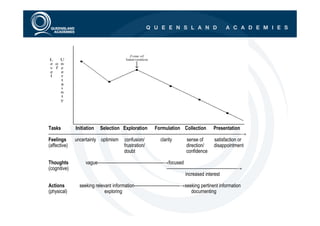
Tasks       Initiation Selection Exploration Formulation Collection Presentation
————————————————————————————————————————————→
Feelings    uncertainly optimism confusion/    clarity    sense of  satisfaction or
(affective)                      frustration/            direction/ disappointment
                                 doubt                   confidence

Thoughts        vague———————————————→focused
(cognitive)                          ————————————————→
                                             increased interest

Actions       seeking relevant information——————————-→seeking pertinent information
(physical)                 exploring                     documenting
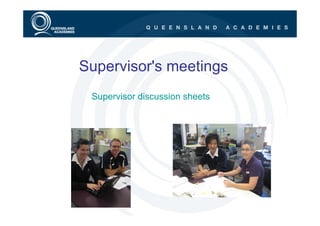
Supervisor's meetings
 Supervisor discussion sheets
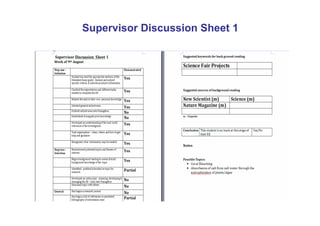
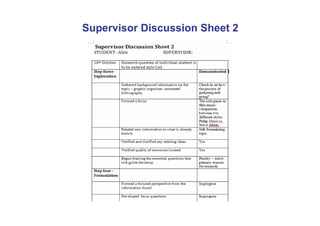
Supervisor Discussion Sheet 1
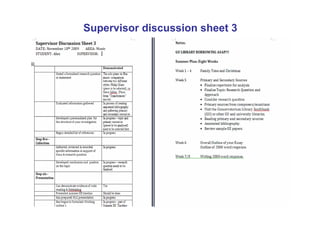
Supervisor Discussion Sheet 2
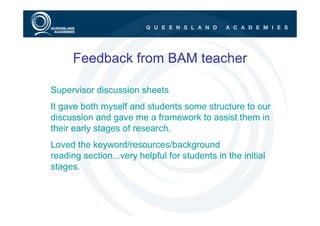
Supervisor discussion sheet 3
Feedback from BAM teacher

Supervisor discussion sheets
It gave both myself and students some structure to our
discussion and gave me a framework to assist them in
their early stages of research.
Loved the keyword/resources/background
reading section...very helpful for students in the initial
stages.
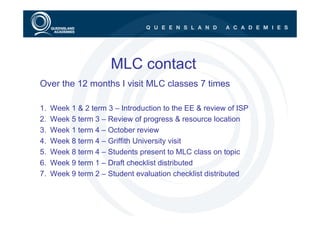
MLC contact
Over the 12 months I visit MLC classes 7 times

1.   Week 1 & 2 term 3 – Introduction to the EE & review of ISP
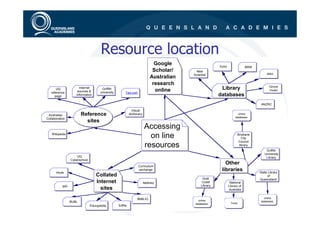
2.   Week 5 term 3 – Review of progress & resource location
3.   Week 1 term 4 – October review
4.   Week 8 term 4 – Griffith University visit
5.   Week 8 term 4 – Students present to MLC class on topic
6.   Week 9 term 1 – Draft checklist distributed
7.   Week 9 term 2 – Student evaluation checklist distributed
Resource location
                                                                              Google                    Echo                BRW
                                                                             Scholar/      New
                                                                                         Scientist                                     Jstor
                                                                            Australian
                                                                             research                                                    Grove
      UQ               Internet
                      sources &
                                       Griffith
                                                                              online                     Library                         music
   reference                          university      Ted.com
     page            information                                                                        databases
                                                                                                                                   ANZRC
                                                            Visual
 Australian              Reference                        dictionary                                                  online
                                                                                                                    databases
Collaboration
                           sites
                                                                       Accessing
   Wikipedia
                                                                         on line                                      Brisbane
                                                                                                                         City
                                                                                                                       Council
                                                                       resources                                       library
                                                                                                                                      Griffith
                                                                                                                                     University
                      UQ                                                                                                              Library
                  Cyberschool
                                                                                                           Other
                                                                 Curriculum

      Intute
                                                                 exchange                                libraries                State Library
                                   Collated                                                                                             of
                                                                                               Gold                               Queensland
                                   Internet                            Netlinks               Coast             National
           Ipl2                                                                               Library          Library of
                                     sites                                                                     Australia


                                                                IBIBLIO                                                              online
                  BUBL                                                                      online                                 databases
                                                                                          databases             Trove
                                Educypedia         EdNa
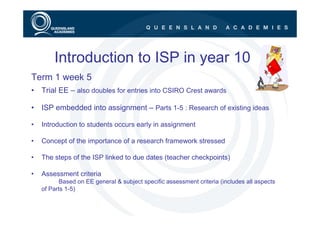
Introduction to ISP in year 10
Term 1 week 5
• Trial EE – also doubles for entries into CSIRO Crest awards

• ISP embedded into assignment – Parts 1-5 : Research of existing ideas

•   Introduction to students occurs early in assignment

•   Concept of the importance of a research framework stressed

•   The steps of the ISP linked to due dates (teacher checkpoints)

•   Assessment criteria
           Based on EE general & subject specific assessment criteria (includes all aspects
    of Parts 1-5)
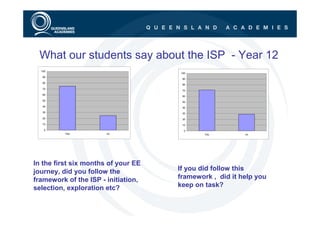
What our students say about the ISP - Year 12
  100
                                     100
   90
                                      90
   80
                                      80
   70
                                      70
   60
                                      60
   50                                 50
   40                                 40
   30                                 30
   20                                 20
   10                                 10
   0                                  0
          Yes          no                    Yes         no


In the first six months of your EE
journey, did you follow the          If you did follow this
framework of the ISP - initiation,   framework , did it help you
selection, exploration etc?          keep on task?
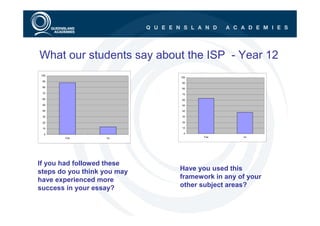
What our students say about the ISP - Year 12
100
                             100
 90
                             90
 80                          80
 70                          70
 60                          60

 50                          50

 40                          40

 30                          30

 20                          20

 10                          10

 0                            0
       Yes         no               Yes        no


If you had followed these
steps do you think you may   Have you used this
have experienced more        framework in any of your
success in your essay?       other subject areas?
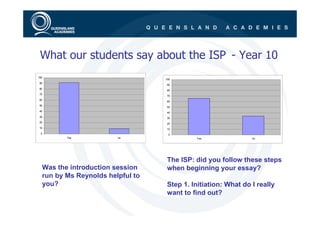
What our students say about the ISP - Year 10
100
                                  100
90
                                  90
80
                                  80
70
                                  70
60                                60
50
                                  50
40                                40
30                                30
20                                20
10                                10
 0                                 0
         Yes            no                  Yes                no


                                   The ISP: did you follow these steps
  Was the introduction session     when beginning your essay?
  run by Ms Reynolds helpful to
  you?                             Step 1. Initiation: What do I really
                                   want to find out?
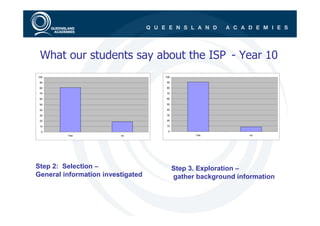
What our students say about the ISP - Year 10
100                                100

 90                                 90

 80                                 80

 70                                 70

 60                                 60

 50                                 50

 40                                 40

 30                                 30

 20                                 20

 10                                 10

 0                                  0
         Yes             no                    Yes            no


Step 2: Selection –                      Step 3. Exploration –
General information investigated         gather background information
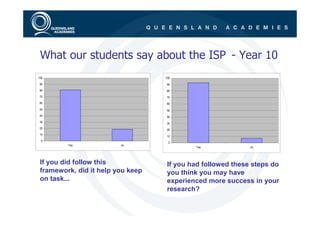
What our students say about the ISP - Year 10
100                                100
90                                  90
80                                  80
70                                  70
60                                  60
50                                  50
40                                  40
30                                  30
20
                                    20
10
                                    10
 0
                                    0
         Yes             no
                                            Yes              no


 If you did follow this             If you had followed these steps do
 framework, did it help you keep    you think you may have
 on task...                         experienced more success in your
                                    research?
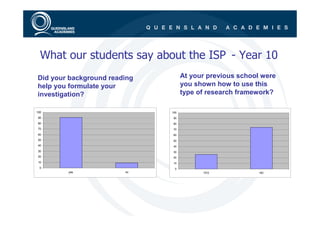
What our students say about the ISP - Year 10
Did your background reading         At your previous school were
help you formulate your             you shown how to use this
investigation?                      type of research framework?

100                           100
90                            90
80                            80
70                            70
60                            60
50                            50
40                            40
30                            30
20                            20
10                            10
 0                             0
        yes             no                YES              NO
What our students say about the ISP - Year 10
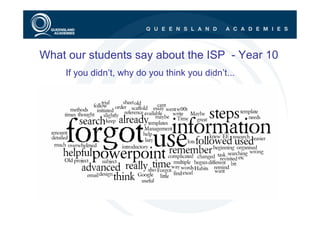
    If you didn’t, why do you think you didn’t...
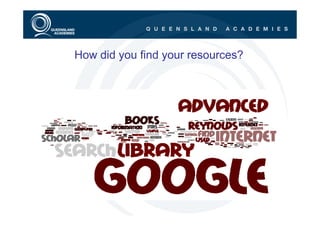
How did you find your resources?
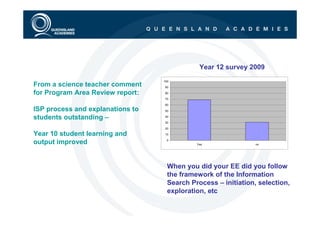
Year 12 survey 2009
                                  100
From a science teacher comment    90

for Program Area Review report:   80

                                  70

                                  60
ISP process and explanations to   50

students outstanding –            40

                                  30

                                  20

Year 10 student learning and      10


output improved                    0
                                             Yes                no


                                    When you did your EE did you follow
                                    the framework of the Information
                                    Search Process – initiation, selection,
                                    exploration, etc
Questions?

The Information Search Process (ISP) and the research essay

  • 1.
    The Information SearchProcess (ISP) & the research essay How one school library supports student learning by using the ISP as the framework for the Extended Essay Helen Reynolds Teacher Librarian Extended Essay Co ordinator Queensland Academy for Health Sciences IASL 2010
  • 2.
    Queensland Academy forHealth Sciences • Ed Qld senior secondary high school • Emphasis on Health Sciences • 1 of 3 – QACI & SMT • Years 10-12 • IB DP only • Selective entry – academic test & interview • Students drawn from a number of different secondary schools
  • 3.
    The Extended Essay • 4000 word fully referenced research essay on topic of students’ choosing • Done over a 12 month period • Promotes high level research & writing, intellectual discovery and creativity • Students are engaged in personal research – under the guidance of a supervisor (usually a teacher in the school) • Compulsory for all DP students • Externally assessed • The IB Learner Profile is the basis of the essay
  • 4.
    The Information SearchProcess 2. Selection : Decide on topic for research. General information 1. Initiation: 3. Exploration : investigated. Discuss Investigate & Begin to gather topic with others understand background requirements of the EE. information on the General topic area topic with the idea of selected & ideas forming a focus. considered. Develop new Brainstorm prior knowledge. knowledge. Framework for research Information Search Process 4. Formulation : Develop focus questions. Focus 6. Presentation: gives direction to your Information search 5. Collection : search for information. complete . Essay Gather, review & Evaluate information writing begins. record specific gathered. Re visit topic to information in ensure relevance support of focus http://comminfo.rutgers.edu/~kuhlthau/information_search_process.htm
  • 5.
    Step One –Initiation In the first stage, initiation, a person becomes aware of a gap in knowledge or a lack of understanding, where feelings of uncertainty and apprehension are common. At this point, the task is merely to recognize a need for information. Thoughts center on contemplating the problem, comprehending the task, and relating the problem to prior experience and personal knowledge. Actions frequently involve discussing possible avenues of approach or topics to pursue.
  • 6.
    Step One –Initiation [Inquirers, Thinkers, Risk-takers] • Investigate & understand requirements of the EE • Clarify the expectations and different tasks needed to complete the EE • Relate the task to your personal knowledge • Select your general subject area • Establish & map your prior knowledge • Develop an understanding of the real world relevance of your investigation • Task organisation • Recognise what information may be needed
  • 7.
  • 8.
    Step Two –Selection • Identify and select the general topic to be investigated and the approach to be pursued. • Weigh prospective topics against the criteria of task requirements, time allotted, personal interest, and information available. • The outcome of the possible choices is predicted, and the topic or approach judged to have the greatest potential for success is selected. • Confer with others & make a preliminary search of information available • Skim and scan for an overview of alternative topics
  • 9.
    Step Two –Selection [Inquirers, Open- minded, Knowledgeable, Reflective, Thinkers, Risk-takers] • Brainstorm potential topics and themes of interest • Investigate general information – begin background reading to access & build background knowledge of your topic There is no need at this stage to be making lots of notes! You may just wish to be making brief dots points • Meet with supervisor to identify, justify & decide on topic for research • Discuss topic with others
  • 10.
    Step Three –Exploration [Inquirers, knowledgeable, thinkers, open-mined, reflective] • Gather background information to form a focus & develop new knowledge [this is often called an annotated bibliography] - use a graphic organiser to record your ideas • Relate new information to what you already know • Verify and clarify any existing ideas you may have & the accuracy and bias of these ideas • Look at quality of your sources & the quality of any websites you might find • Begin framing the essential questions that will guide your essay
  • 11.
    Step Four –Formulation [Thinkers, communicators, open-minded, reflective] • Form focused perspective - factual platform on which to being to develop and frame your focus questions • What questions spring to mind as you do your reading – note these down • Develop focus questions • Evaluate information gathered • Personalised plan for the structure of your investigation • Begin detailed list of references – reference list on the Library homepage
  • 12.
    Step Five –Collection [Inquirers, knowledgeable, open-minded, reflective] • Gather, review & record specific information in support of focus- make detailed notes • Ensure that these notes answer your research questions and are not just fact gathering • Develop conclusions and your position on the topic
  • 13.
    Step Six –Presentation [Thinkers, communicators, open-minded, reflective] In this stage you will be ready to begin writing your essay or you may be ready to begin your experimental work.
  • 14.
    Developing the researchquestion Subject (what are you interested in?) Topic (after doing background reading have you found anything that you think you can investigate) Research question (what is the specific question you are going to now answer)
  • 15.
    Tasks Initiation Selection Exploration Formulation Collection Presentation ————————————————————————————————————————————→ Feelings uncertainly optimism confusion/ clarity sense of satisfaction or (affective) frustration/ direction/ disappointment doubt confidence Thoughts vague———————————————→focused (cognitive) ————————————————→ increased interest Actions seeking relevant information——————————-→seeking pertinent information (physical) exploring documenting
  • 16.
  • 17.
  • 18.
  • 19.
  • 20.
    Feedback from BAMteacher Supervisor discussion sheets It gave both myself and students some structure to our discussion and gave me a framework to assist them in their early stages of research. Loved the keyword/resources/background reading section...very helpful for students in the initial stages.
  • 21.
    MLC contact Over the12 months I visit MLC classes 7 times 1. Week 1 & 2 term 3 – Introduction to the EE & review of ISP 2. Week 5 term 3 – Review of progress & resource location 3. Week 1 term 4 – October review 4. Week 8 term 4 – Griffith University visit 5. Week 8 term 4 – Students present to MLC class on topic 6. Week 9 term 1 – Draft checklist distributed 7. Week 9 term 2 – Student evaluation checklist distributed
  • 22.
    Resource location Google Echo BRW Scholar/ New Scientist Jstor Australian research Grove UQ Internet sources & Griffith online Library music reference university Ted.com page information databases ANZRC Visual Australian Reference dictionary online databases Collaboration sites Accessing Wikipedia on line Brisbane City Council resources library Griffith University UQ Library Cyberschool Other Curriculum Intute exchange libraries State Library Collated of Gold Queensland Internet Netlinks Coast National Ipl2 Library Library of sites Australia IBIBLIO online BUBL online databases databases Trove Educypedia EdNa
  • 23.
    Introduction to ISPin year 10 Term 1 week 5 • Trial EE – also doubles for entries into CSIRO Crest awards • ISP embedded into assignment – Parts 1-5 : Research of existing ideas • Introduction to students occurs early in assignment • Concept of the importance of a research framework stressed • The steps of the ISP linked to due dates (teacher checkpoints) • Assessment criteria Based on EE general & subject specific assessment criteria (includes all aspects of Parts 1-5)
  • 24.
    What our studentssay about the ISP - Year 12 100 100 90 90 80 80 70 70 60 60 50 50 40 40 30 30 20 20 10 10 0 0 Yes no Yes no In the first six months of your EE journey, did you follow the If you did follow this framework of the ISP - initiation, framework , did it help you selection, exploration etc? keep on task?
  • 25.
    What our studentssay about the ISP - Year 12 100 100 90 90 80 80 70 70 60 60 50 50 40 40 30 30 20 20 10 10 0 0 Yes no Yes no If you had followed these steps do you think you may Have you used this have experienced more framework in any of your success in your essay? other subject areas?
  • 26.
    What our studentssay about the ISP - Year 10 100 100 90 90 80 80 70 70 60 60 50 50 40 40 30 30 20 20 10 10 0 0 Yes no Yes no The ISP: did you follow these steps Was the introduction session when beginning your essay? run by Ms Reynolds helpful to you? Step 1. Initiation: What do I really want to find out?
  • 27.
    What our studentssay about the ISP - Year 10 100 100 90 90 80 80 70 70 60 60 50 50 40 40 30 30 20 20 10 10 0 0 Yes no Yes no Step 2: Selection – Step 3. Exploration – General information investigated gather background information
  • 28.
    What our studentssay about the ISP - Year 10 100 100 90 90 80 80 70 70 60 60 50 50 40 40 30 30 20 20 10 10 0 0 Yes no Yes no If you did follow this If you had followed these steps do framework, did it help you keep you think you may have on task... experienced more success in your research?
  • 29.
    What our studentssay about the ISP - Year 10 Did your background reading At your previous school were help you formulate your you shown how to use this investigation? type of research framework? 100 100 90 90 80 80 70 70 60 60 50 50 40 40 30 30 20 20 10 10 0 0 yes no YES NO
  • 30.
    What our studentssay about the ISP - Year 10 If you didn’t, why do you think you didn’t...
  • 31.
    How did youfind your resources?
  • 32.
    Year 12 survey2009 100 From a science teacher comment 90 for Program Area Review report: 80 70 60 ISP process and explanations to 50 students outstanding – 40 30 20 Year 10 student learning and 10 output improved 0 Yes no When you did your EE did you follow the framework of the Information Search Process – initiation, selection, exploration, etc
  • 33.