BARKS AND WOODS 3
DR. MOSTAFA MAHMOUD HEGAZY PH.D
➢ content
➢ Barks containing Tannins (Witch Hazel and Pine Bark)
➢ Galls
➢ woods (Quassia, Guaiacum and sandal)
Barks and woods Dr. Mostafa Hegazy
Barks containing
Tannins
Hamamelis leaves and Barks
Witch Hazel (winter bloom)
‫الهماميليس‬ ‫لحاء‬ ‫و‬ ‫أوراق‬
Origin: Dried leaves and/ or barks of Hamamelis
virginiana L. Family Hamamelidaceae
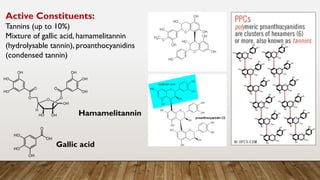
Gallic acid
Hamamelitannin
Active Constituents:
Tannins (up to 10%)
Mixture of gallic acid, hamamelitannin
(hydrolysable tannin), proanthocyanidins
(condensed tannin)
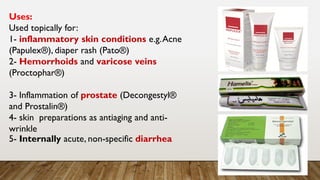
Uses:
Used topically for:
1- inflammatory skin conditions e.g.Acne
(Papulex®), diaper rash (Pato®)
2- Hemorrhoids and varicose veins
(Proctophar®)
3- Inflammation of prostate (Decongestyl®
and Prostalin®)
4- skin preparations as antiaging and anti-
wrinkle
5- Internally acute, non-specific diarrhea
Pine Bark
‫الصنوبر‬ ‫لحاء‬
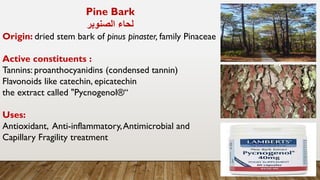
Origin: dried stem bark of pinus pinaster, family Pinaceae
Active constituents :
Tannins: proanthocyanidins (condensed tannin)
Flavonoids like catechin, epicatechin
the extract called "Pycnogenol®“
Uses:
Antioxidant, Anti-inflammatory,Antimicrobial and
Capillary Fragility treatment
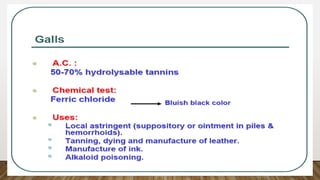
Galls
Galls ‫العفص‬
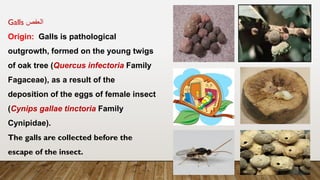
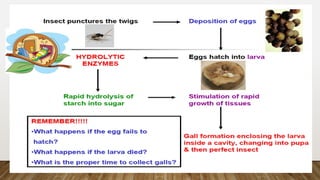
Origin: Galls is pathological
outgrowth, formed on the young twigs
of oak tree (Quercus infectoria Family
Fagaceae), as a result of the
deposition of the eggs of female insect
(Cynips gallae tinctoria Family
Cynipidae).
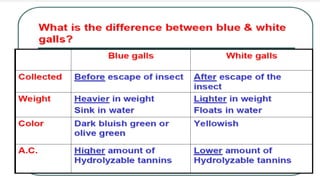
The galls are collected before the
escape of the insect.
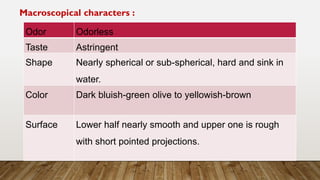
Odor Odorless
Taste Astringent
Shape Nearly spherical or sub-spherical, hard and sink in
water.
Color Dark bluish-green olive to yellowish-brown
Surface Lower half nearly smooth and upper one is rough
with short pointed projections.
Macroscopical characters :
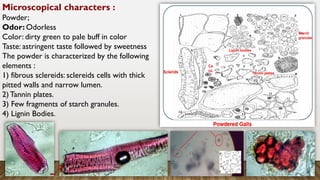
Microscopical characters :
Powder;
Odor: Odorless
Color: dirty green to pale buff in color
Taste: astringent taste followed by sweetness
The powder is characterized by the following
elements :
1) fibrous sclereids: sclereids cells with thick
pitted walls and narrow lumen.
2) Tannin plates.
3) Few fragments of starch granules.
4) Lignin Bodies.
Woods
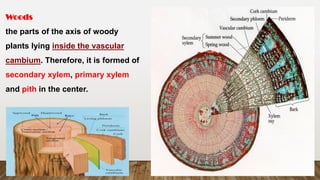
Woods
the parts of the axis of woody
plants lying inside the vascular
cambium. Therefore, it is formed of
secondary xylem, primary xylem
and pith in the center.
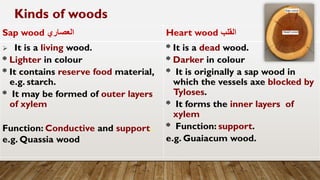
Sap wood ‫العصاري‬ Heart wood ‫القلب‬
➢ It is a living wood.
* Lighter in colour
* It contains reserve food material,
e.g. starch.
* It may be formed of outer layers
of xylem
Function: Conductive and support.
e.g. Quassia wood
* It is a dead wood.
* Darker in colour
* It is originally a sap wood in
which the vessels axe blocked by
Tyloses.
* It forms the inner layers of
xylem
* Function: support.
e.g. Guaiacum wood.
Kinds of woods
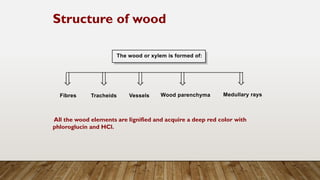
Structure of wood
All the wood elements are lignified and acquire a deep red color with
phloroglucin and HCl.
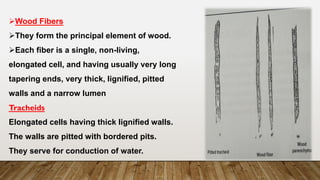
➢Wood Fibers
➢They form the principal element of wood.
➢Each fiber is a single, non-living,
elongated cell, and having usually very long
tapering ends, very thick, lignified, pitted
walls and a narrow lumen
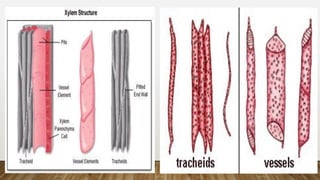
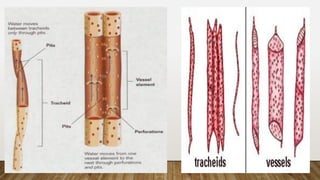
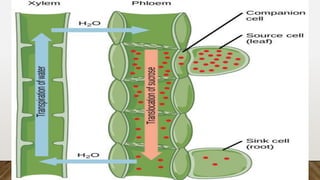
Tracheids
Elongated cells having thick lignified walls.
The walls are pitted with bordered pits.
They serve for conduction of water.
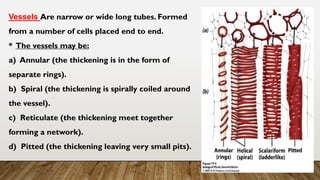
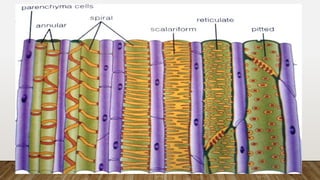
Vessels Are narrow or wide long tubes. Formed
from a number of cells placed end to end.
* The vessels may be:
a) Annular (the thickening is in the form of
separate rings).
b) Spiral (the thickening is spirally coiled around
the vessel).
c) Reticulate (the thickening meet together
forming a network).
d) Pitted (the thickening leaving very small pits).
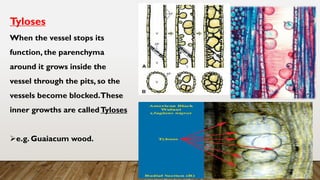
Tyloses
When the vessel stops its
function, the parenchyma
around it grows inside the
vessel through the pits, so the
vessels become blocked.These
inner growths are calledTyloses
➢e.g. Guaiacum wood.
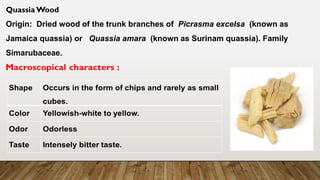
Quassia Wood
Origin: Dried wood of the trunk branches of Picrasma excelsa (known as
Jamaica quassia) or Quassia amara (known as Surinam quassia). Family
Simarubaceae.
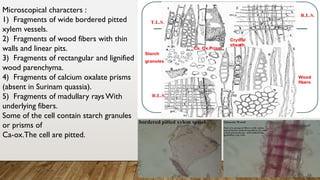
Microscopical characters :
1) Fragments of wide bordered pitted
xylem vessels.
2) Fragments of wood fibers with thin
walls and linear pits.
3) Fragments of rectangular and lignified
wood parenchyma.
4) Fragments of calcium oxalate prisms
(absent in Surinam quassia).
5) Fragments of madullary rays With
underlying fibers.
Some of the cell contain starch granules
or prisms of
Ca-ox.The cell are pitted.
• Active Constituents:
• Bitter principles (Bitter amaroids)
[picrasmin, quassin & neoquassin].
• Chemical test:
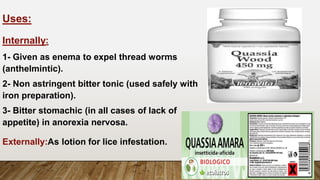
Uses:
Internally:
1- Given as enema to expel thread worms
(anthelmintic).
2- Non astringent bitter tonic (used safely with
iron preparation).
3- Bitter stomachic (in all cases of lack of
appetite) in anorexia nervosa.
Externally:As lotion for lice infestation.
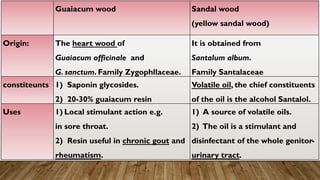
Sandal wood
(yellow sandal wood)
Guaiacum wood
It is obtained from
Santalum album.
Family Santalaceae
The heart wood of
Guaiacum officinale and
G. sanctum. Family Zygophllaceae.
Origin:
Volatile oil, the chief constituents
of the oil is the alcohol Santalol.
1) Saponin glycosides.
2) 20-30% guaiacum resin
constiteunts
1) A source of volatile oils.
2) The oil is a stimulant and
disinfectant of the whole genitor-
urinary tract.
1) Local stimulant action e.g.
in sore throat.
2) Resin useful in chronic gout and
rheumatism.
Uses
Barks and woods Dr. Mostafa Hegazy

Witch Hazel, Pine Bark, galls, Quassia, Guaiacum and sandal

  • 1.
    BARKS AND WOODS3 DR. MOSTAFA MAHMOUD HEGAZY PH.D
  • 2.
    ➢ content ➢ Barkscontaining Tannins (Witch Hazel and Pine Bark) ➢ Galls ➢ woods (Quassia, Guaiacum and sandal) Barks and woods Dr. Mostafa Hegazy
  • 3.
  • 4.
    Hamamelis leaves andBarks Witch Hazel (winter bloom) ‫الهماميليس‬ ‫لحاء‬ ‫و‬ ‫أوراق‬ Origin: Dried leaves and/ or barks of Hamamelis virginiana L. Family Hamamelidaceae
  • 5.
    Gallic acid Hamamelitannin Active Constituents: Tannins(up to 10%) Mixture of gallic acid, hamamelitannin (hydrolysable tannin), proanthocyanidins (condensed tannin)
  • 6.
    Uses: Used topically for: 1-inflammatory skin conditions e.g.Acne (Papulex®), diaper rash (Pato®) 2- Hemorrhoids and varicose veins (Proctophar®) 3- Inflammation of prostate (Decongestyl® and Prostalin®) 4- skin preparations as antiaging and anti- wrinkle 5- Internally acute, non-specific diarrhea
  • 7.
    Pine Bark ‫الصنوبر‬ ‫لحاء‬ Origin:dried stem bark of pinus pinaster, family Pinaceae Active constituents : Tannins: proanthocyanidins (condensed tannin) Flavonoids like catechin, epicatechin the extract called "Pycnogenol®“ Uses: Antioxidant, Anti-inflammatory,Antimicrobial and Capillary Fragility treatment
  • 8.
  • 9.
    Galls ‫العفص‬ Origin: Gallsis pathological outgrowth, formed on the young twigs of oak tree (Quercus infectoria Family Fagaceae), as a result of the deposition of the eggs of female insect (Cynips gallae tinctoria Family Cynipidae). The galls are collected before the escape of the insect.
  • 11.
    Odor Odorless Taste Astringent ShapeNearly spherical or sub-spherical, hard and sink in water. Color Dark bluish-green olive to yellowish-brown Surface Lower half nearly smooth and upper one is rough with short pointed projections. Macroscopical characters :
  • 13.
    Microscopical characters : Powder; Odor:Odorless Color: dirty green to pale buff in color Taste: astringent taste followed by sweetness The powder is characterized by the following elements : 1) fibrous sclereids: sclereids cells with thick pitted walls and narrow lumen. 2) Tannin plates. 3) Few fragments of starch granules. 4) Lignin Bodies.
  • 16.
  • 17.
    Woods the parts ofthe axis of woody plants lying inside the vascular cambium. Therefore, it is formed of secondary xylem, primary xylem and pith in the center.
  • 18.
    Sap wood ‫العصاري‬Heart wood ‫القلب‬ ➢ It is a living wood. * Lighter in colour * It contains reserve food material, e.g. starch. * It may be formed of outer layers of xylem Function: Conductive and support. e.g. Quassia wood * It is a dead wood. * Darker in colour * It is originally a sap wood in which the vessels axe blocked by Tyloses. * It forms the inner layers of xylem * Function: support. e.g. Guaiacum wood. Kinds of woods
  • 19.
    Structure of wood Allthe wood elements are lignified and acquire a deep red color with phloroglucin and HCl.
  • 20.
    ➢Wood Fibers ➢They formthe principal element of wood. ➢Each fiber is a single, non-living, elongated cell, and having usually very long tapering ends, very thick, lignified, pitted walls and a narrow lumen Tracheids Elongated cells having thick lignified walls. The walls are pitted with bordered pits. They serve for conduction of water.
  • 21.
    Vessels Are narrowor wide long tubes. Formed from a number of cells placed end to end. * The vessels may be: a) Annular (the thickening is in the form of separate rings). b) Spiral (the thickening is spirally coiled around the vessel). c) Reticulate (the thickening meet together forming a network). d) Pitted (the thickening leaving very small pits).
  • 26.
    Tyloses When the vesselstops its function, the parenchyma around it grows inside the vessel through the pits, so the vessels become blocked.These inner growths are calledTyloses ➢e.g. Guaiacum wood.
  • 27.
    Quassia Wood Origin: Driedwood of the trunk branches of Picrasma excelsa (known as Jamaica quassia) or Quassia amara (known as Surinam quassia). Family Simarubaceae.
  • 28.
    Microscopical characters : 1)Fragments of wide bordered pitted xylem vessels. 2) Fragments of wood fibers with thin walls and linear pits. 3) Fragments of rectangular and lignified wood parenchyma. 4) Fragments of calcium oxalate prisms (absent in Surinam quassia). 5) Fragments of madullary rays With underlying fibers. Some of the cell contain starch granules or prisms of Ca-ox.The cell are pitted.
  • 29.
    • Active Constituents: •Bitter principles (Bitter amaroids) [picrasmin, quassin & neoquassin]. • Chemical test:
  • 30.
    Uses: Internally: 1- Given asenema to expel thread worms (anthelmintic). 2- Non astringent bitter tonic (used safely with iron preparation). 3- Bitter stomachic (in all cases of lack of appetite) in anorexia nervosa. Externally:As lotion for lice infestation.
  • 31.
    Sandal wood (yellow sandalwood) Guaiacum wood It is obtained from Santalum album. Family Santalaceae The heart wood of Guaiacum officinale and G. sanctum. Family Zygophllaceae. Origin: Volatile oil, the chief constituents of the oil is the alcohol Santalol. 1) Saponin glycosides. 2) 20-30% guaiacum resin constiteunts 1) A source of volatile oils. 2) The oil is a stimulant and disinfectant of the whole genitor- urinary tract. 1) Local stimulant action e.g. in sore throat. 2) Resin useful in chronic gout and rheumatism. Uses
  • 32.
    Barks and woodsDr. Mostafa Hegazy