INTRODUCTION TO
INFORMATION SYSTEM
Prepared by : NUR SYAKIRA IZWANI
BINTI ROSLI
Class : PH240/2E
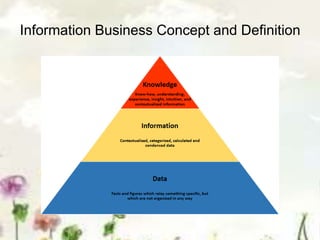
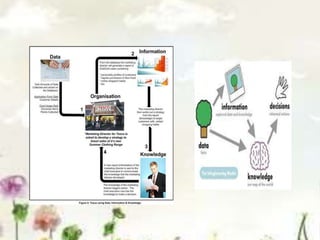
Information Business Concept and Definition
 Information Technology Architecture
 A high-level map or plan of the information assets in
an organization, which guides current operations and
is a blueprint for future directions.
 Information Technology Infrastructure
 The physical facilities, IT components, IT services and
IT management that support an entire organization.
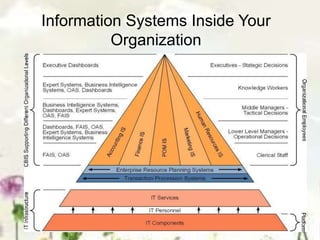
Information Systems Inside Your
Organization
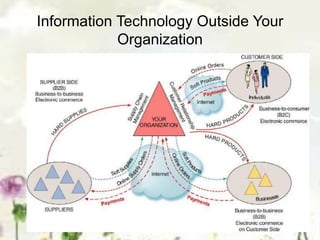
Information Technology Outside Your
Organization
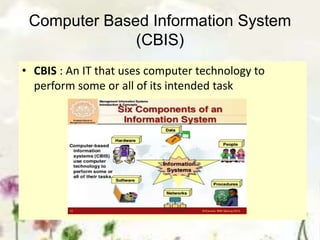
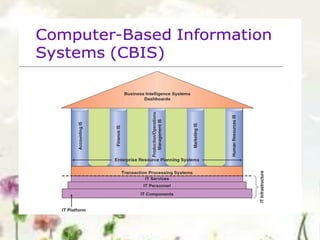
Computer Based Information System
(CBIS)
• CBIS : An IT that uses computer technology to
perform some or all of its intended task
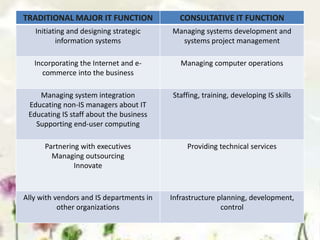
TRADITIONAL MAJOR IT FUNCTION CONSULTATIVE IT FUNCTION
Initiating and designing strategic
information systems
Managing systems development and
systems project management
Incorporating the Internet and e-
commerce into the business
Managing computer operations
Managing system integration
Educating non-IS managers about IT
Educating IS staff about the business
Supporting end-user computing
Staffing, training, developing IS skills
Partnering with executives
Managing outsourcing
Innovate
Providing technical services
Ally with vendors and IS departments in
other organizations
Infrastructure planning, development,
control
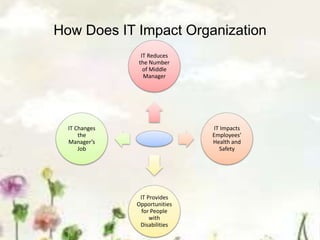
How Does IT Impact Organization
IT Reduces
the Number
of Middle
Manager
IT Impacts
Employees’
Health and
Safety
IT Provides
Opportunities
for People
with
Disabilities
IT Changes
the
Manager’s
Job
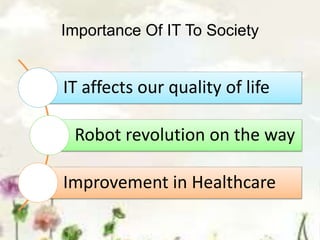
Importance Of IT To Society
IT affects our quality of life
Robot revolution on the way
Improvement in Healthcare
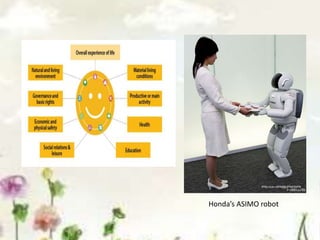
Honda’s ASIMO robot
The patient swallows the Pill Cam
(camera). The camera takes an
image of the digestive tract at
intervals, and sends the images to
a device that patients wear on
their belts. The patients take
their devices to their doctors who
download the images and view
them on a screen. May do away
with endoscopy and the need for
general anesthetic for the
procedure.
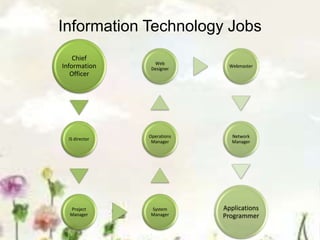
Information Technology Jobs
Chief
Information
Officer
IS director
Project
Manager
System
Manager
Operations
Manager
Web
Designer
Webmaster
Network
Manager
Applications
Programmer
PHARMACY INFORMATION
SYSTEM
• Clinical Screening:
 The Pharmacy Information System can assist in patient
care by the monitoring of drug interactions, drug
allergies and other possible medication-related
complication. When a prescription order is entered,
the system can check to see if there are any
interactions between two or more drugs taken by the
patient simultaneously or with any typical food, any
known allergies to the drug, and if the appropriate
dosage has been given based on the patient’s age,
weight and other physiologic factors. Alerts and flags
come up when the system picks up any of these.
• Prescription Management:
 The Pharmacy Information System can also be use to
mange prescription for inpatients and/or outpatients.
When prescription orders are received, the orders are
matched to available pharmaceutical products and
then dispensed accordingly depending on whether the
patient is an inpatient or outpatient. It is possible to
track all prescriptions passed through the system from
who prescribed the drug, when it was prescribed to
when it was dispensed.
 It is also possible to print out prescription labels and
instructions on how medication should be taken based
on the prescription.
• Patient Drug Profiles:
 These are patient profiles managed by the
Pharmacy Information System and contain
details of their current and past medications,
known allergies and physiological parameters.
These profiles are used for used for clinical
screening anytime a prescription is ordered
for the patient.
• Inventory Management:
 Pharmacies require a continuous inventory culture in
order to ensure that drugs do not go out of stock. This
is made even more difficult when there are multiple
dispensing points. When don manually it is very
difficult to maintain an accurate inventory. Pharmacy
Information Systems aid inventory management by
maintaining an internal inventory of all pharmaceutical
products, providing alerts when the quantity of an item
is below a set quantity and providing an electronic
ordering system that recommends the ordering of the
affected item and with the appropriate quantity from
approved suppliers.
THE END

Introduction to Information System

  • 1.
    INTRODUCTION TO INFORMATION SYSTEM Preparedby : NUR SYAKIRA IZWANI BINTI ROSLI Class : PH240/2E
  • 2.
  • 4.
     Information TechnologyArchitecture  A high-level map or plan of the information assets in an organization, which guides current operations and is a blueprint for future directions.  Information Technology Infrastructure  The physical facilities, IT components, IT services and IT management that support an entire organization.
  • 5.
    Information Systems InsideYour Organization
  • 6.
  • 7.
    Computer Based InformationSystem (CBIS) • CBIS : An IT that uses computer technology to perform some or all of its intended task
  • 9.
    TRADITIONAL MAJOR ITFUNCTION CONSULTATIVE IT FUNCTION Initiating and designing strategic information systems Managing systems development and systems project management Incorporating the Internet and e- commerce into the business Managing computer operations Managing system integration Educating non-IS managers about IT Educating IS staff about the business Supporting end-user computing Staffing, training, developing IS skills Partnering with executives Managing outsourcing Innovate Providing technical services Ally with vendors and IS departments in other organizations Infrastructure planning, development, control
  • 10.
    How Does ITImpact Organization IT Reduces the Number of Middle Manager IT Impacts Employees’ Health and Safety IT Provides Opportunities for People with Disabilities IT Changes the Manager’s Job
  • 11.
    Importance Of ITTo Society IT affects our quality of life Robot revolution on the way Improvement in Healthcare
  • 12.
  • 13.
    The patient swallowsthe Pill Cam (camera). The camera takes an image of the digestive tract at intervals, and sends the images to a device that patients wear on their belts. The patients take their devices to their doctors who download the images and view them on a screen. May do away with endoscopy and the need for general anesthetic for the procedure.
  • 14.
    Information Technology Jobs Chief Information Officer ISdirector Project Manager System Manager Operations Manager Web Designer Webmaster Network Manager Applications Programmer
  • 15.
  • 16.
    • Clinical Screening: The Pharmacy Information System can assist in patient care by the monitoring of drug interactions, drug allergies and other possible medication-related complication. When a prescription order is entered, the system can check to see if there are any interactions between two or more drugs taken by the patient simultaneously or with any typical food, any known allergies to the drug, and if the appropriate dosage has been given based on the patient’s age, weight and other physiologic factors. Alerts and flags come up when the system picks up any of these.
  • 17.
    • Prescription Management: The Pharmacy Information System can also be use to mange prescription for inpatients and/or outpatients. When prescription orders are received, the orders are matched to available pharmaceutical products and then dispensed accordingly depending on whether the patient is an inpatient or outpatient. It is possible to track all prescriptions passed through the system from who prescribed the drug, when it was prescribed to when it was dispensed.  It is also possible to print out prescription labels and instructions on how medication should be taken based on the prescription.
  • 18.
    • Patient DrugProfiles:  These are patient profiles managed by the Pharmacy Information System and contain details of their current and past medications, known allergies and physiological parameters. These profiles are used for used for clinical screening anytime a prescription is ordered for the patient.
  • 19.
    • Inventory Management: Pharmacies require a continuous inventory culture in order to ensure that drugs do not go out of stock. This is made even more difficult when there are multiple dispensing points. When don manually it is very difficult to maintain an accurate inventory. Pharmacy Information Systems aid inventory management by maintaining an internal inventory of all pharmaceutical products, providing alerts when the quantity of an item is below a set quantity and providing an electronic ordering system that recommends the ordering of the affected item and with the appropriate quantity from approved suppliers.
  • 23.